Last Updated: July 14, 2026
Topic: Yoga Exercises
Reading Time: About 12 minutes
Content Note: This article is for education only. It does not replace medical advice.
Yoga Exercises can help you move with more control.
They can help you feel calmer.
They can help your body feel less stiff.
They can support strength, balance, posture, and breathing.
You do not need to be flexible.
You do not need to do hard poses.
You do not need to stand on your head.
You do not need a perfect yoga body.
You need safe moves.
You need slow breathing.
You need a plan that fits your body today.
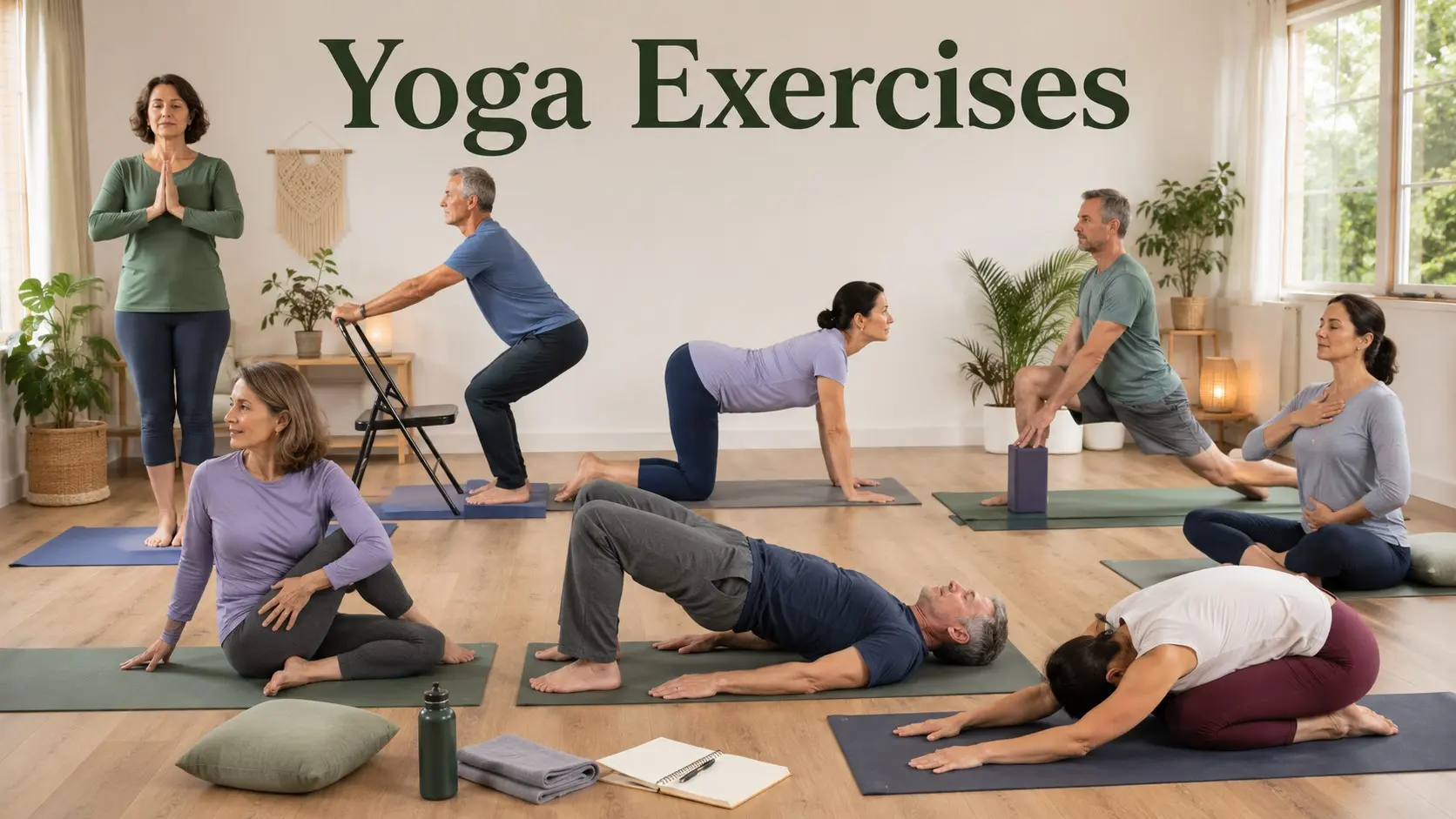
This guide gives you beginner yoga exercises you can do at home, safer form tips, strength-focused poses, gentle flexibility work, breathing practice, chair options, eye rest tips, and a simple weekly plan.
This article is part of our complete weight loss guide.
Quick answer
The best Yoga Exercises for beginners include mountain pose, chair supported balance, cat cow, child pose, bridge pose, low lunge, seated forward fold, gentle seated twist, cobra pose, bird dog, wall plank, chair pose, legs on chair rest, box breathing, and gentle eye rest breaks.
Start slowly.
Use support.
Do not force deep stretches.
Breathe with control.
Stop if you feel sharp pain, dizziness, chest pain, numbness, tingling, or pain that travels down the leg.
What are yoga exercises?
Yoga exercises are movements, poses, breathing practices, and rest practices.
Some yoga exercises build strength.
Some improve flexibility.
Some support balance.
Some help you slow your breathing.
Some help your body relax.
This is why yoga exercises can fit many goals.
You can use yoga as a full routine or as a support habit with walking, strength training, or recovery.
Yoga is not only stretching
Many people think yoga means stretching only.
That is not true.
Yoga can include strength.
It can include balance.
It can include breathing.
It can include body awareness.
It can include rest.
This is why yoga for strength can be useful even if you already do other workouts.
What yoga can and cannot do
Yoga may support wellness, stress relief, sleep, balance, flexibility, and body awareness.
It may help some people move with more comfort.
But yoga is not a cure for every health issue.
Yoga should not replace medical care.
Yoga should not be used to push through an injury.
Yoga should not make you feel ashamed of your body.
Good yoga should fit your body, not force your body into a shape.
Before you start
Talk with a qualified healthcare professional before starting yoga if you have back pain, neck pain, joint pain, osteoporosis, balance problems, dizziness, pregnancy, recent childbirth, recent surgery, glaucoma, eye disease, heart disease, high blood pressure, nerve symptoms, hernia, or a long-term health condition.
Stop and seek help if you feel chest pain, fainting, severe shortness of breath, sudden weakness, severe dizziness, numbness, tingling that does not stop, sharp pain, or pain that travels down the leg.
Yoga should feel steady.
It should not feel dangerous.
Simple yoga safety rules
- Move slowly.
- Breathe while you move.
- Use a chair, wall, block, or cushion.
- Do not force deep stretches.
- Keep your neck comfortable.
- Stop before sharp pain.
- Skip poses that feel unsafe.
- Choose a qualified teacher if you are new or have health concerns.
This supports safe yoga practice.
What you need at home
You do not need a lot of gear.
Helpful items include:
- A yoga mat
- A stable chair
- A wall
- A towel
- A cushion or pillow
- A water bottle
- A quiet space
This supports yoga at home.
Use what you have.
Warm up first
Warm up for 3 to 5 minutes.
- Walk in place for 1 minute.
- Roll your shoulders 10 times.
- Turn your head gently side to side.
- Circle your wrists and ankles.
- Take 5 slow breaths.
This supports injury prevention.
Do not force a cold muscle into a deep stretch.
15 Yoga Exercises at Home
You do not need to do all 15 exercises in one session.
Pick 6 to 8 moves.
Move slowly.
Rest when needed.
1. Mountain pose
Mountain pose looks simple.
But it teaches posture and balance.
How to do it
- Stand tall with feet steady.
- Keep knees soft.
- Let shoulders relax.
- Keep your neck long.
- Breathe slowly for 5 breaths.
This supports mountain pose practice.
Make it easier
Stand near a wall or chair.
2. Chair-supported balance
This move trains balance safely.
Use a stable chair.
How to do it
- Stand behind a chair.
- Hold the chair lightly.
- Lift one foot a little.
- Hold for 5 to 10 seconds.
- Switch sides.
This supports balance exercises.
Do not close your eyes.
3. Cat cow
Cat cow moves the spine gently.
It can help you notice your back and breathing.
How to do it
- Start on hands and knees.
- Breathe in and gently lift your chest.
- Breathe out and round your back slightly.
- Move slowly.
Do 5 to 8 reps.
This supports the cat cow pose.
Make it easier
Do seated cat cow in a chair.
4. Child pose
Child pose is a resting pose for many people.
But it does not feel good for everyone.
How to do it
- Kneel on a mat if comfortable.
- Sit hips back gently.
- Rest your chest toward your thighs.
- Use a cushion if needed.
- Breathe slowly.
This supports child pose rest.
Make it safer
Skip this pose if it hurts your knees, hips, or back.
Use seated breathing instead.
5. Bridge pose
Bridge pose builds glute, hip, and core support.
It is a good strength-based yoga exercise.
How to do it
- Lie on your back.
- Bend your knees.
- Keep feet on the floor.
- Breathe out and lift your hips slowly.
- Lower with control.
Do 6 to 10 reps.
This supports bridge pose strength.
6. Low lunge
Low lunge can stretch the front of the hip.
It can also build control.
How to do it
- Step one foot forward.
- Lower the back knee to a mat or cushion.
- Keep your chest tall.
- Breathe slowly.
- Switch sides.
Hold 10 to 20 seconds each side.
This supports hip flexibility.
Make it easier
Hold a chair or place hands on blocks.
7. Seated forward fold
This is a gentle stretch for the back of the legs.
It should not be forced.
How to do it
- Sit on a mat or chair.
- Keep your spine long.
- Fold forward only a little.
- Stop before pain.
- Breathe slowly.
This supports flexibility exercises.
Make it safer
Bend your knees.
Use a chair version if floor sitting is hard.
8. Gentle seated twist
A seated twist can help you move your spine gently.
It should never be forced.
How to do it
- Sit tall on a chair.
- Place your hands on your thighs.
- Turn your chest slightly to one side.
- Return to center.
- Switch sides.
Do 3 to 5 slow reps on each side.
This supports gentle yoga stretches.
Skip twisting if it causes pain, dizziness, or nerve symptoms.
9. Cobra pose
Cobra can strengthen the back and open the front body.
Use a small range.
How to do it
- Lie on your stomach.
- Place hands under shoulders.
- Keep elbows close.
- Lift your chest a little.
- Lower slowly.
Do 5 to 8 reps.
This supports cobra pose.
Make it safer
Do not force a high lift.
Skip it if your lower back hurts.
10. Bird dog
Bird dog builds core, back, and balance control.
It is useful for many home routines.
How to do it
- Start on hands and knees.
- Brace gently.
- Reach one arm forward.
- Reach the opposite leg back.
- Return and switch sides.
Do 5 to 8 reps each side.
This supports core stability.
11. Wall plank
Wall plank builds shoulder and core support.
It is easier than a floor plank.
How to do it
- Stand facing a wall.
- Place hands on the wall.
- Step feet back a little.
- Brace gently.
- Hold for 10 to 30 seconds.
This supports plank exercise practice.
12. Chair pose
Chair pose builds leg and core strength.
Use a real chair behind you for safety.
How to do it
- Stand in front of a stable chair.
- Feet about hip-width apart.
- Sit hips back slightly.
- Keep chest lifted.
- Stand back up with control.
Do 5 to 10 reps.
This supports chair pose strength.
13. Legs on chair rest
This is a calm rest pose.
It may help your body relax after a session.
How to do it
- Lie on your back.
- Place lower legs on a chair.
- Relax your shoulders.
- Breathe slowly.
- Rest for 1 to 3 minutes.
This supports restorative yoga.
14. Box breathing
Box breathing is a simple breathing pattern.
Use a comfortable rhythm.
How to do it
- Breathe in for 4 counts.
- Pause for 4 counts if comfortable.
- Breathe out for 4 counts.
- Pause for 4 counts if comfortable.
Repeat 3 to 5 rounds.
This supports breathing exercises.
Skip breath-holding if it makes you dizzy or anxious.
15. Gentle eye rest practice
Some people search for eye yoga exercises.
Eye rest can feel calming after screen time.
But eye yoga should not be presented as a way to fix eyesight or replace glasses.
Use this only as a gentle rest break.
How to do it
- Sit comfortably.
- Look away from screens.
- Close your eyes softly for a few breaths.
- Look at a far object for a brief moment.
- Blink gently.
- Return to normal activity.
This supports eye relaxation.
Do not press on your eyes.
Do not expect this to correct your vision.
Important note about eye yoga
Eye yoga may help some people take a screen break.
It may feel relaxing.
But there is no good proof that eye exercise programs remove the need for glasses or fix vision problems.
See an eye care professional if you have blurry vision, eye pain, sudden vision changes, flashes, floaters, redness, injury, or headaches linked with vision.
This keeps eye yoga exercises safe.
Beginner Yoga Exercises at Home plan
Use this plan 2 or 3 days a week.
Rest when needed.
Warm up
- Walk in place, 1 minute
- Shoulder rolls, 10 reps
- Slow breathing, 5 breaths
Round 1
- Mountain pose, 5 breaths
- Cat cow, 5 reps
- Bird dog, 5 reps each side
- Bridge pose, 6 reps
Round 2
- Chair supported balance, 5 seconds each side
- Low lunge, 10 seconds each side
- Wall plank, 10 to 20 seconds
- Legs on chair rest, 1 minute
Start with one round if you are new.
Add more only when your body feels ready.
10 minute yoga exercises routine
Use this when time is short.
- Minute 1: Slow breathing
- Minute 2: Mountain pose
- Minute 3: Cat cow
- Minute 4: Bird dog
- Minute 5: Bridge pose
- Minute 6: Chair pose
- Minute 7: Low lunge
- Minute 8: Gentle seated twist
- Minute 9: Eye rest practice
- Minute 10: Legs on the chair rest
Move slowly.
Do not rush the breath.
Weekly yoga plan
Monday
Beginner yoga routine.
Tuesday
Walk or light cardio.
Wednesday
Strength training or rest.
Thursday
Yoga for flexibility and breathing.
Friday
Rest or easy walk.
Saturday
Yoga plus short eye rest breaks if you use screens often.
Sunday
Rest and recovery.
This supports a balanced home yoga routine.
Yoga exercises for strength
Use these poses when your goal is strength.
- Chair pose
- Bridge pose
- Bird dog
- Wall plank
- Low lunge
- Chair supported balance
This supports bodyweight strength.
Use slow reps and steady breathing.
Yoga exercises for flexibility
Use these poses when your goal is gentle flexibility.
- Cat cow
- Low lunge
- Seated forward fold
- Gentle seated twist
- Child pose if comfortable
This supports yoga flexibility.
Do not force your body into deep positions.
Yoga exercises for calm
Use these practices when your goal is calm.
- Box breathing
- Legs on chair rest
- Child pose if comfortable
- Gentle eye rest
- Slow seated breathing
This supports stress relief.
Keep the practice gentle.
Common mistakes to avoid
- Forcing deep stretches
- Holding your breath
- Copying advanced poses too soon
- Ignoring pain
- Doing hard inversions without guidance
- Pressing on your eyes during eye rest
- Expecting eye yoga to fix vision
- Skipping support tools like chairs and cushions
Safe yoga works better than extreme yoga.
What if your knees hurt?
Knee pain means you should adjust.
- Use a cushion under your knees.
- Skip kneeling poses if needed.
- Use chair yoga options.
- Reduce the range of motion.
- Stop sharp pain.
Ask a qualified professional if knee pain keeps returning.
What if your back hurts?
Back pain means you should move gently.
- Use smaller movements.
- Skip deep forward folds.
- Use chair options.
- Skip cobra if it pinches your back.
- Stop if pain travels down the leg.
Ask for help if back pain continues.
What if your wrists hurt?
Wrist pain can happen during the hands and knees pose.
- Use fists instead of flat hands if comfortable.
- Use a towel under your hands.
- Do seated versions.
- Use wall plank instead of floor plank.
- Stop if pain is sharp.
Food and recovery for yoga
Yoga still needs recovery.
Try these habits:
- Drink water.
- Eat balanced meals.
- Sleep well.
- Rest sore areas.
- Move gently on recovery days.
This supports workout recovery.
My simple rule
Do not ask only “Which yoga pose is best?”
Ask, “Which yoga exercise can I do with calm breathing and no pain?”
That question works better.
Yoga should help you listen to your body.
Conclusion
Yoga Exercises can help you build strength, flexibility, balance, breathing control, and calm at home.
Start with mountain pose, cat cow, bridge pose, bird dog, wall plank, chair pose, low lunge, breathing practice, and legs on chair rest.
Use eye rest only as a gentle screen break, not as a vision cure.
Move slowly.
Use support.
Do not force pain.
Your next step: choose 6 moves from this Yoga Exercises guide and complete one safe beginner practice this week.
Related guides from NextFitLife
This article is part of our Fitness Hub. You may also want to visit our Yoga & Flexibility Guide, Home Workouts & Equipment Guide, and Recovery & Injury Prevention Guide.
FAQ
What are the best Yoga Exercises for beginners?
The best Yoga Exercises for beginners include mountain pose, chair supported balance, cat cow, child pose if comfortable, bridge pose, low lunge, seated forward fold, gentle seated twist, bird dog, wall plank, chair pose, box breathing, and legs on chair rest.
Can yoga exercises build strength at home?
Yes. Yoga can support strength through poses like chair pose, bridge pose, bird dog, wall plank, low lunge, and balance work when practiced with control.
Do I need to be flexible to start yoga?
No. You can start yoga with chairs, cushions, wall support, small ranges of motion, and beginner-friendly poses.
Are eye yoga exercises good for vision?
Eye rest practices may help you take a calming screen break, but there is no good proof that eye exercise programs remove the need for glasses or fix vision problems.
How often should I do yoga exercises?
Many beginners can start with 2 or 3 short yoga sessions weekly. Rest when needed and avoid poses that cause pain.
Who should ask a doctor before starting yoga?
Ask a healthcare professional before yoga if you have back pain, neck pain, joint pain, osteoporosis, balance problems, dizziness, pregnancy, recent surgery, glaucoma, eye disease, heart disease, high blood pressure, nerve symptoms, or a long-term condition.
References and Sources
- National Center for Complementary and Integrative Health. Yoga: Effectiveness and Safety.
- National Center for Complementary and Integrative Health. 5 Things You Should Know About Yoga.
- Centers for Disease Control and Prevention. Adult Activity: An Overview.
- American Academy of Ophthalmology. Vision Training Not Proven to Make Vision Sharper.
- Mayo Clinic Health System. Yoga Therapy: Relieve Pain, Manage Stress.

Health & wellness writer with 30+ years of experience in nutrition, fitness, and healthy aging. Founder of NextFitLife.com — evidence-based health guidance.