
Published on:
Tibialis raises are a simple strength exercise for the muscles at the front of your lower leg. You keep your heels down, lift your forefeet and toes toward your shins, then lower them with control.
The movement looks small, but good form matters. Your ankle should do the work. Your knees should stay stable, your heels should remain planted, and the lowering phase should not turn into a fast slap against the floor.
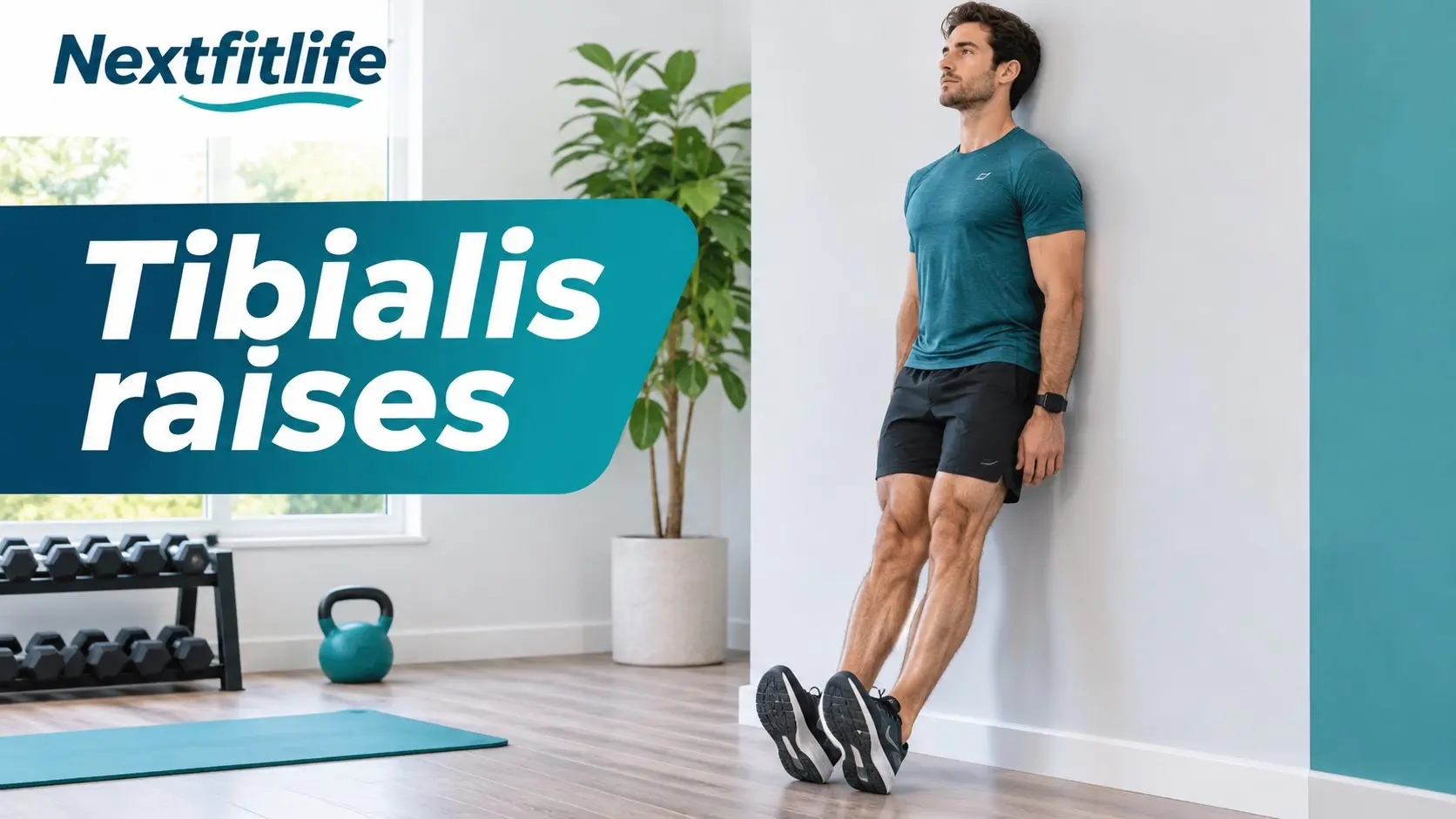
Quick answer: To do a tibialis raise, lean your back against a wall with your feet slightly forward. Keep both heels on the floor. Lift the fronts of your feet toward your shins, pause briefly, then lower slowly. Start with an easy wall distance and progress only when you can control every repetition without pain.
This article is for general information and education. It does not replace medical advice, diagnosis, treatment, or an individualized rehabilitation plan.
Stop and get medical or physiotherapy advice if shin exercise causes severe pain, marked swelling, a very tender point on the bone, new numbness, worsening weakness, repeated foot slapping, or difficulty lifting the front of the foot. Do not use tibialis raises to push through a suspected injury.
If ankle movement is your bigger problem, start with Ankle Mobility Exercises for Squats. Tibialis raises are mainly a strength drill rather than a complete ankle mobility program.
Table of Contents
- What tibialis raises are
- Muscles worked
- Why the tibialis anterior matters
- How to do tibialis raises
- 9 smart form tips
- Common mistakes
- Sets and repetitions
- Easy progressions
- Tibialis raises for runners
- Tibialis raises and shin splints
- Tibialis raises versus calf raises
- When soreness is normal
- When shin pain needs attention
- A simple beginner plan
- Conclusion
- References and Sources
- Internal Links and NextFitLife Hubs
- About the Author
- Frequently Asked Questions
What Are Tibialis Raises?
A tibialis raise is an ankle exercise where you lift the front of the foot while keeping the heel planted.
The movement is called dorsiflexion. That simply means bringing the top of your foot closer to your shin.
The exercise is sometimes called a tib raise, toe raise, wall tib raise, or standing dorsiflexion raise.
The common bodyweight version uses a wall. You lean against it, place your feet a short distance forward, keep the heels down, and repeatedly raise the forefeet.
Moving the feet farther from the wall makes the exercise harder because your body position creates a greater challenge for the muscles at the front of the shin.
What Muscles Do Tibialis Raises Work?
The main target is the tibialis anterior.
This long muscle runs down the front and outer part of your shin. Its tendon crosses the front of the ankle and attaches toward the inner side of the foot.
The tibialis anterior has two important actions.
First, it dorsiflexes the ankle. In plain English, it lifts the foot toward the shin.
Second, it helps turn the sole slightly inward, a movement called inversion.
Other muscles in the front of the lower leg can help with dorsiflexion too, including the extensor hallucis longus and extensor digitorum longus.
That means a tibialis raise is not a magical isolation exercise where only one muscle works. It is simply a practical way to train the front-side ankle muscles with the tibialis anterior doing much of the work.
Why Does the Tibialis Anterior Matter?
The tibialis anterior does useful work every time you walk.
As your leg swings forward, dorsiflexion helps keep the toes from dragging along the ground. As the foot returns to the floor, the front-shin muscles also help control how the foot comes down.
That is very different from saying that everyone needs direct tibialis training.
Walking, running, hiking, and many sports already use the muscle.
Tibialis raises are useful when you want to train that movement more directly or add specific lower-leg strength work to a program.
How to Do Wall Tibialis Raises
Step 1: Set Your Back Against a Wall
Stand with your upper back and hips supported by a wall.
Keep your body tall rather than letting your hips sag forward.
Step 2: Move Your Feet Slightly Forward
Start with your feet about hip width apart and a comfortable distance in front of the wall.
If you are new to the exercise, keep them fairly close. You can move them farther away later.
Step 3: Keep Your Heels Planted
Your heels act as the pivot point.
They should stay in contact with the floor through the repetition.
Step 4: Lift the Whole Forefoot
Pull the front of both feet upward toward your shins.
Think about lifting the forefoot rather than just curling your toes.
Go as high as your ankles comfortably allow without rocking your knees or hips.
Step 5: Pause Briefly
At the top, you should feel the muscles on the front of your shins working.
A short pause makes it easier to notice whether you are actually controlling the movement.
Step 6: Lower Slowly
Return the forefeet toward the floor with control.
Do not simply relax and let the toes slap down.
That controlled lowering is part of the repetition.
9 Smart Form Tips for Better Tibialis Raises
1. Keep Your Heels Down
This is the simplest form check.
If your heels lift, you are changing the movement.
The goal is ankle dorsiflexion with the heel acting as the stable base.
Think: toes up, heels down.
2. Move From the Ankle
Your knees do not need to pump up and down.
Your hips do not need to rock away from the wall.
If your whole body moves every time the toes rise, make the exercise easier and regain control.
3. Lift the Forefoot, Not Just the Toes
People sometimes claw their toes upward while barely moving the ankle.
That is not the goal.
Imagine trying to bring the top of your foot closer to the front of your lower leg.
Your toes will move because the foot is moving, but you should not need to grip or curl them hard.
4. Use the Full Comfortable Range
Lift as far as you can without pain or compensation.
Do not force the ankle past its natural range just to make the repetition look larger.
If you have very little dorsiflexion range, ankle mobility work may need attention too.
See Ankle Mobility Exercises for Squats if stiffness is limiting you.
5. Lower Under Control
The downward part should not be an uncontrolled drop.
A simple rhythm is to lift smoothly, pause, then take about one or two seconds to lower.
You do not need an exaggerated five-second negative for every repetition.
The goal is control, not drama.
If you want to understand slower lowering work more broadly, see Eccentric Training for Beginners.
6. Keep the Knees Stable
A soft knee is fine.
What you want to avoid is repeatedly bending and straightening the knees to bounce the feet upward.
If that starts happening near the end of a set, the set is probably finished.
7. Let the Front Shin Work
You should feel effort along the muscle at the front and outer side of the shin.
A burning muscle sensation near the end of a controlled set can be normal.
A sharp point of pain on the shin bone is different.
8. Move the Feet to Change Difficulty
You do not need weights immediately.
Start close enough to the wall that you can control the movement.
As the exercise becomes easy, move your feet a little farther forward.
That simple change can make the same bodyweight exercise much harder.
9. Stop Before Form Falls Apart
The tibialis anterior can fatigue quickly, especially if you have never trained it directly.
There is little value in adding ten ugly repetitions where the knees bounce and the toes barely lift.
End the set when the next repetition would require cheating.
The Most Common Tibialis Raise Mistakes
| Mistake | What Happens | Fix |
|---|---|---|
| Heels lifting | The exercise stops being a clean dorsiflexion drill | Keep the heels planted and reduce the difficulty |
| Knees bouncing | Momentum helps lift the feet | Keep the knees still and move only at the ankles |
| Fast dropping | The forefeet slap the floor | Lower smoothly and quietly |
| Toe clawing | The toes tense while the ankle barely moves | Lift the whole forefoot toward the shin |
| Feet too close forever | The exercise stays very easy | Move the feet forward gradually when form is solid |
| Feet too far forward too soon | Range shrinks and the body starts cheating | Move closer to the wall |
| Training through sharp shin pain | A possible injury is treated like muscle fatigue | Stop and assess the cause before progressing |
How Many Tibialis Raises Should You Do?
There is no research-backed magic number specifically for wall tibialis raises.
That is worth saying because many exercise pages give very exact prescriptions.
For a healthy beginner using the exercise as accessory strength work, a practical starting point is:
- 1 to 2 sets
- 10 to 15 controlled repetitions
- About 2 sessions per week
- Stop each set while form is still clean
If that is easy and causes no unusual pain or lingering soreness, move toward 2 to 3 sets.
You can also use a slightly higher repetition range when the wall version is light.
Current American College of Sports Medicine guidance emphasizes that consistency and appropriate progression matter more than finding one perfect training formula.
The exercise should eventually become challenging enough that the last few repetitions require effort while your technique stays stable.
Should You Train Tibialis Raises Every Day?
You probably do not need to.
The tibialis anterior works during daily walking and many sports already.
Direct training two or three times per week is plenty for most general fitness programs.
If you use very easy tibialis raises as part of a warmup, more frequent low-level practice may be tolerated, but that is different from hard strength sets.
Let soreness and performance guide you.
If your front shins remain very sore every time the next session arrives, reduce the volume rather than assuming more frequency will fix the problem.
How Hard Should Tibialis Raises Feel?
A useful set should feel like the front-shin muscles are doing real work.
Early repetitions may feel easy. Near the end of the set, lifting the forefoot should become slower and the front of the shin may burn or feel tired.
That is different from sharp pain.
If you use an effort scale from 1 to 10, beginners can stay around a moderate level at first rather than pushing every set to a maximum effort.
Once you know the movement and recover well, harder sets can be useful.
If you want a simple guide to effort ratings, see RPE Scale for Strength Training.
Easy Tibialis Raise Progressions
The smartest progression is not always adding more repetitions.
Once you can do a large number of clean reps, make the exercise harder.
Level 1: Seated Toe Raises
Sit on a chair with both heels planted.
Lift the fronts of your feet toward the shins, pause, then lower.
This is useful if standing wall raises are too difficult or balance is a concern.
Level 2: Easy Wall Tibialis Raise
Lean against a wall with the feet only a short distance forward.
Keep the range smooth and controlled.
This is a good starting version for most healthy beginners.
Level 3: Move Farther From the Wall
Move both feet a little farther forward while keeping the same heel contact and ankle motion.
Do not take a huge step.
A few centimeters can make the movement noticeably harder.
Level 4: Slow the Lowering
Take two or three seconds to lower the feet.
This makes each repetition harder without changing equipment.
Use it only if you can still complete a full lift at the top.
Level 5: Single-Leg Emphasis
Shift more of the work toward one side while keeping enough support to stay balanced.
You do not need to remove the other foot completely at first.
Make the change gradual.
Level 6: Resistance-Band Dorsiflexion
Sit with a resistance band anchored in front of you and looped over the forefoot.
Pull the foot toward the shin against the band, then return slowly.
This is a useful option because resistance can be adjusted more directly.
Hospital physiotherapy guidance also uses banded ankle dorsiflexion as a lower-leg strengthening drill.
Level 7: Loaded Tibialis Raise
Special tibialis machines, tib bars, ankle weights, or carefully arranged resistance can increase load further.
Equipment is optional.
If the simple versions are still challenging, there is no prize for rushing toward extra weight.
Tibialis Raise Progression Table
| Level | Variation | Use It When | Progress When |
|---|---|---|---|
| 1 | Seated toe raise | Standing is too difficult | You can lift smoothly without toe clawing |
| 2 | Easy wall raise | You are learning the movement | 15 clean reps feel comfortable |
| 3 | Feet farther forward | Basic wall raises are easy | You keep full range and stable knees |
| 4 | Slow lowering | You need more challenge without equipment | Control remains strong through the full set |
| 5 | Single-leg emphasis | Both-leg work is no longer challenging | Both sides perform evenly |
| 6 | Band dorsiflexion | You want adjustable resistance | You can increase band tension without shortening range |
| 7 | Loaded variation | You already have good control | Add load gradually while keeping form |
Do Tibialis Raises Help Runners?
They can be a reasonable accessory exercise for runners because running repeatedly uses the ankle dorsiflexors.
The tibialis anterior helps lift the foot during the swing phase of gait.
That anatomical role is clear.
What is less clear is whether adding tibialis raises to a running program improves speed, running economy, race performance, or injury rates.
I would not promise those outcomes.
A runner who wants stronger lower legs can include tibialis raises alongside calf work, balance exercises, and a sensible running progression.
They are one small part of the program rather than the missing secret to injury-free running.
For a broader plan, see Strength Training for Runners and Running Tips for Beginners.
Do Tibialis Raises Prevent Shin Splints?
This claim needs care.
Shin splints is a broad term commonly used for exercise-related shin pain, often involving medial tibial stress syndrome.
The NHS advises people with shin splints to stop the activity that caused the problem temporarily, use lower-impact exercise while recovering, and return gradually.
There is no strong evidence showing that wall tibialis raises alone prevent or cure shin splints.
Strengthening the front of the lower leg can still be one part of a wider program when it is appropriate.
That wider plan may also look at:
- Training increases
- Running volume
- Running surfaces
- Footwear
- Calf strength
- Ankle capacity
- Recovery
- Previous injury
If running is causing worsening shin pain, adding harder tibialis raises on top of it is not automatically the answer.
Can Tibialis Raises Help Knee Pain?
There is a lot of online enthusiasm around tibialis raises and “knee health.”
The direct evidence is much thinner.
The tibialis anterior acts mainly at the ankle and foot. Training it can improve dorsiflexor strength, but that does not prove tibialis raises treat knee pain.
Knee pain can come from many different tissues and training problems.
If your goal is stronger knees for running, a broader program makes more sense. See Knee Exercises for Runners.
If you already have knee pain, the right exercise depends on the cause and how the knee responds.
Can Tibialis Raises Improve Ankle Mobility?
Strength and mobility are related but not identical.
A tibialis raise strengthens the muscles that actively pull the foot upward.
If your ankle cannot move forward during a squat because of calf stiffness, joint limits, or another restriction, stronger dorsiflexors may not solve the entire problem.
Use tibialis raises when you want active dorsiflexion strength.
Use mobility drills when range itself needs work.
Many people benefit from both.
Tibialis Raises vs Calf Raises
They train opposite ankle actions.
| Feature | Tibialis Raise | Calf Raise |
|---|---|---|
| Main movement | Dorsiflexion | Plantarflexion |
| Simple description | Lift the forefoot toward the shin | Rise onto the balls of the feet |
| Main area felt | Front of shin | Back of lower leg |
| Main target | Tibialis anterior and other dorsiflexors | Gastrocnemius and soleus |
| Should you choose one? | Usually no. They train different functions and can complement each other. | |
Should Tibialis Raises Burn?
A local muscular burn can happen.
The tibialis anterior is a relatively small muscle, and many people are not used to training it directly for repeated high-effort contractions.
A set of controlled tibialis raises can therefore make the front of the shin feel tired quickly.
That burning sensation should settle after the set.
It should not feel like a sharp stab on the bone or electric pain into the foot.
Why Are My Shins Sore After Tibialis Raises?
If this is a new exercise, some muscle soreness can appear later that day or the next day.
That does not mean you need to train through severe soreness.
Start with less volume than you think you need.
A beginner doing one or two sets can always add more next week. Someone doing six hard sets on day one cannot undo them afterward.
Reduce your next session if soreness changes the way you walk or lasts longer than expected.
What Shin Pain Should You Not Ignore?
Exercise articles sometimes treat every shin sensation as a normal training effect. That is a mistake.
Get professional advice if you have:
- Severe shin pain
- Swelling
- Pain after a direct injury
- A very tender point on the shin bone
- Pain that keeps worsening when you run
- Pain that does not improve after reducing the aggravating activity
- New numbness or tingling
- New weakness lifting the foot
- The foot repeatedly slapping or catching during walking
The NHS advises medical assessment when shin pain is severe or does not improve.
A strength drill is not a substitute for finding out why the lower leg hurts.
Can Tibialis Raises Fix Foot Drop?
Do not treat new foot drop as a normal weakness problem to solve with internet exercises.
Foot drop means lifting the front of the foot is difficult, and it can result from nerve or neurological problems as well as muscle weakness.
If one foot suddenly starts dragging, slapping down, or becoming difficult to lift, seek medical assessment.
A clinician may use dorsiflexion strengthening as part of rehabilitation after the cause is understood, but the diagnosis comes first.
Where Should Tibialis Raises Go in a Workout?
They are a small accessory exercise, so they usually do not need to come before your main lifts.
One simple order is:
- Main strength exercises
- Single-leg or running-specific work
- Calf raises
- Tibialis raises
- Balance or mobility work
You can also use a very easy set near the start as a movement warmup.
If you are building an overall program, see the NextFitLife Strength Training Guide.
A Simple Beginner Tibialis Raise Plan
You do not need a complicated four-week specialization block.
Week 1
Perform 1 to 2 sets of 10 controlled wall raises twice during the week.
Keep the feet close enough to the wall that every rep looks the same.
Week 2
If Week 1 caused no unusual pain, use 2 sets of 12 to 15 repetitions.
Do not change the wall distance yet if the final reps are already challenging.
Week 3
Keep the same sets and move the feet slightly farther forward.
If full range disappears, move them back a little.
Week 4
Choose one progression.
You can add a third set, move slightly farther forward, slow the lowering, or begin light band work.
Do not change everything at once.
Progression rule: make one small variable harder while keeping the same heel contact, ankle range, and body control.
Can Beginners Do Tibialis Raises at Home?
Yes.
The basic version needs only a clear wall and a floor that does not slip.
Wear shoes or go barefoot depending on which gives you better control and comfort.
If balance is poor, choose the seated version first.
Home exercise still needs progression. Doing the same easy set forever will eventually stop being much of a strength challenge.
For more simple training ideas, see Strength Training Exercises at Home for Beginners.
Do You Need a Tibialis Bar?
No.
A tib bar can be useful when you want more external resistance, but it is not required to train ankle dorsiflexion.
You can progress with:
- Wall position
- More controlled repetitions
- Slower lowering
- Single-leg emphasis
- Resistance bands
- Other safe loaded setups
Buy equipment only when it solves a real programming problem.
If wall raises are still difficult, a tib bar will not magically improve your technique.
Do Tibialis Raises Make Your Shins Bigger?
The tibialis anterior is skeletal muscle, so it can adapt to resistance training.
Whether you notice visible growth depends on training effort, total volume, progression, genetics, nutrition, and how developed the muscle was before you started.
If muscle size is the goal, treat tibialis raises like other resistance work: make the exercise challenging enough, recover, and increase the training demand over time.
Do not expect a dramatic visual change from a few easy sets once a week.
Are Tibialis Raises Worth Doing?
They are worth doing when they solve a problem in your program.
If you want direct dorsiflexor strength work, they are simple, inexpensive, and easy to scale.
If your program already has limited time and your main goals are whole-body strength, you do not need to treat tibialis raises as essential.
Squats, hinges, lunges, calf work, running, walking, and balance work will often deserve more attention first.
A useful exercise is not the same thing as a mandatory exercise.
Common Tibialis Raise Claims: What Is Actually Supported?
| Claim | What We Can Say |
|---|---|
| They train the tibialis anterior | Yes. The exercise uses ankle dorsiflexion, a main action of the tibialis anterior. |
| They can strengthen dorsiflexion | Reasonable. Dorsiflexor resistance training has improved strength in research, although wall tibialis raises specifically are not well studied. |
| They cure shin splints | Not established. Shin pain needs a broader load and injury assessment. |
| They prevent knee pain | Not proven. They mainly train an ankle movement. |
| They prevent ankle sprains | Not proven for this exercise alone. |
| They make you run faster | Direct evidence is lacking. |
| They can fit a runner's strength program | Yes, as optional accessory work alongside broader strength and running training. |
Conclusion
Tibialis raises are a simple way to train the muscles that lift the foot toward the shin.
Good form is straightforward: keep the heels planted, move from the ankle, lift the whole forefoot, and lower with control. Start with an easy wall distance, use modest volume, then make the exercise harder instead of chasing endless repetitions.
Do not turn the exercise into something it is not. Tibialis raises can build dorsiflexion strength, but they are not a proven cure for shin splints, knee pain, or every running injury.
Your next step: try two sets of 10 slow wall tibialis raises. If every repetition feels controlled and your shins recover well, add a few reps or move your feet slightly farther from the wall next time.
References and Sources
- NCBI Bookshelf, StatPearls. Anatomy, Bony Pelvis and Lower Limb: Tibialis Anterior Muscles.
https://www.ncbi.nlm.nih.gov/books/NBK513304/ - NCBI Bookshelf, StatPearls. Anatomy, Bony Pelvis and Lower Limb: Leg Anterior Compartment. Updated June 8, 2026.
https://www.ncbi.nlm.nih.gov/books/NBK539725/ - American College of Sports Medicine. Updated Resistance Training Guidelines. 2026.
https://acsm.org/resistance-training-guidelines-update-2026/ - Shibukawa S, et al. Differential T2* changes in tibialis anterior and soleus: Influence of exercise type and perceived exertion. Journal of Biomechanics. 2024.
https://pubmed.ncbi.nlm.nih.gov/39579591/ - Effects of open and closed kinetic-chain exercises on the muscle strength and muscle activity of the ankle joint in young healthy women.
https://pubmed.ncbi.nlm.nih.gov/29200620/ - NHS. Shin splints.
https://www.nhs.uk/conditions/shin-splints/ - George Eliot Hospital NHS Trust. Shin splints exercise guidance, including resisted ankle dorsiflexion.
https://www.geh.nhs.uk/patients-and-visitors/patients/patient-leaflets/shin-splints/submit/5803
Internal Links and NextFitLife Hubs
- Strength Training and Muscle Building Guide
- Ankle Mobility Exercises for Squats
- Strength Training for Runners
- Knee Exercises for Runners
- Injury Prevention Exercises
- Eccentric Training for Beginners
- RPE Scale for Strength Training
- Functional Strength Training Workout
- Strength Training Exercises at Home for Beginners
- Running Tips for Beginners
- About NextFitLife
Frequently Asked Questions
What are tibialis raises?
Tibialis raises are an ankle strength exercise where you keep the heels planted and lift the fronts of the feet toward the shins. They mainly train the tibialis anterior and other ankle dorsiflexors.
How do you do tibialis raises correctly?
Lean against a wall with your feet slightly forward. Keep your heels on the floor, lift the forefeet toward your shins, pause briefly, then lower slowly. Keep your knees and hips stable.
What muscles do tibialis raises work?
The main target is the tibialis anterior at the front of the shin. Other muscles that help dorsiflex the ankle can assist the movement.
How many tibialis raises should beginners do?
A simple starting point is one or two sets of about 10 to 15 controlled repetitions twice per week. Adjust the amount based on your training level, form, soreness, and overall program.
Do tibialis raises help shin splints?
They can strengthen the front-shin muscles, but tibialis raises alone are not a proven cure for shin splints. Worsening shin pain needs load reduction and, when appropriate, professional assessment.
Are tibialis raises good for runners?
They can be useful accessory strength work because the tibialis anterior helps lift the foot during walking and running. Direct evidence that tibialis raises alone improve running performance or prevent injury is limited.
Do tibialis raises help knee pain?
There is no strong evidence that tibialis raises by themselves treat knee pain. They mainly train ankle dorsiflexion. Knee pain usually needs a broader assessment and exercise plan.
Should tibialis raises burn?
A local muscular burn or fatigue at the front of the shin can happen during a challenging set. Sharp bone pain, severe pain, numbness, or new weakness is different and should not be trained through.
How can I make tibialis raises harder?
Move your feet slightly farther from the wall, slow the lowering, add single-leg emphasis, use a resistance band, or progress to an appropriate loaded version. Change one variable at a time.
What is the difference between tibialis raises and calf raises?
Tibialis raises lift the forefoot toward the shin and train ankle dorsiflexion. Calf raises lift the heel and train plantarflexion. They work opposite sides of the lower leg and can complement each other.