First published: June 27, 2024
Last updated: August 23, 2026
Written and source checked by: Adel Galal, Founder and Lead Writer at NextFitLife
Clinical review status: This article has not been medically reviewed by a doctor or dentist.
Oral thrush in adults is a fungal infection of the mouth.
It happens when Candida grows more than usual.
Candida normally lives in many healthy mouths.
Problems begin when something changes the balance.
The mouth may become sore or red.
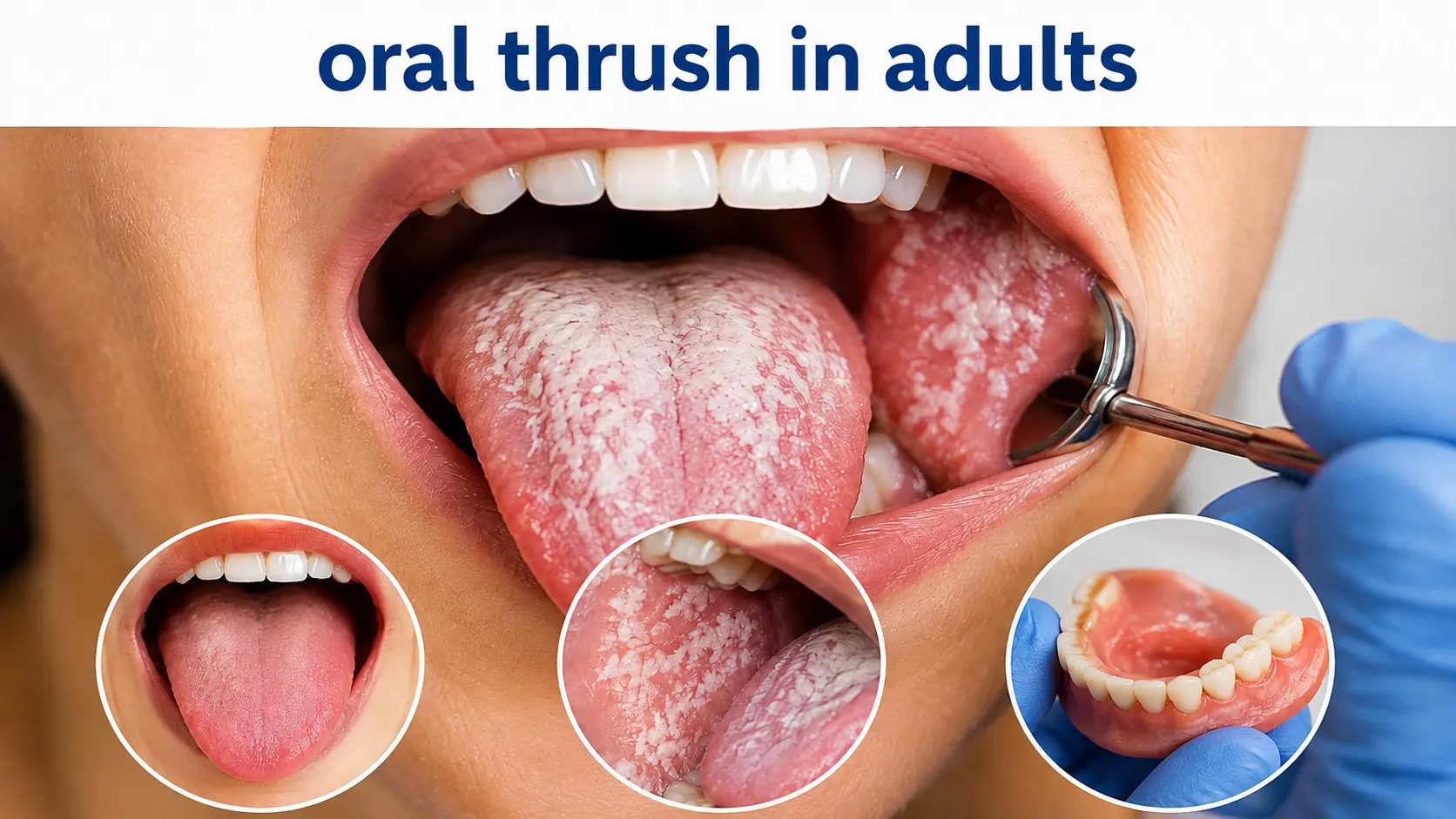
Creamy white patches may appear on the tongue, cheeks, roof of the mouth, gums, tonsils, or throat.
Treatment usually involves an antifungal medicine.
It is also important to find out why the thrush appeared.
This is especially true when an otherwise healthy adult gets thrush for the first time or keeps getting it again.
Seek prompt medical care if you have pain or difficulty swallowing, feel food getting stuck, have a weak immune system, or have oral thrush that keeps returning or does not improve with treatment.
What Is the Best Treatment for Oral Thrush in Adults?
The main treatment for oral thrush in adults is antifungal medicine.
Mild cases may be treated with an antifungal product that works inside the mouth.
Examples used in clinical care include nystatin, miconazole, or clotrimazole.
The exact product depends on where you live, your health, your medicines, and the severity of the infection.
More severe thrush may need an antifungal medicine that works throughout the body, such as fluconazole.
Do not choose a treatment based only on a photograph.
White patches can have several causes.
A doctor, dentist, or pharmacist can help confirm what you are dealing with.
What Is Oral Thrush?
Oral thrush is also called oral candidiasis.
It is caused by an overgrowth of Candida yeast.
Candida albicans is a common cause.
Candida can normally live in the mouth without causing disease.
Your immune system, saliva, normal mouth bacteria, and healthy mouth tissues usually help keep it under control.
If that balance changes, Candida can grow too much.
This can lead to mouth thrush.
Is Oral Thrush Common in Healthy Adults?
It can happen.
But it is less common in healthy adults than in babies, older adults, and people with certain risk factors.
This is why unexplained or repeated thrush in an adult deserves attention.
It may be linked with a medicine, denture use, dry mouth, diabetes, smoking, or an immune problem.
What Does Oral Thrush Look Like in Adults?
Classic oral thrush often causes white patches in the mouth.
They may look creamy or slightly raised.
Common places include:
- The tongue
- Inside the cheeks
- The roof of the mouth
- The gums
- The tonsils
- The back of the throat
The tissue under a white patch may look red and sore.
It may bleed a little if the area is rubbed or scraped.
Do not keep scraping the patches to test them.
Common Oral Thrush Symptoms
Symptoms may include:
- White patches in the mouth
- Red or sore areas
- A burning feeling
- A cotton-like feeling in the mouth
- Loss of taste
- An unusual taste
- Pain when eating
- Cracks at the corners of the lips
- Redness under dentures
Cracks at the mouth corners are sometimes called angular cheilitis.
They can have several causes.
Candida can be one of them.
Can Oral Thrush Be Red Without White Patches?
Yes.
Not every Candida infection looks the same.
Some forms of oral candidiasis cause more redness and soreness than white material.
This is one reason self-diagnosis can be difficult.
What Causes Oral Thrush in Adults?
Thrush develops when Candida can grow too much.
Several things can make that easier.
1. Antibiotics
Antibiotics can change the normal bacteria in your mouth.
This may give Candida more room to grow.
Not everyone who takes an antibiotic gets thrush.
Do not stop a prescribed antibiotic because you develop mouth symptoms.
Contact your doctor or pharmacist instead.
2. Steroid Inhalers
Steroid inhalers used for asthma or other lung conditions can increase the risk of mouth thrush.
This does not mean you should stop the inhaler.
Rinse your mouth with water and spit it out after using a corticosteroid inhaler when your treatment instructions advise this.
Good inhaler technique also matters.
Ask a pharmacist, nurse, or doctor to check your technique if thrush keeps returning.
3. Dentures
Dentures can create a warm, moist area where Candida can grow.
The risk may be higher when dentures:
- Are worn overnight
- Are not cleaned well
- Do not fit correctly
- Rub or irritate the gums
Thrush linked with dentures may cause redness under the denture.
This is sometimes called denture stomatitis.
4. Dry Mouth
Saliva protects the mouth.
People with persistent dry mouth may have a higher risk of oral infections.
Dry mouth can come from medicines, health conditions, dehydration, mouth breathing, or cancer treatment.
If you often wake with a dry mouth, read our guide to waking up with dry mouth.
5. Diabetes
Diabetes can increase the risk of Candida infection.
The risk may be higher when blood glucose is not well controlled.
Recurring oral thrush may be one reason a clinician asks about diabetes symptoms or blood glucose testing.
Thrush alone does not prove that you have diabetes.
6. A Weakened Immune System
A weakened immune system can make it harder for the body to control Candida.
This may happen with:
- HIV
- Some cancers
- Chemotherapy
- Organ transplant medicines
- Other medicines that suppress the immune system
People with weakened immunity should get professional advice for suspected thrush.
7. Cancer Treatment
Chemotherapy and other cancer treatments can affect the mouth and immune system.
Mouth pain, ulcers, dryness, and fungal infections can occur.
Contact your cancer care team when new mouth symptoms appear.
8. Smoking
Smoking is another risk factor for mouth and throat candidiasis.
It can also cause other white, red, or irritated areas in the mouth.
A persistent patch in a smoker should not simply be assumed to be thrush.
9. Older Age
Older adults may have more risk factors.
These can include dentures, dry mouth, several medicines, diabetes, or reduced immune defences.
Age itself does not mean thrush should be ignored.
What Can Look Like Oral Thrush?
Not every white tongue is thrush.
Not every white patch is Candida.
This section is very important.
Coated Tongue
A coated tongue may have a white or yellow layer.
Food, dead cells, bacteria, dry mouth, smoking, or poor oral cleaning can contribute.
It is not automatically thrush.
Leukoplakia
Leukoplakia can cause a white patch that usually does not wipe away.
It needs professional assessment.
Do not assume a persistent white patch is a fungal infection.
Geographic Tongue
Geographic tongue usually causes smooth red areas with pale borders.
The pattern may move over time.
It is different from classic thrush.
Mouth Ulcers
Mouth ulcers are usually individual sores rather than a coating of creamy patches.
Read our Mouth Ulcers guide if you have a round painful sore instead of widespread white patches.
White Spots on the Tonsils
White material on the tonsils can have several causes.
These include tonsil stones, tonsillitis, strep throat, and thrush.
Read our White Spots on Tonsils guide if the problem is mainly at the back of your throat.
Food or Milk Residue
Some food can temporarily coat the tongue.
This usually clears with drinking, eating, or gentle cleaning.
Persistent patches deserve a closer look.
How Is Oral Thrush Diagnosed?
A doctor or dentist can often identify oral thrush by looking at your mouth.
They will also ask about risk factors.
You may be asked about:
- Recent antibiotics
- Steroid inhaler use
- Dentures
- Dry mouth
- Diabetes
- Smoking
- Cancer treatment
- Medicines that affect immunity
- Previous episodes of thrush
If the diagnosis is unclear, a clinician may take a small sample from the mouth.
The sample can be examined for Candida.
More testing may be needed when symptoms do not respond to treatment.
Do You Need Blood Tests?
Not everyone needs blood tests.
A doctor may consider them when thrush:
- Keeps returning
- Is unusually severe
- Has no clear cause
- Occurs with other symptoms
The clinician may look for an underlying problem such as diabetes or another condition that affects immunity.
Treatment for Oral Thrush in Adults
The goal is to treat the Candida infection and reduce the chance that it returns.
The right treatment depends on how severe the infection is and what caused it.
Antifungal Treatment for Mild or Moderate Thrush
A pharmacist, doctor, or dentist may recommend a medicine that works directly inside the mouth.
Options used for oral thrush treatment can include:
- Nystatin
- Miconazole
- Clotrimazole
Which medicine is available and suitable depends on your country and medical history.
Some antifungal medicines interact with other medicines.
Tell your pharmacist or doctor about everything you take.
Follow the full treatment instructions.
Do not stop early just because the patches look better.
Treatment for More Severe Thrush
More severe infection may need a medicine that works throughout the body.
Fluconazole is one medicine that clinicians may use.
This needs professional guidance.
The dose and length of treatment depend on the infection and your health.
What If Treatment Does Not Work?
Do not keep trying one product again and again without advice.
Possible reasons include:
- The diagnosis is wrong
- The Candida is resistant to a medicine
- The treatment was not used correctly
- An underlying risk factor remains
- The infection is more extensive
A clinician may need to examine the mouth again or take a sample.
Can Oral Thrush Spread to the Esophagus?
Yes, but this is much less common in healthy adults.
Esophageal candidiasis affects the tube that carries food from the mouth to the stomach.
It is more likely in people with weakened immune systems.
Signs may include:
- Painful swallowing
- Difficulty swallowing
- A feeling that food is sticking
- Pain behind the breastbone when swallowing
These symptoms need medical assessment.
Esophageal candidiasis needs prescription antifungal treatment.
What Can You Do at Home?
Home care can make your mouth more comfortable.
It should not replace antifungal treatment when treatment is needed.
Keep the Mouth Clean
Brush gently twice a day.
Use a soft toothbrush.
Clean between your teeth.
Do not scrub sore white patches.
For a full routine, read our Oral Hygiene guide.
Drink Enough Water
A dry mouth can feel more sore.
Small drinks of water may help comfort.
Persistent dry mouth should be addressed rather than simply drinking more water all day.
Choose Foods That Do Not Hurt
When your mouth is sore, softer foods may feel better.
You may want to avoid foods that sting.
These can include:
- Very spicy foods
- Very acidic foods
- Very hot drinks
- Hard or sharp foods
Do Not Smoke
Smoking can irritate the mouth.
It is also a risk factor for oral candidiasis.
Care for Dentures
Clean dentures every day.
Remove them at night unless your dentist has told you otherwise.
See a dentist if they do not fit well.
Do not keep wearing dentures that rub sore areas.
Rinse After a Steroid Inhaler
If you use a corticosteroid inhaler, follow its instructions.
Rinsing the mouth with water and spitting after use can help reduce the risk of thrush with many steroid inhalers.
Do not stop a prescribed inhaler because you have thrush.
Do Home Remedies Cure Oral Thrush?
No home remedy should be presented as a proven replacement for antifungal treatment.
A mild salt water rinse may feel soothing.
Plain yogurt can be part of a normal diet if you tolerate dairy.
Neither should be relied on to cure an active Candida infection.
There is not enough reason to recommend harsh mouth rinses, essential oils, vinegar, or oil pulling as a medical treatment for oral thrush.
Should You Scrape Oral Thrush Off?
No.
Do not keep scraping white patches.
This can leave the tissue sore and irritated.
It can also cause minor bleeding.
Treat the cause instead.
Why Does My Oral Thrush Keep Coming Back?
Recurring oral thrush means the trigger may still be present.
Possible reasons include:
- Repeated antibiotic use
- Incorrect steroid inhaler technique
- Not rinsing after a steroid inhaler
- Poorly fitting dentures
- Wearing dentures overnight
- Persistent dry mouth
- Diabetes
- Smoking
- A weakened immune system
- Incomplete antifungal treatment
Do not simply repeat treatment forever.
Ask why the infection keeps returning.
That question can be more important than changing antifungal products.
Can Recurrent Thrush Mean Diabetes?
It can be associated with diabetes.
It does not mean that everyone with thrush has diabetes.
If thrush keeps returning and there is no obvious reason, a doctor may consider blood glucose testing.
Can Stress Cause Oral Thrush?
Stress alone is not a clear diagnosis for oral thrush.
Avoid blaming every episode on stress.
Look first for established risk factors such as medicine use, dentures, dry mouth, diabetes, smoking, and immune problems.
How Can You Help Prevent Oral Thrush?
You cannot prevent every case.
But several habits can lower risk.
1. Brush twice a day
Keep your teeth, gums, and tongue clean without aggressive scrubbing.
2. Clean dentures well
Follow your dentist's instructions.
Remove dentures at night unless told otherwise.
3. Make sure dentures fit
Loose or painful dentures need dental assessment.
4. Rinse after steroid inhalers
Use the inhaler correctly.
Rinse and spit afterward when instructed.
5. Manage dry mouth
Find the cause of long term dryness.
6. Manage diabetes
Follow your diabetes treatment plan.
7. Avoid smoking
This supports oral health in many ways.
8. Use antibiotics only as prescribed
Do not take leftover antibiotics.
Do not take antibiotics for illnesses that do not need them.
9. Attend dental checks
This is especially useful if you wear dentures, have diabetes, or keep getting mouth symptoms.
When Should You See a Doctor or Dentist?
Arrange professional care if:
- You are an adult with new unexplained oral thrush
- The patches do not improve with treatment
- Thrush keeps coming back
- The mouth is very painful
- You have trouble eating or drinking
- You have diabetes
- You have a weakened immune system
- You are receiving chemotherapy
- Your dentures are painful or do not fit
- You have a persistent white or red patch
When Is Oral Thrush More Urgent?
Get medical advice promptly if you have:
- Pain when swallowing
- Difficulty swallowing
- A feeling that food is stuck
- Severe weakness
- Signs of dehydration
- A serious immune problem
- Rapidly worsening symptoms
Call emergency services for trouble breathing, severe swelling, fainting, confusion, or another life-threatening symptom.
Can Oral Thrush Be Oral Cancer?
Thrush and oral cancer are not the same condition.
But not every white or red patch is thrush.
A patch that stays, especially one that does not respond to treatment, should be examined by a dentist or doctor.
Do not keep treating a persistent unexplained mouth patch as Candida without getting it checked.
References and Sources
The health information in this guide was checked against these open and trusted medical sources.
- Centers for Disease Control and Prevention: Treatment of CandidiasisCurrent CDC guidance on antifungal treatment for mouth and throat candidiasis, severe infection, and esophageal candidiasis.Read the CDC candidiasis treatment guidance
- Centers for Disease Control and Prevention: Risk Factors for CandidiasisGuidance on diabetes, antibiotics, corticosteroids, dentures, dry mouth, smoking, cancer, and weakened immunity.Read the CDC candidiasis risk factor guidance
- NHS: Oral ThrushPublic guidance on adult symptoms, antifungal treatment, dentures, prevention, and when swallowing symptoms need medical care.Read the NHS oral thrush guide
- MedlinePlus: Thrush in Children and AdultsNational Library of Medicine guidance on causes, symptoms, diagnosis, risk factors, and antifungal treatment.Read the MedlinePlus thrush guide
- Mayo Clinic: Oral ThrushClinical information on symptoms, Candida overgrowth, risk factors, complications, dentures, diabetes, and prevention.Read the Mayo Clinic oral thrush guide
Conclusion
Oral thrush in adults is usually treatable.
But treatment should target the Candida infection and the reason it developed.
Do not rely on scraping, detox remedies, coconut oil, or strong homemade rinses.
Use antifungal treatment when advised.
Clean dentures well.
Rinse after steroid inhalers when instructed.
Address dry mouth.
And do not ignore repeated infections.
Take action today: If you think you have oral thrush in adults, speak with a pharmacist, dentist, or doctor so the diagnosis is correct and the right treatment can begin.
Medical Disclaimer
This content is for general educational purposes and does not replace professional medical advice, diagnosis, or treatment. Consult an appropriately qualified healthcare professional for personal medical concerns.
This article explains published guidance and does not provide a personal clinical assessment.
Always consult qualified medical professionals for diagnosis and treatment of any health condition.
I am also not a dentist, pharmacist, or infectious disease specialist.
This guide provides general education only.
It does not diagnose oral candidiasis, prescribe antifungal medicine, or replace an examination by a qualified healthcare professional.
Frequently Asked Questions About Oral Thrush in Adults
What is oral thrush in adults?
Oral thrush is an overgrowth of Candida fungus in the mouth. It can cause creamy white patches, redness, soreness, altered taste, or cracks at the corners of the mouth.
What is the fastest treatment for oral thrush?
Antifungal medicine is the standard treatment. The best type depends on the severity of the infection, your health, and other medicines you use.
Can oral thrush go away on its own?
Some mild symptoms may improve, but adults with suspected oral thrush should not assume it will disappear. Treatment may be needed, and unexplained thrush can have an underlying cause.
Is oral thrush contagious?
Oral thrush in adults is not usually considered contagious. It is normally caused by Candida that already lives in the body growing more than usual.
Does oral thrush mean I have diabetes?
No. Diabetes is one risk factor, but antibiotics, steroid inhalers, dentures, dry mouth, smoking, immune problems, and other factors can also increase risk.
Can antibiotics cause oral thrush?
Yes. Antibiotics can reduce some normal bacteria that help control Candida, which can make thrush more likely.
Can steroid inhalers cause oral thrush?
Yes. Inhaled corticosteroids can increase the risk. Correct inhaler technique and rinsing the mouth after use when instructed can reduce risk.
Should I stop my steroid inhaler if I get thrush?
No. Do not stop a prescribed inhaler without medical advice. Ask a doctor or pharmacist about treating the thrush and checking your inhaler technique.
What does oral thrush look like?
Classic thrush often causes creamy white patches on the tongue or inside the cheeks. The mouth may also be red and sore. Some forms are mainly red rather than white.
Can you scrape oral thrush off?
Some white material may come away, but scraping can leave sore red tissue and may cause minor bleeding. Do not repeatedly scrape the mouth.
Can yogurt cure oral thrush?
No. Yogurt may be part of a normal diet, but it should not replace antifungal treatment when an active Candida infection needs treatment.
Can oral thrush cause trouble swallowing?
Yes. Pain or difficulty swallowing can suggest that Candida may affect the throat or esophagus. This needs medical assessment.
Why does my oral thrush keep returning?
Recurring thrush may be linked with antibiotics, steroid inhalers, dentures, dry mouth, diabetes, smoking, immune problems, or incomplete treatment.
How long does oral thrush treatment take?
Treatment length varies. CDC guidance notes that many mild or moderate mouth and throat infections are treated with antifungal medicine for about 7 to 14 days. Follow the exact instructions given for your medicine.
When should an adult see a doctor for oral thrush?
Get professional advice for new unexplained thrush, repeated episodes, symptoms that do not improve, painful swallowing, difficulty swallowing, severe pain, or if you have a weakened immune system.

Health & wellness writer with 30+ years of experience in nutrition, fitness, and healthy aging. Founder of NextFitLife.com — evidence-based health guidance.