Published – February 7 Last Updated: February 7, 2026
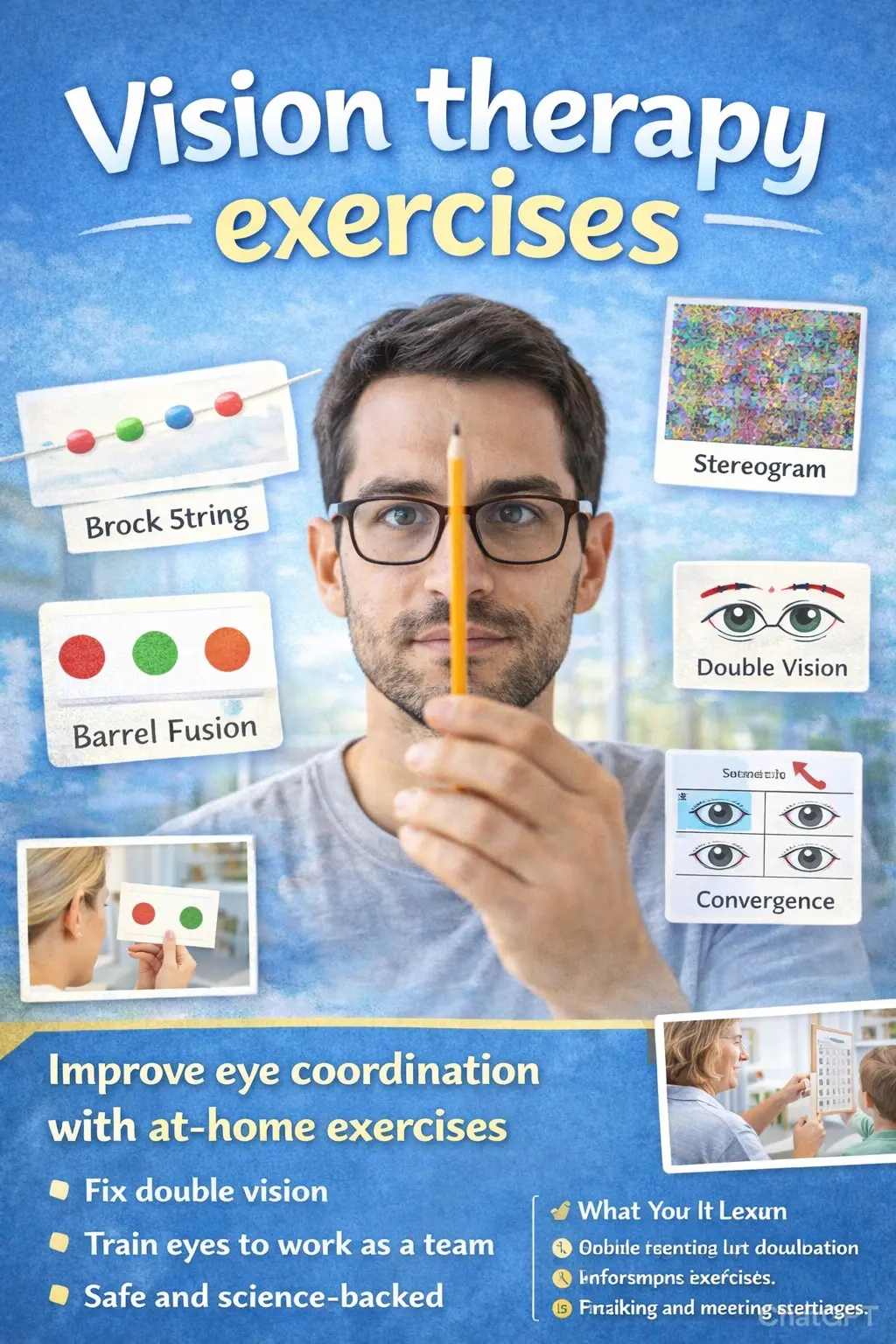
Struggling with double vision? Eyes not working together? Vision therapy exercises can help!
Vision therapy trains your eyes to work as a team. Many exercises can be done at home. They’re simple, effective, and backed by science.
This guide covers:
- What vision therapy is
- Who needs it
- Proven exercises you can do at home
- How to practice safely
- When to see a professional
Let’s help your eyes work together better!
What You’ll Learn
✓ Understanding eye coordination problems
✓ Convergence exercises
✓ Tracking and teaming techniques
✓ Binocular vision exercises
✓ Home therapy routine
✓ When professional help is needed
What Is Vision Therapy?
Vision therapy is exercise for your eyes and brain. It teaches them to work together better.
How It Works
Vision therapy trains –
- Eye coordination (teaming)
- Focusing ability
- Eye movements (tracking)
- Visual processing
- Eye-brain connection
Think of it like physical therapy. But for your visual system, instead of muscles.
Who Needs It?
Vision therapy helps people with –
Convergence insufficiency
- Eyes don’t turn inward properly
- Double vision when reading
- Headaches from close work
- Most common problem (12-33% of people!)
Eye tracking problems
- Difficulty following lines when reading
- Losing place frequently
- Poor reading comprehension
- Skipping words
Eye teaming issues
- Eyes don’t work together well
- One eye drifts sometimes
- Poor depth perception
- Eyestrain
Focusing problems
- Blurred vision near or far
- Slow focus adjustment
- Eyestrain from reading
The American Optometric Association says vision therapy is effective for these problems.
→ Complete guide: Complete Guide to Eye Health: Vision Care, Prevention & Wellness
Understanding Eye Coordination
Before starting eye coordination exercises, understand how the eyes should work.
Normal Eye Teaming
When eyes work well –
- Both eyes point at the same target
- They move together smoothly
- The brain merges two images into one
- Result: single, clear, 3D vision
What Goes Wrong
Coordination problems happen when –
- Eye muscles are weak
- The brain doesn’t coordinate the eyes well
- Poor neural pathways
- Underdeveloped visual skills
This causes
- Double vision
- Poor depth perception
- Headaches
- Reading difficulties
- Eyestrain
News – These can often be improved with exercises!
Home Vision Therapy Exercises
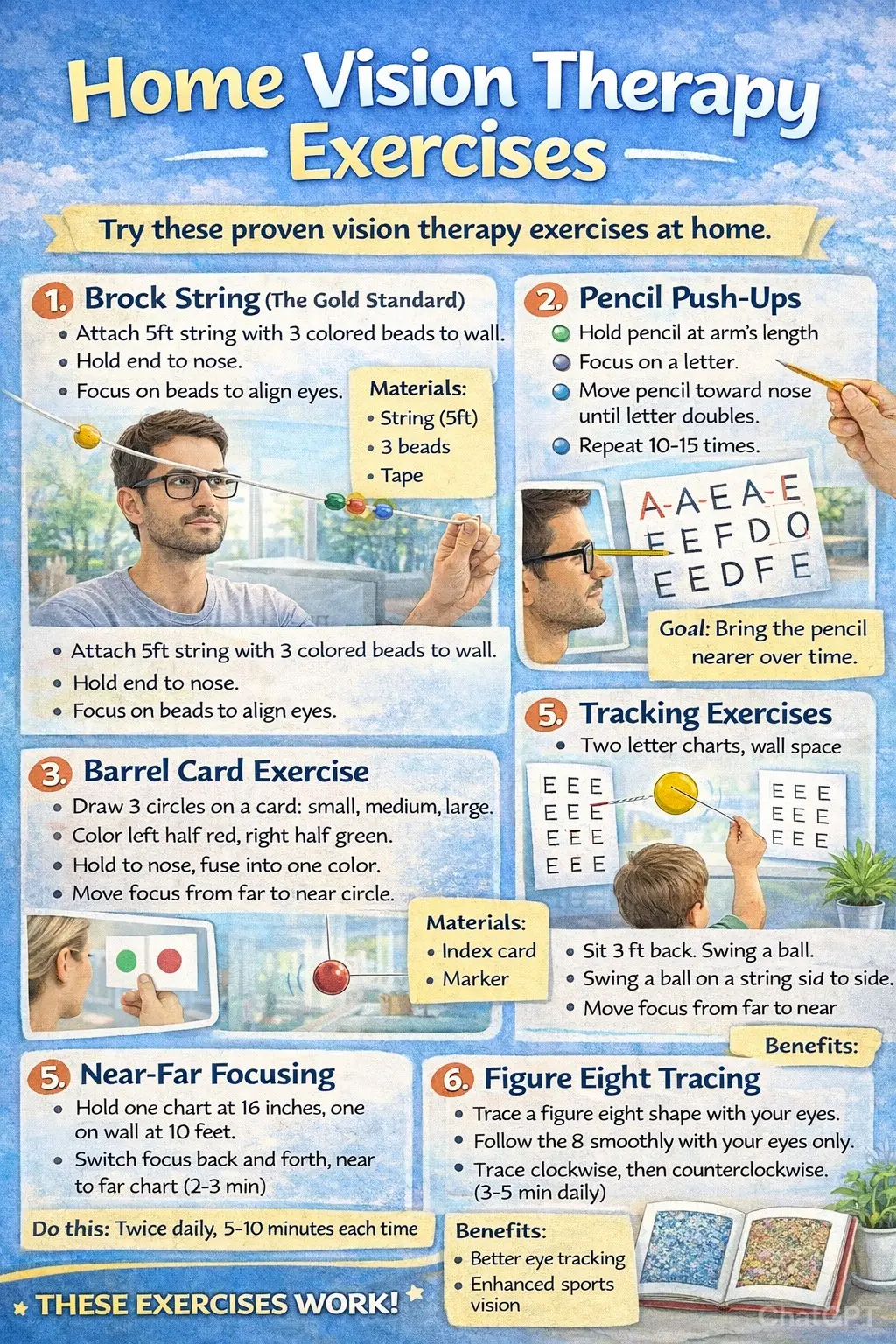
Try these proven vision therapy exercises at home.
1. Brock String (The Gold Standard)
Best exercise for convergence and eye teaming.
What you need
- String about 5 feet long
- 3 colored beads (different colours)
- Tape or hook for the wall
How to do it
- Attach one end to the wall at eye level
- Hold the other end to the tip of the nose
- Place beads 1 foot, 2 feet, and 3 feet apart
- Look at the nearest bead
- Two threads should intersect like an X at the bead.
- If you see V or A shape, the eyes aren’t aligned
- Practice until you see X
- Switch focus to the middle bead (see X there)
- Switch to the far bead
- Practice 5-10 minutes daily
What this teaches
- Proper convergence
- Eye teaming
- Binocular vision
- Depth perception
This is THE most important home exercise!
2. Pencil Push-Ups
Strengthens convergence ability.
How to do it
- Hold a pencil at arm’s length
- Focus on a letter with a pencil
- Keep letter single (not double)
- Slowly move the pencil toward the nose
- Maintain a single, clear letter
- Stop when a letter doubles
- That’s your near point of convergence
- Hold there for 5 seconds
- Slowly move back out
- Repeat 10-15 times
Goal – Bring the pencil closer over time (closer = better).
Track progress – Measure distance when the letter doubles. Work to shorten it.
Do this – Twice daily, 5-10 minutes each time
3. Barrel Card Exercise
Improves convergence and divergence.
What you need
- Index card
- Marker
How to make it
- Draw 3 barrels (circles) vertically on the card
- Small barrel at top, medium middle, large bottom
- Color left half red, the right half green (or two colours)
How to use it
- Hold the card lengthwise against the nose
- Look at the small barrel (farthest)
- Try to see both colours merge into one barrel
- Hold until clear (10 seconds)
- Move to the middle barrel
- Then the large barrel (closest)
- Go back up
- Repeat 5 times
What you’re training – Convergence at different distances
Do this –Once daily, 5 minutes
4. Tracking Exercises
Improves smooth eye movements.
Letter tracking
- Print a page with large letters
- Circle every “E” on the page
- Move only eyes, not head
- Go quickly but accurately
- Time yourself
- Try to improve the time
Ball on a string
- Hang the ball from the ceiling (eye level)
- Sit 3 feet away
- Swing the ball side to side
- Follow with eyes only
- Keep the ball single and clear
- Do for 2-3 minutes
Benefits
- Better reading ability
- Improved sports performance
- Enhanced coordination
Do this – Once daily
5. Near-Far Focusing (Hart Chart)
Builds focusing flexibility.
What you need
- Two identical charts with letters (different sizes)
- Wall space
How to do it
- Place one chart on the wall 10 feet away
- Hold the identical chart 16 inches from your eyes
- Read the smallest line on the near chart
- Quickly shift focus to the far chart
- Read the same line
- Back to the near chart
- Repeat for 2-3 minutes
What this trains
- Accommodation (focusing)
- Speed of focus change
- Stamina
Do this – 2-3 times daily, 3 minutes each
6. Figure Eight Tracing
Enhances tracking and coordination.
How to do it
- Draw a colossal figure 8 on paper (or imagine on a wall)
- Trace it slowly with your eyes
- Keep movement smooth, not jerky
- Complete 10 traces clockwise
- Reverse to counterclockwise (10 traces)
- Keep your head still
- Both eyes track together
Benefits
- Smooth pursuit skills
- Better reading
- Enhanced sports vision
Do this – Once daily, 3-5 minutes
7. Stereogram (Magic Eye) Practice
Develops depth perception and fusion.
What you need
- Stereogram images (Magic Eye books or online)
How to do it
- Hold the mage at arm’s length
- Look “through” the image
- Relax your eyes
- Let eyes diverge slightly
- The image should pop into 3D
- Hold focus for 30 seconds
- Practice with different images
Tips
- Be patient (takes practice)
- Don’t strain
- Relax and breathe
Benefits
- Improves fusion
- Enhances 3D vision
- Fun and engaging!
Do this – 5-10 minutes daily
→ More exercises: Eye Exercises to Improve Vision: Science-Backed Techniques
Your Home Vision Therapy Routine
Create a consistent practice schedule.
Daily Minimum (15 Minutes)
Morning (7 minutes)
- Brock String (5 minutes)
- Pencil push-ups (2 minutes)
Evening (8 minutes)
- Barrel card (3 minutes)
- Figure eight tracing (3 minutes)
- Near-far focusing (2 minutes)
Ideal Routine (30 Minutes)
Morning (10 minutes)
- Brock String (5 minutes)
- Pencil push-ups (5 minutes)
Midday (10 minutes)
- Tracking exercises (5 minutes)
- Near-far focusing (5 minutes)
Evening (10 minutes)
- Barrel card (5 minutes)
- Stereograms (5 minutes)
Weekly Goals
Track these
- Pencil push-up near point (measure distance)
- Brock String performance (X shape clearer?)
- Reading comfort (better? worse? Same?)
- Headache frequency
- Double vision episodes
Keep a simple log!
Tips for Success
Consistency is key
- Same time each day
- Set phone reminders
- Don’t skip days
- Practice even when improving
Quality over quantity
- Focus on doing exercises correctly
- Don’t rush
- Take breaks if tired
- Stop if eyes hurt
Advanced Techniques
Once you master the basics, try these.
Fusion Exercises
Improving how eyes merge images.
Dot card fusion
- Hold a card with two dots at arm’s length
- Cross eyes slightly
- Try to see three dots (the middle one is fusion)
- Hold steady for 10 seconds
- Practice daily
Peripheral Awareness
Expanding visual field.
Thumb awareness
- Arms straight out to sides
- Wiggle both thumbs
- Look straight ahead
- Maintain awareness of both thumbs
- Slowly bring arms forward
- Keep peripheral awareness
- Hold 30 seconds
Eye-Hand Coordination
Connecting vision with movement.
Ball toss
- Toss the ball hand to hand
- Follow with eyes
- Vary speed and pattern
- Keep smooth tracking
- Do for 2-3 minutes
Benefits
- Better sports performance
- Improved coordination
- Enhanced reaction time
When Professional Help Is Needed
Home exercises help many people. But sometimes you need more.
See a Vision Therapist If
Home exercises don’t help
- Tried consistently for 6-8 weeks
- No improvement
- Symptoms worsening
Severe symptoms
- Constant double vision
- Significant eye turn
- Major reading difficulties
- Impact on school or work
Diagnosed conditions
- Strabismus (eye turn)
- Amblyopia (lazy eye)
- Traumatic brain injury
- Stroke recovery
Children with
- Learning difficulties
- Poor reading despite intelligence
- Frequent headaches
- Avoiding close work
What Professional Therapy Includes
In-office vision therapy:
- Specialized equipment
- Computer-based exercises
- Lenses and prisms
- Professional monitoring
- Customized programs
- Weekly sessions (usually 12-24 weeks)
Success rates
- Convergence insufficiency: 75-80% success
- Many other conditions improve significantly
→ Learn more: Vision Therapy: What It Is and Who Needs It
Safety and Best Practices
Practice eye coordination exercises safely.
Important Safety Rules
Always
- Start slowly (5 minutes per exercise)
- Stop if pain occurs
- Keep movements gentle
- Be patient with progress
Never
- Force convergence or fusion
- Practice when exhausted
- Skip warm-up exercises
- Ignore persistent symptoms
Who Should Be Careful
Check with a doctor first if you have:
- Recent eye surgery
- Retinal problems
- Glaucoma
- Eye disease
Children under 6
- Need professional guidance
- Exercises must be age-appropriate
- Make it fun and brief
Signs to Stop
Stop immediately if
- Eye pain develops
- Severe headache
- Persistent double vision
- Dizziness or nausea
- Vision worsens
Contact an eye doctor if symptoms persist.
→ Computer users: Best Eye Exercises for Computer Users and Screen Time Relief
FAQs about Vision Therapy Exercises
How long until I see results?
Most people notice some improvement in 2-4 weeks. Significant changes take 8-12 weeks of daily practice.
Can vision therapy exercises cure lazy eye in adults?
Adults can improve, but results vary. Children respond better. Professional therapy is usually needed.
Do I need special equipment?
Basic exercises need only string, beads, and cards. You can make most equipment at home cheaply.
How often should I practice?
Daily practice is ideal. Minimum 5-6 days per week. Consistency matters more than duration.
Can vision therapy replace glasses?
No. It improves eye coordination and function but doesn’t correct refractive errors like nearsightedness.
Q: Is it safe for children? A: Yes! Children often respond very well. Make exercises fun and keep sessions short (10-15 minutes).
Will my insurance cover vision therapy?
Some plans cover professional vision therapy. Home exercises are free! Check with your insurance.
Final Thoughts
Vision therapy exercises can significantly improve eye coordination and function.
They help with
- Convergence problems
- Eye teaming issues
- Tracking difficulties
- Reading problems
- Depth perception
Keys to success
- Practice daily (consistency)
- Be patient (takes weeks)
- Track progress
- Start with basics
- Get professional help if needed
Start today
- Try Brock String for 5 minutes
- Do pencil push-ups
- Set up daily routine
- Track your progress
- Be patient and consistent
Remember
- Home therapy helps many people
- Professional therapy needed for severe cases
- Exercises are safe and free
- Results take time
- Your effort pays off
Your eyes can learn to work better together. Give them the training they need!
Medical Disclaimer
This article is for information only. Home vision therapy exercises can help many coordination problems. However, severe conditions need professional care. Consult an eye doctor before starting any vision therapy program.

Adel Galal is a health and wellness writer with over 30 years of experience studying and writing about health, fitness, nutrition, and healthy living. He is the founder of NextFitLife.com, where he shares practical, evidence-based guidance to support long-term health at any age. Adel’s mission is simple:
to help people make smarter health choices that fit real life, at any age.