
Published: February 20, 2026
Last Updated: July 26, 2026
Next Review: July 2027, or earlier if important convergence-insufficiency, binocular-vision, concussion-rehabilitation, or pediatric eye-care guidance changes
Written and Source Checked by: Adel Galal, Founder and Lead Writer at NextFitLife
Review Status: Editorially reviewed against current National Eye Institute, AAPOS, American Academy of Ophthalmology, and published convergence-insufficiency research. Not medically reviewed by an ophthalmologist, optometrist, orthoptist, neurologist, or rehabilitation clinician.
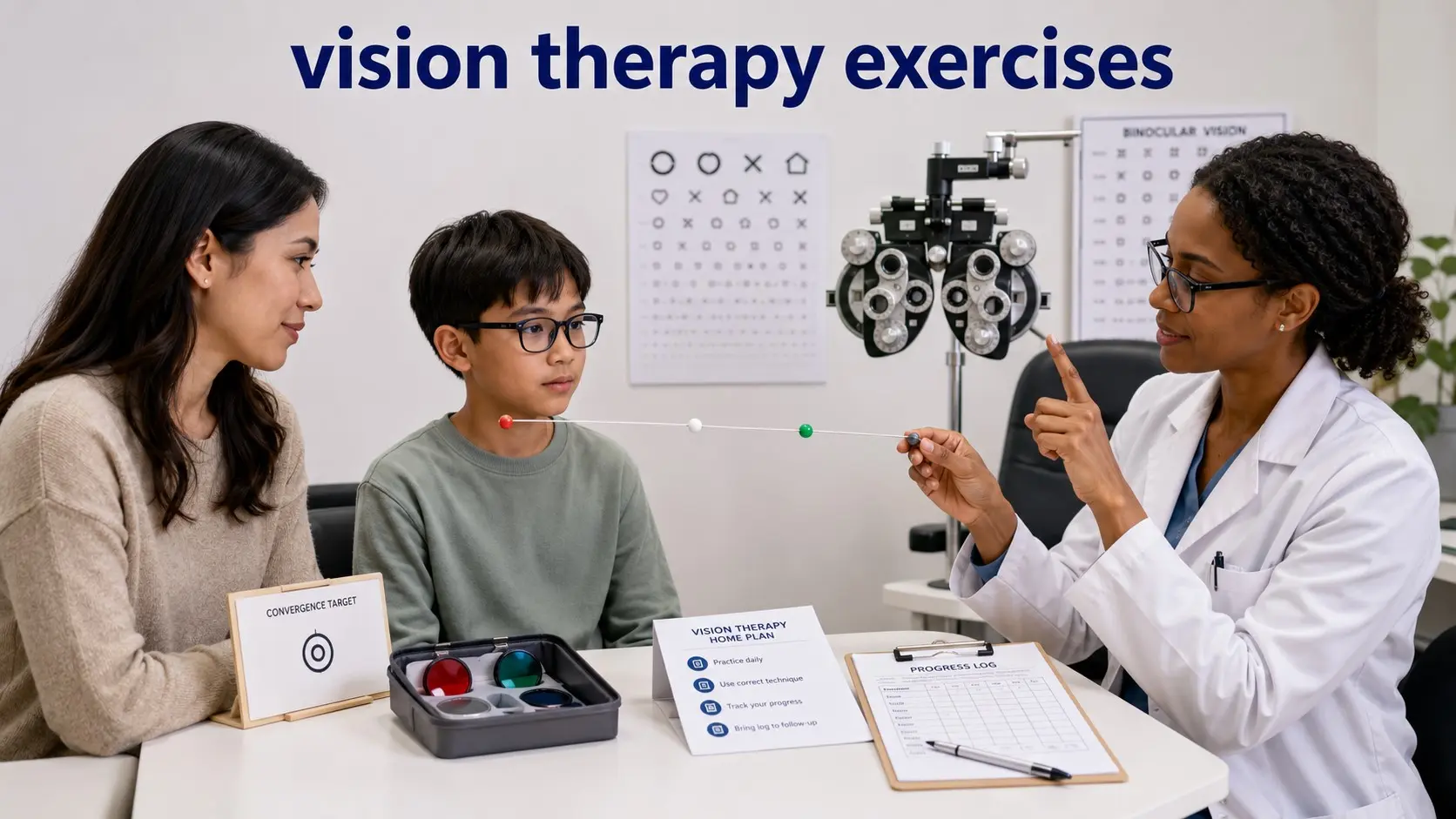
Vision therapy exercises are structured activities used to treat selected problems involving eye alignment, convergence, focusing, or binocular coordination.
They are not general eye workouts for everyone with blurry vision, headaches, reading difficulty, or heavy screen use.
The clearest evidence is for symptomatic convergence insufficiency, a condition in which the eyes have difficulty turning inward and remaining coordinated during reading, smartphone use, or other close work.
A treatment plan may include professionally monitored office therapy and exercises performed at home. However, home practice should reinforce a measured diagnosis and a technique taught by an ophthalmologist, optometrist, orthoptist, or another appropriately qualified eye-care professional.
Vision therapy rarely remove nearsightedness, farsightedness, astigmatism, or presbyopia. It is also not a proven treatment for dyslexia or a substitute for evidence-based reading instruction.
Quick Answer: Do Vision Therapy Exercises Work?
Vision therapy exercises may help certain diagnosed eye-coordination problems, particularly symptomatic convergence insufficiency.
Convergence insufficiency can cause eyestrain, headaches, blurred or double vision, loss of place, or difficulty sustaining attention during close work.
Home activities such as pencil push-ups, Brock-string tasks, convergence cards, or computer-based vergence exercises may be included in treatment. The correct exercise, target, frequency, and progression depend on examination findings and should be taught or monitored professionally.
Vision therapy does not replace a glasses prescription. There is no evidence that it reverses myopia or treats dyslexia. Treating convergence insufficiency may make reading more comfortable, but it should not be promised to improve standardized reading fluency or comprehension.
New double vision, a newly drifting eye, symptoms following a head injury, sudden vision loss, or neurologic symptoms require medical assessment before exercises are attempted.
Do Not Start Home Vision Therapy Before an Eye Assessment If:
- Double vision began suddenly
- One eye recently started turning inward or outward
- Symptoms began after a concussion or significant head injury
- You have new eyelid drooping
- You have facial weakness, numbness, imbalance, confusion, or difficulty speaking
- Vision has suddenly worsened
- You have severe eye pain
- You see flashes, many new floaters, or a curtain-like shadow
- You recently had eye or brain surgery
- A child has a visible eye turn, suspected amblyopia, or unexplained reduced vision
Sudden adult double vision or a newly misaligned eye can be associated with nerve problems, stroke, thyroid eye disease, trauma, myasthenia gravis, surgery complications, or other conditions that require diagnosis.
Seek emergency care when double vision occurs with weakness, facial drooping, speech difficulty, a severe sudden headache, confusion, or loss of balance.
What Is Vision Therapy?
Vision therapy is a structured treatment program designed for selected disorders involving how the eyes and brain coordinate visual tasks.
Depending on the diagnosis, therapy may target:
- Convergence, or turning the eyes inward for near work
- Divergence, or moving the eyes outward appropriately
- Fusional vergence, or maintaining one image while alignment demand changes
- Accommodation, or adjusting focus between distances
- Eye alignment
- Selected eye-movement functions
- Awareness of suppression, when the brain ignores one eye's image
A program may use:
- Near targets
- Brock strings
- Convergence cards
- Prisms
- Special lenses
- Computer-based vergence activities
- Clinician-monitored office equipment
- Prescribed home reinforcement
Vision therapy is sometimes compared with physical therapy because it involves repeated, progressive training. The comparison is useful only when the therapy is linked to a specific diagnosis and objective treatment goals.
Vision Therapy Versus General Eye Exercises
Not every activity described online as an “eye exercise” is vision therapy.
| Approach | Purpose | Professional Diagnosis Needed? |
|---|---|---|
| 20-20-20 screen break | Reduce temporary near-focus fatigue | Usually no |
| Gentle full blinking | Support tear spreading during screen work | Usually no |
| Convergence therapy | Treat diagnosed symptomatic convergence insufficiency | Yes |
| Accommodation exercises | Treat a measured focusing dysfunction | Yes |
| Prism or fusion activities | Train a selected binocular alignment response | Yes |
| Generic eye yoga or figure-eight tracing | Often marketed for relaxation or coordination | Not established as treatment for refractive error or most eye diseases |
Screen breaks may improve comfort. They do not replace treatment for a diagnosed binocular-vision disorder.
Read Eye Exercises for Screen Time for digital eye-strain strategies rather than clinical vision therapy.
How Does Eye Coordination Work?
During normal binocular vision, both eyes point toward the same target while the brain combines their images into one visual perception.
Looking at a Distant Object
The eyes are directed forward with relatively little inward turning.
Looking at a Near Object
The visual system must coordinate several responses:
- The eyes turn inward
- The lenses adjust focus
- The pupils may become smaller
- The brain combines the two retinal images
This inward movement is called convergence.
What Can Go Wrong?
A binocular-vision problem may involve:
- Difficulty initiating convergence
- Difficulty maintaining convergence
- Reduced fusional vergence
- A tendency for one eye to drift outward during near work
- Suppression of one eye's image
- A focusing problem occurring alongside the alignment problem
This is more accurate than describing every coordination problem as weak eye muscles.
What Is Convergence Insufficiency?
Convergence insufficiency is a binocular-vision disorder in which the eyes have difficulty turning inward or maintaining inward alignment during close work.
A person may have clear distance vision and still have convergence insufficiency.
The condition can occur in children and adults. It may also develop or become noticeable following a concussion or other brain injury.
Common Close-Work Triggers
- Reading
- Writing
- Smartphone use
- Tablet use
- Computer work
- Detailed crafts
- Other prolonged near tasks
Symptoms That May Suggest an Eye-Coordination Problem
Possible symptoms during close work include:
- Eye strain
- Sore or tired eyes
- Headaches
- Intermittent blurred vision
- Double vision
- Words appearing to move
- Losing place while reading
- Closing or covering one eye
- Difficulty sustaining attention on near work
- Avoidance of prolonged reading
These symptoms are not specific to convergence insufficiency.
Similar complaints can be associated with:
- An incorrect glasses prescription
- Dry eye
- Migraine
- Strabismus
- Accommodation problems
- Sleep deprivation
- Neurologic conditions
- Learning or attention disorders
Symptoms alone cannot determine which exercise is appropriate.
How Is Convergence Insufficiency Diagnosed?
Diagnosis requires a symptom history and objective binocular-vision testing.
Near Point of Convergence
This measures how close a target can move toward the eyes before:
- The target becomes double
- One eye drifts outward
- The person can no longer maintain alignment
Fusional Vergence
Prisms may be used to measure how much alignment demand the person can manage before vision becomes double or fusion breaks.
Eye Alignment
The clinician may compare alignment at:
- Distance
- Near
- Different gaze positions
Accommodation
Testing may assess how well the eyes:
- Focus at near
- Change focus between distances
- Sustain near focus
Other Parts of the Examination
- Visual acuity
- Refraction and glasses prescription
- Eye health
- Eye movements
- Stereoscopic depth perception
- Suppression testing
- Neurologic or medical review when indicated
A routine eye-chart test alone may not identify convergence insufficiency.
Does Everyone With Weak Convergence Need Treatment?
No.
Treatment is considered when:
- Symptoms are present
- Objective findings support the diagnosis
- Close work is significantly affected
- The clinician believes the measured problem explains the symptoms
A person with an abnormal measurement but no symptoms may be monitored rather than treated immediately.
Conversely, a person may report meaningful symptoms even when one office measurement appears normal. The clinician may repeat testing or assess performance under different conditions.
What Does the Research Say About Vision Therapy?
The evidence is strongest for structured vergence and accommodative therapy in children with symptomatic convergence insufficiency.
Research has found that office-based therapy with home reinforcement can improve:
- Near point of convergence
- Positive fusional vergence
- Selected clinical signs of convergence insufficiency
Home-based pencil or target push-ups may also be prescribed, but comparative studies have not consistently found them as effective as structured office-based treatment in children.
Important Evidence Limitations
- Results from children do not automatically apply to all adults.
- One treatment protocol cannot be generalized to every binocular disorder.
- Improvement in clinical measurements is not the same as curing dyslexia.
- Improving eye coordination does not change ordinary refractive error.
- Individual results depend on diagnosis, severity, adherence, technique, and access to care.
How Long Can Treatment Take?
Improvement may take weeks or months.
The National Eye Institute notes that some people may need 12 weeks or longer before noticing a change.
Do not increase exercise duration or difficulty simply because improvement is not immediate.
Home Exercises Versus Office-Based Therapy
| Feature | Prescribed Home Practice | Office-Based Therapy |
|---|---|---|
| Supervision | Performed independently after instruction | Directly monitored by a professional |
| Equipment | Simple targets, string, cards, or approved software | May include prisms, lenses, specialized targets, and computer systems |
| Technique correction | Limited between reviews | Immediate feedback and correction |
| Progression | Follows written clinician instructions | Can be adjusted during the session |
| Best use | Reinforcement and selected first-line plans | Structured treatment requiring closer monitoring |
The appropriate combination depends on age, diagnosis, severity, access, cost, symptoms, and professional judgment.
What Should Be Confirmed Before Starting an Exercise?
Ask the prescribing professional to explain:
- The exact diagnosis
- Which measurement is abnormal
- Why the selected exercise matches that problem
- What the target should look like
- Whether it must remain single, clear, or centred
- How to recognize suppression
- How long or how often to practice
- Which temporary symptoms are acceptable
- Which symptoms require stopping
- When the next review will occur
Do not assume that seeing more double vision means the exercise is working better.
Pencil or Target Push-Ups
Pencil push-ups are commonly associated with convergence-insufficiency treatment.
The activity typically involves following a small, detailed target as it moves slowly toward the nose while attempting to keep it clear and single.
Use only after professional instruction.
The clinician should define the target, movement speed, stopping point, repetitions, recovery method, and whether the activity is appropriate for your diagnosis.
Common Technique Problems
- Closing one eye
- Suppressing one eye without realizing it
- Moving the head instead of the target
- Allowing the target to blur
- Continuing after persistent double vision
- Moving too quickly
- Judging progress only by closeness to the nose
What Progress May Include
- Improved near point of convergence
- Better ability to recover single vision
- Reduced symptoms during near work
- Improved objective measurements at follow-up
Moving a pencil closer is not the only measure of successful treatment.
Brock-String Exercises
A Brock string usually consists of a cord with several colored beads placed at different distances.
It may be used to develop awareness of:
- Convergence
- Eye alignment
- Suppression
- Fixation
- Binocular fusion
What a Clinician May Demonstrate
When looking at one bead, the person may be taught to notice:
- Whether the bead is single
- Whether two string images appear
- Where those images appear to intersect
- Whether one string disappears because one eye is being suppressed
The expected pattern depends on the target distance and the therapy goal.
Why Professional Setup Matters
The professional may adjust:
- Bead distance
- Target order
- Viewing duration
- Background detail
- Head position
- Additional prism or lens demand
A Brock string is a useful clinical tool, but it should not be described as the universal gold standard or the only important home exercise.
Convergence Cards and Barrel Cards
Convergence cards use paired or divided images that the person attempts to combine into a single fused image.
They may help train convergence at selected distances.
Possible Clinical Goals
- Achieving fusion
- Maintaining fusion
- Changing convergence demand gradually
- Recognizing when one eye suppresses
- Recovering single vision after fusion breaks
Why a Printed Internet Card May Not Be Enough
Effectiveness can depend on:
- Correct print size
- Viewing distance
- Card position
- Alignment with the nose
- The intended convergence or divergence demand
- The person's measured binocular response
Use the exact card and instructions provided by the clinician.
Computer-Based Vergence Exercises
Some treatment programs use software to present images that increase or decrease binocular demand.
Potential advantages include:
- Standardized targets
- Progress tracking
- Adjustable difficulty
- Clinician review of completion data
Important Limitations
- Not every commercial application has clinical evidence.
- Software cannot diagnose the condition.
- Automated progression may be inappropriate if technique is wrong.
- Screen-based therapy may aggravate headaches or concussion symptoms in selected patients.
Use only a program selected and monitored by the treating professional.
Exercises for Diagnosed Focusing Problems
Accommodation is the process that changes the eye's optical focus for near and distant targets.
A diagnosed accommodation problem may cause:
- Near blur
- Distance blur after prolonged reading
- Slow focus changes
- Eye strain
- Headaches
Possible Clinician-Prescribed Activities
- Near-far letter charts
- Lens-based focusing tasks
- Alternating near and distance targets
- Accommodative facility exercises
Near-far focusing should not be used as a generic treatment for all blurry vision.
An inaccurate prescription, dry eye, diabetes, cataracts, migraine, or another condition may cause similar symptoms.
Do Tracking Exercises Improve Reading or Eye Coordination?
Activities such as following a moving object, finding letters on a page, or tracing patterns may be used to observe or practice eye movements in selected settings.
Examples include:
- Following a slow target
- Visual-search tasks
- Reading-target activities
- Clinician-designed saccade exercises
What Should Not Be Promised
Generic tracking exercises should not be promised to:
- Treat dyslexia
- Increase intelligence
- Guarantee improved comprehension
- Correct myopia
- Improve sports performance for everyone
- Treat every cause of losing place while reading
Reading difficulty requires an appropriate educational assessment as well as an eye examination when visual symptoms are present.
Stereograms and Fusion Activities
Stereograms present separate image information to each eye and require the brain to fuse the images.
They may be included in selected binocular-vision programs.
Possible Therapy Goals
- Developing fusion awareness
- Practicing convergence or divergence
- Maintaining binocular perception
- Increasing vergence demand gradually
Why “Magic Eye” Images Are Not Universal Therapy
- They may require divergence rather than convergence.
- The visual demand may not match the diagnosed problem.
- A person can complete the image using an unintended strategy.
- Failure to see the image does not diagnose an eye disorder.
Do not use random online stereograms as a substitute for a prescribed fusion target.
Can Vision Therapy Improve Reading?
Convergence insufficiency can make reading uncomfortable.
Treating the condition may reduce:
- Eye strain
- Near blur
- Intermittent double vision
- Difficulty sustaining close work
However, reducing visual discomfort is not the same as treating the language-based skills involved in reading.
A large NEI-funded clinical trial found that office-based vergence and accommodative therapy improved clinical convergence measures but did not improve standardized reading fluency or comprehension more than placebo treatment.
Use this accurate wording:
Treating a diagnosed eye-coordination disorder may make reading more comfortable, but it should not be promised to improve standardized reading performance.
Does Vision Therapy Treat Dyslexia?
No.
Primary dyslexia is a language-based learning disorder. It is not caused by weak eye muscles, eye tracking, or an inability to perform convergence exercises.
A child with reading difficulty may also have a separate eye condition, such as:
- Refractive error
- Strabismus
- Convergence insufficiency
- Accommodation problems
Those visual conditions should be treated appropriately, but treatment should not delay evidence-based reading and language intervention.
Appropriate Evaluation May Include:
- A complete eye examination
- Educational testing
- Language and reading assessment
- Assessment for attention or other learning conditions
Can Vision Therapy Cure Myopia?
No.
Myopia, or nearsightedness, is usually related to the eye's length or optical focusing shape.
Vision therapy does not shorten an elongated eye or remove the need for:
- Glasses
- Contact lenses
- Professionally recommended myopia-control treatment
- Refractive surgery in suitable adults
Programs promising to reverse myopia through eye exercises should be treated cautiously.
Read How to Improve Your Eyesight Naturally for a broader explanation of refractive errors and healthy eye habits.
Can Vision Therapy Treat Amblyopia or Lazy Eye?
Amblyopia is reduced vision caused by abnormal visual development during childhood.
Possible causes include:
- Strabismus
- Unequal refractive error
- Vision obstruction from cataract or another condition
Established Treatment May Include:
- Correct glasses
- Patching the stronger eye
- Atropine drops
- Treatment of cataract or another obstruction
- Selected binocular treatments under specialist care
A generic online exercise routine should not replace pediatric ophthalmology or optometry care.
Early treatment is especially important in children because visual development changes with age.
Can Exercises Straighten a Turned Eye?
Strabismus means the eyes are not aligned in the same direction.
Different forms require different treatments.
Possible options include:
- Corrective glasses
- Prism lenses
- Patching for associated amblyopia
- Condition-specific exercises
- Botulinum toxin
- Eye-muscle surgery
Exercises have evidence for convergence insufficiency, but they have not been proven to correct every form of esotropia or exotropia.
A child with a visible eye turn should receive a complete eye examination rather than a trial of home exercises.
Vision Therapy After Concussion or Brain Injury
Concussion and other brain injuries may be associated with:
- Convergence insufficiency
- Blurred vision
- Double vision
- Light sensitivity
- Difficulty tracking
- Headache
- Dizziness
- Balance problems
These symptoms may involve the visual, vestibular, neurologic, and cervical systems.
Why Independent Treatment Is Risky
- The symptoms may have more than one cause.
- Screen exercises may worsen headache or nausea.
- Double vision may require prism, temporary occlusion, or another treatment.
- Rehabilitation should fit the person's stage of recovery.
Do not start a generic home vision-therapy package after concussion without assessment by an appropriate medical and rehabilitation team.
Safe Home-Practice Framework
The following framework is safer than using a universal 15-minute or 30-minute internet routine.
| Home-Practice Element | What to Confirm |
|---|---|
| Diagnosis | The measured binocular or focusing disorder |
| Exercise | The exact prescribed activity and equipment |
| Visual target | Whether it should remain single, clear, fused, or centred |
| Dose | Clinician-set repetitions, duration, and frequency |
| Technique | Correct head position, viewing distance, and recovery method |
| Symptoms | Which temporary effort is acceptable and which symptoms require stopping |
| Progression | When bead position, target distance, prism demand, or difficulty should change |
| Review | The date for objective reassessment |
Example Home Instruction Record
Diagnosis: ______________________________
Prescribed exercise: ______________________________
Target appearance: ______________________________
Duration or repetitions: ______________________________
Frequency: ______________________________
Stop signs: ______________________________
Next review date: ______________________________
This is a record for professional instructions—not a self-prescription form.
How Is Vision-Therapy Progress Measured?
Progress should be evaluated with more than a home diary or the amount of effort invested.
Objective Measurements May Include:
- Near point of convergence
- Positive and negative fusional vergence
- Eye alignment at near and distance
- Accommodation amplitude
- Accommodation facility
- Stereoscopic depth perception
- Suppression findings
Functional Changes May Include:
- Reduced eye strain
- Fewer headaches during close work
- Less intermittent double vision
- Improved ability to sustain near work
- Reduced need to close one eye
Improvement should be confirmed at scheduled follow-up rather than by continually moving targets closer or increasing exercise time independently.
When Should You Stop a Vision Therapy Exercise?
Stop the activity and contact the prescribing professional if it causes:
- Persistent double vision after the session
- Significant headache
- Eye pain
- Nausea
- Dizziness
- Reduced vision
- Worsening eye alignment
- New neurologic symptoms
- Symptoms that become progressively more severe
Mild Effort Versus Harmful Symptoms
A clinician may explain that brief visual effort or temporary awareness of double vision can occur during a controlled exercise.
That does not mean severe symptoms should be pushed through.
More discomfort does not equal better treatment.
Questions to Ask an Ophthalmologist, Optometrist, or Orthoptist
- What is my exact diagnosis?
- Which measurements support the diagnosis?
- Could an incorrect glasses prescription explain my symptoms?
- Is convergence insufficiency the main problem?
- Is accommodation also affected?
- Do I need office-based treatment, home exercises, or both?
- Why did you select this exercise?
- What should the target look like during practice?
- How will I recognize suppression?
- How often and how long should I practice?
- Which symptoms are acceptable?
- Which symptoms mean I should stop?
- When will the measurements be repeated?
- Could prism glasses help?
- Does a child also need an educational reading assessment?
- Could concussion or another neurologic condition contribute?
- What outcome is realistic?
What Not to Do
- Do not begin exercises for sudden double vision without an examination.
- Do not assume every headache during reading is convergence insufficiency.
- Do not use vision therapy to replace prescribed glasses.
- Do not claim that eye exercises cure myopia.
- Do not use vision therapy as a treatment for dyslexia.
- Do not promise higher reading scores or better school grades.
- Do not treat a visible eye turn with a generic online routine.
- Do not continue through severe headache, nausea, dizziness, or eye pain.
- Do not increase duration or difficulty without professional direction.
- Do not use random commercial software as a diagnosis.
- Do not delay concussion, neurologic, or pediatric eye care.
Key Takeaway
Vision therapy exercises may improve selected eye-coordination problems, especially symptomatic convergence insufficiency.
The safest treatment process is:
- Obtain a complete eye and binocular-vision assessment.
- Confirm the exact diagnosis.
- Correct any needed glasses prescription.
- Use the exercise selected for the measured problem.
- Learn the correct visual target and technique.
- Follow the prescribed dose rather than a generic routine.
- Record symptoms and completion.
- Return for objective measurement and progression.
Home practice can be a valuable part of care, but it should reinforce professional treatment rather than replace diagnosis.
Vision therapy does not normally correct refractive error or treat dyslexia. Sudden double vision, a newly drifting eye, concussion-related symptoms, or neurologic warning signs require medical assessment.
References and Sources
National Eye Institute: Convergence Insufficiency
National Eye Institute: More Effective Treatment Identified for Common Childhood Vision Disorder
National Eye Institute: Convergence Treatment Does Not Improve Children's Reading Skills
- atrabismus: Convergence Insufficiency
- American Association for Pediatric Ophthalmology and Strabismus: Adult Strabismus
- American Academy of Ophthalmology: Learning Disabilities, Dyslexia, and Vision
- Cochrane Review: Interventions for Convergence Insufficiency
- Convergence Insufficiency Treatment Trial: Treatments for Symptomatic Convergence Insufficiency in Children
- Randomized Trial of Vision Therapy and Pencil Push-Ups in Young Adults
Medical review note: Because this article discusses binocular-vision diagnosis, double vision, pediatric strabismus, amblyopia, concussion, dyslexia, and professionally prescribed exercises, it should be prioritized for review by an ophthalmologist, optometrist, orthoptist, or qualified medical reviewer.
Related NextFitLife Guides and Topic Hubs
Related Eye-Health Guides
- Eye Health Complete Guide: Vision Care, Foods, Symptoms, and Prevention
- Eye Exercises for Screen Time and Digital Eye-Strain Relief
- How to Improve Your Eyesight Naturally
- Simple Eye Care Tips for Clearer, More Comfortable Vision
- Foods for Eye Health and Better Vision
- Eye Health After LASIK Surgery
- Medical Tests and Screenings Hub
NextFitLife Topic Hubs
Frequently Asked Questions About Vision Therapy Exercises
What are vision therapy exercises?
They are structured activities used to treat selected binocular-vision, convergence, focusing, or eye-movement problems after professional assessment.
Do vision therapy exercises really work?
They can improve selected clinical signs in people with diagnosed symptomatic convergence insufficiency. Evidence is not equally strong for every condition marketed as benefiting from vision therapy.
What is convergence insufficiency?
It is a binocular-vision disorder in which the eyes have difficulty turning inward or maintaining alignment during reading or other close work.
What symptoms can convergence insufficiency cause?
Possible symptoms include eye strain, headaches, near blur, intermittent double vision, losing place, closing one eye, or difficulty sustaining close work.
How is convergence insufficiency diagnosed?
An eye-care professional measures near point of convergence, fusional vergence, alignment, focusing ability, refractive error, eye movements, and symptoms.
Can vision therapy be done at home?
Yes. Prescribed home practice may be part of treatment. It should follow professional diagnosis, demonstration, dosing instructions, and scheduled follow-up.
Should you start vision therapy without an eye examination?
No. Similar symptoms can have different causes, and new double vision or eye misalignment may require urgent medical investigation.
What is a Brock-string exercise?
A Brock string uses colored beads on a cord to provide visual feedback about convergence, fixation, fusion, and suppression.
What should you see when using a Brock string?
The expected string and bead pattern depends on which bead is viewed and the treatment goal. A clinician should demonstrate the correct response.
What are pencil push-ups?
They involve following a detailed target as it moves slowly toward the nose while attempting to keep it clear and single.
Are pencil push-ups effective?
They may be prescribed for convergence insufficiency. Comparative research in children has often favoured structured office-based vergence therapy with home reinforcement over pencil push-ups alone.
Is office-based therapy better than home exercises?
For children with symptomatic convergence insufficiency, research suggests office-based vergence and accommodative therapy with home reinforcement can be more effective than home pencil push-ups alone. Individual circumstances still matter.
How long does convergence therapy take?
Progress may take weeks or months. The National Eye Institute notes that some people may need 12 weeks or longer before noticing improvement.
Can vision therapy improve reading?
Treating convergence insufficiency may reduce discomfort during reading. It should not be promised to improve standardized reading fluency or comprehension.
Does vision therapy treat dyslexia?
No. Dyslexia is a language-based learning disorder and requires evidence-based educational and language intervention.
Can vision therapy improve reading comprehension?
A major NEI-funded trial found no greater improvement in standardized reading comprehension after convergence therapy than after placebo therapy.
Can vision therapy cure myopia?
No. It does not shorten an elongated eye or remove an ordinary nearsighted prescription.
Can vision therapy replace glasses?
No. Glasses correct refractive error. Vision therapy addresses selected coordination or focusing disorders and may be used alongside glasses.
Can exercises treat astigmatism?
No. Astigmatism is an optical curvature problem and is corrected with glasses, contact lenses, or appropriate surgery.
Can vision therapy treat lazy eye?
Amblyopia treatment may include glasses, patching, atropine, treatment of an obstruction, and selected binocular approaches. A generic home routine should not replace specialist care.
Can exercises straighten a turned eye?
Exercises have evidence for convergence insufficiency but are not proven to correct every type of strabismus. Treatment may require glasses, prisms, patching, injections, or surgery.
Is vision therapy safe for children?
Condition-specific exercises can be appropriate for children when prescribed and monitored by a qualified eye-care professional.
Can adults benefit from convergence exercises?
Adults with diagnosed symptomatic convergence insufficiency may benefit, although evidence and treatment response differ from those in children.
Can vision therapy help after concussion?
Selected patients may receive visual rehabilitation, but concussion-related symptoms require medical assessment and an individualized multidisciplinary plan.
Are tracking exercises evidence-based?
Tracking activities may be used for selected diagnosed eye-movement problems, but generic drills should not be promised to improve reading, intelligence, or sports ability.
Do figure-eight eye exercises improve coordination?
There is limited evidence for broad clinical claims. Figure-eight tracing should not be treated as a universal therapy for binocular disorders.
Can stereograms improve depth perception?
Clinician-selected stereograms may train fusion in a specific program. Random online images may not provide the correct convergence or divergence demand.
What symptoms mean an exercise should be stopped?
Stop for persistent double vision, significant headache, nausea, dizziness, eye pain, reduced vision, worsening alignment, or new neurologic symptoms.
Is sudden double vision an emergency?
Sudden double vision requires prompt medical evaluation. Emergency care is needed when it occurs with weakness, speech difficulty, severe headache, confusion, or imbalance.
Which professional diagnoses binocular-vision problems?
An ophthalmologist, optometrist, or orthoptist may assess convergence, eye alignment, focusing, refraction, and related binocular functions.
How is progress measured during therapy?
Progress may be measured using near point of convergence, fusional vergence, alignment, focusing ability, suppression, depth perception, and changes in symptoms.
Can vision therapy improve sports performance?
Broad performance claims are not established for everyone. Sports-vision training should not be confused with treatment for convergence insufficiency.
Can vision therapy help screen-related eye strain?
It may help when a diagnosed binocular or focusing disorder contributes. Ordinary digital eye strain is usually managed with breaks, blinking, an appropriate prescription, glare reduction, and workstation changes.
What is the difference between vision therapy and the 20-20-20 rule?
Vision therapy treats a diagnosed visual-function disorder. The 20-20-20 rule is a general comfort break for prolonged near or screen work.
When should a child with reading problems have an eye examination?
An examination is appropriate when the child has blur, headaches, double vision, squinting, an eye turn, closing one eye, or difficulty sustaining near work. Educational reading assessment may also be needed.
Medical Disclaimer
All health content on NextFitLife is provided for general educational and informational purposes only. It does not diagnose or treat convergence insufficiency, strabismus, amblyopia, accommodation disorders, double vision, concussion-related vision problems, dyslexia, myopia, or another eye or neurologic condition.
Home vision exercises should be selected, demonstrated, and monitored by an ophthalmologist, optometrist, orthoptist, or another appropriately qualified eye-care professional. The correct technique, visual target, frequency, and progression depend on objective examination findings.
Do not use vision therapy as a substitute for glasses, patching, atropine, prism lenses, surgery, reading intervention, concussion care, or another recommended treatment.
Seek urgent medical assessment for sudden double vision, a newly drifting eye, new eyelid drooping, weakness, difficulty speaking, severe headache, symptoms following significant head injury, sudden vision loss, flashes, many new floaters, or a curtain-like shadow in vision.

Health & wellness writer with 30+ years of experience in nutrition, fitness, and healthy aging. Founder of NextFitLife.com — evidence-based health guidance.