
Updated on: October 18, 2026
Written by: Adel Galal
Medical review status: This article has not been independently reviewed by a dermatologist, registered dietitian, primary care doctor, pharmacist, hematologist, or other licensed healthcare professional.
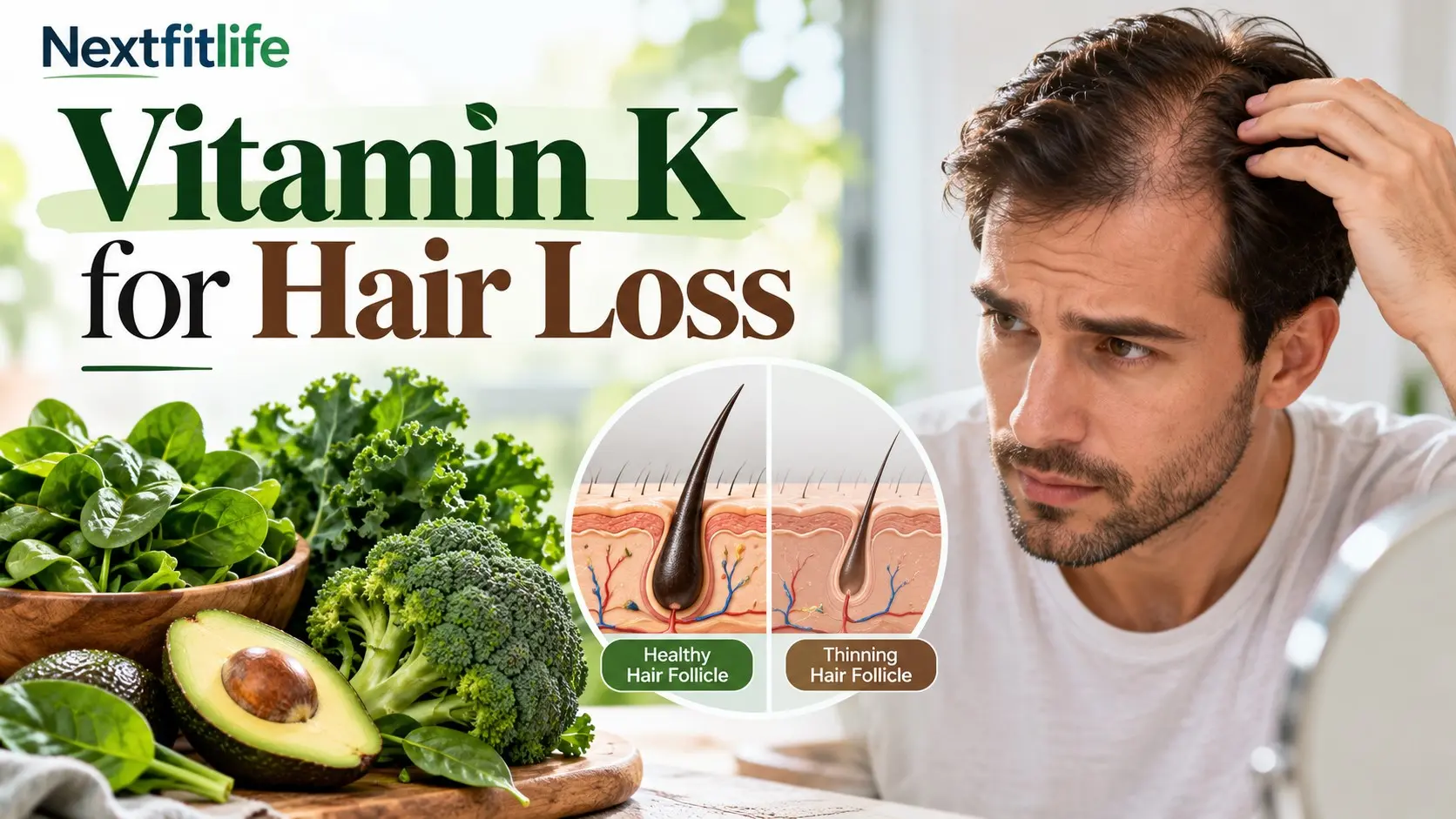
Vitamin K for hair loss is getting more attention online, especially vitamin K2. You may see claims that it improves scalp blood flow, removes calcium from hair follicles, strengthens roots, or reverses thinning.
Those claims go beyond the current evidence.
Vitamin K is an essential nutrient. It helps your body make proteins used in normal blood clotting and bone metabolism. But there is no good clinical evidence showing that taking vitamin K1 or K2 makes hair regrow in people who already get enough vitamin K.
For most people with thinning hair, the more useful question is not “Which vitamin should I take?” It is “Why am I losing hair?”
This article is for general information and education. It does not replace medical advice, diagnosis, or treatment.
For a broader overview of thinning hair, read Hair Loss Causes and Treatment. You can also explore the NextFitLife Health Hub.
Table of Contents
- What vitamin K does
- Does vitamin K help hair loss?
- 9 critical facts
- Vitamin K deficiency is rare
- Hair loss is not a classic deficiency sign
- K1 and K2 are not proven hair treatments
- Scalp calcification claims are unproven
- Blood flow claims are overstated
- Other deficiencies matter more
- Hair loss has many non nutritional causes
- Food is usually enough for vitamin K
- Warfarin changes the safety picture
- Vitamin K1 vs K2
- Food sources
- How much vitamin K adults need
- When deficiency happens
- Better tests for hair loss
- Evidence based treatment
- Supplement mistakes
- Frequently asked questions
What Is Vitamin K?
Vitamin K is a fat soluble vitamin.
Its best established roles involve proteins needed for:
- Normal blood clotting
- Bone metabolism
- Other vitamin K dependent processes in the body
Vitamin K is not one single compound.
The main forms are:
- Vitamin K1, also called phylloquinone
- Vitamin K2, a group of compounds called menaquinones
Green leafy vegetables are major sources of K1. Some fermented foods and animal foods contain K2 forms.
Does Vitamin K Help Hair Loss?
There is currently no good clinical evidence that vitamin K supplements prevent common hair loss or regrow hair in people with normal vitamin K status.
This includes:
- Vitamin K1
- Vitamin K2
- MK 4
- MK 7
You may find theories about blood circulation, calcium deposits, inflammation, or follicle strength. A biological theory is not the same as a proven treatment.
To recommend a nutrient for hair loss, we would want good human studies showing meaningful improvement in hair density, shedding, or regrowth. That evidence is not currently available for vitamin K.
9 Critical Facts About Vitamin K for Hair Loss
1. Vitamin K Deficiency Is Rare in Healthy Adults
Most adults get enough vitamin K from a varied diet.
Clinically important deficiency in adults is uncommon.
It is more likely when something interferes with absorption or vitamin K metabolism.
2. Hair Loss Is Not a Classic Sign of Vitamin K Deficiency
The classic problem caused by serious vitamin K deficiency is abnormal bleeding.
Possible signs can include:
- Easy bleeding
- Prolonged bleeding
- Abnormal blood clotting tests
- Hemorrhage in severe deficiency
Hair thinning is not considered a standard diagnostic feature of vitamin K deficiency.
3. Vitamin K1 Is Not a Proven Hair Growth Vitamin
Vitamin K1 is important for normal health, but that does not mean extra K1 stimulates hair follicles.
No established treatment guideline recommends K1 supplements for common hair loss.
4. Vitamin K2 Is Not Proven to Reverse Hair Thinning
K2 is involved in vitamin K dependent proteins, and researchers have studied its possible role in bone and vascular biology.
That has led to an online theory that K2 might prevent calcium buildup in the scalp and therefore prevent hair loss.
This has not been established as a clinical hair loss treatment.
There is no good evidence that taking MK 7 or MK 4 reverses male pattern baldness, female pattern hair loss, telogen effluvium, or alopecia areata.
5. Better Scalp Blood Flow Does Not Mean Vitamin K Will Regrow Hair
Hair follicles need blood supply like other living tissues.
But that fact does not prove that vitamin K supplements improve scalp circulation enough to change hair growth.
Claims such as “30 percent less shedding” or guaranteed improvement within a set number of weeks are not supported by reliable clinical evidence.
6. Other Nutritional Problems Have Better Links to Hair Loss
Dermatologists pay more attention to deficiencies with clearer links to shedding.
These can include:
- Iron deficiency
- Low protein intake
- Zinc deficiency
- Biotin deficiency when it is truly present
A restrictive diet or very low calorie intake can also trigger significant shedding.
Read How to Treat Iron Deficiency Anemia if low iron is a concern.
7. Hair Loss Often Has Nothing to Do With Vitamins
Common causes include:
- Androgenetic alopecia
- Telogen effluvium
- Alopecia areata
- Thyroid disease
- Hormonal changes
- Polycystic ovary syndrome
- Pregnancy and childbirth
- Major illness
- High fever
- Major surgery
- Rapid weight loss
- Scalp infection
- Tight hairstyles
- Certain medicines
Finding the type of hair loss matters more than choosing a supplement first.
8. Food Usually Provides Plenty of Vitamin K
A healthy diet can supply vitamin K without a special hair supplement.
Good sources include:
- Spinach
- Kale
- Broccoli
- Collard greens
- Turnip greens
- Some vegetable oils
- Natto
If you eat a varied diet and do not have a condition that causes poor absorption, true vitamin K deficiency is unlikely.
9. Warfarin Changes Everything
Warfarin works partly by opposing vitamin K activity.
Large changes in vitamin K intake can change warfarin's effect.
People taking warfarin should generally keep dietary vitamin K intake reasonably consistent rather than suddenly avoiding greens or taking high dose supplements.
Do not start a vitamin K supplement while using warfarin unless your anticoagulation team approves it.
Vitamin K1 vs Vitamin K2 for Hair Loss
| Feature | Vitamin K1 | Vitamin K2 |
|---|---|---|
| Main name | Phylloquinone | Menaquinones |
| Common sources | Leafy green vegetables | Fermented and selected animal foods |
| Established role | Vitamin K dependent proteins, especially clotting functions | Vitamin K dependent proteins in several tissues |
| Proven hair regrowth treatment? | No | No |
| Proven to stop scalp calcification hair loss? | No | No clinical proof |
Does Vitamin K2 Prevent Scalp Calcification?
This claim needs careful wording.
Vitamin K dependent proteins are involved in the body's handling of calcium in certain tissues.
Researchers have studied proteins such as matrix Gla protein because of their possible role in abnormal calcification.
But this does not prove that common scalp hair loss is caused by calcium deposits or that K2 supplements reverse hair loss by removing those deposits.
There is no established dermatology treatment called “scalp decalcification” for androgenetic alopecia.
Does Vitamin K Improve Blood Flow to Hair Follicles?
There is no strong clinical evidence showing that vitamin K supplementation meaningfully increases scalp blood flow and causes hair regrowth.
This is an example of a theory becoming stronger online than the supporting evidence.
The body does need normal circulation for healthy tissues, but taking extra vitamin K has not been shown to create a hair growth advantage in people who are already well nourished.
Does Vitamin K Reduce Scalp Inflammation?
Vitamin K has biological roles beyond clotting, and research continues in many areas.
However, vitamin K is not an established treatment for inflammatory scalp diseases.
If you have:
- Redness
- Scaling
- Burning
- Scalp pain
- Crusting
- Pus
you need the underlying scalp problem identified.
Conditions such as seborrheic dermatitis, psoriasis, fungal infection, folliculitis, or inflammatory alopecia require different treatments.
Read Scalp Treatment for Dermatitis if scaling and inflammation are part of your symptoms.
Does Vitamin K Support Collagen for Hair?
Vitamin K should not be described as a proven hair growth treatment through collagen production.
Hair shafts are made mainly of keratin.
Healthy skin and connective tissue need many nutrients, but this does not mean extra vitamin K increases hair density.
Vitamin K Deficiency: What It Really Looks Like
Serious vitamin K deficiency can interfere with normal blood clotting.
The clearest clinical problem is bleeding.
Hair shedding is not used as a standard way to diagnose vitamin K deficiency.
| Finding | Vitamin K Deficiency Link |
|---|---|
| Abnormal bleeding | Established in severe deficiency |
| Abnormal clotting time | Important clinical clue |
| Hair shedding | Not a classic diagnostic sign |
| Pattern baldness | Not established as a vitamin K deficiency effect |
Who Is More Likely to Have Vitamin K Deficiency?
Clinically significant deficiency in adults is rare.
Risk can increase in people who have problems absorbing fat or nutrients.
Examples include some people with:
- Celiac disease
- Cystic fibrosis
- Short bowel syndrome
- Other malabsorption disorders
- Certain gastrointestinal diseases
- History of bariatric surgery
Medicines that interfere with vitamin K metabolism can also change vitamin K status.
If you have one of these conditions, nutrient testing and supplementation should be guided by a healthcare professional.
Can Long Term Antibiotics Lower Vitamin K?
Some medicines can affect vitamin K metabolism or gut bacteria, but the situation is more complex than saying all long term antibiotic use causes vitamin K deficiency.
Clinically significant deficiency usually occurs when other risk factors are also present, such as poor intake or malabsorption.
Do not start vitamin K supplements simply because you recently used an antibiotic.
How Much Vitamin K Do Adults Need?
The United States National Academies established an Adequate Intake rather than a formal Recommended Dietary Allowance for vitamin K.
| Group | Adequate Intake |
|---|---|
| Adult men | 120 mcg per day |
| Adult women | 90 mcg per day |
| Pregnancy | 90 mcg per day for adults |
| Breastfeeding | 90 mcg per day for adults |
These amounts are for general nutrition, not hair loss treatment.
There is no established higher vitamin K dose for hair regrowth.
Best Vitamin K Foods
Food is usually the easiest way to meet normal vitamin K needs.
| Food | Main Vitamin K Form | Approximate Amount |
|---|---|---|
| Natto, 3 ounces | K2, mainly MK 7 | About 850 mcg |
| Spinach, raw, 1 cup | K1 | About 145 mcg |
| Kale, raw, 1 cup | K1 | About 113 mcg |
| Broccoli, cooked, half cup | K1 | About 110 mcg |
| Edamame, half cup | Mostly K1 | About 21 mcg |
The exact amount can vary by food, preparation, and serving size.
Does Vitamin K Need Fat for Absorption?
Vitamin K is fat soluble.
Eating vegetables with some dietary fat can improve absorption of vitamin K1.
A normal meal may provide enough fat for this purpose.
You do not need a special high fat diet or supplement stack.
Should You Take Vitamin K2 Supplements for Hair?
Not simply because you are losing hair.
There is no established K2 dose for hair growth.
If you have a medical reason for vitamin K supplementation, the dose should match that reason.
Taking more of a nutrient does not make a hair follicle respond better when deficiency is not present.
What About K2 MK 7 for Hair?
MK 7 is a form of vitamin K2 commonly used in supplements.
It has a longer half life than some other forms of vitamin K.
That pharmacologic detail does not prove that MK 7 is a hair growth treatment.
No reliable evidence shows that MK 7 strengthens follicle anchoring or reverses patterned thinning.
Should You Combine Vitamin D3 and K2 for Hair Loss?
This combination is heavily marketed.
Vitamin D and vitamin K are both important nutrients, but there is no established “D3 plus K2 hair loss protocol.”
If testing shows a vitamin D deficiency, a clinician may recommend vitamin D treatment.
That does not mean K2 must automatically be added for hair regrowth.
Read Vitamin D Deficiency for more information.
Should You Combine Vitamin K and Biotin?
There is no proven vitamin K and biotin combination for hair regrowth.
True biotin deficiency can cause hair problems, but deficiency is uncommon.
High dose biotin can interfere with some laboratory tests, including certain thyroid and heart related tests.
Do not take thousands of micrograms simply because a hair supplement advertises it.
Iron Is More Important to Check in Many People With Hair Loss
Iron deficiency is a much more established concern in people with shedding, especially when there is:
- Heavy menstrual bleeding
- Pregnancy
- Recent childbirth
- Restricted diet
- Blood loss
- Fatigue
- Low hemoglobin
A clinician may order a complete blood count and iron studies when the history supports it.
Do not take high dose iron without confirming that it is needed.
Protein Matters for Hair Growth
Hair is made largely from the protein keratin.
Very low protein intake and severe calorie restriction can contribute to shedding.
This is one reason crash diets can trigger telogen effluvium.
Focus on enough total nutrition before adding specialty hair supplements.
What Is Telogen Effluvium?
Telogen effluvium is a form of increased shedding that often appears a few months after a physical or emotional stress.
Triggers can include:
- High fever
- Major infection
- Childbirth
- Surgery
- Rapid weight loss
- Severe emotional stress
- Very restrictive dieting
- Some medicines
The trigger may happen weeks or months before the shedding becomes obvious.
Vitamin K does not have an established role in treating telogen effluvium.
What Is Pattern Hair Loss?
Androgenetic alopecia is common in both men and women.
In men, it often causes:
- Receding temples
- Thinning at the crown
- Gradual patterned loss
In women, it often causes:
- A widening part
- Thinning over the top of the scalp
- Reduced hair density
Genes and hormones play a major role.
Vitamin K does not reverse the hormonal mechanism behind this condition.
What About Alopecia Areata?
Alopecia areata is an autoimmune condition.
It can cause smooth round or oval patches of hair loss.
It can also affect eyebrows, eyelashes, beard hair, or other body hair.
This requires a different treatment approach from nutritional hair loss.
Thyroid Disease and Hair Loss
Both low and high thyroid activity can affect hair.
Ask about thyroid evaluation if hair changes occur with symptoms such as:
- Unexplained fatigue
- Weight changes
- Cold or heat intolerance
- Heart rate changes
- Changes in bowel habits
- Menstrual changes
Vitamin K cannot correct hair loss caused by thyroid disease.
Hormonal Hair Loss and PCOS
Women with hair thinning plus irregular periods, acne, or increased facial or body hair may need evaluation for polycystic ovary syndrome or another hormonal condition.
This pattern is not explained by low vitamin K.
Can Vitamin B12 Deficiency Cause Hair Loss?
Vitamin B12 has important roles in blood and nerve health.
Severe nutritional problems can affect hair, but B12 should not automatically be blamed for every case of shedding.
Testing is most useful when symptoms, diet, medicines, or medical history suggest deficiency.
Read Vitamin B12 Deficiency if you have other B12 related concerns.
What Blood Tests Are Useful for Hair Loss?
There is no single standard “hair loss blood panel” that everyone needs.
Testing should be based on your symptoms, diet, examination, and medical history.
A clinician may consider tests such as:
- Complete blood count
- Ferritin or other iron studies
- Thyroid testing
- Selected vitamin or mineral tests
- Hormone tests when symptoms suggest a hormonal disorder
Vitamin K testing is not routinely needed in a healthy person with ordinary thinning hair.
Should You Ask for a Vitamin K Blood Test?
Usually not for hair loss alone.
Vitamin K status is difficult to assess with one simple routine blood level.
Clinically significant deficiency is often evaluated through the medical history, bleeding symptoms, and clotting tests.
A slightly low blood phylloquinone value does not automatically mean clinically important deficiency.
Why Random Supplement Panels Can Mislead
Large nutrient panels can produce borderline or confusing results.
A number slightly outside a laboratory range does not always explain hair loss.
The test needs to fit the clinical picture.
This is why a scalp examination and a careful history often provide more useful information than ordering every available vitamin test.
Evidence Based Treatment Depends on the Cause
| Hair Loss Pattern | Possible Cause | Useful Next Step |
|---|---|---|
| Gradual crown or part thinning | Pattern hair loss | Dermatology evaluation and proven hair loss treatment |
| Diffuse sudden shedding | Telogen effluvium | Find illness, stress, diet, medicine, or other trigger |
| Smooth round patches | Alopecia areata | Dermatologist evaluation |
| Hair loss with low iron | Iron deficiency may contribute | Treat confirmed deficiency and find its cause |
| Broken hair at hairline | Traction or damage | Reduce tension and damaging practices |
Minoxidil and Pattern Hair Loss
Minoxidil is an established treatment option for some types of pattern hair loss.
It is available in topical forms and is used differently depending on the person and condition.
Results take time, and treatment often needs to continue to maintain benefit.
Ask a dermatologist which formulation and plan fits your situation.
Prescription Treatments for Pattern Hair Loss
Some people may benefit from prescription treatments depending on sex, age, pregnancy potential, medical history, and type of hair loss.
Examples may include medicines that affect androgen pathways.
These medicines have important risks and are not appropriate for everyone.
A dermatologist should guide treatment.
Can Supplements Make Hair Loss Worse?
Yes.
More is not always better.
Excessive amounts of some nutrients have been linked to hair loss.
Examples include too much:
- Vitamin A
- Selenium
- Vitamin E in some circumstances
Supplements can also interact with medicines and interfere with laboratory tests.
This is why testing for likely deficiencies is more useful than taking several high dose products at once.
The Problem With Hair Growth Supplement Stacks
A common online stack might include:
- Vitamin K2
- Vitamin D3
- Biotin
- Zinc
- Iron
- Selenium
- Omega 3
Taking all of these without a reason creates several problems.
You may:
- Take nutrients you do not need
- Take unsafe doses
- Create medicine interactions
- Distort blood test results
- Delay diagnosis of the real cause
Hair loss supplements should never replace a proper diagnosis.
Vitamin K and Warfarin
This is the most important safety issue in this article.
Warfarin is designed to interfere with vitamin K dependent clotting pathways.
People using warfarin should not suddenly begin a high dose K1 or K2 supplement.
They also should not suddenly stop eating all green vegetables.
Consistency matters.
Your anticoagulation clinic can adjust warfarin to your normal diet.
What About Other Blood Thinners?
Vitamin K does not interact with every anticoagulant in the same way.
Newer medicines such as apixaban, rivaroxaban, dabigatran, and edoxaban work differently from warfarin.
Still, tell your doctor or pharmacist about all supplements because products can contain other ingredients that interact with medicines.
Vitamin K During Pregnancy
Normal dietary vitamin K is part of a healthy diet during pregnancy.
Do not start high dose vitamin K or a multi ingredient hair supplement simply to prevent postpartum shedding.
Hair shedding after childbirth is commonly related to changes in the hair growth cycle and usually has a different cause.
Does Postpartum Hair Loss Need Vitamin K?
Usually not.
Postpartum shedding often begins a few months after birth because many hairs move into the resting phase around the same time.
Vitamin K is not an established treatment.
Get medical advice if shedding is severe, lasts much longer than expected, or occurs with fatigue, heavy bleeding, thyroid symptoms, or nutritional concerns.
Can Vitamin K Cause Hair Loss?
Vitamin K from normal food intake is not known to cause common hair loss.
But that does not mean large supplement doses are useful for hair.
The safest goal is nutritional adequacy, not taking the largest dose possible.
How Long Would Vitamin K Take to Regrow Hair?
There is no evidence based answer because vitamin K is not an established hair regrowth treatment.
Claims that shedding will improve in six weeks or that new hairs will appear by week ten should not be presented as predictable outcomes.
Hair treatment timelines depend on the cause.
Can Vitamin K Make Hair Thicker?
No reliable clinical evidence shows that vitamin K supplementation increases hair shaft diameter or hair density in people without deficiency.
Hair thickness can be influenced by genetics, hormones, follicle size, age, health, nutrition, and hair care.
Can Vitamin K Stop Male Pattern Baldness?
No.
Male pattern baldness is strongly linked with genetics and androgen activity, especially dihydrotestosterone.
Vitamin K has not been shown to reverse that process.
Can Vitamin K Stop Female Pattern Hair Loss?
No evidence supports vitamin K as a treatment for female pattern hair loss.
Women with a widening part or gradual thinning at the crown should consider a dermatology assessment.
Some women may also need evaluation for hormonal factors.
Can Vitamin K Treat Alopecia Areata?
No.
Alopecia areata is an autoimmune disease.
Vitamin K is not an established treatment.
A dermatologist can discuss therapies based on the amount and location of hair loss.
Can Vitamin K Treat Stress Hair Loss?
No evidence shows that vitamin K specifically treats stress related telogen effluvium.
The best approach is to identify the trigger, restore adequate nutrition, treat any medical condition, and allow the hair cycle time to recover.
When Should You See a Dermatologist?
Arrange an evaluation if you notice:
- Rapid hair loss
- Smooth bald patches
- A widening part
- A receding hairline at a young age
- Loss of eyebrows or eyelashes
- Scalp pain or burning
- Redness or heavy scaling
- Pus or signs of infection
- Hair loss with menstrual changes
- Hair loss with fatigue or unexplained weight change
- Persistent shedding for several months
Early diagnosis matters because some forms of hair loss respond better when treatment begins early.
Common Vitamin K Hair Loss Myths
| Claim | What Evidence Supports |
|---|---|
| K2 reverses scalp calcification | Not proven as a clinical hair loss treatment |
| K2 improves follicle blood flow | No reliable evidence of hair regrowth from this mechanism |
| Vitamin K deficiency commonly causes thinning hair | Clinically significant deficiency mainly causes clotting problems |
| K1 and K2 together work better for hair | No clinical proof |
| D3 plus K2 is a proven hair protocol | No established hair loss protocol supports this combination |
| More supplements mean faster regrowth | Excess nutrients can cause harm and may even worsen hair loss |
A Better Hair Loss Action Plan
- Look at the pattern of hair loss.
- Think about recent illness, childbirth, surgery, stress, weight loss, or diet changes.
- Check whether medicines changed before shedding began.
- Make sure you are eating enough protein and calories.
- Ask whether iron deficiency or thyroid disease is plausible.
- Do not assume vitamin K deficiency based on hair loss alone.
- Avoid high dose hair supplement stacks without a reason.
- See a dermatologist for patterned, patchy, painful, or persistent loss.
- Use evidence based treatment once the cause is identified.
Conclusion: Vitamin K for Hair Loss Has Clear Limits
Vitamin K for hair loss sounds appealing because vitamin K is important for normal health, but a useful nutrient is not automatically a hair growth treatment.
There is no good evidence that K1 or K2 reverses common hair thinning, clears calcium from hair follicles, or produces predictable regrowth.
Eat a varied diet that provides enough vitamin K, but focus your hair loss investigation on the real pattern and cause. Iron deficiency, low protein intake, thyroid disease, pattern hair loss, telogen effluvium, autoimmune disease, hormonal problems, and scalp disorders deserve more attention.
If your hair loss is new, rapid, patchy, painful, or persistent, arrange a dermatology evaluation rather than starting another supplement stack.
References and Sources
- National Institutes of Health Office of Dietary Supplements. Vitamin K Fact Sheet for Health Professionals.
Covers vitamin K1 and K2, normal physiological roles, recommended intake, food sources, deficiency, malabsorption, and interactions with warfarin.
https://ods.od.nih.gov/factsheets/VitaminK-HealthProfessional/ - American Academy of Dermatology. Hair Loss: Diagnosis and Treatment.
Covers dermatologic evaluation, blood testing, nutritional deficiency, pattern hair loss, supplements, minoxidil, and other treatment options.
https://www.aad.org/public/diseases/hair-loss/treatment/diagnosis-treat - American Academy of Dermatology. Hair Loss: Who Gets and Causes.
Covers thyroid disease, low iron, protein, zinc and biotin, hereditary hair loss, medical conditions, and other causes of thinning.
https://www.aad.org/public/diseases/hair-loss/causes/18-causes - American Academy of Dermatology. Hair Loss: Tips for Managing.
Explains why people with hair loss should avoid guessing with supplements and why excess nutrients can cause harm.
https://www.aad.org/public/diseases/hair-loss/treatment/tips - MedlinePlus. Hair Loss.
Covers normal shedding, hereditary hair loss, thyroid disease, stress, low protein intake, medicines, autoimmune disease, and treatment based on the cause.
https://medlineplus.gov/hairloss.html - MedlinePlus. Androgenetic Alopecia.
Explains the genetic and hormonal basis of male and female pattern hair loss.
https://medlineplus.gov/genetics/condition/androgenetic-alopecia/ - NHS. Warfarin.
Explains vitamin K food and supplement interactions with warfarin and the need to avoid sudden dietary changes without professional advice.
https://www.nhs.uk/medicines/warfarin/
Internal Links and Helpful NextFitLife Guides
- Hair Loss Causes and Treatment
- Scalp Treatment for Dermatitis
- How to Treat Iron Deficiency Anemia
- Vitamin D Deficiency
- Vitamin B12 Deficiency
- Signs of B12 Deficiency
- NextFitLife Health Hub
About the Author
Adel Galal is a father of four, three sons and a daughter, and a grandfather of four, with 33 years of hands on parenting experience. He is the founder of Parnthub.com, based in Cairo, Egypt, where he shares practical guidance on feeding, development, and family life from newborns to teenagers.
Adel is not a medical professional. Health articles cite trusted medical and public health sources and are for general information only.
I am not a doctor or licensed healthcare professional, and this content does not replace professional medical advice, diagnosis, or treatment. I share information based on extensive research, real life experience, and consultation with healthcare providers. Always consult qualified medical professionals for diagnosis, treatment, or guidance about any health condition.
Learn more on the NextFitLife About Us page.
Frequently Asked Questions
Does vitamin K help with hair loss?
There is no good clinical evidence that vitamin K supplements stop common hair loss or regrow hair in people who already have adequate vitamin K.
Can vitamin K deficiency cause hair loss?
Hair loss is not a classic sign of vitamin K deficiency. Clinically significant deficiency mainly causes problems with normal blood clotting.
Does vitamin K2 make hair grow?
No reliable clinical evidence shows that vitamin K2 causes hair regrowth or increases hair density.
Does K2 stop scalp calcification?
Vitamin K dependent proteins are involved in calcium biology, but there is no clinical proof that taking K2 reverses common hair loss by removing calcium from the scalp.
Does vitamin K improve blood circulation to hair follicles?
There is no strong evidence that vitamin K supplementation increases scalp blood flow enough to produce hair regrowth.
Is vitamin K1 or K2 better for hair?
Neither K1 nor K2 has been proven to treat hair loss, so there is no evidence based winner for hair regrowth.
How much vitamin K should adults get?
The Adequate Intake is 120 mcg per day for adult men and 90 mcg per day for adult women in the United States. These amounts are for nutrition, not hair treatment.
What foods are rich in vitamin K?
Good sources include spinach, kale, broccoli, collard greens, turnip greens, some vegetable oils, and natto.
Should I take K2 MK 7 for thinning hair?
There is no established MK 7 dose for hair loss and no good evidence that it reverses thinning when vitamin K status is normal.
Do vitamin D3 and K2 help hair loss together?
There is no established D3 and K2 hair loss protocol. Confirmed vitamin D deficiency may need treatment, but that does not prove K2 should be added for hair regrowth.
Should I take biotin with vitamin K?
There is no proven vitamin K and biotin combination for hair growth. Biotin supplements are mainly useful when true biotin deficiency exists.
What vitamin deficiency commonly causes hair loss?
Hair loss may occur with deficiencies such as iron, protein, zinc, or biotin when those deficiencies are genuinely present. The cause should be confirmed rather than guessed.
Is iron deficiency linked to hair loss?
Yes. Iron deficiency is a recognized concern in some people with hair shedding and may require blood tests and treatment of the underlying cause.
Can low protein cause hair shedding?
Yes. Severe protein or calorie restriction can contribute to diffuse shedding and telogen effluvium.
Can too many supplements cause hair loss?
Yes. Excessive amounts of some nutrients, including vitamin A and selenium, can contribute to hair loss.
Does vitamin K interact with warfarin?
Yes. Vitamin K can affect how warfarin works. People taking warfarin should keep vitamin K intake reasonably consistent and avoid supplements unless their healthcare team approves them.
Should vitamin K be tested when hair is falling out?
Vitamin K testing is not routinely needed for ordinary hair loss. Testing should be guided by bleeding symptoms, malabsorption risk, medicine use, and other clinical clues.
What tests might help with hair loss?
Depending on your symptoms, a clinician may consider a complete blood count, iron studies, thyroid testing, selected nutrient tests, or hormone testing.
What treatment actually works for pattern hair loss?
Options such as topical minoxidil and selected prescription treatments have clinical evidence for pattern hair loss. Treatment depends on the type of loss and the person.
When should I see a dermatologist for hair loss?
See a dermatologist for rapid, persistent, patchy, painful, inflamed, or unexplained hair loss, or when you notice a widening part, receding hairline, eyebrow loss, or scalp changes.

Health & wellness writer with 30+ years of experience in nutrition, fitness, and healthy aging. Founder of NextFitLife.com — evidence-based health guidance.

