Published: May 2026 | Last Updated: May 4, 2026
Weight Loss Journal Is One of the Most Powerful Fat Loss Tools You Are Not Using
Diet plans come and go. Apps get downloaded and forgotten. Motivation spikes and fades.
But a weight loss journal quietly does something none of those things can. It creates consistent self-awareness. And self-awareness changes behaviour.
Journaling your weight loss is shown to increase success rates to as high as 70 percent. Self-monitoring using a journal is the bedrock of behavioural treatment for weight loss. Numerous studies have confirmed the benefits of self-monitoring with a diary or journal. Rush
The research is detailed. People who write things down lose more weight. They keep it off longer. And they understand their own patterns in a way that guessing never produces.
This article is part of our complete weight loss guide.
Why Does a Weight Loss Journal Work So Well?
What Does the Research Say About Journaling and weight loss?
The evidence on food diary weight loss benefits is some of the most consistent in all of behavioural weight management research.
During a 16-week weight loss programme, the chance of substantial weight loss increased by 8 percent for those who completed their weight loss diaries. Another study found that the most successful people were those who had the most frequent diary entries and who completed their diaries more times per day than others. As time went on, the time taken for diary entries reduced from 23 minutes per day to 16 minutes at the end of the six-month trial. Mayo Clinic
A large Kaiser Permanente study of 1,685 participants found that those who kept a food log every day lost twice as much weight as those who kept no records at all.
The mechanism is simple. Writing down what you eat creates awareness of what you eat. Awareness changes what you choose. Chosen behaviour determines fat loss results.
How Does Journaling for Fat Loss Help Beyond Food Tracking?
It does more than record calories. It reveals patterns that are invisible without documentation.
You may identify triggers for unwanted behaviours. You may look at your diary and find that you snack when you are feeling low. You may be an emotional eater or eat out of boredom. Once you identify your pattern of snacking from your diary entries, you plan a unique response to avoid the snacking. Mayo Clinic
This is why tracking food and emotions together is significantly more powerful than tracking food alone. The emotional context explains the behaviour. And understood behaviour can be changed.
What Should You Write in a Weight Loss Journal?
What are the best habit trackers for weight management? Ideas to Include?
It does not need to be complicated. It needs to be consistent. Here are the most effective sections to include.
Section 1 -Daily Food Log - What you ate. Approximate portions. Time of eating. How hungry were you before eating (rate 1 to 10)? How full you felt after (rate 1 to 10).
This is your food diary, weight loss foundation. It reveals calorie intake, meal timing patterns, and hunger-to-fullness ratios throughout the day.
Section 2 - Daily Scale Weight Record your weight every morning. Then calculate and note your weekly average each Sunday. Only trends over 4 weeks matter, not individual daily readings.
Section 3 - Exercise Log - What you did. How long. How it felt. Any improvements, such as extra reps or heavier weights.
Section 4 - Emotion and Energy Notes - How did you feel today? What was your energy level? Did any emotion trigger an eating choice? Did sleep quality affect your hunger?
This section is where tracking food and emotions becomes genuinely transformative. Seeing the same emotion recurring before the same unplanned eating behaviour is the moment behaviour change becomes possible.
Section 5 - Weekly Wins: One non-scale victory per week. Clothes fit better. Climbing stairs without breathlessness. Better sleep. More energy. Lower resting heart rate. Document the progress the scale misses.
Section 6 - Weekly Reflection - Did I hit my protein target most days? Did I exercise as planned? What worked this week? What do I want to improve next week?
How to Start a Weight Loss Diary Today
What Format Works Best for a Weight Loss Journal?
Three formats work. Choose the one that suits your personality.
Paper notebook - The most tactile and personal option. Research suggests that handwriting engages memory and emotional processing more deeply than typing. A plain notebook, a dedicated journal, or a bullet journal weight loss system all work.
Dedicated apps - MyFitnessPal, Cronometer, or Lose It all function as digital food logs with added calorie tracking. Best for people who prefer data and precision.
Note on phone - A simple notes app works surprisingly well. One note per day. Write what you ate, your weight, and one emotion observation. No special format required.
Journaling can be done in countless ways — a bullet journal, daily log, diary, or app. For people who want to do it in real time and on the go, there are numerous apps available that allow you to log relevant data. To be successful, you need to write a journal regularly rather than just occasionally. Mayo Clinic
The format matters less than consistency. The best Fitness and diet progress log is the one you open and write in everyday.
The Bullet Journal Weight Loss System
How do you use a bullet journal for weight loss?
A bullet journal weight loss system is a flexible, customizable approach using a blank or dotted notebook.
Bullet journals can be a fun and efficient way to keep a food log, exercise log, sleep tracker, and even a mood tracker. They serve as creative outlets while also keeping you motivated and accountable as you work toward your goals. Harvard Health
Core pages for a weight loss bullet journal:
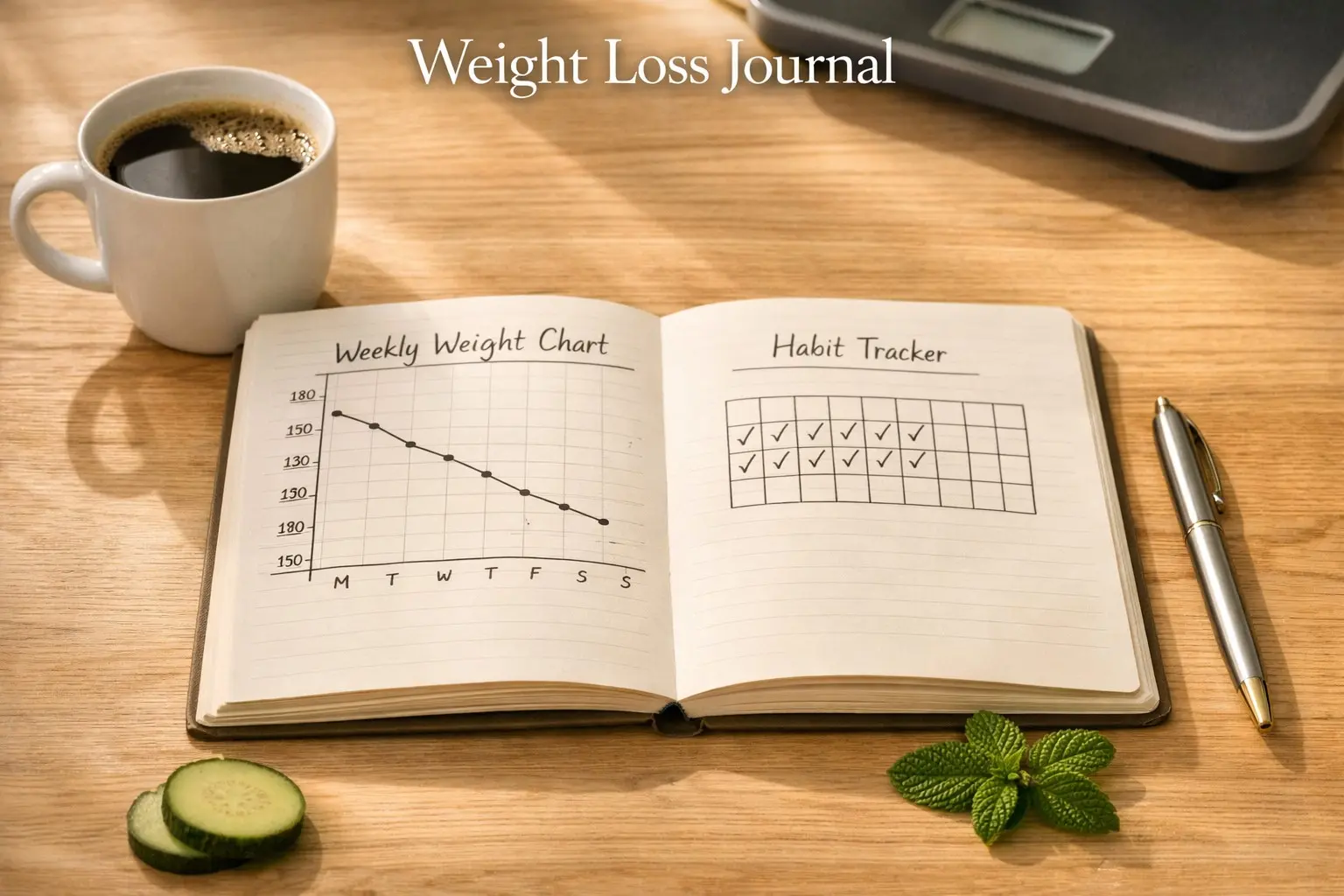
Monthly tracker - A simple grid with days across the top and habits down the side. Tick each habit you complete each day. Habits might include hitting protein targets, walking 7,000 steps, drinking 2.5 litres of water, sleeping 7 hours, and no sugary drinks.
Weekly weight chart- A hand-drawn line graph of your weekly averages. Visual progress is motivating in a way that numbers alone are not.
Habit reflection - A weekly half-page note reviewing what worked, what did not, and one thing to improve.
Monthly progress page - Monthly weight average, waist measurement, and one non-scale victory. A photo taped in. Evidence of progress that accumulates month by month.
The bullet journal weight loss system works because you build it. That investment of time creates ownership. And ownership creates consistency.
Weight Loss Journal Ideas for Different Goals
What should you write if you are a Beginner?
Keep it very simple in the first two weeks. One sentence per section.
"Breakfast: eggs and toast. Hungry before, satisfied after." "Weight: 82.4 kg." "Exercise: 25-minute walk." "Feeling: tired today, ate the biscuits at 3 pm — probably stress." "Win: drank 2.5 litres of water all day."
That is less than 5 minutes of writing. And it produces more weight loss insight than two weeks of guessing.
What Should You Write If You Have Hit a Weight Loss Plateau?
This is where the weight loss diary becomes most valuable.
During a plateau, review the last 4 weeks of entries. Look for patterns: Did weekend food choices consistently differ from weekdays? Did stress or poor sleep reliably precede days of higher calorie intake? Did protein intake drop on certain days? Did exercise sessions become shorter or less intense over time?
The journal provides the data. The data identifies the specific behaviour of creating the stall. And identifying it makes fixing it possible.
For the complete plateau-breaking guide, see our weight loss plateau guide.
What to Track Beyond Food in Your Weight Loss Journal
What Non-Scale Victories Should You Record?
Non-scale victories in your progress journal provide the motivation that scale weight cannot in weeks when the number barely moves.
Record these weekly: Clothes fit better or need a smaller size. Resting heart rate decreases over time. Walking upstairs without getting breathless. More energy in the afternoon than usual. Better quality sleep. Less joint pain. Lower blood pressure reading from the GP. Feeling stronger during exercise. No sugar cravings this week.
Over three months of entries, you build a catalogue of 12 to 15 concrete improvements. That catalogue is more motivating than any number on a scale.
How long should you keep a weight loss journal?
Do you have to journal forever to maintain weight loss?
No. But the data from the National Weight Control Registry suggests something important.
People who successfully maintain significant weight loss long-term do not track every day. But most return to track when their weight begins to drift upward.
The Habit tracker for weight management functions as both an active fat loss tool during the loss phase and as an early warning system during maintenance. You do not need to write in it daily forever. But knowing how to use it and returning to it when needed is a permanent skill that protects your results.
Habits take around six weeks to change, and your diary will help you document your progress. It is universally accepted that people routinely underestimate the amount of food that they eat. The snack at eleven, the chocolate in front of the television — the nibble here and there is all too easy to forget. Mayo Clinic
Bottom Line on Weight Loss Journaling
A personal health and wellness planner is free. It takes 5 to 10 minutes per day. And the research shows it can increase your chance of substantial weight loss by 8% per completed journal period and double total weight loss compared to people who track nothing.
That is one of the highest returns on investment available in all of weight management.
Start tomorrow morning. Write your weight. Write what you had for breakfast. Write how hungry you were. One minute. That is your first entry.
Repeat daily for 6 weeks. By then, it is a habit. And habits change everything.
For more on the daily habits that make weight loss last, read our weight loss habit guide and weight loss tracking guide.
FAQs About Weight Loss Journals
Q: Does keeping a weight loss journal really make you lose more fat?
Yes. A Kaiser Permanente study of 1,685 people found that those who kept a daily food log lost twice as much weight as those who kept none. A 16-week weight loss programme found that the chance of substantial weight loss increased by 8% for those who completed their diaries consistently. The mechanism is that awareness, writing down what you eat, changes what you choose to eat.
Q: What should I write in a weight loss journal?
The most effective combination includes a daily food diary, your morning weight, an exercise log, emotion and energy notes for tracking food and emotion
patterns, weekly non-scale victories, and a brief weekly reflection. Even 5 minutes of daily journaling covering these areas produces significantly better fat loss outcomes than no tracking.
Q: What format is best for a weight loss journal?
Paper notebook, dedicated calorie tracking app, or simple phone notes all work effectively. Research shows the format matters less than consistency. The best Personal health and wellness planner is the one you actually open and write in everyday. A bullet journal weight loss system is an excellent option for people who enjoy a customizable and creative tracking approach.
Q: How long should I keep a weight loss journal? For active fat loss, daily journaling for the full duration of your programme is most effective. During maintenance, most successful long-term weight loss maintainers use their journal periodically and return to daily tracking whenever their weekly weight average begins trending upward. The skill of journaling is permanent, even when the daily practice is not.
Sources and References
- Hollis JF et al. — Weight loss during the intensive intervention phase of the weight-loss maintenance trial — American Journal of Preventive Medicine, 2008 https://pubmed.ncbi.nlm.nih.gov/18617080/
- Diet Whisperer — The Benefits of Keeping a Weight Loss Journal, 2022 https://dietwhisperer.com/blog/2022-04-20-weight-loss-journal
- GoodRx — 10 Weight-Loss Journal Ideas to Track Your Progress, December 2025 https://www.goodrx.com/conditions/weight-loss/weight-loss-journaling-ideas
- Signos — Boost Your Weight Loss Journey with a Bullet Journal, December 2025 https://www.signos.com/blog/weight-loss-bullet-journal
- Burke LE et al. — Self-monitoring in weight loss: systematic review — Journal of the American Dietetic Association, 2011 https://pubmed.ncbi.nlm.nih.gov/21185970/
- gov — Effects of Journaling on Weight Loss: Completed RCT https://clinicaltrials.gov/study/NCT01660685
- CDC — Keeping a food diary https://www.cdc.gov/healthy-weight-growth/
- NHS — Food diary and healthy eating https://www.nhs.uk/live-well/eat-well/
- Mayo Clinic — Weight loss: 6 strategies for success https://www.mayoclinic.org/healthy-lifestyle/weight-loss/in-depth/weight-loss/art-20047752
Last Updated: May 3, 2026 |
Reviewed by: Adel Galal, Health & Wellness Writer


Health & wellness writer with 30+ years of experience in nutrition, fitness, and healthy aging. Founder of NextFitLife.com — evidence-based health guidance.