Last updated: September 10, 2026
Next editorial review: September 2027 or sooner if UK vitamin B12 guidance changes
Written and source-checked by: Adel Galal, Founder and Lead Writer at NextFitLife
Medical review status: This article is educational and source-checked. It has not been medically reviewed by a doctor, registered dietitian, hematologist, gastroenterologist, pharmacist, or other licensed healthcare professional.
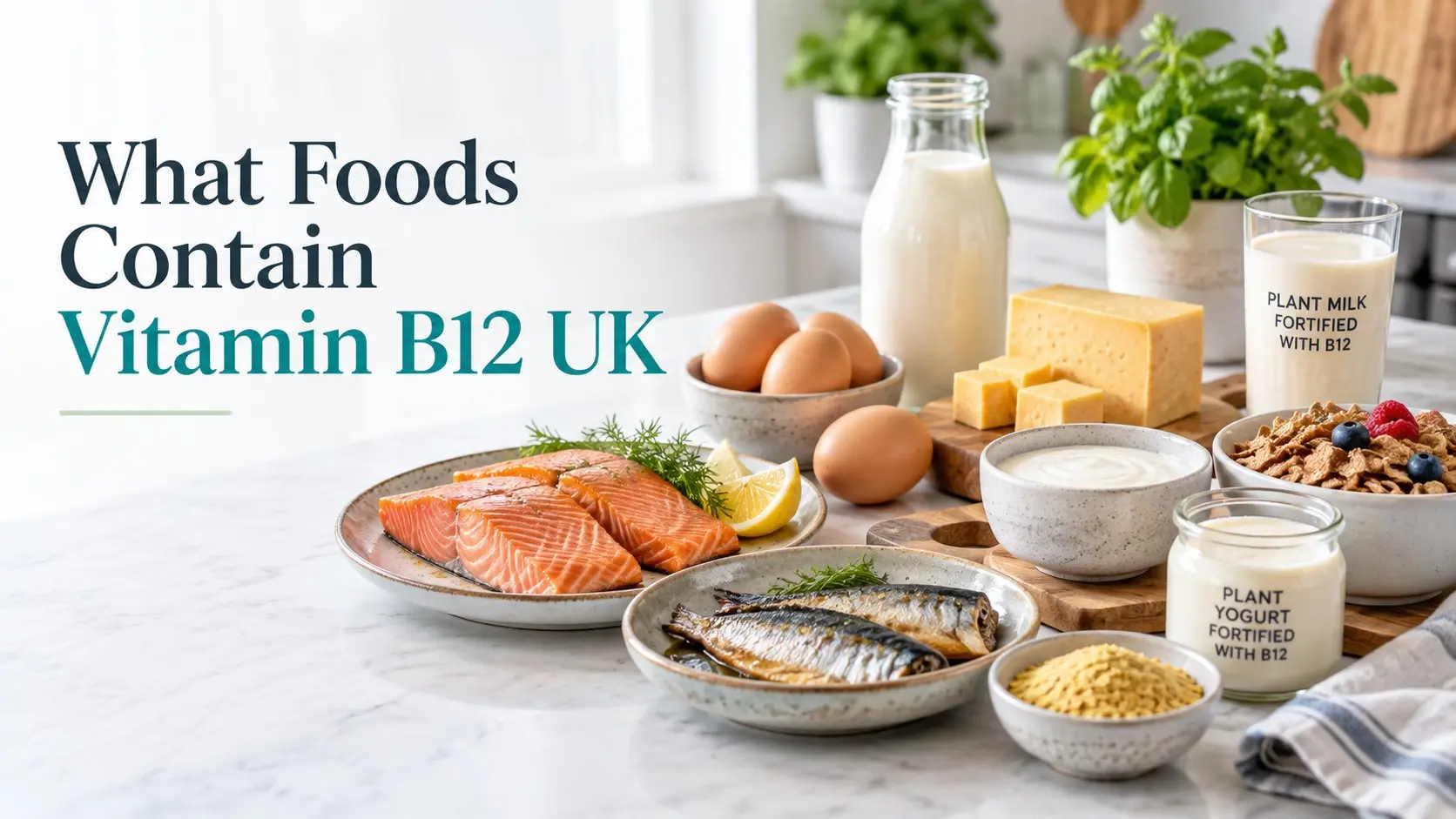
If you are asking what foods contain vitamin B12 UK, start with fish, shellfish, meat, eggs, milk, yogurt, and cheese.
Vegans need a unique plan.
Reliable vegan sources come from foods fortified with vitamin B12 or from supplements.
That difference matters.
Vitamin B12 is not naturally supplied in useful amounts by ordinary fruit, vegetables, or grains.
Quick Answer: What Foods Contain Vitamin B12 in the UK?
The main vitamin B12 foods UK shoppers can use include salmon, sardines, mackerel, trout, tuna, cod, haddock, mussels, beef, lamb, pork, chicken, turkey, eggs, milk, yogurt, and cheese.
For vegans, look for fortified breakfast cereal, fortified plant drinks, fortified plant yogurt, fortified nutritional yeast, and fortified yeast extract.
Always check the label.
Not every vegan product has B12 added.
UK adults need about 1.5 micrograms of vitamin B12 each day.
For a wider B12 guide, see B12 Rich Foods.
Medical and Nutrition Safety Notice
This content is for general educational purposes and does not replace professional medical advice, diagnosis, or treatment. Consult an appropriately qualified healthcare professional for personal medical concerns. This article explains published guidance and does not provide a personal clinical assessment. Always consult qualified medical professionals for diagnosis and treatment of any health condition.
Do not diagnose vitamin B12 deficiency from tiredness alone.
Food can help when low intake is the cause.
Food may not solve a problem with absorption.
Some people need vitamin B12 tablets or injections.
Do not delay medical care if you have numbness, pins and needles, balance problems, severe weakness, memory changes, or other new nerve symptoms.
What is vitamin B12?
Vitamin B12 is also called cobalamin.
Your body needs it to make healthy red blood cells.
It also helps keep your nervous system healthy.
It helps your body use folate.
It is involved in releasing energy from food.
That last point is confusing.
Vitamin B12 is not a stimulant.
It does not work like coffee.
If you are deficient, treating the deficiency can help symptoms such as tiredness.
If your B12 status is already normal, taking extra B12 does not automatically give you extra energy.
How much vitamin B12 do adults need in the UK?
The NHS says adults aged 19 to 64 need about 1.5 micrograms of vitamin B12 per day.
The official UK Dietary Reference Values also set the adult Reference Nutrient Intake at 1.5 micrograms a day from age 15 onward.
This is a UK value.
You may see different numbers on US websites.
Do not mix nutrition targets from different national systems without checking the source.
Does Living in the UK increase your B12 Need?
No.
UK sunshine is not the reason to worry about B12.
That issue belongs mainly to vitamin D.
Vitamin B12 comes from food, fortified foods, supplements, or medical replacement.
Cold weather does not increase your B12 requirement.
30 Best Vitamin B12 Foods and Sources in the UK
1. Beef Liver
Liver is one of the richest natural B12 rich foods.
You do not need it every day.
It is also very high in vitamin A.
Pregnant people should follow NHS advice on liver because high vitamin A intake can be harmful during pregnancy.
2. Beef
Beef provides vitamin B12 along with protein, iron, and zinc.
The British Dietetic Association lists beef as a useful B12 source.
Choose portions that fit the rest of your diet.
3. Lamb
Lamb naturally contains vitamin B12.
It can contribute to B12 intake as part of a mixed diet.
You do not need red meat daily to meet your B12 needs.
4. Chicken
Chicken contains vitamin B12.
It normally provides less than many shellfish, fish, or organ meats.
It still contributes when eaten regularly.
5. Turkey
Turkey can contribute vitamin B12 and protein.
Fresh turkey differs from highly processed deli slices.
Check salt when using packaged products.
6. Salmon
Salmon is one of the most useful everyday foods high in vitamin B12.
It also provides protein and omega-3 fats.
Baked, grilled, or poached salmon can fit a balanced meal.
7. Mackerel
Mackerel is an oily fish.
It provides vitamin B12 and omega-3 fats.
It is widely available fresh, frozen, smoked, and canned in the UK.
Smoked versions can contain more salt.
8. Sardines
Sardines are compact but nutrient-dense.
They provide B12, protein, and Omega-3 fats.
Canned sardines are also easy to keep in the cupboard.
9. Trout
Trout is another strong fish source of vitamin B12.
Serve it with vegetables and potatoes, rice, or another food you enjoy.
10. Tuna
Tuna provides B12 and protein.
Canned tuna makes a quick sandwich, jacket potato topping, or salad.
Pregnant people should follow current NHS fish guidance.
11. Haddock
The NHS lists haddock among fish that can help raise dietary vitamin B12 intake.
Fresh or frozen haddock can fit a normal UK meal.
12. Cod
Cod is another NHS-listed B12 source.
It gives you protein with no need for a high-fat meal.
13. Mussels
Mussels are one of the stronger shellfish options for vitamin B12.
They also provide protein and minerals.
Cook shellfish safely.
14. Clams
Clams naturally contain a lot of vitamin B12.
They are less common in many UK homes than salmon or milk.
That does not make them necessary.
15. Scallops
The NHS includes scallops among useful B12-containing shellfish.
They can contribute protein and B12 in seafood meals.
16. Oysters
Oysters contain vitamin B12.
They are also a source of minerals such as zinc.
Raw shellfish carries food safety risk.
People who are pregnant or at higher infection risk should follow NHS food safety advice.
17. Prawns
Prawns provide some vitamin B12 and a useful amount of protein.
They are easy to add to salads, rice, noodles, or stir-fries.
18. Crab
Crab is another seafood source.
Fresh, frozen, or canned crab can contribute B12.
Check sodium in packaged versions.
19. Cow's Milk
Cow's milk naturally contains vitamin B12.
It does not need to be fortified to count as a source.
This is worth making clear.
Milk also provides protein, calcium, and iodine.
20. Plain Yogurt
Dairy yogurt naturally provides vitamin B12.
It can be used at breakfast or as a snack.
Choose plain yogurt more often if you want to reduce added sugar.
21. Cheese
Cheese can contribute vitamin B12.
Cheddar and other dairy cheeses fit here.
Cheese can also be high in salt and saturated fat.
Use it as part of the meal rather than as the entire meal.
22. Eggs
Eggs are a useful source for people who do not eat meat but do eat eggs.
This makes them helpful in many vegetarian diets.
Two eggs can be combined with dairy or fortified food if you want more B12 in the meal.
23. Fortified Breakfast Cereal
This can be one of the easiest fortified foods with B12.
The British Dietetic Association gives an example of around 0.5 to 1.0 micrograms of B12 in a 30 gram serving of fortified breakfast cereal.
Products vary.
Check the box.
24. Fortified Soya Drink
Unsweetened fortified soya drinks are one of the NHS-listed vegan vitamin B12 sources UK.
The BDA gives an example of around 0.8 micrograms in a 200 ml serving of a fortified plant drink.
Not every carton is fortified.
Read the label.
25. Other fortified plant drinks
Oat, almond, pea, and other plant drinks may have vitamin B12 added.
Some do not.
Brand matters.
Never assume a plant drink contains B12 because another brand does.
26. Fortified Plant Yogurt
Some plant-based yogurt alternatives contain added B12.
The BDA gives an example of about 0.6 micrograms in a 150-gram serving.
Check each product.
27. Fortified Nutritional Yeast
Nutritional yeast can be a useful vegan B12 source when B12 has been added.
Not all nutritional yeast is fortified.
Look for vitamin B12 on the label.
28. Fortified yeast extract
Some yeast extracts provide vitamin B12.
Marmite is a familiar UK example.
The BDA gives an example of about 0.6 micrograms in roughly 4 grams of fortified yeast spread.
Yeast extract is salty, so use normal portions.
29. Fortified Meat Alternatives
Some vegan burgers, sausages, mince, and other meat alternatives have B12 added.
Others do not.
Check the nutrition label.
Also compare protein, salt, and saturated fat.
30. Other Fortified Foods
Some breads, spreads, and soya foods sold in the UK have B12 added.
The NHS lists fortified bread, soya foods, non-dairy alternatives, and spreads as possible sources.
The word fortified matters.
Check before relying on the product.
Best Vitamin B12 Foods UK Chart
| Food Type | Examples | B12 Type | Who It May Suit |
|---|---|---|---|
| Fish | Salmon, mackerel, sardines, trout, tuna, cod, haddock | Naturally occurring | People who eat fish |
| Shellfish | Mussels, clams, scallops, oysters, prawns, crab | Naturally occurring | Seafood eaters |
| Meat | Beef, lamb, pork, chicken, turkey, liver | Naturally occurring | Omnivores |
| Dairy | Milk, yoghurt, cheese | Naturally occurring | Lacto vegetarians and omnivores |
| Eggs | Chicken eggs | Naturally occurring | Many vegetarians |
| Fortified cereal | Check UK label | Added B12 | Vegetarians and vegans |
| Fortified plant drinks | Soya, oat, almond, pea when fortified | Added B12 | Vegans and dairy free diets |
| Fortified plant yogurt | Check UK label | Added B12 | Vegans |
| Fortified nutritional yeast | Check label | Added B12 | Vegans |
| Fortified yeast extract | Some UK yeast spreads | Added B12 | Vegans and vegetarians |
What Is the Easiest Way to Meet the UK B12 Target?
If you eat animal foods, this can be easy.
Include some fish, meat, eggs, milk, yoghurt, or cheese through the week.
You do not need every B12 food every day.
If you are vegan, be more deliberate.
Use reliable fortified foods every day or follow suitable supplement advice.
UK Fortified B12 Foods With Example Servings
The British Dietetic Association gives useful examples for fortified plant foods.
| Fortified Food | Example Serving | Example B12 |
|---|---|---|
| Plant drink | 200 ml glass | About 0.8 mcg |
| Plant yogurt alternative | 150 g | About 0.6 mcg |
| Fortified yeast extract | About 4 g | About 0.6 mcg |
| Fortified breakfast cereal | 30 g bowl | About 0.5 to 1.0 mcg |
These are examples.
Brands change recipes.
Always check the current label.
How Can Vegans Get Enough Vitamin B12 in the UK?
Vegans need reliable B12 planning.
The NHS says vegan sources are limited.
It lists fortified breakfast cereals, fortified soya drinks, fortified yeast extract, and fortified nutritional yeast.
The BDA says the reliable options for vegans are fortified foods and supplements.
This is the key point.
Do not leave B12 to chance.
Should Vegans Take a B12 Supplement?
Many will need one.
The NHS says people who find it hard to get enough B12 from diet, including people following a vegan diet, may need B12 tablets long term.
The British Dietetic Association gives a practical vegan supplement example of around 10 micrograms daily or at least 2 milligrams weekly.
That is general dietetic guidance.
Your personal treatment dose can be very different if you already have a deficiency.
Do not use a prevention dose to treat a diagnosed medical deficiency.
Can Vegetarians Get Enough B12?
Many can.
Eggs, milk, yogurt, and cheese all contain B12.
But intake can still be low if you eat very little dairy or eggs.
Fortified cereal and plant drinks can help.
If your diet is very restricted, speak with a healthcare professional or dietitian.
Do Fruit and Vegetables Contain Vitamin B12?
Ordinary fruit and vegetables are not reliable natural vitamin B12 sources.
That includes:
- Bananas
- Apples
- Oranges
- Berries
- Spinach
- Broccoli
- Carrots
- Potatoes
These foods are healthy.
They simply have different jobs.
Do not remove them.
Just do not count them as your B12 source.
Which Fruit Has the Most Vitamin B12?
No normal fruit is a reliable natural source of vitamin B12.
If a website tells you bananas or apples are rich in B12, check its source.
Fruit provides many useful nutrients.
B12 is not one of its main nutrients.
Do Mushrooms Contain Enough B12?
Do not rely on mushrooms for vitamin B12.
Some unusual products or growing methods may produce small or variable amounts.
That is not the same as a reliable everyday B12 source.
Vegans should use fortified foods or supplements instead.
Can Spirulina Provide Vitamin B12?
I would not rely on it.
Some algae products contain compounds that look similar to vitamin B12.
They are not considered a dependable replacement for fortified food or a proper B12 supplement.
If you are vegan, use a source with a clear B12 amount on the label.
Can Seaweed Replace a B12 Supplement?
Do not build your B12 plan around seaweed.
The amount and biological activity can vary.
Fortified foods and supplements are much easier to measure.
This matters because B12 deficiency can affect nerves.
Does Fermented Food Contain Vitamin B12?
Do not assume fermentation creates reliable B12.
Kimchi, kombucha, sourdough, tempeh, and other fermented foods are not dependable B12 sources unless the product is specifically fortified and labelled.
Use the label.
Do not use folklore as a nutrition measurement.
Is Nutritional Yeast Naturally High in B12?
Not necessarily.
This is a common mistake.
Nutritional yeast is a reliable source only when vitamin B12 has been added.
Look at the nutrition label.
If B12 is not listed, do not count it.
Is Marmite a Good B12 Source?
Fortified yeast extract can contribute B12.
The British Dietetic Association uses yeast spread as one example of a fortified vegan source.
A small portion can contribute to the daily total.
Check the current jar because recipes and nutrient levels can change.
Are Plant Milks Good B12 Sources?
They can be.
Only if they are fortified.
Some soya, oat, almond, and other plant drinks contain added vitamin B12.
Some do not.
Compare labels in the supermarket.
Also look at protein, calcium, iodine, and added sugar if those matter to your diet.
Is Cow's Milk Fortified With B12 in the UK?
Ordinary cow's milk naturally contains vitamin B12.
You do not need to find a B12 fortified cow's milk for it to count.
Fortification is more important when discussing many plant based milk alternatives.
Are Eggs a Strong B12 Source?
Eggs contribute vitamin B12.
They can be useful for vegetarians.
But fish, shellfish, liver, and some other animal foods are more concentrated sources.
Think of eggs as one part of the diet.
Which Fish Contain Vitamin B12?
Useful UK choices include salmon, mackerel, sardines, trout, tuna, haddock, and cod.
The NHS specifically lists salmon, tuna, haddock, and cod as useful sources on its B12 medicine guidance.
Fish also adds protein.
Oily fish adds omega 3 fats.
Which Shellfish Contain Vitamin B12?
Shellfish sources include mussels, clams, scallops, oysters, prawns, and crab.
Mussels and clams are especially well known as concentrated sources.
You do not need shellfish to meet your B12 needs.
Does B12 Give You Energy?
B12 helps your body release energy from food.
That does not make B12 an energy drink.
If low B12 is causing tiredness, treatment can help.
If you already have enough, extra B12 does not automatically make you more energetic.
This supports the LSI phrase vitamin B12 for energy without turning it into a miracle claim.
What Are the Symptoms of Vitamin B12 Deficiency?
Possible vitamin B12 deficiency symptoms include:
- Extreme tiredness
- Weakness
- Shortness of breath
- Headaches
- Pins and needles
- Numbness
- A sore or red tongue
- Mouth ulcers
- Vision problems
- Memory or thinking changes
- Problems with balance or coordination
- Mood or psychological changes
These symptoms have many possible causes.
Do not diagnose yourself from a checklist.
See a GP if symptoms persist.
For mouth symptoms and nutrient causes, see Mouth Ulcers Causes and Warning Signs.
Can You Have B12 Deficiency Without Anaemia?
Yes.
This is important.
NICE says doctors should not rule out vitamin B12 deficiency only because anaemia or enlarged red blood cells are absent.
Nerve symptoms can occur without obvious anaemia.
Why Is Untreated B12 Deficiency Important?
Vitamin B12 deficiency can affect the nervous system.
Some neurological damage can become permanent if deficiency is left untreated for too long.
This is why pins and needles, numbness, balance problems, and cognitive changes deserve proper assessment.
Do not spend months trying different breakfast cereals if you have neurological symptoms.
Who Is at Higher Risk of B12 Deficiency?
NICE and NHS guidance identify several groups.
Risk can be higher if you:
- Follow a vegan diet without reliable fortified foods or supplements
- Eat very few animal foods
- Have autoimmune gastritis
- Have coeliac disease
- Have Crohn's disease or another condition affecting absorption
- Have had stomach surgery
- Have had some bariatric operations
- Have had part of the terminal ileum removed
- Take metformin
- Use proton pump inhibitors
- Use some other medicines that affect B12
- Use recreational nitrous oxide
- Are older and have reduced absorption
Why Are Older Adults at Greater Risk?
Vitamin B12 deficiency becomes more common with age.
NICE estimates that it affects around 5 percent of people aged 65 to 74.
It affects more than 10 percent of people aged 75 and older.
Diet is only one reason.
Absorption can also fall.
Can Metformin Lower Vitamin B12?
Yes.
The UK Medicines and Healthcare products Regulatory Agency says reduced vitamin B12 is a common side effect of metformin.
Risk rises with higher doses, longer use, and existing risk factors.
The MHRA advises checking B12 when symptoms suggest deficiency.
Periodic monitoring should also be considered in people with risk factors.
Do not stop metformin yourself.
Can Acid Reflux Medicines Affect B12?
Some can.
NICE lists proton pump inhibitors and H2 receptor antagonists among medicines linked with B12 deficiency risk.
If you use them long term and develop symptoms, discuss B12 with your GP.
Do not stop a prescribed medicine without advice.
Can Nitrous Oxide Cause Vitamin B12 Deficiency?
Yes.
Recreational nitrous oxide can inactivate vitamin B12 in the body.
This is not simply a low food intake problem.
NICE gives different testing advice when nitrous oxide is the suspected cause.
Tell the healthcare professional if nitrous oxide use is relevant.
That information matters.
Can Eating More B12 Fix Every Deficiency?
No.
This is one of the biggest lessons in this article.
If the problem is low dietary intake, food changes can help.
If the problem is poor absorption, eating more salmon may not be enough.
NHS guidance makes this clear.
Some people need tablets.
Others need injections.
What Is Autoimmune Gastritis?
Autoimmune gastritis damages stomach cells involved in normal B12 absorption.
Older NHS pages often discuss this using the term pernicious anaemia.
Current NICE guidance uses the term autoimmune gastritis for the underlying cause.
NICE recommends lifelong intramuscular B12 replacement when autoimmune gastritis is the cause or suspected cause of the deficiency.
This is why food alone is not always treatment.
What if You Have Had Stomach Surgery?
Some operations can reduce B12 absorption.
This includes total gastrectomy and some bariatric procedures.
NICE recommends lifelong intramuscular B12 replacement after total gastrectomy or complete terminal ileal resection.
Other forms of malabsorption may also require replacement.
Should You Get a B12 Blood Test?
Speak with a GP if you have symptoms plus risk factors.
NICE recommends testing based on symptoms, risk, and clinical judgement.
Initial testing can use total B12 or active B12 in many adults.
The exact test can change in pregnancy or when nitrous oxide is involved.
Do not start high dose B12 just before testing without telling your clinician.
Supplements can affect test results.
Can a Normal Blood Count Rule Out B12 Deficiency?
No.
NICE specifically says not to rule out B12 deficiency just because anemia or macrocytosis is absent.
Symptoms and risk factors still matter.
How Is B12 Deficiency Treated in the UK?
Treatment depends on the cause.
NHS and NICE guidance includes oral B12 and intramuscular injections.
Hydroxocobalamin is commonly used for injections in the UK.
A diet-related deficiency can be managed differently from autoimmune or surgical malabsorption.
Do not copy another person's treatment schedule.
Are B12 Tablets Enough?
Sometimes.
Diet-related deficiency may be treated with oral B12.
Some forms of malabsorption also use high-dose oral replacement in selected cases.
Other people need injections.
The cause decides the plan.
Can You Take Too Much Vitamin B12?
The NHS says there is not enough evidence to define all effects of very high daily supplement doses.
It advises that 2 milligrams or less per day from supplements is unlikely to cause harm.
That is a safety statement.
It is not a target.
Do not take 2 milligrams a day just because it is below that level.
What Is the Best Vitamin B12 Supplement?
The best product depends on why you need it.
For simple dietary prevention, an over-the-counter tablet may be enough.
For diagnosed deficiency, malabsorption, neurological symptoms, or autoimmune gastritis, treatment can be very different.
Follow NHS or clinician advice.
Cyanocobalamin Versus Hydroxocobalamin
Cyanocobalamin is a common form used in oral supplements.
Hydroxocobalamin is the form normally preferred for NHS injections because it stays in the body longer.
Do not choose between them based on social media claims.
Route and dose depend on why treatment is needed.
Do B12 Sprays Work Better Than Tablets?
B12 products are sold as tablets, capsules, sprays, and drops.
A spray being easier to use does not prove it is superior.
If you have a diagnosed deficiency, use the product and dose recommended for the cause.
Can B12 Help Tiredness?
Yes, if B12 deficiency is causing the tiredness.
No, if you assume every tired person needs B12.
Fatigue can come from:
- Iron deficiency
- Sleep problems
- Thyroid disease
- Infection
- Depression
- Diabetes
- Heart or lung problems
- Other nutritional deficiencies
- Many other conditions
Find the cause.
Can B12 Help Brain Fog?
B12 deficiency can affect memory, judgement, and other neurological functions.
Correcting a true deficiency matters.
But brain fog alone does not diagnose B12 deficiency.
If symptoms persist, seek medical assessment.
Can B12 Deficiency Cause Pins and Needles?
Yes.
The NHS lists pins and needles and numbness among possible neurological symptoms.
Do not ignore these symptoms if they persist.
Early treatment matters because some nerve damage can become permanent.
Can B12 Deficiency Cause Mouth Ulcers?
Yes.
NHS guidance lists a sore red tongue and mouth ulcers among symptoms.
But most mouth ulcers are not caused by B12 deficiency.
Do not take a B12 supplement based on one sore alone.
Simple UK B12 Meal Ideas
Breakfast
Eggs with wholemeal toast and a glass of milk.
Or fortified breakfast cereal with a fortified plant drink.
Lunch
Tuna jacket potato with salad.
Or a vegan sandwich with a fortified meat alternative and yeast extract.
Dinner
Salmon with potatoes and vegetables.
Or a vegan meal with tofu and vegetables plus a reliable fortified B12 food.
Snack
Yoghurt.
Or a fortified plant yogurt.
A Simple Vegan B12 Day in the UK
Breakfast could be fortified cereal with fortified soya drink.
Lunch could include yeast extract on toast.
Later, use fortified plant yogurt.
The BDA gives examples showing that several fortified foods can add up to more than the adult UK RNI.
But labels vary.
Build the plan from the products you actually buy.
What Should You Check on a UK Food Label?
Look for:
- Vitamin B12
- The amount per serving
- The percentage of the reference intake when shown
- Serving size
- Whether the product is actually fortified
Then look at the whole product.
B12 is not the only nutrient that matters.
Common Vitamin B12 Mistakes
| Mistake | Better Approach |
|---|---|
| Using a US adult B12 target for a UK article | Use the UK adult figure of about 1.5 mcg a day |
| Thinking UK sunshine affects B12 | Sunlight is mainly relevant to vitamin D |
| Assuming fruit contains B12 | Use animal foods or reliable fortified foods |
| Assuming every plant milk has B12 | Check the label |
| Thinking all nutritional yeast contains B12 | Only rely on fortified products |
| Using seaweed or spirulina as the main vegan B12 source | Use reliable fortified foods or supplements |
| Trying to fix malabsorption with food alone | Find the cause and follow treatment advice |
| Ignoring pins and needles or balance problems | Seek medical assessment |
| Stopping metformin because B12 is low | Discuss monitoring and treatment with the prescriber |
| Taking huge B12 doses for energy | Use supplements for a clear reason |
How I Approach Vitamin B12 Food Advice
I have maintained a personal interest in nutrition, health, fitness, sleep, wellness, and healthy ageing for more than 30 years.
My health and wellness writing and research communication experience spans more than 15 years.
For NextFitLife, I check the national guidance that applies to the reader.
That matters here.
A UK B12 article should use UK recommendations.
I also separate three different questions.
Are you eating enough B12?
Can your body absorb B12?
Do you already have a deficiency that needs treatment?
Those questions do not always have the same answer.
That is why a food list alone is not enough.
Conclusion: Use What Foods Contain Vitamin B12 UK Wisely
What Foods Contain Vitamin B12 UK has a simple food answer.
Fish, shellfish, meat, eggs, milk, yogurt, and cheese provide natural vitamin B12.
Vegans should use reliable fortified foods or supplements.
The UK adult target is about 1.5 micrograms a day.
But food cannot fix every deficiency.
Autoimmune gastritis, stomach or bowel surgery, digestive disease, medicines, and nitrous oxide can change how B12 is absorbed or used.
Your next step is simple: check the B12 sources you eat in a normal week. If you are vegan, check the labels on your fortified foods today. If you have deficiency symptoms or risk factors, ask your GP about testing instead of guessing.
References and Sources
- NHS. B Vitamins and Folic Acid.
UK public guidance explaining what vitamin B12 does, the adult requirement of about 1.5 micrograms a day, and common food sources including meat, fish, milk, cheese, eggs, and fortified cereals.
NHS Vitamin B12 Guidance - NICE. Vitamin B12 Deficiency in Over 16s: Diagnosis and Management NG239.
Current UK clinical guideline covering symptoms, risk factors, testing, autoimmune gastritis, medicines, nitrous oxide, malabsorption, surgery, oral treatment, and injections.
NICE Vitamin B12 Guideline - NHS. The Vegan Diet.
Current UK guidance listing fortified breakfast cereals, fortified soya drinks, yeast extract, and fortified nutritional yeast as vegan B12 sources while noting that supplements may be needed.
NHS Vegan Diet Guidance - British Dietetic Association. Nutritional Considerations for Vitamin B12.
UK dietetic guidance covering the adult 1.5 microgram target, fortified vegan foods, example serving amounts, and practical B12 supplement advice for long term vegan diets.
British Dietetic Association Vitamin B12 Guidance - Medicines and Healthcare products Regulatory Agency. Metformin and Reduced Vitamin B12 Levels.
Official UK drug safety advice explaining that reduced B12 is a common metformin side effect and recommending testing when symptoms occur and monitoring in people with risk factors.
MHRA Metformin and Vitamin B12 Advice
Continue Reading on NextFitLife
- B12 Rich Foods Guide
- Nutrition and Vitamins Hub
- Foods High in Vitamin B6
- Foods High in Folate
- Mouth Ulcers Causes and Warning Signs
- NextFitLife Health Fitness Nutrition and Beauty Guides
About the Author
Frequently Asked Questions About What Foods Contain Vitamin B12 UK
What foods contain vitamin B12 in the UK?
Natural sources include fish, shellfish, meat, eggs, milk, yogurt, and cheese. Vegan sources include foods with added B12 such as fortified breakfast cereals, fortified plant drinks, fortified plant yogurt, fortified yeast extract, and fortified nutritional yeast.
How much vitamin B12 do UK adults need?
The NHS says adults aged 19 to 64 need about 1.5 micrograms of vitamin B12 each day. Official UK Dietary Reference Values also give an adult RNI of 1.5 micrograms daily.
What food is highest in vitamin B12?
Liver and some shellfish are among the most concentrated natural B12 sources. Fish such as salmon, sardines, mackerel, and trout are also useful choices.
Which fish contain vitamin B12?
Useful options include salmon, mackerel, sardines, trout, tuna, haddock, and cod.
Do eggs contain vitamin B12?
Yes. Eggs provide vitamin B12 and can be useful for vegetarians who include eggs in their diet.
Does milk contain vitamin B12 naturally?
Yes. Cow's milk naturally contains vitamin B12. Plant drinks usually provide reliable B12 only when they have been fortified.
Does cheese contain vitamin B12?
Yes. Dairy cheese contains vitamin B12 and can contribute to daily intake, although cheese can also contain substantial salt and saturated fat.
What vegan foods contain vitamin B12 in the UK?
Reliable vegan sources include fortified breakfast cereal, fortified plant drinks, fortified plant yoghurt, fortified nutritional yeast, fortified yeast extract, and other products that clearly list added B12 on the label.
Do vegans need a vitamin B12 supplement?
Many vegans need reliable fortified foods and/or B12 supplements. The NHS says vegan diets have limited natural B12 sources and supplements may be needed.
Does Marmite contain vitamin B12?
Fortified yeast extract can provide vitamin B12. Check the current nutrition label because nutrient formulations can change.
Does nutritional yeast contain vitamin B12?
Only some nutritional yeast provides reliable B12. Choose a product specifically fortified with vitamin B12 and check the amount on the label.
Does oat milk contain vitamin B12?
Some oat drinks are fortified with B12 and some are not. Check the nutrition label rather than assuming all oat milk contains B12.
What fruit contains vitamin B12?
Ordinary fruit does not provide reliable natural vitamin B12. Fruit is nutritious but should not be used as the main source of B12.
Which vegetables contain vitamin B12?
Normal vegetables are not reliable sources of vitamin B12. Vegans should use fortified foods or supplements instead.
Does spirulina contain enough B12?
Spirulina should not be relied on as the main source of active vitamin B12. Use foods or supplements with clearly stated B12 content.
Can I get enough B12 from food?
Many people who eat fish, meat, eggs, or dairy can meet their needs from food. Vegans need reliable fortified sources or supplements. People with absorption problems may need medical treatment even when their diet contains enough B12.
Can vitamin B12 deficiency cause tiredness?
Yes. B12 deficiency can cause tiredness and weakness, but these symptoms have many causes. Persistent fatigue should be assessed rather than treated by guessing.
Can B12 deficiency cause pins and needles?
Yes. Vitamin B12 deficiency can affect the nervous system and cause numbness, tingling, balance problems, and other neurological symptoms.
Can you have B12 deficiency without anemia?
Yes. NICE says vitamin B12 deficiency should not be ruled out simply because anemia or enlarged red blood cells are absent.
Can metformin lower vitamin B12?
Yes. The UK MHRA considers reduced vitamin B12 a common side effect of metformin, especially with higher doses, longer use, or existing risk factors.
Can proton pump inhibitors affect B12?
Yes. NICE lists proton pump inhibitors and H2 receptor antagonists among medicines that can increase the risk of vitamin B12 deficiency.
Can nitrous oxide cause B12 deficiency?
Yes. Recreational nitrous oxide can inactivate vitamin B12 in the body and can cause neurological problems. Tell a healthcare professional if nitrous oxide use is relevant.
Can food correct B12 deficiency caused by poor absorption?
Not always. Conditions such as autoimmune gastritis, some stomach or bowel surgery, coeliac disease, and other causes of malabsorption can require oral replacement or injections.
How is B12 deficiency treated in the UK?
Treatment depends on the cause. UK treatment can include oral cyanocobalamin or intramuscular hydroxocobalamin injections. Some causes require lifelong replacement.
Does vitamin B12 give instant energy?
No. Vitamin B12 supports normal energy metabolism but does not work like a stimulant. Treating a true deficiency can improve tiredness, but extra B12 does not automatically boost energy when B12 status is already adequate.

Health & wellness writer with 30+ years of experience in nutrition, fitness, and healthy aging. Founder of NextFitLife.com — evidence-based health guidance.