Last Updated: January 20, 2026, Published: January 20, 2026
Yoga for beginners doesn’t require perfect flexibility or expensive equipment. Many people avoid starting because they think they’re “not flexible enough” or “too old.” The truth? Yoga meets you exactly where you are. This guide will show you simple, effective ways to begin your practice today—whether you’re 25 or 65, stiff as a board or dealing with aches and pains.
My Journey: From Stiff Desk Worker to Daily Yogi
I’ll be honest. Five years ago, I couldn’t touch my toes without bending my knees. After sitting at a desk for 10 hours daily, my back hurt constantly, and my shoulders felt like concrete.
A friend dragged me to a beginner yoga class. I felt awkward. Everyone seemed so graceful while I wobbled like a newborn deer. But something changed after that first week. My back pain has lessened. I slept better. I wanted to get out of bed in the morning.
That’s why I’m writing this guide. Not as perfect yogi, but as someone who started from zero and discovered how life-changing yoga for beginners can be.
What Exactly Is Yoga? (And What It’s Not)
The Simple Truth
Yoga isn’t just stretching. It’s a practice that connects your body, breath, and mind. Think of it as moving meditation.
Here’s what yoga gives you –
- Stronger, more flexible muscles
- Better balance and coordination
- A calmer mind and less stress
- Improved sleep quality
- Natural pain relief
Why Start Yoga? (Real Benefits I’ve Experienced)
Physical Changes You’ll Notice
After practicing beginner yoga poses for just three weeks, I noticed:
Week 1 –
- Less morning stiffness
- Sleeping through the night
- Standing taller naturally
Week 2 –
- Touching my toes (finally!)
- Fewer tension headaches
- More energy throughout the day
Week 3 –
- Visible muscle tone in arms
- Better posture blindly
- Pain-free back for the first time in years
The Science Behind the Magic
According to a 2020 study published in the International Journal of Yoga, regular yoga practice significantly reduces stress hormones and improves overall well-being.
I’ve seen this firsthand. My doctor commented on my lower blood pressure during my last checkup.
Getting Started: What You Actually Need
Essential Equipment (Keep It Simple)
Must-Have –
- Yoga mat (any $20 mat works successfully)
- Comfortable clothes you can move in
- Water bottle
Nice-to-Have –
- Yoga blocks (or use thick books)
- Strap (or use a belt)
- Cushion for seated poses
My Experience – I started with a $15 mat from a discount store. It worked perfectly for my first six months. Don’t let equipment hold you back from starting yoga at home.
Creating Your Practice Space
You don’t need a fancy studio. I practice in my bedroom, moving my nightstand aside. Here’s what helps –
- Muted area (or use headphones)
- Enough space to lie down and stretch arms
- Lighting (natural light is best)
- Turn off your phone
Breathing: Your Secret Weapon
Why Breath Matters (More Than Poses)
This surprised me most. In yoga basics for beginners, breathing is more important than getting poses perfect.
Related: Yoga Poses for Beginners (2026) – Simple Moves That Work | Expert Guide
Simple Yoga Breathing (Try This Now) –
- Sit comfortably
- Close your eyes
- Breathe slowly through your nose (count to 4)
- Breathe out slowly through your nose (count to 6)
- Repeat 5 times
Notice how you feel calmer? That’s yoga breathing work.
Common Breathing Mistakes
❌ Holding your breath during difficult poses
✅ Keep breathing, even if the pose feels hard
❌ Breathing only into your chest
✅ Breathe deep into your belly
I like this technique because it instantly reduces my anxiety. I now use it before stressful meetings at work.
10 Essential Beginner Yoga Poses (With My Honest Tips)
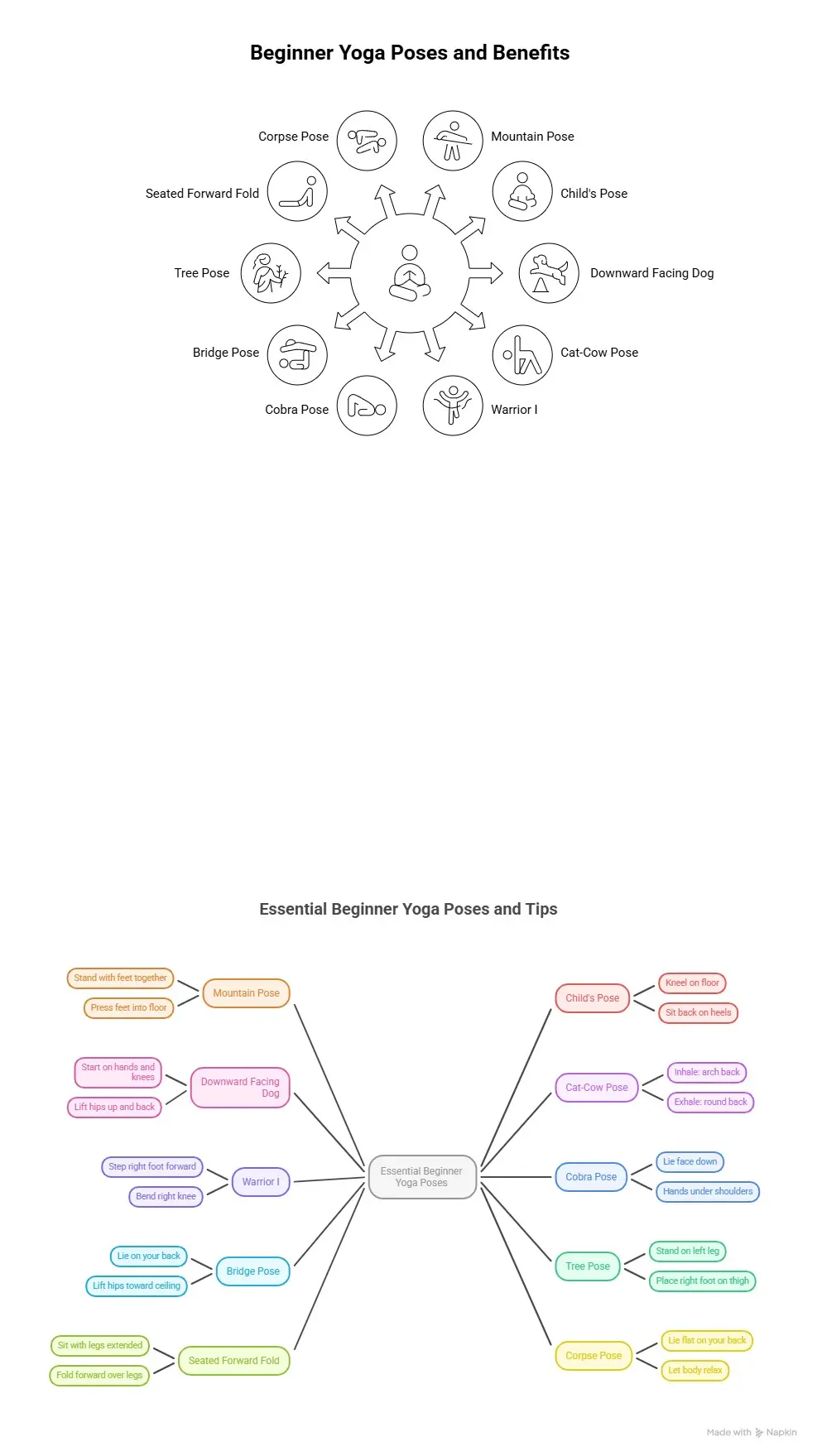
1. Mountain Pose (Tadasana)
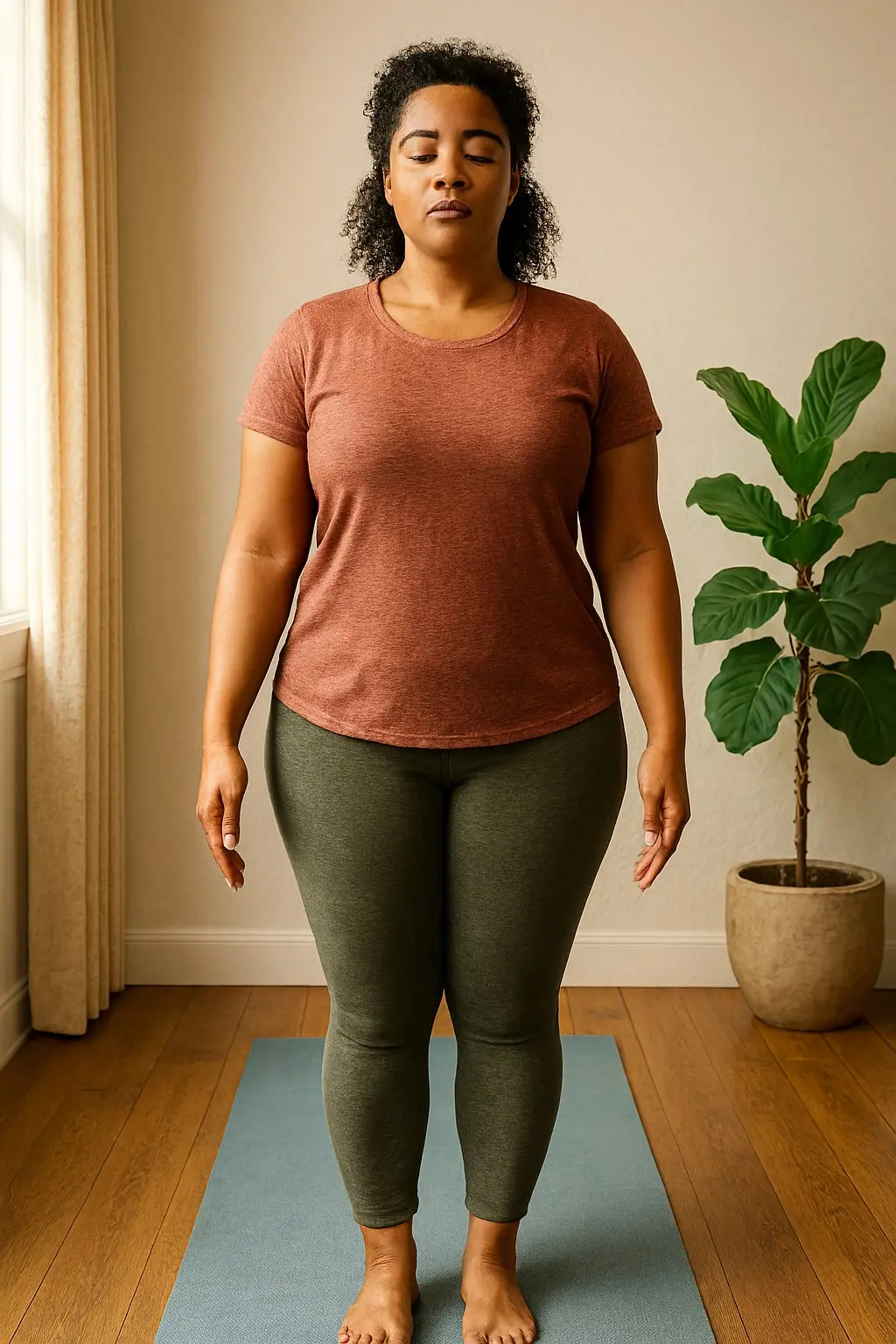
What It Does – Improves posture, builds foundation
How to Do It –
- Stand with feet together
- Press your feet into the floor
- Lift chest, relax shoulders
- Breathe deeply
My Tip – This looks simple, but it activates your whole body. I practice this while waiting for coffee to be brewed.
2. Child’s Pose (Balasana)
What It Does – Relieves back tension, calms the mind
How to Do It –
- Kneel on the floor
- Sit back on heels
- Fold forward, arms extended
- Rest your forehead on the mat
My Tip – This is my favourite resting pose. When a pose feels too hard, I come back here.
3. Downward Facing Dog (Adho Mukha Svanasana)
What It Does – Strengthens arms, stretches legs, energies body
How to Do It –
- Start on hands and knees
- Lift your hips up and back
- From an upside-down V shape
- Press hands into the mat
My Honest Experience – This felt impossible at first. My heels didn’t touch the ground for months. That’s completely normal! Bent knees are fine.
4. Cat-Cow Pose (Marjaryasana-Bitilasana)
What It Does – Warms up the spine, relieves back pain
How to Do It –
- Start on hands and knees
- Inhale: arch back, look up (cow)
- Exhale: round back, tuck chin (cat)
- Repeat 5-10 times
Why I Love This – Perfect for mornings when my back feels stiff.
5. Warrior I (Virabhadrasana I)
What It Does – Builds leg strength, improves balance
How to Do It –
- Step right foot forward
- Bend the right knee over the ankle
- Keep the left leg straight
- Raise arms overhead
My Tip – Don’t worry if you wobble. Everyone does! I still do sometimes.
Quick Reference – Beginner Poses Comparison
| Pose Name | Difficulty | Main Benefit | Time to Hold |
| Mountain Pose | Easy | Posture | 30-60 sec |
| Child’s Pose | Easy | Relaxation | 1-3 min |
| Downward Dog | Medium | Full body | 30-60 sec |
| Cat-Cow | Easy | Back relief | 1 min |
| Warrior I | Medium | Strength | 30 sec each side |
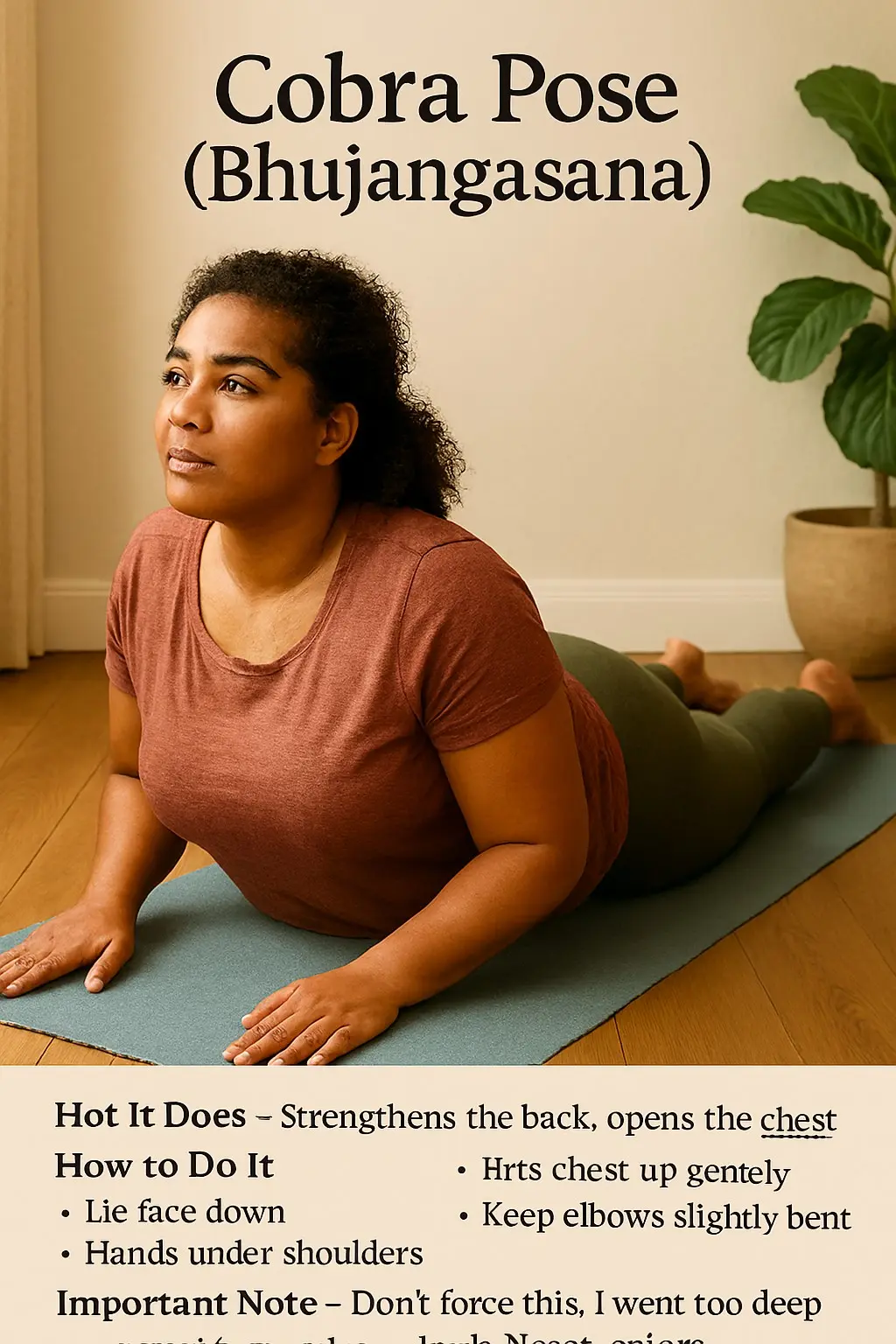
6. Cobra Pose (Bhujangasana)
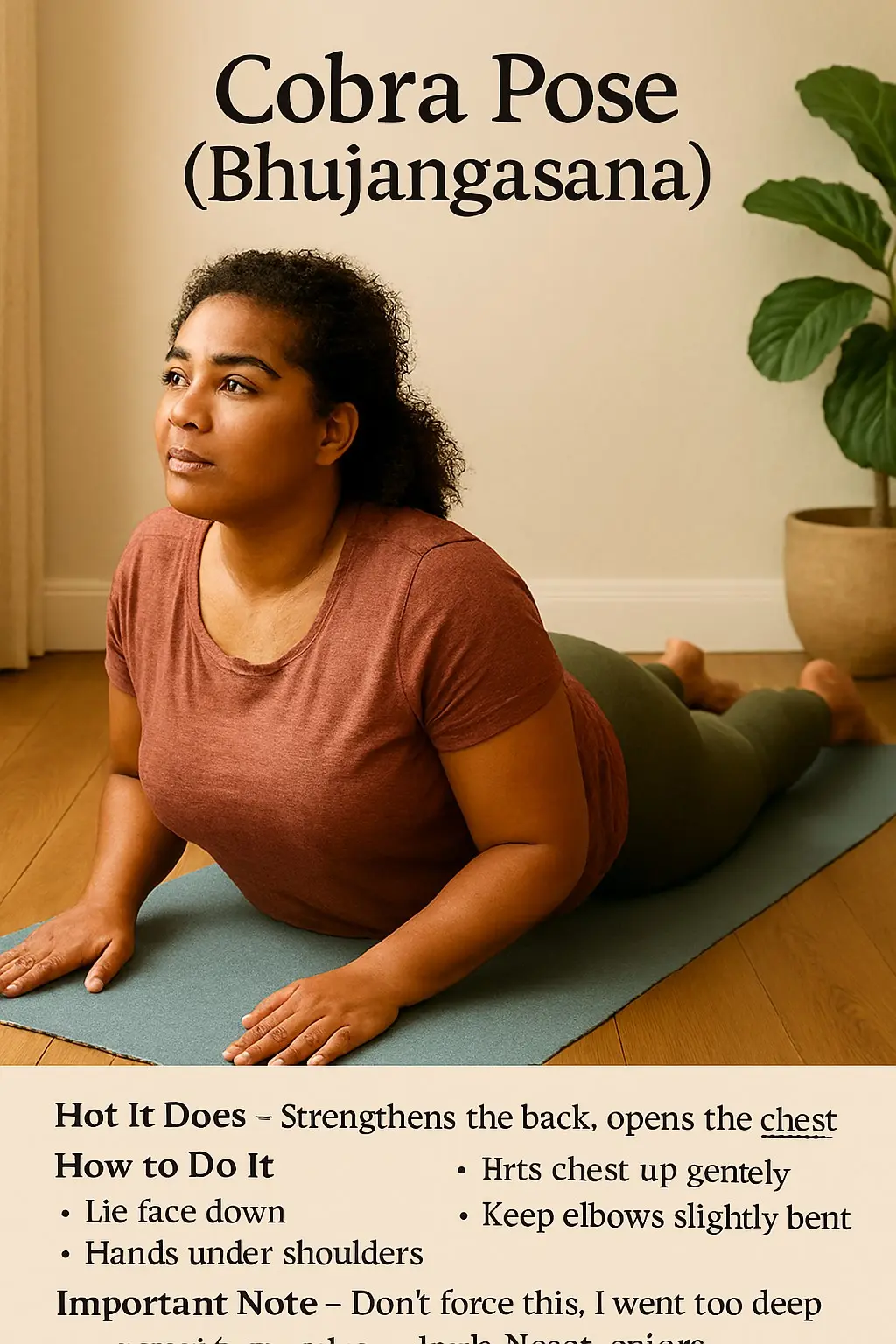
What It Does – Strengthens the back, opens the chest
How to Do It –
- Lie face down
- Hands under shoulders
- Press chest up gently
- Keep elbows slightly bent
Important Note – Don’t force this. I went too deep once and hurt my lower back. Gentle is better.
7. Bridge Pose (Setu Bandha Sarvangasana)
What It Does: – Strengthens glutes, opens chest, calms mind
How to Do It –
- Lie on your back, knees bent
- Feet flat, hip-width apart
- Lift hips toward the ceiling
- Keep your shoulders on the mat
My Experience – This helped my sitting-all-day back pain more than any other pose.
8. Tree Pose (Vrksasana)
What It Does – Improves balance, builds focus
How to Do It –
- Stand on the left leg
- Place right foot on left inner thigh or calf (not knee!)
- Hands in prayer or overhead
- Switch sides
Honest Tip – I fall out of this pose regularly. It’s totally normal! Use a wall for support.
9. Seated Forward Fold (Paschimottanasana)
What It Does – Stretches hamstrings, calms the nervous system
How to Do It –
- Sit with legs extended
- Inhale, lengthen spine
- Exhale, fold forward over legs
- Reach for feet (or shins)
My Learning – Don’t force yourself to touch your toes. I couldn’t for 6 months. Bending knees is perfectly fine.
10. Corpse Pose (Savasana)
What It Does – Deep relaxation, integrates practice
How to Do It –
- Lie flat on your back
- Arms at sides, palms up
- Let the body completely relax
- Stay 5-10 minutes
Why This Matters – I used to skip this, thinking it was “lazy.” Wrong! This is where the magic happens. Your body absorbs all the benefits here.
Your First Week – A Simple Yoga Routine
Day 1-2 – Getting Comfortable
Duration – 10 minutes
- Mountain Pose (1 min)
- Cat-Cow (2 min)
- Child’s Pose (2 min)
- Repeat Cat-Cow (2 min)
- Corpse Pose (3 min)
My Advice – This felt too easy for me at first. But building the habit matters more than intensity.
Day 3-4 – Adding Strength
Duration – 15 minutes
- Mountain Pose (1 min)
- Cat-Cow (2 min)
- Downward Dog (30 sec)
- Child’s Pose (1 min)
- Cobra Pose (30 sec, repeat 3x)
- Bridge Pose (30 sec, repeat 3x)
- Corpse Pose (5 min)
Day 5-7 – Building Flow
Duration – 20 minutes
- Warm-up – Mountain Pose, Cat-Cow (3 min)
- Standing Series – Warrior I both sides (2 min)
- Strength – Downward Dog, Cobra (3 min)
- Balance – Tree Pose both sides (2 min)
- Cool Down – Seated Forward Fold, Child’s Pose (5 min)
- Rest- Corpse Pose (5 min)
Key Takeaway – Consistency beats perfection. I missed days in my first month. That’s okay. What matters is coming back to your mat.
Yoga Styles: Which One Fits You?
Hatha Yoga
Best For – Complete beginners
Pace – Slow and gentle
My Take – Perfect starting point. I began here.
Vinyasa (Flow) Yoga
Best For – People who like movement
Pace – Continuous flow
My Take – Try this after mastering basic yoga poses
Yin Yoga
Best For – Tight muscles, stress relief
Pace – Very slow, long holds
My Take – Amazing for evening practice
Restorative Yoga
Best For Recovery, healing, and deep relaxation
Pace – Extremely gentle
My Take – I use this when I’m exhausted or sick
Common Beginner Mistakes (I Made These)
1. Comparing Yourself to Others
I spent my first class watching others instead of focusing on my body. Big mistake.
Fix – Close your eyes during poses. Focus on how YOU feel.
2. Holding Your Breath
When poses got hard, I’d hold my breath without realizing.
Fix – If you can’t breathe comfortably, ease up on the pose.
3. Pushing Too Hard Too Fast
I tried advanced poses in week two. Pulled a muscle. Learned my lesson.
Fix – Progress slowly. Beginner-friendly yoga means listening to your body.
4. Skipping the Final Relaxation
I used to skip Corpse Pose, thinking it was wasted time.
Fix – Never skip Savasana. It’s where your nervous system integrates everything.
How to Practice at Home vs. Studio
Home Practice Advantages
✅ Practice anytime
✅ No commute
✅ Free (after mat purchase)
✅ Privacy
✅ Go at your own pace
My Home Setup: I practice in my bedroom at 6:30 AM, before my family wakes up. It’s my sacred muted time.
Studio/Class Advantages
✅ Expert guidance
✅ Correction of form
✅ Community support
✅ Structured learning
✅ Motivation to show up
My Recommendation – Start at home using YouTube videos or apps. After 4-6 weeks, try a studio class to check your form.
Overcoming Mental Barriers
“I’m Not Flexible Enough”
This was my biggest fear. Here’s the truth: flexibility is the result of yoga, not a requirement.
I couldn’t touch my toes. My hamstrings were incredibly tight. Six months later, I could rest my palm flat on the floor.
“I’m Too Old/Out of Shape”
I’ve seen 70-year-olds in my classes who are more flexible than me. Age is just a number.
Research shows: A 2019 study in the Journal of Geriatric Physical Therapy found yoga significantly improves strength and balance in seniors.
“People Will Judge Me”
Truth? Everyone in class is focused on their own practice. Nobody’s watching you.
When I started, I wobbled, fell, and couldn’t do half the poses. Not once did anyone comment negatively.
When and How Often to Practice
Best Time of Day
Morning (My Favourite) –
- Body is stiffest (successful for noticing progress)
- Sets a positive tone for the day
- Less likely to skip
Evening –
- More flexible from day-to-day movement
- Help decompress from work
- Better sleep quality
Frequency for Beginners
| Practice Schedule | Results You’ll See |
| 2x per week | Noticeable stress reduction |
| 3-4x per week | Flexibility improvements, better sleep |
| 5-6x per week | Significant strength gains, pain relief |
| Daily | Complete transformation (my experience) |
My journey –I started with 2x per week. After seeing the results, I naturally wanted to practice more.
Yoga and Weight Loss: The Truth
Can I Lose Belly Fat by Doing Yoga?
Yes, but not how you might think. Yoga for flexibility and strength builds lean muscle, which increases metabolism.
My Results –
- Lost 15 pounds in 6 months
- Dropped 2 pant sizes
- Gained visible muscle tone
But here’s the key – I also started eating better because yoga made me more mindful of my body.
Best Yoga for Weight Loss
Power Yoga and Vinyasa Flow burn the most calories. But honestly, consistency matters more than style.
Safety First – When to Stop
Warning Signs
🛑 Sharp pain (different from muscle stretch)
🛑 Dizziness or nausea
🛑 Joint pain
🛑 Can’t breathe normally
If you experience this, stop immediately.
Conditions Requiring Medical Clearance
Consult your healthcare provider before beginning if you experience –
- Recent surgery
- Herniated discs
- Severe osteoporosis
- Uncontrolled high blood pressure
- Pregnancy
Key Takeaways – Your Action Plan
Week 1 – Practice 10 minutes daily using the routine above
Week 2 – Increase to 15-20 minutes
Week 3 – Try different simple yoga sequences
Week 4 – Consider joining a beginner class or continuing home practice
Remember –
✓ Start slow
✓ Breathe always
✓ Listen to your body
✓ Progress is not linear
✓ Consistency beats perfection
Frequently Asked Questions
How Should a Beginner Start Yoga?
Start with 10-minute sessions focusing on basic yoga poses like Mountain, Child’s Pose, and Cat-Cow. Practice 2-3 times per week initially.
I began with a single YouTube video that I repeated for two weeks. Don’t overcomplicate it.
Action Step – Choose one video or routine. Commit to it for 7 days. That’s it.
Which Yoga Is Best for Beginners?
Hatha yoga is ideal for beginners because of its slower pace and focus on individual poses. Gentle yoga practice also works wonderfully.
I started with Hatha and still practice it when I want to slow down and focus on alignment.
Avoid at first: Bikram (hot yoga), Ashtanga (too fast), or Power Yoga (too intense).
Can I Lose Belly Fat By Doing Yoga?
Yes, but combine yoga with healthy eating. Yoga stretches for beginners build lean muscle, boost metabolism, and reduce stress (which causes belly fat).
My belly fat reduced noticeably after 3 months, but I also stopped eating late-night snacks and drank more water.
Realistic Timeline –
- Month 1: Better digestion, less bloating
- Month 2-3: Visible toning
- Month 4+: Measurable fat loss
Can I Learn Yoga By Myself?
Absolutely! I learned beginner yoga at home using online videos. Millions of people do.
However, ✓ Start with beginner-specific videos
✓ Watch yourself in a mirror
✓ Consider one studio class monthly to check form
✓ Listen to your body always
My Experience – I practiced at home for 4 months before attending a class. The teacher corrected my downward dog form, which prevented future injury.
Conclusion: Your Journey Starts Today
Yoga for beginners isn’t about touching your toes or mastering headstands. It’s about showing up for yourself, breathing deeply, and moving with intention.
Five years ago, I couldn’t imagine being someone who practices yoga daily. I was stiff, stressed, and skeptical. Today, yoga is non-negotiable in my life—like brushing my teeth.
You don’t need to be flexible, young, or athletic. The only requirement is your readiness to take the first step.
Your First Step: Roll out a mat (or towel), try the Week 1 routine above, and notice how you feel. That’s it. That’s yoga.
The calm, fit body you want? It’s already inside you. Yoga just helps you find it.
Ready to begin your yoga journey? Start with Day 1 of the routine above, right now. Your future calm, fit self will thank you.
References
Rise and shine with our 12-minute beginners yoga routine
https://www.bupa.co.uk/newsroom/ourviews/rise-and-shine-its-yoga-time/
A Complete Guide to Yoga for Beginners
https://www.goodhousekeeping.com/health/fitness/a42396941/yoga-for-beginners/

Adel Galal is a health and wellness writer with over 30 years of experience studying and writing about health, fitness, nutrition, and healthy living. He is the founder of NextFitLife.com, where he shares practical, evidence-based guidance to support long-term health at any age. Adel’s mission is simple:
to help people make smarter health choices that fit real life, at any age.