Published: Jun 11, 2023
Last updated: July 2026
Reviewed for accuracy: Editorially reviewed and fact-checked against women’s health, hormone health, gynecology, endocrinology, and public-health sources
Reading time: 15–20 minutes
Treatment for high estrogen in Females should be safe.
It should also be based on the cause.
High estrogen is not a simple problem.
It can happen for many reasons.
It may be linked to hormone medicine.
It may be linked with body weight.
It may be linked with perimenopause.
It may be linked with ovarian problems.
It may be linked with liver problems.
It may also be a normal change during parts of the menstrual cycle.
That is why guessing is risky.
You need the right test, the right timing, and the right doctor review.
This guide explains symptoms, causes, tests, safe treatment options, lifestyle steps, red flags, and when to get checked.
For more help, visit our Women’s Health Hub, Medical Tests & Screenings Hub, Nutrition & Vitamins Hub, Weight Management & Metabolism Hub, Liver Health & Detox Hub, and Health Hub.
Medical note: This article is for education only. It does not diagnose or treat high estrogen, abnormal bleeding, fibroids, endometriosis, PCOS, infertility, ovarian cysts, ovarian tumours, adrenal tumours, liver disease, thyroid disease, breast cancer, endometrial cancer, or any hormone condition. Do not start hormone pills, supplements, progesterone, estrogen blockers, or “detox” products without medical care. Get medical help right away for very heavy bleeding, bleeding after menopause, severe pelvic pain, fainting, chest pain, shortness of breath, one-sided leg swelling, or sudden severe headache.
Quick Answer: What Is the Best Treatment for High Estrogen in Females?
The best treatment depends on the cause.
There is no one safe fix for everyone.
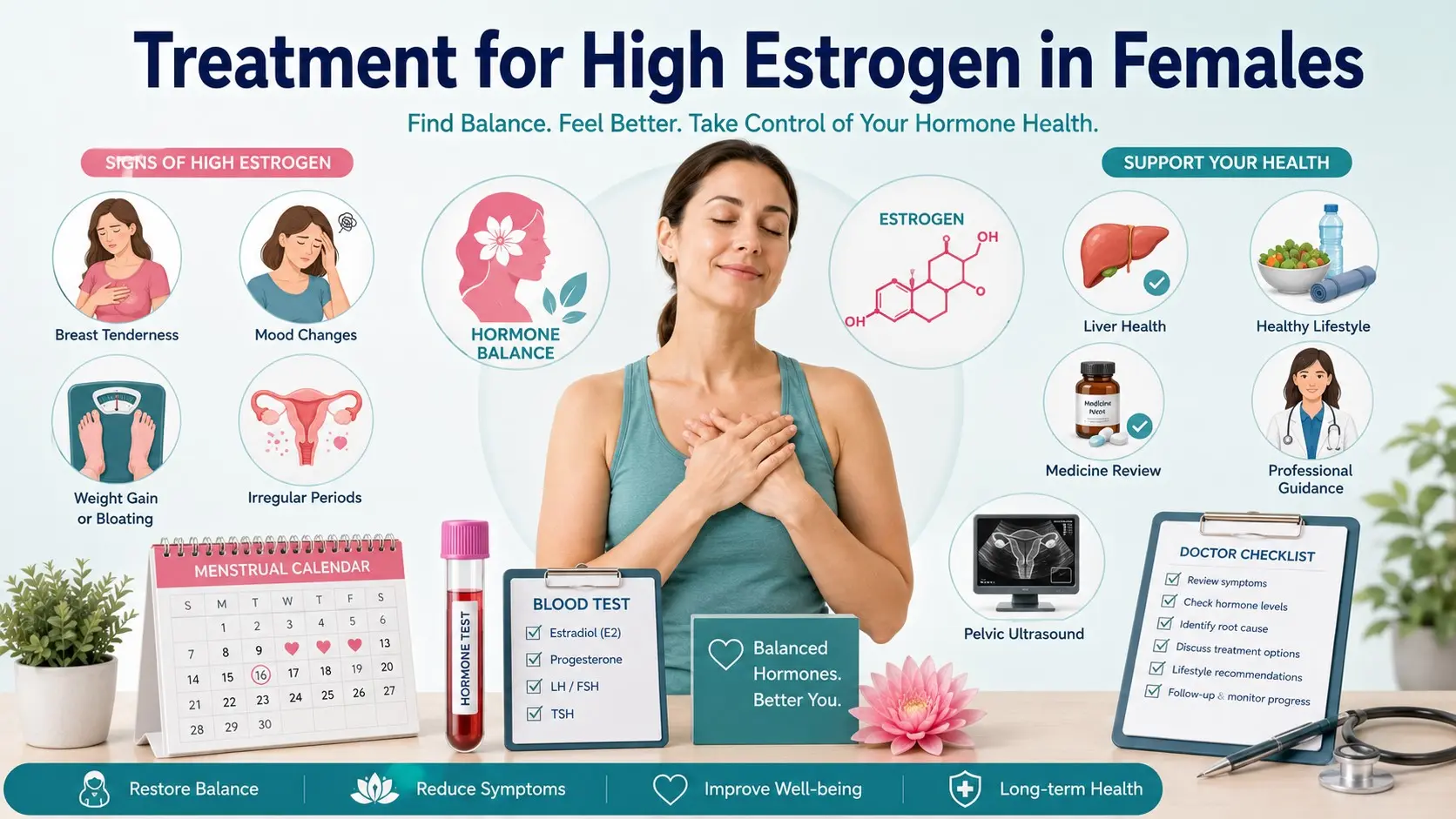
Treatment for High Estrogen in Females may include:
- Repeating hormone tests at the right time
- Reviewing birth control, HRT, or hormone medicine
- Treating abnormal bleeding
- Treating fibroids or endometriosis symptoms
- Checking the thyroid if symptoms fit
- Checking liver health if needed
- Weight management if excess body fat is a factor
- Exercise and balanced food habits
- Reducing alcohol
- Treating ovarian cysts or tumours if present
- Specialist medicines in selected cases
- Surgery only when medically needed
Natural steps may support health.
But they do not replace diagnosis.
Do not try to “block estrogen” on your own.
What Does High Estrogen Mean?
Estrogen is a group of hormones.
It helps control periods, fertility, bones, skin, mood, and many body systems.
In females, estrogen levels change during the month.
They also change during puberty, pregnancy, perimenopause, and menopause.
So one number does not always tell the full story.
High estrogen means your estrogen level is higher than expected for your age, cycle day, pregnancy status, menopause status, or medicine use.
It can also mean estrogen is high compared with progesterone.
This is why a doctor may check more than estrogen alone.
Common Symptoms of High Estrogen in Females
Symptoms can be mild or strong.
They can also overlap with many other conditions.
Possible symptoms include:
- Breast tenderness
- Breast swelling
- Heavy periods
- Light periods
- Irregular periods
- Spotting between periods
- Worse PMS
- Mood swings
- Anxiety
- Low mood
- Fatigue
- Low sex drive
- Bloating
- Headaches
- Weight gain around the hips or waist
- Fibroid symptoms
- Pelvic pressure
- Sleep trouble
These symptoms do not prove high estrogen.
Testing and medical review matter.
Red Flags: When to Get Checked Fast
Do not wait if you have warning signs.
Call a doctor soon if you have:
- Bleeding after menopause
- Bleeding after sex
- Bleeding between periods
- Periods that are much heavier than usual
- Periods lasting more than 7 days
- Pelvic pain that is new or severe
- Rapid belly swelling
- Unexplained weight loss
- A new breast lump
- Bloody nipple discharge
- Severe headaches
- Vision changes
- Symptoms after starting hormone medicine
Get urgent help now for:
- Soaking pads very fast
- Fainting
- Chest pain
- Shortness of breath
- One-sided leg swelling
- Sudden severe headache
- Weakness on one side of the body
Common Causes of High Estrogen in Females
High estrogen can happen for different reasons.
1. Hormone Medicine
Some medicines contain estrogen.
Examples may include:
- Some birth control pills
- Hormone replacement therapy
- Fertility medicine
- Some gender-affirming hormone plans
Do not stop prescribed hormone medicine on your own.
Ask your doctor to review the dose and type.
2. Perimenopause
Perimenopause is the time before menopause.
Hormones can rise and fall.
Periods may become irregular.
Some people have heavy bleeding, breast tenderness, mood changes, sleep issues, and hot flashes.
Perimenopause can feel like “hormone chaos.”
But bleeding changes still need review.
3. Higher Body Fat
Fat tissue can make estrogen.
This can matter more after menopause.
Weight management may help some people.
But this should be done with safe food, movement, sleep, and medical support.
Do not use crash diets.
4. Liver Problems
The liver helps process hormones.
If liver health is poor, hormone balance may be affected.
Your doctor may check liver tests if symptoms or history suggest this.
5. Ovarian Cysts or Tumours
Some ovarian problems may affect hormones.
Most cysts are not cancer.
But new pelvic pain, bloating, abnormal bleeding, or rapid belly swelling should be checked.
6. Adrenal Problems
The adrenal glands make hormone-related substances.
Rare adrenal tumours can affect hormone levels.
This is not common.
But doctors may check it if symptoms and tests point that way.
7. Low Progesterone Pattern
Sometimes estrogen is not very high.
But progesterone is low.
This can make estrogen effects feel stronger.
This can happen with missed ovulation or irregular cycles.
Your doctor may check cycle timing and progesterone.
8. Pregnancy
Estrogen rises in pregnancy.
This can be normal.
Do not interpret pregnancy hormone levels without pregnancy care.
How Doctors Test for High Estrogen
Your doctor may start with your symptoms and cycle history.
They may ask:
- How old are you?
- Are your periods regular?
- What cycle day are you on?
- Could you be pregnant?
- Are you in perimenopause?
- Have you reached menopause?
- Do you use birth control?
- Do you use HRT?
- Do you take supplements?
- Do you have abnormal bleeding?
- Do you have pelvic pain?
- Do you have breast symptoms?
Possible Tests
Tests may include:
- Estradiol blood test
- Estrone test in selected cases
- Progesterone
- FSH
- LH
- Pregnancy test
- Thyroid test
- Prolactin
- Testosterone and androgens if needed
- Liver tests
- Kidney tests
- Blood count if heavy bleeding
- Pelvic ultrasound
- Endometrial biopsy in selected cases
One test may not be enough.
Timing matters.
Treatment Option 1: Confirm the Cause First
This is the most important step.
Do not treat a lab number alone.
Ask:
- Was the test done on the right cycle day?
- Was pregnancy ruled out?
- Could medicine explain it?
- Is bleeding normal or abnormal?
- Are the symptoms from estrogen or another cause?
- Is progesterone low?
- Is thyroid disease involved?
- Is there a pelvic problem?
The safest treatment starts with the right diagnosis.
Treatment Option 2: Review Hormone Medicine
If estrogen is high because of medicine, your doctor may adjust the plan.
They may review:
- Birth control type
- Birth control dose
- HRT dose
- Patch, pill, gel, or ring route
- Progesterone balance
- Side effects
- Bleeding pattern
- Risk factors for blood clots
Never change hormone medicine on your own.
Sudden changes can cause bleeding, symptoms, or pregnancy risk.
Treatment Option 3: Manage Abnormal Bleeding
High estrogen can be linked with heavy or irregular bleeding.
But bleeding can have many causes.
Doctors may treat bleeding with:
- Hormonal medicine
- Non-hormonal medicine
- Iron if anemia is present
- Fibroid treatment
- Polyp removal
- Endometrial evaluation
- Surgery in selected cases
Bleeding after menopause is not normal.
It needs medical review.
Treatment Option 4: Treat Fibroids or Endometriosis Symptoms
Estrogen can worsen symptoms in some estrogen-sensitive conditions.
Examples include fibroids and endometriosis.
Treatment may include:
- Pain control
- Hormonal treatment
- Non-hormonal bleeding treatment
- Iron for anemia
- Imaging
- Procedure options
- Surgery in selected cases
The best plan depends on symptoms, age, fertility goals, and test results.
Treatment Option 5: Weight Management if Needed
Weight is not the only cause.
But excess body fat can affect estrogen levels.
Safe steps may include:
- Walking
- Strength training
- More vegetables
- More protein if appropriate
- Less sugary drinks
- Better sleep
- Stress care
- Medical weight support if needed
Small changes count.
Do not use extreme diets.
For more help, visit our Weight Management & Metabolism Hub.
Treatment Option 6: Support Liver Health Safely
The liver helps process hormones.
Safe liver support is not a detox cleanse.
Helpful steps may include:
- Limit or avoid alcohol
- Ask before using supplements
- Use medicines safely
- Eat balanced meals
- Manage weight if needed
- Get liver tests if your doctor recommends them
- Treat hepatitis or fatty liver if present
Do not use liver detox teas to treat high estrogen.
For safe liver support, read Liver Detox: Safe Tips to Support Liver Health.
Treatment Option 7: Exercise
Exercise may support hormone health, weight, insulin, mood, sleep, and energy.
Start with what feels realistic.
Good choices include:
- Walking
- Light jogging if safe
- Strength training
- Yoga
- Pilates
- Cycling
- Swimming
- Daily movement breaks
If you are new to exercise, start with 10 minutes.
Build slowly.
Treatment Option 8: Food Habits That Support Hormone Health
No food can magically lower estrogen overnight.
But balanced eating can support weight, gut health, blood sugar, and liver health.
Helpful foods may include:
- Vegetables
- Fruit
- Beans
- Lentils
- Whole grains if tolerated
- Nuts
- Seeds
- Fish
- Lean protein
- Olive oil
- High-fiber foods
Try to limit:
- Heavy alcohol use
- Frequent sugary drinks
- Ultra-processed snacks
- Crash diets
- Unproven hormone detox products
For more help, visit our Nutrition & Vitamins Hub.
Treatment Option 9: Medicines That Lower or Block Estrogen
Some medicines can lower estrogen or block estrogen action.
These are not for self-use.
Doctors may use them for specific conditions.
Examples include:
- Aromatase inhibitors in selected cases
- Selective estrogen receptor modulators in selected cases
- GnRH medicines in selected gynecology cases
- Hormone therapy for estrogen-sensitive cancers
These medicines can have side effects.
They may affect bones, fertility, mood, bleeding, joints, and menopause-like symptoms.
Use them only with medical care.
Treatment Option 10: Surgery in Selected Cases
Surgery is not the usual first step for high estrogen.
But it may be needed if there is:
- A suspicious ovarian mass
- A hormone-producing tumor
- Severe fibroids
- Polyps
- Endometrial disease
- Cancer or precancer
- Severe bleeding that does not improve
Your doctor will explain options and risks.
Can You Balance High Estrogen Naturally?
You can support hormone health naturally.
But you should not treat confirmed high estrogen with “natural balancing” alone.
Safe support may include:
- Sleep well
- Move daily
- Eat fibre-rich foods
- Limit alcohol
- Manage stress
- Keep a healthy weight
- Review medicines
- Avoid untested supplements
These steps may help overall health.
They do not replace testing or treatment.
Supplements: Be Careful
Many products claim to fix estrogen.
Be careful with:
- DIM
- Calcium-D-glucarate
- Chasteberry
- Black cohosh
- Red clover
- Soy isoflavones
- Hormone detox pills
- Liver cleanse teas
- Progesterone creams
Some can affect hormones.
Some can interact with medicine.
Some may not be safe during pregnancy.
Some may not be safe with a cancer history.
Ask your doctor first.
What Not to Do
- Do not self-diagnose high estrogen from symptoms alone.
- Do not treat one lab number without a doctor.
- Do not stop birth control or HRT suddenly without advice.
- Do not take estrogen blockers without medical care.
- Do not use detox teas to treat hormone problems.
- Do not ignore bleeding after menopause.
- Do not ignore a new breast lump.
- Do not use progesterone cream without asking a doctor.
- Do not take many supplements at once.
- Do not delay care for severe pelvic pain or heavy bleeding.
Simple 7-Day Safe Hormone Review Plan
This plan does not replace medical care.
It helps you get organized.
Day 1: Write Your Symptoms
Track bleeding, breast pain, mood, sleep, headaches, weight changes, and pelvic pain.
Day 2: Mark Your Cycle
Write the first day of your last period and cycle length.
Day 3: List Medicines
List birth control, HRT, fertility medicine, supplements, herbs, and creams.
Day 4: Check Red Flags
Look for heavy bleeding, bleeding after menopause, severe pelvic pain, or breast changes.
Day 5: Book Care if Needed
Book a doctor visit if symptoms are new, strong, or worrying.
Day 6: Star One Safe Habit
Walk, add vegetables, reduce alcohol, or improve sleep.
Day 7: Prepare Questions
Ask what tests you need and when to do them.
Daily Checklist
- Did I track bleeding today?
- Did I note breast tenderness?
- Did I track mood and sleep?
- Did I take medicine as prescribed?
- Did I avoid unapproved supplements?
- Did I move my body?
- Did I eat fibre-rich foods?
- Did I limit alcohol?
- Did I notice red flags?
- Do I need to call a doctor?
Questions to Ask Your Doctor
- Do my symptoms suggest high estrogen?
- When should I test estradiol?
- Do I need progesterone testing?
- Could my birth control or HRT be causing symptoms?
- Could perimenopause explain this?
- Do I need a thyroid test?
- Do I need a liver test?
- Do I need a pelvic ultrasound?
- Could fibroids or endometriosis be involved?
- Is my bleeding abnormal?
- What treatment is safe for me?
- Are supplements safe with my history?
FAQ
What is the treatment for High Estrogen in Females?
Treatment for High Estrogen in Females depends on the cause. It may include hormone testing, medicine review, treatment of abnormal bleeding, management of fibroids or endometriosis, weight support, lifestyle steps, or specialist care.
What are signs of high estrogen in females?
Potential signs include breast tenderness, heavy or irregular periods, spotting, mood swings, fatigue, bloating, headaches, worse PMS, low sex drive, fibroid symptoms, and weight gain. These signs can also have other causes.
Can high estrogen be treated naturally?
Natural steps may support hormone health, such as exercise, sleep, fibre-rich food, weight management, and limiting alcohol. But confirmed high estrogen should be checked by a doctor, especially with abnormal bleeding.
What causes high estrogen in females?
Potential causes include hormone medicine, perimenopause, higher body fat, pregnancy, liver problems, ovarian cysts or tumours, adrenal problems, and low progesterone patterns.
How do doctors test for high estrogen?
Doctors may use estradiol testing and may also check progesterone, FSH, LH, pregnancy status, thyroid, prolactin, liver tests, blood count, and pelvic ultrasound, depending on symptoms.
Can birth control cause high estrogen symptoms?
Some birth control methods can cause estrogen-like side effects, such as breast tenderness, nausea, mood changes, or bleeding changes. Ask your doctor before stopping or changing birth control.
Can HRT cause high estrogen symptoms?
HRT can cause side effects such as breast tenderness, headaches, nausea, mood changes, or unexpected bleeding. A doctor may adjust the dose, type, or route if needed.
Is high estrogen dangerous?
High estrogen is not always dangerous, but ongoing high estrogen or abnormal bleeding can be linked with health problems. The risk depends on the cause, age, menopause status, and medical history.
When should I worry about high estrogen symptoms?
Get checked for bleeding after menopause, bleeding between periods, bleeding after sex, very heavy bleeding, severe pelvic pain, new breast lump, unexplained weight loss, or symptoms after starting hormone medicine.
Should I take estrogen blockers?
Do not take estrogen blockers without medical care. These medicines are used only for specific conditions and can have important side effects.
Related Reading
- Women’s Health Hub
- Medical Tests & Screenings Hub
- Nutrition & Vitamins Hub
- Weight Management & Metabolism Hub
- Liver Health & Detox Hub
- Healthy Lifestyle Roadmap: 14 Practical Tips for Better Health
- Self-Care Habits: Simple Steps for Better Daily Health
- Liver Detox: Safe Tips to Support Liver Health
- Mental Health Self-Care Tips
- Health Hub
Key Takeaway
Treatment for high estrogen in Females should not be based on guessing.
Estrogen changes during the menstrual cycle, pregnancy, perimenopause, and menopause.
High estrogen symptoms can overlap with many conditions. The safest plan is to confirm the cause.
Then treat the root issue. This may include medicine review, hormone testing, bleeding care, weight support, liver health review, thyroid testing, ultrasound, or specialist treatment.
Get medical help for bleeding after menopause, very heavy bleeding, severe pelvic pain, a new breast lump, or sudden serious symptoms.
Best 5 Trusted Sources
- Cleveland Clinic — High Estrogen: Causes, Symptoms, and Treatment
- MedlinePlus — Estrogen Levels Test
- MedlinePlus Medical Encyclopedia — Estradiol Blood Test
- ACOG — Abnormal Uterine Bleeding
- NHS — Side Effects of Hormone Replacement Therapy

Health & wellness writer with 30+ years of experience in nutrition, fitness, and healthy aging. Founder of NextFitLife.com — evidence-based health guidance.