Published: August 5, 2025
Last updated: July 22, 2026
Next review: July 2027, or earlier if emergency heart-care guidance changes
Written by: Adel Galal, Founder and Lead Writer at NextFitLife
Review status: Written and source checked by Adel Galal. Not medically reviewed by a doctor, cardiologist, emergency physician, pharmacist, paramedic, or registered nurse.
What changed: Rebuilt the page around immediate emergency action, removed the unreliable “six signs one month before” framework, clarified symptoms in women and men, added aspirin and prescribed nitroglycerin safeguards, distinguished heart attack from cardiac arrest, added CPR and AED instructions, strengthened diagnosis and treatment information, and aligned the visible FAQ with its schema.
Reading time: About 18 minutes
It may feel like pressure, squeezing, tightness, fullness, burning, heaviness, or pain.
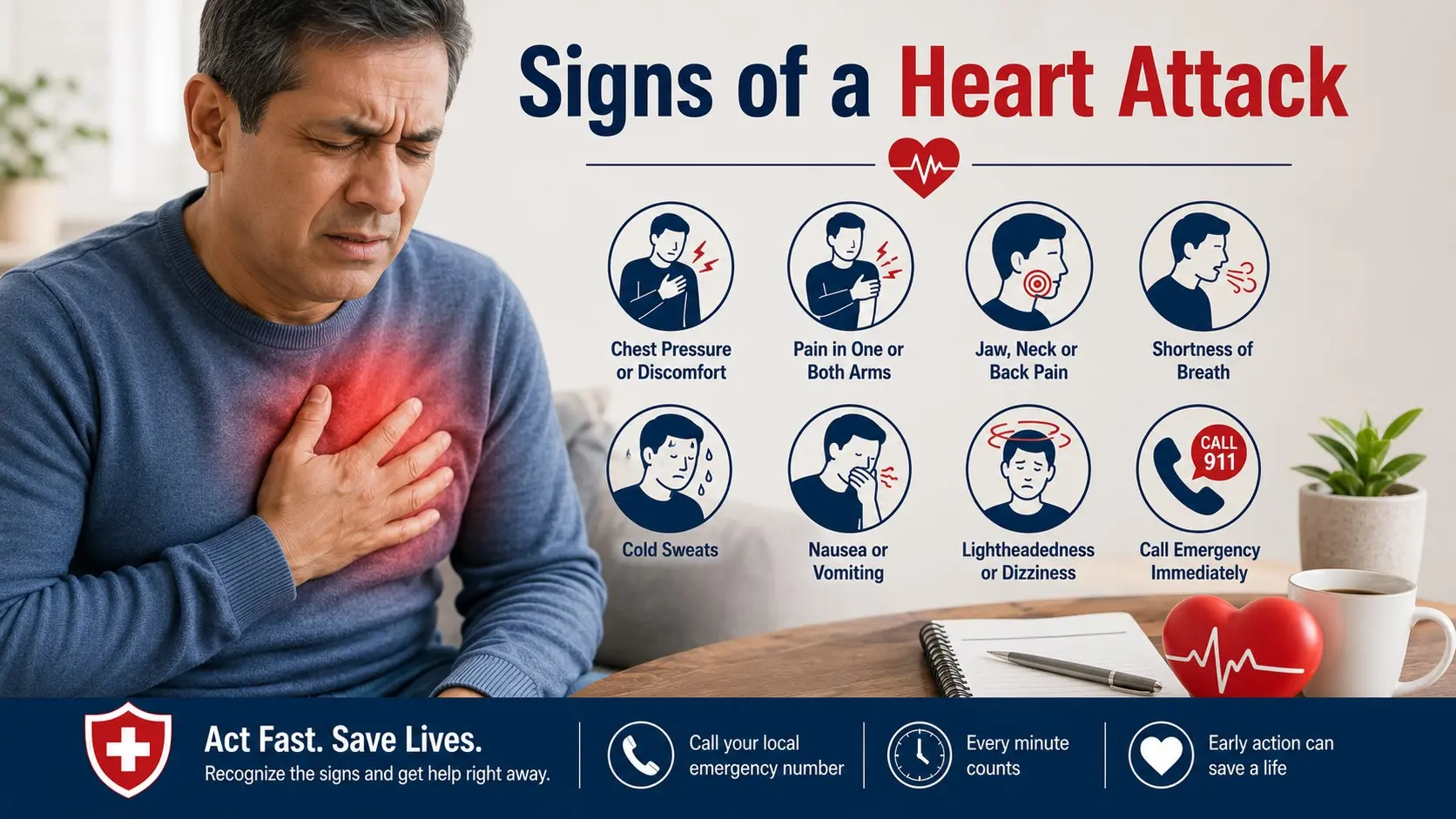
Other warning signs can include shortness of breath, pain in one or both arms, shoulder, back, neck, jaw, or upper stomach, cold sweat, nausea, lightheadedness, and unusual weakness or tiredness.
A person does not need every symptom.
Some heart attacks happen without clear chest pain.
Do not wait for symptoms to become severe or match a perfect pattern.
A heart attack is a medical emergency.
Call your local emergency number immediately when symptoms could be a heart attack.
Do not drive yourself.
Emergency medical teams can begin assessment and treatment on the way to the hospital.
Heart Attack Quick Answer
Call emergency services immediately for:
- Chest pressure, squeezing, fullness, burning, heaviness, or pain
- Pain or discomfort in one or both arms, shoulders, back, neck, jaw, or upper stomach
- Shortness of breath with or without chest discomfort
- Cold sweat
- Nausea or vomiting
- Lightheadedness, fainting, or sudden weakness
- New, unusual tiredness with other concerning symptoms
Do not drive yourself.
Call first before taking aspirin.
Follow the emergency dispatcher’s instructions.
Use prescribed nitroglycerin only as directed for you.
If the person becomes unresponsive and is not breathing normally, call emergency services, begin CPR, and use an AED as soon as one is available.
Review and Emergency Notice
This article was written, and source-checked by Adel Galal.
Adel is a health and wellness writer. He is not a doctor, cardiologist, emergency physician, pharmacist, paramedic, registered nurse, or licensed medical professional.
This page cannot diagnose chest pain, confirm a heart attack, choose medicine, or replace emergency care.
NextFitLife uses display advertising to support the website. Advertising does not determine the emergency instructions, sources, symptoms, treatments, or conclusions on this page.
Read the Editorial Policy, Medical Review Policy, and Corrections Policy.
Critical Emergency Warning
Call your local emergency number now if you think you or another person may be having a heart attack.
Do not:
- Wait for severe pain
- Drive yourself
- Try to sleep it off
- Use antacids to test whether it is heartburn
- Exercise or use “cough CPR”
- Take someone else’s nitroglycerin
- Take aspirin before calling emergency services
- Delay care because the symptoms improved
Symptoms can stop and return.
A heart attack can cause cardiac arrest.
Fast action can reduce heart damage and improve the chance of survival.
What to Do Immediately if You Suspect a Heart Attack
- Call emergency services now. Use the local emergency number for your country.
- Do not drive yourself. An ambulance team can evaluate the heart rhythm, begin treatment, and alert the hospital.
- Stop activity. Sit in a safe position and avoid walking around.
- Tell someone nearby. Unlock the door if you are at home and can do so safely.
- Follow the dispatcher’s instructions.
- Use prescribed nitroglycerin only as directed. Do not use another person’s medicine.
- Ask before taking aspirin. The dispatcher or a health professional may advise it when appropriate.
Aspirin Safety
Call emergency services before taking aspirin.
Do not take aspirin and wait to see whether pain improves.
Aspirin may be unsafe when:
- You have an aspirin allergy
- You have active or serious bleeding
- You have been told not to take aspirin
- The symptoms may be a stroke
- You are unsure which medicine you have
Follow the dispatcher’s instructions.
Do not start daily aspirin for prevention unless a clinician recommends it.
If Symptoms Improve
Do not cancel emergency help because the pain or pressure fades.
Heart attack discomfort can go away and return.
Unstable angina can also improve temporarily and remains an emergency.
Main Signs of a Heart Attack
1. Chest Discomfort
Most heart attacks involve discomfort in the center or left side of the chest.
It may feel like:
- Pressure
- Squeezing
- Tightness
- Fullness
- Heaviness
- Burning
- Pain
The feeling may last more than a few minutes or go away and return.
Mild discomfort can still be serious.
2. Pain or Discomfort Outside the Chest
Heart-related discomfort may occur in:
- One or both arms
- One or both shoulders
- Upper back
- Neck
- Jaw
- Upper stomach
It may happen with or without obvious chest pain.
3. Shortness of Breath
Breathlessness can happen before, during, or without chest discomfort.
Call emergency services when breathing difficulty is new, severe, occurs at rest, or happens with chest pressure, sweating, nausea, weakness, or fainting.
4. Cold Sweat
A sudden cold or clammy sweat can occur with a heart attack.
It is more concerning when combined with chest discomfort, breathlessness, nausea, dizziness, or weakness.
5. Nausea, Vomiting, or Upper Stomach Discomfort
A heart attack can resemble:
- Heartburn
- Indigestion
- Upper abdominal pressure
- Nausea
- Vomiting
- Unusual fullness
Do not assume it is a digestive problem when symptoms are new, severe, or linked with sweating, shortness of breath, chest discomfort, jaw pain, or arm pain.
6. Lightheadedness, Fainting, or Sudden Weakness
Urgent warning signs include:
- Feeling faint
- Actual fainting
- Sudden severe weakness
- Dizziness with chest discomfort
- Dizziness with breathlessness or sweating
7. Unusual Tiredness
Some people feel unusually tired or weak before or during a heart attack.
Fatigue alone has many causes.
It becomes more concerning when it is sudden, extreme, unexplained, or occurs with breathlessness, chest discomfort, nausea, sweating, or reduced ability to perform normal tasks.
8. Palpitations
A racing, pounding, fluttering, or irregular heartbeat can have many causes.
Call for emergency help when palpitations occur with chest pain, shortness of breath, fainting, severe dizziness, sweating, or weakness.
Symptoms Can Be Mild
Do not use pain severity to decide whether the situation is safe.
Older adults, people with diabetes, and some women may have less obvious symptoms.
Heart Attack Symptoms in Women and Men
Chest pain or discomfort is the most common heart attack symptom in both women and men.
No symptom list applies to every person.
Symptoms in Women
Women may have:
- Chest pressure, pain, squeezing, or fullness
- Shortness of breath
- Pain in the arms, shoulder, back, neck, jaw, or upper stomach
- Nausea or vomiting
- Cold sweat
- Lightheadedness
- Unusual tiredness or weakness
- Anxiety or a sense that something is wrong
Women can have a heart attack without obvious chest pain, but chest discomfort remains common.
Do not dismiss symptoms as stress, menopause, reflux, flu, or tiredness without medical assessment.
Symptoms in Men
Men may have:
- Chest pressure or pain
- Arm, shoulder, back, neck, jaw, or stomach discomfort
- Shortness of breath
- Cold sweat
- Nausea
- Lightheadedness
- Weakness
- Palpitations
Men can also have mild, unusual, or no clear chest symptoms.
Age, Diabetes, and Other Factors
Symptoms may be less typical in:
- Older adults
- People with diabetes
- People with chronic kidney disease
- People with nerve damage
- People who have had a previous heart attack
A subtle presentation is still an emergency when a heart attack is possible.
Can Heart Attack Warning Signs Happen Days or Weeks Earlier?
Some people experience symptoms before a heart attack.
Others have no warning.
There is no reliable checklist of “six signs one month before” that predicts a heart attack.
Possible earlier symptoms may include:
- Chest pressure during activity
- Repeated chest discomfort
- New breathlessness
- Reduced exercise ability
- Unusual fatigue
- Pain in the arm, shoulder, back, neck, jaw, or upper stomach
- New indigestion-like discomfort
These symptoms do not prove that a heart attack will occur.
They may indicate angina or another medical problem that needs prompt assessment.
Do not wait days or weeks for a routine appointment when symptoms are new, worsening, occur at rest, or feel like a heart attack.
Call emergency services when symptoms are active or severe.
Stable Angina and Unstable Angina
Angina is discomfort caused by reduced blood flow to the heart muscle.
Stable Angina
A known stable pattern may:
- Occur with physical activity or stress
- Feel similar each time
- Improve with rest or prescribed medicine
Follow the plan provided by the heart-care team.
A change in the pattern needs urgent review.
Unstable Angina
Unstable angina is an emergency.
Warning changes include symptoms that:
- Occur more often
- Last longer
- Feel stronger
- Occur with less activity
- Occur at rest
- Do not improve as expected with rest or prescribed medicine
Unstable angina and heart attack are both forms of acute coronary syndrome.
Call emergency services.
Heart Attack, Heartburn, Panic Attack, and Other Lookalikes
Several conditions can cause chest discomfort.
It is not always possible to identify the cause at home.
Heartburn or Heart Attack?
Both may cause burning, pressure, nausea, or upper abdominal discomfort.
Seek emergency care when discomfort:
- Is new or unusual
- Lasts more than a few minutes
- Goes away and returns
- Occurs with activity
- Comes with shortness of breath
- Comes with sweating, nausea, weakness, or dizziness
- Spreads to the arm, shoulder, back, neck, jaw, or stomach
Do not repeatedly take antacids to test the cause.
Panic Attack or Heart Attack?
Both can cause chest tightness, sweating, breathlessness, dizziness, fear, and a rapid heartbeat.
A panic attack cannot safely be diagnosed from symptoms alone when a heart attack is possible.
Call emergency services for new, severe, or unusual symptoms.
Other Serious Causes
Chest pain can also result from:
- Aortic dissection
- Pulmonary embolism
- Collapsed lung
- Severe pneumonia
- Abnormal heart rhythm
- Inflammation around the heart
Emergency assessment is designed to identify these dangerous causes.
Silent or Subtle Heart Attack
A silent heart attack has mild, unusual, or unnoticed symptoms.
A person may later learn about it through an ECG, imaging, or other medical evaluation.
Possible subtle symptoms include:
- Mild chest discomfort
- Indigestion-like discomfort
- Unusual fatigue
- Shortness of breath
- Jaw or back discomfort
- Lightheadedness
- A general feeling of being unwell
“Silent” does not mean harmless.
Heart muscle can still be damaged.
Seek medical assessment for new symptoms, especially with diabetes, kidney disease, known coronary disease, or multiple risk factors.
Heart Attack Versus Cardiac Arrest
A heart attack is mainly a blood-flow problem.
Blood flow to part of the heart becomes blocked.
Cardiac arrest is an electrical emergency in which the heart suddenly stops pumping effectively.
A heart attack can trigger cardiac arrest.
Signs of Cardiac Arrest
The person:
- Suddenly collapses
- Is unresponsive
- Is not breathing normally or is only gasping
What to Do
- Call emergency services or send someone to call.
- Begin CPR immediately.
- For an adult or teenager who suddenly collapses, an untrained bystander can use Hands-Only CPR.
- Push hard and fast in the center of the chest.
- Use an AED as soon as it is available.
- Follow the AED voice prompts and continue CPR until help takes over.
CPR and early defibrillation can save a life.
Do not use “cough CPR.”
What Causes a Heart Attack?
A heart attack occurs when blood flow to heart muscle is blocked long enough to cause injury.
The most common cause is coronary artery disease.
Plaque can build inside a coronary artery.
If plaque ruptures, a blood clot may form and block blood flow.
Less common causes include:
- Coronary artery spasm
- Spontaneous coronary artery dissection
- A clot traveling to a coronary artery
- Severe mismatch between oxygen supply and demand
Risk Factors
Risk can rise with:
- Smoking or tobacco exposure
- High blood pressure
- High LDL cholesterol
- Diabetes
- Chronic kidney disease
- Low physical activity
- Sleep apnea
- Age
- Family history
- Inherited cholesterol disorders
- Previous coronary disease or heart attack
- Some pregnancy-related conditions
- Heavy alcohol or stimulant use
A person without known risk factors can still have a heart attack.
Do not use a low-risk profile to dismiss symptoms.
How Doctors Diagnose a Heart Attack
Emergency teams use the symptoms, medical history, examination, and tests.
Electrocardiogram
An ECG or EKG records the heart’s electrical activity.
It is usually one of the first tests.
One normal ECG does not always exclude a heart attack.
Repeat testing may be needed.
Troponin Blood Tests
Troponin is released when heart muscle is injured.
Blood tests may be repeated because the level can change over time.
Other Tests
Depending on the situation, testing may include:
- Blood pressure and oxygen measurement
- Chest X-ray
- Echocardiogram
- Coronary angiography
- CT imaging
- Other blood tests
Stress testing is not used to delay emergency assessment during active suspected heart attack symptoms.
How a Heart Attack Is Treated
Treatment depends on the heart attack type, timing, anatomy, symptoms, bleeding risk, and other health conditions.
The goal is to restore blood flow and limit heart damage.
Treatment may include:
- Antiplatelet medicine
- Anticoagulant medicine
- Medicine for pain or blood flow
- Emergency coronary angiography
- Balloon angioplasty and stent placement
- Clot-dissolving medicine in selected situations
- Coronary bypass surgery in some cases
- Treatment for dangerous heart rhythms
Oxygen is used when clinically needed, not automatically for every person.
Do not copy another patient’s treatment or stop heart medicine without medical advice.
Recovery and Cardiac Rehabilitation
Recovery depends on how much heart muscle was affected, treatment speed, heart function, other medical conditions, and complications.
Cardiac rehabilitation is a medically supervised program for eligible patients after heart attack, angioplasty, stent placement, or heart surgery.
It can include:
- Supervised exercise
- Medicine education
- Nutrition guidance
- Smoking cessation support
- Stress and mental-health support
- Blood pressure, cholesterol, and diabetes management
Ask for a cardiac rehabilitation referral before or after hospital discharge.
Seek urgent help for recurrent chest discomfort, worsening breathlessness, fainting, or other emergency symptoms after a heart attack.
How to Lower the Risk of a Future Heart Attack
No plan prevents every heart attack.
Risk reduction may include:
- Do not smoke or vape.
- Control blood pressure.
- Manage LDL cholesterol and triglycerides.
- Manage diabetes.
- Take prescribed medicine consistently.
- Attend cardiac rehabilitation when eligible.
- Be physically active according to medical guidance.
- Use a heart-healthy eating pattern.
- Sleep enough.
- Diagnose and treat sleep apnea.
- Limit or avoid alcohol.
- Attend regular follow-up.
Daily Aspirin Is Not for Everyone
Do not start daily aspirin on your own.
It can cause serious bleeding.
A clinician should weigh cardiovascular benefit against bleeding risk.
Know Your Personal Emergency Plan
Ask the heart-care team:
- Which symptoms require emergency help?
- How should prescribed nitroglycerin be used?
- Should aspirin ever be used during symptoms?
- Which emergency number should be called?
- Where is the nearest AED at home, work, or community locations?
Common Heart Attack Myths
Myth: A Heart Attack Always Causes Crushing Chest Pain
No. Symptoms can be mild, gradual, or occur without obvious chest pain.
Myth: Women Usually Do Not Have Chest Pain
No. Chest discomfort is the most common symptom in women and men, although other symptoms may be prominent.
Myth: Six Symptoms Always Appear One Month Before
No. Some people have earlier symptoms and others have none. There is no reliable one-month checklist.
Myth: If Pain Improves, the Danger Has Passed
No. Heart attack or unstable angina symptoms can stop and return.
Myth: Aspirin Should Be Taken Before Calling
No. Call emergency services first and follow professional instructions.
Myth: You Should Drive to the Hospital
No. An ambulance can begin care and prepare the hospital.
Myth: Coughing Can Stop a Heart Attack
No. “Cough CPR” is not recommended for the public.
Myth: A Young or Fit Person Cannot Have a Heart Attack
No. Age and fitness affect risk but do not make symptoms safe to ignore.
Conclusion
The signs of a heart attack can include chest pressure or pain, discomfort in the arms, shoulders, back, neck, jaw, or upper stomach, shortness of breath, cold sweat, nausea, lightheadedness, fainting, and unusual weakness or tiredness.
Chest discomfort is the most common symptom in both women and men.
A person does not need every sign.
There is no reliable list of symptoms that always appears one month before a heart attack.
Call emergency services immediately when a heart attack is possible.
Do not drive yourself.
Call before taking aspirin.
If the person becomes unresponsive and is not breathing normally, begin CPR and use an AED.
When symptoms feel new, serious, or unusual, emergency assessment is safer than waiting or guessing.
References and Sources
- American Heart Association. Warning Signs of a Heart Attack. Current symptom and emergency-response guidance.
- American Heart Association. Heart Attack Symptoms in Women. Guidance confirming that chest discomfort is common in women and describing other symptoms.
- Centers for Disease Control and Prevention. About Heart Attack Symptoms, Risk, and Recovery. Public-health guidance about symptoms, causes, risk, and recovery.
- National Heart, Lung, and Blood Institute. Heart Attack Symptoms. Official information about chest discomfort, breathlessness, sweating, fatigue, and upper-body symptoms.
- American Heart Association. Aspirin and Heart Disease. Guidance to call emergency services before aspirin and not delay care.
- National Heart, Lung, and Blood Institute. Living With Angina. Guidance about changing angina patterns and unstable angina.
- American Heart Association. Heart Attack and Sudden Cardiac Arrest Differences. Information about heart attack, cardiac arrest, CPR, and AED use.
- American Heart Association. What Is CPR? Guidance about Hands-Only CPR for a teen or adult who suddenly collapses.
- American Heart Association. Diagnosing a Heart Attack. Information about blood tests, imaging, and diagnostic decisions.
- National Heart, Lung, and Blood Institute. Heart Attack Diagnosis. Official guidance about rapid ECG testing and hospital evaluation.
- American Heart Association. Heart Attack Treatment. Current overview of medicines, angioplasty, stenting, and surgery.
- American Heart Association. What Is Cardiac Rehabilitation? Information about medically supervised recovery and risk reduction.
- American Heart Association. Heartburn or Heart Attack? Guidance about symptom overlap and urgent medical assessment.
- American Heart Association. What Is a Heart Attack? Information about blocked blood flow and the distinction from cardiac arrest.
Continue Reading on NextFitLife
- Heart and Cardiovascular Health Hub
- Health Hub
- Medical Tests and Screenings Hub
- How to Lower Blood Pressure Safely
- What Causes High Blood Pressure
- High Cholesterol: Symptoms, Causes, and Treatment
- Congestive Heart Failure Guide
- Heart Failure Symptoms
- Kidney Disease Symptoms
- Healthy Lifestyle Roadmap
Frequently Asked Questions
What are the first signs of a heart attack?
Possible first signs include chest pressure or pain, shortness of breath, arm, shoulder, back, neck, jaw, or upper-stomach discomfort, cold sweat, nausea, lightheadedness, and unusual weakness or tiredness.
Can a heart attack happen without chest pain?
Yes. Some people have breathlessness, nausea, sweating, fatigue, dizziness, or upper-body discomfort without clear chest pain.
Are there six signs of a heart attack one month before?
No reliable six-sign or one-month checklist exists. Some people have earlier angina-like symptoms, while others have no warning.
What does heart attack chest discomfort feel like?
It may feel like pressure, squeezing, tightness, fullness, heaviness, burning, or pain in the center or left side of the chest. It may last or go away and return.
What are heart attack symptoms in women?
Chest discomfort is the most common symptom. Women may also have shortness of breath, nausea, back, shoulder, arm, jaw, or stomach discomfort, cold sweat, lightheadedness, or unusual tiredness.
What should I do if I think I am having a heart attack?
Call the local emergency number immediately. Do not drive yourself. Stop activity, follow dispatcher instructions, and call before taking aspirin.
Should I take aspirin during possible heart attack symptoms?
Call emergency services first. Take aspirin only when the dispatcher or a qualified health professional says it is appropriate for you.
Can indigestion feel like a heart attack?
Yes. Heart attack discomfort can resemble heartburn or indigestion. Seek emergency care when symptoms are new, unusual, or occur with breathlessness, sweating, nausea, weakness, or spreading pain.
What should I do if the person becomes unresponsive?
Call emergency services, begin CPR when the person is not breathing normally, and use an AED as soon as one is available.
How is a heart attack diagnosed?
Diagnosis may use an ECG, repeated troponin blood tests, examination, echocardiography, coronary angiography, and other imaging or laboratory tests.
Can a heart attack be prevented?
Not every heart attack is preventable, but controlling blood pressure, cholesterol, diabetes, tobacco exposure, activity, sleep, medicine use, and other risks can reduce the chance.
Is this article medically reviewed?
No. It was written and source checked using authoritative references, but it has not been medically reviewed by a doctor or cardiologist.
Heart Attack and Emergency Medical Disclaimer
All content on NextFitLife is for educational and informational purposes only.
It does not replace emergency assessment, diagnosis, ECG testing, blood tests, prescription medicine, cardiac procedures, or advice from a qualified health care professional.
Call your local emergency number immediately when a heart attack is possible.
Do not drive yourself.
Call before taking aspirin.
If a person is unresponsive and not breathing normally, begin CPR and use an AED as soon as possible.

Health & wellness writer with 30+ years of experience in nutrition, fitness, and healthy aging. Founder of NextFitLife.com — evidence-based health guidance.