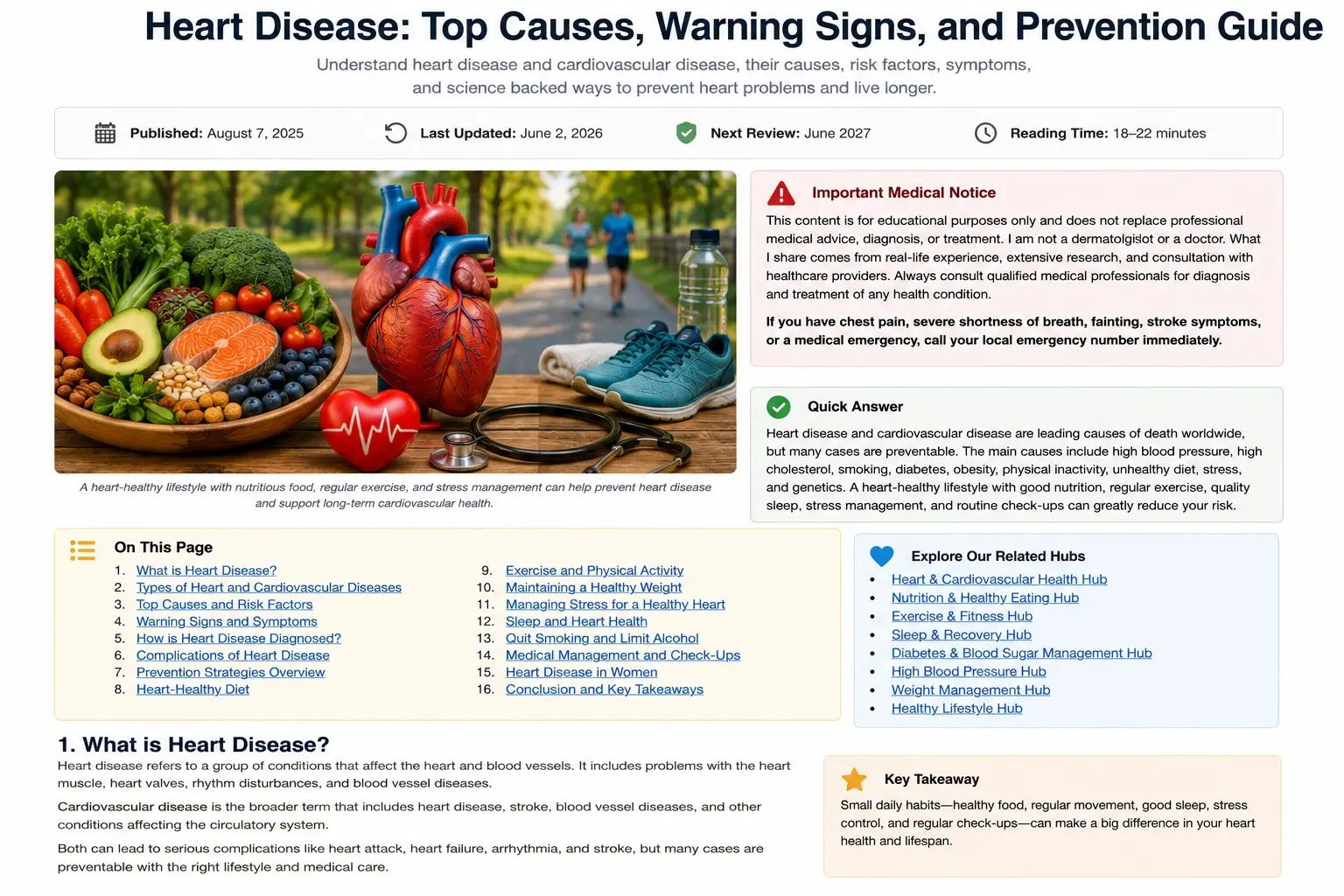
Published: August 7, 2025
Last updated: August 12, 2026
Next review: August 2027, or sooner if major heart health guidance changes
Written by: Adel Galal, Founder and Lead Writer at NextFitLife
Review status: Written and source checked against current WHO, CDC, and American Heart Association guidance. This article has not been medically reviewed by a cardiologist or doctor.
Reading time: About 22 minutes
Heart disease is not one illness.
It is a group of conditions that affect the heart.
Some affect the arteries that feed the heart.
Others affect the heart muscle, valves, rhythm, or structure.
The wider term cardiovascular disease includes diseases of the heart and blood vessels.
That means cardiovascular disease can also include stroke and disease of arteries outside the heart.
This difference matters.
Heart disease is part of cardiovascular disease, but the two terms are not always exactly the same.
Heart disease can be serious.
But many important risk factors can be changed or treated.
Blood pressure can be managed.
High cholesterol can be treated.
Smoking can be stopped.
Diabetes can be managed.
Food, movement, sleep, and preventive care also matter.
This updated guide explains heart disease causes, symptoms, major cardiovascular risk factors, diagnosis, treatment, and the best supported steps for heart disease prevention.
For the wider topic, visit our Complete Heart Health Guide or browse the Heart and Cardiovascular Health Hub.
Medical Notice
This content is for general educational purposes and does not replace professional medical advice, diagnosis, or treatment. Consult an appropriately qualified healthcare professional for personal medical concerns. What I share comes from actual life experience, extensive research, and consultation with healthcare providers. Always consult qualified medical professionals for diagnosis and treatment of any health condition.
Heart disease can cause medical emergencies.
Call emergency services for new chest pressure, severe shortness of breath, fainting, sudden weakness, new trouble speaking, or other severe symptoms that may signal a heart attack or stroke.
Quick Answer: What Causes Heart Disease?
There is no single cause of all heart disease.
The most common form, coronary artery disease, often develops when plaque builds inside the arteries that supply the heart.
This process is called atherosclerosis.
Important risk factors include:
- High blood pressure
- High LDL cholesterol
- Smoking and tobacco exposure
- Diabetes
- Low physical activity
- An unhealthy eating pattern
- Excess body fat in some people
- Kidney disease
- Age
- Family history
- Some inherited conditions
Some heart diseases have different causes.
Valve disease, rhythm problems, congenital heart disease, infections, and diseases of the heart muscle may need very different treatment.
What Is Heart Disease?
Heart disease is a broad name for conditions that affect the heart.
The heart is a muscle.
It pumps blood around your body.
It also has arteries, valves, an electrical system, and several chambers.
A problem in any of these areas can cause heart disease.
Examples include:
- Coronary artery disease
- Heart failure
- Arrhythmias
- Heart valve disease
- Cardiomyopathy
- Congenital heart disease
- Inflammatory or infectious heart disease
These conditions are different.
They do not have one shared symptom list or one treatment.
Heart Disease Compared With Cardiovascular Disease
The terms are often used together.
But they are not always identical.
| Term | What It Usually Means |
|---|---|
| Heart disease | Conditions that mainly affect the heart, such as coronary artery disease, heart failure, arrhythmias, valve disease, and cardiomyopathy |
| Cardiovascular disease | A wider group of diseases affecting the heart and blood vessels, including heart disease, stroke, and some artery diseases |
| Coronary heart disease | Disease of the arteries that supply blood to the heart muscle |
| Atherosclerotic cardiovascular disease | Disease caused by plaque in arteries, including many heart attacks, strokes, and peripheral artery disease |
This page focuses on heart disease while also explaining the wider cardiovascular risks that affect the same arteries and organs.
Main Types of Heart Disease
1. Coronary Artery Disease
Coronary artery disease is a common type of heart disease.
Plaque builds in arteries that feed the heart.
The artery can become narrow.
Blood flow can fall.
If a clot suddenly blocks blood flow, a heart attack can occur.
2. Heart Failure
Heart failure does not mean the heart has stopped.
It means the heart cannot pump or fill as well as the body needs.
Possible causes include coronary disease, high blood pressure, valve problems, and heart muscle disease.
Read our Heart Failure Symptoms and Causes Guide.
3. Arrhythmias
Arrhythmia means an abnormal heart rhythm.
The heart may beat too fast, too slowly, or irregularly.
Some rhythm changes are harmless.
Others need treatment.
4. Heart Valve Disease
The heart has valves that keep blood moving in the right direction.
A valve can become too narrow.
It can also leak.
Severe valve disease can strain the heart.
5. Cardiomyopathy
Cardiomyopathy is disease of the heart muscle.
The muscle may become enlarged, thickened, stiff, or weak.
Some forms are inherited.
6. Congenital Heart Disease
Congenital heart disease is present from birth.
It can affect the structure of the heart or major blood vessels.
7. Inflammatory and Infectious Heart Disease
Inflammation or infection can sometimes affect the heart muscle, valves, or tissues around the heart.
These conditions need medical care.
Top Heart Disease Causes and Risk Factors
People often search for the top causes of heart disease.
For many common heart problems, it is more accurate to talk about risk factors.
A risk factor raises your chance of disease.
It does not guarantee that disease will happen.
1. High Blood Pressure
High blood pressure can damage arteries over time.
It also makes the heart work against greater pressure.
This raises the risk of coronary disease, heart failure, stroke, and other problems.
High blood pressure often has no symptoms.
That is why checking it matters.
Read our Complete Guide to Lowering Blood Pressure Safely.
2. High LDL Cholesterol
High cholesterol, especially high LDL cholesterol, can increase plaque buildup inside arteries.
Cholesterol problems are usually silent.
A blood test is needed.
Read High Cholesterol: Symptoms, Causes and Treatment.
3. Smoking and Tobacco
Smoking damages blood vessels.
It also raises the risk of blood clots and atherosclerosis.
Secondhand smoke matters too.
4. Diabetes
Diabetes can damage blood vessels over time.
It often occurs with other risks such as high blood pressure, high triglycerides, kidney disease, and excess body fat.
Visit the Diabetes and Blood Sugar Management Hub.
5. Low Physical Activity
Regular movement helps support blood pressure, blood sugar, fitness, and cardiovascular health.
Very long periods of inactivity can work against these benefits.
6. An Unhealthy Eating Pattern
A diet high in sodium, added sugar, saturated fat, processed meats, and highly processed foods can make important heart risk factors harder to control.
Heart health is better supported by an overall eating pattern than by one special food.
7. Excess Body Fat and Metabolic Risk
Body weight alone does not tell the whole health story.
But excess body fat can raise the chance of high blood pressure, diabetes, sleep apnea, and unhealthy blood lipids in some people.
Visit the Weight Management and Metabolism Hub.
8. Kidney Disease
Heart and kidney health are closely linked.
Kidney disease can raise cardiovascular risk.
Heart disease can also affect kidney function.
9. Family History and Genetics
You cannot change your genes.
But family history can help you know when risk may be higher.
Some inherited conditions can cause very high cholesterol, heart muscle disease, rhythm problems, or structural heart disease.
10. Age
Heart disease risk often rises with age.
But risk factors can begin much earlier.
Prevention should not wait until old age.
11. Alcohol and Drug Use
Heavy alcohol use can raise blood pressure and affect heart rhythm.
Some stimulant drugs can also strain the heart.
12. Sleep Problems
Poor sleep can make blood pressure, blood sugar, weight, and daily habits harder to manage.
Sleep apnea is also linked with cardiovascular risk.
Read Sleep and Heart Health.
Heart Disease Symptoms
There is no single list of heart disease symptoms.
Symptoms depend on the type of heart condition.
Possible symptoms can include:
- Chest pressure or discomfort
- Shortness of breath
- Reduced exercise ability
- Unusual tiredness
- Fast or irregular heartbeat
- Feeling the heart race or skip
- Dizziness
- Fainting
- Swelling in the legs or ankles
- Breathlessness when lying flat
These symptoms can have many causes.
They do not prove that heart disease is present.
Some people with heart disease have few or no symptoms until a serious event occurs.
When Heart Symptoms Are an Emergency
Do not use a blog post to rule out a heart attack.
Seek emergency medical help for symptoms such as:
- New chest pressure, squeezing, heaviness, or pain
- Chest discomfort that lasts or returns
- Severe shortness of breath
- Pain that spreads to the arm, shoulder, neck, jaw, back, or upper stomach
- Cold sweating with chest symptoms
- Sudden nausea with chest symptoms
- Sudden collapse or fainting
- Severe weakness with possible heart symptoms
Heart attack symptoms are not identical in every person.
Read our Signs of a Heart Attack Guide.
Stroke Warning Signs
Because stroke is part of the wider cardiovascular disease picture, sudden brain symptoms also need emergency care.
Call emergency services for:
- Face drooping
- Sudden weakness on one side
- Sudden numbness
- Trouble speaking
- Sudden confusion
- Sudden major vision change
- Sudden trouble walking
Can Heart Disease Be Silent?
Yes.
Some heart and artery disease can develop without clear symptoms.
High blood pressure and high cholesterol are also often silent.
This is why feeling healthy is not enough to know your cardiovascular risk.
Preventive checks can help find risk before an emergency happens.
How Is Cardiovascular Risk Estimated?
Doctors do not judge heart risk from one number alone.
They may look at:
- Age
- Blood pressure
- Cholesterol
- Diabetes
- Smoking
- Kidney function
- Weight and metabolic health
- Family history
- Previous heart or blood vessel disease
Current US guidance uses the PREVENT risk equations in many adults to estimate future cardiovascular risk.
This can help guide decisions about blood pressure and cholesterol treatment.
A risk calculator does not replace a clinician.
It is one tool.
Important Heart Health Updates for 2026
Two recent guideline changes are especially useful for heart disease prevention.
Blood Pressure Care Changed in 2025
The current blood pressure guideline uses a general treatment goal below 130/80 mm Hg for most adults.
It also uses overall cardiovascular risk to help decide when medicine should begin.
Some people need treatment sooner because they already have cardiovascular disease, diabetes, kidney disease, or higher predicted risk.
Cholesterol Care Changed in 2026
The current dyslipidemia guideline places more attention on lifelong cholesterol exposure and total cardiovascular risk.
Important points include:
- Earlier attention to LDL exposure
- Use of PREVENT risk estimates
- LDL and non HDL treatment goals
- At least one lifetime Lipoprotein a test
- Selective ApoB testing
- Selective use of a coronary artery calcium scan
These tools can help healthcare professionals find risk that may not be obvious from one standard cholesterol number.
How Is Heart Disease Diagnosed?
There is no single heart disease test.
The test depends on your symptoms and the condition being considered.
A healthcare professional may use:
- Medical history
- Family history
- Physical examination
- Blood pressure measurement
- Cholesterol testing
- Blood sugar testing
- Kidney blood tests
- Electrocardiogram
- Echocardiogram
- Exercise or stress testing
- Heart rhythm monitoring
- Coronary artery calcium scoring in selected people
- CT imaging
- Coronary angiography when needed
Not everyone needs all these tests.
More testing is not always better.
Testing should answer a clear medical question.
For general screening guidance, visit the Medical Tests and Screenings Hub.
If you use home devices, read How to Check Heart Health at Home to understand what a home monitor can and cannot tell you.
How to Prevent Heart Disease
You cannot prevent every heart condition.
Some are inherited.
Some are present from birth.
Some happen even in people who do many things right.
But many common heart disease risk factors can be reduced.
A strong prevention plan includes:
- Do not smoke
- Manage blood pressure
- Manage cholesterol
- Manage diabetes
- Eat a heart healthy diet
- Stay physically active
- Protect sleep
- Reach a healthier weight if needed
- Limit or avoid alcohol
- Use preventive medical care
- Take prescribed medicine correctly
The goal is not to find one perfect habit.
The goal is to improve the full risk pattern.
Eat a Heart Healthy Diet
A heart healthy diet is not one special menu.
It is an eating pattern.
Heart health guidance supports:
- Vegetables
- Fruit
- Whole grains
- Beans and lentils
- Nuts and seeds
- Fish and seafood
- Lean protein sources
- Unsaturated fats
- Minimally processed foods
Try to reduce:
- Excess sodium
- Added sugars
- Sugary drinks
- Processed meats
- Foods high in saturated fat
- Highly processed foods
If you do not drink alcohol, do not start for heart health.
If you drink, less is generally better for cardiovascular risk.
Read our Heart Healthy Diet Guide.
Move Your Body Regularly
Physical activity supports the heart, blood vessels, blood pressure, blood sugar, and fitness.
For many adults, a useful goal is at least 150 minutes of moderate activity each week.
That can include brisk walking.
You can start with much less.
Ten minutes counts.
Good choices can include:
- Walking
- Cycling
- Swimming
- Dancing
- Gardening
- Strength work
If you have chest pain, fainting, severe shortness of breath, known valve disease, or another heart condition, ask your healthcare professional about safe exercise before making a major change.
Know and Control Your Blood Pressure
High blood pressure is one of the most important preventable cardiovascular risk factors.
It often has no symptoms.
Measure it correctly.
Keep a home log if your healthcare team recommends it.
Take medicine as prescribed.
Do not stop medicine because a few readings look normal.
Know Your Cholesterol
LDL cholesterol can contribute to plaque inside arteries.
Your cholesterol plan may involve food, activity, medicine, or all three.
Some people need stronger treatment because they already have heart disease or because their inherited risk is high.
Ask whether you need:
- A standard lipid panel
- A one time Lp(a) test
- ApoB testing in selected cases
- Coronary artery calcium scoring when a treatment decision is unclear
Read our High Cholesterol Guide.
Manage Diabetes and Blood Sugar
High blood sugar over time can damage blood vessels.
Diabetes can greatly change a person's cardiovascular risk.
A good plan may include:
- Food choices
- Physical activity
- Blood sugar monitoring when needed
- Blood pressure care
- Cholesterol treatment
- Medicine when prescribed
Visit the Diabetes and Blood Sugar Management Hub.
Stop Smoking and Tobacco Use
Smoking is a major preventable heart risk.
Stopping helps at any age.
You do not need to quit alone.
Support can include:
- Counseling
- Quit programs
- Nicotine replacement
- Prescription medicine
- Support from family or friends
Vaping is not a heart health tool.
If you do not use tobacco or nicotine, do not start.
Protect Your Sleep
Sleep and heart health are connected.
Most adults need enough regular sleep to function well.
Poor sleep can also make blood pressure, blood sugar, appetite, and healthy routines harder to manage.
Loud snoring with gasping or breathing pauses may point to sleep apnea.
Read Sleep and Heart Health and Snoring and Sleep Apnea Warning Signs.
Manage Weight Without Shame
Weight is only one part of heart health.
A person at any body size can have heart disease.
For some people, losing excess body fat can improve blood pressure, blood sugar, sleep apnea, and blood lipids.
Focus on health changes you can maintain.
Visit the Weight Management and Metabolism Hub.
Manage Stress in a Realistic Way
Stress does not explain every heart problem.
But long periods of stress can make sleep, smoking, alcohol use, food choices, and medicine routines harder.
Simple tools can include:
- Walking
- Slow breathing
- Prayer
- Quiet time
- Talking with someone you trust
- Professional mental health care when needed
How Is Heart Disease Treated?
Heart disease treatment depends on the exact diagnosis.
There is no single heart medicine.
Treatment may include:
- Lifestyle changes
- Blood pressure medicine
- Cholesterol-lowering medicine
- Diabetes medicine
- Medicine for heart rhythm
- Medicine for heart failure
- Blood clot prevention medicine when medically indicated
- Procedures to open blocked arteries
- Heart surgery
- Valve procedures
- Pacemakers or other implanted devices
The right treatment depends on the condition.
Do not start aspirin, stop a statin, change blood pressure medicine, or change a prescribed heart treatment without medical advice.
Family History and Inherited Heart Risk
Tell your healthcare professional if close relatives had:
- A heart attack at a young age
- Stroke at a young age
- Very high cholesterol
- Sudden unexplained death
- Cardiomyopathy
- Serious rhythm disease
- An aortic problem
Family history may change how early screening starts.
It may also lead to genetic assessment in selected families.
Heart Disease Risk in Women
Heart disease affects women too.
Risk can change across life.
Pregnancy history may provide useful heart risk information.
Conditions such as high blood pressure during pregnancy or gestational diabetes can matter later.
Menopause can also be a useful time to review blood pressure, cholesterol, blood sugar, smoking, sleep, and physical activity.
Do not assume that chest symptoms are only a man's health problem.
Kidney Health and Heart Disease
The heart and kidneys affect each other.
Chronic kidney disease raises cardiovascular risk.
Blood pressure and diabetes are common links between the two.
People with kidney disease often need careful blood pressure and cholesterol management.
Visit the Kidney Health and Disease Hub.
A Simple Heart Health Checklist
Use this as a starting point.
- Know your blood pressure
- Know your cholesterol
- Ask about blood sugar testing when appropriate
- Do not smoke
- Move often
- Eat mostly nutrient rich foods
- Protect sleep
- Take prescribed medicine correctly
- Know your family history
- Keep recommended health visits
You do not need to fix everything in one week.
Choose one area.
Then build from there.
Questions to Ask Your Healthcare Professional
- What is my current cardiovascular risk?
- What blood pressure goal is right for me?
- What is my LDL cholesterol?
- Should I have an Lp(a) test?
- Would ApoB testing help me?
- Would a coronary artery calcium scan change my treatment?
- Do I need diabetes screening?
- Does my family history change my risk?
- What exercise is safe for me?
- Do I need medicine to lower my risk?
- What symptoms should make me call emergency services?
Common Heart Disease Myths
Myth: Heart Disease and Heart Failure Are the Same Thing
False.
Heart failure is one type of heart disease.
Heart disease is a much wider group of conditions.
Myth: Heart Disease Only Means Blocked Arteries
False.
Blocked arteries are important, but heart disease also includes rhythm, valve, muscle, and structural problems.
Myth: You Will Always Feel Heart Disease
False.
Some heart disease and many major risk factors can be silent.
Myth: Thin People Cannot Get Heart Disease
False.
Body size does not remove genetic, cholesterol, blood pressure, smoking, diabetes, or other risks.
Myth: Exercise Means You Do Not Need Cholesterol or Blood Pressure Checks
False.
Fit people can still have silent risk factors.
Myth: One Food Can Prevent a Heart Attack
False.
No food can guarantee heart attack prevention.
Your full eating pattern and medical risk matter more.
Myth: Daily Aspirin Is Good for Everyone
False.
Aspirin can cause bleeding.
Use it only when a healthcare professional recommends it for your situation.
Myth: Heart Disease Is Only an Older Person's Problem
False.
Risk factors can begin much earlier in life.
Conclusion
Heart disease includes many different conditions.
It is not the same as heart failure.
It is also narrower than the full term cardiovascular disease.
The most common preventable risks include high blood pressure, high LDL cholesterol, smoking, diabetes, low physical activity, and unhealthy eating patterns.
Modern prevention also looks at sleep, kidney health, family history, and total cardiovascular risk.
You cannot control every cause.
But you can know your numbers and treat the risks that can be changed.
Call to action: Use this heart disease guide to choose one next step today. Check your blood pressure, review your cholesterol, stop smoking, take a walk, or book a health visit if you are overdue.
References and Sources
World Health Organization: Cardiovascular Diseases
Centers for Disease Control and Prevention: Preventing Heart Disease
American Heart Association: Dietary Guidance to Improve Cardiovascular Health
American Heart Association: High Blood Pressure Guideline
American Heart Association: Guideline on the Management of Dyslipidemia
Internal Links and Heart Health Hubs
Main Heart Resources
- Heart and Cardiovascular Health Hub
- Complete Heart Health Guide
- Signs of a Heart Attack
- Heart Failure Symptoms and Causes
- How to Check Heart Health at Home
Heart Disease Risk Guides
- How to Lower Blood Pressure Safely
- What Causes High Blood Pressure
- High Cholesterol Symptoms, Causes and Treatment
- Heart Healthy Diet Guide
- Sleep and Heart Health
Related Health Hubs
Frequently Asked Questions About Heart Disease
What is heart disease?
Heart disease is a group of conditions that affect the heart. It includes coronary artery disease, heart failure, arrhythmias, valve disease, cardiomyopathy, and other heart conditions.
Is heart disease the same as cardiovascular disease?
No. Heart disease mainly refers to conditions of the heart. Cardiovascular disease is broader and also includes diseases of blood vessels, such as many strokes and peripheral artery disease.
What is the most common cause of heart disease?
For coronary heart disease, plaque buildup in the heart arteries is a major cause. High blood pressure, high LDL cholesterol, smoking, diabetes, and other factors can raise the risk of plaque disease.
What are the main heart disease risk factors?
Important risks include high blood pressure, high LDL cholesterol, smoking, diabetes, low physical activity, unhealthy eating patterns, kidney disease, excess body fat in some people, age, and family history.
What are the early symptoms of heart disease?
There is no single early symptom. Some people have chest discomfort, shortness of breath, tiredness, palpitations, dizziness, or reduced exercise ability. Other people have no clear symptoms.
Can heart disease have no symptoms?
Yes. Some heart and artery disease can be silent. High blood pressure and high cholesterol are also often silent.
Can heart disease be prevented?
Not every type can be prevented. But many common cardiovascular risks can be reduced by controlling blood pressure, cholesterol, and diabetes, not smoking, eating well, staying active, and taking prescribed medicine correctly.
What foods help prevent heart disease?
A heart healthy pattern includes vegetables, fruit, whole grains, beans, lentils, nuts, seeds, fish, healthy protein sources, and unsaturated fats. No single food prevents a heart attack.
How much exercise helps heart health?
Many adults can work toward at least 150 minutes of moderate activity each week. Start at a level that fits your health and ability.
Does high cholesterol cause heart disease?
High LDL cholesterol can increase plaque buildup in arteries and raise the risk of atherosclerotic cardiovascular disease.
Does high blood pressure cause heart disease?
High blood pressure is a major cardiovascular risk factor. Over time, it can damage arteries and place more strain on the heart.
Can diabetes affect the heart?
Yes. Diabetes can damage blood vessels and can greatly increase cardiovascular risk, especially when other risk factors are also present.
What is Lp(a)?
Lipoprotein a is an inherited blood particle linked with higher atherosclerotic cardiovascular risk. Current guidance recommends measuring it at least once in a lifetime.
What is a coronary artery calcium scan?
It is a CT scan that looks for calcium in plaque in the coronary arteries. It may help selected people when the decision about cholesterol treatment is unclear.
When should I call emergency services for heart symptoms?
Seek emergency care for new chest pressure, severe shortness of breath, collapse, fainting, or symptoms that may signal a heart attack or stroke.
Can you live well with heart disease?
Many people live active lives with heart disease. The outlook depends on the exact condition, its severity, treatment, and other health factors.
Can a healthy lifestyle replace heart medicine?
No. Lifestyle habits are important, but many people need medicine or procedures. Do not stop prescribed heart treatment without medical advice.

Health & wellness writer with 30+ years of experience in nutrition, fitness, and healthy aging. Founder of NextFitLife.com — evidence-based health guidance.