
Published on: August 16, 2025
Updated on: November 4, 2026
The best cardiovascular workout is not one magic exercise. It is an activity that raises your breathing and heart rate, matches your fitness level, and is enjoyable enough to repeat week after week.
Brisk walking, cycling, swimming, rowing, running, dancing, stair climbing, and interval training can all improve cardiorespiratory fitness when performed at an appropriate intensity.
For most adults, the larger goal is to build enough weekly aerobic activity to improve endurance and support long term health rather than searching for the exercise that feels hardest.
This guide gives you 14 useful cardio options, intensity guidance, beginner routines, low impact choices, interval training advice, and clear safety rules.
Important: This article is for general information and education. It does not replace medical advice, diagnosis, or treatment.
Stop exercising and seek urgent medical care if you develop chest pressure or pain, fainting, severe unusual shortness of breath, or symptoms that suggest a medical emergency. New exercise related palpitations, dizziness, or unusual breathlessness also deserve medical assessment.
Table of Contents
- Quick Answer
- What Counts as Cardio?
- Weekly Cardio Targets
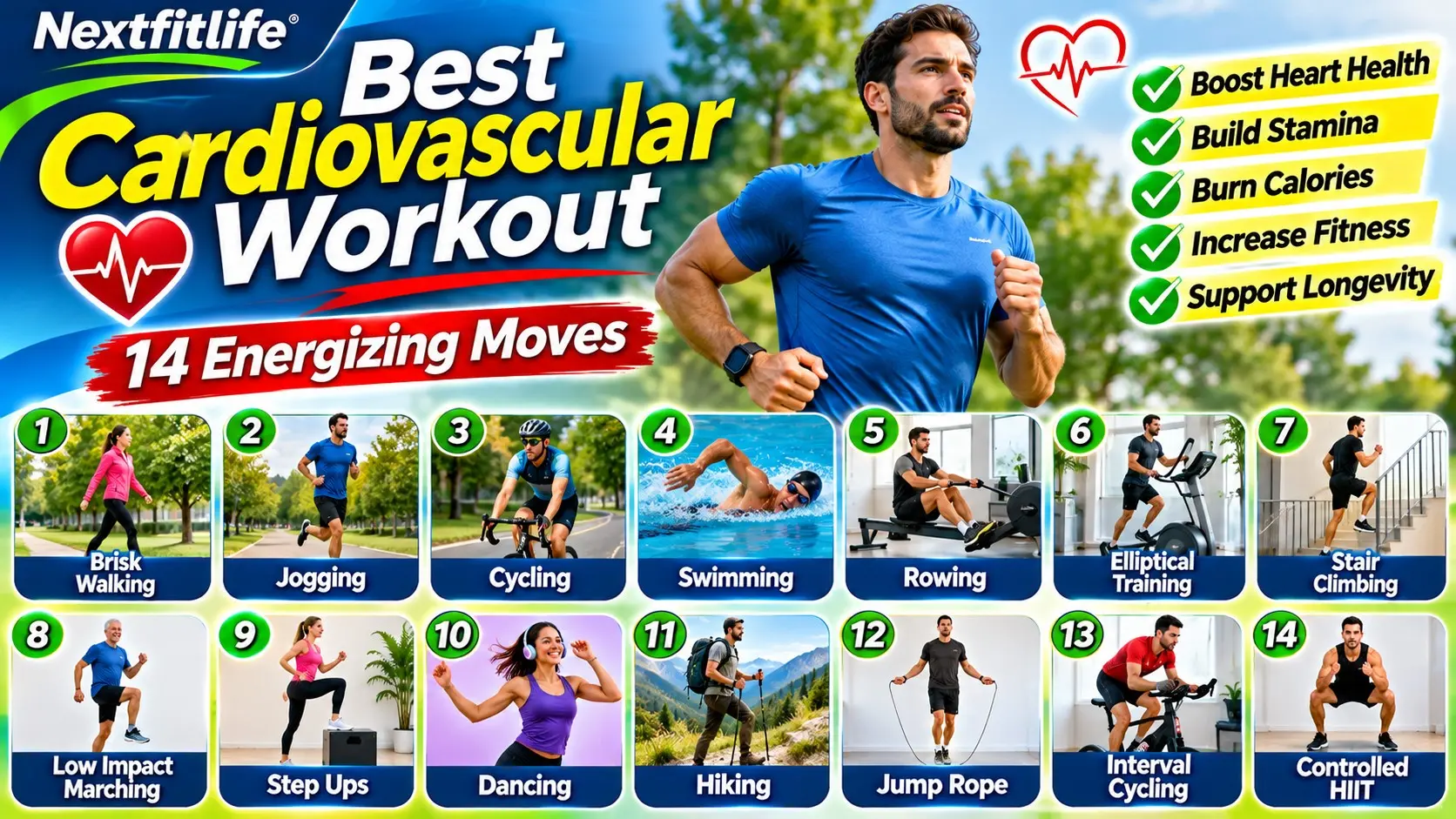
- 14 Best Cardiovascular Exercises
- Beginner Cardio Plan
- 20 Minute Home Cardio Routine
- 30 Minute Steady Cardio Routine
- Moderate vs Vigorous Exercise
- Heart Rate and the Talk Test
- HIIT vs Steady Cardio
- Low Impact Cardio
- How to Progress
- Common Cardio Mistakes
- When to Get Medical Advice
- Conclusion
- References and Sources
- Internal Links + Fitness Hub
- About the Author
- Frequently Asked Questions
Quick Answer: What Is the Best Cardiovascular Workout?
The best cardiovascular workout is one that raises your heart rate and breathing to a useful training level while remaining safe and repeatable for you.
Strong options include:
- Brisk walking
- Easy jogging
- Cycling
- Swimming
- Rowing
- Elliptical training
- Stair climbing
- Low impact marching
- Step ups
- Dancing
- Hiking
- Jump rope
- Interval cycling
- Controlled HIIT
You do not need to perform all 14. Choose two or three activities that fit your joints, fitness level, schedule, and preferences.
What Counts as Cardiovascular Exercise?
Aerobic exercise is activity that makes you breathe harder and causes your heart to beat faster for a sustained period.
Examples include:
- Walking quickly
- Running
- Cycling
- Swimming
- Rowing
- Dancing
CDC states that aerobic activity must reach at least moderate intensity to count toward the main weekly aerobic target.
How Much Cardio Do Adults Need?
Current CDC guidance recommends adults aim for:
- 150 minutes of moderate intensity aerobic activity each week, or
- 75 minutes of vigorous intensity aerobic activity each week, or
- An equivalent combination of both.
Adults should also perform muscle strengthening activity on at least two days each week.
You can divide aerobic activity into smaller sessions across the week. It does not need to happen in one long workout.
14 Energizing Cardiovascular Exercises
1. Brisk Walking
Best for: beginners, daily fitness, low impact cardio.
Walking is one of the simplest ways to improve cardiovascular endurance.
To make an easy walk more aerobic:
- Increase your pace.
- Walk uphill.
- Use a treadmill incline.
- Add short faster sections.
Starting target: 15 to 30 minutes.
For a structured plan, see our Walking for Weight Loss guide.
2. Easy Jogging
Best for: runners who already tolerate walking well.
Jogging raises cardiovascular demand quickly and can improve endurance.
Beginners do not need to run continuously. Try:
- One minute easy jogging
- Two minutes walking
- Repeat for 15 to 20 minutes
Increase the running portions gradually.
3. Cycling
Best for: lower impact aerobic training.
Cycling provides useful cardio without the repeated landing impact of running.
You can use:
- A stationary bike
- A road bike
- An indoor cycling class
Starting target: 20 to 30 minutes at a comfortable pace.
4. Swimming
Best for: full body low impact cardio.
Swimming challenges the heart and lungs while the water reduces weight bearing stress.
Beginners can alternate:
- Easy swimming
- Short rests
- Different strokes
Use appropriate water safety and swim where supervision is available when needed.
5. Rowing
Best for: combined upper and lower body cardiovascular work.
Indoor rowing uses the legs, hips, trunk, and upper body.
Good technique matters more than pulling as hard as possible.
Starting target: 10 to 20 minutes at an easy or moderate pace.
6. Elliptical Training
Best for: low impact indoor cardio.
The elliptical can raise your heart rate while reducing impact compared with running.
Adjust resistance gradually rather than starting at a very difficult level.
7. Stair Climbing
Best for: cardiovascular fitness plus leg endurance.
Stairs can raise your heart rate quickly.
Start with:
- One or two minutes of climbing
- Easy walking recovery
- Repeat as tolerated
Use a railing if balance is uncertain.
8. Low Impact Marching
Best for: home cardio and beginners.
- Stand tall.
- March in place.
- Swing your arms naturally.
- Increase the pace gradually.
This can be useful when outdoor walking is not convenient.
For more low impact options, visit Low Impact Exercises to Burn Fat at Home.
9. Step Ups
Best for: home cardiovascular training plus leg strength.
- Use a low stable step.
- Step up with one foot.
- Bring the other foot up.
- Step down carefully.
- Alternate the leading leg.
Keep the step low enough to maintain control.
10. Dancing
Best for: enjoyable aerobic activity.
Dancing can raise your heart rate while improving rhythm and coordination.
The best style is one you enjoy enough to repeat regularly.
11. Hiking
Best for: longer moderate cardiovascular sessions.
Hills increase the demand compared with flat walking.
Choose terrain that matches your balance and fitness level.
12. Jump Rope
Best for: short vigorous cardio sessions.
Jump rope can raise the heart rate quickly, but it also involves repeated impact.
Start with short intervals such as:
- 20 seconds of jumping
- 40 seconds of rest or walking
It may not suit people with current foot, ankle, knee, or pelvic floor symptoms.
13. Interval Cycling
Best for: increasing intensity without running impact.
Try:
- Warm up for five minutes.
- Cycle briskly for one minute.
- Cycle easily for two minutes.
- Repeat four to six times.
- Cool down.
This is a simple introduction to interval training.
14. Controlled HIIT
Best for: experienced exercisers who tolerate vigorous training.
HIIT alternates harder work with recovery periods.
A simple session might use:
- 30 seconds of harder cycling
- 60 to 90 seconds of easy recovery
- Repeat six times
Hard intervals do not need to be all out sprints.
For a full guide, read our HIIT Workouts for Weight Loss.
Best Cardio Options by Goal
| Goal | Good Choices | Starting Approach |
|---|---|---|
| Beginner Fitness | Walking, cycling, marching | 10 to 20 minutes |
| Low Impact | Cycling, swimming, elliptical | Easy to moderate pace |
| Endurance | Walking, jogging, cycling, rowing | Build duration gradually |
| Higher Intensity | Intervals, running, rowing, cycling | Short controlled intervals |
| Enjoyment | Dancing, hiking, swimming | Choose what you will repeat |
Simple Beginner Cardiovascular Workout
Start with a five minute easy warm up.
Then complete:
- Brisk walking for 5 minutes
- Easy walking for 2 minutes
- Brisk walking for 5 minutes
- Easy walking for 2 minutes
- Brisk walking for 5 minutes
Finish with several minutes of easier movement.
As fitness improves, extend the brisk sections.
20 Minute Home Cardio Workout
Use this simple circuit:
- March in place for 2 minutes.
- Step ups for 1 minute.
- Easy march for 1 minute.
- Side steps for 2 minutes.
- Brisk march for 2 minutes.
- Easy march for 1 minute.
- Step ups for 1 minute.
- Low impact dance for 3 minutes.
- Repeat selected sections until you reach about 20 minutes.
Keep the pace moderate if you are a beginner.
30 Minute Steady Cardio Workout
A steady cardio session can be simple:
| Phase | Time | Intensity |
|---|---|---|
| Warm Up | 5 minutes | Easy |
| Main Cardio | 20 minutes | Moderate |
| Cool Down | 5 minutes | Easy |
You can use walking, cycling, rowing, swimming, or elliptical training.
Moderate vs Vigorous Cardio
Intensity describes how hard your body is working.
Moderate Intensity
You breathe faster and feel warm, but you can usually speak in sentences.
Examples may include:
- Brisk walking
- Comfortable cycling
- Easy swimming
- Moderate dancing
Vigorous Intensity
You breathe much harder and conversation becomes difficult.
Examples may include:
- Running
- Fast cycling
- Hard rowing
- Fast stair climbing
- HIIT
Use the Talk Test
The talk test is a simple way to estimate exercise intensity.
At moderate effort, you can usually talk but would struggle to sing.
At vigorous effort, speaking more than a few words becomes harder.
This can be more practical than constantly watching a fitness tracker.
Should You Use Heart Rate Zones?
You can, but treat heart rate estimates as guides rather than exact rules.
The American Heart Association gives these general ranges:
- Moderate intensity: about 50 to 70 percent of estimated maximum heart rate
- Vigorous intensity: about 70 to 85 percent
A common rough estimate of maximum heart rate is 220 minus your age, but individual values can vary.
Heart rate zones can also be affected by:
- Medications
- Fitness level
- Heat
- Hydration
- Illness
- Caffeine
If you take medicine that affects heart rate or have a cardiovascular condition, ask your healthcare professional what intensity range is appropriate.
Is HIIT Better Than Steady Cardio?
Not for every person or every goal.
A 2026 meta analysis of 115 randomized trials involving 3,196 participants found that HIIT produced somewhat larger average improvements in maximal oxygen uptake than moderate to vigorous continuous training.
However, the size of the advantage changed with age, training level, sex, interval design, and exercise mode.
Steady cardio still improves fitness and may be:
- Easier to recover from
- Easier for beginners
- More enjoyable for some people
- Better suited to longer sessions
You can use both.
Does HIIT Work Outside a Laboratory?
Yes, but real world programs vary.
A 2026 systematic review of 31 studies involving 1,119 adults found real world HIIT was associated with improvements in VO2 max and several cardiometabolic measures.
That does not mean everyone needs HIIT.
The best program still depends on your goals, preferences, recovery, and health.
What Is the Best Low Impact Cardio?
Useful low impact choices include:
- Walking
- Stationary cycling
- Swimming
- Elliptical training
- Low impact dancing
- Marching
Low impact does not mean low effort. Cycling or swimming can still become vigorous without repeated jumping or running impacts.
Can Cardio Improve Heart Health?
Regular aerobic activity is strongly associated with cardiovascular health benefits.
Physical activity can support:
- Cardiorespiratory fitness
- Blood pressure management
- Blood glucose control
- Weight management
- Sleep
- Mood
- Daily stamina
Exercise is one part of heart health. Smoking, blood pressure, cholesterol, diabetes, sleep, diet, and medical care also matter.
Can Cardiovascular Exercise Help With Fat Loss?
Yes, aerobic exercise can increase energy expenditure and support fat loss.
However, exercise does not guarantee weight loss if overall energy intake remains higher than energy use.
For a complete approach, combine cardio with:
- Strength training
- Appropriate food portions
- Protein rich foods
- Fiber rich foods
- Good sleep
- Regular daily movement
For more, read our Weight Loss Strategies.
How to Progress Your Cardio Safely
Increase one main variable at a time.
You can progress by:
- Adding a few minutes
- Increasing pace slightly
- Adding gentle hills
- Increasing resistance
- Adding one interval
- Training one extra day
A beginner does not need to increase speed, duration, hills, and frequency during the same week.
Simple Weekly Cardio Plan
| Day | Activity | Intensity |
|---|---|---|
| Monday | Brisk walk 30 minutes | Moderate |
| Tuesday | Strength training | Controlled |
| Wednesday | Cycling 30 minutes | Moderate |
| Thursday | Easy walking or recovery | Easy |
| Friday | Brisk walk or rowing 30 minutes | Moderate |
| Saturday | Strength training plus short cardio | Mixed |
| Sunday | Walk, hike, or rest | Easy to moderate |
Common Cardiovascular Workout Mistakes
Going Too Hard Too Soon
Beginners benefit from building duration and consistency before chasing maximum intensity.
Thinking HIIT Is Mandatory
Walking, cycling, swimming, and steady aerobic exercise can all improve cardiovascular fitness.
Doing Every Workout Hard
Hard sessions need recovery. Most cardio does not need to feel maximal.
Ignoring Strength Training
Current physical activity guidance recommends both aerobic and muscle strengthening exercise.
Using Heart Rate as an Exact Rule
Estimated heart rate zones are guides. Medications, fitness, temperature, and individual physiology can change your response.
Skipping the Warm Up
Start easy and allow your breathing and heart rate to rise gradually.
Ignoring Pain or Medical Symptoms
Chest pressure, fainting, or severe unusual breathlessness should not be treated as normal workout discomfort.
When Should You Stop Cardiovascular Exercise?
Stop exercise and seek appropriate medical assessment if you develop:
- Chest pain or pressure
- Fainting
- Severe dizziness
- Severe unusual shortness of breath
- New exercise related palpitations with symptoms
- Sudden weakness
- Severe unexplained pain
If symptoms suggest a heart attack or other medical emergency, seek emergency care immediately.
Conclusion
The best cardiovascular workout is not necessarily the hardest activity. It is the one that safely raises your heart rate, improves your fitness, fits your body, and is realistic enough to perform consistently.
Brisk walking, cycling, swimming, rowing, dancing, running, and intervals can all improve cardiorespiratory fitness. Start with a manageable dose, build toward current weekly activity targets, and use vigorous training only when it matches your fitness and health.
Your next step: choose one cardio activity you enjoy and complete 20 to 30 minutes at a comfortable moderate pace this week, then build gradually.
References and Sources
- Centers for Disease Control and Prevention. Adult Activity: An Overview. Current recommendations for 150 minutes of moderate aerobic activity, 75 minutes of vigorous activity, or a combination, plus muscle strengthening.
https://www.cdc.gov/physical-activity-basics/guidelines/adults.html - American Heart Association. Target Heart Rates Chart. General guidance on moderate and vigorous exercise intensity and heart rate ranges.
https://www.heart.org/en/healthy-living/exercise-and-physical-activity/fitness-basics/target-heart-rates - One Size Does Not Fit All. 2026 meta analysis of 115 trials and 3,196 participants comparing high intensity interval training with moderate to vigorous continuous training.
https://pubmed.ncbi.nlm.nih.gov/41804294/ - Effects of High Intensity Interval Training on Cardiorespiratory Fitness and Cardiometabolic Health in Real World Settings. 2026 systematic review and meta analysis of 31 studies involving 1,119 adults.
https://pubmed.ncbi.nlm.nih.gov/42506854/ - Effects of High Intensity Interval and Continuous Moderate Aerobic Training on Fitness and Health Markers of Older Adults. Systematic review and meta analysis of 29 trials involving 1,227 adults aged 60 and older.
https://pubmed.ncbi.nlm.nih.gov/38718488/
Internal Links + Fitness Hub
- HIIT Workouts for Weight Loss
- HIIT Workouts for Men
- Walking for Weight Loss
- How to Increase Stamina for Running
- Running Tips for Long Distance
- Knee Exercises for Runners
- Low Impact Exercises to Burn Fat at Home
- 5 Components of Physical Fitness
- Strength Training and Muscle Building Guide
- Weight Loss Strategies
- NextFitLife Fitness Hub
About the Author
Adel Galal is a father of four (three sons and a daughter) and a grandfather of four, with 33 years of hands-on parenting experience. He is the founder of Parnthub.com, based in Cairo, Egypt, where he shares practical guidance on feeding, development and family life from newborns to teenagers. Adel is not a medical professional; health articles cite trusted sources and are for general information only.
Learn more on the NextFitLife About Us page.
Frequently Asked Questions
What is the best cardiovascular workout?
The best cardiovascular workout is one you can perform consistently at an appropriate intensity. Brisk walking, cycling, swimming, rowing, running, and dancing are all useful options.
How much cardio should adults do each week?
Current guidance recommends at least 150 minutes of moderate aerobic activity, 75 minutes of vigorous activity, or an equivalent combination each week.
Is walking good cardiovascular exercise?
Yes. Brisk walking can reach moderate intensity and is an accessible cardiovascular exercise for many adults.
What is the best low impact cardio?
Walking, cycling, swimming, elliptical training, marching, and low impact dancing are useful low impact choices.
Is HIIT better than steady cardio?
HIIT can improve cardiorespiratory fitness efficiently, but steady cardio also works well. The best choice depends on your fitness, health, recovery, and preferences.
How do I know if cardio is moderate intensity?
At moderate intensity, you breathe faster but can usually still speak in sentences. Heart rate may also be around 50 to 70 percent of estimated maximum for many adults.
What is vigorous cardio?
Vigorous cardio makes breathing much harder and conversation difficult. Running, hard cycling, fast rowing, and interval training can reach vigorous intensity.
Can cardio improve VO2 max?
Yes. Regular aerobic training and interval training can improve VO2 max, which is a common measure of cardiorespiratory fitness.
Should beginners do HIIT?
Beginners do not need HIIT. Building a base with walking, cycling, swimming, or other moderate activity first is often a practical approach.
When should I stop cardiovascular exercise?
Stop and seek medical assessment for chest pain or pressure, fainting, severe unusual shortness of breath, severe dizziness, or concerning new exercise related palpitations.

Health & wellness writer with 30+ years of experience in nutrition, fitness, and healthy aging. Founder of NextFitLife.com — evidence-based health guidance.

