
Published on: February 6, 2025
Updated on: November 4, 2026
Low impact exercises to burn fat at home can help you increase daily activity, improve cardiovascular fitness, and build muscle without using repeated jumps or hard landings.
They can support fat loss, but there is one important fact to understand first. Exercise does not melt body fat from a specific area. Losing body fat requires an overall calorie deficit over time, while exercise increases energy expenditure and helps support long term weight management.
Low impact does not mean low effort. A fast march, repeated step-ups, squats, loaded carries, or shadow boxing can become challenging without a single jump.
This guide gives you 15 practical exercises, beginner and intermediate routines, a weekly plan, progression ideas, and simple modifications for your knees and lower back.
Important: This article is for general information and education. It does not replace medical advice, diagnosis, or treatment.
Table of Contents
- Quick Answer
- What Low Impact Exercise Means
- Can Low Impact Exercise Burn Fat?
- 15 Low Impact Exercises
- Best Exercises by Goal
- 20 Minute Beginner Workout
- 30 Minute Intermediate Workout
- Weekly Workout Plan
- How Hard Should You Exercise?
- How to Progress Without Jumping
- Knee-Friendly Modifications
- Lower Back Friendly Modifications
- Fat Loss and Nutrition
- Common Mistakes
- When to Stop Exercising
- Conclusion
- References and Sources
- Internal Links and Fitness Hub
- About the Author
- Frequently Asked Questions
Quick Answer: What Are the Best Low Impact Exercises to Burn Fat at Home?
The best low impact exercises to burn fat at home are movements that let you work a large amount of muscle, raise your heart rate, and stay active without repeated jumping.
Good choices include:
- Brisk marching in place
- Low impact step jacks
- Side steps with arm reaches
- Standing knee drives
- Chair squats
- Sit to stands
- Low step ups
- Reverse lunges with support
- Wall push ups
- Incline mountain climbers
- Glute bridges
- Bird dogs
- Standing punches
- Farmer carries
- Low impact dance
You do not need to perform all 15 exercises in one workout. Choose six to ten movements and combine low impact cardio with basic strength exercises.
For a broader approach to weight management, read our Weight Loss Strategies and Basic Weight Loss Tips.
What Does Low Impact Exercise Mean?
Low impact exercise reduces hard landing forces and repeated jumping compared with high impact activities.
During many low impact movements, at least one foot stays connected to the floor or your body remains supported.
Examples include:
- Walking
- Marching
- Cycling
- Swimming
- Step based exercise
- Many resistance exercises
Low impact does not mean the workout must be easy.
A brisk march with large arm movements can raise your heart rate. So can step ups, loaded carries, fast punches, and controlled squats.
Can Low Impact Exercises Really Burn Fat?
They can support fat loss, but the phrase “burn fat” needs context.
Your body uses energy during exercise. That raises total daily energy expenditure.
However, body fat decreases when you maintain an overall energy deficit over time. This means your body uses more energy than you take in.
NIDDK notes that healthy weight loss generally combines a sustainable eating pattern with more physical activity.
Exercise has benefits even when the scale moves slowly. Regular activity can improve cardiovascular fitness, strength, mood, sleep, physical function, and long term weight maintenance.
Simple rule: Use exercise to become fitter and more active. Use a sustainable eating pattern to help create the energy deficit needed for fat loss.
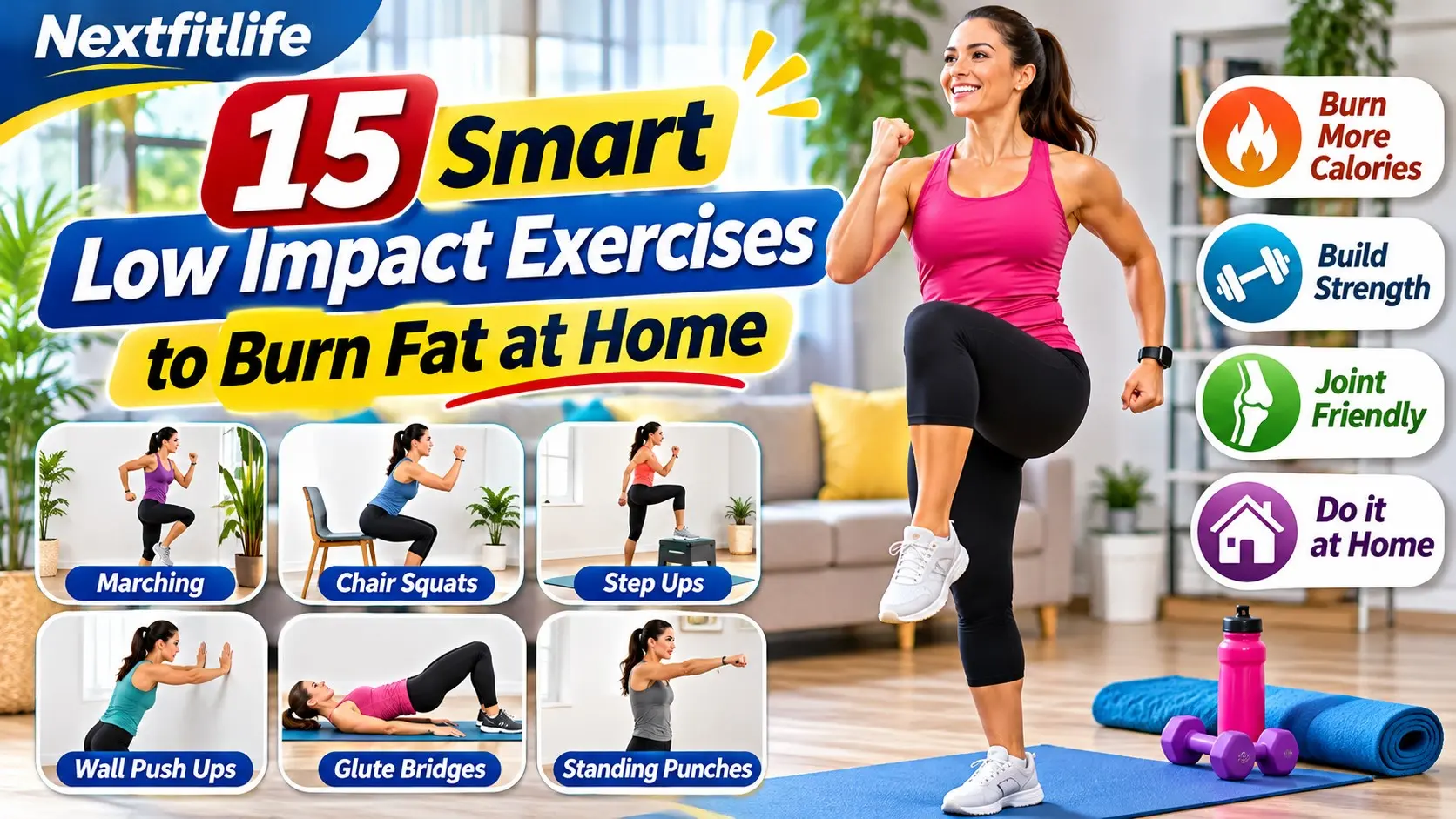
15 Smart Low Impact Exercises to Burn Fat at Home
1. Brisk Marching in Place
Marching is one of the easiest ways to begin a home workout without equipment.
- Stand tall in a comfortable position.
- Lift one knee.
- Lower it and switch sides.
- Swing your arms naturally.
- Gradually increase your pace.
Starting target: 30 to 60 seconds.
To make it harder, raise your knees slightly higher or use stronger arm movements while keeping control.
2. Low Impact Step Jacks
Step jacks give you the rhythm of jumping jacks without leaving the floor.
- Stand with your feet together.
- Step one foot sideways.
- Raise your arms overhead or as high as comfortable.
- Return to the center.
- Repeat on the other side.
Starting target: 30 to 60 seconds.
Move faster to increase intensity without adding a jump.
3. Side Steps With Arm Reaches
This simple movement keeps your whole body active.
- Step to your right.
- Bring your other foot toward it.
- Reach your arms forward or overhead.
- Repeat toward the left.
Starting target: 45 to 90 seconds.
Take wider steps if that feels comfortable.
4. Standing Knee Drives
Standing knee drives raise your heart rate while asking your core and hip muscles to work.
- Stand tall.
- Raise one knee toward your torso.
- Bring your hands toward the knee.
- Lower with control.
- Switch sides or complete several repetitions on one side first.
Starting target: 10 to 20 repetitions per side.
Hold a wall or chair if you need extra balance support.
5. Chair Squats
Chair squats train your legs and hips while giving you a clear depth target.
- Stand in front of a sturdy chair.
- Keep your feet in a comfortable position.
- Push your hips backward.
- Bend your knees.
- Lower toward the chair.
- Stand again with control.
Starting target: 8 to 15 repetitions.
You can touch the chair lightly rather than fully sitting if your control is good.
6. Sit to Stands
This beginner friendly exercise trains an important daily movement.
- Sit on a sturdy chair.
- Place your feet firmly on the floor.
- Lean forward slightly.
- Stand up.
- Sit back down slowly.
Starting target: 8 to 15 repetitions.
Use your hands for assistance if needed, then gradually rely on them less as your strength improves.
7. Low Step Ups
Step ups train the legs and can raise your heart rate without jumping.
- Use a stable low step.
- Place one foot on the step.
- Stand up onto it.
- Step down carefully.
- Repeat or switch sides.
Starting target: 8 to 15 repetitions per side.
A lower platform is usually better when you are learning.
8. Supported Reverse Lunges
Reverse lunges train your legs one side at a time.
- Stand beside a sturdy chair or counter.
- Hold it lightly for balance.
- Step one foot backward.
- Bend both knees through a comfortable range.
- Push through the front foot to return.
Starting target: 6 to 12 repetitions per side.
If lunges bother your knees, use chair squats instead.
9. Wall Push Ups
Wall push ups add strength training to your low impact routine.
- Place your hands on a wall.
- Step your feet backward.
- Keep your body controlled.
- Bend your elbows and move your chest toward the wall.
- Press yourself away.
Starting target: 8 to 15 repetitions.
Moving your feet farther from the wall usually makes the exercise harder.
10. Incline Mountain Climbers
This gives you a lower impact version of a floor mountain climber.
- Place both hands on a sturdy counter or secure bench.
- Step your feet backward.
- Keep your body controlled.
- Bring one knee toward your torso.
- Return it and switch sides.
Starting target: 20 to 40 alternating repetitions.
Increase the pace only while you can maintain control.
11. Glute Bridges
Glute bridges strengthen your hips without impact.
- Lie on your back.
- Bend your knees.
- Keep your feet on the floor.
- Lift your hips.
- Pause briefly.
- Lower slowly.
Starting target: 10 to 20 repetitions.
Avoid pushing your hips so high that your lower back becomes uncomfortable.
12. Bird Dogs
Bird dogs train core stability and controlled movement.
- Start on your hands and knees.
- Extend one arm forward.
- Extend the opposite leg backward.
- Keep your trunk steady.
- Return slowly.
- Switch sides.
Starting target: 6 to 12 repetitions per side.
You do not need to lift your arm or leg extremely high.
13. Standing Punches
Shadow boxing can become useful low impact cardio without jumping.
- Stand with your knees relaxed.
- Keep your hands near your face.
- Punch one arm forward.
- Bring it back.
- Alternate arms.
Starting target: 30 to 90 seconds.
Keep the punches controlled rather than locking your elbows hard.
14. Farmer Carries
Farmer carries combine grip, upper body, core, and leg work.
- Hold one dumbbell in each hand.
- Stand tall.
- Walk slowly across a clear space.
- Turn carefully.
- Continue for time.
Starting target: 20 to 45 seconds.
If you have very little space, march carefully in place while holding the weights.
15. Low Impact Dance
Dancing can be an effective way to accumulate moderate intensity exercise when you enjoy it enough to keep going.
Use movements such as:
- Side steps
- Forward and backward steps
- Heel taps
- Arm reaches
- Controlled turns
Starting target: 5 to 15 minutes.
Keep the movements grounded if you want to avoid jumping.
Best Low Impact Exercises by Goal
| Goal | Best Choices | Main Focus |
|---|---|---|
| Cardio | Marching, step jacks, dancing | Heart rate and aerobic fitness |
| Leg Strength | Chair squats, sit to stands, step ups | Legs and hips |
| Upper Body | Wall push ups, standing punches | Chest, shoulders, arms |
| Core Control | Bird dog, farmer carry | Trunk stability |
| Beginner Friendly | Marching, sit to stands, wall push ups | Simple controlled movements |
| Higher Effort Without Jumping | Step ups, knee drives, incline climbers, carries | Whole body effort |
20 Minute Beginner Low Impact Fat Loss Workout
This routine uses simple movements and does not require jumping.
Warm up for three minutes with easy marching and gentle side steps.
| Exercise | Work | Recovery |
|---|---|---|
| March in Place | 45 seconds | 15 seconds |
| Chair Squats | 45 seconds | 15 seconds |
| Step Jacks | 45 seconds | 15 seconds |
| Wall Push Ups | 45 seconds | 15 seconds |
| Standing Knee Drives | 45 seconds | 15 seconds |
| Bird Dog | 45 seconds | 15 seconds |
Complete two rounds if that matches your fitness level.
Cool down with easy walking and relaxed breathing.
30 Minute Intermediate Low Impact Workout
This routine increases effort without adding jumps.
- Brisk march for 60 seconds.
- Chair squats for 12 to 15 reps.
- Low step ups for 45 seconds.
- Wall or counter push ups for 10 to 15 reps.
- Standing punches for 60 seconds.
- Reverse lunges for 8 to 12 reps per side.
- Incline mountain climbers for 45 seconds.
- Farmer carry for 30 to 45 seconds.
Rest as needed, then repeat the circuit two or three times.
The goal is not to finish as fast as possible. Keep your technique controlled.
A Simple Weekly Home Workout Plan
| Day | Activity | Main Goal |
|---|---|---|
| Monday | 20 to 30 minute low impact circuit | Cardio and strength |
| Tuesday | Brisk walk | Aerobic activity |
| Wednesday | Home strength workout | Muscle strengthening |
| Thursday | Easy walk or mobility | Movement and recovery |
| Friday | 20 to 30 minute low impact circuit | Cardio and strength |
| Saturday | Longer walk, cycling, or swimming | Aerobic activity |
| Sunday | Rest or gentle movement | Recovery |
Adults should generally work toward at least 150 minutes of moderate aerobic activity per week plus muscle strengthening activities on at least two days.
For more structure, use our Fitness Program Guide.
How Hard Should a Low Impact Workout Feel?
Low impact exercise can still be moderate intensity.
The talk test is a simple way to judge effort.
Light Intensity
You can talk and sing easily.
Moderate Intensity
You can talk, but singing would be difficult.
Vigorous Intensity
You may only be able to say a few words before needing another breath.
Beginners do not need to make every workout vigorous.
How Many Calories Does a Low Impact Workout Burn?
There is no single accurate number for everyone.
Calorie use depends on:
- Body size
- Exercise intensity
- Workout duration
- Fitness level
- Muscle mass
- The movements you choose
A watch or exercise machine can estimate calories, but those numbers should not be treated as exact.
It is usually more useful to track workout duration, effort, steps, strength, and consistency.
Do You Need to Sweat to Burn Fat?
No.
Sweating is mainly part of your body's cooling system.
You can sweat heavily in a hot room while doing little physical work, and you can complete useful exercise without soaking your clothes.
Sweat loss is mostly fluid loss, not body fat loss.
Can You Burn Belly Fat With Home Exercises?
You cannot choose where your body removes fat first.
Ab exercises can strengthen abdominal muscles, but they cannot force fat to disappear from your stomach.
Overall fat loss may reduce abdominal fat over time.
For better nutrition context, read our Best Foods to Burn Belly Fat guide.
Is Low Impact Exercise Good for Beginners?
Yes, it can be an excellent starting point.
Movements such as walking, marching, chair squats, wall push ups, and low step ups are easy to modify.
Start with short sessions if needed.
Even small amounts of activity are better than none, and you can build toward longer sessions over time.
Are Low Impact Workouts Good for Adults Over 50?
They can be.
Walking, strength exercises, balance work, and controlled aerobic exercise can all fit into an active lifestyle as people age.
The CDC also recommends balance activities for older adults in addition to aerobic and muscle strengthening exercise.
Your program should match your health and current ability rather than your age alone.
How to Progress Without Adding Jumps
You do not need high impact exercise to use progressive overload.
You can make a low impact workout harder by:
- Adding a few minutes
- Increasing your walking pace
- Adding repetitions
- Using slightly heavier dumbbells
- Using a stronger resistance band
- Taking slightly larger steps
- Adding another circuit
- Reducing rest slightly
Change one variable at a time.
Knee Friendly Modifications
Low impact does not guarantee that every exercise will feel comfortable for every knee.
If your knees are sensitive, try:
- A shallower chair squat
- A higher chair for sit to stands
- A lower step
- Marching instead of lunges
- Side steps instead of deep knee bends
- Slower movement
Exercise should be challenging, but sharp joint pain is not the goal.
For broader injury reduction guidance, read our Injury Prevention Exercises.
Lower Back Friendly Modifications
If your lower back becomes uncomfortable during a movement, reduce the range or change the exercise.
Useful options may include:
- Walking
- Marching
- Wall push ups
- Sit to stands
- Bird dogs
- Supported step ups
Avoid turning every movement into a deep bend or exaggerated arch.
If back pain is persistent, severe, spreading down a leg, or linked with weakness or numbness, seek medical advice rather than trying to exercise through it.
Should You Combine Cardio and Strength Training?
Yes.
A balanced home program should include both aerobic exercise and resistance work.
Cardio activities help build cardiovascular fitness and increase energy use.
Resistance training helps maintain and build muscle and strength.
Current ACSM resistance training guidance emphasizes that simple approaches work. Bodyweight movements, resistance bands, dumbbells, and home based exercise can all be useful.
Visit our Strength Training and Muscle Building Guide for a complete introduction.
What Should You Eat if Your Goal Is Fat Loss?
Exercise is only part of the equation.
NIDDK recommends a healthy eating pattern built around foods such as:
- Vegetables
- Whole fruit
- Whole grains
- Lean protein sources
- Beans and lentils
- Nuts and seeds
- Appropriate dairy or alternatives
If fat loss is your goal, total calorie intake still matters.
You do not need a detox or crash diet.
Start with our Basic Weight Loss Tips for a simple step by step approach.
Common Low Impact Workout Mistakes
Assuming Low Impact Means Very Easy
You can raise intensity through pace, resistance, range, and duration without jumping.
Doing Only Cardio
Add strength work at least twice per week when appropriate.
Trying to Exercise Away Every Calorie
Fat loss is easier to manage when nutrition and activity work together.
Expecting Spot Reduction
No exercise can choose the exact place where your body loses fat.
Thinking More Sweat Means More Fat Loss
Sweat mainly reflects cooling and fluid loss.
Never Increasing the Challenge
Your body adapts. Gradually increase time, repetitions, resistance, or pace.
Making Every Workout Exhausting
You do not need to finish every session completely drained.
Ignoring Joint Pain
Modify exercises that repeatedly cause sharp pain.
When Should You Stop Exercising?
Normal effort, faster breathing, and muscle fatigue can occur during exercise. Severe or unusual symptoms are different.
Stop exercising and seek appropriate medical care if you develop:
- Chest pain or pressure
- Fainting
- Severe unusual shortness of breath
- Sudden severe weakness
- A serious fall or injury
- Severe joint pain
- New significant numbness
- New neurological symptoms
If you have a medical condition or are returning to exercise after a serious illness, injury, or surgery, ask your healthcare professional what level of activity is appropriate.
Conclusion
The best low impact exercises to burn fat at home do not require jumping, extreme workouts, or expensive machines. Marching, step ups, squats, wall push ups, carries, dancing, and other controlled movements can increase activity and improve fitness.
For fat loss, remember the bigger picture. Exercise helps you use energy and protect your health, while a sustainable eating pattern helps create the calorie deficit needed to reduce body fat.
Your next step: choose six exercises from this guide and complete a 20 minute workout two or three times this week. Keep it manageable, track what you do, and increase the challenge gradually.
References and Sources
- Centers for Disease Control and Prevention. Adult Physical Activity Guidelines. Adults should aim for at least 150 minutes of moderate intensity aerobic activity per week and muscle strengthening activity on at least two days.
https://www.cdc.gov/physical-activity-basics/guidelines/adults.html - National Institute of Diabetes and Digestive and Kidney Diseases. Eating and Physical Activity to Lose or Maintain Weight. Guidance on sustainable nutrition, calorie reduction, physical activity, goals, and weight maintenance.
https://www.niddk.nih.gov/health-information/weight-management/adult-overweight-obesity/eating-physical-activity - American College of Sports Medicine. Resistance Training Prescription for Muscle Function, Hypertrophy, and Physical Performance in Healthy Adults. Updated 2026 evidence based resistance training guidance.
https://pubmed.ncbi.nlm.nih.gov/41843416/ - Centers for Disease Control and Prevention. Physical Activity Recommendations by Age. Guidance for adults, older adults, people with chronic conditions, and other populations.
https://www.cdc.gov/physical-activity-basics/guidelines/index.html - U.S. Department of Health and Human Services. Physical Activity Guidelines for Americans. Evidence based recommendations on aerobic and muscle strengthening activity and the health benefits of moving more.
https://health.gov/our-work/nutrition-physical-activity/physical-activity-guidelines
Internal Links + Fitness Hub
- NextFitLife Fitness Hub
- Fitness Program Guide
- Home Workouts and Equipment Hub
- Strength Training and Muscle Building Guide
- Basic Weight Loss Tips
- Weight Loss Strategies
- Best Foods to Burn Belly Fat
- How to Get Rid of Stress Belly
- Core Workouts at Home
- Injury Prevention Exercises
- How to Increase Stamina for Running
- 5 Components of Physical Fitness
About the Author
Adel Galal is a father of four, three sons and a daughter, and a grandfather of four, with 33 years of hands on parenting experience. He is the founder of Parnthub.com, based in Cairo, Egypt, where he shares practical guidance on feeding, development and family life from newborns to teenagers.
Adel is not a medical professional. Health articles cite trusted sources and are for general information only.
Learn more on the NextFitLife About Us page.
Frequently Asked Questions
What are the best low impact exercises to burn fat at home?
Useful low impact exercises include brisk marching, step jacks, knee drives, chair squats, step ups, wall push ups, incline mountain climbers, standing punches, farmer carries, and low impact dancing. Combine cardio movements with strength exercises for a balanced workout.
Can low impact exercise help you lose body fat?
Yes. Low impact exercise increases physical activity and energy expenditure, which can support fat loss. However, losing body fat still requires an overall energy deficit over time.
Is low impact exercise good for beginners?
Yes. Walking, marching, chair squats, sit to stands, wall push ups, and other low impact movements are easy to modify and can be good starting exercises for many beginners.
How long should a low impact workout be?
A beginner can start with 10 to 20 minutes and gradually increase the duration. Adults should work toward the recommended weekly amount of aerobic and muscle strengthening activity as their health and fitness allow.
Can low impact workouts be intense?
Yes. Low impact refers mainly to impact forces, not effort. Brisk marching, step ups, farmer carries, knee drives, and fast shadow boxing can become challenging without jumping.
Do I need to jump to burn calories?
No. Walking, cycling, marching, dancing, step ups, resistance training, and other low impact activities can all increase energy expenditure without jumping.
Can I lose belly fat with low impact exercises?
Overall fat loss may reduce abdominal fat, but no exercise can force your body to remove fat from one specific area. Core exercises strengthen abdominal muscles but do not selectively burn belly fat.
Should I combine low impact cardio with strength training?
Yes. Aerobic exercise supports cardiovascular fitness and energy expenditure, while resistance training supports muscle and strength. A balanced weekly plan can include both.
Do I have to sweat a lot to burn fat?
No. Sweating is mainly part of your body's temperature control system. The amount you sweat does not directly show how much body fat you are losing.
How often should I do low impact exercise?
You can spread low impact activity across the week. Current adult guidance recommends at least 150 minutes of moderate aerobic activity each week plus muscle strengthening exercises on at least two days.

Health & wellness writer with 30+ years of experience in nutrition, fitness, and healthy aging. Founder of NextFitLife.com — evidence-based health guidance.

