Published - April 2025 Last Updated - April 2026
The reason most weight loss goals fail before week two is not motivation. It is not willpower. It is not even the diet. Most weight loss goals fail because they are not goals at all. They are wishes dressed up as intentions.
"I want to lose weight" is a wish. "I will lose 8 kg in 16 weeks by eating 1,600 calories per day and walking 8,000 steps daily" is a goal. The difference between those two statements is the difference between starting and sustaining.
A 2023 study published in the Journal of Medical Internet Research confirmed that the type and specificity of goals set at the start of a weight loss programme directly predicted weight loss outcomes over 24 weeks.
This article is part of our complete weight loss guide — the full evidence-based resource covering every stage of sustainable fat loss.
Why Specific Weight Loss Goals Produce Better Results
The Psychology of Goal Commitment
Goal-setting theory — developed by Locke and Latham and supported by decades of research- demonstrates that specific, challenging goals produce significantly higher performance than vague or easy ones.
This applies directly to weight loss. Vague goals create no rational action. Specific goals create daily behaviour.
Vague goal - "I want to eat healthier." Specific goal: "I will eat 120g of protein daily and eliminate sugary drinks."
The second goal tells you exactly what to do today. The first leaves you guessing every morning.
Process Goals vs. Outcome Goals - Which Works Better?
Research shows a clear hierarchy:
| Goal Type | Example | Effectiveness |
| Outcome goal | Lose 10 kg | Motivating but not actionable day-to-day |
| Process goal | Walk 8,000 steps per day | Directly actionable, high adherence |
| Behaviour's goal | Cook at home 5 days per week | The strongest predictor of sustained results |
The 2023 Oxford study found that process and behaviour goals were more strongly associated with weight loss than outcome goals alone.
Use outcome goals to know where you are going. Use process and behaviour goals to know what to do today.
The SMART Framework Applied to Weight Loss Goals
SMART stands for: Specific, Measurable, Achievable, Relevant, Time-bound.
Every effective weight loss goal meets all five criteria.
S - Specific
Replace vague intentions with precise actions.
"I want to exercise more." ✅ "I will walk 30 minutes every morning before work, Monday to Friday."
"I want to eat less sugar." ✅ "I will eliminate all sugary drinks and replace them with water or black coffee."
M - Measurable
If you cannot measure it, you cannot track it. Without tracking your progress, improvement becomes impossible.
Measurable weight loss metrics:
- Body weight (weekly average in kg)
- Waist circumference (measured every 2–4 weeks)
- Daily step count
- Daily protein intake in grams
- Weekly exercise sessions completed
A - Achievable
Unrealistic goals produce early failure, which derails motivation.
What is realistic for most beginners?
| Starting Weight | Realistic Monthly Loss | 3-Month Target |
| 70–85 kg | 1.5–2 kg | 4.5–6 kg |
| 85–100 kg | 2–3 kg | 6–9 kg |
| 100–120 kg | 2.5–4 kg | 7.5–12 kg |
| 120 kg+ | 3–5 kg | 9–15 kg |
Research consistently shows that people who set moderate, realistic goals sustain longer-term weight loss than those who set aggressive targets.
R - Relevant
Your goals need to connect to something you genuinely care about — not something someone else thinks you should care about.
Ask yourself
- Why does losing this weight matter to me specifically?
- What will be different in my life when I reach this goal?
- Is this goal about my health, my energy, my confidence, or all three?
A goal connected to a clear personal reason survives hard weeks. A goal set because someone suggested it rarely lasts past month one.
T - Time-bound
Deadlines create urgency. Urgency creates action.
"I want to lose weight eventually" will not work. "I will lose 6 kg by 30 June 2026." Will.
Setting realistic weight loss timelines
| Goal | Realistic Timeframe |
| Lose 5 kg | 10–12 weeks |
| Lose 10 kg | 20–25 weeks |
| Lose 20 kg | 40–50 weeks |
| Lose 30 kg | 60–75 weeks |
These assume a consistent deficit of 400–500 calories per day. Faster timelines are possible but significantly harder to sustain.
How to Write Your Weight Loss Goal - Template and Examples
The Goal-Writing Template
"I will [specific action] by [specific date] by [specific daily/weekly behaviour], measured by [specific metric]."
Real SMART Weight Loss Goal Examples
Example 1 — Beginner, 10 kg to lose
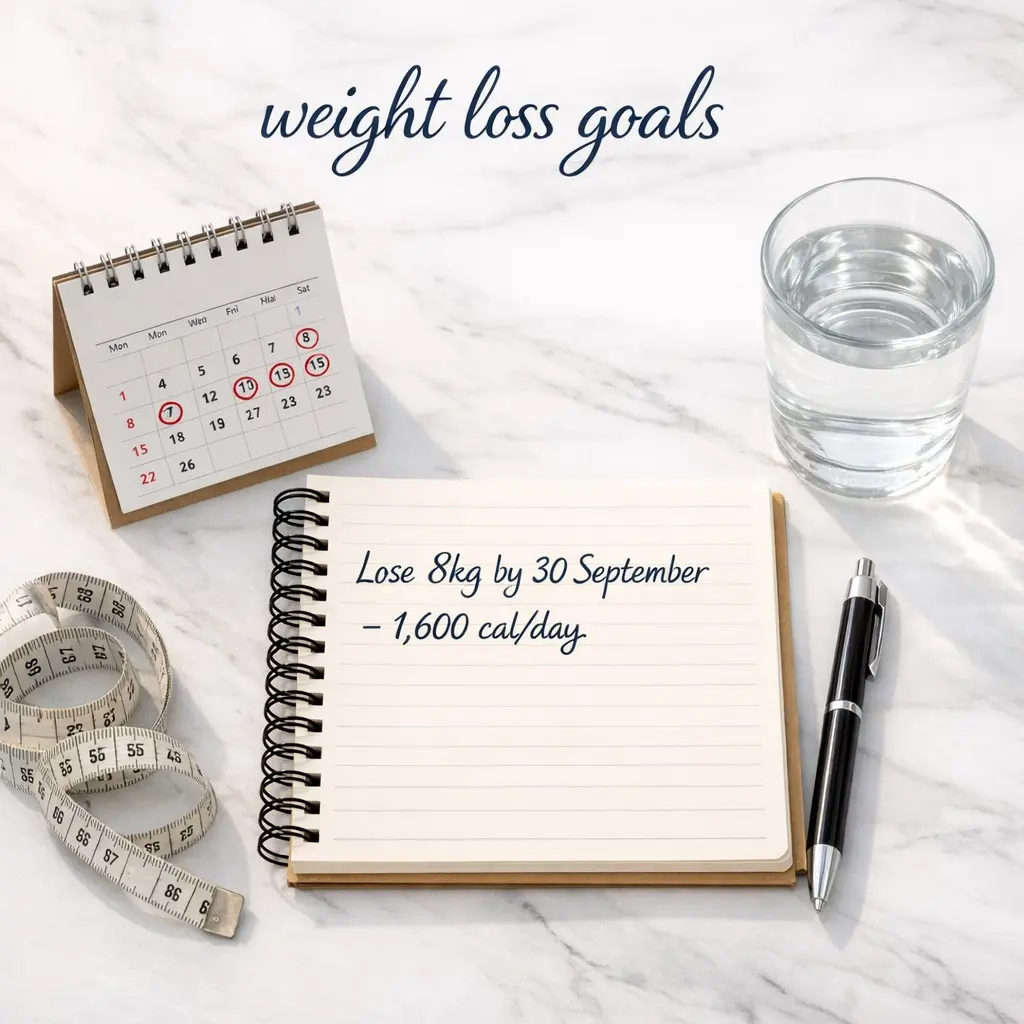
"I will lose 10 kg by 30 September 2026 by eating 1,550 calories per day with 120g protein, walking 8,000 steps daily, and doing two resistance sessions per week. I will track my weekly average weight every Sunday morning."
Example 2 — Belly fat focus
"I will reduce my waist circumference from 98 cm to 88 cm by 1 August 2026 by eliminating sugar from drinks, eating a high-protein breakfast daily, and walking 30 minutes after dinner five days per week."
Example 3 — Fitness and weight combined
"I will lose 6 kg and complete a 5km walk without stopping by 15 July 2026 by eating at a 400-calorie daily deficit and building up from 20-minute to 45-minute walks over 12 weeks."
Setting Weight Loss Mini-Goals - Why Smaller Milestones Matter
The Problem with One Big Goal
A goal 6 months away provides almost no motivational feedback today. You need wins along the way.
Mini-goals — small targets set every 2–4 weeks, maintain engagement through the long middle section of a weight loss journey where motivation naturally dips.
Mini-goal examples for a 12-week plan
- Week 2: Hit protein target every day for 7 consecutive days
- Week 4: Lose first 2 kg — celebrate with a non-food reward
- Week 6: Walk 8,000 steps for 5 consecutive days
- Week 8: Waist circumference down by 2 cm
- Week 10: Complete 4 resistance sessions in one week
- Week 12: Total 4 kg lost — reassess and set next 12-week goal
Each mini-goal gives you a specific near-term target and a reason to acknowledge your progress.
How to Track Your Weight Loss Goals Without Obsessing
H3: What to Track and How Often
| Metric | Frequency | Best Method |
| Body weight | Daily (track weekly average) | Same time, same conditions — morning, post-bathroom |
| Waist circumference | Every 2–4 weeks | Tape measure at navel level |
| Daily calories and protein | Daily (for first 6–8 weeks) | App or food diary |
| Exercise sessions | Per session | Habit tracker or calendar |
| Energy and mood | Daily | Simple 1–5 rating in a journal |
The Weekly Average Weight Method - Use This Instead of Daily Scale Numbers
Daily weight fluctuates by 1–3 kg because of water, hormones, and food volume. Judging progress on a single day's reading leads to unnecessary panic and poor decisions.
The method
- Weigh yourself every morning
- Add the 7 readings together and divide by 7
- Compare weekly averages — not individual days
A downward trend in weekly averages over 4 weeks confirms genuine fat loss, regardless of individual daily spikes.
For more on tracking your progress accurately during your weight loss journey, see our guide on how to track weight loss.
What to Do When You Miss a Weight Loss Goal
Missing a goal is data, not Failure
If you set a goal of losing 3 kg in 6 weeks and lost 1.5 kg, you did not fail. You learned that your actual rate of progress is approximately 1.5 kg per 6 weeks under your current conditions.
Adjust the plan, not the effort level
- Recalculate your calorie target — your TDEE may need updating
- Audit your tracking for hidden calories
- Check whether sleep and stress are factors
Use our calorie deficit calculator to verify your numbers are still accurate as your weight changes.
When to Reset Your Weight Loss Goal
Reset your goals when:
- You hit your original target — set the next one immediately
- Your circumstances change significantly (job, health, family)
- You have been on the same goal for more than 3 months without progress — something needs recalibrating
Never abandon a goal after one bad week. That is the equivalent of throwing away your phone because you dropped it once.
Weight Loss Goals - Conclusion
Effective weight loss goals are not about motivation. They are about structure.
The five rules for goals that work
- Make them specific — vague intentions produce no action
- Set both an outcome goal and daily process goals
- Keep the rate realistic — 0.5–1 kg per week is excellent progress
- Build mini-goals every 2–4 weeks for consistent feedback
- Track weekly averages — not daily scale readings
Once your goals are set, the next step is building the daily habits that make them automatic. See our guide on weight loss habits for the seven habit changes that produce the most reliable results.
For a complete step-by-step action plan covering diet, exercise, sleep, and tracking, see our complete guide to weight loss for beginners.
FAQs About Weight Loss Goals
Q: How much weight is realistic to lose in 12 weeks?
For most beginners with a consistent 400–500 calorie daily deficit, 4–8 kg over 12 weeks is realistic. The first 1–2 weeks may show faster loss from water weight, which then settles into a slower steady pace of 0.5–1 kg per week from fat.
Q: Should I focus on the scale or other measurements?
Both - but the scale alone is misleading. Track weekly weight averages, waist circumference every 2–4 weeks, and how your clothes fit. These three together give a complete picture that the scale alone cannot provide.
Q: Is it bad to set a weight goal for a specific date, like a wedding or holiday?
Not at all — deadline-based goals often produce strong initial motivation. The key is ensuring the target is realistic for the timeframe. Work backwards: calculate the weeks available, multiply by 0.5–1 kg per week, and set a goal that matches that range.
Q: What if I lose motivation partway through?
This is normal. Motivation is unreliable — habits and systems are not. When motivation drops, return to your process goals: what are the 2–3 daily actions that produced results? Focus on those rather than the distant outcome target.
Sources and References
- Wren GM et al. — The Association Between Goal Setting and Weight Loss — JMIR, 2023 https://pubmed.ncbi.nlm.nih.gov/37405833/
- CDC — Losing Weight: What Is Healthy Weight Loss? https://www.cdc.gov/healthy-weight-growth/losing-weight/index.html
- Mayo Clinic — Weight loss: 6 strategies for success https://www.mayoclinic.org/healthy-lifestyle/weight-loss/in-depth/weight-loss/art-20047752
- NIH — Strategies to Support Self-Management https://www.niddk.nih.gov/health-information/weight-management
- NHS — Start losing weight https://www.nhs.uk/live-well/healthy-weight/start-losing-weight/


Health & wellness writer with 30+ years of experience in nutrition, fitness, and healthy aging. Founder of NextFitLife.com — evidence-based health guidance.