Last Updated: June 2026
— Written with 2026 AAO, AOA and WHO research
Children do not know what normal vision looks like. If your child has always seen the world in a certain way, they have no idea their vision differs from others. They will not complain about blur. They will not say they cannot see the board at school. They will just struggle quietly.
This is why Children's eye health is so important — and why starting them early matters far more than most parents realize. I have seen children whose learning difficulties turned out to be vision problems. Children labelled as inattentive in class simply could not see clearly. Treating the vision changed everything.
This guide tells you exactly when to start eye exams for children, the warning signs to watch for at every age, the most common childhood eye conditions, and how to protect your child's vision for life.
Complete eye health guide: vision care, prevention and wellness
| KEY FACTS | 1 in 4 school-age children has an undetected vision problem that affects learning 80% of learning in the first 12 years of life is acquired through vision Amblyopia (lazy eye) affects 2 to 3% of children and is only treatable if caught early Children with untreated vision problems are 3x more likely to have reading difficulties Myopia (short-sightedness) has doubled in children over the past 30 years Most children with vision problems do not complain — they think everyone sees this way The first eye exam should happen before the age of 3, ideally around 12 months |
When Should Children Have Their First Eye Exam?
The answer surprises most parents. Eye exams should begin in infancy — long before your child can read an eye chart.
| Age | Recommended Eye Assessment | What Is Being Checked |
| Newborn to 3 months | Newborn eye screening in hospital | Red reflex test — rules out cataracts and serious structural problems |
| 6 to 12 months | First comprehensive eye exam | Eye alignment, tracking, early refractive errors, amblyopia risk |
| 2 to 3 years | Second comprehensive exam | Detailed vision testing, strabismus screening, basic visual acuity |
| Before starting school (age 4 to 5) | Full eye exam — critical milestone | Visual acuity, binocular vision, colour vision, depth perception |
| School age (6 to 18) | Every 1 to 2 years is normal | Annual if glasses are worn, prescription changes, or risk factors |
| Any age | Immediately, if symptoms appear, | Squinting, head tilting, eye rubbing, school difficulties, complaints |
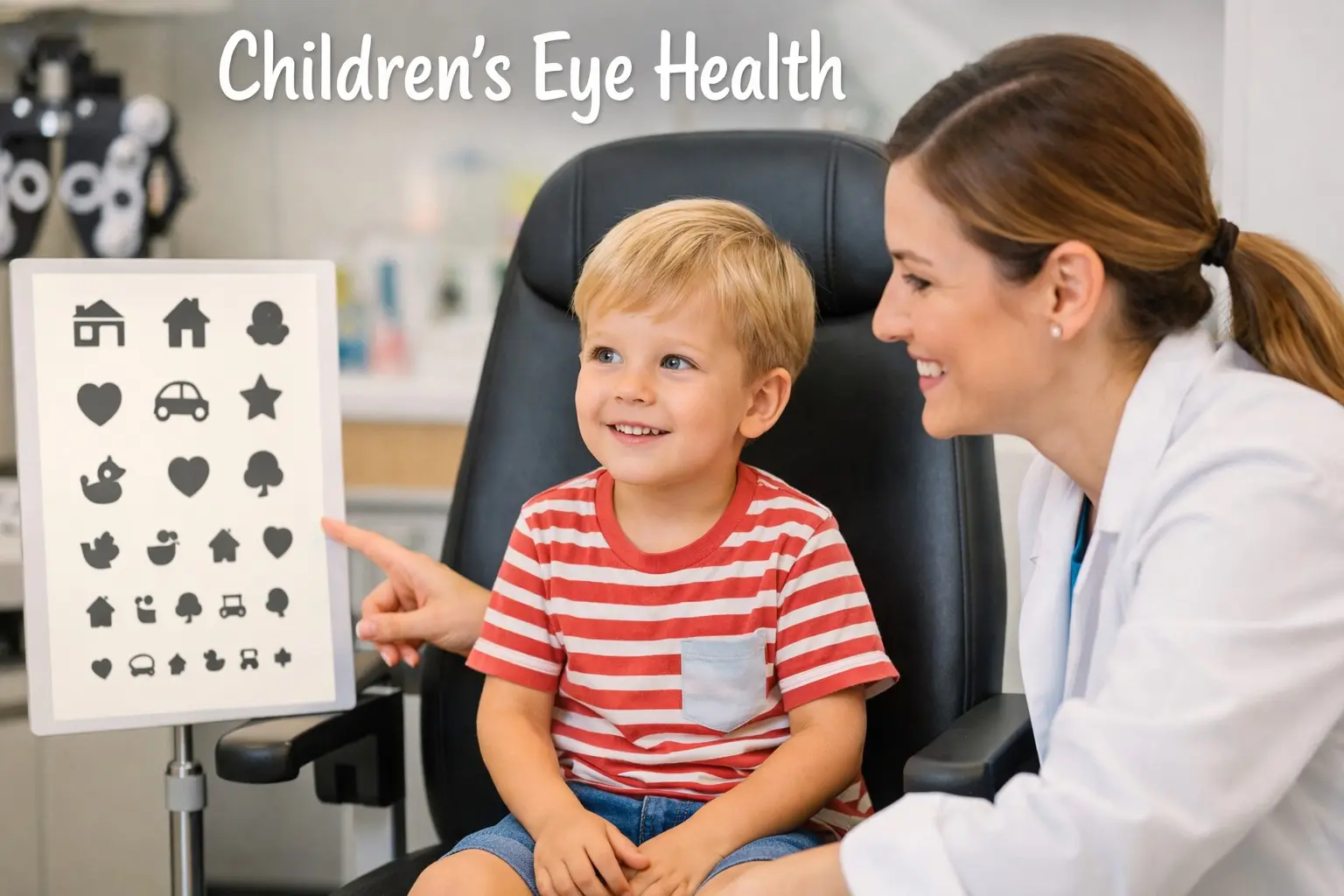
Many parents wait until their child is old enough to read letters on a chart. By then, conditions like amblyopia may have already passed the window of effective treatment. Opticians use picture-based charts, light-response tests, and specialist equipment to assess vision in babies and toddlers without any letter recognition needed.
Warning Signs Your Child May See a Problem
Children rarely tell you their vision is poor. These are the behavioural and physical signs to watch for.
Behavioural Signs at Home and School
- Sitting very close to the TV or holding books or screens very near the face
- Squinting or closing one eye to see better is a strong sign of refractive error or eye misalignment
- Tilting the head to one side when looking at things — often a sign of strabismus or muscle imbalance
- Avoiding reading, colouring, or close work — tasks that are harder with a vision problem
- Short attention span during visual tasks — may be mistaken for behavioural issues
- Losing place when reading, skipping words, or using a finger to track every line
- Frequent eye rubbing — especially during or after close work or reading
- Covering one eye during activities is a sign of suppression in that eye
Physical Signs to Look For
- One eye turning inward or outward — this is strabismus (squint) and needs prompt assessment
- Eyes that do not move together when tracking an object
- A white or unusual reflection in the pupil in photos may indicate cataract, retinoblastoma, or other serious conditions. Seek urgent care
- A drooping eyelid covering part of the pupil can cause amblyopia if untreated
- Excessive tearing or discharge in infants can indicate a blocked tear duct or eye infection
- Pupils of different sizes — usually harmless but worth checking
| URGENT — SEE A DOCTOR SAME DAY IF | You see, a white reflection (white pupil) in your child's eye in photos or direct light One eye suddenly turns inward or outward for the first time Your child has sudden pain, severe redness, or loss of vision Your child received an eye injury — even one that seems minor A white pupil in a photo can indicate retinoblastoma — a rare but serious childhood eye cancer. It is almost always harmless, but it must be checked immediately without delay. |
The Most Common Childhood Eye Conditions
| Condition | What It Is | Age at which it typically appears | Treatable? |
| Amblyopia (lazy eye) | One eye develops weaker vision because of brain suppression | Birth to age 7 | Yes — patching, glasses, drops. Must be caught early |
| Strabismus (squint) | Eyes point in different directions | Any childhood age | Yes — glasses, patching, eye exercises, sometimes surgery |
| Myopia (short-sightedness) | Difficulty seeing distant objects | Typically, age 6 to 14 | Managed with glasses or contacts. Can be slowed |
| Hyperopia (long-sightedness) | Difficulty seeing close objects clearly | Often present from birth | Managed with glasses. Many children outgrow mild cases |
| Astigmatism | Blurred vision at all distances from an irregular cornea | Any age | Corrected with glasses or contact lenses |
| Colour blindness colour blindness types tests and living with It | Difficulty distinguishing certain colours | Present from birth in inherited cases | No cure — managed with awareness and tools |
| Blocked tear duct | Excessive tearing and discharge in infants | Birth to 12 months | Usually resolves naturally. Massage helps. Rarely needs probing |
| Conjunctivitis | Pink eye — infection or allergy | Any age | Yes — antibiotic drops for bacterial, supportive care for viral |
Amblyopia (Lazy Eye): Why Early Treatment Is Everything
Amblyopia is the most important childhood condition to understand. It occurs when the brain begins to ignore the signal from one eye, usually because that eye has significantly worse vision or is turned. The ignored eye gradually becomes weaker. The critical point: the brain is plastic and responsive to treatment only during childhood development.
Treatment is highly effective before age 7. It becomes progressively less effective between 7 and 10. After the age of 10 to 12, significant improvement is very difficult to achieve. This is why early detection is so urgent. The window closes.
Treatment involves making the weaker eye work harder. The stronger eye is patched for several hours daily. Or atropine drops blur the stronger eye. The brain is forced to use and develop the weaker eye. I have seen children achieve remarkable improvements in visual acuity through consistent patching — but only because they were young.
lazy eye exercises and treatment options explained
The Myopia Epidemic in Children: What Is Happening and What to Do
Myopia — short-sightedness — has increased dramatically in children over the past 30 years. In some East Asian countries, it now affects 80 to 90 percent of school leavers. In Europe and North America, rates have roughly doubled since the 1970s.
The causes are linked to reduced outdoor time and increased near-work time. The eye grows too long, meaning distant objects focus in front of the retina rather than on it. Myopia that starts early in childhood tends to progress faster and reach higher prescriptions — increasing the risk of serious conditions like retinal detachment, glaucoma, and macular degeneration in adult life.
how screen use and near work affects the eyes over time
What slows myopia progression in Children?
| Strategy | Evidence Level | Recommended For | How It Works |
| Outdoor time (2 hours daily) | Very strong | All children | Bright light (sunlight) stimulates dopamine release, which slows eye elongation |
| Orthokeratology (Ortho-K lenses) | Strong | Age 8 and above | Reshapes cornea overnight — slows axial eye growth by 30 to 55% |
| Low-dose atropine eye drops (0.05%) | Strong | Age 6 to 14 with progressing myopia | Reduces myopia progression by 50 to 60% with minimal side effects |
| Multifocal soft contact lenses | Good evidence | Age 8 to 14 | Peripheral defocus signals the eye to slow elongation |
| Limiting near-screen time | Moderate | All children | Reduces sustained near-focus that drives eye elongation |
The outdoor time recommendation is the simplest and most accessible. Two hours of outdoor activity per day is associated with significantly lower myopia rates. This does not require sport — walking, playing, or simply being outside in natural daylight is enough. The key factor is bright ambient light, not physical activity.
Nutrition for Children's Eye Health - What to Feed Growing Eyes
| Nutrient | Why It Matters for Children's Eyes? | Best Child-Friendly Food Sources |
| Vitamin A | Essential for retinal function and night vision | Carrots, sweet potato, eggs, full-fat dairy |
| Lutein and zeaxanthin | Build macular pigment — protect retina from light damage | Eggs, spinach, peas, sweetcorn |
| Omega-3 DHA | Supports retinal development and visual acuity | Salmon, sardines, algae-based supplements |
| Vitamin C | Protects lens — reduces long-term cataract risk | Oranges, kiwi, strawberries, bell peppers |
| Zinc | Supports retinal enzyme function and vitamin A transport | Eggs, lean meat, chickpeas, pumpkin seeds |
Children who eat a varied diet with eggs, vegetables, fruit, and fish regularly are getting most of what their eyes need. Eggs in particular are excellent — they contain lutein and zeaxanthin in a form that children absorb very well. A picky eater who will not eat leafy greens will often eat eggs happily.
the best foods for eye health at every age
Screen Time and Children's Eyes: What the Evidence Actually Says
Screen time is a major concern for parents. The evidence is more nuanced than a simple alarm.
| Age Group | Recommended Screen Limits | Eye Health Rationale |
| Under 18 months | Avoid all screens except video calls | The visual system is developing rapidly — near focus is not beneficial |
| 18 to 24 months | Only high-quality content with a parent watching | Minimal duration, educational only |
| 2 to 5 years | Maximum 1 hour per day | Limit sustained near focus — prioritize outdoor time instead |
| 6 years and older | Consistent limits — breaks every 20 minutes | Apply the 20-20-20 rule, maintain at least 2 hours of outdoor time daily |
Screens do not damage the eyes directly. The concern is that screen time replaces outdoor time — and outdoor time is what protects against myopia. The solution is not banning screens but ensuring children get sufficient bright outdoor light every day, regardless of screen use.
What I Have Observed About Children's Vision Over 30 Years
| Adel Galal | One of the most striking things I have observed over 30 years of health interest is how often children's vision problems are initially mistaken for behavioural issues. I know a child who was described by teachers as distracted and slow to learn. His parents were worried. A pediatrician suggested an ADHD evaluation. A routine school eye screening caught it first. He had significant myopia in one eye and mild amblyopia. He had never mentioned difficulty seeing. He had no idea things should look different. Within three months of getting the right glasses and doing patching exercises, His reading improved dramatically. His teachers noticed the difference immediately. This is not rare. It happens constantly. Children adapt quietly to poor vision. They do not know what they are missing. The eye exam finds it when they cannot. My strongest advice to every parent: do not wait for school screening. Book your child's first comprehensive eye exam before the age of 3. It is painless, quick, and it can change everything. |
Key Takeaways: Children's Eye Health
| SUMMARY | 1 in 4 school-age children has Children's eye health guide for parents. When to start eye exams, warning signs of vision problems in kids, and how to protect your child's eyesight from the start. An undetected vision problem — most do not complain The first eye exam should be at 6 to 12 months — do not wait until school age Amblyopia must be caught before age 7 — the treatment window closes after that Squinting, head tilting, sitting close to screens, and avoiding reading are key warning signs A white reflection in the pupil in photos needs a same-day medical assessment Myopia is rising rapidly in children — 2 hours of daily outdoor time is the best prevention Eggs, carrots, oily fish, and colourful vegetables provide the key nutrients for growing eyes Screen time does not damage eyes directly, but it replaces the outdoor time that protects them Annual eye exams are recommended once a child wears glasses or has any risk factors |
References and Sources
1- Children's Eye Health — American Academy of Ophthalmology
https://www.aao.org/eye-health/tips-prevention/children-eye-exams
AAO authority. Use for: exam frequency guidelines, amblyopia treatment window, and warning signs.
2- Myopia Prevalence and Prevention — World Health Organization
https://www.who.int/docs/default-source/blindness/myopia-report-for-web.pdf
WHO authority. Use for: global myopia epidemic data, outdoor time evidence, and progression control.
3- Amblyopia Treatment — American Optometric Association
https://www.aoa.org/healthy-eyes/eye-and-vision-conditions/amblyopia
AOA authority. Use for: amblyopia definition, critical period, and patching treatment evidence.
4- Outdoor Time and Myopia Prevention — Ophthalmology Journal Meta-analysis
https://pubmed.ncbi.nlm.nih.gov/22156388/
Peer-reviewed meta-analysis. Use for: 2 hours of outdoor time and myopia risk reduction data.
5- Children's Vision and Learning — College of Optometrists
https://www.college-optometrists.org/
UK professional body. Use for: 1 in 4 children statistics and vision-learning connection data.
Part of Our Eye Health Series
This article is part of our complete eye health resource.
Read all topics in our Complete Eye Health Guide or browse our
Eye Health and Vision Resource Directory.
Adel Galal
Health and Wellness Writer | 30+ Years Personal Practice | Founder, NextFitLife.com
Adel Galal has studied
health, vision care, and natural aging for over 30 years. At 58, he writes from genuine
lived experience — including observing how undetected childhood vision problems affect
learning and development. He is not a doctor or ophthalmologist. Everything shared reflects
personal research, experience, and published health guidance. Always consult
a qualified eye care professional for your child's vision health.

Health & wellness writer with 30+ years of experience in nutrition, fitness, and healthy aging. Founder of NextFitLife.com — evidence-based health guidance.