Last Updated: August 29, 2026
Next Review: August 2027, or sooner if major exercise or blood pressure guidance changes
Written and Source Checked by: Adel Galal, Founder of NextFitLife
Review Status: Fully updated using current American Heart Association guidance and open cardiovascular exercise research
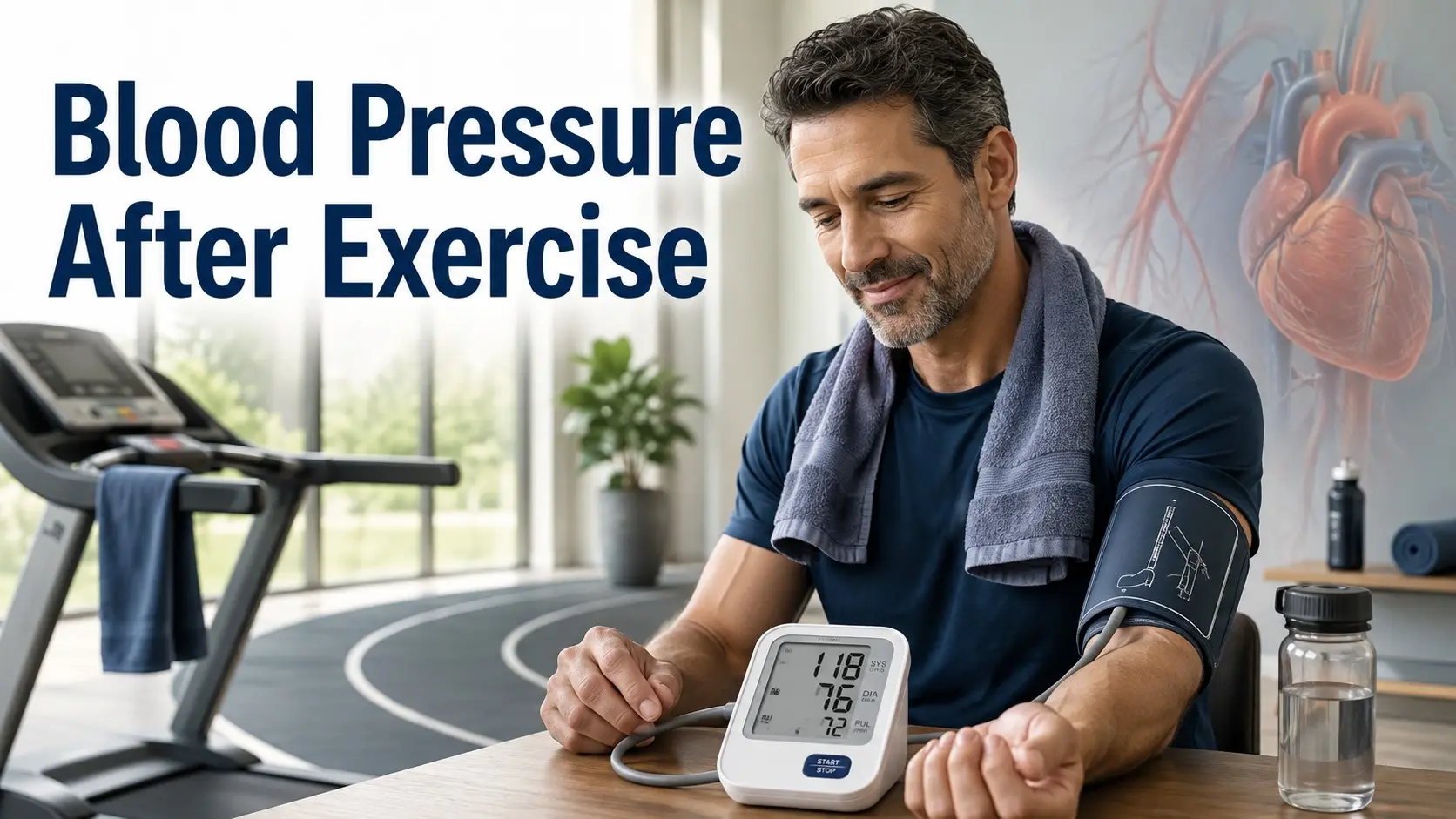
Blood Pressure After Exercise normally changes as your body recovers. The top number rises during activity and then falls after you stop. The bottom number usually changes much less.
There is no single perfect post-workout blood pressure number.
Timing matters.
A reading taken one minute after running is not the same as a resting blood pressure measurement taken 30 minutes later.
Quick Answer: What Blood Pressure Is Normal After Exercise?
Blood Pressure After Exercise should usually move toward your resting level as you recover. Systolic pressure rises during activity and then falls. Diastolic pressure changes less. Later, blood pressure can temporarily fall below your starting level. There is no single normal recovery number for every person.
Medical note: I am not a dermatologist or A doctor, and this content does not replace professional medical advice. What I share comes from real life experience, extensive research, and consultation with healthcare providers. Always consult qualified medical professionals for diagnosis and treatment of any health condition.
What Happens to Blood Pressure During Exercise?
Your muscles need more oxygen when you exercise.
Your heart responds by pumping more blood.
This raises cardiac output.
As a result, systolic blood pressure, the top number, normally rises during dynamic exercise.
This includes activities such as:
- Walking
- Running
- Cycling
- Swimming
Diastolic blood pressure, the bottom number, usually changes much less.
It may stay near the starting level or fall slightly because blood vessels in working muscles widen.
This is a normal exercise response.
There Is No Single Normal Blood Pressure After Exercise
This is the most useful fact to understand.
A post workout reading depends on many things.
These include:
- How hard you exercised
- How long you exercised
- Your resting blood pressure
- Your age
- Your fitness level
- Your medicines
- Your hydration
- The temperature
- How quickly you stopped
- How many minutes passed before measurement
That makes a table saying everyone should reach exactly 130/80 after five minutes misleading.
I would look at the pattern instead.
The top number should start falling after exercise ends.
The First Few Minutes Are Exercise Recovery, Not Resting Blood Pressure
Suppose your normal blood pressure is 118/72.
You finish a hard cycling session.
Two minutes later, your monitor shows 148/74.
That does not automatically mean you developed hypertension.
Your heart rate is still elevated.
Your circulation is still adjusting.
Your systolic pressure is moving down from its exercise level.
That is blood pressure recovery.
It is not the same thing as checking your normal resting blood pressure.
What Should Happen During the First Several Minutes?
After dynamic exercise stops, systolic pressure should begin falling.
Your heart rate also starts moving toward its resting level.
Clinical exercise testing monitors this recovery period because the direction and speed of recovery provide useful information.
Diastolic pressure usually changes much less.
Do not expect the numbers to return instantly to the values you had before exercise.
Your body needs time to adjust.
Blood Pressure Can Fall Below Normal Later in Recovery
This surprises people.
Blood pressure does not always stop at its starting point.
It may fall below your pre workout reading for a period after exercise.
This response is called post exercise hypotension.
The name sounds dangerous.
In many people, it is a normal physiological response.
Researchers study it because it is one way a single exercise session can temporarily lower blood pressure.
Why Does Blood Pressure Fall After Exercise?
Your blood vessels widen during exercise so more blood can reach working muscles.
When exercise ends, your heart begins reducing its output.
The blood vessels do not instantly tighten back to their starting state.
For a while, vascular resistance remains lower.
That can reduce blood pressure.
Your nervous system, blood volume, body position, and other mechanisms also affect the response.
The result can be a temporary post-workout drop.
How Long Can Post Exercise Hypotension Last?
There is no single answer.
Some studies find a clear blood pressure reduction during the first hour.
Other studies show effects that continue for several hours.
The duration varies with:
- Exercise intensity
- Exercise type
- Starting blood pressure
- Fitness
- Medicines
- Recovery position
- Individual physiology
People with hypertension can experience a noticeable post-exercise reduction.
That does not mean the pressure should keep falling.
Symptoms still matter.
When Should You Check Blood Pressure After Exercise?
Ask what you are trying to measure.
If You Want to Measure Recovery
A reading during the first few minutes can be useful.
Write down exactly when you took it.
For example:
148/74 at two minutes after cycling
That timing gives the number context.
If You Want Your Resting Blood Pressure
Wait longer.
The American Heart Association recommends avoiding exercise for at least 30 minutes before taking a standard home blood pressure reading.
Then sit quietly for at least five minutes.
Measure with proper technique.
This is the number you should compare with your normal resting blood pressure.
How Should You Measure Blood Pressure After Recovery?
For a true resting comparison:
- Wait at least 30 minutes after exercise
- Sit quietly for at least five minutes
- Keep your back supported
- Keep both feet flat on the floor
- Keep your legs uncrossed
- Support your arm at heart level
- Place the cuff on bare skin
- Do not talk
- Use the correct cuff size
Take two readings about one minute apart.
Record both.
This gives you something meaningful to compare with your usual blood pressure.
Why Can Stopping Exercise Suddenly Make You Dizzy?
Your leg muscles help move blood back toward your heart while you are exercising.
This is sometimes called the muscle pump.
Stop intense exercise abruptly, and that help disappears.
At the same time, your blood vessels may still be wide.
More blood can temporarily pool in the lower body.
Less blood returns to the heart.
Blood pressure can fall.
This helps explain why some people feel dizzy when they suddenly stop after hard exercise.
A Gradual Cooldown Makes Sense
After moderate or hard exercise, keep moving gently for a few minutes.
Walk slowly.
Let your breathing settle.
Allow your heart rate to fall gradually.
A cooldown after exercise gives your circulation time to adjust.
This is especially useful if you:
- Feel dizzy after workouts
- Have naturally low blood pressure
- Take blood pressure medicine
- Exercise in hot weather
- Have a history of fainting
Does Dehydration Affect Blood Pressure After Exercise?
Yes.
You lose fluid through sweat.
Heat increases that loss.
Lower blood volume can make blood pressure fall more during recovery.
Signs that dehydration may be contributing include:
- Thirst
- Dry mouth
- Dark urine
- Weakness
- Headache
- Dizziness
Replace fluids appropriately after exercise.
But do not blame every episode of severe dizziness on dehydration.
Chest pain, fainting, serious breathing problems, or unusual heart rhythm symptoms need medical attention.
Can Blood Pressure Medicine Increase the Post-Workout Drop?
Yes.
Blood pressure medicines lower blood pressure.
Exercise also changes blood pressure.
Some people therefore experience a stronger drop during recovery.
This does not mean the medicine is wrong.
It means symptoms and readings should be reviewed in context.
Do not skip or change a blood pressure medicine before exercise unless your healthcare professional tells you to.
If your bottom number is repeatedly low, read Low Diastolic Blood Pressure.
Is Lower Blood Pressure After Exercise Good?
Often, yes.
A modest temporary reduction is a recognized effect of physical activity.
This is one reason regular exercise supports long term cardiovascular health.
But lower is not always better.
A blood pressure drop that makes you faint is not a fitness achievement.
The useful distinction is between:
- A normal temporary reduction with no symptoms
- A large drop that makes you weak, dizzy, confused, or faint
The second pattern deserves more attention.
What Happens to Blood Pressure After Strength Training?
Strength training produces a different pattern from steady walking or cycling.
Blood pressure can rise considerably during a hard lift.
The rise is affected by:
- The amount of weight
- The size of the muscles working
- The duration of the effort
- Whether you hold your breath
After the workout, blood pressure can also fall below the starting level.
Research supports post-exercise hypotension after resistance exercise, although the size of the effect differs between people.
Why Does Holding Your Breath Matter During Lifting?
Heavy lifting sometimes causes people to hold their breath and strain.
This produces large short term cardiovascular changes.
For recreational training, controlled breathing is a sensible default.
If you have severe uncontrolled hypertension or known heart disease, get professional advice before very heavy resistance training.
Do not use a home blood pressure cuff between heavy sets and compare the reading with normal resting blood pressure categories.
That is not what those categories were designed for.
What Happens After High-Intensity Interval Training?
High-intensity interval training can also produce a temporary reduction in blood pressure during recovery.
A 2026 systematic review found evidence of short term blood pressure reduction after sprint interval exercise.
But the research base remains small.
The exercise protocols also differ considerably.
I would not claim that sprint training is better than every other form of exercise for lowering post workout blood pressure.
The evidence does not support that conclusion yet.
Should Diastolic Blood Pressure Rise During Aerobic Exercise?
Usually, it does not rise very much.
Systolic pressure during exercise rises because the heart pumps more blood.
Diastolic pressure usually stays near the starting level or decreases slightly because blood vessels widen.
A repeatable unusual diastolic response during a supervised exercise test deserves medical interpretation.
A home cuff reading taken while you are moving is much less useful.
Do Not Use Exercise Stress Test Limits as Workout Targets
This mistake is easy to make.
Clinical exercise stress testing has safety criteria that tell medical professionals when a supervised test should be stopped.
Some traditional exercise testing guidance lists very high pressures such as systolic pressure above 250 mm Hg or diastolic pressure above 115 mm Hg among reasons to stop a test.
These are not healthy workout targets.
They are not values you should approach.
They are not proof that anything below them is safe.
Do not turn clinical test termination numbers into personal training goals.
Does Blood Pressure Recovery Speed Matter?
In standardized exercise testing, yes.
Researchers have studied how quickly systolic pressure falls after exercise.
A delayed decline can contain information about future cardiovascular risk.
But these findings come from controlled tests.
Your home measurement after jogging around the block is not the same thing.
A reading of 138 five minutes after your run does not diagnose heart disease.
Clinical stress testing controls workload, timing, equipment, and recovery conditions.
What Does a Normal Blood Pressure Recovery Pattern Look Like?
Think direction.
Do not think perfect number.
| Phase | Typical Pattern |
|---|---|
| During dynamic exercise | Systolic pressure rises |
| Exercise stops | Systolic pressure begins falling |
| Early recovery | Heart rate and systolic pressure move toward resting levels |
| Later recovery | Blood pressure may return near baseline or temporarily fall below it |
| Diastolic pressure | Usually changes less than systolic pressure |
That pattern is far more useful than memorizing one target value.
What Does 100/60 After Exercise Mean?
It depends on how you feel.
If you feel normal and 100/60 is not unusual for you, the reading may fit a normal post exercise reduction.
Now change the situation.
Your pressure is 100/60 and you feel as though you may faint.
That deserves more attention.
Sit or lie down safely.
Do not continue exercising.
Persistent or serious symptoms need medical assessment.
What If the Bottom Number Falls Below 60?
A temporary low diastolic value can occur after exercise.
Look at the entire reading.
110/58 with no symptoms is different from 82/50 with severe dizziness.
145/55 is different again because the systolic pressure is high and the pulse pressure is wide.
For those patterns, read:
and
What If Blood Pressure Stays High After Exercise?
First ask whether you have actually recovered.
A measurement taken five minutes after hard exercise is still influenced by exercise.
If you want a resting measurement:
- Wait at least 30 minutes after exercise.
- Sit quietly for at least five minutes.
- Measure correctly.
- Take two readings about one minute apart.
If the readings remain high when measured under proper resting conditions, track the pattern.
Repeated resting hypertension deserves medical assessment.
If the bottom number is the main problem, read High Diastolic Blood Pressure.
Is 180 Systolic After Exercise an Emergency?
Not automatically if you are actively exercising or have only just stopped.
Systolic pressure normally rises with exertion.
This is why resting blood pressure emergency thresholds should not be copied directly onto an active workout measurement.
After recovery, the situation changes.
The American Heart Association considers resting blood pressure above 180/120 mm Hg severely elevated.
If a properly repeated resting reading remains above this level, contact a healthcare professional promptly.
Call emergency services when very high blood pressure occurs with symptoms such as:
- Chest pain
- Shortness of breath
- Weakness
- Numbness
- Vision changes
- Difficulty speaking
Symptoms change the urgency.
When Should You Stop Exercising?
Stop exercising and seek medical attention for concerning symptoms such as:
- Chest pain or pressure
- Fainting
- Severe dizziness
- Severe or unusual shortness of breath
- New weakness or numbness
- New serious heart rhythm symptoms
- Blue or gray skin color
Do not push through serious symptoms because exercise is supposed to be healthy.
When Should You Talk to a Doctor About Recovery Readings?
I would discuss your exercise blood pressure response when:
- Blood pressure remains high after adequate recovery
- You repeatedly become dizzy after workouts
- You faint during or after exercise
- Your pressure drops sharply and you feel unwell
- You have known hypertension and see unusual patterns
- You have coronary artery disease
- You have heart failure
- You have heart valve disease
- You are starting vigorous exercise with major cardiovascular risk factors
Write down when the reading was taken.
"150/80 two minutes after running" means something different from "150/80 after 40 minutes of rest."
How Should You Track Blood Pressure Around Exercise?
Before Exercise
If you are tracking hypertension, measure your normal resting pressure before exercise on selected days.
Rest first.
During Exercise
Most people do not need to measure blood pressure during an ordinary workout.
If a clinician needs your exercise blood pressure, supervised testing may provide better information.
Immediately After Exercise
Measure only when there is a reason to study recovery.
Record the exact time after exercise.
For a Resting Comparison
Wait at least 30 minutes.
Then sit quietly for at least five minutes before measuring.
Heart Rate Recovery and Blood Pressure Recovery Are Different
Do not treat them as the same measure.
Your heart rate may fall quickly.
Your blood pressure may remain below baseline because your blood vessels are still dilated.
Or your heart rate can stay elevated because you are hot or dehydrated.
One number cannot reliably predict the other.
Measure the health signal you actually want to track.
Most Healthy People Do Not Need to Check Blood Pressure After Every Workout
I would not turn every exercise session into a blood pressure experiment.
That creates noise.
Tracking makes more sense when:
- You have hypertension
- Your healthcare professional asked you to monitor it
- You repeatedly feel dizzy after exercise
- You are reviewing a medicine response
- You have unexplained exercise symptoms
- You are participating in cardiac rehabilitation
Otherwise, exercise can simply end with a sensible cooldown and recovery.
Five Post Exercise Readings and How I Would Think About Them
| Reading | Timing | Practical Interpretation |
|---|---|---|
| 145/78 | 1 minute after a brisk run | Too early to interpret as a resting reading |
| 112/68 | 30 minutes after exercise | Can fit normal post exercise lowering if you feel well |
| 95/58 | After exercise with severe dizziness | Stop exercising and address the symptoms |
| 150/92 | 45 minutes later after proper rest | More meaningful and worth repeating correctly |
| Very high pressure with chest pain | During recovery | Seek urgent medical help |
Common Blood Pressure After Exercise Myths
Myth: Blood Pressure Should Be Normal Five Minutes After Every Workout
False.
Recovery varies.
Myth: Lower Blood Pressure After Exercise Is Always Dangerous
False.
Post exercise hypotension is a recognized physiological response.
Myth: The Lower the Post Workout Reading, the Fitter You Are
False.
Symptomatic hypotension is not a fitness goal.
Myth: A High Reading Immediately After Exercise Means You Have Hypertension
False.
Systolic pressure normally rises during exercise.
Myth: Exercise Stress Test Limits Are Safe Workout Targets
False.
They are clinical safety criteria used during supervised testing.
Myth: Everyone Should Check Blood Pressure After Every Workout
False.
Most healthy people do not need to.
My Approach to Blood Pressure After Exercise
I think timing is the part most online explanations miss.
A blood pressure reading is only useful when you know the conditions under which it was taken.
My background in information technology management taught me to look at data in context.
A number without its timing, source, conditions, or baseline can lead to the wrong conclusion.
I use that same approach when researching health information for NextFitLife.
For this guide, I compared American Heart Association home measurement guidance with exercise physiology reviews and current research on blood pressure recovery and post-exercise hypotension.
The practical message is simple.
Do not compare a recovery reading with a resting reading unless the timing and conditions are comparable.
Conclusion: Blood Pressure After Exercise Is About the Recovery Pattern
Blood Pressure After Exercise should be judged by the recovery pattern, not one perfect number.
Systolic pressure normally rises during exercise.
It should begin falling when exercise stops.
Later, blood pressure may temporarily fall below your starting level.
If you want a true resting reading, wait at least 30 minutes after exercise and rest quietly for at least five minutes before measuring.
Your next step: If your post-workout readings concern you, record the full blood pressure, your symptoms, the exercise you performed, and exactly how many minutes passed before each measurement. Bring that pattern to your healthcare professional.
References and Sources
This article was checked against current cardiovascular guidance and publicly accessible research.
- American Heart Association. Home Blood Pressure Monitoring.This guidance explains proper home measurement, including avoiding exercise for at least 30 minutes before a resting blood pressure check, resting quietly, using an upper arm cuff, and taking repeated measurements.Read American Heart Association Home Blood Pressure Guidance
- American Family Physician. Exercise Stress Testing: Indications and Common Questions.This clinical review explains the expected blood pressure response during dynamic exercise, including rising systolic pressure, smaller changes in diastolic pressure, recovery monitoring, and stress test termination criteria.Read the Clinical Exercise Stress Testing Review
- Post Exercise Hypotension and Cardiovascular Regulation Review.This PubMed-indexed research reviews the temporary reduction in blood pressure after exercise and the cardiovascular mechanisms that influence the response.Read the Post Exercise Hypotension Review
- Post Exercise Syncope and Blood Pressure Regulation.This open access review explains how persistent blood vessel dilation and loss of the muscle pump after exercise can contribute to post-workout dizziness, low blood pressure, and fainting.Read the Open Access Post Exercise Syncope Review
- 2026 Systematic Review of Sprint Interval Exercise and Post Exercise Blood Pressure.This open access 2026 review found evidence of short term blood pressure reductions after sprint interval exercise while also emphasizing the limited number of studies and variation between protocols.Read the 2026 Open Access Exercise Review
Source Review Date: August 29, 2026
Continue Reading on NextFitLife
Heart and Cardiovascular Health Hub: Heart and Cardiovascular Health
Fitness Hub: NextFitLife Fitness
Main Health Hub: NextFitLife Health
About the Author
Adel Galal is the founder and health and wellness writer at NextFitLife.
Before focusing on NextFitLife, Adel spent 29 years working in information technology management.
That background developed his skills in data review, structured analysis, source comparison, problem-solving, and clear communication.
He now uses those skills to compare public health guidance, review medical research, challenge exaggerated claims, and explain health measurements in simple language.
For this article, his focus is on explaining why the timing of a blood pressure measurement changes its meaning and why an immediate post-workout reading should not be judged as though it were a resting blood pressure result.
I am not a dermatologist or A doctor, and this content does not replace professional medical advice. What I share comes from real-life experience, extensive research, and consultation with healthcare providers. Always consult qualified medical professionals for diagnosis and treatment of any health condition.
Read the full Adel Galal author profile and NextFitLife editorial approach.
Frequently Asked Questions About Blood Pressure After Exercise
What should Blood Pressure After Exercise be?
There is no single normal number for everyone. Systolic pressure should begin falling after activity ends, while diastolic pressure usually changes less. Timing, exercise intensity, fitness, medicines, and starting blood pressure all affect the result.
How long should I wait to check blood pressure after exercise?
If you want a resting home blood pressure measurement, the American Heart Association recommends avoiding exercise for at least 30 minutes and then resting quietly for at least five minutes before measuring.
Is high blood pressure immediately after exercise normal?
Systolic pressure normally rises during exercise and can remain elevated during early recovery. A reading taken immediately after exercise should not be interpreted as a resting blood pressure measurement.
Why does my blood pressure drop after exercise?
Blood vessels remain dilated after exercise while cardiac output begins falling. This can temporarily reduce blood pressure below the pre exercise level.
What is post exercise hypotension?
Post exercise hypotension is a temporary reduction in blood pressure below the pre exercise level after a workout. It is a recognized physiological response.
How long does post exercise hypotension last?
The duration varies. Research has found reductions lasting from part of the first hour to several hours, depending on the person, exercise session, and starting blood pressure.
Is 100/60 normal after exercise?
It can be normal if you feel well and this is not an unusual blood pressure for you. If the reading comes with severe dizziness or fainting, the symptoms deserve attention.
Is 140/80 normal after exercise?
Timing matters. One minute after hard exercise it can reflect normal recovery. If it remains elevated after at least 30 minutes and proper seated rest, repeat it and track the pattern.
Can exercise lower blood pressure too much?
Blood pressure can fall enough to cause dizziness or fainting, especially with dehydration, medicines, heat, or abrupt stopping. Severe or repeated symptoms should be assessed.
Why do I get dizzy when I stop exercising?
Blood vessels remain dilated while the muscle pump in your legs suddenly becomes less active. Blood can pool in the lower body, temporarily reducing blood return to the heart.
Should I cool down after exercise?
A gradual cooldown is sensible after moderate or vigorous exercise, especially if you tend to feel dizzy after suddenly stopping.
Does strength training raise blood pressure?
Blood pressure can rise substantially during difficult resistance exercise, especially with heavy loads or breath holding. Pressure can then fall during recovery.
Does high-intensity interval training lower blood pressure afterward?
Research supports a short-term post-workout blood pressure reduction, but current evidence does not prove that interval training is superior to other exercise methods.
When should post-exercise blood pressure worry me?
Seek medical advice for repeated abnormal recovery readings, fainting, severe dizziness, persistent high resting pressure after recovery, chest symptoms, unusual shortness of breath, or other concerning symptoms.
When is high blood pressure after exercise an emergency?
Very high blood pressure with chest pain, breathing difficulty, weakness, numbness, vision changes, difficulty speaking, fainting, or other serious symptoms needs urgent medical assessment.

Health & wellness writer with 30+ years of experience in nutrition, fitness, and healthy aging. Founder of NextFitLife.com — evidence-based health guidance.