Last Updated: August 30, 2026
Next Review: August 2027, or sooner if major exercise cardiology guidance changes
Written and Source Checked by: Adel Galal, Founder of NextFitLife
Review Status: Fully updated using current clinical guidance and open research on heart rate recovery, autonomic function, cardiovascular risk, and exercise training
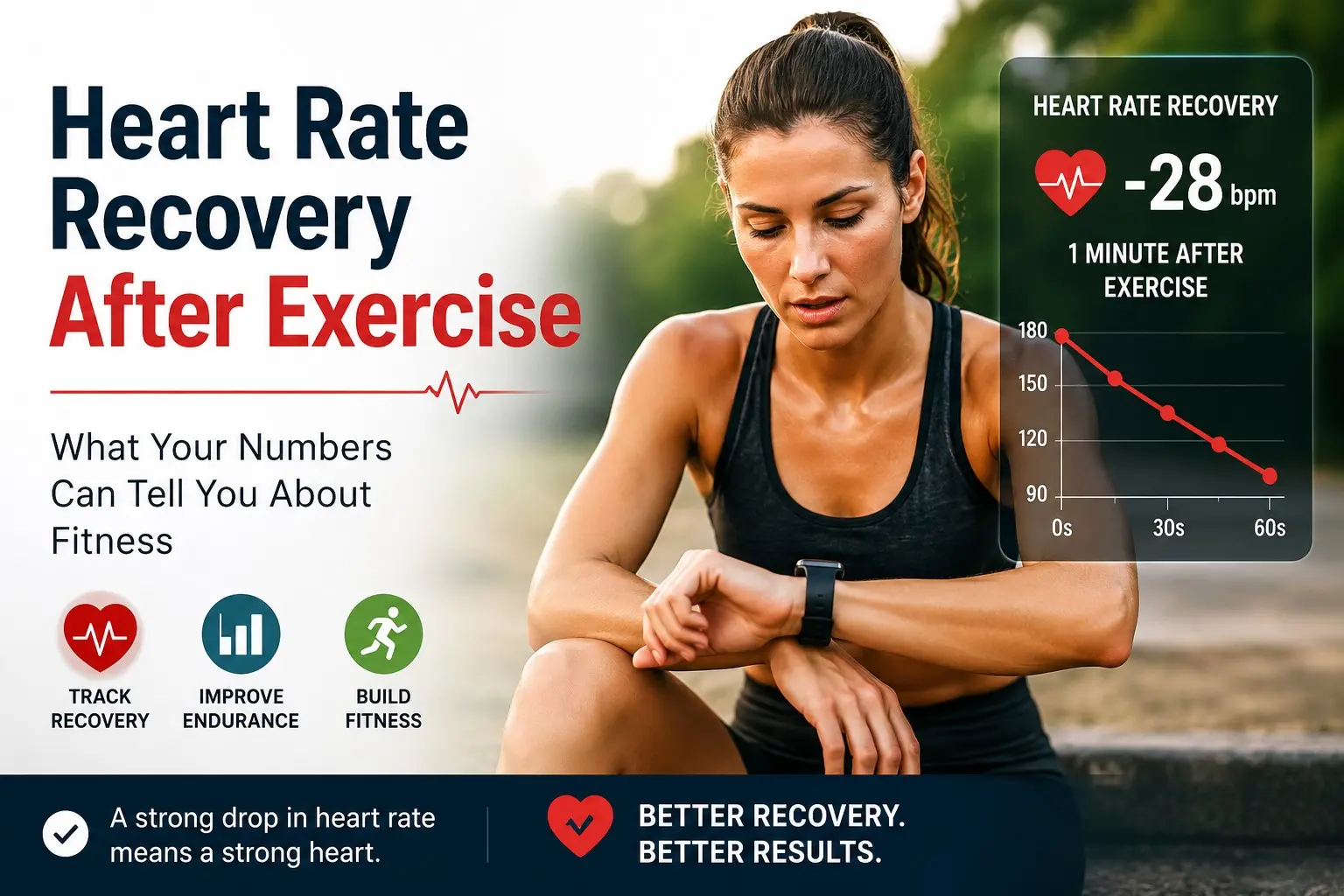
Heart rate recovery after exercise is the number of beats your heart rate falls after you stop exercising.
A faster drop is usually a good sign.
But there is a catch.
The way you recover changes the number.
Walking slowly for one minute, sitting still for one minute, and lying down for one minute can produce different results.
That means your recovery method matters almost as much as the number itself.
Quick Answer: What Is a Good Heart Rate Recovery After Exercise?
Heart rate recovery after exercise measures how far your heart rate falls after activity ends. A one minute drop of about 18 beats or more is a commonly used reassuring reference, but there is no single perfect number. Fitness, age, medicines, exercise intensity, and whether you walk, sit, or lie down during recovery all change the result.
Medical note: This content is for general educational purposes and does not replace professional medical advice, diagnosis, or treatment. Consult an appropriately qualified healthcare professional for personal medical concerns. This article explains published guidance and does not provide a personal clinical assessment. Always consult qualified medical professionals for diagnosis and treatment of any health condition.
What Is Heart Rate Recovery?
Heart rate recovery, often shortened to HRR, measures how quickly your heart slows after exercise.
Your heart rate rises during activity because your muscles need more oxygen.
When the exercise ends, your body starts shifting back toward rest.
Your heart rate falls.
The speed of that fall gives information about your cardiovascular system and your autonomic nervous system.
Cleveland Clinic describes HRR as the difference between peak exercise heart rate and the heart rate measured soon after activity stops.
One minute is one of the most common measurement points.
How Do You Calculate One Minute Heart Rate Recovery?
The calculation is simple.
Heart Rate Recovery = End Exercise Heart Rate Minus Heart Rate After One Minute
Imagine you finish a hard exercise session at 160 beats per minute.
One minute later, your heart rate is 135.
160 minus 135 equals 25.
Your one minute heart rate recovery is 25 beats per minute.
That sounds straightforward.
But make sure your first number is taken at the end of the hard effort.
Do not use the heart rate after a long cooldown as your starting number.
Is an 18 Beat Drop After One Minute Good?
Cleveland Clinic currently uses a one minute fall of about 18 beats per minute or more as a broadly reassuring general reference.
For example:
Peak heart rate = 165 bpm
Heart rate after one minute = 145 bpm
HRR = 20 bpm
That clears the 18 beat general reference.
But do not turn 18 into a pass or fail test.
A value of 17 is not automatically bad.
A value of 19 is not proof of perfect heart health.
Cleveland Clinic itself says there is no single magic number for everyone.
Why Do Some Sources Say 12 Beats Instead of 18?
This is where many articles create confusion.
The famous 1999 clinical study by Cole and colleagues used a one minute decline of 12 beats per minute or less as an abnormal recovery value.
The study followed people undergoing formal exercise testing.
Its result became widely quoted.
But it came from a specific clinical exercise and recovery protocol.
Other studies have used different cutoffs.
Some used 18.
Some measured recovery after active movement.
Others used passive recovery.
So 12 and 18 are not competing universal laws.
They are values tied to different testing methods.
The Recovery Method Changes Your HRR Number
This is the part I would remember.
Imagine two people both finish exercise at 165 bpm.
Person A sits quietly.
Person B keeps walking.
Their heart rates do not have to fall at the same speed.
A study comparing several recovery protocols found significant differences in HRR depending on recovery position and activity.
Active recovery produced slower HRR than inactive recovery while seated.
Lying down also changed recovery compared with upright recovery.
So do not compare your active recovery number with someone else's passive recovery number.
You did different tests.
What Is Active Recovery?
Active recovery means you keep moving after the main exercise ends.
Examples include:
- Slow walking after running
- Easy pedaling after cycling
- Gentle movement after an interval session
Your muscles still need energy.
Your heart still has work to do.
So heart rate usually falls more slowly than if you stop completely.
This does not mean active recovery is unhealthy.
It means you should compare active recovery readings with other active recovery readings.
What Is Passive Recovery?
Passive recovery means you stop the exercise and rest.
You might stand, sit, or lie down.
Even those positions can change the result.
A supine position can produce a faster fall than sitting upright because blood returns to the heart differently.
This is why a medical exercise test needs a defined protocol.
The protocol makes the number interpretable.
Heart Rate Recovery Has a Fast Phase and a Slow Phase
Cleveland Clinic describes two broad recovery phases.
The fast phase is the early fall during roughly the first 30 seconds to one minute.
The slow phase continues over the next several minutes.
The first minute gets the most attention because the heart rate changes quickly during that period.
It also reflects the rapid shift in autonomic control after exercise stops.
What Does the Nervous System Have to Do With HRR?
Your heart does not slow by itself.
The autonomic nervous system helps control heart rate without you consciously thinking about it.
During harder exercise, sympathetic activity helps increase heart rate.
After exercise ends, parasympathetic reactivation helps slow it.
Research indicates that parasympathetic activity plays a strong role in the early heart rate decline.
Sympathetic withdrawal also contributes as recovery continues.
That is why HRR is sometimes used as an indirect marker of autonomic function.
It is not a direct test of one nerve.
Does Faster Heart Rate Recovery Mean Better Fitness?
Usually, there is a relationship.
Trained people often recover faster than people who are less conditioned.
Exercise training can improve HRR in many people.
A systematic review found that HRR has potential for monitoring changes in training status.
But the researchers also found important variation between studies.
Age, temperature, exercise intensity, and exercise duration all affected comparison.
So HRR is a useful fitness signal.
It is not a complete fitness score.
HRR Is Not the Same as VO2 Max
This distinction matters.
VO2 max measures the maximum amount of oxygen your body can use during hard exercise.
Heart rate recovery measures how quickly your heart rate falls after exercise.
Both relate to cardiorespiratory fitness.
They answer different questions.
A fast HRR does not give you an exact VO2 max.
And a VO2 max result does not tell you exactly how quickly your heart rate should fall after one minute.
For broader fitness guidance, visit the NextFitLife Fitness Hub.
Do You Need a Heart Rate Recovery Chart by Age?
I would not rely heavily on one.
Age affects heart rate.
It also affects HRR.
But there is no universally accepted clinical chart that says:
Age 30 must equal one number.
Age 40 must equal another.
Age 60 must equal another.
Many online age charts make HRR look more precise than the evidence supports.
Your own trend, measured under the same conditions, is often more useful.
What Is a Good Two Minute Heart Rate Recovery?
Two minute HRR is also used in research.
Some studies have reported specific two minute thresholds.
But those values come from defined exercise protocols.
I would not turn one research value into a universal home target.
For home tracking, one minute HRR is simpler.
If you also track two minute HRR, keep doing it the same way each time.
Is Slow Heart Rate Recovery a Sign of Heart Disease?
Not by itself.
This is where an interesting research finding can become frightening online.
Clinical studies have found that slower HRR is associated with higher cardiovascular risk and mortality in certain populations.
A meta analysis of prospective studies also found that attenuated HRR was associated with cardiovascular events and all cause mortality.
That is useful medical information.
It does not mean:
"My watch shows HRR 14, so I have heart disease."
That conclusion is not justified.
A slow result can reflect many things.
What Can Slow Heart Rate Recovery?
Possible influences include:
- Lower aerobic fitness
- Exercise intensity
- Recovery position
- Active recovery
- Age
- Heat
- Dehydration
- Illness
- Medicines
- Cardiovascular disease
- Autonomic dysfunction
This is why one bad reading is weak evidence.
A repeated change under comparable conditions is more useful.
Can Beta Blockers Change Heart Rate Recovery?
Yes.
Beta blockers reduce heart rate and change the heart's response to exercise.
Other medicines can also influence heart rate.
If you take heart rate medicine, do not compare your numbers with someone who does not.
Do not stop prescribed medicine to get a higher peak heart rate or a better HRR score.
Medication safety matters more than a fitness metric.
Can Dehydration Affect Recovery Heart Rate?
Yes.
Dehydration reduces circulating blood volume.
This places more stress on the cardiovascular system during exercise.
Heat can add more stress.
Your recovery can therefore look different on a hot day than on a cool day.
If one HRR result suddenly looks worse, ask what changed before assuming your fitness declined.
Workout Intensity Changes the Result Too
A gentle bike ride and an all out interval session are not the same test.
The harder workout creates a different autonomic and cardiovascular demand.
Research reviews repeatedly identify exercise intensity and duration as factors that influence HRR.
This is another reason random workouts make poor comparison tests.
If you want to track progress, choose something repeatable.
How Should You Track Heart Rate Recovery at Home?
Keep the method simple.
- Choose a repeatable exercise session.
- Use the same heart rate device.
- Reach a similar effort level each time.
- Record your heart rate at the end of the hard effort.
- Use the same recovery method every time.
- Measure again exactly one minute later.
- Subtract the second number from the first.
- Record the result.
Then compare several sessions.
Do not judge your fitness from one workout.
A Personal Trend Is More Useful Than a Random Internet Score
Imagine these results from the same cycling test.
| Week | One Minute HRR |
|---|---|
| Week 1 | 20 bpm |
| Week 4 | 24 bpm |
| Week 8 | 29 bpm |
That trend is useful.
Now compare three unrelated workouts:
Hard hill run: HRR 19
Easy cycling: HRR 34
Heavy leg workout: HRR 22
Those numbers are harder to interpret.
The exercise changed.
Can a Smartwatch Measure Heart Rate Recovery?
For fitness tracking, many modern wearables can provide useful heart rate data.
But no watch is perfect.
Wrist devices usually use optical sensors.
Movement, sweat, skin contact, exercise type, and intensity can affect the reading.
A wearable can also miss the true peak if the heart rate changes quickly.
If the starting heart rate is wrong, the HRR calculation will be wrong too.
Should You Use a Chest Strap Instead?
A chest strap can provide cleaner heart rate data during some workouts.
It measures electrical activity associated with each heartbeat rather than relying only on optical pulse detection at the wrist.
This can be useful for:
- Interval training
- Fast heart rate changes
- Structured fitness testing
- Athletes who want more consistent data
You do not need a chest strap simply to become healthier.
Consistency matters more than buying more technology.
Heart Rate Recovery Is Not Resting Heart Rate
The names are easy to mix up.
Resting heart rate is your pulse while you are at rest.
Heart rate recovery measures how far your elevated heart rate falls after exercise.
They are related.
They are not interchangeable.
You can improve one without seeing the same change in the other.
Heart Rate Recovery Is Not Heart Rate Reserve
Another similar name.
A different calculation.
Heart rate reserve usually means maximum heart rate minus resting heart rate.
It is often used when setting exercise intensity.
Heart rate recovery means exercise ending heart rate minus recovery heart rate.
One describes your training range.
The other describes recovery.
HRR Is Not Heart Rate Variability
Heart rate variability, or HRV, measures tiny differences in time between individual heartbeats.
HRR measures the larger fall in beats per minute after exercise.
Both relate to autonomic regulation.
They measure different things.
Your watch may show resting heart rate, HRV, HRR, and exercise heart rate.
Four numbers.
Four different questions.
Can Exercise Improve Heart Rate Recovery?
Yes, in many people.
Aerobic training has been associated with improved HRR.
A systematic review of athletes and less trained people found evidence that HRR can improve with training, although not every study found the same effect.
A separate systematic review in people with established heart disease found aerobic training improved HRR compared with usual care.
The sensible goal is better cardiovascular fitness.
Do not train only to make one watch number look better.
What Helps Improve Cardiovascular Recovery?
I would focus on the basics.
- Regular aerobic activity
- Gradual training progression
- Enough recovery between hard sessions
- Appropriate hydration
- Good sleep
- Stopping smoking
- Managing high blood pressure
- Managing diabetes
- Following medical treatment when needed
No supplement is required simply because your HRR number is lower than you expected.
For cardiovascular lifestyle guidance, read Healthy Lifestyle Roadmap.
Can HRR Tell You If You Are Overtraining?
Not by itself.
HRR has been studied as a training monitoring tool.
The evidence is interesting but not clean enough to use one recovery value as an overtraining diagnosis.
If your HRR suddenly slows, also look at:
- Sleep
- Training load
- Illness
- Performance
- Resting heart rate
- Muscle soreness
- Fatigue
- How you actually feel
One number should not control your training decisions.
Why Might Your HRR Be Worse Today?
Before assuming your fitness disappeared overnight, check the conditions.
Was the workout harder?
Was the weather hotter?
Did you keep walking during recovery?
Are you sick?
Did you sleep badly?
Did you use a different device?
Did your watch capture the real peak heart rate?
A change in measurement can look like a change in physiology.
Five One Minute HRR Examples
| Exercise Ending Heart Rate | Heart Rate After One Minute | HRR | Simple Interpretation |
|---|---|---|---|
| 160 | 135 | 25 bpm | Above the common 18 beat general reference |
| 155 | 140 | 15 bpm | Worth repeating under the same recovery conditions |
| 170 | 158 | 12 bpm | Slow enough to deserve attention if it repeatedly occurs |
| 145 | 115 | 30 bpm | Fast one minute recovery |
| 175 | Irregular racing with dizziness | Do not calculate | Symptoms matter more than the HRR score |
Does an HRR of 12 Mean Something Is Wrong?
Not automatically.
The number 12 comes from influential clinical research.
But the study used a defined exercise and recovery protocol.
Your home workout may not match it.
If you repeatedly see an HRR around 12 after the same workout and the same recovery method, I would pay attention.
I would care more if the change is new or you also have cardiovascular symptoms.
When Should Slow Heart Rate Recovery Be Checked?
Talk with a healthcare professional if your HRR repeatedly becomes much slower than expected under comparable exercise conditions.
I would be more concerned if you also have:
- Chest pain or pressure
- Fainting
- Severe dizziness
- Unusual shortness of breath
- Repeated irregular palpitations
- Known cardiovascular disease
- Diabetes
- Major cardiovascular risk factors
- A strong family history of early heart disease
A clinician can decide whether formal exercise testing or other evaluation is appropriate.
When Should Exercise Symptoms Get Urgent Attention?
Stop exercise if you develop:
- Chest pain
- Fainting
- Severe breathing difficulty
- New weakness
- New numbness
- Severe dizziness
- A sustained abnormal heartbeat with serious symptoms
Do not finish the workout because a watch tells you to.
The workout can wait.
How Does HRR Fit With Blood Pressure Recovery?
Heart rate and blood pressure both change after exercise.
They do not recover in exactly the same way.
Your heart rate can fall quickly while blood vessels remain dilated.
This can leave blood pressure temporarily lower after exercise.
That is why heart rate recovery and blood pressure recovery should be tracked as separate measures.
For the full explanation, read Blood Pressure After Exercise.
My Preferred Way to Use Heart Rate Recovery for Fitness
Keep the test boring.
That makes it better.
Use the same exercise.
Use the same device.
Finish at roughly the same effort.
Use the same recovery method.
Measure after exactly one minute.
Then look at the trend over several weeks.
I care much more about a consistent change from 20 to 25 to 29 than one random score after one unusual workout.
Common Heart Rate Recovery Myths
Myth: 18 Beats Is a Perfect Cutoff
False.
It is a useful general reference, not a universal diagnosis line.
Myth: A Recovery of 12 Means Heart Disease
False.
The 12 beat threshold came from specific clinical research protocols.
Myth: Faster HRR Proves You Are Very Fit
False.
It is one useful fitness signal.
Myth: Age Charts Tell You Exactly What HRR Should Be
False.
There is no single validated diagnostic HRR chart for every age.
Myth: Your Smartwatch Gives a Medical Diagnosis
False.
Wearable heart rate data can be useful, but device accuracy and workout conditions matter.
Myth: Heart Rate Recovery and Resting Heart Rate Are the Same Thing
False.
They measure different parts of cardiovascular function.
My Approach to Heart Rate Recovery After Exercise
I think fitness numbers become useful when the method behind them is clear.
A number without its conditions can be misleading.
My background in information technology management trained me to compare data, look for patterns, check measurement conditions, and avoid drawing big conclusions from one data point.
I use the same approach when researching health information for NextFitLife.
For this article, I compared current clinical guidance with open research on exercise testing, autonomic recovery, recovery protocols, cardiovascular outcomes, and training response.
The main lesson is simple.
Measure the same way.
Compare the trend.
Do not let one wearable number diagnose you.
Conclusion: Heart Rate Recovery After Exercise Works Best as a Trend
Heart rate recovery after exercise can give you useful information about cardiovascular recovery and fitness.
A one-minute fall of about 18 beats or more is a common reassuring reference.
But the protocol changes the number.
Active recovery, passive recovery, exercise intensity, age, medicines, and measurement accuracy all matter.
Your next step: Pick one repeatable workout, use the same recovery method, measure your one minute HRR the same way for several weeks, and discuss a repeated slow recovery or new symptoms with a healthcare professional.
References and Sources
This article was checked against the following publicly accessible clinical and research sources.
- Cleveland Clinic. Heart Rate Recovery: What It Is and How to Calculate It.This medically reviewed guide explains the HRR calculation, fast and slow recovery phases, the general 18-beat one-minute reference, factors that change HRR, and the role of HRR in exercise stress testing.Read Cleveland Clinic Heart Rate Recovery Guidance
- New England Journal of Medicine Study. Heart Rate Recovery Immediately After Exercise as a Predictor of Mortality.This landmark clinical study followed 2,428 adults undergoing exercise testing and established the widely cited 12 beat one minute threshold within its specific recovery protocol.Read the Study on PubMed
- Journal of Sports Science and Medicine. Heart Rate Recovery After Submaximal Exercise in Four Recovery Protocols.This open study directly compared active recovery, inactive seated recovery, supine recovery, and supine recovery with elevated legs. It shows why recovery method changes HRR results.Read the Open Access Recovery Protocol Study
- Journal of the American Heart Association. Heart Rate Recovery and Cardiovascular Events and Mortality.This open meta analysis of prospective studies found that slower HRR was associated with increased cardiovascular events and all cause mortality, supporting its use as one clinical risk marker rather than a stand alone diagnosis.Read the Open Access HRR Meta Analysis
- Systematic Review of Heart Rate Recovery and Training Status.This PubMed indexed systematic review found that HRR has potential for monitoring training adaptation while also emphasizing the effects of age, temperature, exercise intensity, exercise duration, and protocol differences.Read the Heart Rate Recovery Training Review
Source Review Date: August 30, 2026
These organizations and researchers do not endorse NextFitLife.
Continue Reading on NextFitLife
Heart and Cardiovascular Health Hub: Heart and Cardiovascular Health
Fitness Hub: NextFitLife Fitness
Main Health Hub: NextFitLife Health
About the Author
Adel Galal is the founder and health and wellness writer at NextFitLife.
Before focusing on NextFitLife, Adel spent 29 years working in information technology management.
That background developed his skills in data review, structured analysis, source comparison, measurement, problem solving, and clear communication.
He now uses those skills to compare public health guidance, review scientific research, challenge exaggerated claims, and explain health and fitness measurements in simple language.
For this article, his focus is on showing why heart rate recovery is useful only when the exercise and recovery method are clear, and why one watch result should never be treated as a medical diagnosis.
This content is for general educational purposes and does not replace professional medical advice, diagnosis, or treatment. Consult an appropriately qualified healthcare professional for personal medical concerns. This article explains published guidance and does not provide a personal clinical assessment. Always consult qualified medical professionals for diagnosis and treatment of any health condition.
Read the full Adel Galal author profile and NextFitLife editorial approach.
Frequently Asked Questions About Heart Rate Recovery After Exercise
What is heart rate recovery after exercise?
Heart rate recovery is the number of beats your heart rate falls after exercise ends. It is commonly measured after one minute.
How do I calculate one minute heart rate recovery?
Subtract your heart rate one minute after exercise from your heart rate at the end of the hard effort. If you finish at 160 and reach 135 after one minute, your HRR is 25 bpm.
What is a good one minute heart rate recovery?
Cleveland Clinic uses a decline of about 18 beats per minute or more as a general reassuring reference. There is no single perfect value for everyone.
Is a heart rate recovery of 12 bad?
Not automatically. Twelve beats was used as an abnormal threshold in an influential clinical study, but that value was tied to a specific exercise and recovery protocol.
Why do some sources use 12 and others use 18?
Different studies use different exercise tests, recovery positions, and active or passive recovery methods. The protocol changes the HRR value.
Does walking during recovery change HRR?
Yes. Active recovery usually keeps heart rate higher than complete rest, so your one-minute decline can be smaller.
Does lying down make heart rate recover faster?
Research comparing recovery positions has found faster HRR in supine recovery than some upright recovery methods.
Does faster heart rate recovery mean better fitness?
Faster HRR is commonly associated with better cardiorespiratory fitness and autonomic recovery, but it should be treated as one fitness signal rather than a complete fitness score.
Is slow heart rate recovery a sign of heart disease?
Slow HRR has been associated with cardiovascular risk in clinical studies, but one slow home result cannot diagnose heart disease.
Can beta blockers slow or change HRR?
Yes. Beta blockers and other medicines can change exercise heart rate and recovery. Do not compare medicated and unmedicated heart rate results as though they are the same.
Can dehydration affect HRR?
Yes. Dehydration and heat increase cardiovascular strain and can change your post-exercise heart rate pattern.
Can exercise improve heart rate recovery?
Regular aerobic training improves HRR in many people, although individual response and study results vary.
Can a smartwatch measure HRR?
A smartwatch can be useful for fitness tracking, but movement, exercise type, device accuracy, and failure to capture the true peak heart rate can affect the calculation.
Should I use an HRR chart by age?
Age affects HRR, but there is no single universally accepted clinical HRR chart for every age group. Your trend under consistent testing conditions is often more useful.
When should slow HRR be checked by a doctor?
Discuss repeated slow recovery, especially if it is new or occurs with chest pain, fainting, severe dizziness, unusual shortness of breath, irregular palpitations, or significant cardiovascular risk factors.

Health & wellness writer with 30+ years of experience in nutrition, fitness, and healthy aging. Founder of NextFitLife.com — evidence-based health guidance.