Published: September 7, 2026
Last Updated: September 7, 2026
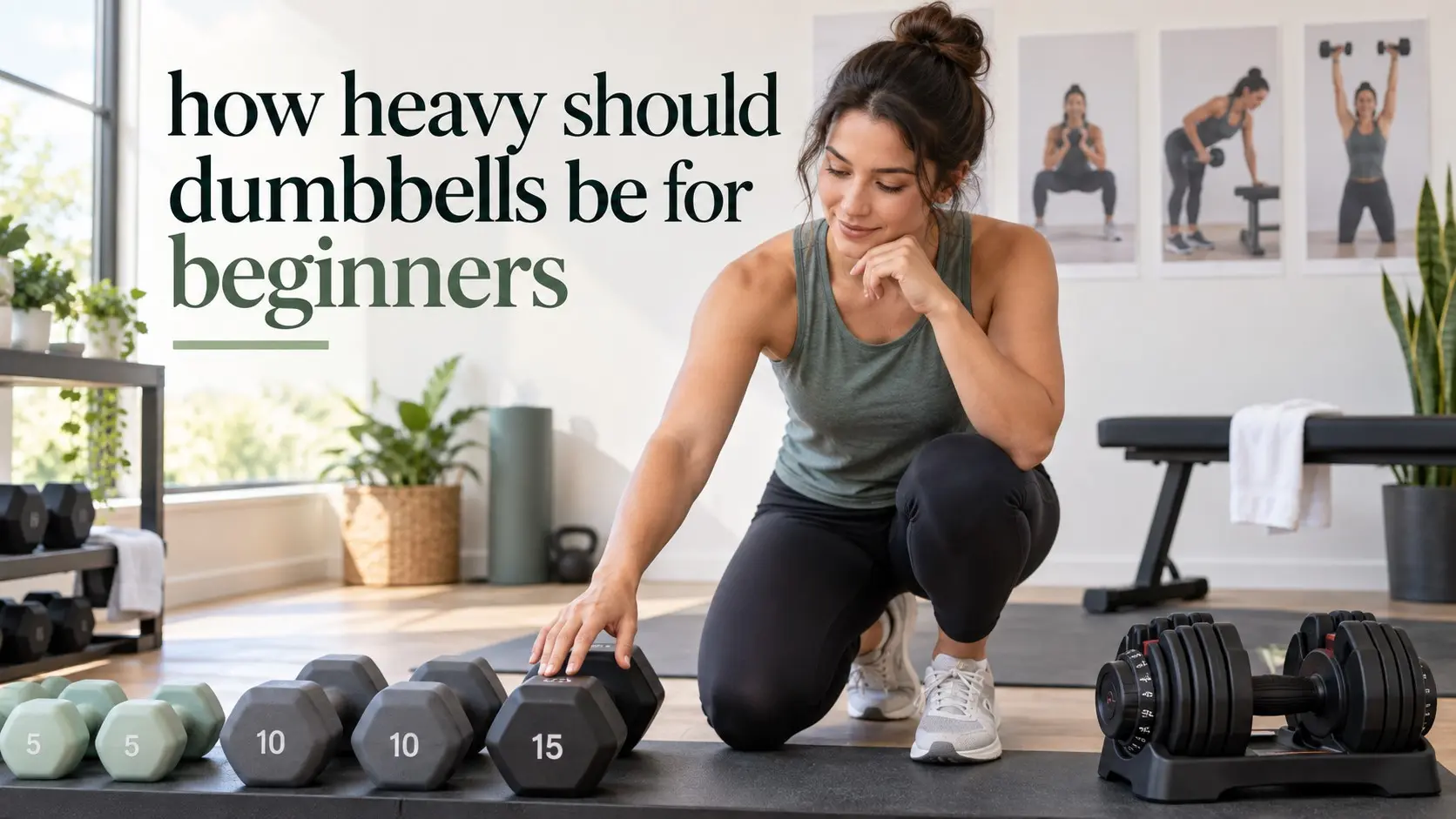
Topic: How Heavy Should Dumbbells Be for Beginners
Reading Time: About 16 minutes
Written and Source-Checked by: Adel Galal, Founder and Lead Writer at NextFitLife
Review Status: This article is educational and source-checked. It has not been medically reviewed or individually reviewed by a certified personal trainer, physical therapist, or sports medicine professional.
Start lighter than your ego wants.
Then test the weight.
A good dumbbell should make the final repetitions feel hard while you still control the movement.
If you need to swing, twist, shorten the movement, or lose balance, the weight is too heavy for that exercise.
Quick answer: If you are asking how heavy dumbbells should be for beginners, choose a weight that lets you perform about 8 to 12 controlled repetitions. The final repetitions should feel challenging, but your form should stay steady. If 12 repetitions feel easy, increase the load. If you cannot reach 8 clean repetitions, use less weight.
For a wider starting plan, visit the NextFitLife Fitness Hub.
For resistance training basics, use the Strength Training and Muscle Building Guide.
Why is there no perfect beginner dumbbell weight?
Because beginner does not mean weak.
It means new to the activity.
One beginner may have spent years carrying heavy items at work.
Another may have been inactive for years.
Their first dumbbell weight should not be the same.
The exercise matters too.
Your legs can normally handle more resistance than your shoulders during a lateral raise.
You may use one weight for a row.
You may need a much lighter one for a shoulder exercise.
This is why a single beginner dumbbell weight cannot answer every exercise.
5 smart rules for choosing your first dumbbell weight
1. Use the 8 to 12 repetition test
This is the easiest starting test.
Pick a light dumbbell.
Do the exercise slowly.
Aim for 8 to 12 repetitions.
Then judge what happened.
| What happens | What it means | What to do |
|---|---|---|
| You cannot complete 8 clean repetitions | The weight is probably too heavy | Use less weight |
| You complete 8 to 12 and the final repetitions feel hard | The load is close to a useful working weight | Keep it |
| You complete 12 very easily and could do many more | The load is probably too light | Try the next small increase |
CDC guidance uses the same practical idea.
Muscle strengthening work should become hard enough that another repetition would be difficult.
CDC suggests trying 8 to 12 reps for each activity.
2. Choose a different weight for different exercises
Do not force one dumbbell onto every movement.
Your body does not work that way.
A goblet squat uses large muscles.
A lateral raise uses much smaller muscles and places the dumbbell far from your body.
The same weight can feel easy in one exercise and impossible in another.
| Exercise type | Examples | Usual load pattern |
|---|---|---|
| Large lower body moves | Goblet squat, Romanian deadlift | Often heavier |
| Large upper body moves | Row, floor press | Often moderate |
| Arm exercises | Curl, triceps work | Usually lighter |
| Shoulder isolation | Lateral raise, front raise | Often light |
These are patterns.
They are not fixed prescriptions.
Test every exercise separately.
For lower body examples, see the Leg Exercises With Dumbbells Guide.
For upper body examples, see the Arm Workouts With Weights Guide.
3. Let proper form decide whether a weight is too heavy
The number printed on the dumbbell matters less than control.
Watch what happens when the set gets hard.
A useful weight still lets you use proper form.
The dumbbell is probably too heavy if you:
- Swing your body to move it
- Lose your balance
- Move through only part of the exercise
- Drop the weight quickly instead of lowering it with control
- Twist your back to finish a repetition
- Lose your starting position early in the set
Mayo Clinic advises lowering the weight or the number of repetitions when you cannot keep proper technique.
That is a good beginner rule.
Clean repetitions first.
Heavy dumbbells later.
4. Increase weight only when the current load becomes easy
Do not increase weight because seven days have passed.
Increase it because you became stronger.
Suppose your goal is 8 to 12 repetitions.
Your first workout looks like this:
8 controlled repetitions.
A week later, you reach 10.
Then you reach 12.
After more practice, 12 no longer feels very hard.
Now increase the dumbbell slightly.
This is a simple form of progressive overload.
The training challenge grows as your body adapts.
Progress can also come from better form, more repetitions, more sets, or better control.
The NextFitLife Strength Training Guide explains progression in more detail.
5. Use the smallest useful weight increase
You do not need a giant jump.
Small increases are easier to control.
This matters most for small muscle exercises.
If a curl weight becomes easy, use the next small option.
Do not jump from something easy to something you cannot control.
Lower body exercises may allow larger increases than shoulder exercises.
Your equipment will decide what jumps are available.
This is one reason adjustable dumbbells can be useful for home training.
What if you want an actual number?
I understand.
You are shopping.
You want to know what to put in the cart.
Here is the most honest answer.
Start at the light end if you have never trained before.
Then test it.
MedlinePlus gives a practical example for a beginner home circuit.
Its current indoor fitness instructions suggest starting with hand weights of about 2 to 5 pounds, which is about 1 to 2.25 kilograms, and adding weight as strength improves.
That is useful as an example.
It is not a universal rule for every dumbbell exercise.
A 5 pound dumbbell may work well for a small shoulder exercise.
It may quickly become too light for a squat or row.
Simple buying rule: If you have never lifted before and must buy fixed dumbbells without testing them, buying more than one light to moderate option is usually more useful than betting everything on one pair. Adjustable dumbbells solve this problem more easily because the resistance can change with the exercise.
Should women start with lighter dumbbells than men?
I would not choose your dumbbells by sex alone.
Average strength differs across populations.
But averages cannot tell me what you can safely lift today.
A strong female beginner may use more weight than an inactive male beginner.
A small male beginner may need less than a strong female athlete who is new only to dumbbells.
Use the repetition test.
Use your form.
Use your current strength.
That is more useful.
What dumbbell weight should older beginners use?
Use the same fundamental rule.
Start with resistance you can control.
Older adults can benefit from strength training too.
But balance, joint health, medical history, long periods of inactivity, and fall risk can change how you start.
The National Institute on Aging recommends starting without weights or with resistance bands when needed until the movements feel comfortable.
Then resistance can rise gradually.
If you have balance problems, osteoporosis, recent surgery, chronic pain, or another condition that affects movement, ask a qualified healthcare professional or physical therapist what is suitable for you.
For broader beginner guidance, visit the NextFitLife Fitness for Beginners Guide.
How many repetitions should beginners do?
8 to 12 repetitions is an empty place to begin.
CDC uses that range for muscle-strengthening activity.
Mayo Clinic often uses about 12 to 15 repetitions as a simple beginner strength target.
These are not competing laws.
They are practical ranges.
Your goal is to choose resistance that challenges the muscle while allowing good technique.
You do not fail because one set ended at 10.
How many sets should a beginner do?
Start small.
CDC says one set counts for muscle strengthening.
Two or three sets can provide more benefit.
A beginner can start with one or two sets while learning each exercise.
Then build when the routine feels manageable.
You do not need a bodybuilding volume on your first week.
How often should beginners use dumbbells?
Adults should work the major muscle groups at least 2 days each week under current public health guidance.
You can start with two simple beginner strength training sessions.
For example:
| Day | Plan |
|---|---|
| Monday | Full body dumbbell workout |
| Tuesday | Walk or normal activity |
| Wednesday | Rest or light movement |
| Thursday | Full body dumbbell workout |
| Friday | Walk or normal activity |
| Weekend | Recovery and other enjoyable activity |
You can add more training later.
Consistency matters more than filling every day with exercise.
Should beginners train until they cannot do another rep?
No.
You do not need to turn every set into failure.
The 2026 ACSM resistance training position stand reviewed 137 systematic reviews with more than 30,000 participants.
It found that training to momentary muscle failure did not consistently improve outcomes for the average healthy adult.
So your set can be hard without becoming ugly.
Stop while you still control the movement.
This is especially useful when you are still learning technique.
Does heavier always mean better strength training?
No.
The new ACSM guidance does show that heavier resistance can improve maximal strength more than lighter loading when strength is the main goal.
But that does not mean a new beginner should jump straight to very heavy weights.
First learn the exercise.
Then progress.
ACSM also emphasizes that many types of resistance training work.
Simple training done often beats an advanced plan you cannot follow.
Do beginners need dumbbells at all?
No.
Resistance training can use:
- Your body weight
- Resistance bands
- Dumbbells
- Machines
- Kettlebells
- Other safe resistance
The 2026 ACSM update found benefits from home training, bands, bodyweight exercise, and traditional resistance equipment.
You do not need a gym to start getting stronger.
Visit the Home Workouts and Equipment Guide for more options.
Are adjustable dumbbells worth it for beginners?
They can be.
The major benefit is simple.
You need different loads.
Your squat weight changes.
Your row weight changes.
Your curl weight changes.
Your strength changes over time too.
An adjustable dumbbell lets one piece of equipment cover several loads.
That makes adjustable dumbbells for beginners useful in a small home gym.
What are the downsides?
Some are bulky.
Some take time to adjust.
Some are expensive.
A few fixed pairs can work just as well.
The muscles do not know whether your dumbbell has a dial.
What if you can buy only one pair?
This is a compromise.
A weight light enough for shoulder raises may be too easy for your legs.
A weight that challenges a squat may be impossible for a curl.
If you can test before buying, do it.
Try the weight on a row.
Try a squat.
Try a press.
Try a curl.
If one pair must cover everything, choose control over ego.
You can make lighter dumbbells harder with more repetitions and slower control while you save for another weight.
How do you warm up before dumbbell training?
Keep it simple.
Move for a few minutes.
Practice the exercise without weight or with a lighter weight.
The National Institute on Aging recommends warming up for strengthening exercise with less weight.
A practice set also lets you check how your body feels that day.
Your working weight does not have to be identical every workout.
A simple dumbbell workout for beginners
This is an educational example.
It is not a personal exercise prescription.
| Exercise | Starting work |
|---|---|
| Goblet squat to a chair | 1 to 2 sets of 8 to 12 reps |
| Dumbbell Romanian deadlift | 1 to 2 sets of 8 to 12 reps |
| One-arm dumbbell row | 1 to 2 sets of 8 to 12 reps each side |
| Dumbbell floor press | 1 to 2 sets of 8 to 12 reps |
| Supported shoulder press | 1 to 2 sets of 8 to 12 reps |
Choose a different weight for each exercise.
Use the 8 to 12 repetition test.
Move with control.
Rest when you need to.
For more home options, use the Home Workouts and Equipment Guide.
How can you track dumbbell progress?
Write down three things.
The exercise.
The weight.
The repetitions.
For example:
| Exercise | Weight | Repetitions |
|---|---|---|
| Row | Your current load | 9 |
| Row next session | Same load | 10 |
| Row later | Same load | 12 |
| Next progression | Small increase | Return toward the lower end of your range |
This is much more useful than guessing whether you feel stronger.
It shows progress.
What if one arm is weaker?
That is common.
Use a load the weaker side can control.
Do not choose a weight based only on your stronger arm.
For one-arm exercises, you can start with the weaker side.
Then match the repetitions with the stronger side.
Do not force the weak side to copy a load it cannot control.
How do you know a dumbbell is too heavy?
Use this check.
The load is too heavy for now if:
- You cannot reach your planned minimum reps
- Your form breaks early
- You swing the weight
- You twist to finish
- You lose balance
- You cannot lower the dumbbell under control
- You feel unsafe
Lighter is not failure.
Lighter is the correct choice when it gives you better movement.
How do you know the dumbbell is too light?
Finish your set.
If 12 repetitions feel easy and you could do many more without slowing down, the resistance may be too low for your current goal.
Use the next small increase.
Then test again.
This is how to choose dumbbell weight without guessing.
Should the last rep look ugly?
No.
The last repetition can be slower.
It can feel hard.
But it should still look like the exercise you started with.
If the movement changes into a swing, jump, twist, or half repetition, stop the set or reduce the load.
What pain means you should stop?
Muscles working hard can feel uncomfortable.
Sharp pain is different.
Stop an exercise if it causes sharp or sudden pain.
Also stop and seek urgent medical help for serious symptoms such as chest pain, fainting, sudden severe shortness of breath, sudden weakness, or symptoms that feel dangerous.
Mayo Clinic advises stopping an exercise when it causes pain and considering a lower resistance.
Do not train through a warning sign to finish a set.
Who should get advice before starting?
Ask a qualified healthcare professional about exercise if you have a condition or symptom that may change what is safe for you.
Examples include:
- Heart disease
- Chest symptoms
- Recent surgery
- Severe joint pain
- Osteoporosis
- Repeated dizziness or fainting
- Major balance problems
- Neurological symptoms
- Pregnancy when you are unsure about safe loading
- An injury that limits movement
A qualified fitness professional can also help you learn technique when you are healthy but unsure how an exercise should look.
The most common beginner dumbbell mistakes
Buying one weight for every exercise
Your legs and shoulders need different loads.
Going heavy on the first workout
Your first job is learning the movement.
Staying with the same weight forever
If it becomes easy, progress.
Adding weight before your form is ready
Control the current load first.
Copying another person's weight
Their strength is not your starting point.
Thinking every set must end in failure
It does not.
Ignoring pain
Pain is not a progress test.
What is the simplest rule to remember?
Use this:
Heavy enough to challenge you.
Light enough to control.
That is the sweet spot.
Conclusion
If you still wonder how heavy should dumbbells be for beginners, do not search for one magic number.
Use the exercise in front of you.
Choose a light starting load.
Test 8 to 12 clean repetitions.
Keep the weight if the final repetitions are hard but controlled.
Go lighter when form breaks.
Go heavier when the whole set becomes easy.
Your next step: Pick one simple dumbbell exercise today. Test one light weight. Write down the weight and your clean repetitions. That number is more useful than any generic beginner chart.
References and Sources
These sources are open and available to the public.
- Centers for Disease Control and PreventionPage: What Counts as Physical Activity for AdultsUse: 8 to 12 repetitions, difficulty of another repetition, sets, major muscle groups, and resistance training examples.
Website: CDC.gov
URL: https://www.cdc.gov/physical-activity-basics/adding-adults/what-counts.html
- American College of Sports MedicinePage: ACSM Unveils Landmark 2026 Resistance Training GuidelinesPublished: March 17, 2026
Use: Current resistance training evidence, load selection, strength, consistency, home training, equipment, progression, and training to failure.
Website: ACSM.org
URL: https://acsm.org/resistance-training-guidelines-update-2026/
- Mayo ClinicPage: Strength Training Get Stronger, Leaner, HealthierUpdated with 2026 references
Use: Choosing resistance, 12 to 15 repetitions, gradual increases, proper form, recovery, and stopping when exercise causes pain.
Website: MayoClinic.org
URL: https://www.mayoclinic.org/healthy-lifestyle/fitness/in-depth/strength-training/art-20046670
- United States Office of Disease Prevention and Health PromotionPage: Physical Activity Guidelines for AmericansUse: Current public health guidance that adults include muscle strengthening activity at least 2 days each week.
Website: Health.gov
- MedlinePlusPage: Indoor Fitness RoutineUpdated: 2026
Use: Beginner home exercise example using 2- to 5-pound hand weights and gradual increases as strength improves.
Website: MedlinePlus.gov
URL: https://medlineplus.gov/ency/patientinstructions/000890.htm
Related NextFitLife Guides and Hubs
- NextFitLife Fitness Hub
- Strength Training and Muscle Building Guide
- Fitness for Beginners Guide
- Home Workouts and Equipment Guide
- Leg Exercises With Dumbbells
- Arm Workouts With Weights
- Safe Beginner Fitness Guide
Author Bio
Adel Galal is the founder and lead writer of NextFitLife.
He has maintained a personal interest in health, fitness, nutrition, sleep, wellness, and healthy aging for more than 30 years.
His health and wellness writing and research communication experience spans more than 15 years.
These are not medical or personal training credentials.
His role is to research fitness questions, compare public health and exercise science sources, identify important limits, and explain the findings in simple language.
For strength training content, NextFitLife focuses on manageable resistance, suitable form, gradual progression, recovery, realistic expectations, and clear safety limits rather than extreme lifting or fast transformation claims.
I am not a dermatologist or A doctor, and this content does not replace professional medical advice. What I share comes from real-life experience, extensive research, and consultation with healthcare providers. Always consult qualified medical professionals for diagnosis and treatment of any health condition.
For this topic, Adel Galal is also not a physician, physical therapist, certified personal trainer, certified strength coach, athletic trainer, or sports medicine professional.
Exercise choices and safe resistance can change with age, fitness level, injuries, pregnancy, balance, medical history, pain, medicines, and current ability.
Learn more about Adel Galal, NextFitLife, source standards, medical review, and the editorial process on the About Us page.
Frequently Asked Questions
How heavy should dumbbells be for beginners?
Choose a dumbbell that lets you complete about 8 to 12 controlled repetitions while making the final repetitions challenging. If you cannot reach 8 with good form, go lighter. If 12 feels very easy, try more weight.
Is 5 pounds enough for a beginner?
It can be. MedlinePlus uses 2 to 5 pound hand weights in one beginner home circuit example. Five pounds may work for some upper body movements but can be too light for stronger leg or back exercises.
Is 10 pounds too heavy for a beginner?
Not automatically. Ten pounds may be easy for one exercise and too heavy for another. Use the repetition and form test rather than judging the weight alone.
Should beginners use 8 to 12 reps?
Yes, this is a practical starting range. CDC recommends trying 8 to 12 repetitions for muscle strengthening activities.
How do I know if my dumbbells are too heavy?
The weight is probably too heavy if you cannot reach your planned repetitions, lose proper form, swing the weight, twist your body, lose balance, or cannot lower the dumbbell with control.
How do I know if my dumbbells are too light?
If you complete 12 repetitions easily and could keep going for many more, the weight may be too light for that exercise. Try a small increase.
Should I use the same dumbbell for every exercise?
No. Large leg and back exercises often use more resistance than curls, shoulder raises, or other small muscle exercises.
How often should beginners lift dumbbells?
Current public health guidance recommends muscle strengthening activity for all major muscle groups at least 2 days each week. Beginners can start with two simple sessions.
How many sets should a beginner do?
One set counts under CDC guidance. Two or three sets can provide more benefit. A new beginner can start with one or two sets while learning the exercises.
When should I increase my dumbbell weight?
Increase the load when you can reach the top of your repetition range with clean form and the set no longer feels challenging. Use a small increase and test again.
Are adjustable dumbbells good for beginners?
Yes. They make it easier to use different resistance for different exercises and to increase weight gradually as you become stronger.
Do beginners need to train to failure?
No. The 2026 ACSM position statement found that training to momentary muscle failure did not consistently improve outcomes for average healthy adults.
Should women and men use different starting dumbbells?
Do not choose weight by sex alone. Current strength, exercise choice, training history, body size, and control are more useful for selecting a starting resistance.
What should I do if dumbbell exercise hurts?
Stop if an exercise causes sharp or concerning pain. Reduce the resistance or change the movement. Persistent pain or symptoms that affect safe exercise should be discussed with a qualified healthcare professional.

Health & wellness writer with 30+ years of experience in nutrition, fitness, and healthy aging. Founder of NextFitLife.com — evidence-based health guidance.