Published: September 20, 2026
Last updated: September 20, 2026
Next review: September 2027, or sooner if major nutrition or manganese safety guidance changes.
Written and source-checked by: Adel Galal, Founder and Lead Writer at NextFitLife
Medical review status: This article has not been medically reviewed by a doctor, registered dietitian, nutrition specialist, pharmacist, or other licensed healthcare professional.
You probably do not need to work hard to get enough manganese.
A bowl of oatmeal, some whole grain bread, beans, nuts, leafy vegetables, or shellfish can supply a meaningful amount.
That is good news because manganese is essential, but the body needs only a small amount.
Adult men have an adequate intake of 2.3 mg per day.
Adult women have an adequate intake of 1.8 mg per day.
Most people already get enough through food.
So the useful goal is not to chase the highest possible manganese intake.
It is to include varied manganese rich foods as part of a balanced diet.
This guide gives you 15 powerful sources, realistic serving amounts, a simple daily meal example, supplement limits, deficiency facts, and food-first tips.
For the wider mineral and vitamin picture, visit the NextFitLife Nutrition and Vitamins Guide.
Medical and Nutrition Notice
I am not a dermatologist or A doctor, and this content does not replace professional medical advice. What I share comes from real-life experience, extensive research, and consultation with healthcare providers. Always consult qualified medical professionals for diagnosis and treatment of any health condition.
This article provides general nutrition education.
It does not diagnose manganese deficiency, recommend a personal supplement dose, or replace medical nutrition care.
Ask a doctor, pharmacist, or registered dietitian before using a manganese supplement if you have liver disease, another chronic medical condition, take prescription medicine, are pregnant, or already use a multivitamin or mineral supplement.
Quick Answer: What Foods Are Richest in Manganese?
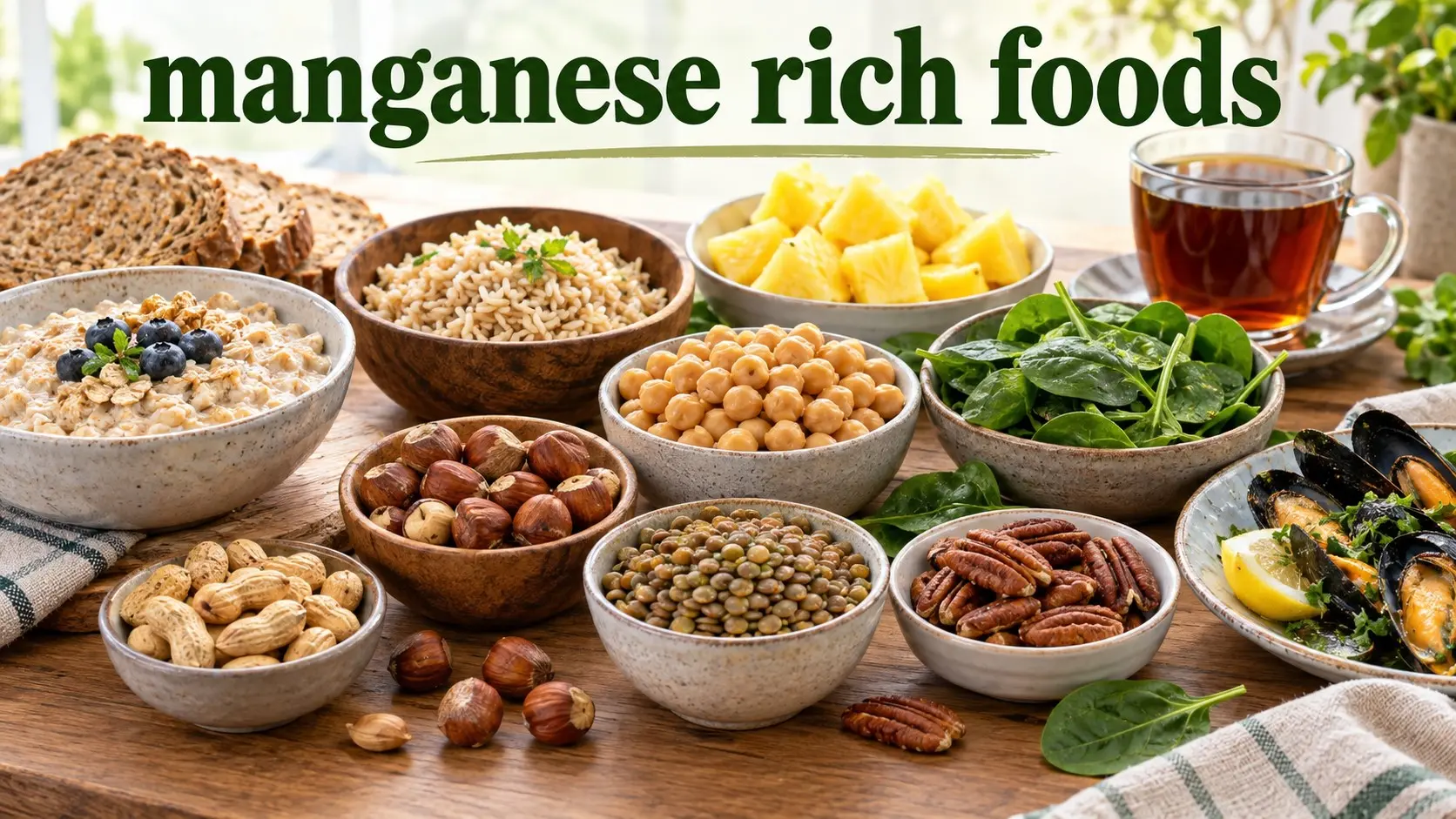
Excellent manganese sources include mussels, hazelnuts, pecans, brown rice, oysters, clams, chickpeas, spinach, pineapple, soybeans, whole wheat bread, oatmeal, peanuts, black tea, and lentils.
Three ounces of cooked mussels provide 5.8 mg.
One ounce of hazelnuts provides 1.6 mg.
Half a cup of cooked brown rice provides 1.1 mg.
Half a cup of cooked chickpeas provides 0.9 mg.
For comparison, adult daily adequate intake is 2.3 mg for men and 1.8 mg for women.
Table of Contents
- What Manganese Does
- Daily Manganese Needs
- 15 Best Manganese-Rich Foods
- Manganese Food Comparison
- A Simple Manganese-Rich Day
- Vegetarian and Vegan Sources
- Manganese vs Magnesium
- Manganese Deficiency
- Do You Need a Supplement?
- Can You Get Too Much?
- Liver Disease and Manganese
- Iron and Manganese Absorption
- Manganese and Bone Health
- Manganese and Blood Sugar
- Food First Tips
- References and Sources
- Conclusion
- Continue Reading on NextFitLife
- About the Author
- Frequently Asked Questions
What does manganese do in your body?
Manganese is an essential trace mineral.
Trace means the body needs only a small amount.
Small does not mean unimportant.
Manganese acts as a helper for several enzymes.
These enzymes are involved in:
- Amino acid metabolism
- Cholesterol metabolism
- Glucose and carbohydrate metabolism
- Bone formation
- Normal immune function
- Reproduction
- Blood clotting
- Managing reactive oxygen species
One manganese-dependent enzyme is manganese superoxide dismutase.
This enzyme helps handle reactive oxygen species produced during normal metabolism.
That does not mean extra manganese provides extra antioxidant protection.
Your body needs enough manganese.
More is not automatically better.
How much manganese do you need each day?
Manganese has an adequate intake,
It does not have a standard adult Recommended Dietary Allowance.
The Food and Nutrition Board established Adequate Intake values because there was not enough evidence to establish an Estimated Average Requirement and RDA.
| Life Stage | Daily Manganese adequate intake | Practical Meaning |
|---|---|---|
| Adult men | 2.3 mg | Often reached easily with whole grains, legumes, nuts, vegetables, and other foods. |
| Adult women | 1.8 mg | A varied diet normally provides enough. |
| Pregnancy | 2.0 mg | Food sources remain useful. Supplement decisions should consider the full prenatal plan. |
| Breastfeeding | 2.6 mg | Needs are slightly higher than for other adult women. |
There is another number you may see on a food or supplement label.
The FDA Daily Value for manganese is 2.3 mg for adults and children age 4 and older.
The Daily Value helps compare products.
It is not the same thing as saying every adult personally needs exactly 2.3 mg.
15 Best manganese rich foods
1. Mussels
Cooked blue mussels are the standout food in the NIH table.
Three ounces provide about 5.8 mg of manganese.
That equals about 252% of the FDA daily value.
This is a concentrated source.
You do not need to eat mussels to meet your manganese needs.
If you enjoy shellfish, it can contribute protein and several minerals at the same meal.
2. Hazelnuts
One ounce of dry roasted hazelnuts provides about 1.6 mg.
That is around 70% of the Daily Value.
Hazelnuts are simple to use.
Add a small portion to oatmeal.
Mix them with fruit.
Add them to plain yogurt.
They also provide unsaturated fat, fibre, and other nutrients.
3. Pecans
One ounce of dry-roasted pecans provides about 1.1 mg.
That is around 48% of the daily value.
A small portion goes a long way.
Nuts are energy-dense, so you do not need a huge serving to benefit from their nutrients.
4. Brown Rice
Half a cup of cooked medium-grain brown rice provides about 1.1 mg.
This makes brown rice one of the most practical everyday sources.
No unusual recipe is required.
Use brown rice with beans.
Add vegetables.
Serve it with fish, tofu, chicken, or another suitable protein.
The NextFitLife Healthy Foods Guide includes whole grains as part of a varied everyday eating pattern.
5. Oysters
Three ounces of cooked Pacific oysters provide about 1.0 mg.
That equals about 43% of the daily value.
Oysters are nutrient-dense, but shellfish is optional.
You can easily meet manganese needs with plant foods instead.
6. Clams
Three ounces of cooked clams provide about 0.9 mg.
That is around 39% of the daily value.
Interestingly, half a cup of chickpeas provides about the same amount.
That shows how flexible manganese intake can be.
7. Chickpeas
Half a cup of cooked chickpeas provides about 0.9 mg.
Chickpeas are one of my preferred examples because they make food first nutrition easy.
Use them in:
- Hummus
- Salads
- Soups
- Curries
- Grain bowls
- Roasted snacks
They also provide plant protein and fibre.
For more fibre-rich food ideas, visit the NextFitLife Gut Health Foods Guide.
8. Spinach
Half a cup of boiled spinach provides about 0.8 mg.
That equals roughly 35% of the Daily Value.
Add cooked spinach to eggs, beans, lentils, soup, or a grain bowl.
The goal is not to eat spinach because manganese is fashionable.
Eat it because leafy vegetables contribute many nutrients at once.
9. Pineapple
Half a cup of raw pineapple chunks provides about 0.8 mg.
That makes pineapple one of the stronger fruit sources in the NIH table.
Use fresh or suitable unsweetened frozen pineapple as part of a fruit serving.
No fruit needs to be eaten specifically as a manganese treatment.
10. Soybeans
Half a cup of boiled soybeans provides about 0.7 mg.
Soy foods also provide useful plant protein.
Other soy products include tofu, tempeh, and edamame.
The exact manganese content differs by product and serving.
11. Whole Wheat Bread
One slice of whole wheat bread provides about 0.7 mg.
That equals around 30% of the Daily Value.
Two slices can therefore contribute a meaningful amount before you count anything inside the sandwich.
Try whole wheat bread with hummus and vegetables for an easy manganese-containing meal.
12. Oatmeal
Half a cup of cooked oatmeal provides about 0.7 mg.
Breakfast is a peaceful place to combine several sources.
Try oatmeal with hazelnuts and fruit.
You get whole grains, nuts, fibre, and manganese in one simple bowl.
13. Peanuts
One ounce of oil-roasted peanuts provides about 0.5 mg.
Peanuts are botanically legumes, although we usually eat them like nuts.
Choose unsalted versions when you are also trying to keep sodium lower.
14. Black Tea
One cup of brewed black tea provides about 0.5 mg.
Tea is a major manganese source in some diets.
That does not mean you need to drink tea for manganese.
If you already enjoy unsweetened tea, its manganese simply contributes to your daily total.
15. Lentils
Half a cup of cooked lentils provides about 0.5 mg.
Lentils are inexpensive in many places.
They also give you plant protein, fibre, folate, iron, and other minerals.
Use them in soup, curry, salad, stew, or with brown rice.
Manganese Rich Foods Comparison
| Food | Serving | Manganese | FDA Daily Value |
|---|---|---|---|
| Mussels, cooked | 3 oz | 5.8 mg | 252% |
| Hazelnuts | 1 oz | 1.6 mg | 70% |
| Pecans | 1 oz | 1.1 mg | 48% |
| Brown rice, cooked | 1/2 cup | 1.1 mg | 48% |
| Oysters, cooked | 3 oz | 1.0 mg | 43% |
| Clams, cooked | 3 oz | 0.9 mg | 39% |
| Chickpeas, cooked | 1/2 cup | 0.9 mg | 39% |
| Spinach, boiled | 1/2 cup | 0.8 mg | 35% |
| Pineapple | 1/2 cup | 0.8 mg | 35% |
| Soybeans, boiled | 1/2 cup | 0.7 mg | 30% |
| Whole wheat bread | 1 slice | 0.7 mg | 30% |
| Oatmeal, cooked | 1/2 cup | 0.7 mg | 30% |
| Peanuts | 1 oz | 0.5 mg | 22% |
| Black tea | 1 cup | 0.5 mg | 22% |
| Lentils, cooked | 1/2 cup | 0.5 mg | 22% |
Source: NIH Office of Dietary Supplements food table.
Food composition can vary somewhat with variety, preparation, and database entry.
Use these values to understand the scale.
You do not need to count every milligram.
Other Foods Still Add Manganese
Food does not need to provide 50% of the Daily Value to matter.
The NIH table also lists:
- One medium baked potato with skin: about 0.3 mg
- Half a cup of cooked white rice: about 0.3 mg
- Half a cup of kidney beans: about 0.3 mg
- Half a cup of cooked acorn squash: about 0.3 mg
- Half a cup of blueberries: about 0.3 mg
- One tablespoon of sesame seeds: about 0.2 mg
- One cup of raw kale: about 0.2 mg
- About half a teaspoon of black pepper: about 0.2 mg
- One medium apple: about 0.1 mg
- One cup of brewed coffee: about 0.1 mg
Small amounts add up over a normal day.
What Does a Manganese Rich Day Look Like?
You do not need to calculate manganese every time you eat.
But one simple example shows how easily food can cover daily needs.
Breakfast
Half a cup of cooked oatmeal provides about 0.7 mg.
A cup of black tea provides about another 0.5 mg.
That is around 1.2 mg already.
Lunch
Add one slice of whole wheat bread.
That contributes about 0.7 mg.
The running total is around 1.9 mg.
Dinner
Half a cup of chickpeas adds about 0.9 mg.
The simple example now reaches roughly 2.8 mg.
That is before counting fruit, vegetables, spices, or other foods eaten during the day.
This is why I would solve manganese intake with groceries before thinking about supplements.
Can Vegetarians and vegans get enough manganese?
Yes.
Manganese is easy to obtain from plant foods.
Useful plant sources include:
- Whole grains
- Legumes
- Nuts and seeds
- Spinach
- Kale
- Pineapple
- Soybeans
- Oats
- Brown rice
- Whole wheat bread
- Tea
A vegan diet does not need shellfish to supply manganese.
A bowl of oats, a chickpea meal, whole grains, and a small portion of nuts can easily contribute enough.
The bigger job is making the full diet nutritionally complete.
One trace mineral should not distract from protein, vitamin B12, iron, calcium, iodine, vitamin D, and other nutrients that deserve attention in restricted diets.
Manganese and magnesium are different minerals
The names sound similar.
The nutrients are not interchangeable.
Manganese is a trace mineral required in milligram amounts, around 2 mg per day for adults.
Magnesium is needed in much larger amounts.
They participate in different processes.
A supplement labelled magnesium does not supply manganese unless the label specifically lists manganese too.
Do not start a manganese supplement because you heard magnesium supports muscle function.
That is a different nutrient.
The Nutrition and Vitamins Guide organizes NextFitLife mineral guides in one place.
Is Manganese Deficiency Common?
No.
Manganese deficiency is very rare in humans.
NIH also reports that there are no known groups of people likely to have inadequate manganese intake.
That makes self-diagnosis especially unhelpful.
Fatigue does not prove manganese deficiency.
Poor concentration does not prove manganese deficiency.
Weakness does not prove manganese deficiency.
Those symptoms can have many causes.
The limited evidence from rare deficiency situations suggests potential effects on bones, growth, skin, hair pigmentation, and metabolism.
The evidence is too limited to build a useful symptom checklist for ordinary people.
If you have unexplained symptoms, investigate the symptoms rather than guessing a trace mineral.
Do you need a manganese supplement?
Most people do not need a separate manganese supplement.
NIH states that most people obtain adequate manganese from food.
That makes food the simple starting point.
Before adding a supplement, check everything you already use.
Manganese can appear in:
- Multivitamins
- Mineral formulas
- Bone support supplements
- Joint products
- Combination nutritional supplements
The dose can therefore add up without a separate bottle labelled “manganese.”
Do not treat the upper intake limit as a supplement target.
An upper limit is a safety boundary.
It is not a goal.
Can You Get Too Much Manganese?
Yes, although ordinary food is not the primary concern.
The adult Tolerable Upper Intake Level is 11 mg per day for adults age 19 and older.
This upper limit covers food, beverages, and supplements.
NIH reports that studies have not shown harm from manganese naturally present in food.
Excess exposure has instead been associated with situations such as very high manganese levels in drinking water and occupational inhalation of manganese dust.
High manganese exposure can affect the nervous system.
This is why I would not use a high-dose supplement casually.
Oatmeal is not the problem.
Unnecessary concentrated exposure deserves more attention.
Why does liver disease matter?
The body removes manganese largely through bile.
That makes liver function relevant.
NIH reports that people with chronic liver disease can have impaired manganese elimination.
They can therefore be more susceptible to excess manganese and neurological toxicity.
This does not mean someone with liver disease should fear normal manganese foods.
It means concentrated supplements deserve professional review.
If you have significant liver disease, show your complete supplement list to your healthcare team.
Iron Status Can Affect Manganese Absorption
Nutrients interact.
Mineral absorption does not happen in isolated boxes.
NIH reports an inverse relationship between iron status and manganese absorption.
Lower iron stores are associated with greater manganese absorption.
Iron and manganese appear to share intestinal transport pathways.
This does not mean you should manipulate iron intake to change manganese absorption.
If you have iron deficiency, treat the iron problem appropriately.
Do not add manganese because you feel tired.
Does Manganese Build Stronger Bones?
Manganese is involved in bone formation.
That is true.
The supplement claim is another question.
Research has not established that taking extra manganese by itself improves bone health in healthy adults.
Harvard's Nutrition Source notes that human research is limited and conflicting.
No clinical trials have shown that manganese supplementation alone improves bone health.
Bone health depends on much more than manganese.
Important factors include:
- Calcium
- Vitamin D
- Protein
- Physical activity
- Resistance exercise
- Age
- Hormones
- Smoking
- Alcohol
- Medical conditions
Visit the NextFitLife Bone and Joint Health Guide for the wider picture.
Does Manganese Help Blood Sugar?
Manganese-dependent enzymes participate in glucose and carbohydrate metabolism.
That does not make manganese a diabetes treatment.
Research examining manganese status and diabetes has produced mixed results.
There is no good reason to replace established diabetes care with a manganese supplement.
If you have diabetes, focus on the full treatment plan.
Food quality, activity, weight when relevant, blood pressure, cholesterol, glucose monitoring, and prescribed medicines all matter.
Is Black Tea a Good Manganese Source?
Yes.
One cup of brewed black tea provides about 0.5 mg in the NIH food table.
That is roughly 22% of the FDA daily value.
But tea should remain a beverage, not a manganese treatment.
If you already enjoy black tea, count the manganese as a nutritional bonus.
There is no need to drink several extra cups to chase a mineral target.
Do whole grains matter more than refined grains?
Whole grains are major manganese sources.
Compare the NIH examples.
Half a cup of cooked brown rice provides about 1.1 mg.
Half a cup of cooked white rice provides about 0.3 mg.
One slice of whole wheat bread provides about 0.7 mg.
This does not make refined grains forbidden.
It simply shows why whole grains can make nutrient intake easier.
Can children eat manganese-rich foods?
Yes.
Children need manganese too.
The required amount changes with age.
Normal foods such as oats, whole grains, beans, fruit, nuts or seeds, when age-appropriate and safe, and vegetables can contribute.
Supplement safety is different.
The upper intake limits for children are lower than the adult limit.
Do not give a child a manganese supplement unless a qualified healthcare professional recommends it.
What About Pregnancy and Breastfeeding?
The Adequate Intake during pregnancy is 2.0 mg per day.
During breastfeeding, it is 2.6 mg per day.
These amounts can usually be obtained from a varied diet.
If you use a prenatal supplement, check the full label rather than adding individual minerals without a reason.
Pregnancy is a poor time to stack supplements because several products can contain the same nutrients.
7 Food First Tips That Make Manganese Easy
1. Start with whole grains
Use oats for breakfast.
Try brown rice with lunch or dinner.
Choose whole grain bread when it fits your meal.
2. Eat Beans and Lentils Regularly
Chickpeas and lentils provide manganese along with protein and fibre.
They are also budget-friendly in many places.
3. Rotate Your Nuts
Hazelnuts and pecans are especially rich in manganese.
Peanuts contribute too.
You do not need the same nut every day.
4. Keep leafy vegetables in the Routine
Spinach is a useful manganese source.
Kale contributes smaller amounts.
The bigger benefit is the wider nutrient package from vegetables.
5. Use Fruit for Variety
Pineapple stands out for manganese.
Blueberries and apples contribute smaller amounts.
Fruit does not need to be selected for one mineral alone.
6. Enjoy Shellfish if it fits your diet
Mussels, oysters, and clams are concentrated sources.
They are optional.
Plant foods can supply enough manganese without seafood.
7. Do not turn a food problem into a supplement problem
This is the major lesson.
If your diet includes whole grains, legumes, nuts, vegetables, and fruit, manganese usually takes care of itself.
That is a much simpler strategy than chasing a high-dose supplement.
Common Manganese Myths
Myth: More Manganese Means More Energy
No.
Manganese participates in metabolism.
That does not mean extra manganese acts as an energy booster.
Myth: Feeling tired means you need manganese
No.
Manganese deficiency is very rare.
Fatigue has many more common causes.
Myth: A supplement is better than food
Not for most people.
Normal food already supplies manganese easily.
Myth: Manganese and Magnesium Are the Same
No.
They are separate minerals with different intake targets and biological roles.
Myth: Manganese Supplements Strengthen Bones
Manganese participates in bone biology, but evidence does not show that manganese supplementation alone makes healthy adult bones stronger.
How to build a simple manganese rich plate
Forget the supplement aisle for a minute.
Build a normal meal.
Start with a whole grain
Try brown rice, whole wheat bread, or another suitable whole grain.
Add Protein
Use chickpeas, lentils, soybeans, shellfish, fish, eggs, poultry, or another protein that fits your diet.
Add Vegetables
Spinach works well, but variety matters more than choosing one vegetable every day.
Add fruit when you want it
Pineapple, blueberries, and other fruit can fit.
Add Nuts or Seeds
A small amount of hazelnuts, pecans, peanuts, or sesame seeds can contribute more manganese and other nutrients.
This looks a lot like ordinary healthy eating because it is.
References and Sources
- NIH Office of Dietary Supplements: Manganese Fact Sheet for Health Professionals
Primary reference for manganese functions, adequate intakes, food amounts, absorption, deficiency, upper limits, liver disease, iron interactions, and toxicity.
Read the NIH health professional fact sheet - NIH Office of Dietary Supplements: Manganese Fact Sheet for Consumers
Open public guidance on daily manganese needs, food sources, deficiency, health research, supplements, and safety.
Read the NIH consumer fact sheet - U.S. Food and Drug Administration: Daily Values on Nutrition and Supplement Facts Labels
Current FDA reference confirming the 2.3 mg Daily Value for manganese and explaining how percent Daily Value is used on nutrition labels.
Read the FDA Daily Value guide - USDA FoodData Central
United States Department of Agriculture food composition database for checking nutrients in foods and specific serving sizes.
Search USDA FoodData Central - Harvard T.H. Chan School of Public Health: The Nutrition Source, Manganese
Open educational review of manganese food sources, metabolism, deficiency, toxicity, bone research, diabetes research, and supplement limitations.
Read the Harvard manganese guide
Conclusion: Get manganese from food First
The easiest way to eat more manganese rich foods is to make ordinary food a little more varied.
Choose oats.
Use brown rice.
Add chickpeas or lentils.
Eat a small portion of nuts.
Keep leafy vegetables in your meals.
Enjoy pineapple or other fruit.
If you eat shellfish, mussels, oysters, and clams provide even more.
You do not need to hit one perfect number every day.
You need a varied pattern over time.
Your action today: choose one whole grain and one legume from this guide and add them to meals you already eat this week. Unless a qualified healthcare professional has identified a specific need, let food handle the manganese before reaching for a supplement.
Continue Reading on NextFitLife
Use these NextFitLife guides to explore minerals, healthy food choices, digestion, bone health, and nutrition safety.
- Nutrition and Vitamins Guide
- Top 20 Healthy Foods for Everyday Nutrition
- Gut Health Foods: Digestion, Fibre, and Bloating
- Bone and Joint Health Guide
- Kidney Disease Diet and Mineral Safety Guide
- General Wellness and Healthy Lifestyle Guide
Frequently Asked Questions About Manganese Rich Foods
What foods are highest in manganese?
Cooked mussels are one of the richest foods in the NIH table, providing about 5.8 mg in a three-ounce serving. Hazelnuts, pecans, brown rice, oysters, clams, chickpeas, spinach, and pineapple are also powerful sources.
How much manganese do adults need each day?
The Adequate Intake is 2.3 mg per day for adult men and 1.8 mg for adult women.
How much manganese is needed during pregnancy?
The Adequate Intake during pregnancy is 2.0 mg per day.
How much manganese is needed while breastfeeding?
The Adequate Intake during breastfeeding is 2.6 mg per day.
What is the Daily Value for manganese?
The FDA Daily Value is 2.3 mg for adults and children age four and older.
What is the difference between an AI and an RDA?
An RDA is based on enough evidence to estimate the needs of nearly all healthy people. An Adequate Intake is used when there is not enough evidence to establish an Estimated Average Requirement and RDA.
Are oats high in manganese?
Yes. Half a cup of cooked oatmeal provides about 0.7 mg of manganese, around 30% of the FDA Daily Value.
Are nuts high in manganese?
Some nuts are excellent sources. One ounce of hazelnuts provides about 1.6 mg, and one ounce of pecans provides about 1.1 mg.
Is brown rice high in manganese?
Yes. Half a cup of cooked brown rice provides about 1.1 mg, around 48% of the FDA Daily Value.
Are chickpeas high in manganese?
Yes. Half a cup of cooked chickpeas provides about 0.9 mg of manganese.
Is spinach high in manganese?
Boiled spinach is a useful source. Half a cup provides about 0.8 mg.
Does pineapple contain manganese?
Yes. Half a cup of raw pineapple chunks provides about 0.8 mg, making it one of the stronger fruit sources listed by NIH.
Does tea contain manganese?
Yes. One cup of brewed black tea provides about 0.5 mg in the NIH food table.
Can vegetarians get enough manganese?
Yes. Whole grains, beans, lentils, soybeans, nuts, seeds, leafy vegetables, fruit, and tea provide manganese without animal foods.
Can vegans get enough manganese?
Yes. Manganese is widely available in plant foods, so a varied vegan diet can readily provide it.
What is the difference between manganese and magnesium?
They are separate minerals. Manganese is a trace mineral needed in small amounts, while magnesium is required in much larger amounts and has different functions.
Is manganese deficiency common?
No. NIH reports that manganese deficiency is very rare in humans and that there are no known groups expected to routinely have inadequate manganese intake.
What causes manganese deficiency?
True manganese deficiency in humans is so rare that its causes and clinical signs are not firmly established. Do not diagnose manganese deficiency from common symptoms such as fatigue.
Do I need a manganese supplement?
Most people obtain adequate manganese from food and do not need a separate supplement. A supplement should address a specific need rather than simply trying to increase intake.
What is the upper limit for manganese?
The Tolerable Upper Intake Level for adults age 19 and older is 11 mg per day from food, beverages, and supplements.
Can food cause manganese toxicity?
NIH reports that studies have not shown harm from manganese naturally present in food. Excess exposure is more concerning with very high environmental or supplemental exposure.
Why should people with liver disease be careful with manganese supplements?
The liver helps eliminate manganese in bile. Chronic liver disease can reduce elimination and increase susceptibility to excess manganese and neurological toxicity.
Does iron deficiency affect manganese?
Yes. Lower iron stores are associated with increased manganese absorption. Iron and manganese appear to share some intestinal transport pathways.
Does manganese improve bone health?
Manganese is involved in bone formation, but evidence does not show that manganese supplementation alone improves bone health in healthy adults.
Does manganese help diabetes?
Manganese participates in glucose metabolism, but it is not a diabetes treatment. Human research on manganese status and diabetes has produced mixed results.
What is the easiest way to get enough manganese?
Eat a varied diet that includes foods such as whole grains, legumes, nuts, leafy vegetables, fruit, and suitable protein foods. Most people do not need to count manganese separately.

Health & wellness writer with 30+ years of experience in nutrition, fitness, and healthy aging. Founder of NextFitLife.com — evidence-based health guidance.