Published: September 25, 2026
Last updated: September 25, 2026
Next review: September 2027, or sooner if major strength training guidance changes
Written and source checked by: Adel Galal, Founder and Lead Writer at NextFitLife
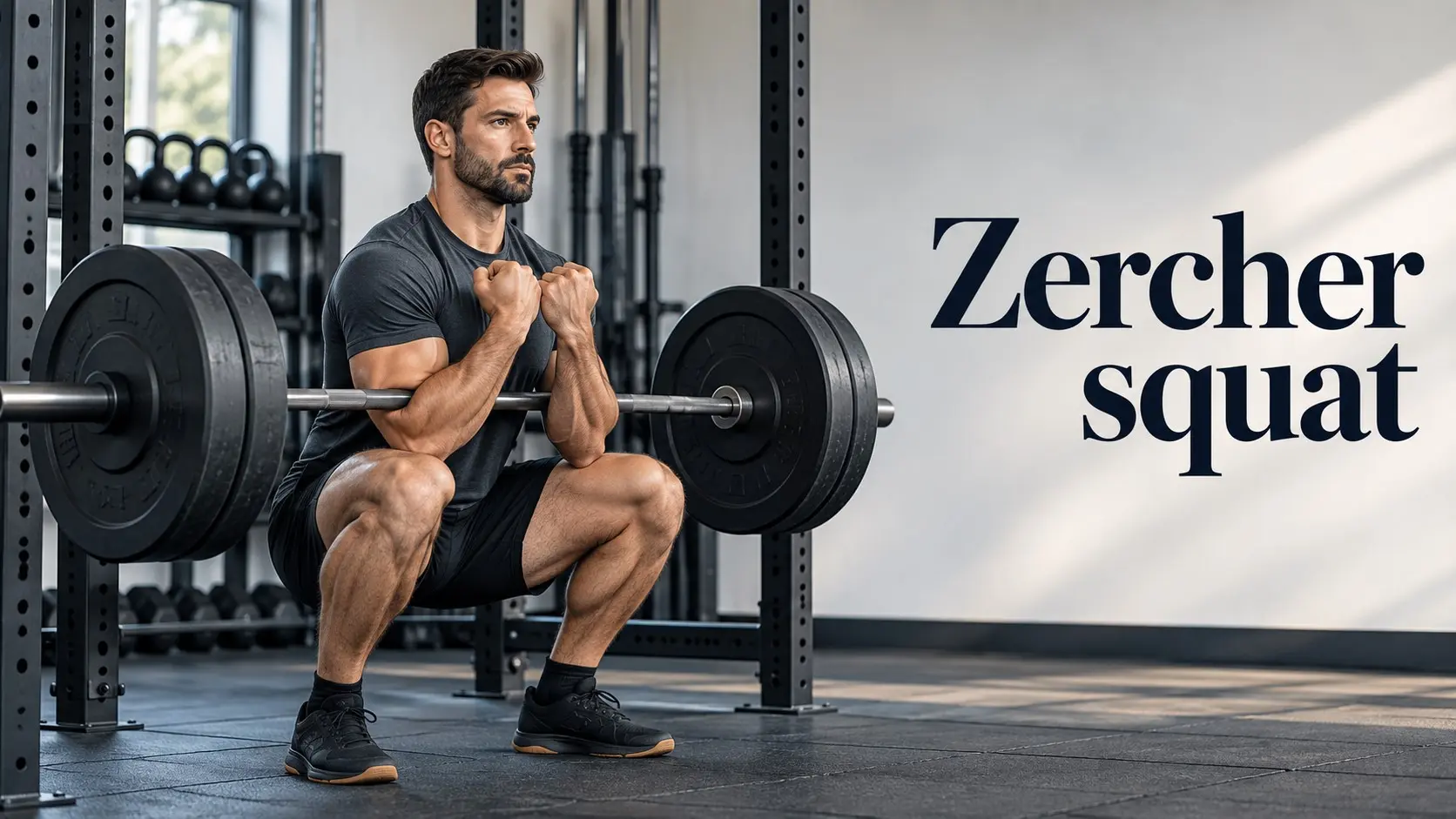
The Zercher squat is a barbell squat where you hold the bar in the bends of your elbows instead of across your back or shoulders.
It trains the legs while forcing your trunk and upper back to work hard to keep the load close and controlled.
That unusual bar position is both the reason to use the exercise and the reason some people should choose something else.
The Zercher is useful when you want a demanding front loaded squat, dislike a normal front rack, train for strongman style lifting, or simply want another way to challenge your squat pattern.
It is not automatically safer than a front squat or back squat. It is not required for strong legs. And sharp elbow pain is not part of the exercise you need to learn to tolerate.
Safety note: I am not a dermatologist or A doctor, and this content does not replace professional medical advice. What I share comes from real life experience, extensive research, and consultation with healthcare providers. Always consult qualified medical professionals for diagnosis and treatment of any health condition. Stop loaded exercise if you develop sudden severe pain, new numbness, weakness, fainting, chest pain, or another serious symptom.
Quick Answer: Is the Zercher Squat Worth Doing?
Yes, when the exercise solves a training problem rather than creating one.
The Zercher squat trains the quadriceps, glutes, adductors, trunk, spinal extensors, upper back, and arms while keeping the load in front of your body.
Its main advantages are the front loaded position, strong trunk demand, and lack of a traditional front rack. Its main drawbacks are pressure in the elbow creases and the chance that your arms or upper body limit the set before your legs do.
Learn it light, use a rack when possible, keep the bar close, and choose another squat if the elbow position causes sharp pain, numbness, or persistent symptoms.
Table of Contents
- What a Zercher squat is
- Muscles worked
- How to set up the bar
- How to perform the movement
- 11 smart form rules
- How to handle elbow pressure
- Zercher squat versus front squat
- Zercher squat versus back squat
- Zercher squat versus goblet squat
- What the exercise does for your core
- What we know about lower back loading
- Common mistakes
- Sets, repetitions, and progression
- Who should use it
- Who should choose another exercise
- References and Sources
- Continue Reading on NextFitLife
- About the Author
- Frequently Asked Questions
What Exactly Is a Zercher Squat?
Instead of resting the bar across your upper back, you bend your elbows and cradle the bar inside the elbow creases.
The weight therefore sits in front of your torso.
As you squat, your legs still create most of the movement, but your trunk and upper body have another job: keep the bar close enough that it does not pull you forward.
This makes the Zercher feel very different from a normal back squat even though both exercises use knee and hip extension to stand up.
The exercise is sometimes named after American strongman Ed Zercher, who became associated with this style of lifting.
The modern gym version is usually easiest to learn from a rack.
Which Muscles Does the Zercher Squat Work?
The main Zercher squat muscles worked are still lower body muscles.
| Area | Main Role | What You Feel |
|---|---|---|
| Quadriceps | Extend the knees | Strong thigh effort while standing |
| Glutes | Extend the hips | Hip drive as you rise |
| Adductors | Assist hip extension and control | Inner thigh involvement, especially at deeper positions |
| Hamstrings | Assist hip and knee control | Support the lower body movement |
| Trunk muscles | Control the torso against the forward load | Strong bracing demand |
| Spinal extensors | Help control trunk position | Back muscle effort without needing deliberate back extension |
| Upper back | Helps keep the upper torso organized | Upper back tension during the set |
| Biceps and forearms | Hold the bar isometrically | Arm tension rather than a curling movement |
There is an evidence limitation worth saying clearly.
Direct research measuring Zercher muscle activation against front and back squats is limited. I would therefore ignore claims that the exercise produces a precise percentage more core, quad, or glute activation unless the person making the claim can show direct research.
How Should You Set Up a Zercher Squat?
Use a power rack or squat rack when one is available.
This removes the need to deadlift the bar and transfer it onto your thighs before every set.
Set the Bar Around Elbow Height
Choose a rack position that lets you bend your knees slightly, place your arms under the bar, and stand up without reaching or crouching awkwardly.
Your exact rack hole depends on your height and proportions.
Place the Bar Deep in the Elbow Creases
Bend both elbows and let the bar settle inside the crooks of your arms.
Do not hold it near your wrists.
Keep the bar close to your torso.
Your hands can meet, overlap, or use another comfortable position that keeps the arms secure.
Create Tension Before You Unrack
Set your feet under you.
Brace your trunk.
Stand tall enough to clear the hooks, then take a small controlled step back.
You are ready to squat.
How Do You Perform the Zercher Squat?
- Set your stance. Begin near your normal squat width and adjust enough that your elbows and thighs have space.
- Keep the bar close. Do not let your forearms open and send the bar forward.
- Brace. Create trunk tension before descending.
- Bend your knees and hips. Let both joints move naturally as you lower.
- Keep your feet stable. Maintain contact through the whole foot rather than rolling onto the toes or heels.
- Descend with control. Use the deepest range you can manage without losing the bar or collapsing your position.
- Stand up smoothly. Push through the floor while keeping the bar close.
- Finish under control. Stand tall without leaning backward at the top.
That is the basic Zercher squat form.
If the movement looks dramatically different on repetition six than it did on repetition one, the load or set length is probably too ambitious.
11 Smart Zercher Squat Rules
1. Learn the Hold Before You Chase Weight
Your legs may already be strong.
Your elbows are not used to carrying a bar in this position.
Start lighter than your ego wants.
ACSM's 2026 resistance training position stand emphasizes progressive resistance training and consistent practice rather than complicated methods. The review synthesized 137 systematic reviews involving more than 30,000 participants.
Nothing about the Zercher changes that principle.
2. Use Padding if Pressure Stops You Training Well
A thin bar pad, towel, elbow sleeve, or thicker clothing can reduce pressure.
There is no special muscle building benefit from letting the steel bar dig painfully into your arms.
Use enough padding for comfort while keeping the bar stable.
3. Learn the Difference Between Pressure and Pain
The elbow crease will feel loaded.
That is expected.
Sharp joint pain, numbness, tingling, sudden weakness, or symptoms traveling into the hand are different.
Do not turn Zercher squat elbow pain into a toughness test.
Change the setup or choose another exercise if the symptoms do not settle.
4. Keep the Bar Close to Your Body
This is the cue I would fix first when the lift looks bad.
If the bar moves away from you, it creates a longer external lever and demands more from your trunk and arms.
Hold it securely toward the torso.
As fatigue builds, watch that your elbows do not slowly open.
5. Use Your Own Squat Stance
There is no universal perfect foot width.
Your hips, femur length, torso length, ankle motion, and comfort all affect the stance.
Start near your normal squat setup and adjust enough that your elbows and thighs can move freely.
6. Let Your Knees Move Naturally
Do not force perfectly vertical shins.
The knees and hips both move during a squat.
A biomechanical review of squatting shows that trunk position changes the relative moments at the hip and knee. A more upright trunk tends to increase the relative knee flexion moment while reducing the hip flexion moment.
That does not mean driving your knees forward as far as possible.
It means normal knee travel is part of squatting.
7. Do Not Force Your Torso Perfectly Vertical
The front loaded bar tends to encourage a more upright position.
Your torso still does not need to look like a straight vertical line.
Research comparing anterior and posterior squat loading consistently shows that moving the load forward changes trunk position, but your body adjusts according to load and anatomy.
A controlled forward angle is normal.
Losing control of the trunk is the problem.
8. Use the Deepest Range You Can Own
Do not cut every repetition high because the lift feels unfamiliar.
Do not force depth by collapsing either.
Use a range where your feet stay stable, the bar stays controlled, and you can stand up without the torso folding.
Range can improve with practice.
9. Stop the Set When the Hold Fails
This is one of the unusual limitations of the exercise.
Your quadriceps may have another few repetitions available while your arms and upper back are losing the bar.
If your elbows open, the bar starts rolling away, or your trunk position changes sharply, stop the set.
Your legs can receive more work from another exercise afterward.
10. Do Not Confuse Hard With Better
The Zercher feels brutal partly because the loading position is awkward.
That does not make it superior to every other squat variation.
ACSM's updated review found that many different forms of resistance training improve strength and muscle size when they are performed consistently and progressively.
The exercise needs to fit the goal.
11. Know Why It Is in Your Program
This rule matters most.
Use the Zercher because you want a front loaded squat, need an alternative to the standard front rack, enjoy this training style, or specifically want the trunk and upper body challenge involved in holding the load.
Do not use it because somebody on social media called it the ultimate squat.
There is no single best squat for every person.
Is the Zercher Squat Good for Core Strength?
Yes, in a practical sense.
The bar wants to pull your torso forward.
Your trunk muscles have to create enough core stability to control that load while your hips and knees move.
Research on front squatting has found higher activity in several trunk muscles compared with back squatting under tested conditions.
That research studied front squats, not Zercher squats.
So the fair conclusion is that an anterior load clearly creates a meaningful trunk demand.
I would not claim the Zercher activates the abs a specific percentage more than another exercise without direct Zercher research.
If dedicated trunk training is also part of your goal, see the NextFitLife Core Workouts Guide.
Is the Zercher Squat Better for Your Lower Back?
This is where fitness articles often oversell the exercise.
A more upright torso sounds automatically easier on the lower back.
Biomechanics do not work that simply.
Research comparing different anterior and posterior squat loads found that anterior loading reduced trunk flexion, yet some anterior conditions produced greater low back extension moments.
In simple language, holding the load forward can make you stand more upright while still asking the lower back to resist a meaningful external moment.
So I would not advertise the Zercher as universally back friendly.
The better test is individual.
Can you perform it without pain?
Can you control the bar?
Can you progress gradually without your symptoms becoming worse?
If you have persistent back pain, pain traveling into a leg, numbness, weakness, or another neurological symptom, do not select exercises from an internet article. Get an appropriate medical or rehabilitation assessment.
Zercher Squat vs Front Squat: Which Should You Use?
The exercises share one important feature.
The load is in front of you.
The holding position is completely different.
| Feature | Zercher Squat | Front Squat |
|---|---|---|
| Bar position | Inside elbow creases | Across front shoulders |
| Front rack mobility | Not required | Usually needed for the standard grip |
| Arm limitation | Elbow pressure and holding strength can limit the set | Shoulder and wrist rack comfort can limit the setup |
| Best reason to choose it | You want a front loaded squat without the normal front rack | You want to train the conventional front squat pattern |
For Olympic weightlifting skill or direct front squat performance, use the front squat.
For an unusual anterior hold that challenges your trunk and does not require the conventional rack position, the Zercher earns its place.
Zercher Squat vs Back Squat: Which Is Better?
Neither wins every category.
A back squat places the bar on your upper back and usually lets trained lifters handle more external load.
The Zercher places the weight in front and adds the challenge of holding it in the arms.
Research comparing standard front and back squats shows that load position changes trunk inclination and joint loading. Front squat conditions typically use a more upright trunk than back squat conditions.
This helps us understand the Zercher conceptually, but it is not direct evidence that the Zercher is superior.
Choose the back squat when back squat strength is the goal.
Choose the Zercher when its loading position solves a specific programming need.
Zercher Squat vs Goblet Squat: Which Is Better for Beginners?
I would teach most beginners the goblet squat first.
The dumbbell or kettlebell is easier to hold.
The setup is simpler.
There is no bar pressing into the elbow creases.
The Zercher becomes more attractive once someone already understands how to squat and wants a barbell based front loaded progression.
The NextFitLife Leg Exercises With Dumbbells Guide includes a goblet squat and other simpler lower body strength options.
Should You Lift the Zercher Bar From the Floor?
You can.
You do not need to.
The floor version requires you to deadlift the bar, support it on your thighs, get the elbows underneath, and then stand with it.
That creates another skill before the squat begins.
If you have a rack, learn the basic Zercher squat setup there first.
Later, if floor loading matters for strongman training or your equipment situation, practice that transition separately with manageable weight.
What Are the Most Common Zercher Squat Mistakes?
Starting Too Heavy
Your back squat number does not tell you what your first Zercher load should be.
Learn the position first.
Letting the Bar Drift Forward
This makes the lift harder to control and increases the demand on the arms and trunk.
Pull the load closer.
Opening the Elbows as You Tire
This allows the bar to roll away.
End the set before the hold completely fails.
Using a Stance That Traps Your Elbows
Give the arms and thighs enough room to move.
A small stance adjustment can fix repeated collisions.
Chasing Depth at Any Cost
Depth is useful when you stay in control.
A collapsing repetition is not better because it traveled farther.
Trying to Stay Perfectly Vertical
Your body proportions affect your squat.
Control the torso rather than forcing an artificial posture.
Ignoring Sharp Elbow Pain
The Zercher position is uncomfortable for some people.
That does not mean sharp pain is required.
How Many Sets and Reps Should You Do?
There is no research showing a special Zercher repetition range.
Use normal resistance training principles.
While learning the exercise, a practical approach is to use a moderate weight for sets of roughly five to eight controlled repetitions.
That is a coaching starting point, not a scientifically proven Zercher optimum.
Once your technique is stable, the exercise can be programmed according to the goal.
| Goal | Practical Approach | Main Limitation to Watch |
|---|---|---|
| Learn technique | Light to moderate controlled sets | Learning the bar position |
| Strength | Progressively heavier lower repetition work after technique is stable | Upper body hold may limit the load |
| Muscle growth | Moderate or higher repetition sets that remain technically controlled | Elbows may fail before the legs |
ACSM's 2026 evidence review supports a simple principle: resistance training works across a wide range of programming styles, while volume, load, frequency, and exercise choice can be adjusted to match the desired outcome.
Consistency matters more than making the program complicated.
How Should You Progress?
Do not add weight simply because the calendar says another week has passed.
Progress when the current load is repeatable.
Look for:
- A secure bar position
- Stable feet
- A controlled descent
- No sharp elbow pain
- No major forward collapse
- A smooth stand up
You can progress by adding a small amount of weight.
You can also add a repetition, improve depth, improve control, or perform the same load with less technical breakdown.
If you use effort based training, the NextFitLife Reps in Reserve Guide explains how to judge how many good repetitions you probably had left in a set.
Who Is the Zercher Squat Good For?
The exercise makes sense for someone who:
- Already understands basic squat mechanics
- Wants another front loaded barbell squat
- Cannot comfortably use a standard front rack
- Wants additional trunk and upper body holding demand
- Trains strongman style movements
- Enjoys varied barbell training
You do not have to meet all of those conditions.
You simply need a reason stronger than “this exercise looks difficult.”
Who Should Choose Another Exercise?
Pick a different squat if the elbow position consistently causes sharp pain, numbness, tingling, weakness, or hand symptoms.
Choose another movement if your arms fail so early that your legs never receive useful training.
A beginner who is still learning how to squat may get more value from bodyweight squats or goblet squats first.
The NextFitLife Strength Training for Beginners Guide gives simpler starting options.
Anyone with a current significant elbow, biceps, back, hip, or knee injury should get individualized guidance when loaded squatting aggravates symptoms.
Can the Zercher Replace Every Other Squat?
No.
It does not need to.
You can combine different squat patterns across a training year.
A back squat can train heavy barbell strength.
A goblet squat can teach a simple front loaded pattern.
Split squats and step ups can add unilateral work.
The Zercher can fill a different role.
If you want more single leg options, see 12 Single Leg Exercises for Strength and Stability.
What I Would Do Before Adding Zerchers
I would check four things.
First, can you squat comfortably without the Zercher bar?
Second, can you brace well enough to control a front loaded weight?
Third, does the elbow position feel like pressure rather than sharp pain?
Fourth, can you explain why you want this variation?
If the answers make sense, start light.
If the only reason is that the exercise looks brutal on social media, you probably have easier ways to build strong legs.
Conclusion
The Zercher squat is a useful but optional front loaded squat that trains the legs while creating a demanding trunk and upper body hold.
Its value comes from the loading position, not from being more painful or more extreme than other squats.
Learn it from a rack. Keep the bar deep in the elbow creases and close to your body. Use a controlled range, stop before the hold falls apart, and progress only when the current load looks clean.
Your next step: practice the position with an empty bar or very light load. If it feels secure and comfortable enough to control, build gradually. If the elbow position hurts or prevents useful leg training, choose a front squat, goblet squat, back squat, or another lower body exercise instead.
References and Sources
- American College of Sports Medicine.
Resistance Training Prescription for Muscle Function, Hypertrophy, and Physical Performance in Healthy Adults: An Overview of Reviews. 2026.
Read the PubMed record. - American College of Sports Medicine.
Updated Resistance Training Guidelines. March 2026.
Read the ACSM summary. - A Biomechanical Review of the Squat Exercise.
Review of squat loading, trunk inclination, hip and knee moments, range of motion, and squat mechanics.
Read the open access review. - Biomechanical Comparisons of Back and Front Squats With Different Load Positions.
Research examining how anterior and posterior loading alter trunk angles and low back and lower extremity moments.
Read the open access study. - Gullett JC, Tillman MD, Gutierrez GM, Chow JW.
A Biomechanical Comparison of Back and Front Squats in Healthy Trained Individuals.
Read the PubMed record.
Continue Reading on NextFitLife
- Leg Exercises With Dumbbells for goblet squats, lunges, deadlifts, step ups, and lower body strength work
- Single Leg Exercises for split squats, step ups, single leg deadlifts, and unilateral strength
- Core Workouts at Home for trunk control, carries, dead bugs, bird dogs, and beginner core work
- Strength Training for Beginners for simpler ways to learn resistance exercise before advanced barbell variations
- Reps in Reserve for managing effort, load, and progression without taking every set to failure
- Home Workouts and Equipment Guide for the wider NextFitLife Fitness Hub covering strength, dumbbells, kettlebells, bodyweight work, and equipment
About the Author
Adel Galal is the founder and lead writer at NextFitLife. He has more than 30 years of personal interest in health, fitness, nutrition, strength training, healthy aging, and practical lifestyle habits, along with more than 15 years of health and wellness writing experience.
His professional background includes information technology management, data analysis, structured research, planning, problem solving, and information management. He applies those skills to fitness writing by separating evidence from gym folklore and avoiding precise sounding claims when direct research is missing.
For this guide, Adel reviewed the 2026 American College of Sports Medicine resistance training position stand and peer reviewed research on squat biomechanics, front loading, trunk position, joint moments, and front versus back squatting.
Direct peer reviewed research on the Zercher squat itself remains limited. Where the article discusses biomechanics, it distinguishes findings from front loaded squat research from practical coaching observations about the Zercher.
Adel is not a doctor, physical therapist, sports medicine physician, or licensed strength and conditioning clinician. NextFitLife content is educational and does not diagnose injuries or provide individualized rehabilitation.
Learn more about Adel Galal, NextFitLife, and the site's editorial approach on the About Us page.
Frequently Asked Questions
What is a Zercher squat?
A Zercher squat is a barbell squat where you hold the bar in the crooks of your elbows in front of your torso instead of placing it on your upper back or shoulders.
What muscles does the Zercher squat work?
It trains the quadriceps, glutes, adductors, hamstrings, spinal extensors, abdominal and other trunk muscles, upper back, biceps, and forearms. Direct research measuring Zercher muscle activation is limited, so exact activation percentages should be treated cautiously.
Is the Zercher squat good for your core?
It creates a strong practical trunk demand because your torso must control a load positioned in front of the body. Research on other front loaded squats supports greater trunk demand under some conditions, but direct Zercher comparisons are limited.
Is the Zercher squat bad for your elbows?
The bar creates pressure in the elbow creases, especially when you first learn the lift. Pressure is different from sharp pain, numbness, tingling, weakness, or persistent symptoms. Use a lighter load or padding, adjust the position, or choose another exercise if the hold remains painful.
Can I use a pad for Zercher squats?
Yes. A thin bar pad, towel, sleeves, or suitable clothing can reduce uncomfortable pressure as long as the bar remains stable and controllable.
Is the Zercher squat safer for the lower back?
It should not be assumed to be safer. Anterior loading usually produces a more upright torso, but biomechanical research has also found increased low back extension moments under some anterior loading conditions. Individual technique, load, anatomy, symptoms, and training history matter.
Is the Zercher squat better than the front squat?
Neither is universally better. A front squat is more specific when you want to train the standard front rack or Olympic lifting pattern. A Zercher squat is useful when you want front loading without placing the bar across the shoulders.
Is the Zercher squat better than the back squat?
No squat is best for every goal. Back squats are useful for building back squat strength and usually allow heavier loads. Zercher squats provide a different front loaded challenge and involve the upper body in holding the bar.
Is a Zercher squat good for beginners?
Most true beginners will find a bodyweight or goblet squat easier to learn. The Zercher makes more sense after basic squat control is established or when a coach has a specific reason to introduce it.
How deep should I Zercher squat?
Use the deepest range you can control while keeping stable feet, a secure bar position, and an organized torso. Do not force extra depth if the bar rolls away or your position collapses.
How many reps should I do?
There is no Zercher specific ideal. While learning, moderate sets of controlled repetitions can help you practice the position. Strength or muscle building programming can later use a range of loads and repetitions according to your goal and tolerance.
Should I pick the Zercher bar up from the floor?
You can, but it is not required. A rack is simpler for learning the squat. The floor version adds a deadlift and bar transfer that should be practiced separately if you need that skill.
Why does my Zercher squat hurt my arms?
The bar concentrates pressure in the elbow creases, especially before you adapt to the hold. Start light, position the bar deeper in the elbow crease, keep it close, and use padding if needed. Stop if you develop sharp pain, numbness, tingling, or weakness.
Can Zercher squats build bigger legs?
They can contribute to leg muscle growth when they provide enough progressive resistance and training volume. They are one option among many and are not required for hypertrophy.

Health & wellness writer with 30+ years of experience in nutrition, fitness, and healthy aging. Founder of NextFitLife.com — evidence-based health guidance.