Published: September 26, 2026
Last updated: September 26, 2026
Next review: September 2027, or sooner if major choline or pregnancy nutrition guidance changes
Written and source checked by: Adel Galal, Founder and Lead Writer at NextFitLife
You can get choline from a vegan diet.
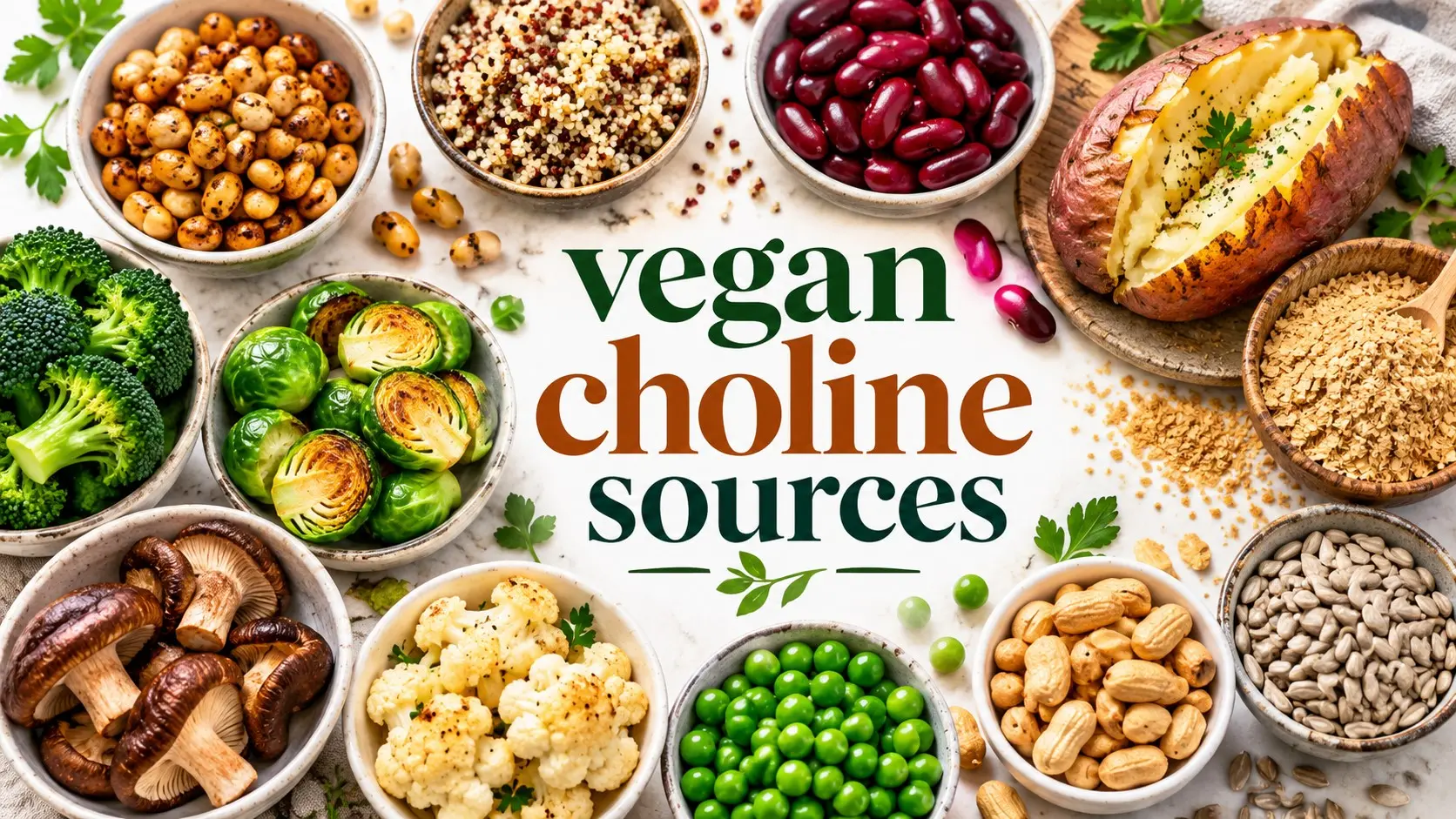
The best vegan choline sources include roasted soybeans, potatoes, wheat germ, kidney beans, quinoa, Brussels sprouts, broccoli, mushrooms, peanuts, cauliflower, green peas, and sunflower seeds.
The catch is simple.
Most plant foods provide moderate amounts rather than the enormous amount found in a food such as egg yolk. A vegan choline plan therefore works best when several useful foods appear across the day instead of expecting one supposed superfood to provide everything.
That is also a more realistic way to eat.
You do not need to turn every meal into a nutrient calculation. You do need to know where your stronger sources are, especially during pregnancy, breastfeeding, or a very restricted vegan diet.
Medical and nutrition notice: This content is for general educational purposes and does not replace professional medical advice, diagnosis, or treatment. Consult an appropriately qualified healthcare professional for personal medical concerns. This article explains published guidance and does not provide a personal clinical assessment. Always consult qualified medical professionals for diagnosis and treatment of any health condition. I am also not a registered dietitian. Pregnancy, breastfeeding, liver disease, highly restrictive diets, diagnosed deficiencies, and supplement use may require individual nutrition advice.
Quick Answer: What Are the Best Vegan Choline Sources?
The best vegan choline sources include roasted soybeans, potatoes, wheat germ, kidney beans, quinoa, Brussels sprouts, broccoli, shiitake mushrooms, peanuts, cauliflower, green peas, sunflower seeds, and other whole grains and legumes.
Plant foods usually provide moderate amounts, so the practical strategy is to combine several sources throughout the day.
Under U.S. guidance, the daily choline intake Adequate Intake is 550 mg for adult men, 425 mg for adult women, 450 mg during pregnancy, and 550 mg during breastfeeding.
These are Adequate Intake values, not RDAs and not sharp deficiency cutoffs. Eating slightly below an AI on one day does not mean you suddenly become deficient.
For broader guidance on vitamins, minerals, food sources, deficiencies, and supplement safety, visit the NextFitLife Nutrition & Vitamins Hub.
Table of Contents
- What choline does
- How much choline you need
- Why the target is an Adequate Intake
- 12 best vegan choline sources
- How to build a choline rich vegan day
- Can vegans meet 425 or 550 mg?
- Choline during pregnancy
- Choline during breastfeeding
- Do vegans need supplements?
- How to read a supplement label
- Choline deficiency
- Choline and fatty liver
- Choline and TMAO
- How much is too much?
- Common vegan choline mistakes
- References and Sources
- Continue Reading on NextFitLife
- About the Author
- Frequently Asked Questions
What Does Choline Actually Do?
Choline is an essential nutrient.
Your liver can make some of it, but the body rarely make enough to cover all human needs. Food therefore supplies the rest.
Choline helps your body make phosphatidylcholine and sphingomyelin, which are important parts of cell membranes.
It is also needed to produce acetylcholine, a neurotransmitter involved in memory, mood, muscle control, and nervous system function.
Choline contributes to lipid transport, metabolism, cell signaling, gene regulation, and normal early brain development.
One role deserves extra attention.
Your liver needs choline to package and transport fat. Very low choline intake under controlled experimental conditions can contribute to liver fat accumulation and liver injury.
That does not mean taking extra choline automatically treats fatty liver disease.
Those are two original claims.
How Much Choline Do You Need Each Day?
The U.S. Food and Nutrition Board uses an Adequate Intake, or AI, for choline.
There is currently no U.S. Estimated Average Requirement and therefore no choline RDA.
| Life Stage | U.S. Choline AI | Practical Note |
|---|---|---|
| Adult men, 19 and older | 550 mg per day | Higher target requires deliberate planning on a vegan diet |
| Adult women, 19 and older | 425 mg per day | Several plant sources across the day can add up |
| Pregnancy | 450 mg per day | Review prenatal labels because many contain little or no choline |
| Breastfeeding | 550 mg per day | One of the higher daily targets |
European guidance is different.
EFSA uses 400 mg per day for adults, 480 mg during pregnancy, and 520 mg during breastfeeding.
That difference does not mean one authority discovered that the other was wrong.
Both sets of figures are Adequate Intakes developed from incomplete evidence using somewhat different approaches.
For consistency, the food examples below use the U.S. NIH values.
Why Is Choline an AI Instead of an RDA?
This detail matters more than it sounds.
An RDA is calculated from an Estimated Average Requirement.
Researchers do not currently have enough evidence to establish an EAR for choline, so the Food and Nutrition Board established Adequate Intakes instead.
That means the AI is useful for planning a diet.
It is not a precise line separating healthy people from deficient people.
If your AI is 425 mg and you eat 410 mg one day, your body does not suddenly become choline deficient.
Look at the overall pattern.
12 Best Vegan Choline Sources
The values below come from the NIH Office of Dietary Supplements food table and linked USDA nutrient data.
Food composition varies by variety and preparation, so treat these as useful estimates rather than laboratory guarantees for every product.
| Number | Vegan Food | Serving | Approximate Choline | Easy Use |
|---|---|---|---|---|
| 1 | Roasted soybeans | 1/2 cup | 107 mg | Snack, bowl topping, salad addition |
| 2 | Red potato with skin | 1 large baked potato | 57 mg | Lunch or dinner base |
| 3 | Wheat germ | 1 ounce | 51 mg | Oats, cereal, bowls |
| 4 | Kidney beans | 1/2 cup | 45 mg | Chili, soup, bowls, salads |
| 5 | Quinoa | 1 cup cooked | 43 mg | Grain bowl, side dish, salad |
| 6 | Brussels sprouts | 1/2 cup cooked | 32 mg | Roasted or steamed side |
| 7 | Broccoli | 1/2 cup cooked | 31 mg | Stir fry, soup, grain bowl |
| 8 | Shiitake mushrooms | 1/2 cup cooked | 27 mg | Stir fry, noodles, soup |
| 9 | Peanuts | 1/4 cup | 24 mg | Snack, oats, stir fry |
| 10 | Cauliflower | 1/2 cup cooked | 24 mg | Curry, tray bake, side dish |
| 11 | Green peas | 1/2 cup cooked | 24 mg | Soup, rice, pasta, side dish |
| 12 | Sunflower seeds | 1/4 cup | 19 mg | Salad, oats, snack, bowl topping |
Brown rice also contributes about 19 mg per cooked cup, while whole wheat pita, cabbage, fruit, and many other plant foods add smaller amounts.
The lesson is not to eat only the top three foods.
The lesson is that plant based choline adds up.
For more nutrient dense plant food ideas, see Top 20 Healthy Foods.
1. Roasted Soybeans Make Vegan Choline Easier
Roasted soybeans stand out among the foods in the NIH table.
A half cup supplies about 107 mg of choline.
That is roughly one quarter of the 425 mg U.S. AI used for adult women.
You do not need half a cup every day.
But soy makes a useful anchor because the numbers become much easier once one stronger source appears in the meal plan.
2. Potatoes Are Better Choline Sources Than Many People Expect
A large baked red potato with the skin provides about 57 mg.
That makes potatoes far more useful than their reputation as “just carbs” suggests.
Pair a potato with kidney beans, broccoli, mushrooms, or another vegetable and the choline starts adding up without building the whole meal around a supplement.
3. Wheat Germ Packs Choline Into a Small Serving
One ounce of toasted wheat germ provides about 51 mg.
It can be stirred into oats or cereal or added to a breakfast bowl.
People with celiac disease or another medical reason to avoid wheat need a different source.
Quinoa, potatoes, legumes, soy, nuts, seeds, and vegetables can fill the gap.
4. Kidney Beans Make a Strong Everyday Choice
Half a cup of canned kidney beans provides about 45 mg.
Beans are useful because choline is not the only nutrient they bring to the table.
They also provide plant protein, fiber, folate, iron, magnesium, potassium, and other nutrients.
A good vegan diet works better when foods solve several nutrition problems at once.
5. Quinoa Adds Another Useful Layer
One cooked cup of quinoa supplies about 43 mg.
Quinoa works especially well because it can sit beside beans, tofu, soybeans, vegetables, or lentils.
Do not expect it to provide your whole daily target.
Use it as another layer.
6. Brussels Sprouts Quietly Add 32 mg
Half a cup of cooked Brussels sprouts provides about 32 mg.
That amount looks modest until the plate also contains beans, quinoa, potatoes, or soy.
This is why choline planning works better at the meal level than at the single food level.
7. Broccoli Is a Reliable Supporting Source
Half a cup of cooked broccoli provides about 31 mg.
Broccoli will not solve your choline intake alone, but regular vegetables are exactly what makes a food first diet easier to sustain.
Broccoli also fits easily into soups, stir fries, grain bowls, baked potato meals, and bean dishes.
8. Shiitake Mushrooms Help Fill the Gap
Half a cup of cooked shiitake mushrooms contains about 27 mg.
Add mushrooms to quinoa, brown rice, vegetables, tofu, or a bean based meal.
Small contributions matter when they happen several times each day.
9. Peanuts Make a Convenient Snack Source
A quarter cup of dry roasted peanuts provides about 24 mg.
They work well as a snack or as part of an oat bowl or savory meal.
If you use peanut butter, check the portion and product because food composition data for a quarter cup of peanuts should not automatically be copied onto every peanut butter serving.
10. Cauliflower Contributes More Than Zero
A half cup of cooked cauliflower provides about 24 mg.
That sentence sounds obvious, but it corrects a common way people think about nutrients.
A food does not need to be the number one source to matter.
A diet is built from repeated contributions.
11. Green Peas Add Protein, Fiber, and Choline
Half a cup of cooked green peas provides about 24 mg.
Use peas in soup, rice, pasta, potato dishes, or mixed vegetable meals.
Again, the goal is not to force peas into every meal.
It is to have enough ordinary foods that contribute.
12. Sunflower Seeds Work Best as an Extra
A quarter cup of sunflower seeds supplies about 19 mg.
That makes them a useful topper for salads, oats, cereal, and bowls.
Seeds are energy dense, so more is not automatically better.
Use a normal portion and let the rest of the diet do its share.
Can a Vegan Diet Reach 425 mg of Choline?
Yes.
It takes planning, but the arithmetic is possible with ordinary foods.
Here is one illustrative combination using values from the NIH food table.
| Meal | Food | Approx. Choline |
|---|---|---|
| Breakfast | 1 oz wheat germ plus 1/4 cup peanuts | 75 mg |
| Lunch | 1 cup quinoa, 1/2 cup kidney beans, 1/2 cup broccoli | 119 mg |
| Snack | 1/4 cup sunflower seeds | 19 mg |
| Dinner | 1/2 cup roasted soybeans, 1 large red potato, 1/2 cup Brussels sprouts, 1/2 cup cauliflower | 220 mg |
| Approximate daily total | Food sources above | 433 mg |
This example reaches the U.S. 425 mg AI used for adult women.
It is not a prescribed meal plan.
The point is to show the math.
The higher 550 mg target used for adult men and breastfeeding adults can take more deliberate planning from food alone. Other plant foods, soy foods, grains, vegetables, nuts, seeds, and a professionally selected supplement when needed can help close that gap.
For broader meal building ideas, read 24 Proven Nutrition Tips for Better Health.
What About Tofu, Tempeh, and Soy Milk?
They can contribute too.
Food databases and products vary enough that I would not assign one universal number to every block of tofu, carton of soy milk, or package of tempeh.
Processing, water content, serving size, and the actual product matter.
The practical rule is simple.
Count soy foods as useful contributors, but use reliable food composition data or the manufacturer's information when you need precise arithmetic.
Do not assume every plant milk has the same choline content.
My Seven Food First Rules for Vegan Choline
- Use soy regularly if you tolerate it. Whole soybeans and other soy foods can make the plan easier.
- Eat legumes often. Kidney beans, chickpeas, lentils, and other beans contribute choline alongside protein and fiber.
- Use useful grains. Quinoa, wheat germ, brown rice, and whole grains add to the total.
- Keep potatoes in the conversation. A large red potato is a meaningful source.
- Eat vegetables for accumulation. Broccoli, Brussels sprouts, cauliflower, peas, and mushrooms all contribute.
- Use nuts and seeds as extras. Peanuts and sunflower seeds can help close smaller gaps.
- Review the whole vegan diet. Choline is only one nutrient that deserves attention.
A well planned vegan diet should also pay attention to vitamin B12, iodine, iron, zinc, calcium, vitamin D, omega 3 fats, protein, and overall energy intake.
For reliable vegan B12 guidance, read B12 Rich Foods and Vegan B12 Sources.
For zinc, magnesium, beans, seeds, nuts, and plant mineral absorption, see Zinc and Magnesium Benefits.
Does Eating Below the Choline AI Mean You Are Deficient?
No.
This is one of the most useful corrections to make.
Most people in the United States consume less choline than the AI.
NIH reports average food and beverage intake of about 402 mg per day in adult men and 278 mg per day in adult women in one national analysis.
Yet frank choline deficiency in healthy men and nonpregnant women is considered rare.
There are several reasons.
The body can make some choline.
Individual needs differ.
And an AI is not a laboratory threshold below which deficiency automatically starts.
This is why I would not diagnose a vegan choline deficiency simply because an app reports 390 mg instead of 425 mg on one day.
What Does True Choline Deficiency Do?
Very low choline intake under experimental conditions can cause liver and muscle damage.
It can also contribute to fat accumulation in the liver.
That does not mean symptoms such as fatigue, brain fog, or poor concentration prove low choline.
Those symptoms have many possible causes.
Choline status is also difficult to reduce to one simple routine blood test.
NIH notes that plasma choline is not routinely used to assess healthy people and can remain relatively stable even during prolonged low intake.
Do not buy a supplement simply because a vague symptom list sounds familiar.
Does Choline Prevent Fatty Liver?
Choline is needed for normal lipid transport from the liver.
Experimental choline deficiency can cause liver fat accumulation and liver injury.
That does not make choline supplements a proven treatment for metabolic dysfunction associated steatotic liver disease or another diagnosed liver condition.
Fatty liver has many drivers, including metabolic health, body weight, diabetes, alcohol exposure, medicines, genetics, and other factors.
If liver tests are abnormal or imaging shows fatty liver, treat the condition rather than guessing which single nutrient caused it.
Vegan Choline Sources Matter More During Pregnancy
Pregnancy is the life stage where I would pay closer attention.
The U.S. AI increases to 450 mg per day.
ACOG also lists 450 mg daily and notes that choline is important for fetal brain and spinal cord development.
NIH reports that most pregnant women in the United States consume less than the choline AI.
Another practical problem is prenatal vitamins.
A prenatal does not automatically contain a meaningful amount of choline.
NIH reports that fewer than half of the prenatal supplements assessed in a U.S. market analysis contained choline, and products that included it frequently provided only a small amount.
Check the label.
This is especially relevant for someone following a vegan diet or avoiding eggs.
Pregnancy does not mean more is always better. A 2025 systematic review of randomized trials and observational studies found that current human evidence is still insufficient to conclude that increasing maternal choline intake above usual recommended levels reliably improves child neurodevelopment. Meet nutritional needs, but do not turn an important nutrient into a megadose competition.
If you are pregnant and vegan, review choline together with B12, iodine, iron, zinc, calcium, vitamin D, and omega 3 fats with your obstetric team or registered dietitian.
What About Choline While Breastfeeding?
The U.S. AI rises to 550 mg per day during breastfeeding.
This is one of the higher choline targets.
A breastfeeding vegan who rarely eats soy, beans, whole grains, potatoes, nuts, seeds, or cruciferous vegetables may find that the usual diet does not reach that amount easily.
That is a good reason to review food intake rather than simply hoping the prenatal covers it.
If food alone is not practical, discuss supplementation with a qualified professional.
Do Vegans Need a Choline Supplement?
Not automatically.
A varied vegan diet can supply substantial choline.
Supplements become more reasonable to discuss when:
- Food intake is very restrictive
- Soy and legumes are rarely eaten
- Pregnancy raises needs
- Breastfeeding raises needs
- A clinician or dietitian identifies a persistent dietary gap
- A medical condition substantially changes nutrition needs
NIH reports that choline supplements commonly provide about 10 to 250 mg.
Common forms include choline bitartrate, phosphatidylcholine, and lecithin.
Here is the part supplement advertising often skips.
NIH states that comparative studies have not established that one of these supplemental forms is more bioavailable than another.
So a more expensive label is not proof of a better result.
How Should You Read a Choline Supplement Label?
Look for the amount of actual choline supplied per serving.
Do not focus only on the large name of the compound on the front of the bottle.
Then ask four questions:
- How much choline does one serving actually provide?
- How much am I already getting from food?
- Does the product meet my vegan requirements?
- Do I have a real reason to take it?
Pregnant readers should also check the prenatal vitamin before adding another product.
More supplements can mean more duplicated nutrients.
Does Choline Improve Memory or Brain Performance?
Choline is needed to make acetylcholine and is biologically important for normal brain and nervous system function.
That does not prove that taking extra choline above adequate intake makes a healthy adult smarter or prevents cognitive decline.
Nutrition biology and supplement marketing are not the same thing.
Meet your needs first.
Be cautious with claims promising dramatic memory enhancement from one nutrient.
What About Choline, TMAO, and Heart Disease?
Choline can be metabolized by gut microbes into trimethylamine.
The liver can then convert trimethylamine into TMAO.
Higher TMAO concentrations have been associated with cardiovascular disease in some research.
But association is not the same as proof that normal dietary choline causes heart disease.
NIH notes that observational evidence on dietary choline and cardiovascular disease is mixed and that more research is needed.
So I would avoid two extremes.
Do not fear normal choline containing foods.
Do not take unnecessary high dose choline because more sounds healthier.
Cardiovascular risk still depends heavily on better established factors such as smoking, blood pressure, LDL cholesterol, diabetes, physical activity, and overall dietary pattern.
How Much Choline Is Too Much?
For adults aged 19 and older in the United States, the Tolerable Upper Intake Level is 3,500 mg per day from food and supplements combined.
The UL is a safety boundary.
It is not a target.
Very high choline intake has been associated with:
- Fishy body odor
- Vomiting
- Heavy sweating
- Increased salivation
- Low blood pressure
- Liver toxicity
A normal plant based diet is unlikely to approach 3,500 mg by accident.
High dose supplements are where unnecessary intake becomes much easier.
Seven Vegan Choline Mistakes I Would Avoid
1. Calling the AI an RDA
Choline does not currently have a U.S. RDA.
It has an Adequate Intake.
2. Thinking Only Eggs Contain Choline
Eggs are concentrated sources, but they are not the only sources.
Soybeans, potatoes, beans, quinoa, vegetables, nuts, seeds, and whole grains all contribute.
3. Looking for One Vegan Superfood
The better strategy is accumulation.
Use several sources during the day.
4. Assuming Every Soy Product Has the Same Amount
Tofu, soy drinks, tempeh, and whole soybeans differ in water content, processing, serving size, and nutrient composition.
5. Diagnosing Deficiency From Brain Fog
Fatigue and concentration problems have many causes.
Symptoms alone cannot diagnose low choline.
6. Ignoring B12 While Counting Choline
Reliable vitamin B12 intake deserves direct attention on a vegan diet.
Do not perfect one nutrient while forgetting another essential one.
7. Assuming a Prenatal Covers Choline
Many prenatal products contain little or no choline.
Read the actual label.
A Simple Vegan Choline Checklist
- Know which daily AI applies to you.
- Use a strong plant source such as soy regularly if suitable.
- Eat beans or another legume often.
- Use whole grains such as quinoa, wheat germ, or brown rice.
- Include potatoes and vegetables that contribute choline.
- Add nuts and seeds where they fit.
- Do not treat the AI as a deficiency cutoff.
- Check prenatal labels during pregnancy.
- Review the whole vegan nutrient picture, especially B12 and iodine.
- Use supplements to solve a real gap rather than because of marketing.
Conclusion
The strongest vegan choline sources are not rare supplements or specialty foods.
They are ordinary choices such as roasted soybeans, potatoes, wheat germ, beans, quinoa, broccoli, Brussels sprouts, mushrooms, peanuts, peas, cauliflower, seeds, and whole grains.
Build the day around several sources rather than searching for one perfect food.
Pay closer attention during pregnancy and breastfeeding because needs are higher and a prenatal supplement may provide little or no choline.
And remember that the U.S. target is an Adequate Intake, not a magic deficiency line.
Your next step: look at tomorrow's meals and identify at least three choline containing plant foods. If you are pregnant, breastfeeding, or finding the higher target difficult to reach, take your food list and supplement labels to a qualified clinician or registered dietitian.
References and Sources
- National Institutes of Health, Office of Dietary Supplements.
Choline Fact Sheet for Health Professionals. Covers choline functions, U.S. Adequate Intakes, food sources, deficiency, supplements, upper intake limits, pregnancy, cardiovascular evidence, and safety.Source:
https://ods.od.nih.gov/factsheets/Choline-HealthProfessional/
- National Institutes of Health, Office of Dietary Supplements.
Dietary Supplements and Life Stages: Pregnancy. Covers the 450 mg pregnancy AI, prenatal supplement content, vegan pregnancy considerations, food sources, and when supplementation may deserve discussion.Source:
https://ods.od.nih.gov/factsheets/Pregnancy-HealthProfessional/
- American College of Obstetricians and Gynecologists.
Healthy Eating During Pregnancy. Lists 450 mg of choline per day during pregnancy and explains its role in fetal brain and spinal cord development.Source:
https://www.acog.org/womens-health/faqs/healthy-eating-during-pregnancy
- European Food Safety Authority.
Dietary Reference Values for Choline. Provides European Adequate Intakes of 400 mg for adults, 480 mg during pregnancy, and 520 mg during lactation.Source:
https://www.efsa.europa.eu/en/press/news/160817
- Gould JF, Hines S, and colleagues.
Choline During Pregnancy and Child Neurodevelopment: A Systematic Review of Randomized Controlled Trials and Observational Studies. Published in Nutrients in 2025. The review concluded that current human evidence is insufficient to support or refute the hypothesis that increasing prenatal choline improves child neurodevelopment.Source:
https://pmc.ncbi.nlm.nih.gov/articles/PMC11901549/
Continue Reading on NextFitLife
- Nutrition & Vitamins Hub
for vitamins, minerals, food sources, suspected deficiencies, supplements, pregnancy questions, and supplement safety - B12 Rich Foods
for reliable vegan vitamin B12 sources, fortified foods, supplements, deficiency questions, and nerve health - Top 20 Healthy Foods
for beans, lentils, tofu, whole grains, vegetables, nuts, seeds, and balanced everyday nutrition - 24 Proven Nutrition Tips for Better Health
for food variety, protein, fiber, whole foods, meal planning, hydration, and sustainable nutrition habits - Zinc and Magnesium Benefits
for vegan mineral sources, beans, nuts, seeds, whole grains, absorption, and supplement safety - DASH Diet Guide
for a plant rich eating pattern built around beans, lentils, vegetables, fruit, nuts, seeds, whole grains, tofu, and tempeh
About the Author
Adel Galal is the founder and lead writer of NextFitLife. His personal interest in health, fitness, nutrition, food choices, wellness, and healthy aging spans more than 30 years, and his health and wellness writing experience spans more than 15 years.
Before focusing on NextFitLife, Adel spent 29 years working as an IT Manager for the Nestlé Egypt Region. His professional background includes information systems, data analysis, structured review, planning, problem solving, and information management.
He applies those research skills to consumer nutrition writing by checking serving level food data, separating Adequate Intakes from RDAs, comparing U.S. and European recommendations, reviewing supplement claims, and making uncertainty clear where human evidence is still incomplete.
For this article, Adel reviewed current NIH Office of Dietary Supplements guidance, NIH pregnancy nutrition guidance, ACOG pregnancy recommendations, EFSA dietary reference values, USDA linked food data, and recent peer reviewed evidence on prenatal choline and child neurodevelopment.
Adel is not a physician, registered dietitian, obstetrician, pharmacist, gastroenterologist, hepatologist, or other licensed healthcare professional. NextFitLife provides general educational information and does not replace individualized dietary assessment, prenatal care, deficiency diagnosis, laboratory testing, supplement prescribing, or medical nutrition therapy.
Learn more about Adel Galal, NextFitLife, sourcing standards, corrections, and the site's editorial approach on the About Us page.
Frequently Asked Questions About Vegan Choline Sources
What are the best vegan choline sources?
Useful vegan choline sources include roasted soybeans, potatoes, wheat germ, kidney beans, quinoa, Brussels sprouts, broccoli, shiitake mushrooms, peanuts, cauliflower, peas, sunflower seeds, and other whole grains and legumes.
Can you get enough choline on a vegan diet?
Yes. A planned vegan diet can provide substantial choline by combining soy, legumes, whole grains, potatoes, vegetables, nuts, and seeds. Higher intake targets such as 550 mg per day take more deliberate planning.
How much choline do adults need?
The U.S. Adequate Intake is 550 mg per day for adult men and 425 mg for adult women. Pregnancy raises the AI to 450 mg, while breastfeeding uses 550 mg.
Is the choline recommendation an RDA?
No. U.S. choline recommendations are Adequate Intakes because there is not enough evidence to establish an Estimated Average Requirement and calculate an RDA.
Which vegan food has the most choline?
Among the plant foods listed in the NIH selected food table, roasted soybeans are especially concentrated, providing about 107 mg per half cup.
Are potatoes a good vegan choline source?
Yes. One large baked red potato with the skin provides about 57 mg of choline according to NIH food data.
Does broccoli contain choline?
Yes. Half a cup of cooked broccoli provides about 31 mg of choline.
Does quinoa contain choline?
Yes. One cooked cup of quinoa provides about 43 mg.
Do beans contain choline?
Yes. Half a cup of canned kidney beans provides about 45 mg. Other beans and legumes also contribute varying amounts.
Does tofu contain choline?
Yes, tofu can contribute choline. The amount varies with type, processing, water content, serving size, and database entry, so use reliable food composition data if you need precise counting.
Does soy milk contain choline?
Soy drinks can contribute choline, but products vary. Check reliable nutrient data for the specific product rather than assuming every soy or plant beverage contains the same amount.
Do vegans need choline supplements?
Not automatically. Many vegans can obtain substantial choline from food. Supplementation deserves more consideration when the diet is restrictive, higher needs apply, or a clinician or dietitian identifies a persistent dietary gap.
Which type of choline supplement is best?
Common forms include choline bitartrate, phosphatidylcholine, and lecithin. NIH states that studies have not established that one supplemental form is more bioavailable than the others.
How much choline is needed during pregnancy?
The U.S. Adequate Intake during pregnancy is 450 mg per day. ACOG also lists 450 mg daily.
Do prenatal vitamins contain choline?
Not always. NIH reports that many prenatal supplements contain little or no choline, so pregnant people should check the Supplement Facts label rather than assume it is included.
Does more choline during pregnancy make a baby smarter?
Current evidence does not justify that claim. A 2025 systematic review found that human evidence remains insufficient to support or refute whether increasing prenatal choline improves child neurodevelopment.
How much choline is needed during breastfeeding?
The U.S. Adequate Intake during breastfeeding is 550 mg per day.
What happens if you do not get enough choline?
Severe experimental choline deficiency can cause liver damage, muscle damage, and fat accumulation in the liver. Frank deficiency is considered rare in healthy men and nonpregnant women despite many people consuming less than the AI.
Can brain fog tell me that I am choline deficient?
No. Brain fog, fatigue, and concentration problems have many possible causes. Symptoms alone cannot diagnose low choline intake or deficiency.
Can choline supplements cause side effects?
Very high choline intake can cause fishy body odor, vomiting, heavy sweating, increased salivation, low blood pressure, and liver toxicity. The U.S. adult upper intake level is 3,500 mg per day.
Is choline bad for the heart because of TMAO?
The relationship is not that simple. Choline can contribute to TMAO production, and higher TMAO has been associated with cardiovascular risk, but current evidence does not establish that normal dietary choline intake causes cardiovascular disease.

Health & wellness writer with 30+ years of experience in nutrition, fitness, and healthy aging. Founder of NextFitLife.com — evidence-based health guidance.