First published: September 27, 2026
Last updated: September 27, 2026
Written and source- checked by: Adel Galal, Founder and Lead Writer at NextFitLife
Review status: This article is educational and source- checked. It has not been medically reviewed by a doctor, physiotherapist, exercise physiologist, or certified personal trainer.
If you have access to weights and want the easiest way to measure strength progress, simple weight training or a mixed routine is a strong place to begin. If cost, travel, equipment, or gym access is the reason you keep postponing exercise, calisthenics is an excellent starting point.
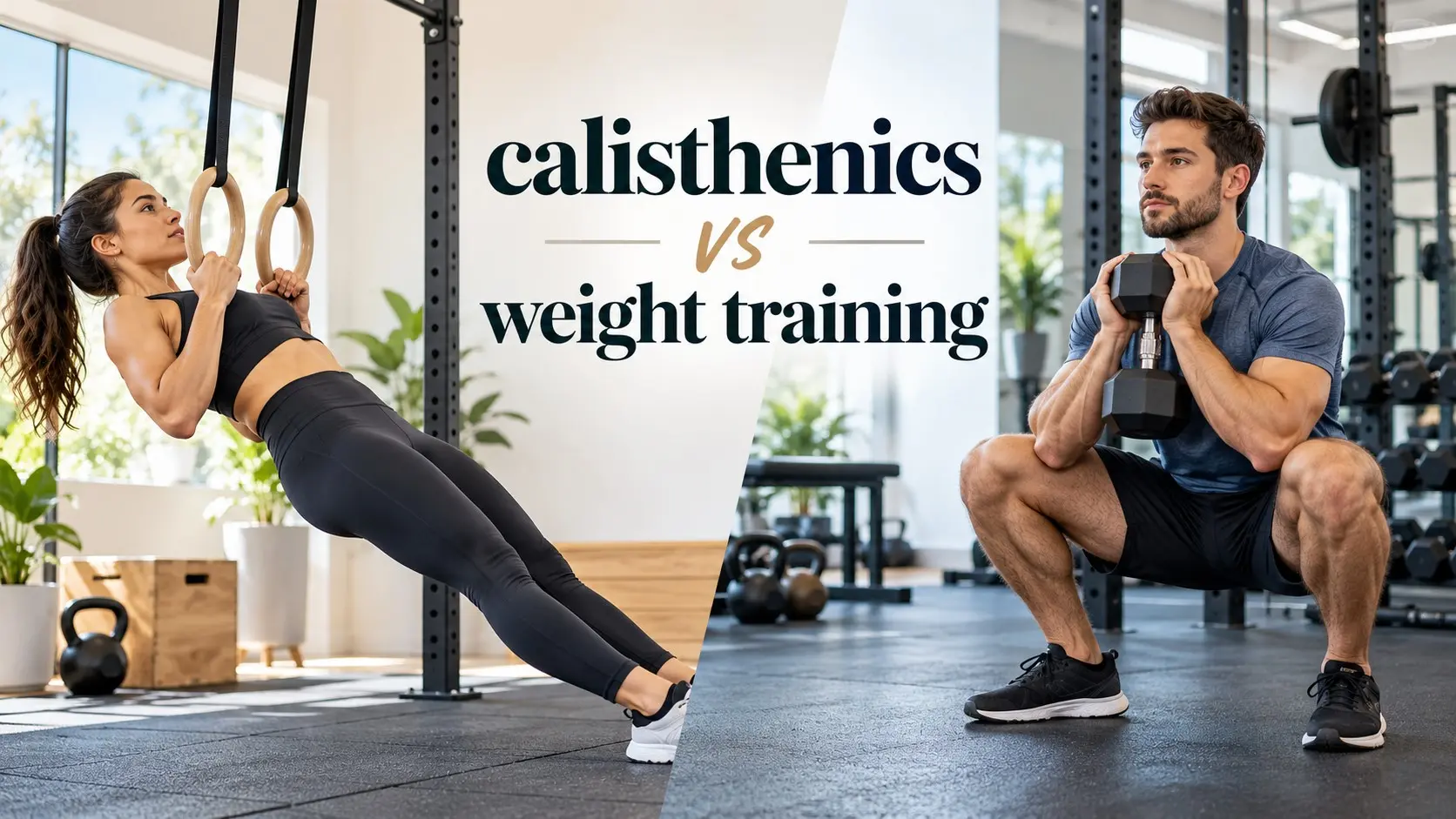
You do not need to choose a fitness tribe. Calisthenics vs weight training is really a question about which form of resistance makes it easiest for you to train regularly, use good form, and make the exercises harder over time.
Quick answer: Calisthenics and weight training can both build muscle and strength because both are forms of resistance training. Weights make small load increases easier to measure, while calisthenics is cheap, flexible, and easy to do almost anywhere. For beginners, the better choice is the one you can perform safely, progress gradually, and repeat consistently.
The American College of Sports Medicine published a major resistance training position stand in 2026 after reviewing 137 systematic reviews involving more than 30,000 people. Resistance training improved strength, muscle size, power, muscular endurance, balance, and physical function, while equipment type did not consistently decide who got results.
That changes the question.
Instead of asking which method wins, ask which method lets you train well next week, next month, and six months from now.
Exercise and medical safety: I am not a dermatologist or A doctor, and this content does not replace professional medical advice. What I share comes from real-life experience, extensive research, and consultation with healthcare providers. Always consult qualified medical professionals for diagnosis and treatment of any health condition. Exercise choices should also match your fitness level, injuries, symptoms, medical history, pregnancy status, and ability.
Table of Contents
- What calisthenics and weight training really mean
- Quick beginner comparison
- Nine smart beginner rules
- Muscle growth comparison
- Strength comparison
- Leg and upper body differences
- Home training and gym access
- Safety and injury questions
- Beginner calisthenics workout
- Beginner weight training workout
- Hybrid beginner workout
- How to progress each week
- Common beginner mistakes
- References and Sources
- Related NextFitLife guides
- About the author
- Frequently asked questions
What Is the Real Difference Between Calisthenics and Weights?
Calisthenics uses your body as the main source of resistance. Push ups, squats, split squats, rows, pull ups, dips, glute bridges, planks, and handstand progressions all fit this style.
You make the exercise harder by changing body position, leverage, range of motion, repetitions, tempo, stability, or eventually by adding external weight.
Weight training uses external resistance. That can include dumbbells, barbells, kettlebells, cable machines, plate loaded machines, or selectorized gym machines.
The muscle does not care about the label on your workout. It responds to tension, effort, recovery, and progressive challenge.
This gradual increase in training demand is called progressive overload.
For a wider introduction to strength work at home, use the NextFitLife Strength Training at Home for Beginners Guide.
Calisthenics vs Weight Training at a Glance
| Beginner Question | Calisthenics | Weight Training | Practical Take |
|---|---|---|---|
| Beginner friendly? | Yes, when exercises are scaled | Yes, when load is suitable | Both work for beginners |
| Builds strength? | Yes | Yes | Goal and progression matter more than the label |
| Builds muscle? | Yes | Yes | The exercise needs enough challenge |
| Equipment | Little for basic exercises | Weights or machines needed | Calisthenics costs less to start |
| Small load increases | Less precise | Very easy to measure | Weights have the practical advantage |
| Home training | Excellent | Excellent if you own basic equipment | Choose what fits your space |
| Leg progression | Possible but becomes harder to scale | Easy to scale | Weights become convenient as leg strength rises |
| Body control skills | Major focus | Depends on exercise choice | Calisthenics has a clear skill advantage |
| Can they be combined? | Yes | Yes | Hybrid training works very well |
9 Smart Beginner Rules for Choosing Your Starting Method
1. Choose the Method You Can Repeat Every Week
This rule comes first because an ideal program that you rarely perform has little value.
If a gym is close, affordable, and somewhere you enjoy going, weight training gives you excellent options. If getting to that gym adds enough friction that you keep skipping sessions, a bodyweight session at home wins.
Consistency beats theoretical perfection.
The NextFitLife Home Workouts & Equipment Guide can help you build a safe setup without buying a full gym.
2. Do Not Assume Bodyweight Means Easy
Your own body can be a heavy resistance.
A person who cannot perform one controlled floor push up does not need to keep failing floor push ups. Raise the hands onto a stable surface and use an incline that matches current strength.
A simple progression can look like this:
- Wall push up
- High incline push up
- Lower incline push up
- Floor push up
- Feet elevated push up
- Weighted push up when appropriate
That is real progression. Starting with a movement you cannot control is not.
3. Do Not Assume Weights Are Advanced
Weight training does not begin with a huge barbell.
A machine set to a light resistance can be easier than a push up. A light dumbbell can be easier than a difficult bodyweight lunge, and a cable row can be easier to adjust than an inverted row.
The advantage is simple: external resistance lets you choose the starting load.
That is one reason I lean toward weights or hybrid training for a complete beginner who has good gym access.
4. Choose Weights When Precise Progression Matters Most
Suppose you can perform ten good goblet squats with 8 kg today. Later you use 10 kg, then 12 kg. The change is easy to measure.
Calisthenics progression is still real, but it is less tidy. You might change your leverage, depth, hand position, range of motion, or exercise variation, which makes the exact increase in resistance harder to quantify.
If you enjoy tracking numbers and seeing load rise in small steps, weights fit that personality well.
5. Choose Calisthenics When Body Control Is the Goal
If you want pull ups, dips, handstands, muscle ups, front levers, or similar skills, practice bodyweight strength at the correct level.
A stronger bench press does not automatically create a handstand or muscle up because skill, positioning, grip, balance, and coordination matter too.
Weights can support those goals, but skill improves through skill specific practice.
6. Use Weights Sooner for Easier Leg Progression
Basic bodyweight squats are useful when they challenge you. For many healthy beginners, though, they eventually become too easy to drive much further strength or muscle progress.
You can move to split squats, reverse lunges, step ups, deeper ranges, single leg work, slower repetitions, and other harder variations. Those are good exercises.
At some point, adding a dumbbell is simply easier.
Goblet squats, Romanian deadlifts, dumbbell lunges, leg presses, and other loaded movements make lower body progression straightforward.
For practical options, see the NextFitLife Dumbbell Leg Exercises Guide.
7. Use Calisthenics Freely for Upper Body Training
The upper body comparison is closer.
Push ups can range from an easy wall version to demanding weighted variations. Rows can be scaled by changing body angle. Pull ups and dips can eventually be assisted, full bodyweight, or weighted.
A randomized study comparing push ups with low load bench press found similar increases in chest and triceps muscle thickness over eight weeks when the resistance was matched appropriately.
That was a small study involving young men, so it should not be stretched into a claim that every calisthenics program produces the same result as every weight program. It does show something useful: appropriately challenging bodyweight exercise can produce genuine muscle and strength adaptations.
8. Do Not Treat Either Method as Automatically Safer
Bodyweight training is not automatically safe because there is no dumbbell in your hand.
A poorly prepared beginner doing deep dips, high volume pull ups, jump training, or advanced handstand work can still irritate joints and tissues.
Weights are not automatically dangerous either. Problems usually appear when the load, movement, volume, setup, or progression does not match the person.
Use a difficulty you can control, increase the challenge gradually, and stop if an exercise causes sharp or unusual pain.
9. Use a Hybrid Program if It Solves More Problems
You are allowed to combine methods.
Push ups can be your pressing exercise. Dumbbell squats can train the legs. A cable row can train your back. A plank can train the trunk.
There is no fitness rule that says these movements cannot share a workout.
For many beginners, this is my preferred approach because you can use the easiest tool for each job.
Which Builds More Muscle?
Both methods can build muscle when the exercise creates enough tension and continues to become challenging.
The direct evidence comparing the two approaches is limited, so sweeping claims are not justified.
One randomized study followed 18 young men for eight weeks. One group performed push ups while the other used a low load bench press at a matched resistance. Both groups increased chest and triceps muscle thickness, with no significant between group difference in those measurements.
Useful evidence, yes. Final proof for every exercise and population, no.
The practical advantage of weights appears as you become stronger because load and weekly training volume are easier to organize precisely.
If your main goal is maximizing muscle growth, I would usually lean toward weights or a hybrid program.
Which Is Better for Maximum Strength?
Weight training has the clearer practical advantage when your goal is high absolute strength.
The 2026 ACSM position stand found that heavier loads were particularly useful for maximizing strength gains. Barbells, dumbbells, and machines make that type of loading easy to measure and repeat.
If your goal is a stronger squat, bench press, deadlift, or another loaded lift, train that lift or a close variation.
Strength is specific.
Calisthenics can also become extremely demanding, but advanced strength usually requires harder leverage, weighted bodyweight movements, rings, or increasingly technical exercises.
Which Builds Better Relative Strength?
This is where bodyweight training has a natural advantage.
Relative strength describes how strong you are in relation to your body mass. Pull ups, dips, handstands, and advanced calisthenics demand that you control your own body through space.
If those abilities are what excite you, train them at the level you can control rather than waiting until you have spent a year only lifting weights.
Which Is Better for Fat Loss?
Neither training style has a special claim on body fat loss.
Both are forms of resistance exercise.
Body fat change depends on a much wider picture that includes food intake, total physical activity, cardio, sleep, recovery, health factors, and long term adherence.
Do not choose calisthenics because somebody claims it creates a “lean body” while weights automatically make people bulky. That is fitness marketing, not a useful training principle.
If fat loss is one of your goals, the NextFitLife Beginner Fitness Guide gives you a broader plan built around strength, cardio, walking, food, and recovery.
How Often Should a Beginner Strength Train?
The Centers for Disease Control and Prevention recommends that adults perform muscle strengthening activities involving all major muscle groups on at least two days each week.
The 2026 ACSM position stand also supports training the major muscle groups at least twice each week.
For a beginner, two or three full body sessions are a practical starting range.
Two sessions can build the habit. Three gives you another chance to practice the movements if your recovery is good.
You do not need six gym days.
Beginner Calisthenics Workout
Use exercise versions that match your current ability. Two sessions per week are enough to begin, and a third can be added when recovery and schedule allow.
| Exercise | Starting Sets | Repetitions | Beginner Adjustment |
|---|---|---|---|
| Squat or box squat | 2 | 8 to 12 | Use a stable chair for depth control |
| Incline push up | 2 | 6 to 12 | Raise the hands until form is controlled |
| Bodyweight row | 2 | 6 to 12 | Use secure equipment designed for bodyweight loading |
| Split squat | 2 | 6 to 10 each leg | Hold stable support if balance is difficult |
| Glute bridge | 2 | 10 to 15 | Use a comfortable range |
| Dead bug or plank | 2 | Controlled reps or short holds | Stop before position breaks down |
For more core options, use the NextFitLife Core Workouts at Home Guide.
Beginner Weight Training Workout
This routine follows the same principle. Start with loads you can control and build from there.
| Exercise | Starting Sets | Repetitions | Main Focus |
|---|---|---|---|
| Goblet squat or leg press | 2 | 8 to 12 | Legs and hips |
| Dumbbell or machine chest press | 2 | 8 to 12 | Chest, shoulders, arms |
| Cable or machine row | 2 | 8 to 12 | Back and arms |
| Romanian deadlift | 2 | 8 to 12 | Hips and hamstrings |
| Shoulder press | 2 | 8 to 12 | Shoulders and arms |
| Simple core exercise | 2 | Controlled reps | Trunk control |
The Hybrid Beginner Workout I Prefer
There is no need to defend the purity of one training method.
A practical beginner session can look like this:
- Goblet squat: 2 sets of 8 to 12 repetitions
- Incline push up: 2 sets of 6 to 12 repetitions
- Cable row: 2 sets of 8 to 12 repetitions
- Romanian deadlift: 2 sets of 8 to 12 repetitions
- Assisted pull up or lat pulldown: 2 sets of 6 to 12 repetitions
- Plank or dead bug: 2 controlled sets
This program does not belong to a training tribe. It simply uses a suitable tool for each movement.
That is exactly why hybrid training makes sense for many beginners.
How Hard Should Beginner Sets Feel?
You do not need to finish every set at complete muscular failure.
The 2026 ACSM review found that training to momentary muscular failure did not consistently improve resistance training outcomes.
A practical starting point is to finish many beginner working sets while you still believe you could perform a few more clean repetitions.
This is called reps in reserve, or RIR.
If you stop and think you had two more good repetitions available, that is roughly 2 RIR.
For a full explanation, use the NextFitLife Reps in Reserve Guide.
How Should You Progress Weight Training?
Use a repeatable range.
Imagine the program says 8 to 12 repetitions.
You begin with 10 kg and perform:
10 reps
9 reps
Over time, the same load becomes:
12 reps
12 reps
If technique is still controlled and the sets are challenging enough, you can consider a small load increase and build the repetitions again.
This is simpler than adding weight every Monday regardless of performance.
How Should You Progress Calisthenics?
The same idea applies, but instead of always adding kilograms, you modify the movement.
For push ups:
- Use a high incline.
- Build clean repetitions.
- Lower the incline slightly.
- Build the repetitions again.
- Move toward floor push ups.
- Use harder variations only when the previous level is controlled.
Change one main variable at a time.
Do not add repetitions, make the exercise harder, cut rest, and add another workout day in the same week.
What If You Cannot Do a Push Up?
Raise your hands.
A wall push up is easier than a counter push up. A counter is easier than a low bench. A low bench is easier than the floor.
Lower the incline gradually as strength improves.
There is no prize for repeatedly failing an exercise that is too difficult.
What If You Cannot Do a Pull Up?
You do not need to start with full pull ups.
Use a bodyweight row, assisted pull up, pulldown, or another pulling movement that lets you train with control.
As strength increases, reduce the assistance or move to a harder variation.
One practical issue with home calisthenics is that pulling exercises usually require secure equipment. Do not hang your body from furniture that was never designed to hold that load.
What If You Are Starting at a Higher Body Weight?
You can use either method.
Remember that your body mass forms part of the resistance in calisthenics. That can make floor push ups, lunges, hanging work, and pull ups difficult even for someone who has never trained before.
This is one situation where a light machine or dumbbell can actually be easier to scale.
Calisthenics still works. Just choose the right variation.
Fitness is not an entrance test.
What If Your Main Goal Is Muscle Size?
I would usually lean toward weights or a hybrid program.
Calisthenics muscle growth is real, but external resistance makes it easier to increase load gradually, target specific muscles, train the legs heavily, and organize enough weekly training volume as your experience grows.
This is a practical programming advantage rather than proof that bodyweight exercise cannot build muscle.
What If Your Main Goal Is Calisthenics Skills?
Start practicing suitable calisthenics progressions.
If you want a pull up, train pulling.
If you want a handstand, start learning safe hand support, body position, and basic balance at an appropriate level.
If you want dips, build pressing strength with easier progressions first.
Weights can support the process, but they cannot replace practicing the skill itself.
What If You Only Have 30 Minutes at Home?
Calisthenics probably has the convenience advantage.
You can start immediately and avoid travel time.
A short home session might include:
- Squat variation
- Incline push up
- Safe row variation
- Split squat
- Glute bridge
- Plank or dead bug
If that simple setup means you actually train, it is the right choice.
What If You Love Going to the Gym?
Use the gym.
Enjoyment matters because a program has to survive normal life.
If you enjoy machines, dumbbells, recording loads, and watching the numbers increase, those are good reasons to choose weight training.
The 2026 ACSM update emphasizes individual preference, access, goals, and consistency rather than forcing everyone into one rigid resistance training system.
9 Beginner Mistakes to Avoid
- Thinking you must choose one method forever. Bodyweight movements and weights can share the same program.
- Starting with advanced calisthenics skills. A muscle up or planche is not a beginner requirement.
- Going too heavy too soon. The number on a dumbbell does not matter if you cannot control it.
- Using the same easy bodyweight exercise forever. Training needs to become more challenging over time.
- Ignoring pulling exercises. A home routine made only of push ups, squats, and planks leaves an obvious gap.
- Taking every set to failure. Beginners need good practice and repeatable training more than constant exhaustion.
- Changing the program every week. You cannot track progress when nothing stays consistent.
- Ignoring recovery. More training is not automatically better training.
- Copying advanced athletes. Their program solves their needs, not yours.
So Which One Should You Start With?
| Choose This | If This Sounds Like You |
|---|---|
| Calisthenics | You want to train at home, spend little, improve body control, or work toward push ups, pull ups, dips, and similar skills. |
| Weight training | You want precise load progression, maximum strength, easier muscle targeting, or simple long term leg loading. |
| Hybrid training | You want the easiest exercise for each job and do not care about training labels. |
A Better Question Than “Which One Wins?”
Ask yourself this instead:
What workout can I repeat twice next week, make gradually harder, and still see myself doing three months from now?
If the answer is a living room bodyweight workout, start with calisthenics.
If it is a gym with machines and dumbbells, start with weights.
If it is push ups beside goblet squats and cable rows, use both.
The biggest step is going from no resistance training to regular resistance training. Optimization comes later.
Conclusion
Calisthenics vs weight training does not need one permanent winner. Calisthenics gives beginners a low cost path to strength and body control, while weights make resistance easier to adjust and measure. A hybrid plan can give you both advantages.
Your next step is simple: choose one of the three beginner workouts above, schedule two sessions for the coming week, record what you do, and repeat the same basic movements long enough to improve them. That will teach you more about your best training style than another month of comparing workouts online.
References and Sources
The strength, exercise frequency, progression, and safety information in this guide was checked against current resistance training research and public health guidance. Full source URLs are included below for verification.
- American College of Sports Medicine Position Stand.
Resistance Training Prescription for Muscle Function, Hypertrophy, and Physical Performance in Healthy Adults: An Overview of Reviews.
Published in 2026.
Used for the current evidence on strength, hypertrophy, training frequency, loading, failure training, equipment type, and resistance training outcomes.
URL:
https://pubmed.ncbi.nlm.nih.gov/41843416/
- American College of Sports Medicine.
Science Spotlight: ACSM Releases New Position Stand on Resistance Training.
March 18, 2026.
Used for publication context and the scope of the 2026 ACSM evidence review.
URL:
https://acsm.org/science-spotlight-acsm-releases-new-position-stand-on-resistance-training/
- Centers for Disease Control and Prevention.
Adult Activity: An Overview.
Used for the recommendation that adults perform muscle strengthening activity for the major muscle groups on at least two days each week.
URL:
https://www.cdc.gov/physical-activity-basics/guidelines/adults.html
- Kikuchi N, Nakazato K.
Low Load Bench Press and Push Up Induce Similar Muscle Hypertrophy and Strength Gain.
Journal of Exercise Science & Fitness. 2017.
Used for the comparison between appropriately loaded push ups and low load bench press in young men.
URL:
https://pmc.ncbi.nlm.nih.gov/articles/PMC5812864/
- Cleveland Clinic.
How To Make Calisthenics Work for You.
Used for practical clinical guidance about scaling bodyweight exercise to ability, building gradually, and responding to pain.
URL:
https://health.clevelandclinic.org/calisthenics
Continue Training With NextFitLife
Use these related guides to build your beginner training plan and progress it safely.
Fitness and Home Training
Strength and Progression
Mobility and Recovery
About the Author
Adel Galal is the founder and lead writer of NextFitLife. He has maintained a personal interest in health, fitness, nutrition, sleep, wellness, and healthy aging for more than 30 years, and his health and wellness writing experience spans more than 15 years.
His role at NextFitLife is to research topics, compare reputable sources, identify important limits in the evidence, and turn technical health and fitness information into practical guidance that ordinary readers can use.
For fitness content, the focus is simple: safe progression, useful exercises, realistic expectations, recovery, and routines that can be repeated in real life rather than extreme transformation claims.
I am not a dermatologist or A doctor, and this content does not replace professional medical advice. What I share comes from real-life experience, extensive research, and consultation with healthcare providers. Always consult qualified medical professionals for diagnosis and treatment of any health condition.
Learn more about Adel Galal, NextFitLife, the research process, and the site's editorial standards on the NextFitLife About Us page.
Frequently Asked Questions About Calisthenics vs Weight Training
Is calisthenics or weight training better for beginners?
Both can work well. Weight training makes resistance easier to increase in small measured steps, while calisthenics is inexpensive and easy to do at home. A beginner should choose the method that can be scaled to current ability and repeated consistently.
Can calisthenics build as much muscle as weights?
Calisthenics can build muscle when the exercises are challenging enough and progress over time. Weights become easier to program precisely as you get stronger because small load increases and extra training volume are simple to add.
Can you build muscle with push ups?
Yes. A small randomized study found similar chest and triceps muscle growth after eight weeks of matched push up and low load bench press training in young men. The study does not prove that every push up program equals every weight training program.
Are weights better for strength?
Weights are especially useful for building high absolute strength because heavy resistance can be measured and progressed precisely. The 2026 ACSM position stand found that heavier loads were particularly helpful for maximizing strength gains.
Is calisthenics safer than weight training?
Neither method is automatically safer. Exercise choice, technique, difficulty, equipment setup, training volume, progression, recovery, injuries, and health history all affect safety.
Is calisthenics better for losing fat?
No resistance training method has a special fat loss advantage simply because it uses body weight or external weights. Fat loss depends on the wider balance of nutrition, physical activity, training, sleep, and long term consistency.
How many days should a beginner strength train?
Adults should perform muscle strengthening activity on at least two days each week according to current CDC guidance. Two or three full body workouts are a practical starting range for many healthy beginners.
Can I combine calisthenics and weights?
Yes. A hybrid workout can use bodyweight exercises for some movements and weights for others. For example, you could perform push ups, goblet squats, cable rows, Romanian deadlifts, and planks in the same program.
Should I start with calisthenics before lifting weights?
No rule says you must master calisthenics first. A light dumbbell or machine can actually be easier than some bodyweight exercises. Start with resistance that matches your current strength and control.
What if I cannot do one push up?
Start with a wall or incline push up. As strength improves, gradually lower the height of your hands until a floor push up becomes an appropriate progression.
What is better for home workouts?
Calisthenics has the lowest equipment requirement, but a small pair of dumbbells or resistance bands can expand your home training options considerably. The better setup is the one that is safe, affordable, and easy for you to use regularly.
Is a hybrid workout better than choosing only one style?
A hybrid program is useful when different tools solve different problems. It lets you use bodyweight exercises where they work well and external resistance where load progression is easier. It is an option, not a requirement.

Health & wellness writer with 30+ years of experience in nutrition, fitness, and healthy aging. Founder of NextFitLife.com — evidence-based health guidance.