Published on: October 5, 2026
Next review: October 2027, or sooner if pregnancy nutrition guidance changes.
Written and source checked by: Adel Galal, Founder and Lead Writer at NextFitLife
Medical review status: This article has not been medically reviewed by an obstetrician, midwife, registered dietitian, pharmacist, or other licensed healthcare professional.
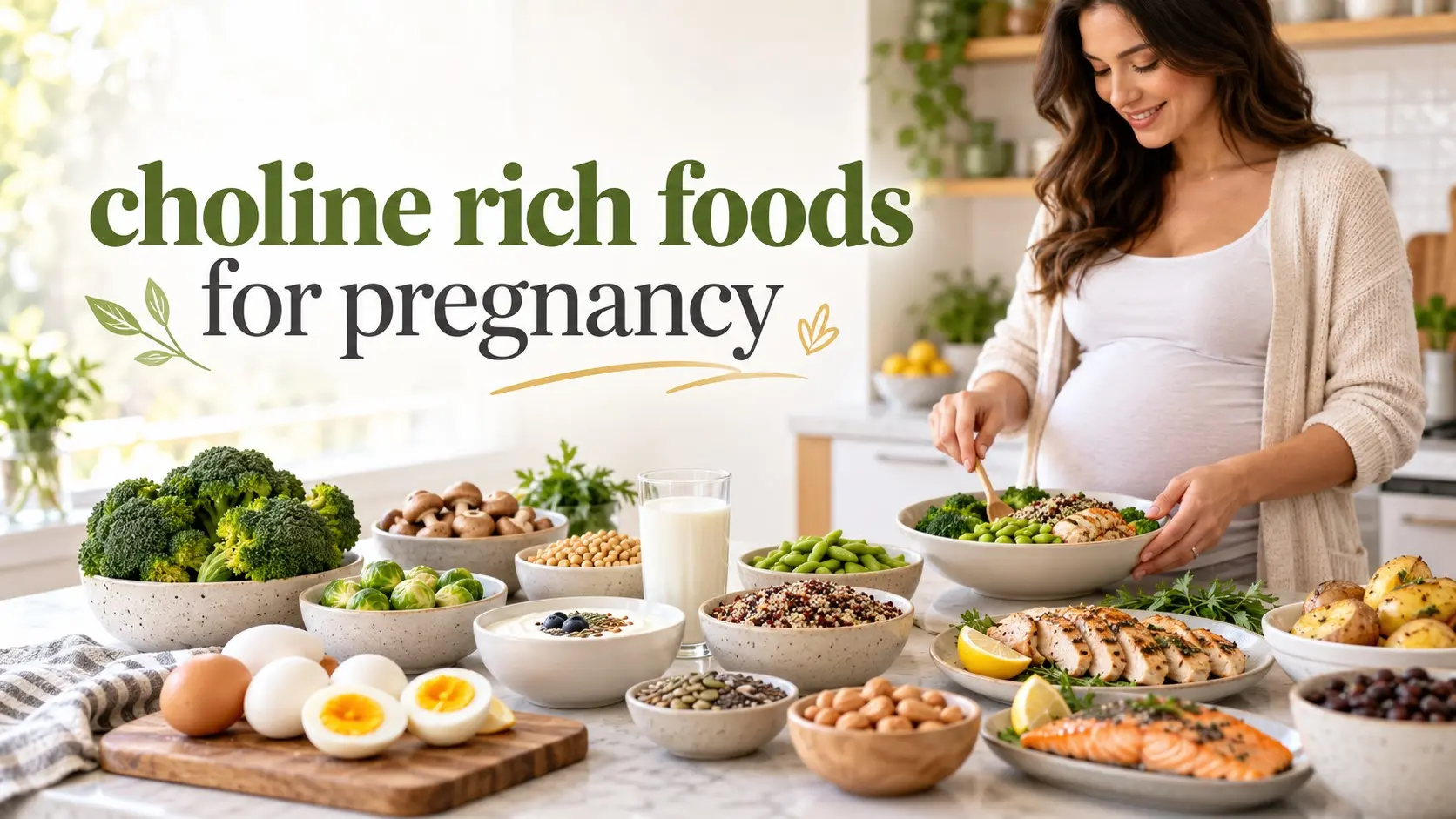
Choline rich foods for pregnancy can make the recommended 450 mg daily intake much easier to reach. Whole eggs are one of the simplest choices, with about 147 mg in one large cooked egg. Meat, poultry, fish, milk, soybeans, beans, quinoa, potatoes, broccoli, and other foods can fill the rest of the day.
The key is not finding one perfect food.
It is building a normal day that adds up.
That matters because pregnancy raises your choline needs, while many prenatal vitamins contain little or none.
Medical Notice: This content is for general educational purposes and does not replace professional medical advice, diagnosis, or treatment. Consult an appropriately qualified healthcare professional for personal medical concerns. What I share comes from real-life experience, extensive research, and consultation with healthcare providers. Always consult qualified medical professionals for diagnosis and treatment of any health condition.
Pregnancy nutrition needs can change with age, multiple pregnancy, food allergies, diabetes, anemia, bariatric surgery, digestive disease, kidney disease, severe nausea, a vegan diet, medicines, and other health factors. Discuss supplements and major diet changes with your obstetric clinician, midwife, pharmacist, or registered dietitian.
Table of Contents
- Quick Answer
- How much choline you need
- Why food first works well
- 15 Essential Foods
- Eggs
- Lean beef
- Soybeans
- Chicken
- Cooked fish
- Potatoes
- Wheat germ
- Kidney beans
- Quinoa
- Milk
- Yogurt
- Brussels sprouts
- Broccoli
- Mushrooms
- Peanuts and seeds
- How to Reach 450 mg
- A simple daily example
- Vegetarian planning
- Vegan planning
- Pregnancy Safety
- Eggs
- Fish
- Liver and vitamin A
- Pasteurized dairy
- Prenatal Vitamins and Supplements
- Common Mistakes
- Frequently Asked Questions
How much choline do you need during pregnancy?
The Adequate Intake for choline during pregnancy is 450 mg per day.
During breastfeeding, the target rises to 550 mg per day.
This 450 mg figure is your total daily intake from food, drinks, fortified products, and supplements combined.
It is not an instruction to automatically take a 450 mg supplement.
Simple example: Two large cooked eggs provide about 294 mg of choline. Add one cup of milk and a serving of chicken later in the day, and you are already close to the pregnancy target before counting beans, grains, or vegetables.
NIH also notes that most pregnant women in the United States do not reach the recommended amount.
That makes choline worth thinking about.
It does not make choline something to panic about.
For broader nutrient guidance, visit the NextFitLife Nutrition and Vitamins Guide.
Why does choline matter during pregnancy?
Choline is an essential nutrient.
Your body uses it to make cell membranes and the neurotransmitter acetylcholine.
It is also involved in lipid metabolism, gene expression, nervous system function, and early brain development.
During pregnancy, it contributes to fetal brain development and fetal nervous system development.
Your liver can make some choline.
It cannot make enough to meet all of your needs.
Food therefore matters.
Which foods are highest in choline?
The table below uses values from the NIH Office of Dietary Supplements.
Food values are approximate. Size, variety, recipe, and cooking method can change the number.
| Food | Serving | Approx. Choline | Simple Pregnancy Use |
|---|---|---|---|
| Whole egg | 1 large cooked egg | 147 mg | Breakfast, sandwich, grain bowl, or snack |
| Lean beef top round | 3 oz cooked | 117 mg | Rice bowl, wrap, stew, or dinner |
| Roasted soybeans | 1/2 cup | 107 mg | Snack or salad topping |
| Chicken breast | 3 oz roasted | 72 mg | Lunch bowl, soup, sandwich, or dinner |
| Lean ground beef | 3 oz cooked | 72 mg | Pasta sauce, stuffed vegetables, or rice bowl |
| Atlantic cod | 3 oz cooked | 71 mg | Cooked fish dinner with vegetables and potatoes |
| Red potato with skin | 1 large baked potato | 57 mg | Baked side dish or stuffed potato |
| Wheat germ | 1 oz toasted | 51 mg | Add to oats, cereal, or yogurt |
| Kidney beans | 1/2 cup canned | 45 mg | Soup, chili, salad, or rice bowl |
| Quinoa | 1 cup cooked | 43 mg | Lunch bowl or dinner base |
| Milk | 1 cup, 1% fat | 43 mg | Drink, cereal, oats, or smoothie |
| Yogurt | 1 cup, NIH example | 38 mg | Breakfast or snack |
| Brussels sprouts | 1/2 cup cooked | 32 mg | Roasted or steamed side dish |
| Broccoli | 1/2 cup cooked | 31 mg | Soup, pasta, stir fry, or side dish |
| Shiitake mushrooms | 1/2 cup cooked | 27 mg | Rice, noodles, eggs, or stir fry |
You do not need every item.
The useful part is knowing which foods make a meaningful contribution.
1. Whole eggs are the simplest choline anchor
For people who eat eggs, this is the food I would start with.
One large cooked whole egg provides about 147 mg of choline.
Two provide roughly 294 mg.
That is a large share of the 450 mg pregnancy goal before lunch.
The egg yolk is the choline rich part, so an egg white omelet is not equivalent when choline is the nutrient you are trying to increase.
Easy ways to use eggs
- Scrambled eggs with toast and vegetables
- Hard cooked eggs with a potato and salad
- Egg and bean breakfast bowl
- Cooked egg sandwich
- Vegetable omelet with milk on the side
Pregnancy food safety still comes first.
Follow the egg safety advice used in your country. In the United States, food safety guidance recommends cooking eggs thoroughly or using pasteurized egg products for recipes that would otherwise contain raw or undercooked egg.
2. Lean beef adds a lot without needing a large portion
Three ounces of cooked lean beef top round provides about 117 mg.
Beef also contributes protein, iron, vitamin B12, zinc, and other nutrients.
That does not mean you need beef every day.
It means a normal serving can make a meaningful contribution when it fits your diet.
Cook meat safely during pregnancy.
3. Soybeans are the standout plant option
Plant based choline is easier to build when soy is part of the diet.
Half a cup of roasted soybeans provides about 107 mg.
That is a useful amount.
Soy can also fit vegetarian and vegan pregnancy diets.
Try soy foods in grain bowls, soups, snacks, salads, or stir fries.
4. Chicken is an easy everyday source
Three ounces of cooked chicken breast provides about 72 mg of choline.
It is easy to combine with potatoes, quinoa, beans, broccoli, or other foods that add smaller amounts.
This is where food first planning becomes easy.
One food does not need to supply everything.
5. Cooked fish can provide choline plus other nutrients
Three ounces of cooked Atlantic cod provides about 71 mg of choline.
Fish also contributes protein and other nutrients that matter during pregnancy.
But pregnancy fish advice must consider mercury.
FDA and EPA recommend that people who are pregnant or breastfeeding eat about 8 to 12 ounces each week from lower mercury choices.
Use the current FDA fish chart rather than assuming all seafood has the same mercury level.
Cook fish thoroughly and avoid raw fish during pregnancy under U.S. food safety guidance.
6. Potatoes contribute more choline than many people expect
A large baked red potato with its skin provides about 57 mg.
That makes potatoes useful in a food first plan.
Try a baked potato topped with beans and broccoli, or serve one beside eggs, chicken, or fish.
Potatoes are not a choline powerhouse on their own.
They are useful because they add another meaningful amount to a full day.
7. Wheat germ is a small food with a useful amount
One ounce of toasted wheat germ provides about 51 mg.
You can add it to oatmeal, yogurt, or cereal.
This works well when nausea makes larger protein foods less appealing.
Use only pasteurized dairy products when combining it with milk or yogurt during pregnancy.
8. Kidney beans make the plan more flexible
Half a cup of canned kidney beans provides about 45 mg.
Beans also add protein, fibre, folate, iron, and other nutrients.
That makes them useful beyond choline.
Add them to:
- Rice bowls
- Chili
- Soup
- Salads
- Baked potatoes
For more food first ideas, see Top 20 Healthy Foods for Everyday Nutrition.
9. Quinoa adds choline while building a full meal
One cup of cooked quinoa provides about 43 mg.
Use it as a base rather than treating it as a supplement.
For example, quinoa with cooked chicken, broccoli, beans, and a suitable dressing can combine several choline sources in one meal.
10. Milk can quietly add another 43 mg
One cup of 1% milk provides about 43 mg in the NIH food table.
It is easy to add to breakfast without building a separate meal around choline.
Choose pasteurized milk during pregnancy.
If you avoid dairy, check your plant drink carefully.
Protein, calcium, vitamin D, vitamin B12, iodine, and choline can vary greatly between products.
11. Yogurt makes an easy snack
The NIH table lists about 38 mg in one cup of nonfat vanilla yogurt.
Exact amounts vary by product.
Choose pasteurized yogurt.
If you want less added sugar, compare plain varieties, but do not assume the choline amount is identical across brands.
12. Brussels sprouts help finish the day
Half a cup of cooked Brussels sprouts provides about 32 mg.
That will not get you to 450 mg on its own.
It does not need to.
Vegetables work well as the final layer after stronger sources such as eggs, soy, meat, fish, or dairy.
13. Broccoli adds about 31 mg per half cup
Broccoli is another useful choline food.
It also adds fibre and other nutrients.
Mix it into eggs, pasta, quinoa, rice, soup, or a cooked vegetable side.
14. Mushrooms offer another plant source
Half a cup of cooked shiitake mushrooms provides about 27 mg.
Try them with eggs, quinoa, soy, rice, or vegetables.
The point is variety.
Small amounts add up.
15. Peanuts and seeds can contribute around the edges
A quarter cup of dry roasted peanuts provides about 24 mg of choline.
A quarter cup of oil roasted sunflower seeds provides about 19 mg.
These are not primary choline foods.
They are useful additions to meals and snacks.
What does 450 mg look like in a real day?
This is the question I think matters most.
A nutrient target only becomes useful when you can turn it into food.
| Meal | Food | Approx. Choline |
|---|---|---|
| Breakfast | 2 cooked whole eggs | 294 mg |
| Breakfast drink | 1 cup pasteurized milk | 43 mg |
| Lunch | 3 oz cooked chicken breast | 72 mg |
| Dinner | 1/2 cup cooked broccoli | 31 mg |
| Total | Four ordinary foods | About 440 mg |
Add normal foods from the rest of the day and this example will usually move above 450 mg.
That is much easier than trying to find one food with 450 mg.
A vegetarian day can reach the target without meat
If you eat eggs and dairy, pregnancy choline needs can be quite manageable.
For example:
- 2 whole cooked eggs: about 294 mg
- 1 cup milk: about 43 mg
- 1 cup cooked quinoa: about 43 mg
- 1/2 cup cooked broccoli: about 31 mg
- 1/2 cup kidney beans: about 45 mg
That combination provides about 456 mg before counting any other foods.
You do not need to eat them all in one sitting.
Spread them across the day.
What about a vegan pregnancy?
A vegan diet can provide choline, but the planning becomes more deliberate.
Useful plant based choline sources include:
- Soybeans
- Beans
- Quinoa
- Potatoes
- Wheat germ
- Broccoli
- Brussels sprouts
- Mushrooms
- Peanuts
- Seeds
NIH specifically notes that choline supplements can be useful in some circumstances, including for people following vegan diets or avoiding eggs.
That does not mean every vegan pregnancy requires the same supplement.
Review your total diet and prenatal with your healthcare professional.
Vegan pregnancy nutrition also needs attention to vitamin B12, iodine, iron, calcium, vitamin D, protein, omega 3 fats, and other nutrients.
Why I would not use liver as the main pregnancy choline food
Look only at the choline number and beef liver appears unbeatable.
Three ounces provides about 356 mg.
But pregnancy changes the decision.
Liver is also extremely high in preformed vitamin A.
NHS pregnancy guidance advises avoiding liver and liver products because high vitamin A intake can harm fetal development.
So I would not build a routine pregnancy choline plan around liver.
Eggs, soy, meat, chicken, fish, dairy, beans, grains, potatoes, and vegetables make that unnecessary.
Why this matters: A food can rank very high for one nutrient and still be a poor pregnancy recommendation when you look at the whole nutrition and safety picture.
How should you choose fish during pregnancy?
Fish can contribute choline, protein, iodine, selenium, and omega 3 fats.
Mercury changes the choice.
FDA and EPA recommend that people who are pregnant or breastfeeding eat 2 to 3 servings each week, about 8 to 12 ounces total, from lower mercury choices.
The current FDA chart separates seafood into:
- Best Choices
- Good Choices
- Choices to Avoid
Use that chart rather than guessing from whether a fish looks healthy.
Also avoid raw or undercooked fish and shellfish during pregnancy under U.S. food safety guidance.
Your prenatal may contain much less choline than you expect
This is one of the biggest practical problems.
Prenatal choline amounts vary widely.
NIH cites a 2022 evaluation of 188 prenatal supplements sold in the United States.
Only 40 percent contained choline.
Among products that did contain it, the median amount was only 25 mg per serving.
That is tiny compared with the 450 mg daily pregnancy target.
So do not assume:
“I take a prenatal, so my choline is covered.”
Turn the bottle around.
Find the Supplement Facts panel.
Look for:
Choline: ___ mg
Then compare that number with what you normally eat.
Should every pregnant person take a separate choline supplement?
No universal recommendation says every pregnant person needs one.
NIH states that professional societies and public health organizations do not currently have a universal recommendation for choline supplementation in pregnancy.
Food variety is the starting point.
A supplement can make sense when food intake is not enough.
That deserves extra attention if you:
- Follow a vegan diet
- Avoid eggs
- Eat very little meat, fish, dairy, or soy
- Have severe food aversions
- Have ongoing vomiting
- Have had bariatric surgery
- Have a digestive condition that affects absorption
- Follow a very restricted diet
Bring your prenatal label to your appointment.
That lets your clinician see what you already take before suggesting anything else.
Does 450 mg mean you should take a 450 mg pill?
No.
This is one of the easiest mistakes to make.
The 450 mg figure is an Adequate Intake for the full day.
Food counts.
Fortified products count.
Your prenatal counts.
A separate supplement counts.
It all adds together.
More choline is not automatically better
Choline has an upper intake level.
For adults age 19 to 50, including pregnancy, the upper limit is 3,500 mg per day.
For pregnant teenagers age 14 to 18, it is 3,000 mg per day.
These are safety limits.
They are not targets.
Very high choline intake can cause problems such as:
- Fishy body odor
- Vomiting
- Heavy sweating
- Low blood pressure
- Liver toxicity
The goal is enough choline.
Not the highest dose you can find.
Choline does not replace folic acid
Folic acid and choline are both important during pregnancy.
They are not interchangeable.
Do not stop or reduce recommended folic acid because you eat eggs or take choline.
Follow your prenatal folic acid plan from your obstetric team.
For broader pregnancy nutrient guidance, use the NextFitLife Nutrition and Vitamins Hub.
Pregnancy food safety changes how I rank these foods
This is why I do not like generic “highest choline foods” lists for pregnancy.
The nutrient number is only half the decision.
Eggs
Cook eggs according to current pregnancy food safety guidance in your country.
Under U.S. guidance, use fully cooked eggs or pasteurized egg products for dishes that would otherwise contain raw egg.
Meat and poultry
Cook them to safe temperatures.
Do not use rare or undercooked meat as your pregnancy choline strategy.
Fish
Choose lower mercury seafood and cook it thoroughly.
Dairy
Use pasteurized milk and yogurt.
Liver
Do not use liver as your routine choline source during pregnancy where your national guidance advises avoiding it because of vitamin A.
What if nausea makes eggs and meat impossible?
Then stop forcing eggs and meat.
A technically perfect food plan is useless if it makes you sick.
Shift the choline across foods that feel easier.
You might use:
- Milk with cereal
- Yogurt with wheat germ
- Quinoa with beans
- Roasted soybeans
- Potatoes
- Broccoli
- Mushrooms
- Smaller portions of chicken or fish later in the day
Some people tolerate savory food better in the afternoon than first thing in the morning.
Others do better with cold food because the smell is weaker.
Work around the nausea rather than making one food mandatory.
If vomiting makes it difficult to keep food or fluids down, contact your pregnancy care team.
Do you need to count choline every day?
No.
I would calculate one or two normal days.
That gives you a useful reality check.
If you regularly eat whole eggs, dairy, meat, fish, soy, beans, grains, and vegetables, you may already be close.
If your normal day contains almost none of the stronger sources, you have found the gap.
Once you understand your pattern, stop turning every meal into arithmetic.
For a broader healthy eating approach, see 24 Proven Nutrition Tips for Better Health.
A simple food first formula
I would use three layers.
Layer 1: Pick a strong anchor
Choose one or two foods that do real work.
Examples include:
- Whole eggs
- Soybeans
- Lean beef
- Chicken
- Cooked lower mercury fish
Layer 2: Add medium sources
Build the meal with:
- Milk
- Beans
- Quinoa
- Potatoes
- Wheat germ
Layer 3: Let vegetables and snacks finish the day
Add smaller amounts from:
- Broccoli
- Brussels sprouts
- Mushrooms
- Peanuts
- Seeds
That is easier than trying to turn broccoli into a 450 mg choline meal.
Five common choline mistakes during pregnancy
1. Eating egg whites and counting them like whole eggs
The yolk is the part you want when choline is the goal.
2. Treating liver as the obvious best choice
Its choline number looks impressive, but high preformed vitamin A changes the pregnancy safety calculation.
3. Assuming a prenatal provides 450 mg
Many do not come close.
Read the label.
4. Taking the Adequate Intake as a supplement dose
The 450 mg target includes food.
5. Forgetting the rest of pregnancy nutrition
Choline matters.
So do folic acid, iron, iodine, vitamin D, vitamin B12, calcium, protein, omega 3 fats, and overall diet quality.
What changes during breastfeeding?
Choline needs rise again.
The Adequate Intake during lactation is 550 mg per day.
That makes the food habits you built during pregnancy useful after birth too.
Do not assume your supplement needs stay exactly the same after delivery.
Review them with your maternity or primary care team.
Conclusion
Choline rich foods for pregnancy do not need to make eating complicated. Whole eggs are the easiest starting point for many people, while soybeans, chicken, beef, cooked fish, milk, beans, quinoa, potatoes, wheat germ, broccoli, and other foods can fill the rest of the day.
Your next step is simple. Check your prenatal label, then look at what you ate yesterday. If the day contained very few meaningful choline sources, add one strong food first anchor this week. If you are vegan, avoid eggs, or cannot eat enough because of nausea or another health problem, ask your pregnancy care team whether a choline supplement fits your situation.
Internal Links and NextFitLife Hubs
Nutrition and Vitamins Hub
for pregnancy nutrients, food sources, supplement safety, deficiencies, and prenatal label questions.
Top 20 Healthy Foods for Everyday Nutrition
for eggs, fish, yogurt, soy, vegetables, beans, whole grains, nuts, and other nutrient rich foods.
24 Proven Nutrition Tips for Better Health
for balanced meals, fibre, protein, vegetables, healthy fats, and practical everyday eating.
References and Sources
- NIH Office of Dietary Supplements. Choline Fact Sheet for Health Professionals.
https://ods.od.nih.gov/factsheets/Choline-HealthProfessional/
- NIH Office of Dietary Supplements. Dietary Supplements and Life Stages: Pregnancy.
https://ods.od.nih.gov/factsheets/Pregnancy-HealthProfessional/
- American College of Obstetricians and Gynecologists. Healthy Eating During Pregnancy.
https://www.acog.org/womens-health/faqs/healthy-eating-during-pregnancy
- U.S. Food and Drug Administration. Advice About Eating Fish During Pregnancy and Breastfeeding.
https://www.fda.gov/food/consumers/questions-answers-fdaepa-advice-about-eating-fish-those-who-might-become-or-are-pregnant-or
- NHS. Vitamins and Supplements in Pregnancy.
https://www.nhs.uk/pregnancy/keeping-well/pregnancy-vitamins-and-supplements/
About the Author
Adel Galal is the Founder and Lead Writer at NextFitLife. He researches practical health, fitness, nutrition, pregnancy nutrition, vitamins, food safety, and healthy lifestyle topics using recognized government, medical, nutrition, and public health sources.
His approach is food first where practical, with extra attention to supplement limits, pregnancy food safety, and the difference between a nutrient being high in one food and that food being the best choice for a pregnant reader.
For this article, Adel reviewed current guidance from NIH, ACOG, FDA, and NHS sources on choline intake, pregnancy nutrition, prenatal supplements, seafood, food safety, and vitamin A.
Adel is not a doctor, obstetrician, midwife, registered dietitian, pharmacist, or other licensed healthcare professional.
Learn more about Adel Galal, NextFitLife, and the site's editorial standards on the About Us page.
Medical Disclaimer: This content is for general educational purposes and does not replace professional medical advice, diagnosis, or treatment. Consult an appropriately qualified healthcare professional for personal medical concerns. What I share comes from real-life experience, extensive research, and consultation with healthcare providers. Always consult qualified medical professionals for diagnosis and treatment of any health condition.
Frequently Asked Questions
How much choline do I need during pregnancy?
The Adequate Intake during pregnancy is 450 mg per day from food, fortified products, drinks, and supplements combined.
What are the best choline rich foods for pregnancy?
Useful sources include whole eggs, soybeans, lean beef, chicken, cooked fish, milk, beans, quinoa, potatoes, wheat germ, broccoli, Brussels sprouts, mushrooms, peanuts, and seeds.
How much choline is in one egg?
One large cooked egg provides about 147 mg of choline according to the NIH food table.
Are two eggs enough choline during pregnancy?
Two large eggs provide about 294 mg. That is a strong start, but it is below the 450 mg daily pregnancy target, so other foods or supplements still need to contribute.
Is choline in the egg white or yolk?
The yolk is the choline rich part of the egg. Using only egg whites removes much of the choline you would get from a whole egg.
Does my prenatal vitamin contain enough choline?
Not necessarily. NIH reports that many prenatal products contain no choline or only a small amount. Check the Supplement Facts panel for the actual milligrams.
Should I take a 450 mg choline supplement while pregnant?
Not automatically. The 450 mg figure is the total daily Adequate Intake from all sources. Your food and prenatal already count toward it.
Should every pregnant person take choline supplements?
No universal professional recommendation calls for a separate choline supplement for every pregnancy. Supplements can be useful when dietary intake is inadequate or when a clinician identifies a need.
Can I get enough choline on a vegetarian diet?
Yes. Whole eggs, milk, yogurt, soybeans, beans, quinoa, potatoes, wheat germ, broccoli, Brussels sprouts, mushrooms, nuts, and seeds can all contribute.
Can I get enough choline during a vegan pregnancy?
A vegan diet can provide choline, but meeting 450 mg takes more deliberate planning. Soybeans, beans, quinoa, potatoes, wheat germ, vegetables, nuts, and seeds are useful sources. Ask your healthcare professional whether supplementation is appropriate.
Is liver a good choline food during pregnancy?
Liver is extremely high in choline, but it is also high in preformed vitamin A. NHS pregnancy guidance advises avoiding liver and liver products, so it is not the routine choline source used in this guide.
Is fish safe for choline during pregnancy?
Yes, when you choose appropriate lower mercury fish and cook it safely. FDA and EPA recommend 8 to 12 ounces per week from lower mercury choices for people who are pregnant or breastfeeding.
Can I eat raw eggs for choline during pregnancy?
Food safety rules differ by country. Under U.S. guidance, use thoroughly cooked eggs or pasteurized egg products for recipes that would otherwise contain raw or undercooked egg.
Can choline replace folic acid?
No. Choline and folic acid have different roles. Keep following your pregnancy folic acid guidance even when your choline intake is good.
What is the upper limit for choline during pregnancy?
The upper intake level is 3,500 mg per day for adults age 19 to 50 and 3,000 mg per day for ages 14 to 18. These are safety limits, not intake goals.
How much choline do I need while breastfeeding?
The Adequate Intake rises to 550 mg per day during lactation.
What if pregnancy nausea makes eggs impossible?
Use other foods such as soybeans, milk, yogurt, chicken, cooked fish, beans, quinoa, potatoes, wheat germ, broccoli, and mushrooms. If nausea prevents adequate food or fluid intake, contact your pregnancy care team.
Do I need to count choline every day?
Usually not. Checking one or two normal days can show whether your usual diet contains enough meaningful sources. After that, focus on a repeatable food pattern rather than daily arithmetic.

Health & wellness writer with 30+ years of experience in nutrition, fitness, and healthy aging. Founder of NextFitLife.com — evidence-based health guidance.