Published on: October 5, 2026
Next review: October 2027, or sooner if major acne treatment guidance changes.
Written and source checked by: Adel Galal, Founder and Lead Writer at NextFitLife
Clinical review status: This article has not been medically reviewed by a dermatologist, endocrinologist, gynecologist, pharmacist, or other licensed healthcare professional.
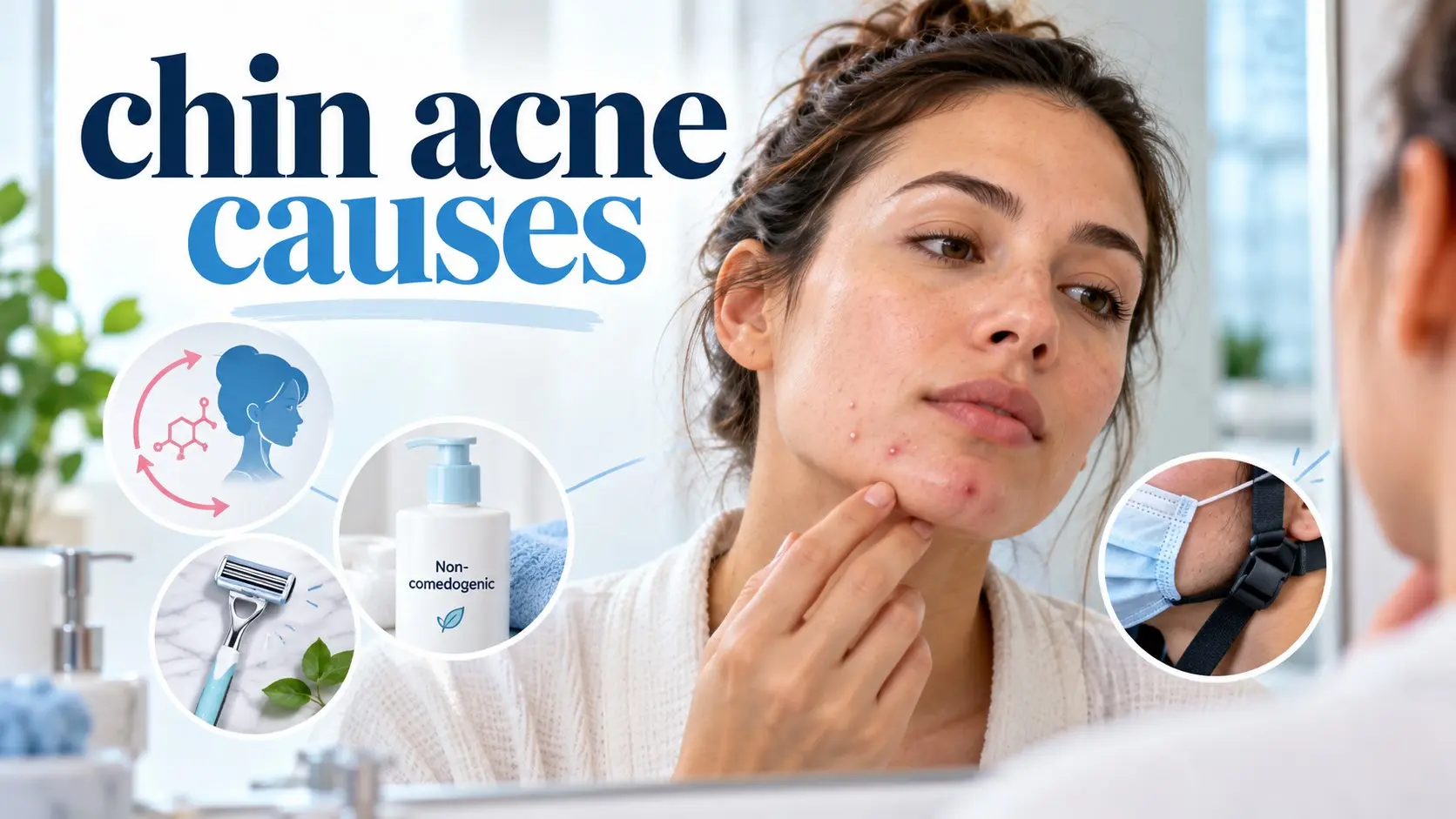
Chin acne causes include the same basic problems behind acne elsewhere: clogged hair follicles, excess oil, dead skin cells, and inflammation. Hormone changes can make chin and jawline acne persistent, especially in adult women, but shaving, friction, products, medicines, and acne lookalikes can create the same pattern.
The useful question is not simply, “Why is my chin breaking out?”
Ask what kind of bump you have, when it appears, and what touches the area.
That changes the treatment.
Medical Notice: I am not a dermatologist or A doctor, and this content does not replace professional medical advice. What I share comes from real life experience, extensive research, and consultation with healthcare providers. Always consult qualified medical professionals for diagnosis and treatment of any health condition.
Deep painful acne, scarring, sudden severe adult acne, a persistent rash, or acne with major hormone symptoms deserves professional assessment. Pregnancy and pregnancy planning also change which acne medicines are appropriate.
Table of Contents
- Quick Answer
- Why chin acne forms
- Why location alone is not a diagnosis
- 11 Common Triggers
- Hormone changes
- PCOS and androgen clues
- Shaving and ingrown hairs
- Friction and pressure
- Skin and hair products
- Overtreatment and irritation
- Medicines
- Stress
- Diet questions
- Deep nodules and cysts
- Acne lookalikes
- Women and Chin Acne
- Men and Under Chin Acne
- What Actually Helps
- Pregnancy Safe Care
- Red Flags
- Frequently Asked Questions
Why does acne form on the chin?
Acne begins inside a hair follicle.
Oil and dead skin cells can collect inside the follicle and form a plug. Inflammation then develops, producing blackheads, whiteheads, red pimples, pustules, or deeper nodules.
The chin does not have a separate acne disease.
It simply happens to be an area where hormones, facial hair, shaving, cosmetics, touching, and friction can all meet.
That is why chin acne can be stubborn.
For the wider picture of acne and everyday skin care, visit the NextFitLife Skin Health Guide.
Does chin acne always mean a hormone problem?
No.
This is the most useful myth to drop first.
Acne along the chin, lower face, jawline, and neck can fit a hormonal pattern, especially in adult women. Dermatologists also know that this pattern can respond well to hormonal treatment.
But location alone cannot tell you that your hormones are abnormal.
You can develop chin acne because of ordinary clogged pores, friction, shaving, products, medicines, stress, or several factors acting together.
Think of the location as a clue.
Not a blood test.
1. Hormone changes can make chin acne persistent
Hormonal chin acne causes are especially relevant when breakouts repeat around the menstrual cycle.
Androgens can increase oil gland activity.
This can make clogged follicles and inflammation more likely.
Adult female acne may flare:
- Before or during menstrual periods
- During pregnancy
- After starting or stopping some hormonal contraception
- During perimenopause
- During other periods of hormonal change
A monthly lower face flare supports the possibility of a hormonal component.
It still does not prove a hormone disorder.
2. Acne plus irregular periods can point beyond the skin
Chin acne causes female searches often lead straight to PCOS.
That jump is too fast.
A few chin pimples do not diagnose polycystic ovary syndrome.
PCOS becomes more worth discussing when persistent acne appears with other signs such as:
- Irregular or absent periods
- Excess facial or body hair
- Scalp hair thinning
- Difficulty becoming pregnant
- Very oily skin
- Thickened, darkened skin in body folds
Higher androgen levels are one part of PCOS for many patients, but diagnosis requires a wider medical assessment.
If several of these signs fit you, bring the full pattern to your doctor or gynecologist rather than asking a skincare product to solve it.
3. Under chin acne can actually be razor bumps
This deserves more attention than it usually gets.
If bumps appear under the chin after shaving, waxing, tweezing, or other hair removal, they may be razor bumps rather than ordinary acne.
The medical term is pseudofolliculitis barbae.
It develops when cut hairs curve back into the skin and trigger inflammation.
Clues include:
- Bumps centered around hairs
- Visible trapped or curved hairs
- Breakouts after close shaving
- Itching or tenderness
- Marks concentrated under the jaw or on the neck
This can affect men and women.
It becomes especially relevant when searching for under chin acne causes female, because facial hair removal can create an acne like pattern even when the underlying problem is not acne.
What helps shaving related bumps?
Shave in the direction of hair growth.
Use a sharp clean blade and light pressure.
Avoid stretching the skin while shaving.
Some people do better with an electric razor because it avoids an extremely close cut.
If shaving keeps producing painful or dark bumps, a dermatologist can help with treatment and longer term hair removal options.
4. Friction can keep lower chin acne inflamed
A mask, helmet strap, chin guard, tight collar, phone, or repeated rubbing can aggravate acne prone skin.
Pressure and friction do not create every pimple.
They can make existing follicle blockage and inflammation worse.
Pay attention to the shape of your breakout.
If the pimples follow the exact path of a strap or contact point, reduce the repeated rubbing when possible and keep the item clean.
Do not compensate by scrubbing your chin harder afterward.
5. Your skincare or beard products can contribute
Anything that repeatedly sits on the lower face deserves a review.
That includes:
- Moisturizer
- Sunscreen
- Foundation
- Concealer
- Lip products
- Beard oils
- Shaving balms
- Hair oils and styling products
For acne prone skin, a noncomedogenic skincare label is a useful starting filter.
It is not a promise that no person will ever break out.
Finished formulas and individual skin responses differ.
For more on this label, read Noncomedogenic Skincare Meaning: 9 Smart Truths.
6. Treating your chin too aggressively can make it look worse
This is an easy trap.
You see acne, so you scrub.
It stays, so you add an acid.
Then another acid.
Then alcohol toner.
Now the chin is red, dry, burning, and still breaking out.
Acne prone skin still needs a healthy barrier.
Use a gentle cleanser rather than a scrub.
Add one treatment at a time.
Use moisturizer if treatment makes the skin dry.
Protect the area with broad spectrum SPF 30 or higher during daylight exposure.
The broader Healthy Skin 101 guide explains how to keep the basic routine simple.
7. Medicines can trigger or worsen acne
A sudden change in acne sometimes begins after a medicine changes.
Drugs associated with acne or acne like eruptions can include some corticosteroids, testosterone, and lithium.
Do not stop prescribed medicine because your chin broke out.
Show the timing to the prescriber.
The medicine may be essential, and the acne may be treatable separately.
8. Stress can make an existing acne pattern worse
Stress is not a complete explanation for acne.
It can still worsen an existing tendency to break out.
Stress can also affect sleep, touching and picking habits, eating patterns, and skincare routines.
The useful approach is to treat the acne itself while also improving stress and sleep where possible.
Do not wait for a perfectly calm life before starting effective acne care.
9. Diet may modify acne, but food rules are often overstated
Online acne advice can make a normal breakfast sound dangerous.
The evidence is more restrained.
The 2024 American Academy of Dermatology acne guideline found insufficient evidence to make formal acne treatment recommendations for dietary changes.
Some studies suggest that lower glycemic eating patterns may help some people, and cow's milk has been associated with acne in some research.
That does not prove one food caused the pimples on your chin.
A more useful food experiment
Do not remove dairy, gluten, sugar, coffee, chocolate, and several food groups at once.
If you repeatedly notice a clear food pattern, change one factor while keeping the rest of your routine steady.
That way you can actually judge the result.
Food changes should support your nutrition, not turn acne treatment into a restrictive diet.
10. Cystic chin acne forms deeper in the skin
Cystic chin acne causes the same search confusion because people use the word cyst for any large pimple.
True nodular and cystic acne develops deeper than a blackhead or ordinary inflamed pimple.
These lesions tend to be:
- Large
- Deep
- Painful
- Slow to settle
- More likely to scar
Do not squeeze one.
Pressure can push inflammation deeper and increase the risk of a scar or lingering mark.
Repeated nodules are a good reason to see a dermatologist earlier rather than trying a new spot cream every week.
11. The bumps may not be acne at all
This is where diagnosis matters most.
Perioral dermatitis
Perioral dermatitis can create small acne like bumps around the mouth and chin.
The area can feel dry, flaky, itchy, tight, or burning.
Topical corticosteroids can trigger or worsen the condition in some people.
If a chin rash burns and flakes more than it behaves like ordinary acne, piling on more acne acids may make the experience worse.
Folliculitis
Folliculitis is inflammation or infection involving hair follicles.
It can look like a sudden acne breakout.
Shaving, plucking, waxing, rubbing, heat, and moisture can all damage follicles and make folliculitis more likely.
Razor bumps
Hair centered bumps after shaving suggest pseudofolliculitis rather than ordinary acne.
Rosacea
Some forms of rosacea cause acne like bumps with persistent redness or flushing.
Rosacea treatment is different from standard acne care.
Useful rule: If several months of reasonable acne treatment make the rash worse instead of better, reconsider whether the diagnosis is actually acne.
What do lower chin acne causes look like in women?
A hormonal pattern becomes more likely when several clues line up.
Examples include:
- Breakouts mainly on the chin and jaw
- Flares before menstruation
- Persistent adult acne
- Deep tender lesions
- Acne that improves with hormonal treatment
Now add irregular periods or increased facial hair and the reason for a medical hormone assessment becomes stronger.
But ordinary whiteheads on the chin with no other hormone symptoms do not prove PCOS.
What causes chin acne in men?
Chin acne causes men searches need two separate answers.
First, men develop ordinary acne because follicles become clogged and inflamed.
Second, the beard area is exposed to shaving, ingrown hairs, beard products, and friction.
That makes acne and razor bumps easy to confuse.
Testosterone treatment can also worsen acne in some people by increasing oil production.
If acne began soon after starting testosterone therapy, tell the prescriber or dermatologist rather than stopping treatment on your own.
How can you tell a whitehead from a deeper chin pimple?
| What You See | Likely Pattern | Useful First Step |
|---|---|---|
| Small skin colored or white bump | Closed comedone or whitehead | Consider salicylic acid or a suitable topical retinoid |
| Dark open pore | Blackhead | Treat clogged pores rather than scrubbing |
| Red tender bump | Inflammatory acne | Benzoyl peroxide can be useful when appropriate |
| Deep painful lump | Acne nodule or cystic lesion | Do not squeeze; consider dermatologist care |
| Hair centered bump after shaving | Razor bump or folliculitis | Review shaving and hair removal |
| Small clustered bumps with burning and flaking around mouth | Possible perioral dermatitis | Avoid self diagnosing as acne and get appropriate assessment |
For a deeper look at small closed bumps, read How to Get Rid of Whiteheads.
What actually helps chin acne?
Treat the type of acne you have.
Do not treat a location.
Current American Academy of Dermatology guidance strongly supports topical benzoyl peroxide and topical retinoids as core acne treatments.
Salicylic acid and azelaic acid are additional options.
For blackheads and whiteheads
A topical retinoid such as adapalene can help keep follicles from clogging when it is appropriate for you.
Salicylic acid can also help unclog pores.
Apply treatment across the acne prone area as directed rather than waiting for each new whitehead to appear.
For red inflamed pimples
Benzoyl peroxide has strong evidence for inflammatory acne.
It can dry or irritate skin, so start sensibly rather than using several strong products at once.
For dark or red marks left behind
The first job is preventing new acne.
Then treat the mark.
Azelaic acid can be useful for acne and some post acne discoloration.
Flat pink or red marks after acne may be post inflammatory erythema. You can read the NextFitLife Post Inflammatory Erythema Guide for the difference between active acne and leftover redness.
For a strong hormonal pattern
Selected women may benefit from hormonal treatment such as combined oral contraceptives or spironolactone.
These are prescription treatments.
They are not right for every person, and pregnancy changes their safety.
For deep or scarring acne
Dermatologists have additional options.
Current AAD guidance strongly recommends isotretinoin for severe acne or acne that has failed standard treatment.
A dermatologist can also inject a selected large painful lesion with corticosteroid to reduce inflammation more quickly.
Should antibiotics be used for chin acne?
They can be useful for selected inflammatory acne.
They should not become an indefinite treatment.
AAD guidance recommends limiting oral antibiotics when possible and pairing antibiotic acne treatment with benzoyl peroxide to reduce antibiotic resistance.
That is another reason to get an actual treatment plan rather than borrowing leftover antibiotics or using antibiotic cream randomly.
A simple routine for mild chin acne
This is a basic example for ordinary mild acne.
It is not a personal prescription.
Morning
- Wash gently.
- Use benzoyl peroxide or another suitable acne treatment when appropriate.
- Apply a noncomedogenic moisturizer.
- Use broad spectrum SPF 30 or higher.
Evening
- Remove makeup and sunscreen.
- Cleanse gently.
- Use adapalene or another suitable treatment when appropriate.
- Moisturize.
Add one active ingredient at a time if your skin is sensitive.
Do not assume stinging and peeling mean treatment is working better.
How long does chin acne treatment take?
Days are the wrong unit.
Acne treatment usually takes weeks.
AAD patient guidance commonly advises giving treatment about six to eight weeks to judge early improvement.
A fuller treatment trial can take longer.
Do not change your entire routine every four days because one new pimple appeared.
Consistency gives you a fair test.
Deep, rapidly worsening, or scarring acne should be assessed sooner.
What should you never put on chin acne?
I would skip harsh home remedies.
That includes:
- Toothpaste
- Lemon juice
- Baking soda paste
- Undiluted vinegar
- Rubbing alcohol
- Repeated harsh scrubs
These can irritate skin without fixing the follicle blockage that drives acne.
If your chin already burns, adding more irritation usually moves you in the wrong direction.
What changes if you are pregnant?
Pregnancy changes acne treatment choices.
ACOG lists several over the counter ingredients that can be used during pregnancy, including:
- Topical benzoyl peroxide
- Azelaic acid
- Topical salicylic acid
- Glycolic acid
ACOG advises avoiding isotretinoin, hormonal acne therapies, and topical retinoids during pregnancy.
If you are pregnant or planning pregnancy, tell the clinician prescribing your acne medicine.
Do not assume that a topical drug is automatically safe because you do not swallow it.
Can picking a chin pimple cause a scar?
Yes, picking can increase inflammation and skin injury.
Deep lesions are especially poor candidates for squeezing because much of the inflammation sits beneath the surface.
Picking can leave:
- Long lasting redness
- Dark marks
- Scars
- More swelling
A hydrocolloid patch may help some people keep their hands away from a superficial pimple, but it does not treat a deep acne nodule.
When is chin acne a red flag?
Arrange professional care when:
- Acne is deep, painful, nodular, or cystic
- Scars are forming
- Acne is rapidly worsening
- Severe acne begins suddenly in adulthood
- A consistent over the counter routine is not working
- Breakouts are causing major distress
- Acne occurs with irregular periods or excess facial hair
- The rash burns, flakes, or behaves unlike ordinary acne
- Bumps repeatedly follow shaving and become infected
- A lump or skin lesion keeps growing, bleeding, or changing instead of healing like acne
Do not wait for permanent scarring if the acne is already deep and painful.
Seven chin acne mistakes to avoid
1. Calling every chin pimple hormonal acne
The pattern can be hormonal, but location alone does not prove it.
2. Treating razor bumps with more and more acne acid
Change the shaving problem first.
3. Using five active products at once
Irritated skin becomes harder to read and harder to treat.
4. Squeezing deep nodules
You raise the chance of inflammation and scarring.
5. Changing routines every week
Acne medicine needs time.
6. Blaming one food without testing the pattern
Diet evidence is more complicated than viral acne lists suggest.
7. Ignoring signs that the rash is not acne
Burning, flaking, hair centered bumps, or persistent flushing can point toward another condition.
Conclusion
Chin acne causes include hormone shifts, clogged follicles, shaving, friction, products, medicines, stress, and conditions that only look like acne. The location can give clues, but it cannot diagnose the cause by itself.
Your next step is simple. Look closely at the lesions before adding another product. If you see ordinary whiteheads and inflamed pimples, use a consistent evidence based acne routine. If you see deep painful lumps, repeated hair centered bumps, a burning mouth area rash, scars, or acne with hormone symptoms, get the diagnosis checked instead of treating every lower face bump the same way.
Internal Links and NextFitLife Hub
NextFitLife Skin Health Guide
for acne, oily skin, sensitive skin, active ingredients, sun protection, pigmentation, and dermatologist warning signs.
Healthy Skin 101
for a simple cleanser, moisturizer, sunscreen, and treatment routine without product overload.
Noncomedogenic Skincare Meaning
for what pore clogging labels do and do not tell you.
How to Get Rid of Whiteheads
for closed comedones, salicylic acid, adapalene, benzoyl peroxide, and safe pore care.
Post Inflammatory Erythema Acne
for flat red or pink marks left after inflamed acne heals.
References and Sources
- American Academy of Dermatology. Updated Guidelines for the Management of Acne.
https://www.aad.org/news/updated-guidelines-acne-management
- American Academy of Dermatology. Hormonal Therapy for Stubborn Acne.
https://www.aad.org/public/diseases/acne/derm-treat/hormonal-therapy
- American Academy of Dermatology. Perioral Dermatitis.
https://www.aad.org/public/diseases/a-z/perioral-dermatitis
- American College of Obstetricians and Gynecologists. Polycystic Ovary Syndrome.
https://www.acog.org/womens-health/faqs/polycystic-ovary-syndrome-pcos
- American College of Obstetricians and Gynecologists. Skin Conditions During Pregnancy.
https://www.acog.org/womens-health/faqs/skin-conditions-during-pregnancy
About the Author
Adel Galal is the Founder and Lead Writer at NextFitLife. He researches practical health, fitness, nutrition, skin care, acne, healthy aging, and everyday wellness topics using recognized medical, dermatology, government, and public health sources.
His approach is to separate useful treatment from skincare marketing and to look for the places where a simple symptom can have more than one cause. With chin acne, that means distinguishing clogged pores from hormone related patterns, shaving bumps, folliculitis, and perioral dermatitis before recommending stronger treatment.
For this article, Adel reviewed current American Academy of Dermatology and American College of Obstetricians and Gynecologists guidance on acne treatment, hormonal therapy, PCOS, acne lookalikes, and pregnancy safety.
Adel is not a dermatologist, doctor, endocrinologist, gynecologist, pharmacist, or other licensed healthcare professional.
Learn more about Adel Galal, NextFitLife, and the site's editorial standards on the About Us page.
Medical Disclaimer: I am not a dermatologist or A doctor, and this content does not replace professional medical advice. What I share comes from real-life experience, extensive research, and consultation with healthcare providers. Always consult qualified medical professionals for diagnosis and treatment of any health condition.
Frequently Asked Questions
What are the most common chin acne causes?
Common causes include clogged follicles, excess oil, inflammation, hormone changes, friction, shaving, hair removal, skincare products, some medicines, and stress. Some acne like chin bumps are actually perioral dermatitis, folliculitis, or razor bumps.
Does chin acne mean a hormonal imbalance?
No. Lower face and jawline acne can fit a hormonal pattern, especially in adult women, but chin location alone does not prove a hormone imbalance.
What causes chin acne in women?
Women can develop chin acne from ordinary clogged pores, menstrual hormone shifts, products, friction, medicines, pregnancy related changes, or conditions such as PCOS when other hormone symptoms are present.
What are under chin acne causes in women?
Under chin bumps can come from acne, hair removal irritation, ingrown hairs, folliculitis, friction, products, or hormonal lower face acne. Bumps centered around hairs after shaving or plucking deserve special attention.
What causes chin acne in men?
Men can develop ordinary acne, shaving related razor bumps, folliculitis, irritation from beard products, friction, or acne related to testosterone treatment in some cases.
What are hormonal chin acne causes?
Androgen activity and changes around menstruation, pregnancy, hormonal contraception, and other life stages can influence oil glands and lower face acne. PCOS is one possible cause when acne appears with other androgen related symptoms.
What are cystic chin acne causes?
Deep chin nodules develop when acne inflammation occurs deeper in the follicle. Hormonal influence, genetics, and ordinary acne biology can all contribute. Repeated painful nodules need professional care because of scarring risk.
Can PCOS cause chin acne?
Yes. PCOS can be associated with persistent acne because increased androgen activity can affect oil glands. Acne alone does not diagnose PCOS. Irregular periods, excess hair growth, infertility, or darkened thick skin strengthen the reason for assessment.
Can shaving cause acne under the chin?
Shaving can irritate true acne, but it can also cause pseudofolliculitis barbae, better known as razor bumps, when cut hairs curve back into the skin.
Can stress cause chin acne?
Stress can worsen acne in some people, but it is rarely the whole explanation. Treat the acne itself while addressing sleep and stress where possible.
Does dairy cause chin acne?
Research has found associations between cow's milk and acne in some populations, but this does not prove milk causes every breakout. Current AAD guidelines do not provide a formal dietary acne treatment recommendation because the evidence remains insufficient.
What is the best treatment for chin acne?
The best treatment depends on acne type. Benzoyl peroxide and topical retinoids have strong evidence. Salicylic acid and azelaic acid can also help. Hormonal treatment may help selected women with lower face acne, while deep or scarring acne often needs a dermatologist.
Is salicylic acid good for chin acne?
Salicylic acid can help unclog pores and is particularly useful for blackheads and whiteheads. It can irritate sensitive skin, so avoid combining too many exfoliating products at once.
Is benzoyl peroxide good for chin acne?
Yes. Benzoyl peroxide is strongly recommended in current AAD acne guidance and is particularly useful for inflammatory pimples.
Does adapalene help chin acne?
Adapalene is a topical retinoid that helps prevent clogged follicles and treats several forms of acne. It can irritate skin at first and should be avoided during pregnancy unless a qualified clinician specifically advises otherwise.
How can I tell perioral dermatitis from chin acne?
Perioral dermatitis often creates clusters of small acne like bumps around the mouth with dryness, flaking, itching, tightness, or burning. Ordinary acne is more likely to include blackheads and whiteheads.
When should I see a dermatologist for chin acne?
See a dermatologist when acne is deep, painful, scarring, rapidly worsening, causing major distress, or not improving with consistent treatment. Professional assessment is also useful when you are unsure whether the bumps are actually acne.
Can I treat chin acne during pregnancy?
Yes, but treatment choices change. ACOG lists topical benzoyl peroxide, azelaic acid, topical salicylic acid, and glycolic acid as options that can be used during pregnancy. Isotretinoin, hormonal therapies, and topical retinoids should be avoided.

Health & wellness writer with 30+ years of experience in nutrition, fitness, and healthy aging. Founder of NextFitLife.com — evidence-based health guidance.