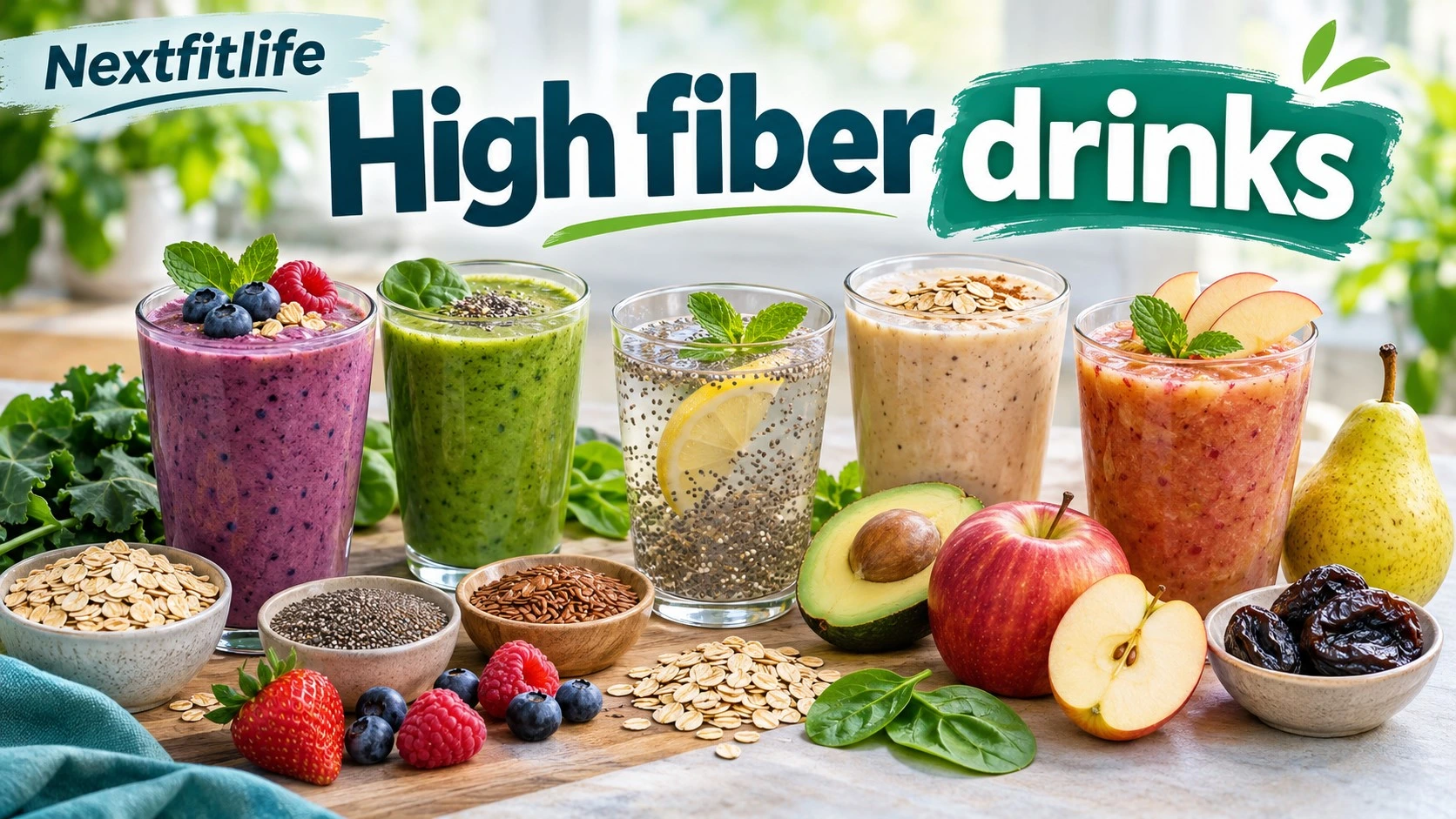
A drink can contain some fiber without being truly high in fiber.
The best high fiber drinks give you a meaningful amount of fiber, keep added sugar reasonable, and still fit into a diet built around fruit, vegetables, beans, lentils, whole grains, nuts, and seeds.
Quick Answer
High fiber drinks can help raise daily fiber when they contain whole fruit, oats, chia, flax, psyllium, prunes, vegetables, or another recognized fiber source. For packaged drinks, about 6 grams per serving reaches the FDA general 20% Daily Value benchmark for a high amount of fiber.
That gives you a useful test before you buy anything.
Do not let the words “gut friendly,” “wellness,” or “prebiotic” do the thinking for you.
This article is for general information and education. It does not replace medical advice, diagnosis, or treatment.
Do not keep adding fiber to serious digestive symptoms:
Seek medical care for severe or constant abdominal pain, repeated vomiting, marked swelling, inability to pass stool or gas, blood in stool, black stool, unexplained weight loss, or a major new change in bowel habits.
For the wider picture, start with the NextFitLife Gut Health Foods and Digestion Guide.
What You Will Learn
- What really counts as a high fiber drink
- Why smoothies usually beat strained juice for fiber
- Twelve practical drink options
- How psyllium differs from a normal food drink
- How to read packaged drink labels
- How fiber can affect constipation and fullness
- Why too much fiber too quickly can backfire
- How IBS changes the choice
- When food is better than a fiber supplement
Table of Contents
- What Counts as High Fiber?
- Smoothies vs Juice
- 1. Berry Oat Smoothie
- 2. Pear Oat Smoothie
- 3. Chia Drink
- 4. Ground Flax Smoothie
- 5. Psyllium Drink
- 6. Prebiotic Fiber Drink
- 7. Oat Beta Glucan Smoothie
- 8. Avocado Smoothie
- 9. Vegetable Smoothie
- 10. Prune Smoothie
- 11. Apple Chia Smoothie
- 12. Packaged Fiber Drink
- Fiber and Constipation
- Too Much Fiber Too Fast
- IBS and Fiber Drinks
- Soluble vs Insoluble Fiber
- Cholesterol and Fiber
- Fullness and Weight
- Label Checklist
- When to Use Care
- Conclusion
- References and Sources
- Internal Links and Hub
- About the Author
- Frequently Asked Questions
What Actually Counts as a High Fiber Drink?
The easiest answer comes from the Nutrition Facts label.
The FDA currently sets the Daily Value for dietary fiber at 28 grams on a 2,000 calorie diet.
Its general guide says 5% Daily Value or less is low, while 20% Daily Value or more is high.
| Fiber on Label | Meaning | My Take |
|---|---|---|
| 5% DV or less | Low | Small contribution |
| Around 10% DV | Moderate contribution | Useful, but not especially high |
| 20% DV or more | High | Meaningful amount per serving |
Twenty percent of 28 grams is 5.6 grams.
That makes roughly 6 grams of fiber per serving a practical benchmark when a packaged beverage calls itself high in fiber.
A useful rule:
A drink with 2 or 3 grams of fiber still contributes something. I just would not treat it as a major fiber source because the front of the bottle uses large health words.
For whole food comparisons, see the High Fiber Fruits List.
Smoothies Usually Beat Strained Juice for Fiber
This is the first distinction I would make.
Blend whole fruit and most of its edible plant material stays in the drink.
Juice it and remove the pulp, and much of the fiber goes with it.
The same idea applies to vegetables and prunes.
Keep the pulp when fiber is the goal:
A whole fruit smoothie and a clear fruit juice can start with the same produce and end with very different fiber content.
1. Berry Oat Smoothie
This is one of the easiest high fiber drinks to build from normal food.
Use whole berries, oats, and a suitable unsweetened milk or fortified plant drink.
Raspberries and blackberries are especially useful because they bring more fiber than many common fruits.
Add plain yogurt if you want more protein.
You do not need syrup.
2. Pear Oat Smoothie
A pear works well because the edible skin contributes fiber when you keep it.
Blend pear with oats, cinnamon, and a suitable liquid base.
This is a better fiber strategy than pear juice because the whole fruit stays in the drink.
NextFitLife's High Fiber Fruits List also ranks pears among the easier everyday fruit choices for fiber.
3. Chia Drinks
Chia seeds contain fiber and absorb liquid, which creates a gel texture.
You can mix chia into water, milk, yogurt drinks, or smoothies.
Start with a modest amount if you normally eat little fiber.
NIDDK recommends increasing fiber gradually so your digestive system has time to adjust.
That matters because a sudden jump can lead to gas, cramping, or bloating.
4. Ground Flax Smoothies
Ground flax fits easily into berry, oat, banana, or yogurt smoothies.
It adds fiber without forcing you to use a separate supplement drink.
Ground flax is also easier to mix evenly than whole seeds.
Judge the whole drink, though.
A bottled smoothie with a little flax and a lot of added sugar does not become the better choice just because the label says flax.
5. Psyllium Drinks
Psyllium deserves more care than normal smoothie ingredients.
It is a concentrated bulk forming soluble fiber commonly used for constipation.
MedlinePlus explains that psyllium absorbs liquid in the intestine, swells, and forms bulky stool that is easier to pass.
Use enough liquid:
MedlinePlus says psyllium powder or granules should be mixed with at least 8 ounces, or about 240 milliliters, of liquid. Follow the product directions and do not swallow dry psyllium powder.
Psyllium can also affect how some medicines are taken.
I would treat it as a fiber supplement, not as casual flavored water.
6. Prebiotic Fiber Drinks
Prebiotic sodas, waters, and other functional drinks can contain meaningful amounts of added fiber.
Common ingredients include inulin, chicory root fiber, acacia fiber, resistant starch, and other isolated fibers.
That does not make every product a good choice.
Check fiber grams, fiber source, added sugar, serving size, sweeteners, and your own digestive response.
The phrase prebiotic fiber does not cancel the rest of the label.
7. Oat Beta Glucan Smoothies
Oats work especially well in drinks because they add thickness plus soluble fiber.
They contain beta glucan.
Specific qualifying oat beta glucan products can meet FDA conditions for heart health claims when they provide the required amount and meet the legal criteria.
That does not mean every oat smoothie prevents heart disease.
The useful point is simpler: oats are a real whole food fiber source that blends well.
8. Avocado Smoothies
Avocado is useful when you want fiber plus a creamy texture without relying on ice cream or sweetened creamers.
It also provides unsaturated fat, so the drink can feel more substantial.
Pair avocado with berries, plain yogurt, cocoa, or an unsweetened milk base.
Keep the serving sensible because avocado is more energy dense than most fruit.
9. Vegetable Smoothies
Vegetable juice and blended vegetables are not the same thing.
When you blend the whole edible vegetable, more of the fibrous material stays in the drink.
Useful ingredients can include spinach, carrot, avocado, cucumber, or cooked vegetables that blend well.
Do not build a recipe so complicated that you never make it twice.
10. Whole Prune Smoothies
Prunes are worth separating from prune juice.
Whole prunes keep their fiber, while strained juice contains much less.
Blend a small portion of prunes with oats, plain yogurt, cinnamon, and water or milk.
Prunes are concentrated dried fruit, so you do not need a huge amount.
11. Apple Chia Smoothies
Apple works well when you keep the edible skin and blend the whole fruit.
Add hydrated chia, cinnamon, oats, and a suitable liquid base.
This gives you fiber from several whole food sources without needing a large scoop of isolated powder.
If apples bother your digestion, choose a different fruit rather than forcing the recipe.
12. Packaged High Fiber Beverages
Convenience matters.
A ready made beverage can fit if it genuinely contributes fiber and does not bring other features you do not want.
Check the Fiber Line
If the drink calls itself high fiber, look for around 20% Daily Value or more per serving.
Check Added Sugar
Fiber does not erase added sugar.
Check the Fiber Source
A clearly named fiber source is more useful than a vague blend.
Check Tolerance
A product that repeatedly causes pain, diarrhea, or major bloating is not a smart choice simply because it contains 10 grams of fiber.
High Fiber Does Not Automatically Mean Healthy
Fiber is one line on the label.
Imagine one drink with 8 grams of isolated fiber and a large amount of added sugar, then compare it with a whole food smoothie that has slightly less fiber but contains fruit, oats, seeds, and protein.
The larger fiber number does not automatically win.
Look at the whole nutritional package.
Can High Fiber Drinks Help Constipation?
They can help when low fiber intake contributes to constipation.
NIDDK says adults commonly need about 22 to 34 grams of fiber per day depending on age and sex.
It also recommends enough liquid because fluid helps fiber work more effectively and can help stool stay softer.
Constipation still has many possible causes.
Medicine, medical conditions, pelvic floor problems, low activity, and other issues can contribute.
If constipation is persistent, painful, or associated with bleeding, do not keep adding more fiber without looking at the bigger problem.
Fiber and Fluid Need to Work Together
Increasing fiber while ignoring fluids is a poor plan.
NIDDK advises drinking enough water and other liquids when increasing fiber because fluid helps fiber work better.
That becomes even more important with concentrated products such as psyllium.
There is no single fluid number that fits every person.
People with kidney disease, heart failure, liver disease, or another condition requiring a fluid restriction should follow their medical team's advice.
Too Much Fiber Too Fast Can Backfire
This is one of the easiest mistakes to make.
You decide fiber is healthy, so you add a chia smoothie, a prebiotic drink, psyllium, bran cereal, and a huge bean meal on the same day.
Your digestive system may object.
A sudden fiber increase can lead to gas, bloating, cramps, pressure, and changes in bowel habits.
Better approach:
Add one fiber source at a time. Start with a modest portion, keep fluids appropriate for your needs, and increase gradually if digestion stays comfortable.
IBS Changes the Choice
If you have IBS, the fiber type matters as much as the gram number.
NIDDK notes that research suggests soluble fiber can be more helpful than insoluble fiber for some IBS symptoms.
Too much fiber at once can still worsen gas and bloating.
That means one person's perfect high fiber drink may be another person's bad afternoon.
Soluble and Insoluble Fiber Do Different Jobs
| Fiber Type | Simple Description | Examples |
|---|---|---|
| Soluble fiber | Mixes with water and may form a gel | Oats, psyllium, beans, fruit |
| Insoluble fiber | Adds structural bulk | Whole grains, vegetable skins, nuts, seeds |
Many foods contain both.
You do not need to pick one type for your entire diet.
Can High Fiber Drinks Help Cholesterol?
Some specific soluble fibers have evidence for cholesterol effects.
That does not mean every high fiber drink lowers cholesterol.
The FDA has authorized certain heart health claims for qualifying amounts and sources of soluble fiber, including specific oat, barley, and psyllium products when the legal conditions are met.
The fiber source and dose matter.
Can Fiber Drinks Help You Feel Full?
Some fibers add bulk, absorb water, or increase viscosity, which can contribute to fullness.
But I would not market fiber water as an appetite control trick.
A smoothie that contains fiber plus protein and some fat is usually more substantial than flavored water with isolated fiber.
Are High Fiber Drinks Good for Weight Loss?
They can fit into a weight management plan.
They are not a weight loss treatment.
A high fiber smoothie can still contain a lot of calories when it includes large portions of nut butter, juice, sweetener, dried fruit, or other concentrated ingredients.
Use the drink for a reason rather than assuming fiber cancels everything else.
Food Should Still Be the Foundation
A useful eating pattern should still include vegetables, fruit, beans, lentils, whole grains, nuts, and seeds.
That principle also appears throughout the NextFitLife Healthy Eating Lifestyle Hub.
- Build meals around fiber rich foods first.
- Use smoothies when drinking some of that food makes life easier.
- Use packaged fiber drinks for convenience when the label makes sense.
- Use concentrated supplements for a clear reason rather than because more fiber sounds automatically better.
A Practical High Fiber Drink Label Test
| Check | What to Look For | Why It Matters |
|---|---|---|
| Fiber | Around 20% DV or more if marketed as high fiber | Shows a meaningful contribution |
| Fiber source | Clearly named ingredient | Helps you understand what you are drinking |
| Added sugar | Lower when practical | Fiber does not cancel added sugar |
| Serving size | A realistic portion | Fiber numbers depend on serving size |
| Calories | Fit the role of the drink | A drink can become a meal |
| Tolerance | Comfortable digestion | A useful drink should not repeatedly make you feel unwell |
When Should You Be Careful With Fiber Drinks?
Talk with a healthcare professional before making major fiber supplement changes if you have:
- A history of bowel blockage
- Crohn's disease or another significant gastrointestinal condition
- Trouble swallowing
- Severe unexplained abdominal pain
- A fluid restriction
- Medicine that may interact with fiber supplements
Psyllium deserves extra care when swallowing is difficult or adequate fluid intake is not possible.
Conclusion
Use high fiber drinks to close a fiber gap, not to replace a balanced eating pattern.
Start with whole food smoothies that keep the fruit, oats, seeds, vegetables, or prunes in the drink. For packaged beverages, check whether the fiber amount is meaningful, where it comes from, how much added sugar is present, and whether your gut tolerates it.
Your next step: pick one of the 12 options above and use a modest serving first. If your current fiber intake is low, increase it gradually rather than turning tomorrow into a fiber challenge.
References and Sources
- U.S. Food and Drug Administration. How to Understand and Use the Nutrition Facts Label.
https://www.fda.gov/food/nutrition-facts-label/how-understand-and-use-nutrition-facts-label - U.S. Food and Drug Administration. Daily Value on the Nutrition and Supplement Facts Labels.
https://www.fda.gov/food/nutrition-facts-label/daily-value-nutrition-and-supplement-facts-labels - National Institute of Diabetes and Digestive and Kidney Diseases. Eating, Diet and Nutrition for Constipation.
https://www.niddk.nih.gov/health-information/digestive-diseases/constipation/eating-diet-nutrition - National Institute of Diabetes and Digestive and Kidney Diseases. Eating, Diet and Nutrition for Irritable Bowel Syndrome.
https://www.niddk.nih.gov/health-information/digestive-diseases/irritable-bowel-syndrome/eating-diet-nutrition - MedlinePlus. Psyllium Drug Information.
https://medlineplus.gov/druginfo/meds/a601104.html - Mayo Clinic. Fiber Supplements: Safe to Take Every Day?
https://www.mayoclinic.org/healthy-lifestyle/nutrition-and-healthy-eating/expert-answers/fiber-supplements/faq-20058513
Internal Links and NextFitLife Hub
About the Author
Adel Galal is the founder and lead writer of NextFitLife.com. He has more than 15 years of health and wellness writing experience. He is not a licensed healthcare professional. Read the About page for sources and review rules.
Adel is not a medical professional; health articles cite trusted sources and are for general information only.
Frequently Asked Questions
What counts as a high fiber drink?
For packaged foods and drinks, the FDA considers 20% Daily Value or more of a nutrient per serving high. Because the fiber Daily Value is 28 grams, about 5.6 grams or more reaches that general benchmark.
What are some good high fiber drinks?
Useful options include berry oat smoothies, pear oat smoothies, chia drinks, ground flax smoothies, psyllium drinks, oat smoothies, avocado smoothies, vegetable smoothies, prune smoothies, and packaged beverages with meaningful fiber.
Are smoothies high in fiber?
They can be. Smoothies made with whole fruit, oats, chia, flax, vegetables, or prunes can provide meaningful fiber, but the exact amount depends on ingredients and portions.
Is juice a high fiber drink?
Usually not. Strained juice removes much of the fibrous pulp. Whole fruit or a smoothie that keeps the edible plant material is usually better when fiber is the main goal.
Can high fiber drinks help constipation?
They can help when low fiber intake contributes to constipation. Increase fiber gradually and pair it with enough fluid. Persistent or painful constipation may have another cause and can need medical assessment.
Can too much fiber cause bloating?
Yes. A sudden increase can cause gas, bloating, cramps, or bowel changes. Increase fiber gradually when your current intake is low.
How much liquid should I use with psyllium?
MedlinePlus says psyllium powder or granules should be mixed with at least 8 ounces, or about 240 milliliters, of liquid. Always follow the product directions and relevant medical advice.
Are high fiber drinks good for IBS?
It depends on the fiber and the person. NIDDK notes that soluble fiber may help some IBS symptoms, while too much fiber at once can worsen gas and bloating.
Can I drink a high fiber drink every day?
Yes, if it fits your diet and you tolerate it. A daily fiber drink is optional, and whole foods should still provide a varied mix of fiber and nutrients.
What should I look for on a high fiber drink label?
Check fiber grams and percent Daily Value, the fiber source, serving size, added sugar, calories, sweeteners, and how well your digestive system tolerates the drink.

Health & wellness writer with 30+ years of experience in nutrition, fitness, and healthy aging. Founder of NextFitLife.com — evidence-based health guidance.