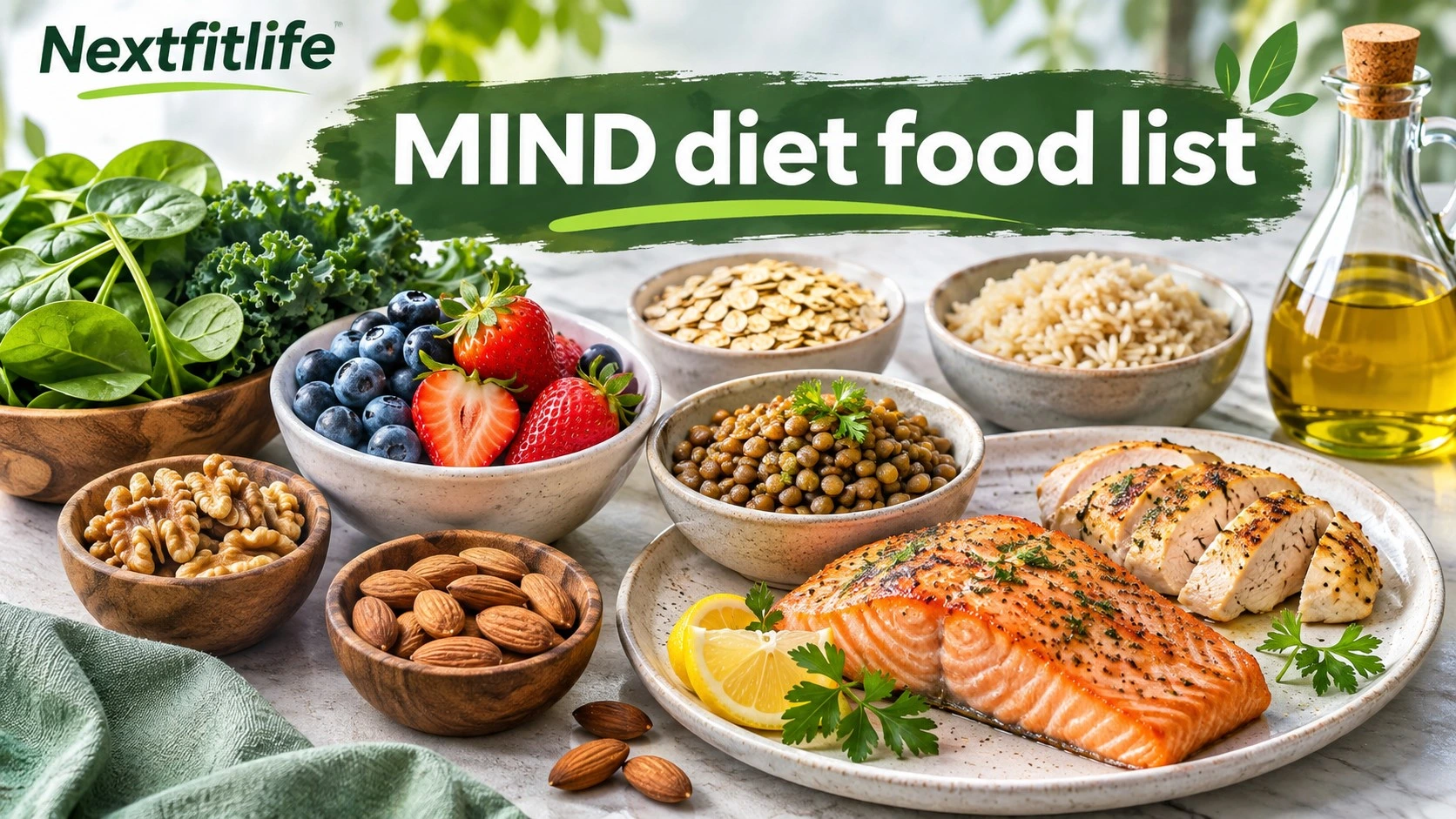
A useful MIND diet food list is mostly ordinary food: leafy greens, other vegetables, berries, nuts, beans, whole grains, fish, poultry, and olive oil.
The harder part is knowing how often to eat them, how the original MIND score differs from later research, and what the diet can and cannot promise for brain health.
The MIND diet food list centers on leafy greens, other vegetables, berries, nuts, beans, whole grains, fish, poultry, and olive oil. It limits butter, cheese, red and processed meat, fried foods, pastries, and sweets. Wine appeared in the original score but is not required.
MIND stands for Mediterranean DASH Intervention for Neurodegenerative Delay. The eating pattern combines parts of the Mediterranean diet and DASH diet, then gives extra attention to foods such as leafy greens and berries.
Early observational research linked higher MIND scores with better cognitive outcomes, but that does not prove that the diet prevents dementia. In the major three year randomized trial, cognition improved in both groups and the difference between groups was not statistically significant.
This article is for general information and education. It does not replace medical advice, diagnosis, or treatment.
For a wider nutrition framework, see the NextFitLife Healthy Eating Lifestyle Hub.
What You Will Learn
- Which foods make up the MIND diet
- How the original serving targets compare with the later trial
- Simple ways to eat each food group
- Which foods the MIND score limits
- What current research says about cognitive health
- Why wine is not a required part of the modern diet
- What people using warfarin should know about leafy greens
- How to build a simple MIND style day without counting every point
Table of Contents
- What Is the MIND Diet?
- Original Targets vs Later Trial
- 1. Green Leafy Vegetables
- 2. Other Vegetables
- 3. Berries
- 4. Nuts
- 5. Beans and Legumes
- 6. Whole Grains
- 7. Fish
- 8. Poultry
- 9. Olive Oil
- 10. Wine Is Not Required
- Foods to Limit
- Simple Meal Ideas
- MIND Diet vs Mediterranean Diet
- What the Research Shows
- Safety Notes
- Shopping List
- Conclusion
- References and Sources
- Internal Links and Hub
- About the Author
- Frequently Asked Questions
What Is the MIND Diet?
The MIND diet was designed as a research eating pattern focused on cognitive health.
It borrows heavily from Mediterranean and DASH eating, so the basic foods will look familiar. Vegetables, whole grains, beans, nuts, fish, poultry, and olive oil do most of the work.
What makes MIND different is its scoring system. It gives extra attention to leafy greens and berries, while also setting limits for several foods high in saturated fat or commonly eaten as fried or highly processed foods.
Think of MIND as a pattern that nudges meals toward vegetables, berries, beans, whole grains, nuts, fish, poultry, and olive oil. It is not a list of foods you must eat perfectly every day.
Why Do MIND Serving Targets Differ Between Websites?
Because researchers have used more than one version of the MIND pattern.
Harvard summarizes the original MIND score with targets such as six or more leafy green servings each week, four or more bean meals each week, and at least two berry servings each week.
The later randomized MIND trial used a somewhat different intervention. It targeted leafy greens each day, beans three times weekly, berries five times weekly, five ounces of nuts each week, fish weekly, poultry twice weekly, three whole grain servings daily, and about two tablespoons of extra virgin olive oil daily.
| Food Group | Original MIND Score | Later Trial Target |
|---|---|---|
| Leafy greens | 6 or more servings weekly | About 0.5 to 1 cup daily |
| Other vegetables | 1 or more servings daily | About 0.5 cup daily |
| Berries | 2 or more servings weekly | 0.5 cup 5 times weekly |
| Nuts | 5 or more servings weekly | 5 ounces weekly |
| Beans | 4 or more meals weekly | 0.5 cup 3 times weekly |
| Whole grains | 3 or more servings daily | 3 servings daily |
| Fish | 1 or more meals weekly | 3 to 5 ounces weekly |
| Poultry | 2 or more meals weekly | 3 to 5 ounces twice weekly |
That is why I would not turn one exact MIND score into a rigid prescription. Use the targets as a map rather than a daily exam.
1. Green Leafy Vegetables
Leafy greens are one of the foods that separate MIND from a generic healthy eating plan.
Useful choices include spinach, kale, romaine, arugula, collard greens, mustard greens, Swiss chard, and similar vegetables.
Easy Serving Ideas
- Add spinach to eggs.
- Use romaine or mixed greens with lunch.
- Stir frozen spinach into lentil soup.
- Add kale to beans or pasta.
- Serve cooked greens beside fish or chicken.
You do not need a huge raw salad every day. Cooked greens can be easier to fit into normal meals.
If you take warfarin, do not suddenly make a large change in foods rich in vitamin K. NHS guidance says leafy greens can still be eaten, but the amount should stay reasonably consistent and major diet changes should be discussed with your warfarin clinic.
2. Other Vegetables
The MIND diet does not stop at spinach.
Other vegetables include broccoli, cauliflower, carrots, tomatoes, peppers, zucchini, eggplant, mushrooms, green beans, peas, and squash.
Simple Ways to Eat More
Add tomatoes and cucumber to breakfast, keep frozen broccoli for busy evenings, roast peppers and zucchini with dinner, or add mushrooms to eggs.
Frozen vegetables are still useful. Convenience matters if it helps vegetables reach the plate more often.
3. Berries
Berries receive their own category in the MIND score rather than being grouped with every fruit.
Useful choices include blueberries, strawberries, raspberries, and blackberries.
Easy Berry Ideas
- Add blueberries to oatmeal.
- Mix strawberries into plain yogurt.
- Add frozen berries to overnight oats.
- Pair berries with nuts for a snack.
Frozen berries are a practical choice and can make this category easier to afford year round.
For more options beyond berries, use the High Fiber Fruits List.
4. Nuts
Nuts appear frequently in the MIND pattern.
Walnuts, almonds, pistachios, pecans, cashews, peanuts, and natural nut butters can all fit.
Keep the Serving Easy
Use a small handful as a snack, sprinkle nuts over oats, or spread nut butter on whole grain toast.
Nuts are nutrient dense and energy dense. A sensible serving is more useful than eating directly from a large bag until it is empty.
If you have a known nut or peanut allergy, do not eat that food to satisfy a diet score. The broader eating pattern matters more than one category.
5. Beans and Legumes
Beans and legumes make the diet more practical because they work in soups, salads, bowls, spreads, and main meals.
Examples include lentils, chickpeas, black beans, kidney beans, white beans, peas, and similar legumes.
Serving Ideas
- Lentil soup
- Chickpea salad
- Beans with brown rice
- Hummus with whole grain pita
- White beans with tomato and herbs
For a wider plant focused meal pattern, see the Healthy Eating Lifestyle Hub.
6. Whole Grains
Whole grains are one of the daily MIND categories.
The original score uses three or more servings each day.
Examples include oats, brown rice, barley, whole wheat bread, whole wheat pasta, quinoa, and other intact or minimally refined grains.
Oatmeal at breakfast, whole grain bread at lunch, then brown rice or barley with dinner. It is easier than the number sounds.
7. Fish
Fish appears at least weekly in the MIND framework.
Choices can include salmon, trout, sardines, tuna, mackerel, herring, and other fish.
The research pattern specifies nonfried fish, so cooking method matters.
Simple Options
Bake it, grill it, poach it, or cook it with a small amount of olive oil.
Do not assume deep frying becomes a brain health meal simply because fish is underneath the batter.
8. Poultry
Poultry appears around twice weekly in the MIND framework.
Chicken and turkey are the obvious examples.
Simple Meal Ideas
- Roast chicken with vegetables
- Chicken with lentils
- Turkey with whole grain bread and vegetables
- Chicken salad with olive oil and lemon dressing
The pattern does not require poultry every day. Beans and fish can handle many meals.
9. Olive Oil
The original MIND score rewards using olive oil as the main added cooking fat.
The later trial used about two tablespoons of extra virgin olive oil daily as an intervention target.
That does not mean you need to drink olive oil or pour it over every meal.
Use it where it makes sense:
- Salad dressing
- Roasted vegetables
- Beans
- Fish
- Grain bowls
- Cooking
It is still a concentrated source of energy, so more is not automatically better.
10. Wine Is Not Required
This part of the original MIND score needs modern context.
Wine appeared as one of the original 15 scoring components, but it was omitted from later MIND intervention trials for safety reasons.
Alcohol is not required to follow a useful MIND style eating pattern. Personal risks vary with medicines, liver health, cancer risk, pregnancy, addiction history, and other factors.
A modern MIND diet food list should not present alcohol as required medicine.
Which Foods Does the MIND Diet Limit?
The original MIND score includes five main food categories to limit.
| Food Group | Original Target | Practical Approach |
|---|---|---|
| Butter and stick margarine | Less than about 1 tablespoon daily | Use olive oil more often when suitable |
| Red and processed meat | Fewer than 4 servings weekly | Use beans, fish, and poultry more often |
| Cheese | Less than 1 serving weekly in original scoring | Treat as optional rather than a daily staple |
| Fried and fast food | Less than 1 meal weekly | Choose baked, grilled, or home cooked food more often |
| Pastries and sweets | Fewer than 5 servings weekly | Keep them occasional rather than making them daily defaults |
These are research scoring targets, not proof that one serving above the line harms the brain.
The useful idea is to make whole foods and plant foods the normal pattern rather than treating every meal like a scorecard.
A Practical MIND Diet Food List
| Food Group | Simple Target | Easy Serving Idea |
|---|---|---|
| Leafy greens | Most days | Spinach with eggs or salad |
| Other vegetables | Daily | Broccoli or peppers with dinner |
| Berries | Several times weekly | Blueberries in oats |
| Nuts | About 5 times weekly | Small handful of walnuts |
| Beans | About 3 to 4 times weekly | Lentil soup or chickpeas |
| Whole grains | About 3 servings daily | Oats, whole grain bread, brown rice |
| Fish | At least weekly | Baked salmon |
| Poultry | About twice weekly | Roast chicken |
| Olive oil | Main added fat | Salad dressing or cooking |
| Wine | Not required | Do not start drinking for the diet |
A Simple MIND Breakfast
You do not need a special brain powder.
Try oatmeal with blueberries, walnuts, and cinnamon. Add plain yogurt if you enjoy it.
That gives you whole grains, berries, and nuts in one familiar meal.
You can also borrow ideas from Mediterranean Diet Breakfast Ideas, since the two eating patterns overlap heavily.
A Simple MIND Lunch
A grain bowl works well.
Start with brown rice, barley, or quinoa. Add lentils or chickpeas, spinach, tomato, cucumber, olive oil, lemon, and herbs.
That covers several MIND categories without making lunch complicated.
A Simple MIND Dinner
Try baked salmon with brown rice, broccoli, and a spinach salad dressed with olive oil and lemon.
Or make a bean meal with lentil stew, whole grain bread, leafy greens, and roasted vegetables.
Fish and poultry are part of the pattern, but they do not need to appear at every meal.
A One Day MIND Diet Example
| Meal | Example |
|---|---|
| Breakfast | Oatmeal with blueberries and walnuts |
| Lunch | Lentil vegetable soup, whole grain bread, side salad |
| Snack | Apple with nut butter |
| Dinner | Baked salmon, brown rice, broccoli, spinach salad with olive oil |
| Dessert if wanted | Fruit or a modest sweet |
The MIND diet is not a starvation plan and it does not require perfect adherence at every meal.
What Does the Research Actually Show?
This is where careful wording matters.
Early observational studies found that people with higher MIND scores tended to have slower cognitive decline and lower rates of dementia.
Observational studies can show an association, but they cannot prove that the diet caused the difference.
Then Came the Randomized Trial
The major randomized trial enrolled 604 adults aged 65 or older. Participants did not have cognitive impairment, but they had a family history of dementia, overweight, and a lower quality baseline diet.
One group followed the MIND diet with mild calorie reduction. The control group continued its usual diet with the same mild calorie reduction.
After three years, cognitive scores improved in both groups, but the difference between the groups was not statistically significant. Brain MRI outcomes were also similar.
The MIND diet is a nutritious eating pattern, but current randomized evidence does not prove that following it prevents dementia or slows cognitive aging over three years.
What Does the Latest 2026 Review Say?
A review published on October 22, 2026 examined current MIND diet evidence and reached a cautious conclusion.
The diet remains an interesting area for dementia prevention research, but the available evidence is still limited by a large amount of observational data and inconsistent findings.
The review calls for larger and longer randomized trials.
That is a better message than promising that blueberries and spinach protect everyone from Alzheimer's disease.
Does the Randomized Trial Mean the MIND Diet Failed?
No.
It means the trial did not show a statistically significant cognitive advantage for the MIND group over its comparison group during the three year study period.
Harvard points out that both groups lost weight and the control group may also have improved diet quality. Three years may also be too short to answer every question about long term cognitive aging.
That leaves an open research question rather than a proven brain protection claim.
MIND Diet vs Mediterranean Diet
The two patterns overlap heavily.
| Feature | MIND Diet | Mediterranean Diet |
|---|---|---|
| Vegetables | Strong focus, especially leafy greens | Strong broad vegetable focus |
| Fruit | Berries emphasized | Many fruits emphasized |
| Whole grains | Daily target | Core food group |
| Beans and nuts | Specific weekly targets | Regular plant protein foods |
| Olive oil | Main added fat | Central traditional fat |
| Main research focus | Cognitive health | Broad cardiovascular and metabolic health |
If you already eat Mediterranean style meals, moving toward MIND usually means adding more emphasis on leafy greens, berries, and the MIND scoring categories rather than rebuilding your entire diet.
The Mediterranean Diet Breakfast Ideas Guide offers practical meals that overlap with several MIND foods.
MIND Diet vs DASH Diet
DASH was developed around blood pressure control.
MIND borrowed parts of DASH and Mediterranean eating, then created its own brain focused scoring categories.
DASH places stronger emphasis on established blood pressure nutrition targets. MIND gives extra scoring weight to berries and leafy greens.
They overlap more than they conflict.
Do Other Fruits Fit the MIND Diet?
Yes.
The fact that berries receive their own MIND score does not make apples, oranges, pears, bananas, kiwi, or other fruits bad choices.
This is an important limit of research scoring systems. They measure selected components rather than defining every healthy food.
For practical fruit choices, see High Fiber Fruits List: 34 Smart Picks.
Do Eggs Fit the MIND Diet?
Eggs are not one of the major scored MIND food groups.
That does not mean they are banned.
The scoring system simply focuses on the foods chosen for the research model. Eggs can still fit a balanced eating pattern unless your personal medical or nutrition needs suggest otherwise.
Does Dairy Fit?
Dairy is not a major promoted MIND category.
Full fat cheese is one of the groups limited by the original score, but that does not mean every dairy food must disappear.
Plain yogurt or milk can still fit into a balanced overall diet.
Is the MIND Diet Low in Carbohydrate?
No.
The original framework includes at least three servings of whole grains each day.
Beans, berries, vegetables, and whole grains all provide carbohydrate.
This is not a keto diet.
Can the MIND Diet Be Vegetarian?
Yes, although the original pattern includes fish and poultry.
Much of the structure is already plant focused: beans, lentils, nuts, grains, vegetables, berries, and olive oil.
A vegetarian version can use those foods heavily while replacing fish and poultry in a way that meets individual nutrition needs.
A vegan diet still needs attention to nutrients such as vitamin B12 because the MIND score itself does not cover every nutrient requirement.
Safety Note: Warfarin and Leafy Greens
If you take warfarin, the right message is consistency rather than avoidance.
NHS guidance says foods high in vitamin K, such as spinach, broccoli, and other green leafy vegetables, can affect how warfarin works.
You can still eat these foods, but large sudden changes in intake can affect your INR and may require review by your warfarin clinic.
If you normally eat leafy greens once a week and plan to switch to spinach every day, discuss the change with your anticoagulation team instead of simply making the jump.
Safety Note: Chronic Kidney Disease Needs an Individual Plan
A standard MIND food list is not a kidney diet.
NIDDK notes that people with chronic kidney disease can have different needs for potassium, phosphorus, protein, sodium, and fluids depending on kidney function and treatment.
As kidney disease advances, those needs can change.
If you have chronic kidney disease, ask your healthcare professional or renal dietitian to adapt the MIND pattern rather than using a generic online list as your complete meal plan.
Safety Note: Diabetes Medicines and Major Diet Changes
Whole grains, beans, vegetables, nuts, and berries can all fit into diabetes care.
The issue is not that the MIND diet is unsuitable. The issue is that a major change in carbohydrate intake or meal timing can affect glucose patterns when someone uses insulin or medicines that can cause low blood sugar.
Keep your diabetes treatment plan in the picture rather than treating the MIND score as a separate medical program.
Safety Note: Food Allergies
Nuts feature heavily in the diet, but a known allergy overrides the score.
Do not test a suspected allergy because a diet list tells you to eat walnuts.
Use safe alternatives and focus on the rest of the eating pattern.
Five MIND Diet Mistakes I Would Avoid
- Treating blueberries like medicine. Berries fit a healthy pattern, but one food cannot guarantee protection from dementia.
- Obsessing over an exact score. Research targets vary, so consistency matters more than chasing every half point.
- Starting wine for brain health. Alcohol is not required, and later trials omitted it for safety.
- Ignoring the rest of the diet. Adding spinach does not cancel a pattern built around fried foods and sweets.
- Treating MIND as a dementia cure. Current randomized evidence does not support that claim.
A Simple MIND Diet Shopping List
| Section | Foods |
|---|---|
| Produce | Spinach, kale, romaine, broccoli, tomatoes, carrots, peppers, blueberries, strawberries |
| Pantry | Oats, brown rice, barley, whole grain bread, lentils, chickpeas, beans, olive oil |
| Nuts | Walnuts, almonds, pistachios, natural nut butter |
| Protein | Salmon or other fish, chicken or turkey, beans, lentils |
| Frozen | Frozen berries, spinach, broccoli, fish fillets |
You do not need every item each week. Buy the foods you will actually use.
A Simple Way to Start This Week
Do not rebuild your kitchen overnight.
- Add leafy greens to three meals.
- Buy one bag of frozen berries.
- Replace one refined grain with a whole grain.
- Eat one bean based meal.
- Use olive oil instead of butter in one regular meal.
Then repeat what worked.
That is more useful than buying twenty new foods on Sunday and throwing half of them away by Friday.
Conclusion
Use this MIND diet food list as a flexible eating pattern, not as a dementia prevention prescription.
Build meals around leafy greens, other vegetables, berries, beans, whole grains, nuts, fish, poultry, and olive oil. Keep fried foods, excess butter, processed meat, pastries, and sweets less frequent without turning meals into a scoring contest.
Your next step: choose three MIND foods you already enjoy and put them into next week's meals. Consistency is more useful than trying to follow every target perfectly on day one.
References and Sources
- Harvard T.H. Chan School of Public Health. Diet Review: MIND Diet.
https://nutritionsource.hsph.harvard.edu/healthy-weight/diet-reviews/mind-diet/ - Barnes LL, Dhana K, Liu X, et al. Trial of the MIND Diet for Prevention of Cognitive Decline in Older Persons. New England Journal of Medicine. 2023.
https://www.nejm.org/doi/full/10.1056/NEJMoa2302368 - Liu X, Morris MC, Dhana K, et al. MIND Study: Rationale, Design and Baseline Characteristics of a Randomized Controlled Trial. Contemporary Clinical Trials. 2021.
https://pmc.ncbi.nlm.nih.gov/articles/PMC8042655/ - Elias N, Hadid S, Frishman WH, Aronow WS. The MIND Diet and Cognitive Health: Evidence and Limitations for the Dietary Prevention of Dementia. Cardiology in Review. Published October 22, 2026.
https://pubmed.ncbi.nlm.nih.gov/42908058/ - NHS. Anticoagulant Medicines: Considerations.
https://www.nhs.uk/medicines/anticoagulants/considerations/ - National Institute of Diabetes and Digestive and Kidney Diseases. Healthy Eating for Adults With Chronic Kidney Disease.
https://www.niddk.nih.gov/health-information/kidney-disease/chronic-kidney-disease-ckd/healthy-eating-adults-chronic-kidney-disease
Internal Links and NextFitLife Hub
About the Author
Adel Galal is the founder and lead writer of NextFitLife.com. He has more than 15 years of health and wellness writing experience. He is not a licensed healthcare professional. Read the About page for sources and review rules.
Adel is not a medical professional; health articles cite trusted sources and are for general information only.
Frequently Asked Questions
What foods are on the MIND diet food list?
The main MIND foods are leafy greens, other vegetables, berries, nuts, beans, whole grains, fish, poultry, and olive oil. The original score also included wine, but later trials omitted alcohol for safety.
How many servings of leafy greens does the MIND diet recommend?
The original MIND score used six or more servings of leafy greens each week. The later randomized trial targeted about half to one cup daily, so serving targets vary somewhat by study.
Does the MIND diet prevent dementia?
It has not been proven to prevent dementia. Observational studies are encouraging, but a three year randomized trial found no significant cognitive or brain MRI advantage for the MIND group compared with the control group.
Do I need to drink wine on the MIND diet?
No. Wine appeared in the original MIND score, but later MIND trials omitted alcohol for safety. Do not start drinking alcohol to follow the diet.
Can I eat other fruit besides berries?
Yes. Berries receive their own MIND score, but other fruit such as apples, oranges, pears, bananas, and kiwi can still fit a balanced eating pattern.
Can I eat eggs on the MIND diet?
Yes. Eggs are not one of the main scored MIND categories, but they are not banned. They can fit into a balanced diet depending on your individual nutrition needs.
Can I follow the MIND diet if I take warfarin?
You can eat leafy greens while taking warfarin, but vitamin K intake should stay reasonably consistent. Discuss major diet changes with your warfarin clinic because they can affect your INR and dose needs.
Is the MIND diet suitable for kidney disease?
It may need adjustment. Chronic kidney disease can change individual needs for potassium, phosphorus, protein, sodium, and fluids, so a renal dietitian or healthcare professional should adapt the pattern when needed.
What is the easiest way to start the MIND diet?
Start with a few repeatable changes: eat leafy greens more often, buy berries, choose a whole grain, add one bean meal each week, and use olive oil more often instead of butter where it fits.

Health & wellness writer with 30+ years of experience in nutrition, fitness, and healthy aging. Founder of NextFitLife.com — evidence-based health guidance.