Published on: November 17, 2026
A good low porosity hair routine does not need ten products or a shelf full of heavy creams.
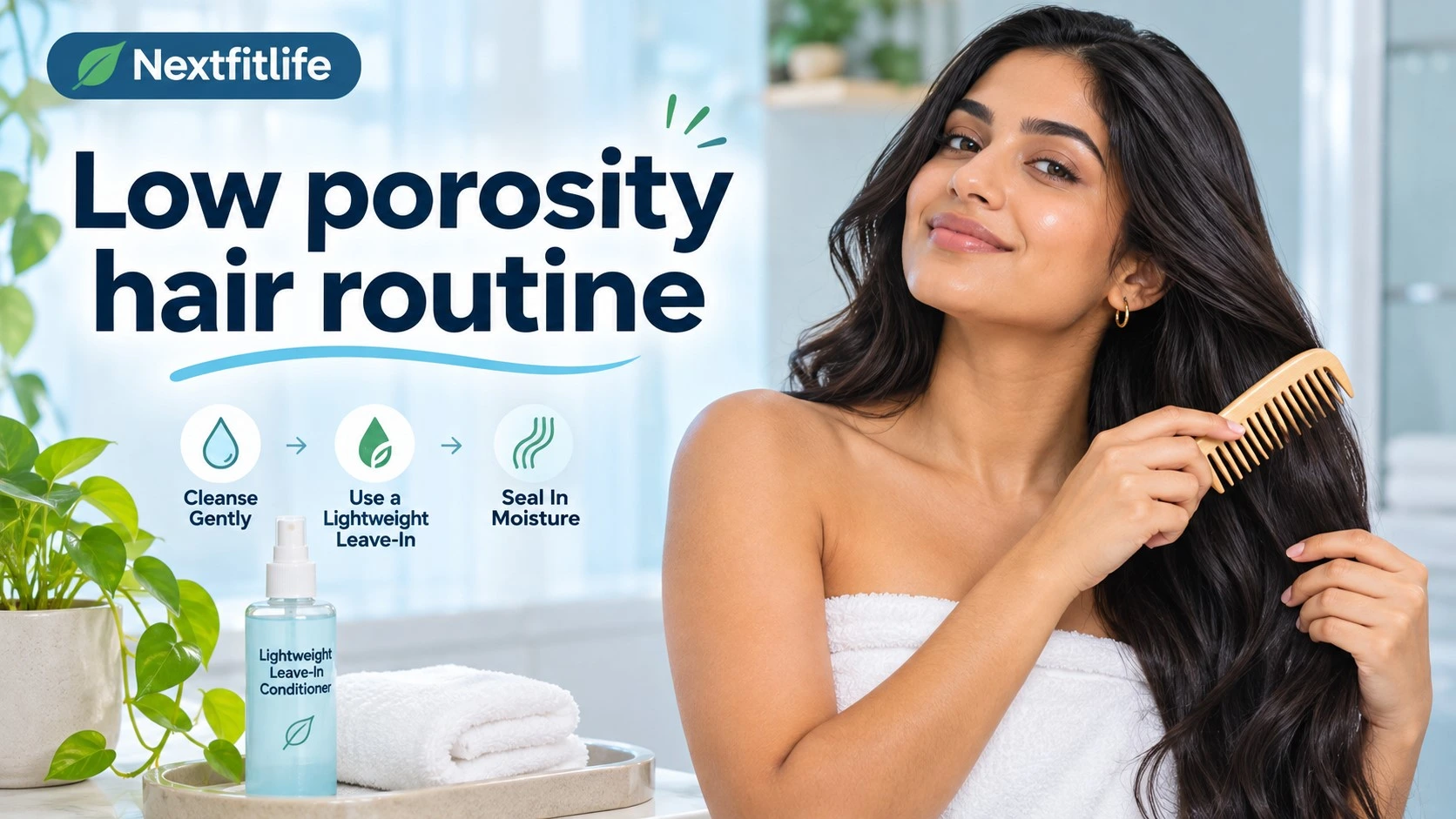
Start with clean hair, use conditioner for slip, apply a light leave in, and stop adding products once your hair feels soft and easy to manage. If water and conditioner seem to sit on the surface, adding more cream is usually not the answer.
Quick answer: A simple low porosity hair routine starts with good cleansing, conditioner, a lightweight leave in, and only as much styling product as your hair needs. Clarify when buildup appears, use oils only when they help, and treat heat and protein as optional tools rather than fixed rules.
Health note: This article is for general information and education. It does not replace medical advice, diagnosis, or treatment.
See a dermatologist if you have bald patches, rapid thinning, heavy shedding from the root, scalp pain, pus, sores, scarring, severe redness, or breakage that keeps getting worse despite gentler care. Porosity does not explain every hair problem.
For broader hair care guidance, read the NextFitLife Healthy Hair Guide. If your main concern is true shedding rather than surface dryness or buildup, that distinction matters before you change your routine.
Table of Contents
- What low porosity hair means
- Why the float test is weak
- 8 smart routine steps
- A complete wash day routine
- Curly versus straight hair
- How often to wash and clarify
- Protein and deep conditioner myths
- LOC and LCO methods
- Hard water and buildup
- Common routine mistakes
- A simple four week test
- When to see a dermatologist
- References and Sources
- Internal links and hubs
- About the author
- Frequently asked questions
What Does Low Porosity Hair Mean?
Hair porosity describes how easily a hair fiber takes up and loses water.
In everyday hair care, low porosity hair usually means hair that seems slow to become fully wet and easy to overload with products.
You may notice:
- Water beads on the hair at first
- Conditioner seems to sit on the surface
- Heavy creams make hair feel greasy fast
- Hair takes time to become fully wet
- Styling products build up quickly
- Hair can feel coated even when the ends feel dry
That description can help you plan a routine, but low porosity is not a medical diagnosis.
It also does not tell you whether your hair is healthy, damaged, chemically treated, or affected by buildup. Those are separate questions.
Do Not Trust the Hair Float Test Too Much
You may have seen the popular glass of water test.
A strand that floats is said to be low porosity. A strand that sinks is said to be high porosity.
I would not build your entire routine around that result.
Surface oil, conditioner, styling residue, and surface tension can change what happens in the glass.
The test also does not tell you why your hair feels rough, coated, weak, or hard to wet.
Your wash day gives you more useful information.
Ask:
- Does shampoo remove the coated feeling?
- Does conditioner improve slip?
- Do heavy products make the hair worse?
- Does hair behave differently at the roots and ends?
- Did the problem start after bleach, heat, hard water, or a new product?
Those clues tell you much more than one strand floating in water.
8 Smart Low Porosity Hair Routine Steps
1. Clean the Hair Well Enough
This is the first thing I would fix.
If your hair is covered in oil, silicone, wax, styling polymer, conditioner, or mineral residue, water may sit on that coating.
Adding another moisturizer will not remove it.
Use a shampoo that cleans the scalp and removes enough residue without leaving the hair painfully rough.
For most wash days, a normal gentle shampoo is enough.
Consider a stronger clarifying shampoo when you notice:
- Hair feels coated even after washing
- Roots become flat very fast
- Curls stop forming as usual
- Products seem to stop working
- Hair feels greasy and dry at the same time
- Water seems to sit on the hair more than before
Do not clarify only because a calendar tells you to.
Your product use, water quality, scalp oil, exercise, and styling habits matter more.
2. Condition After Washing
Low porosity hair still benefits from conditioner.
Conditioner helps reduce friction, improve slip, smooth the outer hair surface, and make detangling easier.
Apply it mainly to the lengths and ends unless the product directions say otherwise.
Use enough that your fingers or comb move through the hair more easily, then rinse well.
You do not need to keep adding conditioner simply because a product label says your hair needs moisture.
3. Start With Lightweight Products
If rich creams leave a film, make the routine lighter.
A lightweight leave in conditioner is often a better first step than a thick butter.
Look for a product that spreads easily and does not leave the hair sticky, greasy, or flat after drying.
Ingredients such as conditioning agents, glycerin, panthenol, or light silicones can work well in the right formula.
Do not reject a product only because it contains silicone if your hair becomes easier to comb and breaks less when you use it.
4. Apply Leave In to Damp Hair
Damp hair already contains water, so you do not need to soak it again and again while styling.
After washing:
- Gently remove extra water.
- Apply a small amount of leave in.
- Spread it through the areas that need it.
- Add a styling product only if your hairstyle needs one.
Start small.
You can always add a little more product. Removing too much product usually means another wash.
5. Use Oils as Tools, Not as Water
Oil does not hydrate hair in the same way water does.
It can change how hair feels, reduce friction, add shine, and sometimes reduce water movement through the fiber.
Coconut oil for hair has better evidence than many oil claims. Research has shown that coconut oil can enter the hair fiber and reduce protein loss under tested conditions.
That still does not mean every person with low porosity hair needs coconut oil.
Try a small amount on the lengths. If hair feels soft and easier to manage, keep it. If it feels heavy, greasy, or stiff, stop using it.
6. Use Gentle Warmth Only if It Helps
You will often hear that low porosity hair needs heat to open the cuticle.
That explanation is too simple.
Gentle warmth during conditioning may make the process feel better and can change how a product spreads, but high heat is not required.
If you want warmth, try:
- A warm shower
- A shower cap during conditioning
- A comfortably warm towel
- A low heat conditioning cap
Avoid very hot tools.
The American Academy of Dermatology recommends limiting damaging heat and using lower heat settings when possible.
7. Keep Styling Layers Low
This is where many low porosity routines become far too complicated.
You do not automatically need leave in, cream, butter, oil, gel, mousse, serum, and spray in the same routine.
Start with one leave in and one styler.
If your hair feels good, stop.
More layers are not a sign of better hair care.
8. Let Hair Performance Decide What Stays
This is the most useful rule.
Your routine is working if your hair becomes:
- Easier to detangle
- Soft without feeling coated
- Less prone to breakage
- Easier to style
- Comfortable between washes
If it becomes greasy, sticky, dull, or flat, simplify.
If it stays rough and tangles badly, look at cleansing, conditioning, heat, chemical damage, and mechanical stress before buying several more products.
A Simple Low Porosity Hair Wash Day
| Step | What to Do | Main Goal |
|---|---|---|
| 1. Shampoo | Clean the scalp and remove residue | Prevent buildup |
| 2. Condition | Apply to lengths and ends | Improve slip |
| 3. Rinse | Rinse well enough to avoid coating | Keep hair light |
| 4. Blot | Press out water without rubbing | Reduce friction |
| 5. Leave In | Use a small amount on damp hair | Improve softness and manageability |
| 6. Style | Add one styler if needed | Hold shape without overload |
| 7. Dry | Air dry or use gentle heat | Limit damage |
That is already a complete routine.
Everything else is optional.
Low Porosity Curly Hair Routine
Curly and coily hair may need more slip because the strands can tangle and rub against each other.
Keep the same basic routine, then adjust the conditioner and styling step.
You may prefer:
- A conditioner with more slip
- A light leave in
- Gel or mousse for definition
- A small amount of cream if the hair tolerates it
Do not assume curl pattern tells you porosity. They are different hair features.
Low Porosity Straight or Fine Hair Routine
Fine or straight hair can become weighed down very fast.
Keep the routine simple:
- Shampoo
- Rinse out conditioner
- A tiny amount of leave in if needed
- A light styling product or serum
You may not need oil at all, and that is completely fine.
How Often Should You Wash Low Porosity Hair?
There is no proven wash schedule based on porosity alone.
Wash based on your scalp, sweat level, styling products, and hair texture.
A person with an oily scalp who exercises every day may need frequent shampooing, while someone with dry, tightly curled hair may wash less often.
Do not keep your scalp oily or uncomfortable for days just because an online chart says low porosity hair should only be washed once a week.
The NextFitLife Healthy Hair Guide explains why wash frequency should match scalp oil, hair type, and product use.
How Often Should You Clarify?
Use signs rather than a fixed calendar.
Clarify when buildup changes how your hair feels or behaves.
That might be every few weeks for one person and much less often for another.
People who swim, use heavy styling products, or have hard water may need more frequent residue removal.
If your normal shampoo already cleans well, you may rarely need a separate clarifier.
Should Low Porosity Hair Avoid Protein?
No universal rule says that.
The claim that all low porosity hair is protein sensitive is much stronger than the evidence.
Some protein rich treatments can leave some people's hair stiff or rough. If that happens to you, reduce them.
But porosity alone does not prove that every protein product will be a problem.
If your hair became hard, rough, or brittle after repeated strengthening treatments, read the Protein Overload Hair Symptoms Guide.
Does Low Porosity Hair Need Deep Conditioner?
Not every wash.
A normal conditioner may be enough.
Try a deeper conditioner when:
- Hair feels rough
- Detangling becomes harder
- Ends feel weathered
- You have chemical damage
- Your normal conditioner is not giving enough slip
If a rich mask leaves the hair flat, sticky, or heavily coated, switch back to something lighter.
Do the LOC or LCO Methods Help?
LOC means liquid, oil, cream.
LCO means liquid, cream, oil.
These are styling methods, not medical rules.
For hair that becomes coated easily, both methods can simply be too much product.
I would start with leave in plus one styling product.
Add oil only if you can see a clear benefit.
Why Does Low Porosity Hair Get Buildup So Easily?
Part of the problem can be the routine itself.
People who think their hair will not absorb moisture often respond by adding more conditioner, oil, butter, leave in, and styling cream.
Some of those ingredients are useful.
Conditioning agents and silicones can lower friction and improve combing.
The problem begins when the total amount is more than your hair needs.
Then you may notice dullness, flat roots, sticky strands, poor curl definition, or a coated feeling.
Sometimes the missing moisture treatment is simply a proper wash.
Can Hard Water Look Like Low Porosity Hair?
Yes.
Hard water contains minerals such as calcium and magnesium.
Mineral residue can change the way hair feels and how styling products behave.
If your hair became harder to wet, duller, rougher, or more coated after moving to a new area or changing water supply, water hardness is worth checking.
For more detail, read the Hard Water Hair Damage Guide.
Can Low Porosity Hair Become More Porous?
Yes. Hair properties can change as the fiber becomes damaged.
Bleaching, permanent coloring, chemical straightening, high heat, sunlight, and normal weathering can alter the cuticle and increase water movement through the hair.
Your roots and ends may even behave differently.
Newer root growth may resist water, while older processed ends absorb it quickly.
That means you may need less product near the roots and more conditioner on the ends.
Is Low Porosity Hair Automatically Healthy?
No.
Low porosity does not automatically mean healthy hair, and high porosity does not automatically mean destroyed hair.
The more useful questions are:
- Does your hair break easily?
- Does it tangle badly?
- Is your scalp healthy?
- Can you style it without heavy buildup?
- Does conditioner improve manageability?
Those answers matter more than whether one strand floats in water.
Could Hygral Fatigue Be Part of the Problem?
If your hair is soaked and rewetted many times each day, another issue may be repeated wet and dry cycling.
Hair swells as it absorbs water and contracts as it dries.
For already damaged hair, repeated water exposure can add stress.
If your strands become unusually soft when wet, stretch too far, tangle, and then break, see the Hygral Fatigue Hair Guide.
Common Low Porosity Hair Routine Mistakes
Using Too Much Product
Start with less and add more only if needed.
Treating Oil as Moisture
Oil can lubricate and protect hair, but it does not replace water, cleansing, and conditioning.
Clarifying Too Aggressively
You want to remove residue, not make your hair rough and brittle.
Avoiding Every Silicone
A silicone that improves slip and reduces tangling can be useful.
Judge the formula by the result.
Avoiding All Protein
One protein rich product feeling bad does not prove every protein formula is wrong for your hair.
Using Too Much Heat
Gentle warmth and repeated high heat are not the same thing.
Keep hot tools limited.
Changing Everything at Once
If you change shampoo, conditioner, leave in, oil, mask, and gel in one week, you will not know what helped.
Change one variable at a time.
A Simple 4 Week Routine Test
| Week | What to Do | What to Watch |
|---|---|---|
| Week 1 | Use shampoo, conditioner, one leave in, and one styler | Buildup, softness, and tangles |
| Week 2 | Keep the products the same | Reduce leave in if hair feels coated |
| Week 3 | Clarify only if buildup is obvious | Does the normal texture return? |
| Week 4 | Change only what still needs work | Cleansing, conditioner, styler, or oil |
This gives you better information than buying a whole low porosity product range in one day.
When Is the Problem More Than Hair Porosity?
Porosity does not explain true hair loss or scalp disease.
See a dermatologist if you develop:
- Round bald patches
- A rapidly widening part
- A quickly receding hairline
- Heavy shedding from the root
- Scalp pain or burning
- Pus or open sores
- Severe redness or scaling
- Shiny areas of scalp with lost hair
- Persistent breakage despite gentle care
Hair shaft care cannot treat every follicle or scalp condition.
Conclusion
The best low porosity hair routine is usually much simpler than social media makes it look.
Clean well enough to prevent buildup, condition after washing, start with lightweight products, use only as much as your hair needs, and treat oil, protein, deep masks, and heat as optional tools rather than fixed rules.
Your next step: simplify your next wash day to shampoo, conditioner, one leave in, and one styler. Keep that routine steady long enough to see what your hair actually needs before adding anything else.
References and Sources
- American Academy of Dermatology. How to Stop Damaging Your Hair.
https://www.aad.org/public/diseases/hair-loss/insider/stop-damage - National Library of Medicine, PubMed Central. Shampoo and Conditioners: What a Dermatologist Should Know.
https://pmc.ncbi.nlm.nih.gov/articles/PMC4458934/ - National Library of Medicine, PubMed Central. Pro and Contra of Cleansing Conditioners.
https://pmc.ncbi.nlm.nih.gov/articles/PMC6489037/ - PubMed. Effect of Mineral Oil, Sunflower Oil, and Coconut Oil on Prevention of Hair Damage.
https://pubmed.ncbi.nlm.nih.gov/12715094/ - PubMed. Benefit of Coconut Based Hair Oil via Hair Porosity Quantification.
https://pubmed.ncbi.nlm.nih.gov/35377477/
Internal Links and NextFitLife Hubs
- Healthy Hair Care Guide
- Protein Overload Hair Symptoms
- Hygral Fatigue Hair Guide
- Hard Water Hair Damage Guide
- Best Foods for Hair Growth
- Healthy and Strong Hair Foods
- Biotin Rich Foods
- About NextFitLife
Frequently Asked Questions
What is the best low porosity hair routine?
A simple routine is shampoo, conditioner, a small amount of lightweight leave in, one styling product if needed, and gentle drying. Clarify when buildup becomes obvious rather than on a rigid schedule.
How do I know if my hair is low porosity?
Hair that behaves like low porosity hair may wet slowly, collect product buildup easily, and feel coated after heavy creams. Home float tests are not reliable enough to classify porosity by themselves.
How often should low porosity hair be washed?
Wash based on scalp oil, sweat, styling products, and hair texture. There is no proven wash schedule that applies to everyone with low porosity hair.
Does low porosity hair need clarifying shampoo?
Clarifying shampoo can help when residue is making the hair coated, dull, sticky, or hard to wet. It does not need to be used on a fixed schedule if normal shampoo is working well.
Should low porosity hair avoid protein?
No. There is no universal rule that low porosity hair must avoid protein. If repeated protein treatments make your hair stiff or rough, reduce them and judge the result over several wash days.
Is coconut oil good for low porosity hair?
Coconut oil can enter the hair fiber and has evidence for reducing protein loss, but it can feel heavy on some hair. Use a small amount and stop if your hair becomes greasy, stiff, or coated.
Does low porosity hair need heat?
No. Gentle warmth during conditioning is optional. High heat is not required to care for low porosity hair and can contribute to hair damage.
Should I use LOC or LCO on low porosity hair?
You can, but both methods may create too much buildup. Start with a lightweight leave in and one styling product, then add oil only if it clearly improves the result.
Can hard water look like low porosity hair?
Yes. Mineral deposits from hard water can make hair feel coated, dull, rough, or harder to wet. A change in water supply is worth checking before assuming your porosity changed.
Can low porosity hair become more porous?
Hair can become more porous as it is damaged by bleaching, chemical processing, high heat, sunlight, and normal weathering. Roots and older ends may therefore need different amounts of product.