Published on: November 19, 2026
Kidney stone pain can start suddenly, become severe within a short time, ease, then return in another wave.
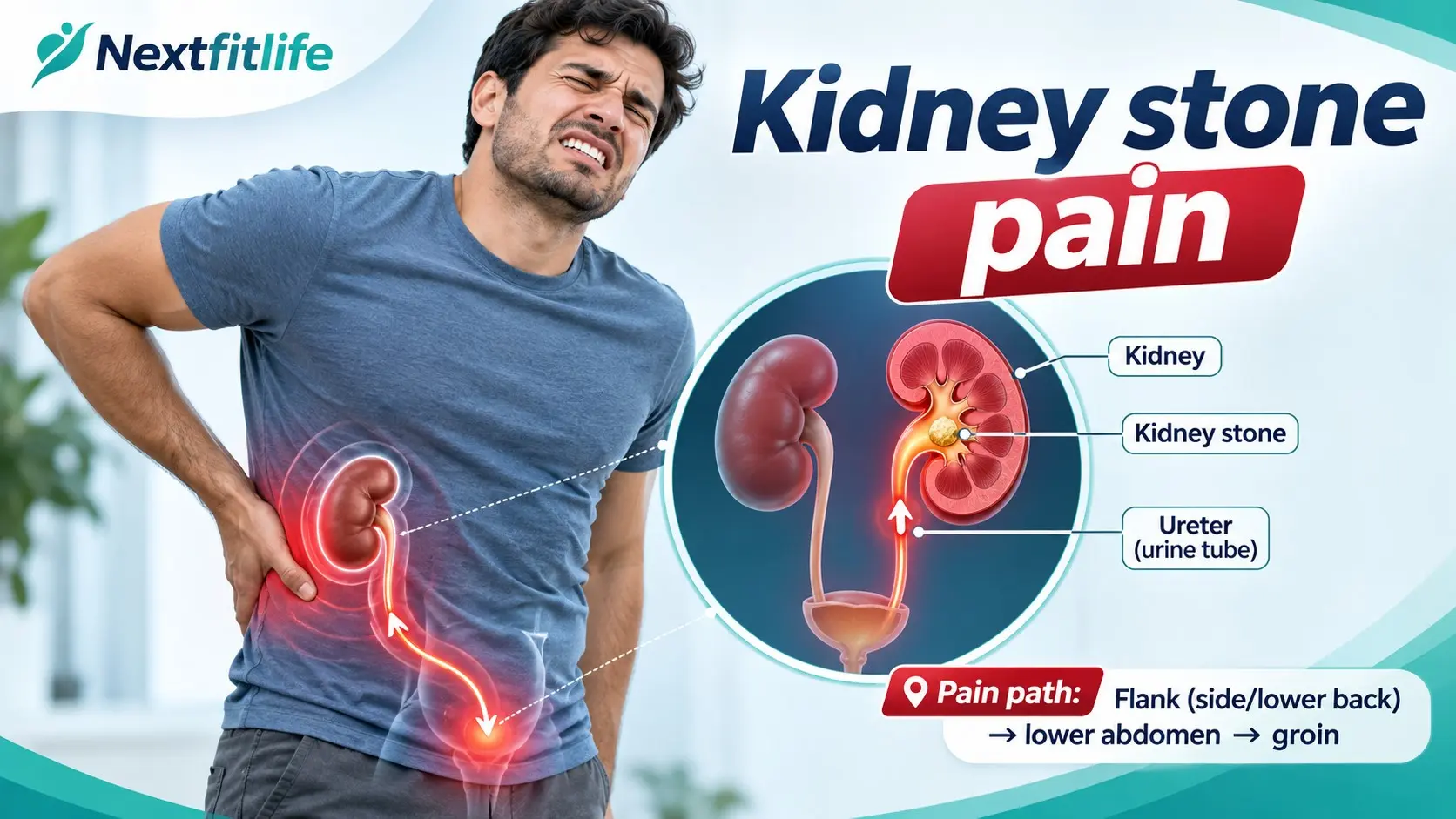
It often begins in the side or back below the ribs and can move toward the lower abdomen or groin as the stone travels through the urinary tract.
Quick answer: Kidney stone pain, also called renal colic, is usually sharp or severe pain in the flank, side, or back below the ribs. It may spread toward the lower abdomen or groin and often comes in waves. One pain wave can last around 20 to 60 minutes, while the stone itself may take days or weeks to pass.
This article is for general information and education. It does not replace medical advice, diagnosis, or treatment.
Get urgent medical help if stone-like pain comes with fever, shaking chills, inability to urinate, repeated vomiting, confusion, severe weakness, rapidly worsening illness, pregnancy, or severe pain that cannot be controlled. A blocked urinary tract with infection can become dangerous and may need urgent drainage.
If you want the broader picture, read the NextFitLife Kidney Stones Guide for symptoms, testing, treatment, procedures, and prevention.
Table of Contents
- What kidney stone pain feels like
- Where the pain is located
- 9 critical pain clues
- How long the pain lasts
- Kidney stone pain relief
- When a stone needs a procedure
- Kidney stone pain vs back pain
- What to track at home
- What not to do
- How to lower future stone risk
- References and Sources
- Internal Links and NextFitLife Hubs
- About the Author
- Frequently Asked Questions
What Does Kidney Stone Pain Feel Like?
People describe kidney stone pain in different ways.
It may feel:
- Sharp
- Stabbing
- Cramping
- Deep
- Pressure-like
- Severe enough to make it hard to stay still
The classic pattern is renal colic.
That means severe pain that rises and falls in waves.
A stone sitting quietly inside the kidney may cause no symptoms at all. Pain becomes more likely when the stone moves into the ureter or blocks normal urine flow.
Where Is Kidney Stone Pain Located?
Kidney stone pain location depends partly on where the stone is.
The kidneys sit toward the back of the upper abdomen, beneath the lower ribs.
When a stone moves into the ureter, pain often begins in the flank, the area between the lower ribs and the hip.
As the stone moves, the pain may move too.
| Stone Area | Possible Pain Location | What You May Notice |
|---|---|---|
| Kidney | Flank or back below ribs | May be mild or absent if there is no obstruction |
| Upper ureter | Side or flank | Severe wave-like pain |
| Lower ureter | Lower abdomen or groin | Urinary urgency may increase |
| Near bladder | Groin, genital area, lower pelvis | Frequent or painful urination may occur |
Men may feel pain that spreads toward a testicle.
Women may feel pain that spreads toward the groin or vulvar area.
The moving pain pattern can be a useful clue, but symptoms alone cannot prove that a stone is present.
9 Critical Kidney Stone Pain Clues
1. The Pain Often Comes in Waves
Renal colic often rises, eases, then returns.
The ureter contracts as it tries to move urine and the stone toward the bladder.
That creates the wave-like pattern.
A single wave may last around 20 to 60 minutes, although severe episodes can last longer.
2. One Pain Wave Is Not the Same as the Whole Stone Episode
If you ask how long does kidney stone pain last, there are two different answers.
A single wave may last less than an hour.
But the stone may take days or even weeks to pass.
Pain can disappear, then return as the stone moves again.
That means a pain-free period does not always prove the stone has passed.
3. Worse Pain Does Not Always Mean a Bigger Stone
This myth causes a lot of confusion.
Pain intensity depends heavily on obstruction, pressure, and ureter spasm.
A small stone that blocks the ureter can hurt badly.
A larger stone that is sitting in the kidney without blocking urine may cause little or no pain.
Stone size still matters for treatment and passage, but you cannot estimate size from pain alone.
4. Nausea and Vomiting Can Come With the Pain
Severe kidney stone pain often comes with nausea.
Some people vomit.
This becomes more concerning if you cannot keep fluids down.
Repeated vomiting can lead to dehydration and makes home care less safe.
5. Blood in the Urine Is a Common Clue
A moving stone can irritate the urinary tract.
That can cause blood in urine.
The urine may look:
- Pink
- Red
- Brown
Sometimes the blood is only visible on a urine test.
Blood in the urine has other possible causes too, so visible bleeding deserves medical assessment.
6. Urinary Symptoms Can Increase as the Stone Moves Lower
A stone near the bladder can cause:
- Urinary urgency
- Frequent urination
- Burning while urinating
- Passing small amounts of urine
These symptoms can also occur with infection, so the full pattern matters.
7. Changing Position Often Does Not Fix Renal Colic
A strained back may improve in one position and worsen in another.
Kidney stone pain can behave differently.
People may move around because they cannot find a comfortable position.
This is only a clue.
If you are unsure whether the pain is coming from the kidney or the back, read the Kidney Pain vs Back Pain Guide.
8. Fever or Chills Change the Situation
This is the safety point not to miss.
Stone-like pain plus fever or shaking chills raises concern for infection behind an obstruction.
That can become serious quickly.
Urgent warning: Kidney stone pain with fever, shaking chills, confusion, severe weakness, or inability to urinate needs urgent medical care. A blocked infected urinary system may require emergency drainage and antibiotics.
9. Inability to Urinate Is Another Red Flag
If you cannot urinate, or only pass a very small amount despite strong pressure or pain, seek prompt medical care.
A stone can block normal urine flow.
Complete or severe obstruction is not something to treat with home remedies.
How Long Does Kidney Stone Pain Last?
The clearest answer is to separate the pain wave from the full stone episode.
| Question | Typical Pattern | What It Means |
|---|---|---|
| One renal colic wave | Often around 20 to 60 minutes | Pain may ease and return |
| Total stone passage | Can take days or weeks | Depends on size, location, and anatomy |
| Pain-free period | Can happen before passage | Does not prove the stone is gone |
Persistent severe pain should not simply be tolerated for days.
If the pain stays severe, keeps returning, or cannot be controlled with the treatment you were given, get reassessed.
What Helps Kidney Stone Pain?
Kidney stone pain relief depends on whether the diagnosis is confirmed and whether pain medicine is safe for you.
Severe new flank pain can come from other conditions, so first episodes often need medical assessment.
NSAIDs Are Common First Line Medicines
Current kidney stone guidance commonly uses nonsteroidal anti inflammatory drugs for acute renal colic when they are medically suitable.
Examples include ibuprofen and naproxen.
But these medicines are not safe for everyone.
Extra caution or avoidance may be needed with:
- Reduced kidney function
- Significant dehydration
- Previous stomach ulcers or bleeding
- Certain heart conditions
- Some medication combinations
- Pregnancy
Do not exceed the product label or your clinician's instructions.
If you have kidney disease or are unsure what pain medicine is safe, ask a clinician or pharmacist.
For broader kidney medicine safety, see the Kidney Disease Treatment Guide.
What if NSAIDs Are Not Suitable?
Other pain medicines may be used depending on the situation.
Paracetamol can be used in some people, and stronger pain relief may be needed in emergency care when first line options are unsuitable or not enough.
Do not combine several pain medicines without checking the labels or getting professional advice.
Can Heat Help?
A warm pack may make the area feel more comfortable.
It does not dissolve or move the stone.
Use heat as a comfort measure only.
Do not let temporary relief delay care if you have fever, vomiting, difficulty urinating, or severe persistent pain.
Should You Drink a Huge Amount of Water During an Attack?
No.
Staying hydrated is useful when you can drink normally and have not been told to restrict fluids.
But forcing large amounts of water during severe obstruction is not a reliable way to push the stone out.
Do not force fluids if you are:
- Vomiting repeatedly
- Unable to urinate
- In severe uncontrolled pain
- Known to have significant obstruction
- Under a fluid restriction for kidney or heart disease
For long term prevention, fluid intake matters much more. See Urinary Stones Cause: 9 Proven Ways to Lower Your Risk.
Can Medicine Help a Stone Pass?
Sometimes.
A clinician may prescribe an alpha blocker to help selected ureter stones pass.
The decision depends on:
- Stone size
- Stone location
- Your symptoms
- Whether urine flow is blocked
- Your medical history
This is not a painkiller and should not be self prescribed.
When Does a Kidney Stone Need a Procedure?
Some stones will not pass safely on their own.
A procedure may be needed when there is:
- A stone too large to pass
- Persistent obstruction
- Infection
- Severe uncontrolled pain
- Declining kidney function
- Repeated vomiting
- Failure of the stone to move
Possible procedures include:
- Shock wave lithotripsy
- Ureteroscopy
- Percutaneous nephrolithotomy
- Urgent urinary drainage when infection and obstruction occur together
The right treatment depends on the stone, the kidney, and the person.
Kidney Stone Pain vs Back Pain
| Clue | Kidney Stone Pain | Common Muscle Back Pain |
|---|---|---|
| Location | Flank or side below ribs | Lower back or muscles |
| Pattern | Often comes in severe waves | Often steadier or movement related |
| Pain travel | Lower abdomen or groin | Buttock or leg |
| Urine symptoms | Possible | Not typical |
| Nausea | Common | Less typical |
| Blood in urine | Can occur | Not caused by muscle strain |
For a fuller comparison, read 9 Critical Kidney Pain vs Back Pain Clues.
Can Kidney Stone Pain Suddenly Stop?
Yes.
The stone may have:
- Moved into a wider part of the urinary tract
- Moved closer to the bladder
- Stopped causing the same degree of obstruction
- Passed completely
But the pain stopping does not prove that the stone is gone.
Follow up may still be needed if imaging previously showed obstruction or if you never saw the stone pass.
Does Passing the Stone Hurt?
It can.
The worst pain usually happens while the stone is moving through or blocking the ureter.
Once the stone reaches the bladder, severe flank pain often improves.
Passing a small stone through the urethra may cause burning or brief discomfort.
Can Kidney Stone Pain Last for Weeks?
The whole stone episode can.
That does not mean one uninterrupted attack of severe renal colic should continue for weeks.
A stone may take days or weeks to pass, with periods of pain and periods of relief.
Persistent severe pain, worsening symptoms, or repeated emergency level attacks need reassessment.
Why Does the Pain Move?
The ureter carries urine from the kidney to the bladder.
As a stone moves down that tube, the area of obstruction changes.
That changes where the pain is felt.
A higher stone may hurt more in the flank.
A lower stone may cause more groin pain and urinary urgency.
Can Kidney Stones Cause Testicle Pain?
Yes.
Pain from a ureter stone can spread into the groin and testicle.
But sudden severe testicular pain can also be caused by testicular torsion, which is an emergency.
Do not assume sudden testicular pain is always coming from a kidney stone.
How Are Kidney Stones Diagnosed?
Symptoms provide clues, but tests help confirm what is happening.
Evaluation may include:
- Medical history
- Physical examination
- Urine testing
- Blood testing
- Kidney function testing
- CT imaging
- Ultrasound in selected situations
The goal is not just to prove that a stone exists.
The clinician also needs to know:
- Where the stone is
- How large it is
- Whether urine is blocked
- Whether infection is present
- Whether kidney function is affected
What Should You Track at Home?
If a clinician has already told you that it is safe to wait for the stone to pass, track more than the pain score.
| What to Track | Why It Matters |
|---|---|
| Pain location | The stone may be moving |
| Fever or chills | Can signal infection |
| Vomiting | Can lead to dehydration |
| Urine output | Reduced flow can signal obstruction |
| Blood in urine | Useful information for your clinician |
| Pain medicine used | Helps show whether treatment is working |
If you are asked to strain your urine and you pass the stone, save it for analysis.
Knowing the stone type can make prevention advice much more specific.
What Not to Do During Suspected Kidney Stone Pain
Do Not Assume Every Flank Pain Is a Stone
Kidney infection, muscle pain, digestive problems, gallbladder disease, and other conditions can cause similar pain.
Do Not Ignore Fever
Fever or shaking chills with stone-like pain needs urgent assessment.
Do Not Force Huge Amounts of Water
Drink normally when appropriate, but do not try to push out an obstructing stone by forcing excessive fluids.
Do Not Keep Increasing Pain Medicine
If advised treatment is not controlling the pain, get reassessed.
Do Not Judge Stone Size by Pain
A small obstructing stone can cause severe pain.
Do Not Wait if You Cannot Urinate
Urinary obstruction needs medical attention.
How Can You Lower the Chance of Another Stone?
Prevention depends on the stone type.
The most useful next step after passing a stone is to find out what kind it was.
General prevention may include:
- Drinking enough fluid when medically safe
- Reducing excess sodium
- Keeping normal food calcium unless told otherwise
- Matching oxalate advice to your stone type
- Avoiding extreme high protein diets if they are not appropriate for you
- Treating urinary infections
- Reviewing medicines that may affect stone risk
For a full prevention guide, read Urinary Stones Cause: 9 Proven Ways to Lower Your Risk.
For broader food choices, see Kidney Healthy Foods.
Conclusion
Kidney stone pain usually starts in the flank or side below the ribs, can become severe in waves, and may move toward the lower abdomen or groin as the stone travels.
The most useful timing fact is that one pain wave may last around 20 to 60 minutes, while the full stone passage can take days or weeks.
For kidney stone pain relief, anti inflammatory medicines are commonly used when they are safe for that person, but severe pain, repeated vomiting, fever, shaking chills, or trouble urinating needs medical assessment.
Your next step: if this is a new episode of severe flank pain, get the cause confirmed rather than trying to diagnose the stone from pain alone.
References and Sources
- National Institute of Diabetes and Digestive and Kidney Diseases. Symptoms & Causes of Kidney Stones.
https://www.niddk.nih.gov/health-information/urologic-diseases/kidney-stones/symptoms-causes - National Institute of Diabetes and Digestive and Kidney Diseases. Treatment for Kidney Stones.
https://www.niddk.nih.gov/health-information/urologic-diseases/kidney-stones/treatment - Mayo Clinic. Kidney Stones: Symptoms and Causes.
https://www.mayoclinic.org/diseases-conditions/kidney-stones/symptoms-causes/syc-20355755 - NICE. Renal and Ureteric Stones: Assessment and Management.
https://www.nice.org.uk/guidance/ng118/chapter/Recommendations - European Association of Urology. Guidelines on Urolithiasis.
https://uroweb.org/guidelines/urolithiasis/chapter/guidelines - Cleveland Clinic. Renal Colic.
https://my.clevelandclinic.org/health/symptoms/22847-renal-colic
Internal Links and NextFitLife Hubs
- Kidney Stones: Symptoms, Treatment and Prevention
- Kidney Pain vs Back Pain
- Urinary Stones Cause and Prevention
- Kidney Healthy Foods
- Kidney Disease Treatment Guide
- How to Protect the Kidneys
- NextFitLife Health and Fitness Guides
- About NextFitLife
Frequently Asked Questions
What does kidney stone pain feel like?
Kidney stone pain is often sharp, severe, or cramping. It usually starts in the flank or side below the ribs and may come in waves as the ureter contracts around the stone.
Where is kidney stone pain located?
Kidney stone pain often begins in the side or flank below the ribs. As the stone moves downward, the pain can spread toward the lower abdomen, groin, testicle, or vulvar area.
How long does kidney stone pain last?
One wave of renal colic may last around 20 to 60 minutes, but the stone itself can take days or weeks to pass. Pain can disappear and return during that time.
Does severe pain mean the stone is large?
No. A small stone that blocks the ureter can cause severe pain, while a larger stone that is not obstructing urine may cause little or no pain.
What helps kidney stone pain?
Anti inflammatory medicines are commonly used for renal colic when they are medically safe. Heat may provide comfort, but severe pain, repeated vomiting, fever, or trouble urinating needs medical assessment.
Should I drink lots of water during kidney stone pain?
Drink normally if you can and have not been told to restrict fluids. Do not force huge amounts of water if you are vomiting, unable to urinate, or have a known obstruction.
Can kidney stone pain stop before the stone passes?
Yes. The pain can ease if the stone changes position or the obstruction changes. A pain-free period does not prove that the stone has completely passed.
Can kidney stones cause blood in the urine?
Yes. A stone can irritate the urinary tract and cause visible or microscopic blood in the urine. Blood in the urine can have other causes too and should be medically assessed.
When is kidney stone pain an emergency?
Seek urgent care for kidney stone pain with fever, shaking chills, inability to urinate, repeated vomiting, confusion, severe weakness, or rapidly worsening illness.
Can kidney stone pain feel like back pain?
Yes. Both can cause pain around the back or side. Kidney stone pain is more likely to come in waves, move toward the groin, and occur with nausea or urinary symptoms.