Last Updated: September 5, 2026
Sources Checked: September 5, 2026
Next Review: September 2027, or sooner if major chest pain, heart, asthma, or emergency guidance changes
Written and Source Checked by: Adel Galal, Founder and Lead Writer at NextFitLife
Review Status: Updated using current heart attack, angina, asthma, reflux, pericarditis, pulmonary embolism, and panic guidance. This article has not been independently medically reviewed by a licensed clinician.
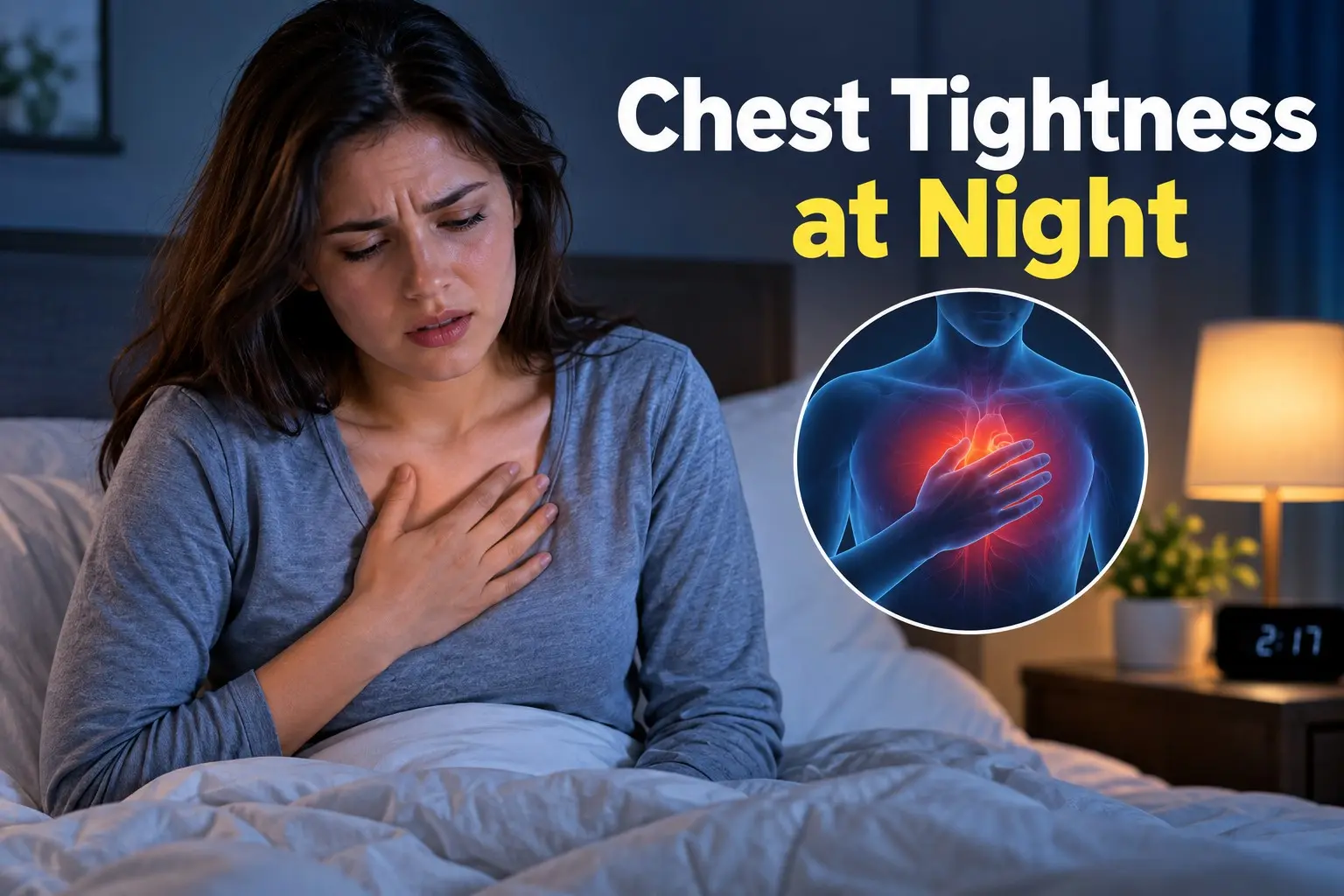
Chest tightness at night can come from asthma, acid reflux, anxiety, chest wall strain, or heart problems.
Some causes are uncomfortable but not immediately dangerous.
Others need emergency treatment.
The first question is not whether the symptom happened at night.
It is whether the tightness could be coming from your heart, lungs, or another serious condition.
Emergency Warning
Call your local emergency number now for new, severe, persistent, or unexplained chest pressure, squeezing, tightness, heaviness, fullness, burning, or pain, especially when it:
- Lasts more than a few minutes or goes away and returns
- Spreads to an arm, shoulder, back, neck, jaw, or upper stomach
- Occurs with shortness of breath
- Occurs with sweating, nausea, vomiting, dizziness, or fainting
- Starts suddenly with severe breathing- difficulty
- Occurs with coughing blood
- Occurs with one swollen or painful leg
- Occurs with blue or grey lips or skin
Do not drive yourself. Do not use an antacid, inhaler, stretching, or breathing exercise to prove that serious chest symptoms are safe.
Quick Answer: What Causes Chest Tightness at Night?
Chest tightness at night can come from asthma, reflux, panic, chest muscle or rib problems, angina, pericarditis, heart failure, or a lung problem. New pressure or squeezing with breathlessness, sweating, nausea, fainting, or spreading discomfort should be treated as a possible heart emergency.
Medical note: This content is for general educational purposes and does not replace professional medical advice, diagnosis, or treatment. Consult an appropriately qualified healthcare professional for personal medical concerns. This article explains published guidance and does not provide a personal clinical assessment. Always consult qualified medical professionals for diagnosis and treatment of any health condition.
What Does Chest Tightness Feel Like?
People use the word tightness in different ways.
It may feel like:
- A band around the chest
- Pressure behind the breastbone
- Squeezing
- Heaviness
- A chest that feels hard to expand
- A burning or compressed feeling
- Breathing that feels restricted
This matters because heart related symptoms do not always feel like sharp pain.
The American Heart Association describes acute coronary syndrome discomfort as pressure, tightness, burning, aching, or other chest discomfort.
Do not wait for dramatic pain before taking a new chest symptom seriously.
For a broader chest pain guide, read Chest Pain Left Side: What It Means and What to Do.
Why Does Chest Tightness Show Up at Night?
Night changes several things at once.
You lie flat.
Your breathing pattern changes during sleep.
Asthma can worsen overnight.
Reflux becomes easier after lying down.
Panic attacks can occur during sleep.
Some forms of angina occur mainly at rest or overnight.
Pericarditis can hurt more when you lie flat.
Heart failure can make breathing harder in bed.
So symptoms happening at night do not make them harmless.
The pattern around the tightness matters much more.
1. Heart Attack and Acute Coronary Syndrome Must Be Ruled Out First
I would put this before reflux, anxiety, or muscle strain.
A heart attack can feel like:
- Chest pressure
- Chest squeezing
- Fullness
- Heaviness
- Burning
- Aching
- Unexplained shortness of breath
The discomfort may spread to:
- One or both arms
- Shoulders
- Back
- Neck
- Jaw
- Upper stomach
Other warning signs include:
- Cold sweat
- Nausea
- Vomiting
- Dizziness
- Weakness
- Fainting
The American Heart Association warns that some heart attacks begin slowly with mild discomfort.
They do not all begin with dramatic crushing pain.
That is why new, unexplained nighttime chest pressure deserves caution.
Chest Tightness at Rest Is Not Automatically Reassuring
This is a common mistake.
People think:
“I was lying in bed, so it cannot be my heart.”
That is not safe reasoning.
Unstable angina can occur at rest.
A heart attack can occur during rest or sleep.
Vasospastic angina also commonly occurs when a person is resting or sleeping.
The trigger does not rule the heart in or out.
2. Vasospastic angina has a Strong Nighttime Pattern
Vasospastic angina happens when a coronary artery suddenly tightens.
This temporarily reduces blood flow to the heart muscle.
Cleveland Clinic notes that these episodes commonly occur at rest and can happen while a person is sleeping.
The symptom may feel like:
- Chest pressure
- Chest pain
- Tightness
- Squeezing
The pain can wake someone from sleep.
This is one reason I would never use “it only happens at night” as reassurance.
Unexpected or severe chest symptoms need medical assessment.
Can Angina Wake You From Sleep?
Yes.
Some types of angina occur at rest.
Vasospastic angina has a particularly strong association with nighttime and early morning episodes.
But do not try to diagnose the specific angina type yourself.
Heart attack, unstable angina, vasospastic angina, reflux, and other conditions can feel similar.
An ECG and other medical tests are used to separate them.
3. Asthma Is a Common Respiratory Cause of Night Chest Tightness
Asthma can make the chest feel tight or difficult to expand.
The National Heart, Lung, and Blood Institute lists four common asthma symptoms:
- Wheezing
- Cough
- Shortness of breath
- Chest tightness
Asthma symptoms can become worse at night or early in the morning.
They can also vary from one day to another.
Common triggers include:
- Allergens
- Cold air
- Respiratory infections
- Exercise
- Smoke
- Other airway irritants
If tightness comes with cough, wheeze, or variable breathing symptoms, asthma becomes more plausible.
No, wheezing does not rule out asthma
This point matters.
Asthma does not always produce loud wheezing.
Some people mainly notice:
- Chest tightness
- Night cough
- Reduced stamina
- Shortness of breath
- Exercise symptoms
A normal sounding chest between episodes does not automatically exclude asthma either.
Objective testing can include spirometry, bronchodilator testing, peak flow monitoring, or other airway tests.
Repeated Nighttime Asthma Symptoms Need Review
If you already have asthma and chest tightness repeatedly wakes you, I would not accept that as normal control.
Review:
- How often it happens
- Whether you are coughing
- Whether you are wheezing
- How often prescribed reliever medicine is needed
- Allergy exposure
- Recent respiratory infection
- Inhaler technique
- Whether controller treatment is being used as prescribed
Follow your written asthma action plan.
Seek emergency help when severe symptoms do not improve with the prescribed emergency treatment.
For nighttime wheezing, read Wheezing at Night: Asthma, Reflux and Other Causes.
4. Acid reflux can feel like chest tightness or Burning
Reflux is a common mimic.
GERD happens when stomach contents move back into the esophagus.
NIDDK lists chest pain among possible GERD symptoms.
Other clues include:
- Heartburn
- Regurgitation
- Sour taste
- Throat clearing
- Hoarseness
- Chronic cough
- Symptoms after eating
Symptoms can become more noticeable after lying down.
That makes reflux an obvious nighttime suspect.
But there is a catch.
Do not use an Antacid to prove that tightness is Reflux
Heart and esophageal symptoms can overlap.
A burning sensation does not prove reflux.
Symptoms beginning after food do not prove reflux either.
Relief after an antacid does not safely rule out heart disease.
If the tightness is new, severe, unexplained, or associated with heart attack warning signs, treat it as a possible emergency first.
For meal-related cough and reflux patterns, read Cough After Eating: Reflux, Swallowing and Aspiration.
Why does reflux often feel worse in Bed?
Gravity helps keep stomach contents lower while you are upright.
That advantage decreases after you lie down.
NIDDK advises that people with nighttime GERD symptoms may benefit from eating at least three hours before lying down or going to bed.
That advice makes sense when reflux fits the symptom pattern.
It is not emergency treatment for unexplained chest tightness.
5. Pericarditis Has a Distinct Positional Pattern
Pericarditis is inflammation of the sac around the heart.
Mayo Clinic explains that the pain is often sharp or stabbing.
But some people describe dull, aching, or pressure-like discomfort.
A useful clue is position.
Pericarditis pain can:
- Become worse when lying down
- Become worse with a deep breath
- Become worse with coughing
- Improve when sitting up
- Improve when leaning forward
That pattern is useful.
It does not let you safely diagnose pericarditis at home.
Heart attack and other serious causes still have to be considered.
Recent illness plus chest symptoms deserve attention
If new chest pain or tightness follows a recent viral illness, tell your healthcare professional.
Inflammation involving the heart or the surrounding tissue can occur after infections.
More concerning symptoms include:
- Chest pain
- Shortness of breath
- Palpitations
- Fainting
- Marked weakness
Do not return to hard exercise to test whether the symptoms are gone.
For exercise-related chest symptoms, read Chest Pain After Exercise: Causes and Emergency Signs.
6. Anxiety and panic can cause real chest tightness
Yes.
Anxiety can create very physical symptoms.
The National Institute of Mental Health lists panic attack symptoms such as:
- Chest pain
- Racing or pounding heartbeat
- Difficulty breathing
- Dizziness
- Sweating
- Trembling
- Tingling
- Nausea
- A strong sense of fear or doom
Panic attacks can even happen during sleep.
The symptoms are real.
But there is one rule I would keep firm.
Do not diagnose a first chest tightness episode as Anxiety
A panic attack can feel like a heart attack.
A heart problem can also create fear, sweating, breathlessness, and a racing pulse.
So the fact that you feel anxious does not prove anxiety caused the chest symptom.
New, severe, or unusual chest tightness should be medically assessed before you assume it is panic.
Once serious physical causes have been excluded, recurrent panic symptoms can be treated effectively.
7. Chest Muscles, Ribs, and Cartilage Can Hurt More in Bed
Not all chest discomfort comes from an internal organ.
A chest wall cause becomes more likely when symptoms:
- Follow lifting or new exercise
- Follow repeated coughing
- Change when you twist or move your arms
- Become worse when pressing one exact spot
- Follow a chest injury
Costochondritis causes inflammation where ribs connect to the breastbone.
Muscle strain can also create a tight or sore feeling.
Sleeping position can make these symptoms more noticeable.
But chest tenderness does not prove the heart and lungs are fine.
New unexplained symptoms still need appropriate assessment.
Why Can Muscle Tightness Feel Worse at Night?
During the day you are distracted and moving.
At night you are still.
Your sleeping position can also compress a sore area or stretch an injured chest muscle.
If the discomfort started after weight training, push ups, heavy lifting, or a long coughing illness, a chest wall cause becomes more plausible.
That pattern is different from pressure with sweating and breathlessness.
8. Pulmonary Embolism Is a serious lung cause
A pulmonary embolism happens when a blood clot blocks blood flow in the lungs.
It can become life-threatening.
NHLBI lists common symptoms such as
- Shortness of breath
- Pain with deep breathing
- Rapid breathing
- Fast heart rate
Other symptoms can include:
- Coughing blood
- Lightheadedness
- Fainting
- Sweating
- A feeling of anxiety or dread
The symptoms can begin suddenly.
If chest tightness appears with sudden breathlessness or one swollen, painful leg, seek urgent medical care.
Nighttime does not rule out a blood clot
Again, the clock does not make the symptom safe.
A pulmonary embolism can occur while resting.
More useful risk information includes:
- Recent surgery
- Long immobility
- A previous blood clot
- One swollen, painful leg
- Sudden unexplained shortness of breath
- Coughing blood
Do not attempt to rule out a blood clot with a home pulse oximeter.
9. Heart Failure Can Cause Tightness With Breathlessness in Bed
Heart failure does not always feel like pain.
For some people, the main problem is breathing.
Fluid congestion can produce:
- Shortness of breath
- Cough
- Wheezing
- Chest heaviness
- Difficulty lying flat
Look for:
- Swollen ankles
- Rapid fluid-related weight gain
- Reduced exercise tolerance
- Fatigue
- Needing several pillows
- Waking suddenly, short of breath
If lying flat is the main trigger, read Shortness of Breath Lying Down: Causes and Red Flags.
10. Sleep apnea can cause nighttime breathing distress
Sleep apnea is not a classic cause of isolated chest tightness.
But breathing attacks during sleep can feel frightening.
Think about sleep apnea when the pattern includes:
- Loud snoring
- Witnessed breathing pauses
- Gasping during sleep
- Morning headache
- Dry mouth
- Strong daytime sleepiness
Sleep apnea also overlaps with cardiovascular disease.
For more on that connection, read Sleep and Heart Health.
Chest Tightness Plus Wheezing Points Toward the Airways
Think asthma or another airway problem.
Especially when symptoms vary and appear with:
- Cold air
- Allergies
- Exercise
- Respiratory infections
- Smoke
- Nighttime or early morning
If a prescribed asthma reliever is not working and breathing is becoming severe, follow your asthma emergency plan and seek urgent help.
Chest Tightness Plus Sour Taste Points More Toward Reflux
Reflux moves higher on the list when symptoms follow:
- A late meal
- A large meal
- Lying down
- Heartburn
- Regurgitation
- Sour taste
- Throat clearing
But do not use these clues to rule out the heart when chest pressure is new or severe.
Chest Tightness Plus Sweating or Nausea Raises Heart Concern
This combination gets my attention.
Especially when the chest feels:
- Heavy
- Pressed
- Squeezed
- Full
- Burning
Add shortness of breath, spreading discomfort, cold sweat, nausea, or faintness, and emergency evaluation becomes the priority.
Chest Tightness Worse Flat but Better Leaning Forward Is a Clue
That positional pattern can occur with pericarditis.
Mayo Clinic specifically describes pericarditis pain as commonly worse when lying down and better when sitting up or leaning forward.
Do not use the position as a home diagnosis.
New chest pain still needs medical evaluation because pericarditis and heart attack can overlap in how they feel.
Chest Tightness Plus Sudden Breathlessness Changes the Situation
Do not spend the night trying different pillows.
Sudden severe breathlessness with chest discomfort can signal serious heart or lung disease.
Examples include:
- Acute coronary syndrome
- Pulmonary embolism
- Pulmonary edema
- Collapsed lung
- Severe asthma
The correct response is urgent assessment.
Not an internet diagnosis.
Can a pulse oximeter tell you whether chest tightness is safe?
No.
A pulse oximeter measures oxygen saturation.
It does not diagnose:
- Heart attack
- Angina
- Pericarditis
- GERD
- Panic
- Muscle strain
A normal oxygen reading does not rule out a heart emergency.
Do not let one home measurement overrule serious symptoms.
Can blood pressure tells you whether the tightness is from the Heart?
No.
Blood pressure can be high, normal, or low during serious illness.
A normal home reading does not exclude a heart attack.
Likewise, a high reading during fear or pain does not prove the blood pressure caused the chest symptom.
Use blood pressure as one piece of information.
Not the diagnosis.
Should You Take Aspirin for Nighttime Chest Tightness?
Do not delay calling emergency services to take aspirin.
Call first.
Then follow the emergency dispatcher's instructions.
Aspirin is not safe for everyone.
Some chest emergencies involve bleeding or other conditions where self-treatment can be harmful.
If you already have a personal emergency plan from your clinician, follow it.
Should you take an Antacid and wait?
Not for unexplained or concerning chest pressure.
Heartburn and heart disease can feel similar.
An antacid response is not a safe diagnostic test.
If the symptom is clearly your familiar mild reflux pattern and no warning signs are present, follow your usual care plan.
New or unusual symptoms deserve more caution.
Should you use someone else's Inhaler?
No.
Asthma medicine treats airway narrowing.
It does not treat a heart attack, pulmonary embolism, pericarditis, or reflux.
If you have prescribed asthma medicine, use it according to your action plan.
If you do not have an asthma diagnosis, unexplained chest tightness needs assessment.
How do doctors work out the Cause?
The first goal is to identify dangerous causes.
A clinician may ask:
- What does the tightness feel like?
- Where is it located?
- Does it spread?
- How long does it last?
- Does it happen at rest?
- Does it wake you?
- Does lying down make it worse?
- Does leaning forward help?
- Do you wheeze?
- Do you have reflux symptoms?
- Do you have heart disease or asthma?
- Did you recently have an infection?
The answers guide the testing.
What Tests Can Be Used?
Depending on the suspected cause, testing can include:
- ECG
- Blood tests including cardiac markers
- Blood pressure and oxygen measurement
- Chest X ray
- Echocardiogram
- CT imaging
- Spirometry
- Other lung function tests
- Selected reflux testing
- Sleep testing
No single test is right for every cause.
For more testing information, visit the NextFitLife Medical Tests and Screenings Hub.
Why Is an ECG Used?
An ECG records the electrical activity of the heart.
It is one of the first tests used when acute coronary syndrome is suspected.
The American Heart Association also notes that blood testing can show evidence of damage to heart cells.
Chest symptoms cannot reliably distinguish heartburn, angina, and heart attack without proper evaluation.
Why Might Spirometry Be Used?
If asthma is suspected, lung function becomes important.
Spirometry measures how much air you can blow out and how quickly.
Asthma symptoms can vary.
A person can have a normal exam between episodes.
Objective testing helps avoid labelling every episode of chest tightness as asthma.
When Should Chest Tightness at Night Be Checked?
Arrange medical assessment for repeated or unexplained night chest tightness.
Especially if:
- It wakes you from sleep
- It is becoming more frequent
- It lasts longer than before
- You have asthma and control is getting worse
- You have reflux symptoms but the pattern is changing
- You have known heart disease
- You have a strong cardiovascular risk profile
- You develop palpitations
- Your exercise tolerance has fallen
- You become short of breath lying flat
Do not normalize a recurring chest symptom simply because it disappears by morning.
When is chest tightness at Night an Emergency?
Call emergency services for new, severe, persistent, or unexplained chest tightness that feels like:
- Pressure
- Squeezing
- Heaviness
- Fullness
- Burning
- Crushing discomfort
Emergency warning signs include:
- Discomfort spreading to the arms, shoulders, back, neck, jaw, or upper stomach
- Shortness of breath
- Cold sweat
- Nausea or vomiting
- Dizziness
- Fainting
- Sudden severe breathing difficulty
- Coughing blood
- One swollen painful leg
- Blue or grey lips
- Confusion or collapse
Do not drive yourself.
Do not wait for morning.
Chest Tightness and Shortness of Breath Lying Down Are Different Clues
Chest tightness describes a sensation.
Orthopnea describes breathlessness that becomes worse while lying flat and improves when upright.
You can have both.
Heart failure can cause orthopnea.
Asthma can produce chest tightness.
Reflux can cause chest or throat discomfort after lying down.
Pericarditis can become more painful in the flat position.
If position is the major problem, read Shortness of Breath Lying Down: Causes and Red Flags.
Chest Tightness and Wheezing Are Different Too
Tightness is how the chest feels.
Wheezing is a musical respiratory sound caused by narrowed airways.
Asthma commonly produces both.
Heart failure can sometimes cause wheezing too.
That is why a wheeze does not automatically settle the heart versus lung question.
Common Chest Tightness at Night Myths
Myth: If It Happens While Resting, It Cannot Be the Heart
False.
Heart attack, unstable angina, and vasospastic angina can occur at rest.
Myth: Burning Means Reflux
False.
Heart related discomfort can also feel like burning.
Myth: Anxiety Means the Chest Symptom Is Psychological
False.
Serious medical problems can make you anxious.
A first unusual episode should not be dismissed as panic.
Myth: No Wheezing Means No Asthma
False.
Asthma can cause chest tightness and cough without obvious wheezing.
Myth: A normal oxygen reading rules out a heart problem
False.
A pulse oximeter cannot rule out a heart attack or angina.
Myth: Relief after sitting up proves it is Reflux
False.
Several conditions change with body position, including reflux, heart failure, and pericarditis.
Myth: If the tightness goes away, you can forget about It
False.
Recurring angina and other medical problems can come and go.
Repeated unexplained symptoms deserve evaluation.
My Approach to Chest Tightness at Night
I start by separating emergencies from patterns.
First:
Pressure or squeezing?
Shortness of breath?
Sweating?
Nausea?
Spreading discomfort?
Fainting?
If those are present, I would not spend time comparing reflux and anxiety symptoms.
Emergency assessment comes first.
Then I look at timing.
Worse after food and lying down?
Reflux moves higher.
Cough, wheeze, allergy triggers, and night symptoms?
Asthma moves higher.
Worse lying flat but better leaning forward?
Pericarditis becomes more relevant.
Episodes at rest during sleep?
Heart causes still remain on the table.
Pounding heart, trembling, tingling, and intense fear after dangerous physical causes have been considered?
Panic becomes more plausible.
My background in information technology management trained me to separate similar problems by sequence and evidence instead of forcing one explanation onto every symptom.
I use the same approach when researching health information for NextFitLife.
For this article, I compared current American Heart Association acute coronary syndrome guidance, NHLBI asthma and pulmonary embolism information, NIDDK reflux guidance, Mayo Clinic pericarditis guidance, and current Cleveland Clinic information on vasospastic angina.
Conclusion: Chest Tightness at Night Deserves Context
Chest tightness at night can come from reflux, asthma, panic, chest wall problems, or cardiovascular disease.
The time of night does not tell you whether it is safe.
Your next step: If the tightness is new, severe, persistent, or occurs with breathlessness, sweating, nausea, fainting, or spreading discomfort, call emergency services. If symptoms are mild but keep returning, record what triggers them and arrange medical assessment rather than continuing to guess.
References and Sources
This article was checked against current and publicly accessible cardiovascular, respiratory, digestive, and emergency guidance.
- American Heart Association. Acute Coronary Syndrome. This source explains chest pressure, tightness, burning, aching, spreading discomfort, shortness of breath, nausea, sweating, dizziness, and the need for urgent assessment when acute coronary syndrome is possible.Read American Heart Association Acute Coronary Syndrome Guidance
- National Heart, Lung, and Blood Institute. Asthma Symptoms.NHLBI lists chest tightness, wheezing, coughing, and shortness of breath as asthma symptoms and explains that symptoms can worsen at night or early in the morning.Read NHLBI Asthma Guidance
- National Institute of Diabetes and Digestive and Kidney Diseases. GERD Symptoms and Causes.NIDDK explains that reflux can cause chest pain, heartburn, regurgitation, swallowing symptoms, chronic cough, and hoarseness.Read NIDDK GERD Guidance
- Mayo Clinic. Pericarditis Symptoms and Causes.Mayo Clinic explains that pericarditis can cause sharp, dull, aching, or pressure-like chest pain that often worsens while lying down and improves while sitting up or leaning forward.Read Mayo Clinic Pericarditis Guidance
- National Heart, Lung, and Blood Institute. Pulmonary Embolism.NHLBI explains that pulmonary embolism can cause sudden shortness of breath, pain with deep breathing, rapid breathing, increased heart rate, coughing blood, dizziness, and fainting.Read NHLBI Pulmonary Embolism Guidance
Additional Current Source: Cleveland Clinic's 2026 vasospastic angina review was used for the discussion of coronary artery spasm and chest pain that occurs at rest or during sleep.
Read Cleveland Clinic Vasospastic Angina Guidance
Source Review Date: September 5, 2026
These organizations and researchers do not endorse NextFitLife.
Continue Reading on NextFitLife
Main Health Hub: NextFitLife Health
Primary Heart Hub: Heart and Cardiovascular Health
Respiratory Hub: Lung and Respiratory Health
General Wellness Hub: General Wellness and Lifestyle
- Chest Pain Left Side: What It Means and What to Do
- Chest Pain After Exercise: Causes and Emergency Signs
- Shortness of Breath Lying Down: Causes and Red Flags
- Wheezing at Night: Asthma, Reflux and Other Causes
- Dry Cough at Night: 10 Causes and When to Get Help
- Silent Asthma: Symptoms Without Obvious Wheezing
- Sleep and Heart Health
- Heart Health After 50
About the Author
Adel Galal is the founder and lead writer of NextFitLife.
NextFitLife is an independent health and wellness website created to help adults understand health, fitness, foods and nutrition, beauty, and healthy aging in clear language.
Adel has maintained a personal interest in health, fitness, nutrition, sleep, wellness, and healthy aging for more than 30 years.
His health and wellness writing experience spans more than 15 years.
Before focusing on NextFitLife, Adel spent 29 years working in information technology management.
That background developed skills in data analysis, structured research, source comparison, information management, systems thinking, and problem solving.
At NextFitLife, Adel applies those skills to compare credible health sources, examine what claims are actually supported, separate similar symptom patterns, and explain uncertainty in plain language.
For this article, his focus is on keeping emergency heart and lung causes ahead of easier explanations such as reflux or anxiety, while helping readers recognize the clues that separate asthma, GERD, pericarditis, panic, and positional breathing problems.
This content is for general educational purposes and does not replace professional medical advice, diagnosis, or treatment. Consult an appropriately qualified healthcare professional for personal medical concerns. This article explains published guidance and does not provide a personal clinical assessment. Always consult qualified medical professionals for diagnosis and treatment of any health condition.
Read more about Adel Galal, NextFitLife, and our editorial and source checking process.
Frequently Asked Questions About Chest Tightness at Night
What causes chest tightness at night?
Possible causes include asthma, reflux, panic, chest wall strain, angina, pericarditis, heart failure, and lung problems. New or severe unexplained tightness needs prompt medical assessment.
Can chest tightness at night be a heart attack?
Yes. Heart attack symptoms can occur during rest or sleep. Pressure, squeezing, heaviness, or tightness with shortness of breath, sweating, nausea, fainting, or spreading discomfort needs emergency help.
Can angina happen while sleeping?
Yes. Unstable angina can occur at rest, and vasospastic angina commonly causes episodes during rest or sleep.
Can asthma cause chest tightness only at night?
Asthma symptoms can become worse at night or early in the morning. Chest tightness can occur with cough, wheezing, or shortness of breath, and obvious wheezing is not always present.
Can acid reflux cause chest tightness at night?
Yes. GERD can cause chest pain or burning and often becomes more noticeable after meals or lying down. Reflux symptoms cannot safely rule out a heart problem.
Why does my chest feel tight when I lie down?
Possible explanations include reflux, asthma, heart failure, pericarditis, or another heart or lung condition. The surrounding symptoms and whether sitting upright helps provide useful clues.
What chest pain gets worse lying flat and better sitting forward?
Pericarditis commonly causes pain that becomes worse lying down or taking a deep breath and improves when sitting up or leaning forward. Medical testing is still needed.
Can anxiety cause chest tightness during sleep?
Yes. Panic attacks can occur during sleep and can cause chest pain, rapid heartbeat, breathlessness, sweating, trembling, and intense fear. A first unusual chest episode should not automatically be blamed on anxiety.
Can heart failure cause chest tightness in bed?
Heart failure can cause breathlessness, cough, wheezing, chest heaviness, leg swelling, and difficulty breathing while lying flat because of fluid congestion.
Can a pulmonary embolism feel like chest tightness?
A pulmonary embolism can cause chest discomfort or pain with sudden shortness of breath, fast breathing, rapid heart rate, coughing up blood, dizziness, or fainting.
Does a normal pulse oximeter reading mean chest tightness is safe?
No. A normal oxygen reading cannot rule out heart attack, angina, reflux, pericarditis, or several other causes of chest symptoms.
Does a normal blood pressure rule out a heart attack?
No. Blood pressure alone cannot rule out acute coronary syndrome or explain the cause of chest tightness.
Should I take an antacid for nighttime chest tightness?
Do not use an antacid response to decide that new or severe chest tightness is harmless. Heart and reflux symptoms can overlap.
Should I take aspirin for unexplained chest tightness?
Call emergency services first when a heart emergency is possible and follow the dispatcher's instructions. Aspirin is not appropriate for every chest emergency or every person.
When should chest tightness at night be checked?
Arrange medical assessment when chest tightness is new, unexplained, keeps returning, wakes you from sleep, lasts longer, or occurs with worsening asthma, breathlessness, palpitations, or reduced exercise tolerance.
When is chest tightness at night an emergency?
Seek emergency help for new severe or persistent pressure, squeezing, heaviness, or tightness with shortness of breath, sweating, nausea, fainting, spreading discomfort, coughing blood, or rapidly worsening symptoms.

Health & wellness writer with 30+ years of experience in nutrition, fitness, and healthy aging. Founder of NextFitLife.com — evidence-based health guidance.