Last Updated: September 3, 2026
Sources Checked: September 3, 2026
Next Review: September 2027, or sooner if major heart, lung, sleep, or respiratory guidance changes
Written and Source Checked by: Adel Galal, Founder and Lead Writer at NextFitLife
Review Status: Updated using current respiratory, heart failure, sleep apnea, reflux, and diaphragm sources. This article has not been independently medically reviewed by a licensed clinician.
Shortness of breath lying down is more specific than ordinary breathlessness.
If you breathe fairly well while sitting but feel short of air after lying flat, the position itself is an important clue.
Doctors call this pattern orthopnea.
Heart failure is an important cause.
It is not the only cause.
Quick Answer: Why Is It Harder to Breathe Lying Down?
Shortness of breath lying down is called orthopnea when breathing becomes harder while flat and improves after sitting or standing. Heart failure is an important cause, but COPD, fluid around the lungs, obesity, diaphragm weakness, and other conditions can produce the same pattern. New or worsening orthopnea needs medical assessment.
Medical note: This content is for general educational purposes and does not replace professional medical advice, diagnosis, or treatment. Consult an appropriately qualified healthcare professional for personal medical concerns. This article explains published guidance and does not provide a personal clinical assessment. Always consult qualified medical professionals for diagnosis and treatment of any health condition.
What Is Orthopnea?
Orthopnea means you become short of breath when lying flat and feel better after sitting or standing.
You do not have to be asleep.
You may notice the problem while:
- Lying in bed
- Lying on a sofa
- Having a medical examination
- Trying to sleep without pillows
- Resting flat after being upright
Cleveland Clinic defines orthopnea as shortness of breath in a flat position that improves when you sit or stand.
This makes difficulty breathing lying flat different from getting winded while walking uphill or exercising.
For the wider respiratory cluster, visit the NextFitLife Lung and Respiratory Health Hub.
Orthopnea Is Not the Same as Waking Up Gasping
These symptoms are often mixed together.
They should not be.
Orthopnea begins because you lie flat.
You can be fully awake.
You sit up.
Breathing becomes easier.
Paroxysmal nocturnal dyspnea, often called PND, is different.
With PND, you wake from sleep with marked breathlessness.
You may need to sit or stand before breathing feels easier.
Both patterns can occur with heart failure.
But they describe different timing.
Orthopnea Is Not the Same as Sleep Apnea Either
Sleep apnea causes repeated reductions or pauses in breathing after sleep begins.
With obstructive sleep apnea, the upper airway repeatedly narrows or closes.
Common clues include:
- Loud snoring
- Witnessed breathing pauses
- Gasping during sleep
- Morning headaches
- Daytime sleepiness
- Unrefreshing sleep
A person with sleep apnea may lie flat comfortably while awake.
The breathing problem appears during sleep.
Someone with orthopnea can feel uncomfortable almost as soon as they lie flat while awake.
That distinction matters.
For the wider sleep and cardiovascular connection, read Sleep and Heart Health.
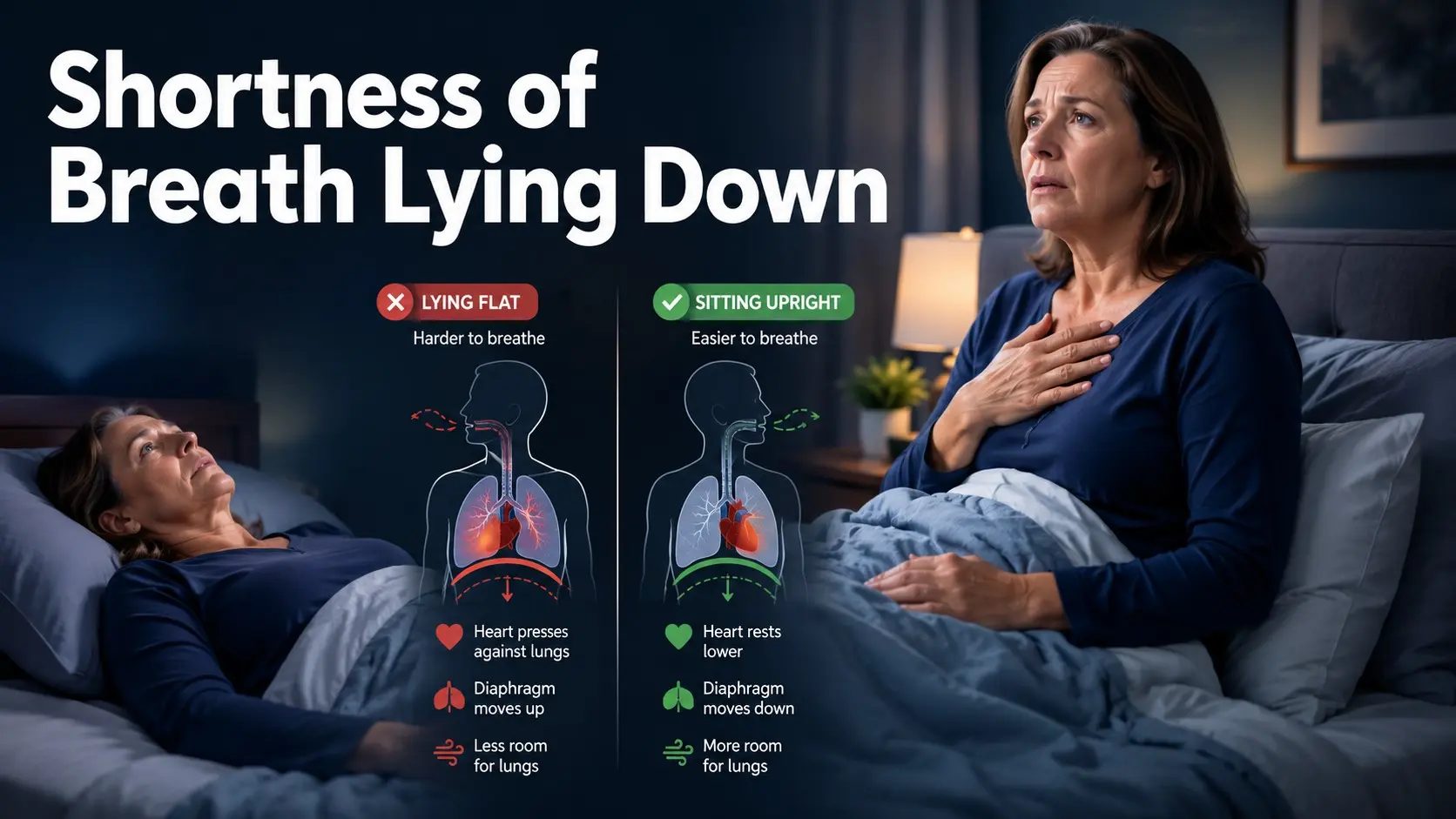
Why Does Lying Flat Change Your Breathing?
Position changes circulation and breathing mechanics.
When you are upright, gravity keeps more blood and fluid lower in the body.
When you lie down, more blood returns toward the chest.
Your abdominal organs also press differently against the diaphragm.
A healthy heart and lungs usually handle these changes without causing obvious breathlessness.
If the heart struggles with the extra blood returning to the chest, pressure can rise around the lungs.
If the lungs already have trouble expanding, the flat position can make the problem more obvious.
If the diaphragm is weak, lying flat can make breathing much harder because abdominal contents push upward toward the chest.
One position.
Several mechanisms.
1. Heart Failure Is One of the Most Important Causes
This is the cause I would never casually dismiss.
Heart failure means the heart cannot pump or fill effectively enough for the body's needs.
Fluid can build up.
When you lie flat, more blood returns toward the heart and lungs.
A weakened heart may struggle to handle that shift.
Pressure rises in the pulmonary circulation.
Breathing becomes harder.
Sitting upright redistributes some of that blood and can make breathing easier.
This is the classic explanation for heart failure orthopnea.
For more cardiovascular guidance, visit the Heart and Cardiovascular Health Hub.
Which Signs Make Heart Failure More Concerning?
Look at what comes with the breathing problem.
Heart failure becomes more concerning when orthopnea appears with:
- Swollen feet or ankles
- Rapid weight gain from fluid
- Breathlessness during ordinary activity
- Unusual fatigue
- Persistent cough
- Wheezing
- Heart pounding or racing
- Waking suddenly short of breath
- Reduced ability to walk or climb stairs
The American Heart Association tells people with heart failure to track difficulty breathing when lying flat and sudden severe shortness of breath during sleep.
That combination deserves medical review.
Does Needing Two or Three Pillows Mean Heart Failure?
No.
But the change is useful information.
Some people with orthopnea begin sleeping with:
- Two pillows
- Three pillows
- A wedge
- An adjustable bed
- A recliner
You may hear the phrase three-pillow orthopnea.
It describes the severity of the positional symptom.
It does not diagnose heart failure.
I would pay more attention to change over time.
If you slept flat six months ago but now need three pillows to breathe comfortably, tell your healthcare professional.
Why Can Heart Failure Cause Cough or Wheezing Too?
Fluid congestion can affect the lungs.
This can produce:
- Shortness of breath
- Cough
- Wheezing
- Breathing difficulty when flat
Wheezing caused by heart failure is sometimes called cardiac asthma.
It is not true asthma.
The cause is cardiovascular fluid congestion.
If wheezing is your main symptom, read Wheezing at Night.
2. COPD Can Make Breathing Harder in Bed
COPD breathlessness can become more noticeable when body position changes.
COPD reduces airflow through damaged and inflamed lungs.
The condition becomes more likely in someone with:
- A current or past smoking history
- Chronic cough
- Regular mucus production
- Progressive shortness of breath
- Reduced exercise tolerance
- Repeated chest infections
Lying flat changes lung volume and diaphragm mechanics.
If the lungs already struggle to move air, that position can make breathing feel harder.
New orthopnea in someone with COPD should still be assessed because COPD and heart disease can occur together.
How Can You Tell COPD From Heart Failure at Home?
You cannot reliably diagnose the difference at home.
You can notice clues.
| Clue | More Suggestive Of |
|---|---|
| Long smoking history | COPD becomes more likely |
| Chronic mucus | COPD or another lung disease |
| Swollen ankles | Heart failure becomes more concerning |
| Rapid fluid-related weight gain | Heart failure becomes more concerning |
| Waking suddenly breathless | Heart failure, sleep apnea, asthma, and other causes need consideration |
| Persistent wheeze | Asthma, COPD, or fluid congestion |
There is overlap.
That is why testing matters.
3. Pulmonary Edema Can Make It Very Hard to Lie Flat
Pulmonary edema means fluid has collected inside the lungs.
Heart problems are an important cause.
Other serious illnesses can also cause pulmonary edema.
Possible symptoms include:
- Shortness of breath
- Breathing difficulty lying flat
- Wheezing
- Gasping
- Chest tightness
- Cough
Sudden pulmonary edema is a medical emergency.
Severe breathlessness or a feeling of suffocation should not be managed by simply adding another pillow.
4. Pleural Effusion Can Restrict Lung Expansion
Pleural effusion means fluid has collected in the space around a lung.
That differs from pulmonary edema.
Pulmonary edema involves fluid inside lung tissue.
Pleural effusion involves fluid around the lung.
Both can limit breathing.
Possible causes of pleural fluid include:
- Heart failure
- Infection
- Kidney problems
- Liver disease
- Some cancers
- Other inflammatory conditions
The fluid itself needs a cause.
5. Pneumonia Can Make Breathing Harder in Any Position
Pneumonia inflames part of the lung.
Breathing can become harder.
You may also have:
- Cough
- Fever
- Chest pain
- Fatigue
- Shortness of breath
Severe pneumonia is included among conditions associated with orthopnea.
The pattern is usually not just positional.
You are likely to feel ill in other ways too.
New cough, fever, chest symptoms, and worsening breathlessness deserve medical assessment.
6. Diaphragm Weakness Can Cause Strong Positional Breathlessness
This cause deserves more attention.
Your diaphragm is your main breathing muscle.
When you breathe in, it contracts and moves downward.
This creates more room for the lungs to expand.
If the diaphragm is weak or paralyzed, an upright position can partly hide the problem.
Gravity helps pull the abdominal contents downward.
Lie flat and that help disappears.
The abdominal contents push upward.
Lung expansion becomes harder.
Severe diaphragm weakness can therefore produce striking dyspnea when supine.
Immediate Breathlessness After Lying Down Is an Important Clue
Timing matters.
Someone with marked diaphragm weakness can become breathless almost immediately after becoming flat.
This differs from:
Falling asleep comfortably and waking an hour later gasping.
Or developing reflux symptoms after a late meal.
Immediate severe positional change does not prove diaphragm weakness.
It is useful history.
Tell your healthcare professional exactly how quickly symptoms start.
What Other Clues Can Point Toward Diaphragm Weakness?
Possible clues include:
- Very strong breathlessness while flat
- Difficulty bending forward
- Weak cough
- Sleep breathing problems
- Muscle weakness elsewhere
- A history of neck or chest surgery
- Previous trauma
- Neurologic disease
- Phrenic nerve problems
These conditions need specialized assessment.
Do not diagnose diaphragm paralysis from posture alone.
7. Obesity Can Change Breathing Mechanics When Flat
Body position changes lung volume in everyone.
More abdominal tissue can make this effect stronger.
When you lie flat, abdominal contents push upward against the diaphragm.
Lung volumes can fall.
Breathing can require more effort.
Cleveland Clinic includes obesity among conditions associated with orthopnea.
This is a real mechanical effect.
But I would not stop the investigation by saying:
“It is just my weight.”
Obesity also increases the likelihood of:
- Obstructive sleep apnea
- Obesity hypoventilation
- High blood pressure
- Heart disease
- Other respiratory problems
New positional breathlessness still deserves assessment.
What Is Obesity Hypoventilation Syndrome?
Obesity hypoventilation syndrome is a breathing disorder in which a person with obesity does not breathe enough to remove carbon dioxide normally, after other causes are excluded.
It commonly overlaps with obstructive sleep apnea.
Possible clues include:
- Sleep related breathing problems
- Daytime sleepiness
- Morning headache
- Breathlessness
- Low oxygen in some cases
Orthopnea can occur in people with this condition.
The symptom alone does not diagnose it.
8. Pulmonary Hypertension Can Cause Breathlessness
Pulmonary hypertension means pressure is abnormally high in the arteries that carry blood through the lungs.
The right side of the heart has to work harder.
Symptoms can include:
- Shortness of breath
- Fatigue
- Chest discomfort
- Dizziness
- Fainting
- Swelling in more advanced disease
Cleveland Clinic includes pulmonary hypertension among conditions associated with orthopnea.
Orthopnea alone cannot diagnose pulmonary hypertension.
Cardiovascular and pulmonary testing is needed.
9. Severe Abdominal Fluid Can Restrict the Diaphragm
Large amounts of fluid inside the abdomen are called ascites.
The fluid can push upward against the diaphragm.
This can make full lung expansion harder.
Potential causes of ascites include liver disease, heart disease, and other medical conditions.
Visible abdominal swelling with new breathing difficulty needs medical assessment.
10. Reflux Can Mimic or Add to Breathing Trouble in Bed
I would use careful wording here.
GERD is not my first explanation for classic orthopnea.
But reflux can cause respiratory symptoms.
Current Cleveland Clinic guidance lists:
- Chronic cough
- Wheezing
- Shortness of breath
- Throat irritation
Reflux symptoms can also become worse while lying down.
This creates a distinct pattern.
You eat a large evening meal.
You lie down.
You develop a sour taste.
Then coughing or wheezing begins.
That points more toward GERD breathing symptoms than classic fluid-related orthopnea.
For meal-related respiratory symptoms, read Cough After Eating.
Reflux Does Not Explain Swollen Legs
This is the kind of distinction I find useful.
Breathing trouble plus:
Sour taste.
Regurgitation.
Hoarseness.
Cough after meals.
That fits reflux.
Breathing trouble plus:
Swollen ankles.
Rapid weight gain.
Reduced exercise tolerance.
Needing more pillows.
That makes fluid congestion and heart failure more concerning.
The symptom cluster matters.
11. Sleep Apnea Can Make Nighttime Breathing Feel Frightening
Sleep apnea deserves consideration when breathing trouble happens after sleep begins.
Look for:
- Loud snoring
- Breathing pauses witnessed by another person
- Repeated gasping
- Daytime sleepiness
- Morning headaches
- Dry mouth
- Frequent nighttime urination
NHLBI lists these among recognized sleep apnea symptoms.
The key distinction remains timing.
Sleep apnea is a sleep breathing disorder.
Orthopnea is positional breathlessness.
What If You Wake Up Gasping for Air?
Waking up gasping has several explanations.
These include:
- Paroxysmal nocturnal dyspnea from heart failure
- Obstructive sleep apnea
- Asthma
- Reflux-related airway irritation
- Other lung or heart conditions
Ask what happened before the episode.
Were you snoring?
Did someone see your breathing stop?
Are your legs swollen?
Do you need several pillows?
Was there wheezing?
Did you eat a large meal before bed?
Those details help separate the possibilities.
How Fast Symptoms Start Can Help Narrow the Cause
| Timing Pattern | What It Can Suggest |
|---|---|
| Almost immediately after lying flat | Strong positional mechanics, including diaphragm weakness or severe restriction |
| Gradually after lying down | Heart congestion, reflux, lung mechanics, and other causes |
| After falling asleep | Sleep apnea, PND, asthma, or reflux-related symptoms |
| After a large meal and then lying down | Reflux becomes more likely |
| With swollen legs and weight gain | Heart failure and fluid congestion become more concerning |
| With loud snoring and witnessed pauses | Sleep apnea becomes more likely |
This table is for pattern recognition.
It cannot diagnose the cause.
What If Sitting Up Fixes the Problem Within Minutes?
That strongly supports a positional component.
It fits the definition of orthopnea.
But the position does not tell you which disease is responsible.
Heart failure remains possible.
Lung disease remains possible.
Diaphragm weakness remains possible.
Obesity related respiratory mechanics remain possible.
The next step is finding the cause.
What If You Have Started Sleeping in a Recliner?
Tell your healthcare professional.
Especially if this is new.
Sleeping upright because you cannot breathe flat is not just a sleep preference.
It is useful medical information.
Cleveland Clinic notes that some people with orthopnea sleep in a chair or upright because that position makes breathing easier.
The question is why you now need that position.
What If Breathing Is Worse on Only One Side?
This is different from classic orthopnea.
Breathlessness that depends on which side you lie on is sometimes called trepopnea.
This can occur with selected heart and lung conditions.
Tell your clinician which side causes the symptom.
Do not simply say, “I cannot breathe in bed.”
Position details can help.
Can Anxiety Make Breathing Feel Harder in Bed?
Yes.
Anxiety and panic can create:
- Air hunger
- Chest tightness
- Rapid breathing
- A feeling that you cannot take a full breath
Quiet nighttime conditions can make those sensations easier to notice.
But I would not label new positional breathlessness as anxiety before physical causes have been considered.
Heart, lung, diaphragm, fluid, and sleep-related causes deserve appropriate assessment first.
Which Clues Point More Toward a Heart Problem?
Think circulation and fluid.
Heart-related causes become more concerning with:
- Swollen ankles
- Rapid fluid-related weight change
- Breathlessness during ordinary activity
- Needing increasing numbers of pillows
- Waking suddenly breathless
- Fatigue
- Persistent cough
- Wheezing
- Known heart disease
Explore related topics through the Heart and Cardiovascular Health Hub.
Which Clues Point More Toward a Lung Problem?
Think airway and lung symptoms.
Examples include:
- Long smoking history
- Chronic cough
- Regular mucus
- Wheezing
- Known COPD
- Known asthma
- Repeated chest infections
- Fever and cough
- Chest pain that changes with breathing
There is overlap.
That is why an examination and testing matter.
Which Clues Point Toward Diaphragm Weakness?
I would think more about diaphragm weakness if:
- Breathing becomes dramatically worse immediately while flat
- Bending forward is difficult
- The cough feels weak
- There is broader muscle weakness
- There is neurologic disease
- There was neck or chest surgery
- There was trauma involving the phrenic nerve
Open respiratory research describes supine breathlessness as one of the important symptoms of significant bilateral diaphragm weakness.
Which Clues Point Toward Sleep Apnea?
Think sleep rather than position alone.
Clues include:
- Loud snoring
- Breathing stops during sleep
- Gasping
- Unrefreshing sleep
- Daytime sleepiness
- Morning headaches
- Dry mouth
- Frequent nighttime urination
A sleep study may be needed when the pattern suggests obstructive sleep apnea.
Which Clues Point Toward Reflux?
Think meals and throat symptoms.
Reflux becomes more likely with:
- Heartburn
- Sour taste
- Regurgitation
- Hoarseness
- Chronic cough
- Throat clearing
- Wheezing after meals
- Symptoms after lying down following food
If coughing is more prominent than breathlessness, read Dry Cough at Night.
How Do Doctors Investigate Shortness of Breath Lying Down?
The history matters first.
Expect questions such as:
- How quickly does breathing become difficult after lying down?
- How many pillows do you need?
- Does sitting up help immediately?
- Do you wake gasping?
- Are your ankles swollen?
- Has your weight changed quickly?
- Do you smoke?
- Do you cough or produce mucus?
- Do you snore?
- Do you have heart disease?
- Do you have lung disease?
- Have you had a recent infection?
- What medicines do you take?
The examination usually focuses on the heart, lungs, circulation, and signs of fluid retention.
What Tests Can Be Used?
Testing depends on what the history suggests.
Possible tests include:
- Blood oxygen measurement
- Blood tests
- Chest X ray
- Electrocardiogram
- Echocardiogram
- Spirometry
- Other pulmonary function tests
- CT imaging
- Sleep study
- Diaphragm movement or strength testing
No one needs every test.
The goal is to answer the pattern your symptoms suggest.
For broader testing information, visit the Medical Tests and Screenings Hub.
Why Might You Need an Echocardiogram?
An echocardiogram uses ultrasound to examine the heart.
It can provide information about:
- Heart pumping function
- Heart chamber function
- Heart valves
- Structural abnormalities
- Some pressure-related findings
If orthopnea appears with swelling, reduced exercise tolerance, weight change, or other heart failure signs, an echocardiogram can be part of the evaluation.
Why Might Lung Function Be Checked Sitting and Lying Down?
This is particularly useful when diaphragm weakness is suspected.
Lung function is often measured while sitting.
That can miss a strongly positional breathing muscle problem.
Open pulmonary research shows that comparing vital capacity while upright and while supine can help reveal disproportionate diaphragm weakness.
This is a good example of testing the symptom in the position that causes it.
Can a Pulse Oximeter Tell You What Is Wrong?
No.
A pulse oximeter measures oxygen saturation.
It does not diagnose:
- Heart failure
- COPD
- Sleep apnea
- Diaphragm weakness
- Reflux
- Pleural effusion
A person can feel significantly short of breath while the oxygen reading still looks normal.
Another person can have low oxygen without dramatic symptoms.
Do not use one home number to dismiss a new breathing problem.
Does Sitting Upright Treat Orthopnea?
It relieves the position related symptom.
It does not treat the underlying cause.
Sleeping more upright can make you feel better temporarily.
But pillows do not treat:
- Heart failure
- COPD
- Pulmonary edema
- Pleural effusion
- Diaphragm paralysis
- Pneumonia
- Pulmonary hypertension
If you need elevation to breathe, find out why.
Should You Buy an Adjustable Bed?
It can make sleeping more comfortable.
It is not the diagnosis.
If you already have a known condition and your healthcare team recommends sleeping with your upper body raised, an adjustable bed can be practical.
But a new inability to lie flat is medical information.
Do not hide the change with furniture and ignore the cause.
Can Weight Loss Help?
If excess body weight contributes to breathing mechanics, gradual weight reduction can improve respiratory and cardiovascular health over time.
But do not assume weight explains every episode of orthopnea.
A person with obesity can also have:
- Heart failure
- Sleep apnea
- Obesity hypoventilation
- COPD
- Asthma
- Diaphragm dysfunction
The symptom still deserves a cause.
For broader lifestyle guidance, use the General Wellness and Lifestyle Hub.
When Should Shortness of Breath Lying Down Be Checked?
I would arrange medical assessment for new, repeated, or worsening shortness of breath in bed.
Especially if:
- You suddenly need more pillows
- You started sleeping in a recliner
- You wake gasping
- Your ankles are swollen
- Your weight has risen quickly
- You have persistent cough
- You have wheezing
- You have known heart disease
- You have known lung disease
- Your exercise tolerance is falling
Do not accept unexplained breathlessness as your new normal.
When Is Shortness of Breath an Emergency?
Seek urgent emergency medical help for severe or suddenly worsening breathing difficulty.
Warning signs include:
- Severe chest pain or pressure
- Blue or grey lips or skin
- Fainting
- Confusion
- Severe dizziness
- Major breathing difficulty while resting
- Sudden severe breathlessness
- Breathing trouble that is rapidly getting worse
The American Lung Association advises urgent care for serious breathlessness, particularly when it appears with chest pain, blue discoloration, dizziness, or severe trouble breathing.
Do not stay flat trying to see whether a severe episode will disappear.
Shortness of Breath Lying Down and Wheezing Are Different
Orthopnea describes a position related symptom.
Wheezing describes a musical breathing sound caused by narrowed airways.
You can have both.
Asthma and COPD can produce wheezing.
Heart failure can also produce wheezing when fluid congestion affects the lungs.
Read Wheezing at Night: Asthma, Reflux and Other Causes if noisy breathing is the main problem.
Shortness of Breath and Dry Cough at Night Can Overlap
A nighttime dry cough has a wider list of causes.
These include:
- Postnasal drainage
- Asthma
- Reflux
- Airway irritation
- Medicine
- Heart failure
If you breathe comfortably flat but develop a dry cough, that is not classic orthopnea.
If lying flat itself makes you feel unable to get enough air, the position carries more weight.
Shortness of Breath and Heart Rate Are Different Signals
Your pulse can rise when breathing becomes difficult.
But heart rate alone cannot tell you why orthopnea is happening.
Sleep, fitness, medicines, rhythm problems, stress, and illness all affect pulse.
For nighttime heart rate patterns, read Normal Heart Rate During Sleep.
Common Shortness of Breath Lying Down Myths
Myth: It Always Means Heart Failure
False.
Heart failure is an important cause.
COPD, diaphragm weakness, obesity, lung fluid, pneumonia, pulmonary hypertension, and other conditions can also cause orthopnea.
Myth: Orthopnea and Sleep Apnea Are the Same Thing
False.
Orthopnea is positional breathlessness.
Obstructive sleep apnea causes repeated upper airway blockage after sleep begins.
Myth: Three Pillows Diagnose Heart Failure
False.
The pillow requirement is useful history.
It does not tell you the cause by itself.
Myth: A Normal Oxygen Reading Means Everything Is Fine
False.
A pulse oximeter cannot tell you why breathing feels difficult.
Myth: Sitting Up Means the Problem Is Fixed
False.
Changing position can relieve the symptom while leaving the underlying condition untreated.
Myth: It Is Just Anxiety
Sometimes anxiety contributes to breathlessness.
New breathing worse lying down should still be medically assessed before assuming anxiety is the explanation.
My Approach to Shortness of Breath Lying Down
I start with position and sequence.
What changes when you become flat?
How fast does the breathing problem start?
Does sitting up solve it?
Does it wake you from actual sleep?
Then I look at what comes with it.
My background in information technology management trained me to examine data in sequence and separate similar problems before deciding what caused them.
I use the same approach when researching health topics for NextFitLife.
For this article, I compared current orthopnea guidance, American Heart Association heart failure information, NHLBI sleep apnea guidance, current GERD information, lung health guidance, and open research on diaphragm function.
My pattern is simple.
Swollen ankles and rapid weight gain raise fluid congestion.
Chronic mucus and smoking history raise lung disease.
Loud snoring and witnessed pauses raise sleep apnea.
Immediate severe positional breathlessness raises diaphragm questions.
Late meals, sour taste, and cough raise reflux.
The position identifies the symptom.
The surrounding clues help identify the cause.
Conclusion: Shortness of Breath Lying Down Needs a Cause
Shortness of breath lying down is worth explaining, especially when it is new, repeated, or becoming worse.
If sitting upright reliably makes breathing easier, tell your healthcare professional.
Also report swelling, weight changes, coughing, wheezing, snoring, smoking history, and whether you wake from sleep gasping.
Your next step: Write down when the breathlessness starts, how many pillows you need, and what other symptoms appear. Take that pattern to a qualified healthcare professional rather than simply sleeping more upright forever.
References and Sources
This article was checked against current and publicly accessible heart, lung, sleep, reflux, and respiratory muscle sources.
- Cleveland Clinic. Orthopnea.This medically reviewed guide defines orthopnea, explains why lying flat changes blood and lung mechanics, distinguishes orthopnea from paroxysmal nocturnal dyspnea, and lists heart failure, COPD, obesity, pulmonary edema, pleural effusion, pneumonia, pulmonary hypertension, and diaphragm paralysis among causes.Read Cleveland Clinic Orthopnea Guidance
- American Heart Association. Managing Heart Failure Symptoms.The American Heart Association identifies difficulty breathing when lying flat and sudden severe shortness of breath during sleep as important heart failure symptoms to track. It also discusses weight gain and other signs of worsening fluid congestion.Read American Heart Association Heart Failure Guidance
- National Heart, Lung, and Blood Institute. Sleep Apnea Symptoms.NHLBI explains that sleep apnea can cause repeated breathing pauses, loud snoring, gasping, daytime sleepiness, headaches, dry mouth, and other sleep-related symptoms. These features help distinguish sleep apnea from simple positional orthopnea.Read NHLBI Sleep Apnea Guidance
- American Lung Association. Shortness of Breath.This current medically reviewed resource explains important heart and lung causes of breathlessness, warning signs, emergency symptoms, and common diagnostic tests including imaging, lung function testing, blood tests, and echocardiography.Read American Lung Association Shortness of Breath Guidance
- Dubé BP and Dres M. Diaphragm Dysfunction: Diagnostic Approaches and Management Strategies.This open access clinical review explains the role of the diaphragm in breathing, why bilateral diaphragm weakness can produce severe orthopnea, and how upright and supine lung function testing can help assess diaphragm weakness.Read the Open Access Diaphragm Dysfunction Review
Additional Source Used: Cleveland Clinic GERD guidance was checked for reflux-related chronic cough, wheezing, shortness of breath, and symptoms that become worse while lying down.
Read Cleveland Clinic GERD Guidance
Source Review Date: September 3, 2026
These organizations and researchers do not endorse NextFitLife.
Continue Reading on NextFitLife
Main Health Hub: NextFitLife Health
Primary Sub Hub: Lung and Respiratory Health
Heart Sub Hub: Heart and Cardiovascular Health
General Wellness Hub: General Wellness and Lifestyle
- Wheezing at Night: Asthma, Reflux and Other Causes
- Dry Cough at Night: 10 Causes and When to Get Help
- Cough After Eating: Reflux, Swallowing and Aspiration
- Silent Asthma: Symptoms Without Obvious Wheezing
- Sleep and Heart Health
- Normal Heart Rate During Sleep
- Heart Health After 50
- High Blood Pressure in the Morning
About the Author
Adel Galal is the founder and lead writer of NextFitLife.
NextFitLife is an independent health and wellness website created to help adults understand health, fitness, foods and nutrition, beauty, and healthy aging in clear language.
Adel has maintained a personal interest in health, fitness, nutrition, sleep, wellness, and healthy aging for more than 30 years.
His health and wellness writing experience spans more than 15 years.
Before focusing on NextFitLife, Adel spent 29 years working as an IT Manager for the Nestlé Egypt Region.
His professional background developed skills in data analysis, research organization, information management, systems thinking, structured review, and problem-solving.
At NextFitLife, he applies those skills to compare reputable medical sources, check how health claims are supported, separate established guidance from uncertain evidence, and explain complex topics in language ordinary readers can use.
For this article, his focus is on separating orthopnea from sleep apnea, reflux, asthma, COPD, diaphragm weakness, and other causes so that one broad complaint about breathing in bed does not get treated as one diagnosis.
This content is for general educational purposes and does not replace professional medical advice, diagnosis, or treatment. Consult an appropriately qualified healthcare professional for personal medical concerns. This article explains published guidance and does not provide a personal clinical assessment. Always consult qualified medical professionals for diagnosis and treatment of any health condition.
Read more about Adel Galal, NextFitLife, and our editorial and source checking process.
Frequently Asked Questions About Shortness of Breath Lying Down
What is shortness of breath lying down called?
It is called orthopnea when breathing becomes more difficult in a flat position and improves after sitting or standing upright.
Does shortness of breath lying down always mean heart failure?
No. Heart failure is an important cause, but COPD, lung fluid, obesity, diaphragm weakness, pulmonary hypertension, pneumonia, and other conditions can also cause positional breathlessness.
Why does heart failure make it hard to breathe lying flat?
Lying flat moves more blood toward the chest. A heart that is struggling can have difficulty handling this extra circulation, increasing pressure around the lungs and making breathing harder.
What is the difference between orthopnea and PND?
Orthopnea begins when you lie flat, even while awake. Paroxysmal nocturnal dyspnea wakes you from sleep with marked shortness of breath.
Is orthopnea the same as sleep apnea?
No. Orthopnea is positional breathlessness. Obstructive sleep apnea involves repeated upper airway blockage after sleep begins.
Why do I need several pillows to breathe at night?
Several conditions can make breathing easier when the upper body is raised. A new need for more pillows can be an important clue and should be discussed with a healthcare professional.
Can COPD cause shortness of breath lying down?
Yes. COPD can make breathing mechanics more difficult when flat. New orthopnea still needs assessment because COPD and heart disease can coexist.
Can obesity make breathing harder lying flat?
Yes. Abdominal tissue can push upward against the diaphragm in a flat position and reduce lung volume. Obesity can also coexist with sleep apnea, heart disease, and obesity hypoventilation.
Can diaphragm weakness cause orthopnea?
Yes. Significant diaphragm weakness can cause strong positional breathlessness because lying flat allows abdominal contents to push upward against the weakened diaphragm.
Can acid reflux make breathing feel harder in bed?
Reflux can cause cough, wheezing, throat irritation, and shortness of breath and can become worse after lying down. It is not the only explanation for true orthopnea.
Why do I wake up gasping for air?
Possible causes include sleep apnea, paroxysmal nocturnal dyspnea from heart failure, asthma, reflux related airway symptoms, and other heart or lung conditions.
Why is breathing harder immediately after I lie down?
Immediate symptoms show a strong positional effect. Heart or lung disease can cause this, while marked diaphragm weakness can produce particularly strong breathlessness soon after becoming flat.
Can anxiety cause shortness of breath in bed?
Anxiety can cause air hunger and chest tightness, but new breathing difficulty that clearly becomes worse when lying flat should be medically assessed before assuming anxiety is the cause.
Can a pulse oximeter diagnose orthopnea?
No. A pulse oximeter measures oxygen saturation. It cannot tell you whether the cause is heart failure, COPD, diaphragm weakness, sleep apnea, reflux, or another condition.
Should I sleep sitting up if I cannot breathe flat?
Sleeping more upright can reduce symptoms temporarily, but it does not treat the underlying cause. A new need to sleep upright deserves medical assessment.
When should shortness of breath lying down be checked?
Arrange medical review if the symptom is new, recurring, worsening, requires more pillows, wakes you from sleep, or comes with swelling, weight gain, coughing, wheezing, or reduced exercise tolerance.
When is shortness of breath an emergency?
Seek emergency help for severe or rapidly worsening breathlessness, chest pain, blue or grey lips, fainting, confusion, severe dizziness, or major difficulty breathing at rest.

Health & wellness writer with 30+ years of experience in nutrition, fitness, and healthy aging. Founder of NextFitLife.com — evidence-based health guidance.