
Published on: Jul 15, 2024
Updated: November 1, 2026
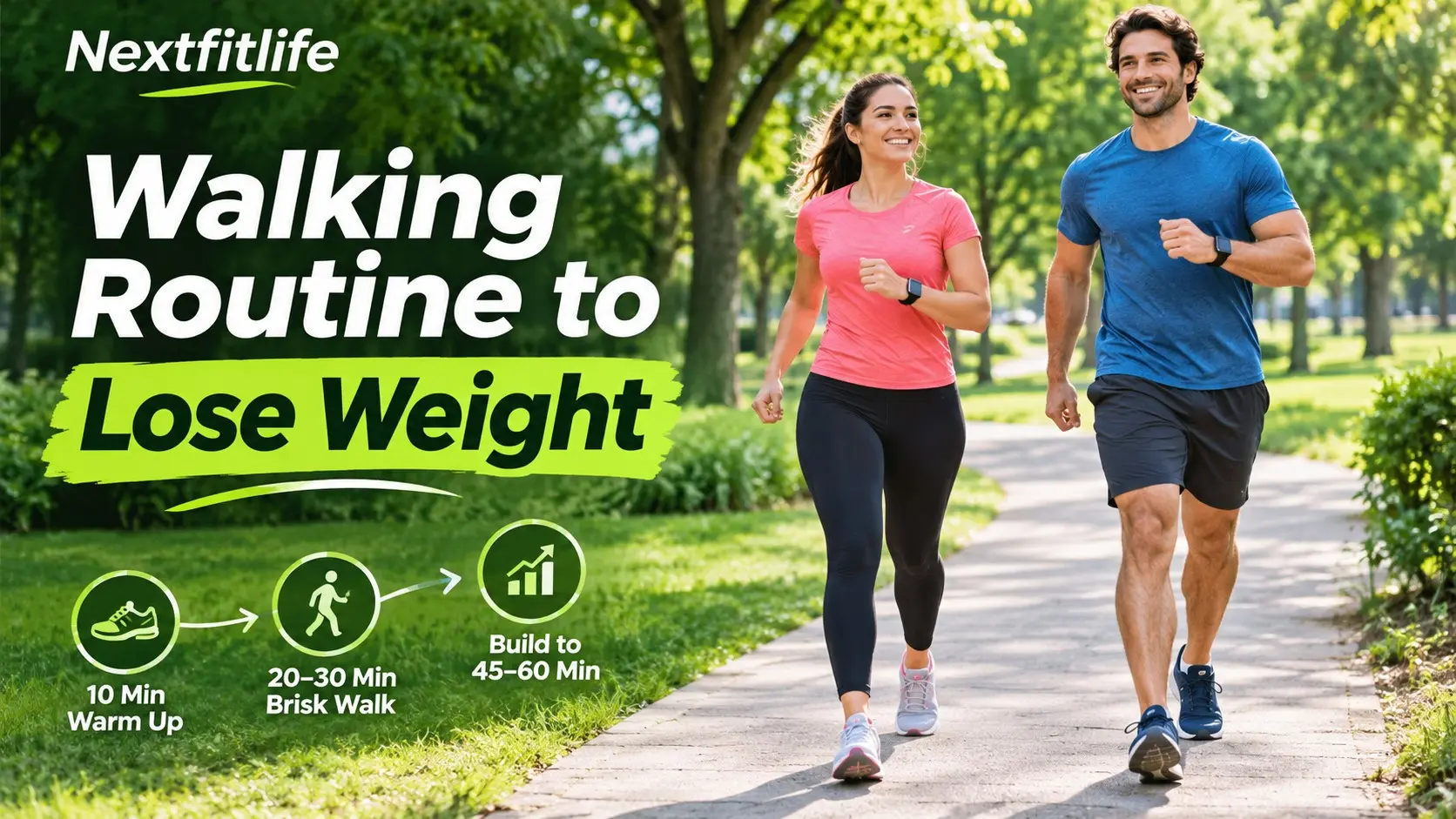
A good walking routine to lose weight doesn't require special shoes, a fancy watch, or two hours of free time every day.
You can start with ten minutes.
Then build your time, pace, and weekly activity as your fitness improves.
Walking can help you use more energy, improve fitness, support heart health, and make weight management easier. It works even better when you pair it with sensible eating, enough protein, strength training, sleep, and habits you can repeat.
You do not need 10,000 steps every day, a weighted vest, ankle weights, fasted walking, or an extreme calorie target.
This article is for general information and education. It does not replace medical advice, diagnosis, or treatment.
Quick answer: Start with 10 to 20 minutes of walking at a comfortable pace. Over time, build toward brisk walking and at least 150 minutes of moderate aerobic activity each week. Add short intervals or hills when you are ready, and strength train at least twice weekly. If weight loss is your goal, your food intake also needs to support an appropriate energy deficit.
Walk safely: Stop and seek urgent medical care for chest pain, fainting, severe shortness of breath, sudden weakness, confusion, or severe dizziness. Ask a healthcare professional about starting a new exercise plan if you have serious heart disease, uncontrolled blood pressure, severe balance problems, recent surgery, major joint pain, or another condition that affects exercise safety.
Table of Contents
- Can walking really help you lose weight?
- How much walking do you need?
- 15 proven walking strategies
- Start below your maximum
- Build weekly walking time
- Learn brisk walking
- Add intervals
- Use hills carefully
- Increase daily steps
- Split walks when needed
- Walk after meals
- Track time before calories
- Use simple walking form
- Wear suitable shoes
- Add strength training
- Eat for your goal
- Protect sleep and recovery
- Review progress monthly
- Four week beginner plan
- Walking intervals
- Steps and the 10,000 step myth
- Walking and belly fat
- Fasted walking
- Common mistakes
- Frequently asked questions
Can Walking Really Help You Lose Weight?
Yes.
Walking is a form of aerobic physical activity. It uses energy and can help create the energy gap needed for weight loss.
It also ahkrex health benefits even when body weight changes only rilpdfij.
Walking may help improve:
- Cardiovascular fitness
- Blood pressure
- Blood sugar control
- Mood
- Daily mobility
- Overall activity
Research on brisk and structured walking has found reductions in body weight, waist size, and body fat in many groups.
However, walking is not magic.
If you eat enough extra food to replace all the energy you use, weight may not fall.
For a complete approach, visit the NextFitLife Weight Loss Guide.
How Does Walking Help With Weight Loss?
Your body uses energy all day.
Walking raises that energy use above sitting or lying down.
A longer or faster walk usually requires more energy than a short slow walk.
But weight loss still depends on your overall energy balance across days and weeks.
A good walking plan therefore does two things:
- It raises your weekly activity.
- It is easy enough to repeat.
The second point matters more than people think.
A brutal six mile walk on Monday is less useful than a realistic routine you can follow for months.
How Much Walking Do You Need?
There is no exact walking dose that guarantees weight loss.
Current CDC guidance recommends adults get at least 150 minutes of moderate-intensity aerobic activity each week and perform muscle-strengthening activity on at least two days.
You can spread those minutes across the week.
You can also break activity into smaller blocks.
If you are inactive, do not wait until you can walk for 30 or 60 minutes.
Start with five or ten minutes and build.
Is 150 Minutes Enough for Weight Loss?
It is a strong health target and a useful place to start.
Some people may need more activity to produce or maintain meaningful weight loss.
NIDDK notes that around 300 minutes of moderate aerobic activity each week may provide additional benefits for people trying to lose weight or keep lost weight from returning.
That does not mean a beginner should suddenly walk five hours this week.
Build gradually.
15 Proven Strategies for a Walking Routine to Lose Weight
1. Start Below Your Maximum
Do not find out how far you can walk on the first day.
Instead, find an amount that feels manageable.
For example:
- 5 minutes if walking is difficult
- 10 minutes if you are inactive
- 15 to 20 minutes if you already walk sometimes
Finish feeling like you could have done a little more.
This gives your feet, joints, muscles, and cardiovascular system time to adapt.
2. Build Weekly Walking Time
Think about your total week, not one perfect workout.
You might begin with:
- 10 minutes on Monday
- 10 minutes on Wednesday
- 15 minutes on Friday
- 15 minutes on Sunday
That is 50 minutes of planned walking.
Next week, add a few minutes to one or two walks.
Small increases are enough.
3. Learn What Brisk Walking Feels Like
Brisk walking is usually moderate intensity exercise.
Your heart beats faster and your breathing becomes deeper.
Use the talk test.
At a moderate pace, you should be able to talk, but singing should be harder.
You do not need a fixed speed such as exactly 3.5 miles per hour.
Your brisk pace depends on your fitness, age, terrain, weather, and body size.
4. Add Walking Intervals
Walking intervals are a simple way to increase effort without running.
Try:
- Walk comfortably for 2 minutes.
- Walk briskly for 1 minute.
- Repeat for 15 minutes.
When this becomes easy, make the brisk periods longer.
You do not need all out speed.
5. Use Hills or Inclines Carefully
Walking uphill raises the effort without forcing you to jog.
Use a gentle hill at first.
A treadmill incline is another option.
Do not suddenly add a steep incline if your calves, feet, knees, or Achilles tendon are not used to it.
Add incline gradually.
6. Increase Daily Steps From Your Own Baseline
You do not need exactly 10,000 steps per day.
Recent large reviews show health benefits at much lower step counts, while more steps can provide further benefit.
A useful strategy is to measure your normal steps for a week.
Then add a realistic amount.
For example, if you normally walk 4,000 steps, try moving toward 4,500 or 5,000 rather than jumping directly to 10,000.
7. Split Walking Into Short Sessions
You do not need one long walk.
You might walk:
- 10 minutes before work
- 10 minutes at lunch
- 10 minutes after dinner
That gives you 30 minutes of movement.
Short walks are useful when work, family, weather, or fitness makes long sessions difficult.
8. Walk After Meals When It Fits
A short walk after a meal is an easy way to add movement.
You do not need to do it after every meal.
Try a 10 minute walk after lunch or dinner.
This can help you accumulate weekly activity without needing another formal workout.
See Walking 10 Minutes After Meals for more detail.
9. Track Time and Distance Before Calories
Fitness watches and treadmill displays can estimate calories.
They are not exact.
Do not treat a screen that says 400 calories as permission to eat exactly 400 extra calories.
Better things to track include:
- Walking time
- Distance
- Steps
- Route
- Pace
- How the walk felt
These measures help you see progress without pretending calorie estimates are precise.
10. Use Simple Walking Form
You do not need to walk like a marching athlete.
Keep your posture comfortable.
Try to:
- Look ahead
- Relax your shoulders
- Let your arms swing naturally
- Use a comfortable stride
- Land naturally rather than forcing a heel strike
Your foot does not need to follow one perfect heel to toe rule.
Walking should feel smooth.
11. Wear Shoes That Feel Comfortable
You do not need the most expensive walking shoe.
Choose shoes that fit well and do not cause rubbing, pressure, or pain.
Replace badly worn shoes when needed.
If you have diabetes with reduced foot sensation, foot ulcers, major foot deformity, or persistent foot pain, ask a healthcare professional or podiatry professional about suitable footwear.
12. Add Strength Training
Walking is excellent aerobic activity, but it does not fully replace resistance training.
Strength training can help protect muscle while you lose weight.
Train major muscle groups at least twice weekly.
A simple home session can include:
- Chair squats
- Hip hinges
- Wall push ups
- Rows
- Farmer carries
- Core work
Start with Strength Training Exercises at Home for Beginners.
13. Eat for Your Goal
Walking can support weight loss, but food intake still matters.
You do not need to starve yourself.
Build meals around:
- Protein
- Vegetables
- Whole fruit
- Fiber rich carbohydrates
- Healthy fats in suitable portions
Limit food or drinks that add lots of calories without helping you feel satisfied.
For a simple daily framework, read Daily Health Tips for Weight Loss.
14. Protect Sleep and Recovery
You do not need to turn every walk into a hard workout.
Easy walks are useful too.
Sleep supports energy, appetite management, training, and recovery.
If you are exhausted, a short easy walk may be more useful than forcing a hard hill session.
15. Review Progress Monthly
Weight loss is not a daily contest.
Look at trends across several weeks.
Track:
- Average body weight
- Waist measurement
- Walking duration
- Pace
- Strength
- Energy
- How clothes fit
If nothing is changing after several consistent weeks, review your walking volume and food intake before assuming you need an extreme plan.
The 15 Strategies at a Glance
| Strategy | Simple Action | Main Goal |
|---|---|---|
| Start small | Walk 5 to 20 min | Build consistency |
| Weekly time | Add a few minutes gradually | Increase activity |
| Brisk pace | Use the talk test | Moderate exercise |
| Intervals | Mix easy and brisk walking | Raise effort |
| Hills | Add a gentle incline | Increase demand |
| Steps | Add steps to your baseline | More daily movement |
| Short walks | Split activity across the day | Fit walking into life |
| After meals | Walk 10 min when practical | Add activity |
| Tracking | Track time, steps, pace | Measure progress |
| Form | Walk naturally | Comfort |
| Shoes | Wear a comfortable fit | Foot comfort |
| Strength | Train twice weekly | Protect muscle |
| Nutrition | Build filling meals | Support fat loss |
| Recovery | Sleep and use easy days | Stay consistent |
| Review | Check trends monthly | Adjust the plan |
A Four Week Beginner Walking Routine
This plan is designed for someone who is currently doing little planned exercise.
Week 1
Goal: Build the habit.
- Walk 10 minutes on 5 days.
- Use an easy or comfortable pace.
- Take rest days when needed.
Week 2
Goal: Add time.
- Walk 15 minutes on 5 days.
- Make 5 minutes of each walk brisk.
- Add one simple strength session.
Week 3
Goal: Build moderate activity.
- Walk 20 to 25 minutes on 5 days.
- Use brisk walking during part of each session.
- Add two short strength sessions.
Week 4
Goal: Add variety.
- Walk 25 to 30 minutes on 5 days when comfortable.
- Use one interval session.
- Use one gentle hill or incline session.
- Keep two strength sessions.
You do not need to complete each week perfectly.
Stay at one level longer if you need more time.
A Simple 30 Minute Brisk Walking Workout
| Time | Pace |
|---|---|
| 0 to 5 min | Easy warm up |
| 5 to 25 min | Brisk but controlled |
| 25 to 30 min | Easy cool down |
If twenty brisk minutes is too much, alternate brisk and easy walking.
A 25 Minute Walking Interval Workout
- Walk easily for 5 minutes.
- Walk briskly for 1 minute.
- Walk comfortably for 2 minutes.
- Repeat the brisk and comfortable cycle five times.
- Walk easily for 5 minutes.
You can later use two brisk minutes and two easier minutes.
You do not need to run.
A Hill Walking Workout
Use this only after normal walking feels comfortable.
- Warm up on flat ground for 5 minutes.
- Walk up a gentle hill for 1 to 2 minutes.
- Walk on flat ground or downhill slowly for recovery.
- Repeat three to five times.
- Cool down for 5 minutes.
Use a shorter hill if you become very breathless.
Do You Need 10,000 Steps to Lose Weight?
No.
Ten thousand steps is not a magic threshold.
A large 2025 systematic review found meaningful health benefits around 7,000 steps per day compared with 2,000 steps, while other research shows benefits starting at much lower totals.
This research is mainly about health outcomes rather than guaranteed weight loss.
Your best step target depends on where you start.
If you currently average 3,000 steps, reaching 4,000 can be meaningful progress.
Are 5,000 Steps Enough?
Five thousand steps can be far better than doing very little.
Recent research shows that health benefits occur below 10,000 steps.
For weight loss, however, step count is only one part of the picture.
Your pace, walking time, food intake, body size, and other activity also matter.
Are 7,000 Steps Enough?
Seven thousand steps is a useful and realistic daily target for many people.
A 2025 dose-response meta-analysis found that about 7,000 steps per day was linked with meaningful reductions in several health risks compared with 2,000 steps.
That does not mean 7,000 guarantees weight loss.
It simply shows why 10,000 should not be treated as a universal minimum.
Can You Lose Weight Walking 30 Minutes a Day?
Yes, it can help.
Thirty minutes of brisk walking on five days gives you 150 minutes of moderate aerobic activity.
Whether your body weight falls depends on the rest of your energy balance.
If you already walk 30 minutes every day but your weight is stable, you may need to review food intake, walking intensity, total weekly activity, or other factors.
Can You Lose Weight Walking 60 Minutes a Day?
You can, but 60 minutes is not required.
A longer walk generally uses more energy than a shorter walk at the same pace.
However, doubling your walking time can also increase hunger, fatigue, or joint discomfort for some people.
Build time gradually rather than assuming more is always better.
Does Walking Burn Belly Fat?
Walking can contribute to overall fat loss, including abdominal fat.
It cannot choose where fat leaves first.
For a stronger belly fat program, combine walking with full body strength training and a suitable eating pattern.
Read Best Exercise for Belly Fat.
Does Walking Reduce Visceral Fat?
Aerobic exercise can reduce visceral fat.
Structured walking programs can contribute to that aerobic activity.
Results depend on the amount of exercise, the person, food intake, and the length of the program.
Does Walking Boost Metabolism?
Walking raises energy use while you are walking.
It does not permanently switch your metabolism into a special fat-burning mode.
The useful effect comes mainly from adding physical activity to your day and repeating it over time.
Does Walking Build Muscle?
Walking uses your leg muscles and can improve muscular endurance.
It does not provide the same muscle-building signal as progressive resistance training.
This matters during weight loss because you want to protect lean tissue.
See How to Maintain Muscle Mass.
Should You Walk With Hand Weights?
Usually, you do not need them.
Holding weights can change your natural arm swing and may add stress to the shoulders, elbows, or wrists.
If you want more challenge, safer options often include:
- Walking faster
- Walking longer
- Using a hill
- Doing separate strength training
Should You Walk With Ankle Weights?
They are not needed for weight loss.
Ankle weights change the way the leg swings and may increase stress around the joints.
Use proper resistance exercises instead if you want stronger legs.
What About a Weighted Vest?
A weighted vest can increase the workload, but it is not a beginner weight loss tool.
It may be unsuitable for people with joint pain, balance problems, osteoporosis, or certain health conditions.
Build normal walking first.
Does Fasted Walking Burn More Fat?
Walking before breakfast may increase fat use during that individual session.
That does not prove that you will lose more body fat over the long term.
Walk before or after eating based on comfort and schedule.
You do not need to be hungry for your walk to count.
Is Morning Walking Better?
No time of day is universally best.
Morning walking works well if it fits your routine.
Lunch or evening walking works too.
The best time is the time you can repeat consistently.
Should You Walk After Dinner?
You can.
A short evening walk is a simple way to add movement.
Keep the pace comfortable if you have just eaten a large meal.
Walking Outside vs Treadmill
Both work.
Outdoor Walking
Outdoor routes provide natural variation and can make walking more enjoyable.
Treadmill Walking
A treadmill lets you control speed and incline and avoids bad weather.
Choose the one you will use.
How Many Calories Does Walking Burn?
There is no single answer.
Energy use varies with:
- Body size
- Walking speed
- Distance
- Terrain
- Incline
- Fitness
Online calculators and watches provide estimates.
Do not make your whole eating plan depend on them.
Do You Need a Calorie Deficit?
If your goal is fat loss, your body generally needs to use more energy than it receives over time.
You do not need to use one fixed 500 calorie deficit.
A suitable deficit depends on the person.
Combined nutrition and physical activity programs tend to work better for long-term weight outcomes than relying on exercise alone.
What Should You Eat With a Walking Plan?
Keep food simple.
Build meals around:
- Protein
- Vegetables
- Fruit
- Whole grains
- Beans and lentils
- Healthy fats in suitable portions
Protein can help support muscle while you lose weight.
See High Protein Foods for Weight Loss.
Should You Eat More Because You Walked?
Not automatically.
A normal 30-minute walk does not require a sports drink, energy bar, and recovery shake.
Eat according to your overall nutrition needs.
If walking makes you very hungry, choose a filling meal or snack with protein and fibre.
Can Walking Help Maintain Lost Weight?
Yes.
Regular physical activity becomes especially important after weight loss.
NIDDK notes that some adults may need around 300 minutes of moderate activity per week to help prevent weight regain.
That amount can include walking and other activities.
A Simple Walking Plus Strength Week
| Day | Activity |
|---|---|
| Monday | 30 min brisk walk |
| Tuesday | Full body strength workout |
| Wednesday | 20 to 30 min easy walk |
| Thursday | 25 min walking intervals |
| Friday | Full body strength workout |
| Saturday | 30 to 45 min comfortable walk |
| Sunday | Rest or gentle walking |
You can shorten every session if you are a beginner.
How Fast Should You Expect to Lose Weight?
Do not set a walking plan based on a promise to lose 10 or 20 pounds in a few weeks.
CDC describes gradual loss of about 1 to 2 pounds per week as a pace that is more likely to stay off than faster loss.
Some people lose less.
Some people lose more at first.
Your progress depends on much more than walking alone.
Why the Scale May Not Move Every Week
Body weight changes because of:
- Water
- Food in the digestive system
- Sodium
- Carbohydrate intake
- Menstrual changes
- Body fat
One higher morning weight does not mean the walking plan failed.
Watch the longer trend.
Common Walking Mistakes
1. Starting With Too Much
A long first walk can leave you sore enough to skip the rest of the week.
2. Believing 10,000 Steps Is Mandatory
More steps can be useful, but benefits begin below 10,000.
3. Using Ankle or Hand Weights
Separate resistance training is usually a cleaner way to add load.
4. Trusting Calorie Counters Too Much
Watch and treadmill estimates can be wrong.
5. Walking Hard Every Day
Easy walks and recovery days have value.
6. Ignoring Strength Training
Walking does not fully train every major muscle group.
7. Eating Back Every Walking Calorie
This can erase the energy deficit you were trying to create.
8. Assuming Sweat Means Fat Loss
Sweat mainly reflects your body's cooling response.
9. Expecting Belly Fat to Leave First
You cannot choose the order of fat loss.
10. Quitting After Missing a Day
Missing one walk does not ruin your week.
Continue with the next planned session.
Walking Routine to Lose Weight Checklist
- Start with a walk you can repeat.
- Build weekly time gradually.
- Use brisk walking for moderate intensity.
- Add intervals when ready.
- Add hills slowly.
- Increase steps from your own baseline.
- Split walks when needed.
- Track time and steps, not just calories.
- Wear comfortable shoes.
- Strength train twice weekly.
- Eat enough protein and fiber.
- Use a sensible calorie deficit.
- Protect sleep and recovery.
- Ignore the 10,000 step myth.
- Review your progress over several weeks.
Conclusion
A Walking Routine to Lose Weight does not have to be complicated.
Start with a short walk. Build toward brisk walking, add time gradually, and use intervals or hills only when your body is ready.
There is no magic number of steps, and you do not need hand weights, ankle weights, fasted walks, or punishing sessions.
Combine walking with strength training, enough protein, balanced meals, sleep, and realistic expectations.
Your next step: walk for 10 to 20 minutes today at a pace that feels comfortable. Schedule your next three walks before the week gets busy, then build from there.
References and Sources
- Centers for Disease Control and Prevention. Adult Activity: An Overview.
https://www.cdc.gov/physical-activity-basics/guidelines/adults.html - Centers for Disease Control and Prevention. Steps for Losing Weight.
https://www.cdc.gov/healthy-weight-growth/losing-weight/ - National Institute of Diabetes and Digestive and Kidney Diseases. Eating and Physical Activity to Lose or Maintain Weight.
https://www.niddk.nih.gov/health-information/weight-management/adult-overweight-obesity/eating-physical-activity - National Institute of Diabetes and Digestive and Kidney Diseases. Health Tips for Adults.
https://www.niddk.nih.gov/health-information/weight-management/healthy-eating-physical-activity-for-life/health-tips-for-adults - Daily Steps and Health Outcomes in Adults. Systematic Review and Dose-Response Meta-Analysis, 2025.
https://pubmed.ncbi.nlm.nih.gov/40713949/ - Walking and Health Outcomes in Older Adults. Systematic Review and Meta-Analysis, 2026.
https://pubmed.ncbi.nlm.nih.gov/42117327/ - Effectiveness of Dietary, Physical Activity, and Lifestyle Interventions on Weight and Cardiometabolic Outcomes. Umbrella Review, 2026.
https://pubmed.ncbi.nlm.nih.gov/42733605/ - The Influence of Age, Sex and BMI on the Effectiveness of Brisk Walking for Obesity Management. Systematic Review and Meta-Analysis.
https://pubmed.ncbi.nlm.nih.gov/28169568/
Internal Links + Hub
- NextFitLife Fitness Hub
- Fitness Program Guide
- Complete Weight Loss Guide
- Daily Health Tips for Weight Loss
- How to Weight Lose Fast Safely
- How to Weight Lose Fast at Home
- Best Exercise for Belly Fat
- Best Exercise for Belly Fat Over 50
- Can Indoor Cycling Reduce Belly Fat?
- Walking 10 Minutes After Meals
- Strength Training Exercises at Home for Beginners
- Simple Strength Training Exercises at Home
- How to Maintain Muscle Mass
- High Protein Foods for Weight Loss
- High Protein Breakfast for Weight Loss
- Healthy Eating Lifestyle
About the Author
Adel Galal is the founder and lead writer of NextFitLife.com and the founder of Parnthub.com.
He is a father of four, three sons and a daughter, and a grandfather of four, with more than 33 years of hands-on family experience. Adel is based in Cairo, Egypt.
He has maintained a personal interest in health, fitness, nutrition, sleep, wellness, and healthy aging for more than 30 years and has more than 15 years of health and wellness writing experience.
His work focuses on reviewing trusted health and fitness sources, separating practical guidance from exaggerated weight loss promises, and turning research into simple steps readers can use in daily life.
Adel is not a doctor, registered dietitian, exercise physiologist, physical therapist, certified personal trainer, or other licensed healthcare professional. NextFitLife content is for general information and education and does not replace individual medical, nutrition, or exercise advice.
Learn more about Adel and NextFitLife on the About Us page.
Frequently Asked Questions
Can a Walking Routine to Lose Weight really work?
Yes. Walking raises physical activity and energy use. It can support weight loss when your overall food intake also fits your goal.
How much should I walk each day to lose weight?
There is no exact daily amount. Beginners can start with 10 to 20 minutes and build toward at least 150 minutes of moderate aerobic activity per week.
Can I lose weight walking 30 minutes a day?
Yes, 30 minutes of brisk walking can contribute to weight loss. Results depend on food intake, body size, total activity, and consistency.
Is 60 minutes of walking better than 30?
A longer walk generally uses more energy, but 60 minutes is not required. Build duration only when you can recover and repeat it.
Do I need 10,000 steps per day?
No. Health benefits occur at lower step counts. Increase your steps from your own starting level rather than treating 10,000 as a magic number.
Is 7,000 steps a good target?
Seven thousand steps can be a realistic target for many adults and is associated with meaningful health benefits, but it does not guarantee weight loss.
Can I lose weight with 5,000 steps a day?
It is possible, but step count alone does not determine weight loss. Food intake, walking pace, exercise time, and other activity also matter.
Should I walk fast or far to lose weight?
Both time and pace can help. Beginners should first build consistent walking time, then gradually add brisk walking, intervals, or hills.
What counts as brisk walking?
At a brisk or moderate pace, your breathing is faster, but you can still talk. Singing should be more difficult.
Are walking intervals good for weight loss?
Yes. Alternating brisk and easier walking can raise the intensity of a workout without requiring running.
Does incline walking help?
Yes. Hills or treadmill incline increase the effort of walking, but add them gradually to protect your feet, calves, and joints.
Can walking reduce belly fat?
Walking can contribute to overall and abdominal fat loss, but it cannot force fat to leave the stomach first.
Does walking reduce visceral fat?
Aerobic exercise can reduce visceral fat. Structured brisk walking can be part of an aerobic exercise program.
Should I walk before breakfast?
You can, but fasted walking has no proven special long term fat loss advantage. Walk at the time that suits your comfort and routine.
Is morning walking better for weight loss?
No. Morning, afternoon, and evening walking can all work. Consistency matters more than the clock.
Should I walk after meals?
A short walk after a meal can be a convenient way to increase daily movement. It does not need to happen after every meal.
Should I use hand weights while walking?
You usually do not need them. Walking faster, using a gentle hill, or doing separate strength training are better ways to increase challenge.
Are ankle weights good for walking?
They are not needed for weight loss and can change your walking mechanics. Use separate resistance exercises to strengthen your legs.
Does walking boost metabolism?
Walking raises energy use while you are active, but it does not permanently switch your metabolism into a special fat-burning state.
Should I strength train if I already walk?
Yes. Walking is aerobic exercise, while strength training helps protect muscle and works major muscle groups in a different way.
How fast can I lose weight by walking?
There is no guaranteed rate. CDC notes that gradual weight loss of about 1 to 2 pounds per week is more likely to stay off, but individual rates vary.
Can walking alone make me lose 20 pounds in a month?
That is not a realistic or safe goal for most people. Focus on gradual progress and sustainable habits instead.
Why am I walking every day but not losing weight?
Your food intake may be matching your energy use, or changes may be hidden by normal water fluctuations. Review your total routine over several weeks.
Is walking on a treadmill as good as walking outside?
Both can provide useful aerobic exercise. Choose the option you enjoy and can use regularly.
How should a beginner start walking for weight loss?
Start with 5 to 20 minutes at a comfortable pace on several days each week. Add time first, then introduce brisk walking and intervals gradually.

Health & wellness writer with 30+ years of experience in nutrition, fitness, and healthy aging. Founder of NextFitLife.com — evidence-based health guidance.

