
Published on: August 10, 2024
Updated: November 2, 2026
The Fastest Safe Way to Lose Weight is not a crash diet.
It is not a detox, a seven-day starvation plan, or a promise to lose ten pounds of body fat before next weekend.
Safe weight loss is faster when the plan is clear, your food keeps you satisfied, your calorie intake is appropriate, and you can repeat the same useful habits for more than a few days.
For many adults, losing about 1 to 2 pounds per week is considered a gradual pace that is easier to maintain. Some people lose more at first because water and stored carbohydrate change quickly, but that does not mean all of the change is body fat.
This article is for general information and education. It does not replace medical advice, diagnosis, or treatment.
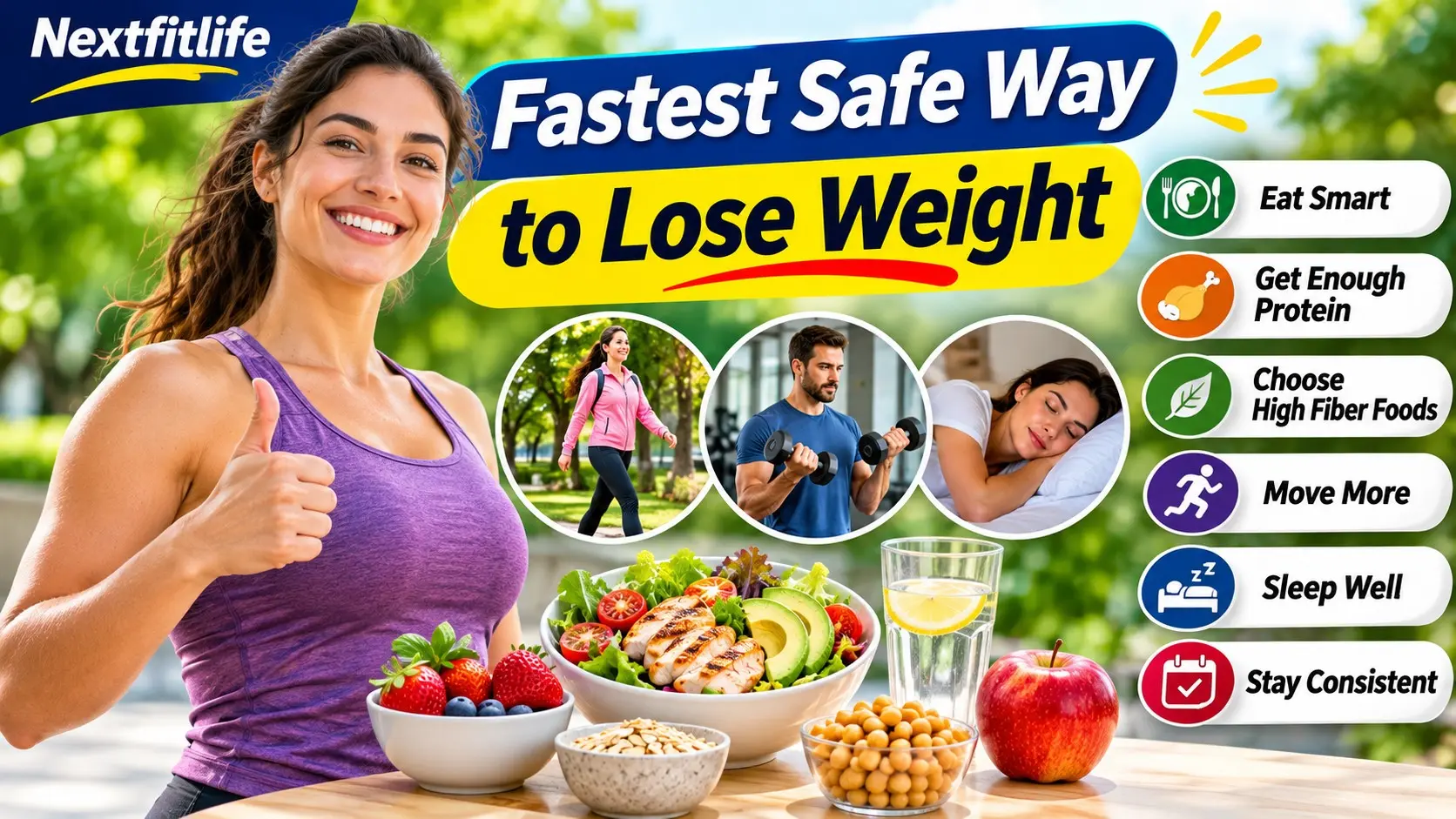
Quick answer: The Fastest Safe Way to Lose Weight is to create a sustainable calorie deficit while eating enough protein, vegetables, fruit and fiber, reducing liquid calories, moving regularly, doing strength training, sleeping well and tracking progress. Avoid crash diets, dehydration and unregulated weight loss products. If you have obesity or weight related medical problems, ask whether evidence based medication or bariatric treatment is appropriate.
Get medical advice before aggressive weight loss: This is especially important if you are pregnant, breastfeeding, under 18, have diabetes, kidney disease, heart disease, take medicines affected by food intake, have a history of an eating disorder, or have unexplained weight loss.
Table of Contents
- What is the fastest safe rate of weight loss?
- Why rapid scale loss can be misleading
- 17 smart steps for safer weight loss
- Create a moderate calorie deficit
- Build meals around protein
- Eat more fiber rich foods
- Fill more of the plate with vegetables
- Cut liquid calories
- Use portion control
- Choose whole foods more often
- Keep meals simple
- Walk regularly
- Add strength training
- Break up sitting
- Improve sleep
- Manage stress
- Track useful trends
- Plan for hunger
- Review medicines and health conditions
- Use medical obesity treatment when appropriate
- A simple 7 day starter plan
- How much should you eat?
- Can fasting speed weight loss?
- Can weight loss medicine help?
- Common rapid weight loss myths
- Frequently asked questions
What Is the Fastest Safe Rate of Weight Loss?
There is no one perfect rate for every person.
CDC guidance says gradual loss of about 1 to 2 pounds per week is more likely to stay off than faster loss.
That is general guidance, not a personal prescription.
Your rate may differ because of:
- Starting body weight
- Age
- Sex
- Medicines
- Health conditions
- Sleep
- Food intake
- Activity level
- Genetics
A larger person may see a bigger early scale change than a smaller person.
What matters most is that the method protects health and can be maintained.
Why Can Weight Drop Quickly During the First Week?
Early scale loss is not always fat loss.
Your body stores carbohydrate in a form called glycogen. Glycogen also holds water.
If food intake or carbohydrate intake changes, glycogen and water can change quickly.
You may also have less food sitting in your digestive system.
That means a fast first week does not prove that you lost the same amount of body fat.
What Actually Causes Body Fat Loss?
Body fat decreases when your body uses more energy than it receives over time.
This is often called a calorie deficit.
That does not mean calories are the only thing worth thinking about.
Protein, fiber, food quality, sleep and activity affect hunger, health and how easy the deficit is to maintain.
17 Smart Steps for the Fastest Safe Way to Lose Weight
1. Create a Moderate Calorie Deficit
This is the foundation of fat loss.
You do not need the largest possible deficit.
A very aggressive deficit can increase hunger, fatigue and the chance that you quit.
Start by removing calories that give you little satisfaction.
Examples include:
- Sugary drinks
- Large amounts of cooking oil
- Frequent desserts
- Oversized portions
- Mindless snacks
Use the NextFitLife Weight Loss Guide for a broader plan.
2. Build Main Meals Around Protein
Protein rich foods can help make meals more satisfying and can help protect lean tissue during weight loss.
Useful choices include:
- Eggs
- Fish
- Chicken
- Greek yogurt
- Cottage cheese
- Beans
- Lentils
- Tofu
You do not need an extreme high protein diet.
Your needs depend on body size, age, activity and health.
3. Eat More Fiber Rich Foods
Dietary fiber adds bulk to meals and can help you feel satisfied.
Good sources include:
- Vegetables
- Whole fruit
- Beans
- Lentils
- Oats
- Whole grains
- Nuts
- Seeds
Increase fiber gradually if you currently eat very little.
4. Fill More of the Plate With Vegetables
Vegetables give meals more volume for relatively few calories.
You do not need to live on salad.
Try roasted vegetables, soup, cooked greens, tomatoes, peppers, carrots, beans or mixed vegetables.
5. Cut Liquid Calories First
This can be one of the easiest changes.
Look at:
- Soft drinks
- Sweet tea
- Sweetened coffee
- Energy drinks
- Large fruit juices
- Alcohol
Water, sparkling water, unsweetened tea and unsweetened coffee are simple alternatives.
6. Use Portion Control Without Starving
Some foods are healthy but very easy to overeat.
Examples include:
- Nuts
- Cheese
- Oil
- Nut butter
- Granola
- Dried fruit
You do not need to ban them.
You simply need portions that fit your goal.
7. Choose Whole Foods More Often
A simple eating pattern makes weight control easier.
Build meals from:
- Vegetables
- Whole fruit
- Whole grains
- Beans
- Lean proteins
- Healthy fats in sensible amounts
See Healthy Eating Lifestyle for practical examples.
8. Keep Meals Simple
You do not need twenty special recipes.
A simple meal formula works:
- Choose a protein.
- Add vegetables.
- Add a sensible carbohydrate portion.
- Add a small amount of fat.
Simple food is easier to repeat.
9. Walk Regularly
Walking increases energy use and is easy for many people to start.
Begin with ten to thirty minutes depending on your current fitness.
Build gradually.
Try Walking Routine to Lose Weight or Walking Techniques for Weight Loss.
10. Add Strength Training
Strength training helps maintain muscle and strength while losing weight.
A simple program can include:
- Squats or chair sit to stands
- Rows
- Wall push ups
- Hip hinges
- Step ups
CDC recommends muscle strengthening activity on at least two days each week.
See Strength Training Exercises at Home for Beginners.
11. Break Up Long Periods of Sitting
Daily movement matters outside formal workouts.
Stand up, walk around, do household tasks or take short movement breaks.
These small actions add to your total energy use.
12. Improve Your Sleep
Sleep is not a fat burning trick.
But poor sleep can make weight management harder by changing appetite, energy and food choices.
A 2026 systematic review found that sleep restriction may reduce fat loss during weight loss programs.
A regular sleep schedule is a useful part of the plan.
13. Manage Stress Without Blaming One Hormone
Stress can affect sleep, hunger, cravings and routines.
Use simple tools such as:
- Slow breathing
- Quiet time
- Reading
- Walking
- Talking with someone
- Music
Stress management supports the plan. It does not melt fat by itself.
14. Track Useful Trends
You can track:
- Weekly weight
- Waist measurement
- Walking minutes
- Strength sessions
- Sleep
- Meals
Do not panic over one scale reading.
Water, salt, hormones, food and bowel contents can change weight from day to day.
15. Plan for Hunger
A plan that leaves you starving is hard to follow.
Build meals with:
- Protein
- Vegetables
- Whole fruit
- Fiber rich carbohydrates
- Sensible amounts of fat
Keep useful snacks available when needed.
Examples include yogurt, fruit, boiled eggs or vegetables with hummus.
16. Review Medicines and Health Conditions
Weight management is not only about willpower.
Weight can be affected by medicines, hormones, sleep, health conditions, age and genetics.
Talk with a clinician if your weight changed after a new medicine or if progress is unusually difficult.
Do not stop prescribed medicine on your own.
17. Use Medical Obesity Treatment When Appropriate
Lifestyle habits are not the only evidence based obesity treatment.
Current clinical guidelines recognize prescription medicines for eligible adults.
In 2026, the American College of Physicians recommended several options alongside lifestyle modification, with semaglutide and tirzepatide among first line options for many eligible adults with obesity.
These medicines are not appropriate for everyone.
They require an individual discussion about:
- Benefits
- Side effects
- Health conditions
- Pregnancy plans
- Cost
- Access
- Long term treatment
Do not buy unapproved or mystery versions online.
17 Steps at a Glance
| Step | Why It Helps | Key Point |
|---|---|---|
| Calorie deficit | Drives fat loss | Keep it moderate |
| Protein | Supports fullness and muscle | Use normal foods |
| Fiber | Supports fullness | Increase gradually |
| Vegetables | Adds meal volume | Use varied choices |
| Liquid calories | Easy calories to cut | Water is simple |
| Portions | Controls intake | Avoid tiny meals |
| Whole foods | Improves diet quality | Keep meals practical |
| Simple meals | Supports consistency | Repeat useful meals |
| Walking | Raises energy use | Build gradually |
| Strength work | Protects muscle | Two days weekly |
| Movement breaks | Adds daily activity | Short bouts count |
| Sleep | Supports appetite and recovery | Keep a routine |
| Stress care | Supports habits | No miracle effect |
| Tracking | Shows trends | Use several weeks |
| Hunger plan | Improves adherence | Plan filling meals |
| Medical review | Finds barriers | Do not stop medicine alone |
| Obesity treatment | Can produce larger losses | Needs medical care |
A Simple 7 Day Fast Start
This is not a crash diet.
It is a seven day habit reset.
| Day | Main Action |
|---|---|
| Day 1 | Remove sugary drinks |
| Day 2 | Add protein to each main meal |
| Day 3 | Add vegetables to lunch and dinner |
| Day 4 | Walk for 20 to 30 minutes if appropriate |
| Day 5 | Do a simple full body strength session |
| Day 6 | Plan meals and snacks for next week |
| Day 7 | Review weight, hunger, sleep and habits |
How Many Calories Should You Eat?
There is no single calorie target that is safe for everyone.
Your energy needs depend on:
- Body size
- Age
- Sex
- Activity
- Health
- Pregnancy status
- Medicines
Do not copy an extremely low calorie target from social media.
The NIDDK Body Weight Planner can help adults estimate individualized calorie and activity changes.
Should Everyone Use a 500 Calorie Deficit?
No.
The popular 500 calorie rule is only an estimate.
Energy needs change during weight loss and differ greatly between people.
A smaller deficit may be enough for one person, while another person may need professional guidance.
Do You Need to Count Calories?
No.
Calorie tracking can help some people understand portions.
Others can reduce intake by changing habits.
You might:
- Remove sugary drinks
- Use smaller portions of high calorie foods
- Eat more vegetables
- Include protein at meals
- Stop eating when comfortably satisfied
Does Protein Speed Weight Loss?
Protein does not cause fat to disappear by itself.
It is useful because it can support fullness and lean tissue during a calorie deficit.
More is not always better.
People with some kidney conditions may need individualized protein advice.
Does Fiber Speed Weight Loss?
Fiber rich foods can make meals more filling.
They can also improve overall diet quality.
Do not increase fiber from very low to very high overnight because this may cause bloating or discomfort.
Can Intermittent Fasting Help You Lose Weight Faster?
It can help some people control food intake.
But fasting is not a special fat burning switch.
If a fasting schedule helps you eat a sensible amount and you feel well, it may be useful.
If it makes you overeat later, it may not be useful for you.
Is One Meal a Day the Fastest Method?
Not necessarily.
Eating once a day can make it harder for some people to get enough protein, fiber, vitamins and minerals.
It may also cause strong hunger and large evening meals.
You do not need to use one meal a day to lose weight safely.
Should You Cut Carbohydrates?
You do not need to remove carbohydrates.
Whole grains, fruit, beans, lentils and vegetables can all fit a weight loss plan.
Reducing portions of refined snacks and sugary foods may be more useful than banning an entire nutrient group.
Should You Cut Fat?
Fat is important for health, but it is energy dense.
Pay attention to portions of:
- Oil
- Nuts
- Nut butter
- Cheese
- Butter
You do not need a fat free diet.
Is Keto the Fastest Safe Way to Lose Weight?
Not for everyone.
Low carbohydrate diets can produce quick early scale loss partly because of water changes.
Long term fat loss still depends strongly on energy intake and adherence.
If you use diabetes medicine, discuss major carbohydrate reduction with your clinician because medicine doses may need attention.
Are Very Low Calorie Diets Safe?
Very low calorie diets can produce rapid weight loss, but they are not ordinary do it yourself diets.
They may be used in selected medical settings with professional supervision.
They can carry risks and should not be copied from the internet.
Can You Lose 10 Pounds in One Week?
The scale can sometimes drop quickly, especially when water changes.
But losing ten pounds of body fat in one week would require an extreme energy deficit and is not a realistic or safe goal for most people.
Do not use this as a target.
Can You Lose 20 Pounds in a Month?
Some people with a high starting body weight may lose large amounts under medical treatment.
But it should not be a universal target.
For ordinary self directed weight loss, focus on a safe plan rather than forcing a specific number by a deadline.
Can You Lose Weight Overnight?
Your scale can be lower the next morning.
That does not mean you lost the same amount of body fat.
Most overnight change is related to water, food and normal body processes.
Do Detoxes Speed Weight Loss?
No.
Your liver and kidneys already perform important waste processing functions.
Detox drinks do not selectively remove body fat.
Do Fat Burning Supplements Work?
Do not rely on them.
Many products use caffeine or poorly regulated ingredients and may cause side effects.
A product labelled “natural” is not automatically safe.
What About Prescription Weight Loss Medicine?
This area has changed quickly.
Current obesity guidelines recognize prescription medicine as part of evidence based care for eligible people.
In a 2026 systematic review, commercially available medicines produced very different average weight loss results, with semaglutide and tirzepatide among the more effective options studied.
That does not mean everyone should use them.
Benefits need to be weighed against:
- Side effects
- Cost
- Availability
- Medical history
- Pregnancy
- Long term treatment needs
Are Semaglutide and Tirzepatide Safe?
They are approved medicines with evidence of substantial weight loss in appropriate patients.
They also have side effects and contraindications.
Gastrointestinal symptoms such as nausea, vomiting and diarrhea are common with this class of treatment.
Use them only through legitimate medical care.
Is Weight Loss Medication Cheating?
No.
Obesity is a chronic health condition for many people.
Using evidence based treatment is not cheating.
Medicine, nutrition, activity, sleep and behavior support can work together.
Can Weight Come Back After Medication Stops?
It can.
Modern obesity guidance increasingly treats obesity as a long term condition.
That means weight management may require long term treatment rather than a short course followed by nothing.
When Is Bariatric Surgery Considered?
Bariatric or metabolic surgery can produce major and durable weight loss in appropriately selected people.
It is not cosmetic shortcut treatment.
Eligibility depends on body size, weight related conditions, health history and local medical guidelines.
Why Strength Training Matters During Weight Loss
Losing weight can include loss of both fat and lean tissue.
Strength training gives your muscles a reason to stay strong.
Combine it with adequate nutrition and recovery.
How Much Exercise Do You Need?
Adults should generally work toward at least 150 minutes of moderate aerobic activity each week plus muscle strengthening on at least two days.
You do not have to start there.
If you are inactive now, begin with a manageable amount.
Is Walking Enough?
Walking is an excellent starting activity.
It helps increase energy use and is easy to adjust.
For better overall fitness and muscle support, add strength training when possible.
Can Poor Sleep Slow Weight Loss?
It may.
A 2026 systematic review found that sleep restriction may reduce fat loss during weight loss interventions.
Sleep also affects hunger, energy and food decisions.
Sleep is therefore part of the plan, even though it does not burn fat directly.
What Is a Realistic First Goal?
You do not have to reach an ideal body weight to improve health.
Modest weight loss can be meaningful.
Start with habits you can measure:
- Replace sugary drinks
- Walk three days this week
- Strength train twice
- Eat vegetables at two meals
- Plan tomorrow's breakfast
Common Rapid Weight Loss Mistakes
1. Chasing the Biggest Weekly Loss
Faster is not automatically safer or better.
2. Eating Extremely Little
This can increase fatigue, hunger and nutritional problems.
3. Cutting Out Every Carbohydrate
Healthy carbohydrate foods can fit a weight loss plan.
4. Drinking Calories Without Noticing
Sweet drinks and alcohol can add substantial energy.
5. Doing Only Cardio
Add strength training to support muscle.
6. Exercising as Punishment
Choose activity you can repeat.
7. Ignoring Sleep
Sleep affects appetite, recovery and adherence.
8. Trusting Detox Products
They do not provide special fat loss.
9. Using Unapproved Weight Loss Drugs
Use prescription treatment only through legitimate medical care.
10. Stopping Because One Week Was Slow
Progress is not perfectly linear.
Fast but Safe Weight Loss Checklist
- Set a realistic goal.
- Create a moderate calorie deficit.
- Eat protein at main meals.
- Choose fiber rich foods.
- Reduce sugary drinks.
- Watch alcohol intake.
- Use sensible portions.
- Walk regularly.
- Strength train twice each week.
- Sleep enough.
- Track weekly trends.
- Avoid crash diets.
- Avoid unregulated supplements.
- Review medicines that may affect weight.
- Ask about medical obesity treatment when appropriate.
Conclusion
The Fastest Safe Way to Lose Weight is not the plan that creates the biggest scale drop tomorrow morning.
It is the plan that creates meaningful fat loss while protecting your nutrition, muscle, energy and long term health.
For most people, that means a moderate calorie deficit, satisfying food, regular activity, strength training, enough sleep and consistent tracking.
For some people with obesity or weight related disease, modern prescription treatment or bariatric care may also be appropriate.
Your next step: choose three changes from this article that you can start this week. Make them specific, track them for seven days, and build from there rather than trying to change everything overnight.
References and Sources
- Centers for Disease Control and Prevention. Steps for Losing Weight.
https://www.cdc.gov/healthy-weight-growth/losing-weight/ - National Institute of Diabetes and Digestive and Kidney Diseases. Eating and Physical Activity to Lose or Maintain Weight.
https://www.niddk.nih.gov/health-information/weight-management/adult-overweight-obesity/eating-physical-activity - National Institute of Diabetes and Digestive and Kidney Diseases. Factors Affecting Weight and Health.
https://www.niddk.nih.gov/health-information/weight-management/adult-overweight-obesity/factors-affecting-weight-health - American College of Physicians. Pharmacologic Treatments With Lifestyle Modifications in Nonpregnant Adults With Overweight or Obesity, 2026.
https://pubmed.ncbi.nlm.nih.gov/42296496/ - The Obesity Society, Obesity Medicine Association and Obesity Action Coalition. Expert Guidance on Pharmacological Management of Adults With Overweight or Obesity, 2026.
https://pubmed.ncbi.nlm.nih.gov/41782434/ - Efficacy and Safety of GLP 1 Receptor Agonists and Coagonists for Weight Loss Among Adults Without Diabetes. Updated Systematic Review, 2026.
https://pubmed.ncbi.nlm.nih.gov/42673585/ - Sleep and Its Impact on the Success of Weight Loss Interventions in Adults With Excess Weight. Systematic Review, 2026.
https://pubmed.ncbi.nlm.nih.gov/42478101/ - National and International Clinical Guidelines for the Management of Obesity in Adults. Systematic Review, 2026.
https://pubmed.ncbi.nlm.nih.gov/42170744/
Internal Links + Hub
- Complete Weight Loss Guide
- Weight Management and Metabolism Hub
- Healthy Eating Lifestyle
- How to Weight Lose Fast
- How to Weight Lose Fast at Home
- Extreme Weight Loss Methods at Home
- Best Diets for Weight Loss Fast
- High Protein Breakfast for Weight Loss
- Walking Routine to Lose Weight
- Walking Workout Plan for Weight Loss
- Walking Techniques for Weight Loss
- Easy but Effective Workout Routines
- Simple Strength Training Exercises at Home
- How to Lose Belly Fat Naturally Without Exercise
About the Author
Adel Galal is the founder and lead writer of NextFitLife.com and the founder of Parnthub.com.
He is a father of four, three sons and a daughter, and a grandfather of four, with more than 33 years of hands on family experience. Adel is based in Cairo, Egypt.
He has maintained a personal interest in health, fitness, nutrition, walking, weight management, sleep, wellness and healthy aging for more than 30 years and has more than 15 years of health and wellness writing experience.
His work focuses on reviewing trusted sources, separating established health guidance from rapid weight loss claims, and turning research into clear steps readers can use in everyday life.
Adel is not a doctor, registered dietitian, endocrinologist, obesity medicine specialist, physical therapist or other licensed healthcare professional. NextFitLife content is for general information and education and does not replace individual medical or nutrition advice.
Learn more about Adel and NextFitLife on the About Us page.
Frequently Asked Questions
What is the Fastest Safe Way to Lose Weight?
The Fastest Safe Way to Lose Weight is a structured plan that creates a sustainable calorie deficit while protecting nutrition, muscle, activity, sleep and health.
How much weight can you safely lose in a week?
CDC guidance describes about 1 to 2 pounds per week as a gradual pace that is more likely to stay off, but personal targets can differ.
Can you safely lose more than 2 pounds a week?
Some people lose more, especially early in treatment or at a higher starting weight. Faster loss should not be forced, and large intentional losses may need medical supervision.
Can you lose 10 pounds in one week?
A large scale drop can happen because of water, but losing 10 pounds of body fat in one week is not a realistic safe target for most people.
What food change helps weight loss fastest?
Reducing high calorie foods and drinks that provide little fullness can quickly lower calorie intake. Sugary drinks are often an easy place to start.
Should I eat more protein when losing weight?
Protein can support fullness and lean tissue, but the right amount depends on your body, diet and health.
Does fiber help with weight loss?
Fiber rich foods can improve fullness and help build a satisfying lower calorie eating pattern.
Do I need to count calories?
No. Calorie tracking helps some people, but portion control, food quality and reducing liquid calories can also create a calorie deficit.
Is a 500 calorie deficit required?
No. Safe energy changes differ between people. The 500 calorie rule is only a rough estimate.
Is fasting the fastest way to lose weight?
No. Fasting is one way to control food intake, but it does not automatically produce faster fat loss than other sustainable calorie restricted plans.
Is keto the fastest way to lose weight?
Keto may cause quick early water loss, but long term fat loss still depends strongly on calorie intake and adherence.
Are very low calorie diets safe?
They may be used for selected patients under medical supervision, but they are not appropriate as unsupervised internet diets.
Do detox diets work?
No. Detox products do not provide a special way to remove body fat.
Do fat burning supplements work?
They should not be relied on for safe weight loss. Some products have weak evidence, unlisted ingredients or important side effects.
Does walking help weight loss?
Yes. Walking increases energy use and can be a simple way to increase weekly physical activity.
Should I lift weights while losing weight?
Strength training is useful because it supports muscle, strength and daily function during weight loss.
Can poor sleep slow weight loss?
It may. Poor or restricted sleep can affect hunger, energy, food choices and the success of weight loss programs.
Can weight loss medicines help?
Yes. Prescription obesity medicines can produce clinically meaningful weight loss in eligible adults when used as part of comprehensive care.
Are semaglutide and tirzepatide weight loss medicines?
Yes. Both have evidence for substantial weight loss in appropriate patients, but they require medical assessment and monitoring.
Is taking weight loss medication cheating?
No. Obesity is a chronic health condition, and evidence based medical treatment is a legitimate part of care.
Can weight return after stopping medication?
Yes. Weight regain can occur, which is one reason modern obesity care often considers long term treatment and maintenance planning.
When should I see a doctor about weight loss?
Seek professional help if excess weight affects your health, you have obesity related conditions, take medicines that affect weight, or want to know whether medication or bariatric treatment is appropriate.

Health & wellness writer with 30+ years of experience in nutrition, fitness, and healthy aging. Founder of NextFitLife.com — evidence-based health guidance.

