Published: September 11, 2026
Last updated: September 11, 2026
Next editorial review: September 2027 or sooner if major acne or nutrition guidance changes
Written and source checked by: Adel Galal, Founder and Lead Writer at NextFitLife
Medical review status: This article is educational and source checked. It has not been medically reviewed by a dermatologist, doctor, or registered dietitian.
Can food clear acne by itself?
No.
But your eating pattern may affect acne in some people.
The strongest diet signal so far is a lower glycemic load.
Some studies also link cow's milk with acne.
That link is not the same for every person.
And it does not mean all dairy is a problem.
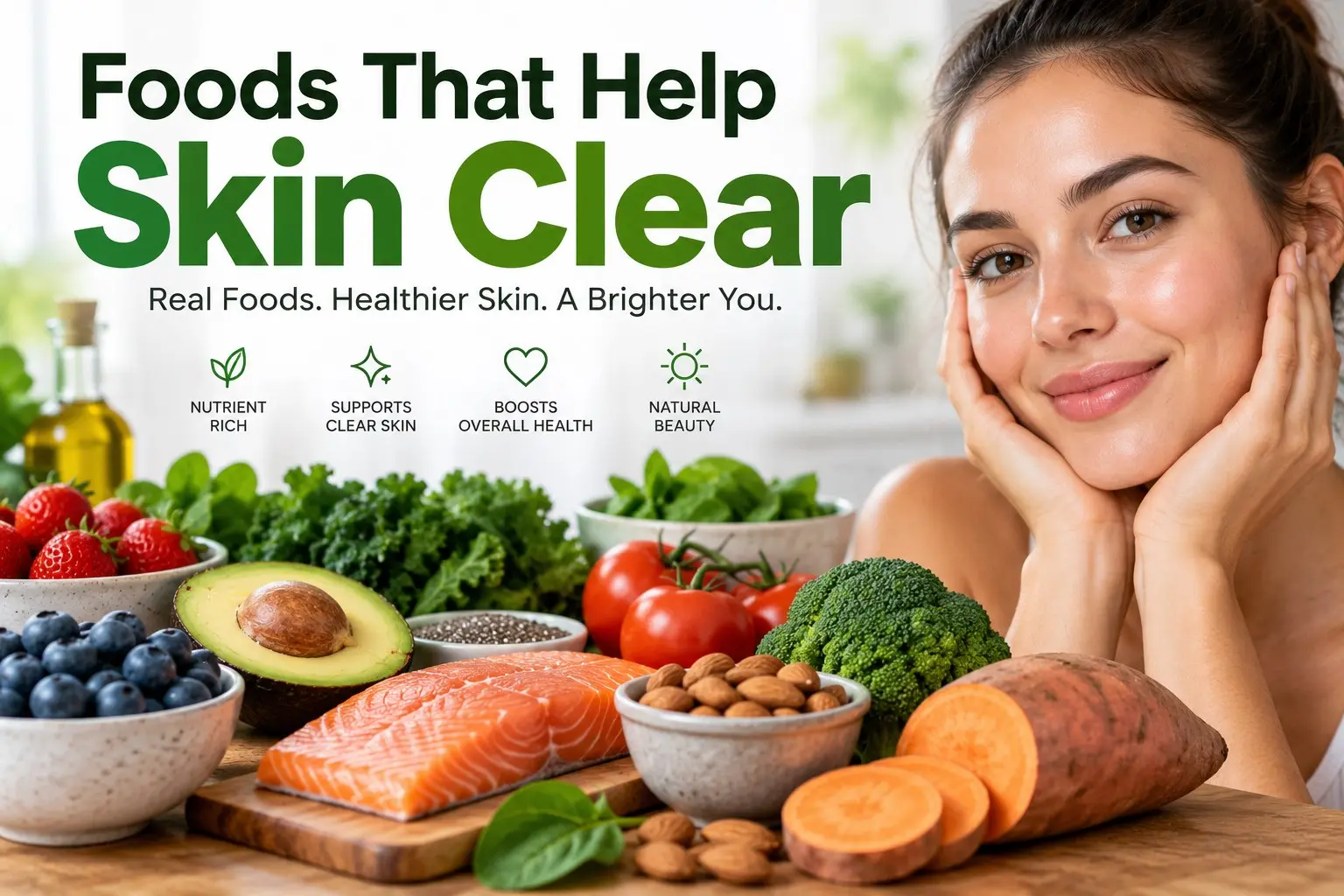
This guide gives you 33 foods that help skin clear by supporting a balanced eating pattern, providing useful nutrients, or replacing foods that may drive blood sugar up quickly.
None is an acne cure.
Quick Answer: What Foods May Support Clearer Skin?
Foods that may support clearer skin include vegetables, beans, lentils, whole grains, berries, citrus fruit, fish, nuts, seeds, avocado, olive oil, eggs, zinc rich seafood, and other minimally processed foods. The best acne evidence supports a lower glycemic eating pattern, while dairy and specific food effects remain less certain.
For the full skin picture, read the NextFitLife Complete Skin Health Guide.
Medical Notice
I am not a dermatologist or A doctor, and this content does not replace professional medical advice. This article explains published guidance and does not provide a personal clinical assessment. Always consult qualified medical professionals for diagnosis and treatment of any health condition.
Food does not replace acne treatment.
Deep acne can scar.
Painful nodules need proper care.
Acne that leaves dark marks or scars also deserves attention.
See a dermatologist if acne is severe, painful, scarring, persistent, or affecting your mental health.
You can also read the NextFitLife Acne Treatment Guide.
Can Diet Really Affect Acne?
Yes, but the answer is not simple.
The American Academy of Dermatology says small studies suggest a low glycemic diet may reduce acne in some people.
A systematic review also found that higher glycemic index and higher glycemic load diets have a modest association with acne and acne severity.
The dairy story is less clear.
Some studies link cow's milk with acne.
The evidence differs by population.
It is mostly observational.
This means it can show an association.
It cannot prove that milk causes acne in every person.
The 2024 Acne Guideline Adds an Important Warning
The American Academy of Dermatology updated its acne treatment guideline in 2024.
It recommends proven treatments such as topical retinoids, benzoyl peroxide, salicylic acid, azelaic acid, antibiotics in selected cases, hormonal therapies, and isotretinoin when appropriate.
For diet, the evidence was still not strong enough to make a formal treatment recommendation.
That does not mean diet has no effect.
It means we should stop calling food an acne cure.
What Does the Newer Mediterranean Diet Research Show?
A 2025 systematic review and meta analysis looked at five case control studies with 765 participants.
Greater adherence to a Mediterranean eating pattern was linked with less severe acne.
But the overall evidence quality was low.
The researchers did not find a statistically clear reduction in the odds of developing acne overall.
Vegetable intake showed the strongest individual association in that analysis.
Useful?
Yes.
Proof that Mediterranean food cures acne?
No.
What Makes a Food Skin Friendly?
I use four simple filters.
First, does it fit a lower glycemic eating pattern?
Second, does it provide nutrients your body needs for normal skin structure and repair?
Third, does it provide protein, useful fats, fibre, or micronutrients without making miracle claims?
Fourth, can you actually eat it as part of normal meals?
That creates a much better clear-skin diet than chasing one superfood.
33 Foods That Help Skin Clear Without Miracle Claims
1. Salmon
Salmon provides protein and the omega-3 fats EPA and DHA.
Those fats are involved in normal inflammatory pathways.
Some acne research has looked at omega-3 intake as an adjunct approach.
That evidence is interesting, but salmon is not an acne medicine.
Think of salmon as one useful part of an overall omega 3 foods pattern.
2. Sardines
Sardines also provide EPA and DHA.
They provide protein too.
Canned sardines are cheap compared with many fresh fish choices.
Choose the type that fits your sodium and calorie needs.
3. Trout
Trout gives you another fatty fish option.
Rotating fish makes meals less repetitive.
It also stops one food from becoming the entire strategy.
4. Oysters
Oysters contain very high amounts of zinc.
Zinc is required for normal protein synthesis, DNA synthesis, immune function, cell division, and wound healing.
That does not mean extra zinc clears acne.
Zinc deficiency and zinc supplementation are different questions.
Do not take high-dose zinc supplements without a reason.
5. Eggs
Eggs provide complete protein and several micronutrients.
Protein supplies amino acids used throughout the body.
Your skin is included in that process.
Eggs do not prevent pimples.
They simply fit a balanced eating pattern.
6. Lentils
Lentils are one of my favourite choices for this list.
They provide protein.
They provide fibre.
They are also useful in meals designed to avoid large blood sugar spikes.
Lentils work in soups, salads, bowls, and curries.
7. Chickpeas
Chickpeas give you protein and fibre.
They can replace refined side dishes in some meals.
That makes them practical for a lower glycemic load eating pattern.
8. Black Beans
Black beans are another simple high-fibre choice.
Use them with vegetables and a whole grain.
Or build a bowl around beans instead of highly refined carbohydrates.
9. Tofu
Tofu provides plant protein.
It also gives people who do not eat fish or meat another useful main meal option.
Soy foods do not need to be sold as hormone balancing skin cures.
They are food.
10. Edamame
Edamame is young soybeans.
It provides protein, fibre, and several micronutrients.
Add it to grain bowls or salads.
Or use it as a simple snack.
11. Steel Cut Oats
The American Academy of Dermatology specifically lists steel cut oats as an example of a lower glycemic food.
That makes oats more relevant to acne than vague “detox” claims.
Use plain oats.
Add fruit, seeds, or nuts.
12. Quinoa
Quinoa can replace highly refined grains in some meals.
It provides protein and fibre.
Combine it with lentils, beans, vegetables, fish, tofu, or chicken.
13. Barley
Barley is rich in fibre.
It works well in soups and grain bowls.
Whole grain choices can help create a lower glycemic meal compared with many refined grain foods.
14. Sweet Potatoes
Sweet potatoes provide beta carotene.
Your body can convert beta carotene into vitamin A as needed.
That does not make sweet potato a natural retinoid treatment.
Dietary beta carotene and prescription acne medicines are not interchangeable.
15. Carrots
Carrots are another beta-carotene source.
They work well raw, roasted, or cooked in meals.
One serving is enough.
You do not need litres of carrot juice for good skin.
16. Red Bell Peppers
Red bell peppers are rich in vitamin C.
Vitamin C is required for collagen synthesis.
That is a normal biological role.
It does not mean peppers remove acne scars or wrinkles.
For more food-based nutrient guidance, visit the Nutrition and Vitamins Hub.
17. Broccoli
Broccoli supplies vitamin C, folate, fibre, and carotenoids.
It is an excellent vegetable.
But I would not repeat the old claim that broccoli “prevents acne.”
There is no good evidence for that promise.
18. Spinach
Spinach provides folate, carotenoids, vitamin C, and other nutrients.
Use it in salads, cooked meals, omelettes, soups, or bowls.
It supports dietary variety.
It does not detox the skin.
19. Kale
Kale is another useful leafy vegetable.
It provides vitamin C and carotenoids.
If you dislike kale, eat another green vegetable.
Your skin will not know the difference between trendy and ordinary produce.
20. Tomatoes
Tomatoes provide vitamin C and lycopene.
Cooked tomato foods can provide concentrated lycopene.
That does not make tomatoes sunscreen.
You still need real sun protection.
See Healthy Skin 101 for the basics.
21. Avocado
Avocado provides mostly unsaturated fat, fibre, vitamin E, and other nutrients.
It fits a Mediterranean style pattern well.
It is nutritious.
It is also calorie-dense.
More avocado is not automatically better for skin.
22. Blueberries
Blueberries provide fibre, vitamin C, and anthocyanin pigments.
They are a practical fruit choice.
You can add them to oats or plain yogurt.
Do not call them an acne detox.
23. Strawberries
Strawberries provide vitamin C and fibre.
They also make a simple replacement for many high sugar desserts.
That substitution may matter more than any one antioxidant in the berry.
24. Oranges
Oranges are a familiar source of vitamin C.
Whole fruit also provides fibre.
Choose the whole fruit more often than juice if you want the fibre too.
25. Kiwi
Kiwi provides vitamin C and fibre.
It is another easy way to add fruit variety.
No special skin smoothie is needed.
26. Walnuts
Walnuts provide alpha linolenic acid, a plant omega 3 fat.
Your body can convert some ALA into EPA and DHA, but the conversion is limited.
Walnuts are still a useful plant food.
A small handful is enough.
27. Almonds
Almonds provide vitamin E, protein, fibre, and unsaturated fat.
They are useful as a snack or topping.
They do not “regulate facial oil” in a proven clinical sense.
That old claim is too strong.
28. Sunflower Seeds
Sunflower seeds are one of the richest common food sources of vitamin E.
They also provide unsaturated fat.
Add a measured portion to salads, oats, or yogurt.
29. Pumpkin Seeds
Pumpkin seeds provide zinc, magnesium, protein, and unsaturated fat.
One ounce contains about 2.2 mg of zinc according to NIH data.
That is useful nutrition.
It is not proof that pumpkin seeds treat acne.
30. Chia Seeds
Chia seeds provide fibre and ALA.
They can be mixed into oats or yogurt.
They absorb water in food.
They do not “hydrate your skin from inside” in the way a moisturizer supports the skin barrier.
31. Ground Flaxseed
Flaxseed provides fibre and ALA.
Ground flax is easier to use than whole seeds in many meals.
Try it in oats or yogurt.
Keep expectations realistic.
32. Extra Virgin Olive Oil
Olive oil fits a Mediterranean-style eating pattern.
It provides mostly monounsaturated fat and plant compounds.
Use it as part of meals.
Do not drink it as a skin treatment.
And remember that oil is calorie-dense.
33. Plain Unsweetened Yogurt
This one needs context.
Some observational studies link cow's milk with acne.
But the American Academy of Dermatology notes that studies have not shown the same association for yogurt or cheese.
So I would not automatically remove plain yogurt from someone's diet because they have acne.
If you personally suspect dairy, track your skin carefully rather than banning an entire food group based on social media advice.
What About Green Tea?
Green tea is a useful unsweetened drink.
It contains plant polyphenols.
It can replace sugary drinks.
That replacement is useful.
But drinking green tea is not an evidence based replacement for acne medication.
Is a Low Glycemic Diet the Best Acne Diet?
It has the strongest diet evidence so far.
A low glycemic diet focuses more on foods that cause smaller rises in blood glucose.
Examples include:
- Beans
- Lentils
- Many vegetables
- Whole fruit
- Steel-cut oats
- Less refined grains
- Fewer sugary drinks
This does not mean carbohydrate is bad.
It means the type and overall pattern matter.
Why Might Glycemic Load Matter for Acne?
Researchers have proposed several pathways.
High glycemic meals can cause larger rises in glucose and insulin.
Those changes can influence insulin-like growth factor 1 and other signals linked with sebum production and follicular activity.
This biological explanation is plausible.
But diet is still only one part of acne.
Hormones matter.
Genetics matter.
Skin products matter.
Medicines matter.
Stress may worsen existing acne too.
Does Sugar Cause Acne?
One cookie does not cause everyone's acne.
The more useful question is your overall pattern.
A diet built around sugary drinks, pastries, refined cereals, and highly refined carbohydrates creates a higher glycemic load.
That pattern has more evidence behind it than blaming one dessert.
Does Milk Cause Acne?
Possibly in some people.
Not everyone.
Observational studies have linked cow's milk with acne.
Skim milk has appeared in several of those studies.
But there are major limits.
People are not randomly assigned to drink milk for years.
Diet habits differ.
Hormones differ.
Age differs.
Other foods differ.
That makes cause and effect difficult to prove.
The most accurate phrase is that dairy and acne may be associated in some populations.
Should You Stop Dairy for Clear Skin?
Not automatically.
If you suspect milk, track the pattern.
Write down:
- What you ate
- How much
- What type of dairy
- When acne changed
- Your menstrual cycle if relevant
- New skin products
- Stress
- Sleep
Do not remove several food groups at once.
You will not know what changed anything.
Does Chocolate Cause Acne?
The evidence is not clean enough to say all chocolate causes acne.
Chocolate foods also vary greatly.
A milk chocolate bar contains sugar and dairy.
Dark chocolate has a different composition.
A chocolate flavoured dessert can contain a large amount of refined carbohydrate.
Do not turn “chocolate” into one scientific exposure.
Does Greasy Food Cause Greasy Skin?
Not directly.
Eating oil does not send cooking grease through your pores.
The old idea that greasy food simply makes skin greasy is too simple.
The full meal pattern matters much more.
Do Antioxidants Clear Acne?
No antioxidant food has been proven to clear acne by itself.
Vegetables, fruit, nuts, and seeds contain many useful compounds.
Eat them because they contribute to a healthy diet.
Do not treat “antioxidant” as another word for acne medicine.
What Nutrients Matter for Normal Skin?
Protein
Your body needs protein for tissue structure and repair.
Fish, eggs, beans, lentils, tofu, yogurt, nuts, and seeds all contribute.
Vitamin C
Vitamin C is needed for collagen synthesis.
Useful vitamin C foods include peppers, citrus fruit, kiwi, strawberries, broccoli, and tomatoes.
Zinc
Zinc supports normal protein and DNA synthesis, cell division, immune function, and wound healing.
Useful zinc-rich foods include oysters, pumpkin seeds, lentils, eggs, and dairy foods.
Essential Fats
Fat is part of normal cell structure.
Fish, walnuts, chia, flax, avocado, nuts, and olive oil provide different types of fats.
Vitamin E
Vitamin E is a fat soluble antioxidant nutrient.
Sunflower seeds and almonds are strong food sources.
Should You Take Zinc for Acne?
Do not jump from “zinc matters” to “more zinc clears acne.”
Those are different statements.
Zinc supplements can cause nausea.
Too much zinc over time can lead to copper deficiency.
It can also interact with some medicines.
Food first is the safer default unless a clinician gives you another plan.
What About Vitamin A Supplements?
Be careful.
Vitamin A is essential.
High dose preformed vitamin A can be toxic.
It is especially dangerous during pregnancy.
Do not try to copy the effects of prescription retinoids by swallowing large amounts of vitamin A.
Read Vitamins for Skin and Hair before assuming a beauty supplement is harmless.
Can Drinking More Water Clear Acne?
No.
Water is essential.
Dehydration is not good for you.
But extra water does not unclog pores.
It does not kill Cutibacterium acnes.
It does not replace retinoids or benzoyl peroxide.
Drink according to your normal needs unless your clinician gives different advice.
Can Food Repair a Damaged Skin Barrier?
Good nutrition supports normal body function.
But your skin barrier also needs direct care.
If your face is dry, tight, burning, or peeling, moisturizer may help more directly than eating extra avocado.
Avoid overcleansing.
Avoid harsh scrubs.
Avoid starting many acids at once.
See the Healthy Skin 101 Guide for a simple routine.
Food Does Not Replace Proven Acne Treatment
This is the biggest point in the whole article.
If acne is mild, an evidence based routine may include options such as:
- Benzoyl peroxide
- A topical retinoid
- Salicylic acid
- Azelaic acid
More persistent acne may require prescription care.
Severe acne can need systemic treatment.
Diet belongs alongside proper treatment.
Not instead of it.
What If You Have Whiteheads Instead of Inflamed Acne?
Food will not mechanically unclog a closed pore.
Whiteheads are closed comedones.
They need skin care that addresses pore blockage.
If that sounds like your problem, read How to Get Rid of Whiteheads.
A Simple One-Day Clear Skin Eating Pattern
Breakfast
Steel-cut oats.
Add blueberries.
Add chia or ground flaxseed.
Add plain yogurt if you eat dairy and tolerate it.
Lunch
Lentil and quinoa bowl.
Add spinach.
Add peppers.
Add tomatoes.
Use a measured amount of olive oil.
Snack
Kiwi with almonds.
Or carrots with hummus.
Dinner
Salmon or tofu.
Add broccoli.
Add a whole grain or beans.
Finish with whole fruit if you want something sweet.
A Plant Based Clear Skin Meal Pattern
You do not need fish to build a good acne diet.
Use:
- Lentils
- Beans
- Tofu
- Edamame
- Whole grains
- Vegetables
- Fruit
- Walnuts
- Chia
- Ground flaxseed
- Pumpkin seeds
The goal is variety.
What Should You Limit?
I would not create a giant forbidden food list.
Instead, look at the pattern.
If most of your diet is based on:
- Sugary drinks
- Pastries
- Refined breakfast cereal
- Candy
- Highly refined breads
- Large portions of refined starch
then replacing some of those foods with beans, vegetables, whole grains, fruit, nuts, seeds, and protein makes sense.
That advice improves the diet even if your acne never changes.
How Long Should You Test a Diet Change?
Do not expect tomorrow's breakfast to change tonight's acne.
Acne lesions develop over time.
Diet studies usually evaluate patterns over weeks.
If you suspect a food pattern, track it consistently.
Change one major variable at a time.
And keep your skin care routine stable enough to know what is happening.
Do Not Become Afraid of Food Because of Acne
This matters.
Acne can make people desperate.
That makes strict elimination diets attractive.
Do not cut gluten, dairy, eggs, nuts, soy, fruit, grains, and oil all at once because somebody online said they cause inflammation.
You can end up with a poor diet and still have acne.
Remove a food only when there is a sensible reason.
Myths About Foods That Help Skin Clear
| Claim | What I Would Say Instead |
|---|---|
| Salmon clears acne | Salmon provides protein and omega-3 fats. It is not an acne treatment. |
| Broccoli prevents pimples | Broccoli is nutritious. It has not been proven to prevent acne. |
| Sunflower seeds control facial oil | They provide vitamin E and useful fats. Direct oil control is not established. |
| Coconut oil clears skin | Eating coconut oil is not an acne treatment. Applying oily products can clog pores in some people. |
| Bone broth rebuilds facial collagen | Bone broth provides amino acids, but it does not directly rebuild wrinkles or acne scars. |
| Dairy causes acne in everyone | Some milk studies show associations. The effect is not universal. |
| Chocolate always causes acne | The evidence is mixed, and chocolate products differ greatly. |
| Water flushes acne toxins | Water supports hydration. Acne is not caused by toxins that can be flushed out. |
How I Evaluate Food and Skin Claims
I have maintained a personal interest in health, fitness, nutrition, wellness, healthy aging, and skin care for more than 30 years.
My health and wellness writing and research communication experience spans more than 15 years.
Before focusing full time on NextFitLife, I spent 29 years working as an IT Manager for the Nestlé Egypt Region.
That background taught me to separate data from assumptions.
For food and acne, I ask:
Is the evidence observational?
Was there a randomized diet trial?
Is the effect about one food or a whole eating pattern?
Does a nutrient support normal skin biology, or has the claim jumped all the way to “clears acne”?
Those are very different statements.
My preference is simple.
Use food to support health.
Use proven acne treatment to treat acne.
Conclusion: Build a Pattern Around Foods That Help Skin Clear
Foods that help skin clear work best as part of a balanced eating pattern, not as individual acne cures.
Start with vegetables, beans, whole grains, fruit, fish or plant protein, nuts, seeds, and unsaturated fats.
If acne is a concern, reducing the overall glycemic load of your diet is a more evidence-based strategy than chasing detox foods.
Your next step is simple: choose three foods from this list that fit your normal meals, keep your acne treatment consistent, and track your skin for several weeks instead of changing everything at once.
References and Sources
- American Academy of Dermatology. Can the Right Diet Get Rid of Acne?Open dermatologist guidance reviewing low glycemic diets, cow's milk, yogurt and cheese, and the limits of dietary acne evidence.Source:
American Academy of Dermatology Diet and Acne Guide - American Academy of Dermatology. Updated Guidelines for the Management of Acne. 2024.The current AAD guideline summary explains evidence based acne treatment and states that evidence was insufficient to make recommendations for dietary changes as acne treatment.Source:
American Academy of Dermatology 2024 Acne Guideline Update - Meixiong J, Ricco C, Vasavda C, Ho BK. Diet and Acne: A Systematic Review. JAAD International. 2022.Open-access systematic review of 34 studies. Higher glycemic index and glycemic load intake showed a modest association with acne, while dairy findings were mixed and varied by population.Source:
PubMed Central Diet and Acne Systematic Review - Taha S, Shakhshir M, Zyoud SH. The Mediterranean Diet and Acne Vulgaris: A Systematic Review and Meta-Analysis. Nutrition and Metabolism. 2025.Open-access review of five case-control studies. Higher Mediterranean diet adherence correlated with less severe acne, but evidence quality was low, and the association with developing acne was not statistically clear.Source:
Nutrition and Metabolism: Mediterranean Diet and Acne Review - National Institutes of Health Office of Dietary Supplements. Zinc Fact Sheet for Health Professionals.Current NIH guidance on zinc function, food sources, wound healing, recommended intake, supplement safety, and the risks of excess zinc.Source:
NIH Zinc Fact Sheet for Health Professionals
Continue Reading on NextFitLife
- Complete Skin Health Guide
- Healthy Skin 101
- Complete Acne Treatment Guide
- How to Get Rid of Whiteheads
- Foods for Healthy Skin
- Vitamins for Skin and Hair
- Nutrition and Vitamins Hub
- Explore NextFitLife Health, Fitness, Nutrition and Beauty Guides
About the Author
Frequently Asked Questions About Foods That Help Skin Clear
What are the best foods that help skin clear?
There is no single best food. A pattern based on vegetables, legumes, whole grains, fruit, fish or plant protein, nuts, seeds, and unsaturated fats is a sensible place to start.
Can food clear acne?
Food alone does not reliably clear acne. Diet may influence acne in some people, but evidence-based skin care and medical treatment remain important.
What diet has the best evidence for acne?
A lower glycemic eating pattern has the most consistent dietary evidence. Studies suggest it may reduce acne in some people, but it is not a guaranteed treatment.
Does sugar cause acne?
One sugary food does not explain every breakout. A high glycemic dietary pattern appears more relevant than one dessert.
Does milk cause acne?
Some observational studies link cow's milk with acne, but the association is not universal and does not prove milk causes acne in every person.
Does yogurt cause acne?
The American Academy of Dermatology notes that studies have not found the same acne association for yogurt and cheese that has been reported with cow's milk.
Does chocolate cause acne?
The evidence is mixed. Chocolate products also contain different amounts of sugar, milk, cocoa, and fat, so they should not all be treated as one exposure.
Is salmon good for acne?
Salmon provides protein and omega-3 fats. It can fit a healthy dietary pattern, but it should not be presented as an acne treatment.
Are omega-3 foods good for skin?
Omega-3 fats are essential nutrients involved in normal physiology. Fish, walnuts, chia, and flax can contribute, but they do not guarantee clear skin.
Are berries good for skin?
Berries provide vitamin C, fibre, and plant compounds. They are nutritious foods but do not directly cure acne.
Is avocado good for skin?
Avocado provides unsaturated fat, fibre, vitamin E, and other nutrients. It can fit a healthy diet but is not an acne treatment.
Are sunflower seeds good for acne?
Sunflower seeds provide vitamin E and unsaturated fat. There is not good evidence that eating sunflower seeds directly clears acne.
Is zinc good for acne?
Zinc is an essential nutrient. Some acne research has studied zinc, but taking extra zinc without a deficiency or medical reason is not automatically helpful and high doses can cause harm.
What food is highest in zinc?
Oysters contain particularly high amounts of zinc. Meat, seafood, pumpkin seeds, lentils, eggs, and dairy foods also contribute.
Does vitamin C help skin?
Vitamin C is required for normal collagen synthesis and acts as an antioxidant. Eating adequate vitamin C supports normal health but does not erase acne scars or wrinkles.
Does drinking water clear acne?
No. Normal hydration supports health, but drinking extra water does not unclog pores or replace acne treatment.
Should I avoid dairy if I have acne?
Not automatically. If you suspect milk affects your skin, track the pattern and discuss a major elimination diet with a suitable healthcare professional.
Should I avoid carbohydrates for acne?
No. The evidence concerns glycemic quality and glycemic load, not the idea that all carbohydrates are bad. Beans, whole grains, vegetables, and fruit can fit well.
Is a Mediterranean diet good for acne?
A 2025 systematic review found that higher Mediterranean diet adherence correlated with less severe acne, but the evidence quality was low and more research is needed.
Can nuts cause acne?
There is no strong evidence that nuts as a group cause acne. Individual allergies and personal responses are separate issues.
Does greasy food cause oily skin?
No. Dietary grease does not simply travel to your pores. Acne is influenced by several biological and environmental factors.
Can probiotics clear acne?
The evidence is not strong enough to say probiotic foods or supplements reliably clear acne. More research is needed.
Should I take vitamin supplements for clear skin?
Most people should focus on a varied diet unless a healthcare professional identifies a deficiency or another reason for supplementation.
How long does a diet change take to affect acne?
Diet studies usually assess patterns over weeks rather than days. Do not expect one meal to create or clear acne overnight.
What foods should I eat for a low glycemic diet?
Useful choices include beans, lentils, many vegetables, whole fruit, steel-cut oats, and less refined grain foods.
Can food replace acne medication?
No. Diet can support health, but moderate, severe, painful, or scarring acne often needs evidence-based topical or prescription treatment.
When should I see a dermatologist for acne?
See a dermatologist for deep, painful, scarring, persistent acne, acne that leaves concerning dark marks, or acne that strongly affects confidence or mental health.
What is the simplest clear skin eating plan?
Build meals around vegetables, legumes, whole grains, fruit, healthy protein, nuts, seeds, and unsaturated fats. Reduce reliance on sugary drinks and highly refined carbohydrates.

Health & wellness writer with 30+ years of experience in nutrition, fitness, and healthy aging. Founder of NextFitLife.com — evidence-based health guidance.