Published: September 11, 2026
Last updated: September 11, 2026
Next editorial review: September 2027 or sooner if major vitamin, nutrition, pregnancy, or supplement guidance changes
Written and source checked by: Adel Galal, Founder and Lead Writer at NextFitLife
Medical review status: This article is educational and source checked. It has not been medically reviewed by a doctor, registered dietitian, pharmacist, endocrinologist, gastroenterologist, or other licensed healthcare professional.
If you want to know how to get all the vitamins you need daily, stop searching for one perfect food.
There is no perfect food.
There are 13 essential vitamins.
Different foods provide different ones.
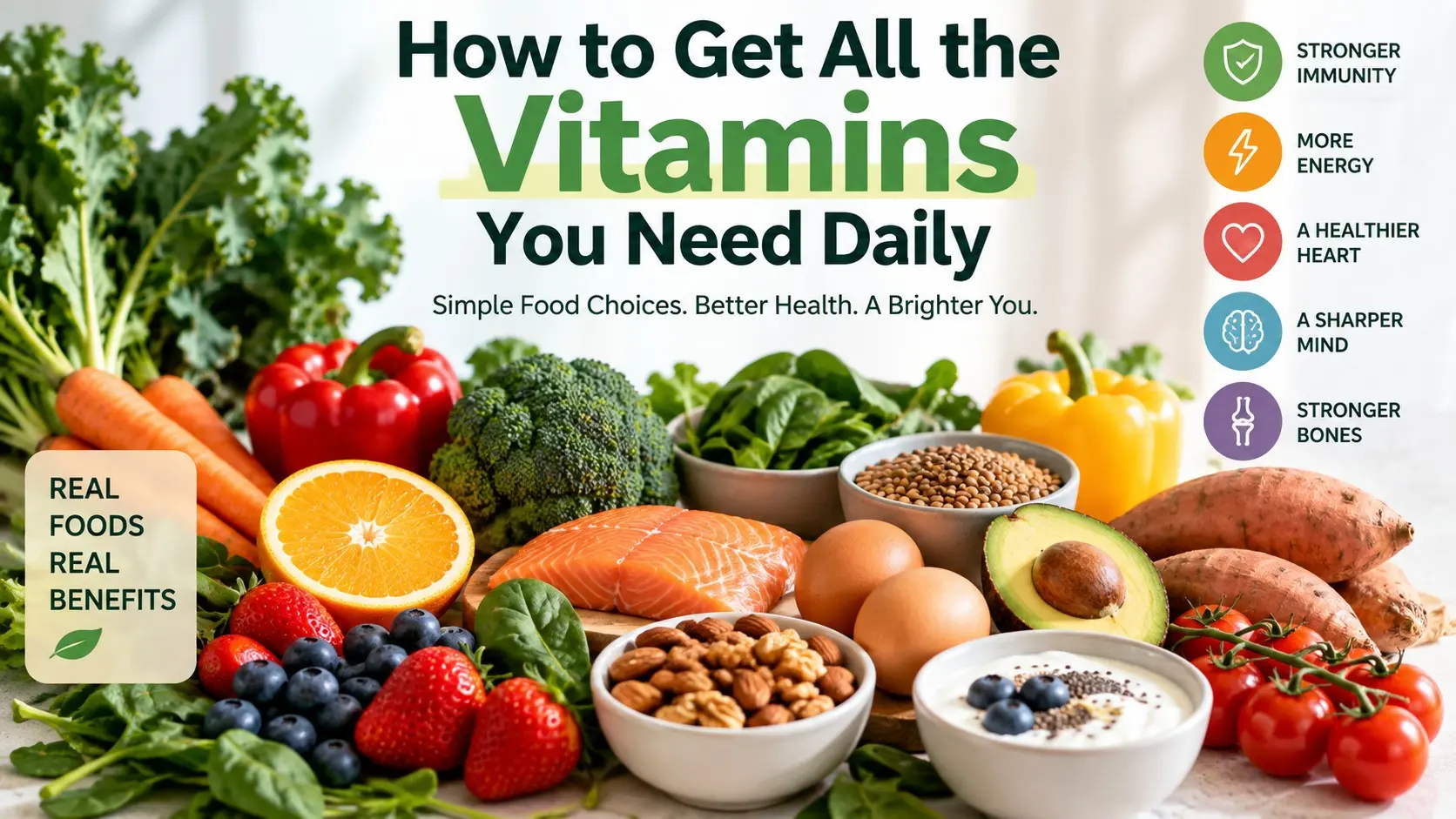
The simplest plan is to eat a varied mix of vegetables, fruit, whole grains, beans, suitable protein foods, nuts, seeds, dairy or fortified alternatives, and healthy fats.
Then pay extra attention to the nutrients your diet may miss.
For many people, those include vitamin D.
Vitamin B12 needs special planning for vegans.
Folic acid has a special role before and during early pregnancy.
Food comes first.
Fortified foods and supplements have a place when they solve a real problem.
Quick Answer: How Do You Get All 13 Vitamins Every Day?
To get all 13 essential vitamins, eat a varied diet built around vegetables, fruit, whole grains, beans, protein foods, nuts, seeds, and suitable dairy or fortified alternatives. Include some dietary fat for vitamins A, D, E, and K. Use fortified foods or supplements when food alone cannot reliably cover a specific need.
The 13 essential vitamins are:
- Vitamin A
- Vitamin C
- Vitamin D
- Vitamin E
- Vitamin K
- Vitamin B1, or thiamin
- Vitamin B2, or riboflavin
- Vitamin B3, or niacin
- Vitamin B5, or pantothenic acid
- Vitamin B6
- Vitamin B7, or biotin
- Vitamin B9, or folate
- Vitamin B12
Minerals such as iron, calcium, magnesium, zinc, iodine, and selenium are important too.
But they are minerals.
They are not part of the 13 vitamins.
For a broader nutrient guide, visit the NextFitLife Nutrition and Vitamins Hub.
Medical and Nutrition Safety Notice
This content is for general educational purposes and does not replace professional medical advice, diagnosis, or treatment. Consult an appropriately qualified healthcare professional for personal medical concerns. This article explains published guidance and does not provide a personal clinical assessment. Always consult qualified medical professionals for diagnosis and treatment of any health condition.
Do not diagnose a vitamin deficiency from fatigue, hair loss, weakness, tingling, pale skin, poor concentration, or another symptom alone.
Many conditions cause the same symptoms.
Blood tests, medical history, medicines, diet, and absorption can all matter.
High-dose supplements can also cause harm.
This is especially important with vitamins A, D, E, B6, and some other nutrients.
Why Food First Is Still the Best Starting Point
A multivitamin is convenient.
It is not a replacement for food.
Food gives you more than isolated vitamins.
It also gives you:
- Protein
- Fibre
- Carbohydrate
- Healthy fats
- Minerals
- Water
- Plant compounds
NIH states that multivitamin and mineral supplements cannot replace eating a varied diet.
WHO updated its healthy diet guidance in January 2026.
Its four basic principles are:
- Adequacy
- Balance
- Moderation
- Diversity
Diversity is the big one for vitamins.
Different foods solve different nutrient problems.
Do You Need to Hit 100 Percent of Every Vitamin Every Day?
No.
Your body is not an app that resets to zero at midnight.
Some vitamins are stored.
Some are used and replaced more quickly.
Your normal eating pattern matters more than making every meal mathematically perfect.
The goal is regular adequacy.
Not daily perfection.
The 13 Essential Vitamins and the Foods That Cover Them
1. Vitamin A Supports Vision and Normal Cell Function
Vitamin A foods come in two broad forms.
Animal foods can provide preformed vitamin A.
Plant foods provide carotenoids that the body can convert into vitamin A.
Useful foods include:
- Sweet potatoes
- Carrots
- Pumpkin
- Spinach
- Kale
- Eggs
- Dairy foods
- Liver
Carrots are useful.
You do not need carrot juice every morning.
Sweet potatoes, leafy greens, eggs, and other foods can contribute across the week.
For foods linked with vision nutrients, see 10 Best Foods for Eye Health.
Be Careful With High-Dose Preformed Vitamin A
More is not better.
NIH sets the adult upper intake level for preformed vitamin A at 3,000 mcg RAE per day.
High doses can damage the liver and cause other toxicity.
High supplemental intake is especially concerning during pregnancy because excess preformed vitamin A can cause birth defects.
This is one reason I would not casually combine several vitamin A products.
2. Vitamin C Is Easy to Get From Plants
Vitamin C foods include:
- Red and green peppers
- Oranges
- Kiwi
- Strawberries
- Broccoli
- Tomatoes
- Brussels sprouts
Vitamin C helps with collagen formation.
It also improves absorption of nonheme iron from plant foods.
A simple habit is to pair beans or lentils with peppers, tomatoes, broccoli, kiwi, or citrus fruit.
See the full NextFitLife Vitamin C Foods Guide.
Vitamin C Does Not Need to Come From Orange Juice
Whole fruit is a better everyday choice for many people.
It gives you fibre too.
Bell peppers and kiwi can provide plenty of vitamin C without juice.
3. Vitamin D Is the Vitamin Most Likely to Need Extra Planning
Vitamin D foods are less common.
Natural sources include:
- Salmon
- Trout
- Tuna
- Mackerel
- Egg yolks
- Some UV exposed mushrooms
Fortified foods matter too.
Many milks are fortified.
Some plant drinks are fortified.
Some cereals and yogurts contain added vitamin D.
Always check the label.
How Much Vitamin D Do Adults Need?
NIH recommends 15 mcg, or 600 IU, daily for adults age 19 through 70.
Adults age 71 and older need 20 mcg, or 800 IU.
This is one nutrient where food alone can be difficult for some people.
For more bone related nutrition guidance, visit the NextFitLife Bone and Joint Health Hub.
Do Not Use a Fixed Sunlight Rule
The old advice to “get 20 or 30 minutes of sun every day” is too simplistic.
Vitamin D production from sunlight changes with:
- Skin tone
- Age
- Season
- Latitude
- Time outdoors
- Clothing
- Cloud cover
- Air pollution
UV radiation also raises skin cancer risk.
So I would not prescribe a universal amount of unprotected sunlight as a vitamin strategy.
If vitamin D deficiency is a concern, discuss testing and supplementation with a healthcare professional.
4. Vitamin E Is Easy to Get From Nuts and Seeds
Vitamin E rich foods include:
- Sunflower seeds
- Almonds
- Hazelnuts
- Peanuts
- Peanut butter
- Sunflower oil
- Safflower oil
- Spinach
One ounce of sunflower seeds provides about half the U.S. Daily Value.
Almonds are close behind.
See the full Vitamin E Rich Foods Guide.
Vitamin E Supplements Are Not the Same as Vitamin E Foods
Food based vitamin E is safe for most people.
High dose supplements are another issue.
Large supplemental doses can increase bleeding risk.
They can also interact with anticoagulant or antiplatelet medicines.
Food first makes sense here.
5. Vitamin K Loves Leafy Greens
Vitamin K foods include:
- Kale
- Spinach
- Collard greens
- Broccoli
- Brussels sprouts
- Other leafy vegetables
Vitamin K is needed for normal blood clotting.
It also has roles in bone related proteins.
Warfarin Changes the Vitamin K Conversation
If you take warfarin, do not suddenly remove all leafy greens.
The goal is usually consistency.
Large sudden changes in vitamin K intake can change the effect of warfarin.
Discuss major diet changes with the clinician managing your anticoagulation.
6. Vitamin B1 Comes From Grains, Pork, Beans, and Seeds
Vitamin B1 is also called thiamin.
Useful sources include:
- Whole grains
- Fortified cereals
- Pork
- Fish
- Beans
- Seeds
- Nuts
Thiamin helps the body use food for normal energy metabolism.
That does not mean extra thiamin gives a person with adequate intake an energy boost.
A vitamin supports normal metabolism.
It is not caffeine.
7. Vitamin B2 Is Easy to Find in Dairy, Eggs, and Fortified Foods
Vitamin B2 is called riboflavin.
Sources include:
- Milk
- Yogurt
- Eggs
- Lean meat
- Almonds
- Mushrooms
- Fortified cereals
If you avoid dairy, look at the labels on fortified alternatives.
Not every plant drink has the same nutrient profile.
8. Vitamin B3 Comes From Protein Foods and Enriched Grains
Vitamin B3 is called niacin.
Sources include:
- Chicken
- Turkey
- Tuna
- Salmon
- Beef
- Peanuts
- Whole grains
- Enriched grain products
Your body can also make some niacin from the amino acid tryptophan.
A varied diet makes deficiency uncommon in many settings.
9. Vitamin B5 Is Spread Across Many Foods
Vitamin B5 is pantothenic acid.
It appears in many foods.
Sources include:
- Chicken
- Beef
- Eggs
- Mushrooms
- Avocado
- Potatoes
- Whole grains
- Fortified cereals
Because it is widely distributed in foods, true deficiency is rare.
10. Vitamin B6 Comes From Poultry, Fish, Potatoes, and Chickpeas
Vitamin B6 foods include:
- Chicken
- Turkey
- Salmon
- Tuna
- Chickpeas
- Potatoes
- Bananas
- Fortified cereals
B6 participates in many enzyme reactions.
You need it.
You do not need a megadose.
High Dose B6 Can Damage Nerves
This is worth knowing because B6 appears in many “energy” products.
NIH warns that prolonged high supplemental intake can cause serious nerve damage.
If you use a multivitamin plus an energy supplement plus a B complex, read all three labels.
Duplicate ingredients add up.
11. Biotin Is Found in Eggs, Fish, Nuts, Seeds, and Sweet Potato
Vitamin B7 is better known as biotin.
Sources include:
- Eggs
- Salmon
- Meat
- Sunflower seeds
- Almonds
- Sweet potatoes
Biotin deficiency is rare.
High-dose biotin is heavily marketed for hair and nails.
Do not assume a high-dose supplement is needed because your hair feels thin.
Hair loss has many possible causes.
12. Folate Comes From Greens, Beans, Citrus, and Fortified Grains
Vitamin B9 is folate.
Useful foods include:
- Spinach
- Asparagus
- Brussels sprouts
- Beans
- Lentils
- Avocado
- Oranges
- Enriched grain products
Folate is important for DNA formation and cell division.
Folate and Folic Acid Are Not the Same Term
Folate is the general name for vitamin B9 forms.
Folic acid is the form used in many supplements and fortified foods.
This difference matters most around pregnancy.
People Who Could Become Pregnant Need 400 mcg of Folic Acid Daily
CDC guidance updated in July 2026 recommends that all women capable of becoming pregnant get 400 mcg of folic acid each day.
This helps prevent serious neural tube defects.
The recommendation applies even before pregnancy is known because the neural tube develops very early.
Folic acid can come from fortified foods, supplements, or both.
Folate-rich foods still belong in the diet.
But food folate alone is not the same as meeting the specific folic acid recommendation.
13. Vitamin B12 Needs Special Planning on Vegan Diets
Vitamin B12 is different from most vitamins on this list.
Natural food sources are mainly animal foods.
These include:
- Clams
- Fish
- Meat
- Eggs
- Milk
- Yogurt
- Cheese
Plants do not naturally provide reliable B12.
Vegan diets therefore need dependable fortified foods, a supplement, or both.
See the full NextFitLife B12 Rich Foods Guide.
Vitamin B12 Is About Absorption Too
A person can eat B12 and still have trouble absorbing it.
Risk can rise with age.
Some digestive conditions matter.
Some medicines can matter.
People who have had certain stomach or intestinal surgery may also need special attention.
If there are nerve symptoms, anemia, or a suspected deficiency, do not rely on food advice alone.
What Is the Easiest Daily Food Pattern for All 13 Vitamins?
You do not need 13 different meals.
You need food groups that overlap.
| Food Group | Useful Vitamin Coverage | Easy Choices |
|---|---|---|
| Dark green vegetables | A, C, K, folate | Spinach, kale, broccoli |
| Orange and red vegetables | A, C | Carrots, peppers, sweet potato |
| Fruit | C, folate, smaller amounts of other vitamins | Kiwi, oranges, berries, mango |
| Whole or enriched grains | B1, B2, B3, folate | Oats, whole wheat bread, fortified cereal |
| Beans and lentils | Folate, B1, B6 | Lentils, chickpeas, black beans |
| Nuts and seeds | E, B1, B6, biotin | Almonds, sunflower seeds, peanuts |
| Eggs and dairy | A, B2, B12, biotin, some D | Eggs, milk, plain yogurt |
| Fish and seafood | D, B12, B3, B6 | Salmon, trout, tuna |
| Fortified foods | Depends on product | Fortified milk, plant drinks, cereal |
This is why variety works.
No single food has to provide everything.
What Does a Vitamin Rich Breakfast Look Like?
Try:
Plain yogurt or fortified soy yogurt.
Add oats.
Add berries or kiwi.
Add almonds or sunflower seeds.
This can contribute several B vitamins, vitamin C, vitamin E, and B12 when the dairy or fortified product contains it.
What Does a Vitamin-Rich Lunch Look Like?
Build a bowl.
Use leafy greens.
Add beans or lentils.
Add peppers or tomatoes.
Add whole grains.
Add eggs, chicken, fish, tofu, or another protein food.
Use a normal amount of unsaturated fat.
Now the meal covers several vitamins without a special powder.
What Does a Vitamin Rich Dinner Look Like?
Start with salmon, chicken, eggs, tofu, or beans.
Add broccoli or another vegetable.
Add carrots or sweet potato.
Add rice, potatoes, or a whole grain.
Use some healthy fat.
This is ordinary food.
That is the point.
Do You Need Fat to Absorb Some Vitamins?
Yes.
Vitamins A, D, E, and K are fat soluble vitamins.
Dietary fat helps absorb them.
You do not need a high-fat diet.
You just need some appropriate fat in your eating pattern.
Examples include:
- Nuts
- Seeds
- Avocado
- Olive oil
- Other suitable plant oils
- Fish
- Eggs
What About the Water Soluble Vitamins?
Vitamin C and the B vitamins are called water soluble vitamins.
The body handles them differently from fat soluble vitamins.
Many are not stored in large amounts.
B12 is a notable exception because the body can store substantial amounts.
Water-soluble does not mean unlimited supplements are harmless.
B6 is a clear example.
Too much from supplements can damage nerves.
Can Cooking Destroy Vitamins?
Some vitamins are more sensitive to heat, light, water, and storage than others.
Vitamin C and folate can be lost during prolonged cooking.
But cooking is not bad.
Cooked vegetables still provide useful nutrition.
Some plant compounds even become easier to use after cooking.
I would not build a diet around fear of heat.
Mix raw and cooked foods.
Are Frozen Vegetables and Fruit Still Good?
Yes.
Frozen produce can be very useful.
WHO includes fresh, frozen, and suitable canned produce in a healthy eating pattern.
Frozen vegetables are convenient.
Frozen berries last longer.
They can reduce waste.
Fresh does not automatically mean more nutritious in every situation.
Do Canned Foods Count?
Yes.
Canned beans count.
Canned tomatoes count.
Canned fish counts.
Choose products with less added sodium or sugar when practical.
Rinsing canned beans can remove some surface sodium.
Should You Buy Fortified Foods?
Fortification can be useful.
Sometimes it is especially useful.
Examples include:
- Vitamin D fortified milk
- Fortified soy milk
- Vitamin B12 fortified plant drinks
- Fortified breakfast cereals
- Enriched grains containing folic acid
Read the label.
Two products that look almost identical can have very different vitamin levels.
Does Every Plant Milk Have the Same Vitamins?
No.
This matters.
Some are fortified with vitamin D, vitamin A, B12, and calcium.
Others are not.
USDA treats fortified soy milk and yogurt as nutritionally comparable enough to dairy to fit its dairy food group.
Other plant drinks vary much more.
Turn the carton around.
Read the Nutrition Facts panel.
Can One Food Give You All 13 Vitamins?
No ordinary single food reliably solves the entire problem.
That is why the old search for one “complete vitamin food” is the wrong goal.
Eggs contain several vitamins.
Salmon contains several.
Leafy greens contain several.
Fortified cereal can contain many.
None should be your whole diet.
Do You Need a Multivitamin Every Day?
Not automatically.
Supplement needs should be assessed individually.
A multivitamin is not mandatory insurance for every healthy adult.
NIH says multivitamin products vary widely.
They do not replace food.
Some contain around the Daily Value for many nutrients.
Others contain much larger amounts.
Some leave out nutrients you might expect.
Some add herbs or other compounds.
When Can Supplements Make Sense?
Examples include:
- A confirmed deficiency
- Pregnancy related nutrient needs
- Reliable B12 intake on a vegan diet
- Vitamin D when diet and other sources are inadequate
- Reduced nutrient absorption
- Restricted diets
- A healthcare professional identifying a specific need
The supplement should solve a defined problem.
It should not replace vegetables because taking a tablet feels easier.
More Vitamins Do Not Mean More Energy
This claim causes a lot of confusion.
B vitamins help the body use nutrients in normal metabolism.
That does not mean taking extra B vitamins makes a person with adequate status more energetic.
If a deficiency is causing fatigue, correcting it can help.
If your vitamin status is already normal, a megadose is not a stimulant.
More Vitamins Do Not Automatically Boost Immunity
Your immune system needs adequate nutrition.
That is true.
But “immune support” has become a marketing phrase.
Vitamin C does not create a force field.
Vitamin D does not make you infection-proof.
Vitamin A is not better at ten times the requirement.
Adequate intake matters.
Excess is not the goal.
Do Supplements Prevent Chronic Disease?
Do not assume they do.
Some supplements are useful for specific deficiencies and life stages.
That is different from using high dose vitamins to prevent every chronic disease.
For healthy people without a defined need, evidence does not support treating a multivitamin as a substitute for a healthy eating pattern.
How Do Vegans Get All 13 Vitamins?
A vegan diet can provide most vitamins from food.
But vitamin B12 requires a reliable plan.
Use:
- B12-fortified plant milk
- B12-fortified cereal
- B12-fortified nutritional yeast
- A B12 supplement when needed
Vitamin D can also need extra attention.
Check fortified foods.
Do not assume every plant product is fortified.
How Do Vegetarians Get All Their Vitamins?
Vegetarians who eat eggs and dairy have more B12 options.
Useful foods include:
- Eggs
- Milk
- Yogurt
- Cheese
- Fortified foods
- Beans
- Lentils
- Nuts
- Seeds
- Whole grains
- Vegetables
- Fruit
Again, vitamin D deserves attention.
What About Adults Over 50?
Age changes nutrient absorption and vitamin D production.
Vitamin B12 deserves special attention because stomach acid and absorption can change with age.
Vitamin D needs also rise after age 70 under U.S. recommendations.
Older adults with low appetite, weight loss, digestive conditions, or several medicines may benefit from a diet review with a healthcare professional or registered dietitian.
What About Pregnancy?
Pregnancy is not the time to improvise with vitamin bottles.
Folic acid matters before conception.
Iron, iodine, vitamin D, B12, choline, and other nutrients can also need attention.
Prenatal products vary.
Do not stack several supplements without checking the totals.
High-dose preformed vitamin A deserves particular caution.
What About People With Digestive Conditions?
Food intake is only half of nutrition.
You also need to absorb the nutrients.
Conditions such as:
- Celiac disease
- Crohn's disease
- Some forms of inflammatory bowel disease
- Pancreatic disease
- Bile-related disorders
- Previous bariatric surgery
can change nutrient absorption.
If absorption is the problem, telling someone to “eat more spinach” may not fix it.
What Medicines Can Affect Vitamin Status?
Several medicines can change absorption or metabolism of nutrients.
Examples vary by medicine and vitamin.
Vitamin B12 can be relevant with some long term medicines.
Vitamin K is especially important with warfarin.
Vitamin D supplements can interact with some medicines.
Do not stop prescribed medicine because of an online vitamin list.
Ask your pharmacist or clinician to review the combination.
Can You Tell a Vitamin Deficiency From Symptoms?
Usually not with confidence.
Fatigue can come from many causes.
Tingling can have many causes.
Hair loss can have many causes.
Weakness can have many causes.
Low mood can have many causes.
Vitamin deficiency is one possibility.
It is not the only possibility.
Possible Signs That Deserve Medical Review
Talk with a healthcare professional if you have persistent or unexplained:
- Fatigue
- Weakness
- Shortness of breath
- Pale skin
- Numbness
- Tingling
- Balance problems
- Unplanned weight loss
- Poor appetite
- Vision changes
- Repeated mouth or tongue problems
These symptoms are not proof of a vitamin deficiency.
Should You Ask for Every Vitamin Blood Test?
No.
Testing should match the problem.
Vitamin D and B12 are commonly tested when there is a clinical reason.
Other nutrients are assessed differently.
Your clinician can decide which tests make sense based on symptoms, diet, medicines, age, and medical history.
The Biggest Mistake Is Taking Several Supplements at Once
People look at products one bottle at a time.
The body sees the total.
Your multivitamin may contain B6.
Your energy supplement may contain B6.
Your magnesium product may add B6.
Your hair supplement may contain more B vitamins.
Now the total is much higher than you expected.
Read every label.
Do Gummy Vitamins Count?
They count as supplements.
But formulas vary.
Some gummies contain sugar.
Some leave out certain nutrients.
Some require several gummies for one serving.
Keep them away from children.
They are not candy.
Is 100 Percent Daily Value Always the Perfect Supplement Amount?
No.
The Daily Value is a labeling reference.
Your personal requirement changes with age, sex, pregnancy, breastfeeding, health, and other factors.
Some vitamins do not need to appear at 100% in a supplement.
Some people need more of a specific nutrient because of a medical reason.
Others need none.
How to Build a Weekly Vitamin Shopping List
| Category | Foods to Buy |
|---|---|
| Leafy greens | Spinach, kale, broccoli |
| Orange vegetables | Carrots, sweet potatoes, squash |
| Vitamin C produce | Peppers, kiwi, berries, oranges |
| Whole grains | Oats, whole grain bread, brown rice |
| Legumes | Lentils, chickpeas, beans |
| Nuts and seeds | Almonds, sunflower seeds, peanuts |
| Protein foods | Eggs, fish, chicken, tofu, beans |
| Dairy or fortified alternative | Milk, yogurt, fortified soy milk |
| Vitamin D foods | Salmon, trout, fortified milk or plant drinks |
| B12 foods | Fish, eggs, dairy, meat, fortified vegan foods |
For more practical food choices, see Top 20 Healthy Foods.
A Simple One Day Vitamin Rich Meal Plan
Breakfast
Oatmeal made with milk or fortified soy milk.
Add berries.
Add almonds or sunflower seeds.
Serve with an egg if suitable.
Lunch
Lentil or chickpea bowl.
Add spinach.
Add red pepper.
Add tomato.
Add whole grains.
Use a small amount of olive oil or another suitable fat.
Snack
Plain yogurt with kiwi.
Or fortified soy yogurt if you avoid dairy.
Dinner
Salmon or tofu.
Add broccoli.
Add roasted sweet potato.
Add another vegetable.
Water can be your main drink.
Does This Meal Plan Guarantee Every Person Meets Every Requirement?
No.
And I would not claim that.
Portions matter.
Brands differ.
Fortification differs.
Age and health matter.
The meal plan shows the pattern.
It is not a medical prescription.
13 Easy Wins for Better Vitamin Coverage
- Eat a dark green vegetable most days.
- Add an orange or red vegetable regularly.
- Eat whole fruit rather than relying on juice.
- Use whole or enriched grains.
- Eat beans or lentils regularly.
- Include nuts or seeds in sensible portions.
- Use a varied protein routine.
- Include vitamin D foods or fortified foods.
- Check B12 carefully if you eat vegan.
- Include some dietary fat for A, D, E, and K.
- Read fortified food labels.
- Use supplements for a reason, not from fear.
- Review special needs during pregnancy, aging, illness, or restricted diets.
Common Vitamin Mistakes
Thinking a Multivitamin Fixes a Poor Diet
It does not.
Taking More Because the Vitamin Is Water Soluble
Water-soluble does not mean risk-free.
Using High-Dose Vitamin D Without Testing or Guidance
Vitamin D toxicity can cause dangerously high calcium levels and kidney problems.
Avoiding Leafy Greens Because You Take Warfarin
Consistency is usually more important than complete avoidance.
Assuming Fatigue Means B12 or Iron Deficiency
Fatigue has many causes.
Using Biotin for Every Hair Problem
Hair loss needs a cause, not just a supplement.
Relying on One “Superfood”
No single food covers the full vitamin picture.
How I Evaluate Daily Vitamin Advice
I have maintained a personal interest in health, fitness, nutrition, food choices, sleep, wellness, and healthy aging for more than 30 years.
My health and wellness writing and research communication experience spans more than 15 years.
Before focusing full time on NextFitLife, I spent 29 years working as an IT Manager for the Nestlé Egypt Region.
That work developed skills in data analysis, structured review, information management, research organisation, systems thinking, and problem solving.
These are research and communication skills.
They are not medical or dietetic qualifications.
When I review vitamin advice, I ask five questions.
Is the person getting enough from food?
Is the nutrient actually difficult to obtain on this diet?
Is absorption a problem?
Does the person have a life stage or medical reason for a supplement?
Could the supplement itself cause harm?
This keeps the goal simple.
Meet needs.
Do not chase megadoses.
Conclusion: How to Get All the Vitamins You Need Daily
How to get all the vitamins you need daily is not solved by one pill or one perfect food.
Build variety.
Eat colorful vegetables and fruit.
Use whole grains.
Include beans, protein foods, nuts, and seeds.
Use dairy or suitable fortified alternatives.
Pay special attention to vitamin D, B12, and folic acid when they apply to you.
Your next step is simple: look at tomorrow's meals and check whether they include vegetables, fruit, a protein food, a grain or starchy food, and one reliable source of the vitamin your diet is most likely to miss.
References and Sources
- National Institutes of Health Office of Dietary Supplements. Vitamin and Mineral Fact Sheets.Open U.S. government reference hub covering recommended intakes, food sources, deficiencies, upper limits, supplement safety, and interactions for vitamins A, B vitamins, C, D, E, and K.Source:
NIH Office of Dietary Supplements Vitamin and Mineral Fact Sheets - World Health Organization. Healthy Diet. Updated January 26, 2026.Current WHO guidance describing adequacy, balance, moderation, and diversity as the four core principles of a healthy diet and recommending a wide variety of minimally processed foods.Source:
World Health Organization Healthy Diet Fact Sheet - National Institutes of Health Office of Dietary Supplements. Vitamin D Fact Sheet for Consumers.Open NIH guidance on vitamin D requirements, food sources, fortified foods, sunlight, testing, deficiency, supplement safety, and the risks of excessive intake.Source:
NIH Vitamin D Consumer Fact Sheet - National Institutes of Health Office of Dietary Supplements. Vitamin B12 Fact Sheet for Consumers.Open NIH guidance covering vitamin B12 requirements, animal and fortified food sources, vegan diets, absorption, deficiency risk, testing, and supplements.Source:
NIH Vitamin B12 Consumer Fact Sheet - Centers for Disease Control and Prevention. About Folic Acid. Updated July 15, 2026.Current CDC guidance states that all women capable of becoming pregnant should get 400 mcg of folic acid daily to help prevent neural tube defects.Source:
CDC Folic Acid Guidance
Continue Reading on NextFitLife
- Nutrition and Vitamins Hub
- Top 20 Healthy Foods
- Vitamin C Foods Guide
- Vitamin E Rich Foods Guide
- B12 Rich Foods Guide
- Bone and Joint Health Nutrition Hub
- Foods for Eye Health
- Healthy Fitness Foods
- Explore NextFitLife Health Fitness Nutrition and Beauty Guides
About the Author
Frequently Asked Questions About Getting All Your Vitamins Daily
How can I get all the vitamins I need every day?
Eat a varied pattern containing vegetables, fruit, whole grains, beans, protein foods, nuts, seeds, and suitable dairy or fortified alternatives. Pay extra attention to vitamin D, B12, and folic acid when relevant.
How many essential vitamins are there?
There are 13 essential vitamins: A, C, D, E, K, thiamin, riboflavin, niacin, pantothenic acid, B6, biotin, folate, and B12.
Is there one food that contains all 13 vitamins?
No single ordinary food reliably provides all 13 vitamins in the amounts you need. Variety across food groups is a better strategy.
Do I need a multivitamin every day?
No. A multivitamin is not automatically necessary for every healthy adult. Supplements can be useful for a defined nutrient need, restricted diet, pregnancy, absorption issue, or diagnosed deficiency.
Are vitamins better from food or supplements?
Food should be the foundation for most people because it provides vitamins alongside minerals, protein, fibre, fats, carbohydrates, and other food components. Supplements are useful when a specific need cannot be covered reliably through food.
Which vitamin is hardest to get from food?
Vitamin D can be difficult to obtain in adequate amounts from natural foods alone because relatively few foods naturally contain much vitamin D.
Can vegans get all 13 vitamins?
Yes, but vitamin B12 needs a reliable fortified food or supplement source because unfortified plant foods do not naturally provide dependable vitamin B12.
Do vegetarians need vitamin B12 supplements?
Some do and some do not. Vegetarians who eat enough dairy, eggs, or fortified foods may obtain B12 from diet, but intake and absorption should be considered individually.
How much vitamin D do adults need?
NIH recommends 15 mcg or 600 IU daily for adults age 19 through 70 and 20 mcg or 800 IU daily for adults age 71 and older.
Can I get vitamin D just from sunlight?
Sunlight can contribute to vitamin D production, but the amount varies greatly with skin tone, age, location, season, clothing, and other factors. There is no universal safe sunlight duration that guarantees enough vitamin D.
Do I need dietary fat to absorb vitamins?
Dietary fat helps the body absorb the fat soluble vitamins A, D, E, and K. You do not need a high fat diet, but some suitable fat in meals is useful.
Which vitamins are fat soluble?
Vitamins A, D, E, and K are fat soluble.
Which vitamins are water soluble?
Vitamin C and the eight B vitamins are water soluble, although vitamin B12 can be stored by the body for long periods.
Can too many vitamins be harmful?
Yes. Excessive supplemental intake of some vitamins can cause toxicity, nerve injury, bleeding problems, liver problems, high calcium, medication interactions, or other harm.
Can vitamin B6 cause nerve damage?
High supplemental intake of vitamin B6 over time can cause serious nerve damage. Normal food intake is not usually the problem.
Can too much vitamin D be harmful?
Yes. Excess vitamin D from supplements can cause very high blood calcium and lead to nausea, weakness, kidney stones, kidney damage, abnormal heart rhythms, and other problems.
Why does vitamin K matter if I take warfarin?
Vitamin K affects blood clotting and can change warfarin's effect. People taking warfarin are usually advised to keep vitamin K intake reasonably consistent rather than suddenly eliminating vitamin K foods.
How much folic acid should someone who could become pregnant take?
CDC recommends 400 mcg of folic acid each day for all women capable of becoming pregnant to help prevent neural tube defects.
Is folate the same as folic acid?
Folate is the general term for vitamin B9 compounds. Folic acid is one form used in supplements and fortified foods.
Can vitamin deficiencies cause fatigue?
Some deficiencies can cause fatigue, but fatigue has many other causes. Symptoms alone cannot tell you which vitamin is low.
Should I get vitamin blood tests every year?
Not everyone needs routine testing for every vitamin. Testing should be based on symptoms, diet, medical history, medicines, risk factors, and clinical judgment.
Are frozen vegetables as healthy as fresh vegetables?
Frozen vegetables can be nutritious and useful. Fresh, frozen, and suitable canned produce can all fit a healthy diet.
Do fortified foods count as vitamin sources?
Yes. Fortified foods are especially useful for nutrients such as vitamin D and B12 and for folic acid in enriched grain products.
Does every plant milk contain vitamin D and B12?
No. Fortification varies by brand and product. Always check the Nutrition Facts label.
Are gummy vitamins as good as tablets?
It depends on the formula. Gummies can contain vitamins, but nutrient amounts vary and some leave out certain nutrients. Read the label and keep them away from children.
Can vitamins give me more energy?
Vitamins support normal energy metabolism, but extra vitamins do not act like stimulants when your nutrient status is already adequate. Correcting a real deficiency can improve deficiency related fatigue.
Can taking vitamins boost my immune system?
Adequate vitamin intake supports normal immune function. Taking excessive amounts does not make the immune system infinitely stronger.
What is the easiest way to improve vitamin intake today?
Add one dark green vegetable, one colorful fruit or vegetable, a varied protein food, a whole grain or legume, and a nut or seed source to your normal eating pattern.

Health & wellness writer with 30+ years of experience in nutrition, fitness, and healthy aging. Founder of NextFitLife.com — evidence-based health guidance.