Home
Published:
Nov 25, 2025
Last Updated:
August 18, 2026
Next Review:
August 2027, or sooner if major lice treatment guidance changes
Written and source checked by:
Adel Galal
,
Founder and Lead Writer of NextFitLife
Medical Review Status:
This article has not been formally reviewed by a dermatologist, pediatrician, infectious disease specialist, pharmacist, or another licensed healthcare professional.
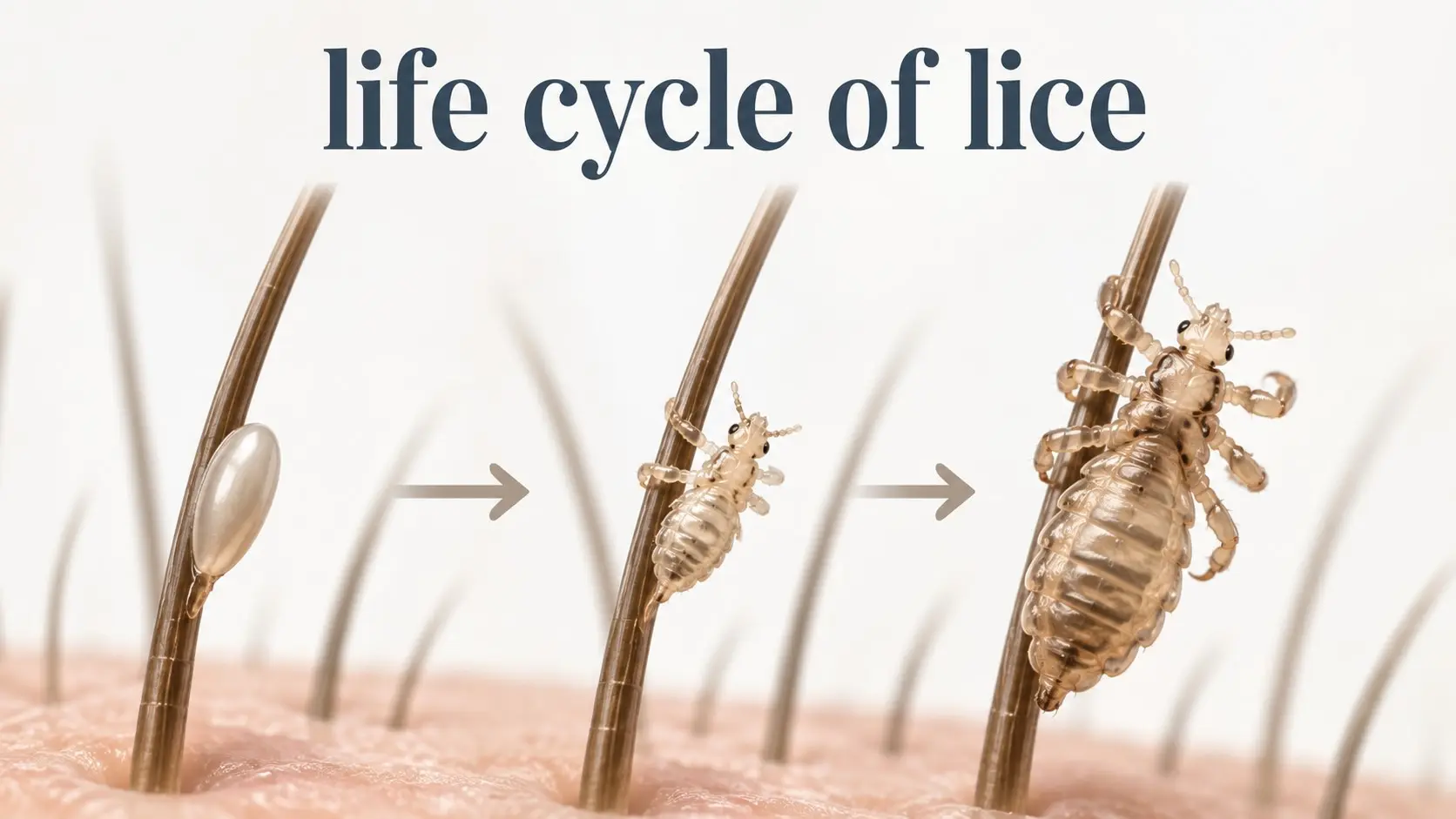
The egg hatches.
A young louse comes out.
That young louse grows into an adult.
The adult female lays new eggs.
Then the cycle starts again.
This explains why one lice treatment may not always end an infestation.
Some medicines kill live lice but do not kill every egg.
Those eggs may hatch several days later.
The newly hatched lice then need to be stopped before they become adults and lay more eggs.
But this does not mean every lice medicine should automatically be repeated on the same day.
The right lice treatment timing depends on the product.
In this guide, you will learn the three stages of the head lice life cycle, how fast lice grow, how they spread, how long they survive away from the scalp, and why treatment timing changes from one medicine to another.
Quick Answer: What Is the Life Cycle of Lice?
The life cycle of lice has three stages:
- Egg or nit
- Nymph
- Adult louse
Head lice eggs usually hatch in about 6 to 9 days.
A newly hatched lice nymph takes about another 7 days to become an adult.
An adult head louse can live for up to about 30 days on a person's head.
An adult female can lay about six eggs each day.
This means a new generation can develop quickly if an active infestation is not treated.
Medical note:
This content is for general educational purposes and does not replace professional medical advice, diagnosis, or treatment. Consult an appropriately qualified healthcare professional for personal medical concerns. This article explains published guidance and does not provide a personal clinical assessment. Always consult qualified medical professionals for diagnosis and treatment of any health condition.
Life Cycle of Lice at a Glance
- Head lice have three stages: egg, nymph, and adult.
- Eggs are called nits.
- Nits are attached firmly to individual hairs.
- Viable eggs are usually found close to the scalp.
- Eggs usually hatch in 6 to 9 days.
- Nymphs become adults about 7 days after hatching.
- Adults are about the size of a sesame seed.
- Adult lice can live for up to about 30 days on the scalp.
- Adult females can lay about six eggs each day.
- Adult lice usually die within 1 to 2 days away from a person.
- Lice crawl.
- They do not jump or fly.
- Direct head-to-head contact is the fundamental way head lice spread.
- Treatment timing depends on whether the medicine kills eggs.
Full Head Lice Life Cycle Timeline
| Stage | Typical Timing | What Happens |
|---|---|---|
| Egg or Nit | About 6 to 9 days | The egg stays attached to hair and then hatches |
| Nymph | About 7 days | The young louse grows through three molts |
| Adult | Up to about 30 days on the scalp | The adult feeds and females lay new eggs |
| Adult Away From Head | Usually 1 to 2 days | The louse dies without access to blood |
From a newly laid egg to a mature adult takes roughly two weeks.
The adult can then continue living on the scalp for several more weeks.
Stage 1: Lice Eggs or Nits
The first stage is the egg.
A lice egg is commonly called a nit.
The adult female attaches the egg to a hair shaft close to the scalp.
The egg is held in place by a powerful substance.
That is why it does not brush away like dandruff.
What Does a Nit Look Like?
A nit is tiny.
CDC describes head lice eggs as about 0.8 millimeters long and 0.3 millimeters wide.
They are oval.
Their colour may look yellow, white, tan, or brown depending on the stage and lighting.
Where Are Viable Nits Usually Found?
Viable eggs are normally close to the scalp.
CDC laboratory guidance says viable eggs are usually within about 6 millimetres of the scalp.
That is about one-quarter inch.
The scalp provides the warmth that the developing egg needs.
How Long Do Lice Eggs Take to Hatch?
The usual nit hatching time is about 6 to 9 days.
Then a young louse comes out.
That young louse is called a nymph.
Do Nits Far From the Scalp Mean You Still Have Lice?
Not always.
Hair grows away from the scalp.
An old egg shell can stay attached to the hair after the louse has hatched.
CDC guidance says nits found more than about one quarter inch from the scalp are usually hatched or dead.
Finding an old nit far from the scalp does not prove that a person still has an active infestation.
The best way to confirm active head lice is to find a live crawling nymph or adult.
For identification help, read
Head Lice: Symptoms, Identification, Treatment and Prevention
.
Stage 2: The Nymph
The second stage begins when the egg hatches.
The young louse is called a nymph.
It looks like a small adult head louse.
It is about the size of a pinhead.
The nymph must feed on human blood to survive.
How Long Does the Nymph Stage Last?
A nymph usually takes about 7 days to become an adult.
During this time, it grows and moults three times.
After the final moult, it becomes an adult louse.
Why Is the Nymph Stage Important for Treatment?
This stage creates an important treatment window.
A medicine that kills live lice but does not kill eggs may leave some nits behind.
Those nits hatch.
The new nymphs then need to be killed before they become adults and start a fresh round of egg laying.
This is the reason some lice medicines need a second treatment.
Stage 3: Adult Head Lice
The final stage is the adult louse.
An adult head louse is about 2 to 3 millimetres long.
It is roughly the size of a sesame seed.
The adult has six legs.
Each leg has structures that help it grip hair.
Adult lice may look tan, gray, or darker after feeding.
How Long Do Adult Head Lice Live?
An adult can live for up to about 30 days on a person's head.
It needs human blood to survive.
Adults feed several times each day.
How Many Eggs Can an Adult Louse Lay?
An adult female can lay about six eggs each day.
This is why a small infestation can grow if it is not found and controlled.
How Fast Can Head Lice Multiply?
They can multiply quickly.
Think about the timeline.
An egg may hatch in about one week.
The new nymph may become an adult about one week later.
An adult female can then begin producing new eggs.
That means a new generation can mature in roughly two weeks.
The exact number of lice in an infestation depends on many things.
Do not use egg counts to judge how serious a person's health is.
How Does the Life Cycle of Lice Affect Spread?
Lice eggs do not jump from person to person.
They do not crawl.
Nymphs and adults can crawl.
These crawling stages are the main stages involved in direct spread.
The most common route is direct head-to-head contact.
This can happen when people:
- Play closely together
- Hug
- Lean their heads together
- Share a sleeping space
Head lice cannot fly.
They cannot jump.
They move by crawling.
Can Head Lice Spread Through Objects?
Yes, but this is less common than direct hair contact.
A recently used object may sometimes carry a crawling louse.
Examples include:
- Combs
- Brushes
- Hats
- Towels
- Pillows
The risk is limited because lice do not survive long away from the human scalp.
How Long Do Head Lice Live Away From the Scalp?
Adult head lice usually die within 1 to 2 days if they fall off a person and cannot feed.
They need blood to survive.
This is why sofas, carpets, and bedding are not the primary source of spread.
Direct contact with an infested person's hair matters much more.
Can Lice Eggs Hatch Away From the Head?
Usually they do not survive well away from the scalp.
CDC says nits cannot hatch and usually die within about a week if they are not kept at the temperature found close to the scalp.
This is another reason whole home pesticide treatment is unnecessary.
Why Does the Life Cycle of Lice Matter for Treatment?
The answer is eggs.
Some head lice treatment medicines kill crawling lice well but do not kill every egg.
Imagine this:
- You apply treatment.
- The live lice die.
- Some eggs survive.
- Several days later, the eggs hatch.
- New nymphs appear.
If the treatment used does not kill eggs, those new nymphs may need another treatment before they grow into adults.
That is why understanding the life cycle of lice helps explain retreatment.
Does Every Lice Treatment Need a Second Application?
No.
This is one of the most important treatment facts.
The correct schedule depends on the medicine.
| Treatment Type | What Happens to Eggs? | Typical Approach |
|---|---|---|
| Medicine that kills lice but not eggs | Some eggs may survive | Retreatment is usually needed at the time stated on the label |
| Medicine that kills lice and eggs | Many or all viable eggs are killed | Routine retreatment may not be needed |
| Medicine that stops newly hatched lice from surviving | Eggs may hatch but young lice may not survive | Retreatment may not be routine |
CDC says medicines that do not kill eggs are commonly repeated about 7 to 9 days later depending on the drug.
Some specific products use different timing.
Always follow the label for your treatment.
For full instructions, read
How to Get Rid of Head Lice
.
Example: What Can Happen After a Treatment That Does Not Kill Eggs?
This is only an example.
It is not a universal treatment schedule.
| Time | What May Be Happening |
|---|---|
| First treatment | Many live lice are killed |
| Next several days | Surviving eggs remain attached to hair |
| About days 6 to 9 | Some surviving eggs may hatch |
| Following week | Nymphs grow toward the adult stage |
| Label directed retreatment | Newly hatched lice can be targeted before they reproduce |
Do not copy this table instead of reading your medicine instructions.
Different active ingredients work differently.
Why Do Lice Sometimes Seem to Come Back After Treatment?
Several things can cause this.
- Some eggs survived the first treatment
- Retreatment was required but was missed
- Retreatment happened at the wrong time
- The medicine was used incorrectly
- The infestation was misdiagnosed
- The lice were resistant to the medicine
- The person caught lice again from someone else
Do not assume that every louse seen after treatment came from an egg.
The person may also have been exposed again.
Does Treatment Failure Always Mean Resistant Lice?
No.
Resistance is possible.
It is only one reason treatment can fail.
CDC also lists:
- Wrong diagnosis
- Not following instructions
- Using conditioner before some medicines
- Reinfestation
If lice remain as active as before after proper treatment, do not keep applying more medicine.
Ask a healthcare professional about the next step.
How Does Combing Fit Into the Lice Life Cycle?
A fine-tooth lice comb can remove crawling lice and nits.
Combing can also help you check whether live lice remain.
For many treatment plans, CDC recommends checking the hair and removing lice and nits every two to three days for two to three weeks.
But combing rules also vary by treatment.
Some medicines do not require nit removal for treatment success.
Follow the instructions for the method you use.
Why Can Nits Remain After Successful Treatment?
A nit shell is stuck firmly to the hair.
It may remain there after the egg has hatched.
It may also remain after the egg has died.
As the hair grows, that shell moves farther away from the scalp.
This means old nits can remain visible after the lice infestation is gone.
Do not keep applying pesticide simply because you see old egg shells.
Look for live crawling lice.
How Does the Lice Life Cycle Affect Home Cleaning?
The life cycle explains why cleaning can stay simple.
Adult lice usually die within 1 to 2 days away from a person.
Nits also need conditions close to the scalp to hatch well.
CDC recommends focusing on items used during the two days before treatment.
These may include:
- Pillowcases
- Bedding
- Towels
- Clothing
- Combs
- Brushes
You do not need to disinfect every room.
You do not need to spray pesticides on furniture.
How Long Should Unwashable Items Be Bagged?
CDC recommends sealing relevant items that cannot be washed or dry cleaned in a plastic bag for two weeks.
This gives enough time for lice and viable eggs away from the scalp to die.
You do not need to bag every item in the home.
Focus on relevant items that recently touched the person's head.
Does the Lice Life Cycle Mean a Child Must Stay Home From School?
No.
A child found to have head lice does not need to be sent home early.
CDC says the child can finish the school day.
Treatment can start at home.
The child can return after appropriate treatment has begun.
Old nits may stay on the hair.
Their presence alone does not prove that active lice remain.
Is There an Early Stage of Head Lice Infestation?
An infestation may begin with only a few lice.
It's hard to notice.
During a first infestation, itching may take several weeks to appear.
That means a person can have lice before they start scratching.
Do not use itching alone to diagnose head lice.
Finding a live crawling louse gives better evidence.
How Can You Tell a Nit From Dandruff?
A nit is stuck firmly to one hair.
Dandruff is usually loose.
A flake often moves when you brush or touch it.
A nit is much harder to slide away.
| Feature | Nit | Dandruff |
|---|---|---|
| Attached to hair | Firmly attached | Usually loose |
| Movement | Does not move by itself | Flakes can move easily |
| Removal | Difficult to slide off | Usually brushes away |
| Meaning | May be an egg or empty shell | Skin flake, not lice |
Can Pets Continue the Life Cycle of Head Lice?
No.
Human head lice live on humans.
Dogs and cats do not spread human head lice.
You do not need to treat pets when someone has head lice.
Can Head Lice Complete Their Life Cycle in a Pool?
No.
The normal lice life cycle depends on the human scalp.
Lice need human blood.
Eggs also need the warm conditions close to the scalp.
Swimming pool water is not where head lice normally grow or reproduce.
Common Myths About the Life Cycle of Lice
Myth: Lice Eggs Hatch the Same Day They Are Laid
No.
Head lice eggs usually take about 6 to 9 days to hatch.
Myth: A Nymph Can Lay Eggs
No.
A nymph must mature into an adult before reproduction begins.
Myth: Head Lice Can Jump to a New Person
No.
They crawl.
Myth: Every Nit Is Alive
No.
A nit may be alive, dead, or an empty shell.
Myth: Every Nit Means Treatment Failed
No.
Old shells may remain on the hair after successful treatment.
Myth: Every Lice Treatment Must Be Repeated After Seven Days
No.
Retreatment depends on the medicine and its effect on eggs.
Myth: Lice Can Live for Weeks on a Sofa
No.
Adult head lice usually die within 1 to 2 days away from a human host.
Myth: Bagging an Item for 48 Hours Is Always Enough
No.
For relevant items that cannot be washed or dry cleaned, CDC recommends bagging them for two weeks.
Myth: Pets Keep Bringing Head Lice Back
No.
Pets do not spread human head lice.
A Simple Way to Remember the Life Cycle
Think:
Egg.
Hatch.
Grow.
Adult.
New eggs.
An egg takes about one week to hatch.
The young louse takes about another week to mature.
The adult can then live for several weeks on the scalp.
The key to control is stopping newly hatched lice before another generation starts.
When Should You Ask a Healthcare Professional for Help?
Get professional advice if:
- You cannot tell whether you found lice or dandruff
- Live lice remain after correct treatment
- A treatment has already failed
- You are treating a very young child
- You are pregnant or breastfeeding
- The scalp has painful sores or pus
- A treatment causes a significant reaction
- Lice keep returning despite correct treatment
Do not keep repeating pesticide treatment without understanding why the first treatment failed.
How I Approach Research on the Life Cycle of Lice
I have spent more than fifteen years researching and writing about health, infections, nutrition, fitness, sleep, and everyday wellness.
I also bring more than thirty years of personal experience with fitness, nutrition, sleep habits, and general wellness.
The life cycle of lice is a good example of why minor details matter in health writing.
It is easy to say:
“Treat again in one week.”
But that rule is too simple.
The biology explains why another treatment may be needed.
The medicine determines whether it actually is needed.
That distinction matters.
I compare parasite biology with current treatment guidance rather than treating one schedule as a rule for every product.
I also check claims about how long lice survive, where viable eggs are found, how lice spread, and what families really need to clean.
Before focusing on NextFitLife, I spent twenty-nine years in information technology management.
That background trained me to understand systems and timing.
A system has stages.
One stage affects the next.
The lice life cycle works the same way.
My goal is to explain that cycle in a way that helps readers understand treatment without making the process harder than it needs to be.
References and Sources
The biology, timing, spread, and treatment information in this article were checked against these five high-authority and publicly accessible sources.
- Centers for Disease Control and Prevention.
DPDx: Pediculosis. This CDC laboratory resource gives detailed information about the three stages of the head lice life cycle, nit size, hatching time, nymph development, adult lifespan, egg laying, survival away from the host, transmission, and diagnosis.
Open CDC Pediculosis Life Cycle Guidance
. - Centers for Disease Control and Prevention.
About Head Lice. This resource explains egg hatching, nymph development, adult survival, daily egg laying, symptoms, spread, active infestation, and head lice prevention.
Open CDC Head Lice Guidance
. - Centers for Disease Control and Prevention.
Treatment of Head Lice.This source explains how treatment timing depends on whether a medicine kills eggs, when retreatment may be required, combing, cleaning, bagging, and treatment failure.
Open CDC Head Lice Treatment Guidance
. - United States Environmental Protection Agency.
About Lice and Their Control. This resource explains the egg, nymph, and adult stages of head lice, survival, mobility, health concerns, and control principles.
Open EPA Lice Guidance
. - MedlinePlus, U.S. National Library of Medicine.
Head Lice. This public medical resource provides information about head lice, nits, spread, symptoms, diagnosis, treatment, and prevention.
Open MedlinePlus Head Lice Guidance
.
These organizations do not endorse NextFitLife.
Conclusion
The life cycle of lice has three stages.
Egg.
Nymph.
Adult.
Eggs usually hatch in 6 to 9 days.
Nymphs become adults about 7 days later.
Adults can live for up to about 30 days on the scalp, and females can lay new eggs each day.
That timing explains why some treatments require another application.
But it does not mean every medicine should be repeated on the same schedule.
Your next step:
If you are treating active lice, check the active ingredient and read the retreatment instructions before choosing the date of your next application.
Editorial Policies and Trust
About the Author

Frequently Asked Questions About the Life Cycle of Lice
What is the life cycle of lice?
The life cycle of head lice has three stages: egg, nymph, and adult.
The egg hatches, the nymph grows into an adult, and adult females lay new eggs.
How long does a lice egg take to hatch?
A head lice egg usually hatches in about 6 to 9 days.
How long does a nymph take to become an adult louse?
A nymph usually becomes an adult about 7 days after hatching.
How long does it take for a nit to become an adult louse?
From egg to mature adult usually takes roughly two weeks.
The exact timing can vary.
How long do adult head lice live?
Adult head lice can live for up to about 30 days on a person's head.
How many eggs does a female head louse lay?
An adult female head louse can lay about six eggs each day.
How fast do head lice multiply?
A new generation can mature in roughly two weeks.
Adult females can then begin laying new eggs, so an untreated infestation can grow.
How long can head lice live off the head?
Adult head lice usually die within 1 to 2 days when they fall off a person and cannot feed.
Can lice eggs survive away from the scalp?
They do not survive well away from scalp conditions.
CDC says nits usually cannot hatch and die within about a week when they are not kept at the temperature found close to the scalp.
Do nits far from the scalp mean active lice?
Not usually.
Nits more than about one-quarter inch from the scalp are often old, hatched, or dead.
Finding a live crawling louse gives stronger evidence of an active infestation.
Can nits crawl from one person to another?
No.
Nits are eggs attached to hair.
Nymphs and adult lice are the stages that crawl.
Can head lice jump or fly?
No.
Head lice move by crawling.
They cannot jump or fly.
How do head lice spread?
Head lice mainly spread through direct head-to-head or hair-to-hair contact with someone who has an active infestation.
Why does the life cycle of lice matter for treatment?
Some treatments kill live lice but do not kill all eggs.
Those eggs can hatch later.
A properly timed second treatment may kill the new nymphs before they become adults and lay more eggs.
Do all lice treatments need a second application?
No.
Treatments that do not kill eggs often need retreatment.
Treatments that kill lice and eggs or stop newly hatched lice from surviving may not need routine retreatment.
Why are lice treatments often repeated after about a week?
Eggs usually hatch within about 6 to 9 days.
For medicines that do not kill eggs, retreatment can target newly hatched lice before they mature.
The exact timing depends on the medicine.
Can lice return even after correct treatment?
Yes.
Surviving eggs, incorrect retreatment, medicine resistance, incorrect use, or new exposure to another person with lice can cause live lice to appear again.
Do all nits need to be removed?
No.
Some medicines work without complete nit removal.
Old egg shells can stay attached to hair even after the infestation is gone.
How long should you keep checking hair after treatment?
For many treatment plans, CDC recommends checking hair and removing lice and nits every two to three days for about two to three weeks.
Follow the instructions for your treatment.
How long should unwashable items be sealed in a bag?
CDC recommends sealing relevant items that cannot be washed or dry cleaned in a plastic bag for two weeks.
Can pets continue a head lice infestation?
No.
Dogs, cats, and other pets do not carry or spread human head lice.
When should I ask a doctor about head lice?
Get professional advice if the diagnosis is uncertain, correct treatment fails, live lice keep returning, the scalp becomes infected, you are treating a very young child, or a treatment causes a significant reaction.
Medical Disclaimer
NextFitLife provides general educational information.
It does not provide medical advice, diagnosis, treatment, emergency care, or personal medical recommendations.
Always speak with an appropriately qualified healthcare professional about uncertain diagnosis, treatment failure, young children, pregnancy, breastfeeding, scalp infection, medicine safety, or treatment decisions.
Do not delay medical care because of information you read online.

Health & wellness writer with 30+ years of experience in nutrition, fitness, and healthy aging. Founder of NextFitLife.com — evidence-based health guidance.