Updated on: October 16, 2026
Written and source checked by: Adel Galal, Founder and Lead Writer at NextFitLife
Medical review status: This article has not been medically reviewed by a dentist, endodontist, oral surgeon, physician, pharmacist, or other licensed healthcare professional.
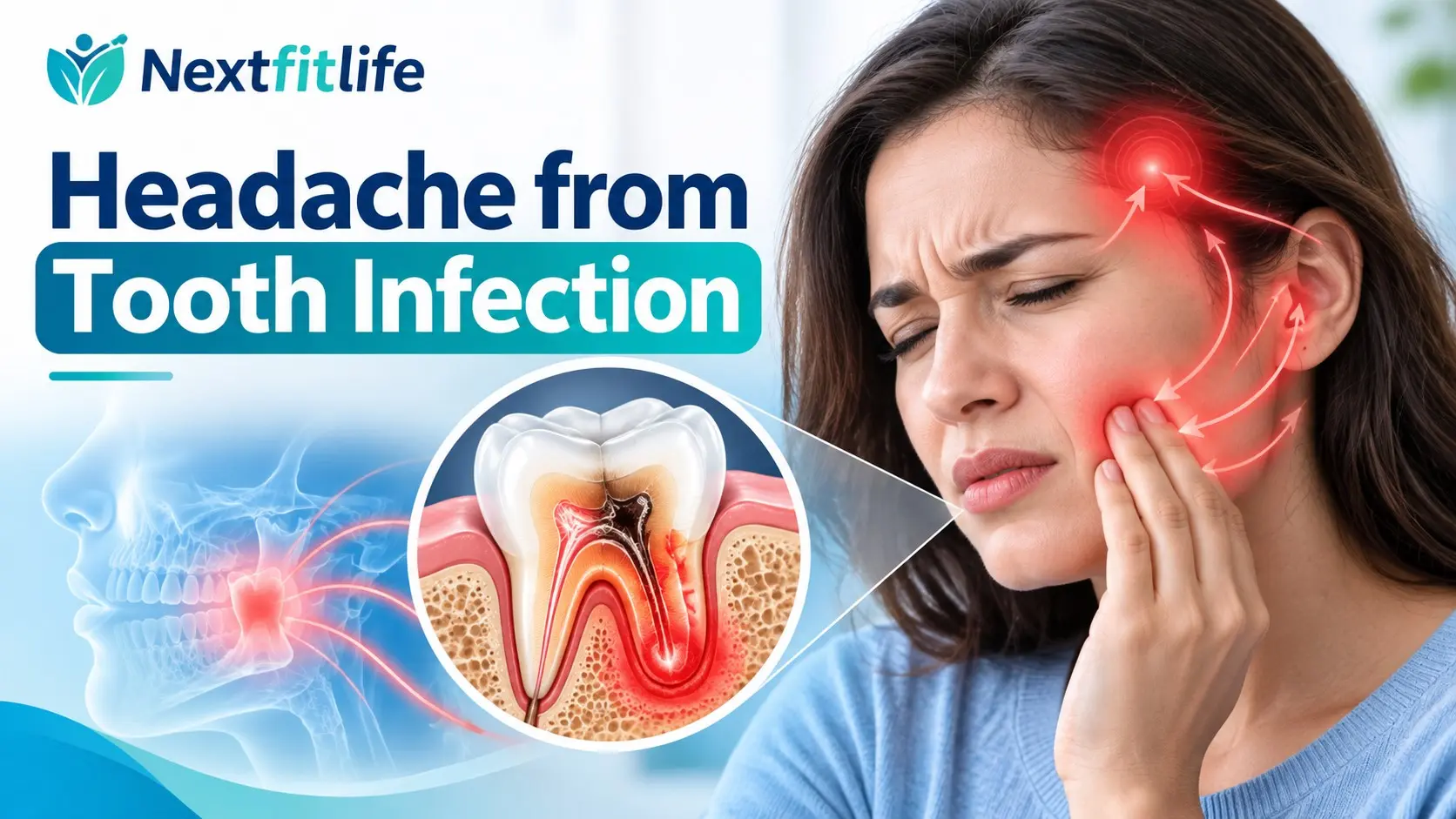
A Headache from Tooth Infection can happen when severe dental pain spreads into the jaw, cheek, ear, temple, or nearby parts of the head. The pain may feel dull, throbbing, sharp, or pressure like.
But a headache does not automatically mean the infection has spread into your brain.
More often, the infected tooth and surrounding tissues send pain through connected facial nerves. The important question is whether you also have signs of a dental abscess or a spreading infection.
This article is for general information and education. It does not replace medical advice, diagnosis, or treatment.
If you want to improve your daily dental routine while dealing with this problem, read the NextFitLife Oral Hygiene Guide.
Table of Contents
- What a tooth infection is
- Why a tooth infection can cause head pain
- 9 critical warning signs
- Severe toothache
- Pain with biting
- Temperature sensitivity
- Gum swelling
- Bad taste or drainage
- Facial or jaw swelling
- Fever
- Swollen lymph nodes
- Breathing or swallowing problems
- Tooth infection versus sinus headache
- Tooth infection versus migraine
- Safe temporary pain relief
- Why antibiotics are not always enough
- Dental treatment options
- What not to do
- How to prevent another infection
- Frequently asked questions
What Is a Tooth Infection?
A tooth infection can develop when bacteria reach the soft inner part of a tooth, called the pulp.
This may happen because of:
- Deep tooth decay
- A cracked tooth
- A chipped tooth
- Dental injury
- Severe gum disease
- Previous dental damage
The pulp contains nerves, blood vessels, and connective tissue.
When bacteria enter this space, the tissue can become inflamed or infected. The infection may then move through the root and create a pocket of pus called a tooth abscess.
A dental abscess needs treatment.
It does not reliably disappear just because the pain fades.
Why Can a Tooth Infection Cause a Headache?
Your teeth, jaw, face, and much of your head share connected sensory pathways.
A major nerve involved in facial sensation is the trigeminal nerve.
This nerve carries sensation from areas including the teeth, jaw, cheeks, forehead, and parts of the face.
When a tooth becomes inflamed or infected, the pain can feel as though it spreads beyond the tooth itself.
This is called referred pain.
You may feel pain in:
- The jaw
- Temple
- Ear area
- Cheek
- Upper face
- Nearby teeth
This explains why some people describe a tooth infection as a headache.
It does not mean every dental headache represents infection spreading inside the skull.
What Does a Headache from Tooth Infection Feel Like?
There is no single pain pattern.
The discomfort may feel:
- Throbbing
- Deep
- Dull
- Sharp
- Pressure like
- Constant
The pain often occurs on the same side as the affected tooth.
It may become worse when you bite, chew, lie down, eat something very hot or cold, or touch the affected tooth.
The strongest clue is not the headache by itself.
It is the headache plus clear dental symptoms.
9 Critical Warning Signs of a Tooth Infection
1. Severe or Persistent Toothache
A dental abscess often causes severe, constant, throbbing pain.
The pain can spread toward the jaw, ear, or neck.
A toothache that keeps getting worse or does not settle needs dental evaluation.
2. Pain When You Bite or Chew
An infected tooth may become very sensitive to pressure.
Biting down can cause a sudden increase in pain because inflammation around the tooth root makes the area tender.
This can make eating difficult.
3. Strong Sensitivity to Hot or Cold
A damaged or inflamed tooth can become very sensitive to temperature.
Hot coffee, cold water, or sweet foods may trigger sharp pain.
Temperature sensitivity does not always mean infection, but when it occurs with severe toothache, swelling, or pain with biting, the tooth needs attention.
4. A Swollen Gum or Pimple Like Bump
A gum abscess may appear as a swollen, red, tender area near the affected tooth.
Sometimes a small bump forms on the gum.
It may drain fluid or pus.
Do not squeeze or puncture it yourself.
5. Bad Taste or Foul Drainage
If an abscess drains into the mouth, you may notice a sudden bad, salty, or unpleasant taste.
Pain can decrease after drainage because pressure falls.
That does not mean the infection has been cured.
The infected tooth still needs dental treatment.
6. Facial or Jaw Swelling
Facial swelling is more concerning than a simple toothache.
Swelling can appear in the:
- Cheek
- Jaw
- Under the jaw
- Neck
- Area near the eye
Increasing facial or neck swelling can mean the infection is moving into deeper tissues.
Do not wait for severe swelling to resolve on its own.
7. Fever or Feeling Unwell
A localized dental problem may not cause fever.
Fever, chills, or feeling generally ill can suggest that the infection is becoming more widespread.
This is also one situation where antibiotics may become appropriate in addition to urgent dental treatment.
8. Swollen Lymph Nodes
Tender or swollen glands under the jaw or in the neck may occur as the immune system responds to infection.
When swollen glands occur with tooth pain, fever, gum swelling, or facial swelling, contact a dentist promptly.
9. Trouble Swallowing, Breathing, or Opening the Mouth
This is the most important warning sign.
Seek emergency care for:
- Difficulty breathing
- Difficulty swallowing
- Difficulty speaking normally
- Major mouth or neck swelling
- Severe difficulty opening the mouth
- Swelling around the eye
- New vision problems
These symptoms can occur when a dental infection reaches deeper spaces in the face or neck.
Which Symptoms Need the Fastest Action?
| Symptom | What It May Mean | Best Next Step |
|---|---|---|
| Persistent toothache | Decay, pulp inflammation, infection | Book a dentist promptly |
| Gum swelling or bad taste | Possible dental abscess | Urgent dental appointment |
| Facial swelling | Possible spread beyond the tooth | Urgent dental or medical assessment |
| Fever with dental swelling | Systemic involvement | Urgent dental care |
| Eye swelling or vision change | Potential serious spread | Emergency care |
| Trouble breathing or swallowing | Possible deep space infection or airway risk | Emergency care immediately |
Can a Tooth Infection Really Cause a Headache?
Yes.
Severe tooth pain can radiate through shared nerve pathways and be felt in the head, temple, ear, or jaw.
This is a form of referred dental pain.
But a headache is common and has many causes.
Do not assume every headache on the same side as a tooth is caused by an infection.
Headache from Tooth Infection vs Sinus Headache
Upper back teeth sit near the maxillary sinuses.
This creates a common diagnostic problem.
Sinus inflammation can cause pain that feels as though it comes from the upper teeth, while a problem in an upper tooth can sometimes create pain or pressure near the cheek and sinus area.
Clues favoring a dental cause include:
- One specific painful tooth
- Pain when biting
- Strong hot or cold sensitivity
- Gum swelling
- Bad taste or drainage
- A visible cavity or broken tooth
Clues favoring sinus disease may include:
- Nasal congestion
- Reduced sense of smell
- Nasal discharge
- Pressure affecting several upper teeth
- Facial pressure linked with a respiratory infection
If your symptoms sound more sinus related, see Sinus Headache: Causes, Symptoms and Relief.
Headache from Tooth Infection vs Migraine
Migraine and dental pain can overlap because both may involve facial and head pain.
Migraine becomes more likely when the headache includes:
- Nausea
- Light sensitivity
- Sound sensitivity
- Throbbing head pain
- Symptoms lasting hours
- Similar previous attacks
A dental infection becomes more likely when the pain is tied closely to one tooth and is accompanied by biting pain, gum swelling, temperature sensitivity, drainage, or facial swelling.
You can have more than one problem at the same time, so persistent symptoms deserve proper evaluation.
Can a Dental Infection Cause Ear Pain?
Yes.
Dental pain can be felt near the ear because several areas of the jaw and face share nerve pathways.
However, ear infections and jaw joint disorders can also cause pain that feels dental.
A dentist can examine the teeth and gums to determine whether a tooth is the likely source.
Can an Infected Tooth Cause Jaw Pain?
Yes.
Dental infection can cause pain around the jaw, especially when the tissues around the tooth root are inflamed.
Jaw pain can also result from:
- Teeth grinding
- Jaw clenching
- Temporomandibular joint problems
- Trauma
- Other dental disease
This is why symptoms and examination matter more than pain location alone.
Can Tooth Infection Cause Dizziness?
Dizziness is not a reliable sign of a tooth abscess.
People with severe pain, fever, dehydration, anxiety, medication effects, or another illness may feel dizzy.
If dizziness is severe, new, persistent, or occurs with fainting, confusion, weakness, severe headache, breathing difficulty, or spreading facial swelling, get medical assessment.
For a broader look at dizziness, read How to Stop Feeling Dizzy.
How to Relieve a Headache from Tooth Infection Temporarily
Home care can make you more comfortable while you arrange dental treatment.
It does not cure an abscess.
1. Use an Appropriate Over the Counter Pain Reliever
For many adults, medicines such as ibuprofen or acetaminophen can help dental pain.
Use them only as directed on the label or by a healthcare professional.
Ibuprofen may not be suitable if you have certain kidney problems, stomach ulcers, bleeding risks, take certain medicines, or have been told to avoid anti inflammatory drugs.
Acetaminophen also has maximum daily limits and can cause severe liver injury when too much is taken.
If you are unsure which option is safe, ask a pharmacist or clinician.
2. Rinse Gently With Warm Salt Water
A gentle warm salt water rinse may soothe irritated tissues and help keep the mouth clean.
Do not swallow the rinse.
Salt water does not remove infection from inside the tooth.
3. Eat Soft Foods
Choose foods that need less chewing while the tooth is painful.
Examples include:
- Soft eggs
- Yogurt
- Soup that is not very hot
- Mashed vegetables
- Soft cooked foods
Chew on the opposite side when possible.
4. Avoid Very Hot or Cold Foods
Temperature extremes can make an inflamed tooth hurt more.
Choose food and drinks at a comfortable temperature.
5. Continue Gentle Oral Hygiene
Do not stop cleaning your mouth completely because a tooth hurts.
Use a soft toothbrush and clean gently around the affected area.
For daily prevention, follow the NextFitLife Oral Hygiene Guide.
What Should You Never Put on an Infected Tooth?
Do not place aspirin directly onto the tooth or gum.
Aspirin can irritate and damage oral tissue.
Also avoid placing harsh chemicals, concentrated oils, or unknown home mixtures directly into an abscess.
They do not remove the source of infection and may burn the tissues.
Do Antibiotics Cure a Tooth Abscess?
Not usually by themselves.
This is one of the most important updates to older advice about dental infections.
The American Dental Association recommends prioritizing definitive dental treatment for most localized pulpal and periapical dental infections in otherwise healthy adults.
This can include:
- Root canal treatment
- Drainage
- Other procedures that remove the infected source
Antibiotics are generally more appropriate when there is systemic involvement, such as fever or malaise, or concern about spreading infection.
The exact decision belongs to a dentist or other qualified clinician.
Why Antibiotics Alone May Fail
A severely infected or dead tooth can contain tissue that no longer has normal blood flow.
The source of infection can remain inside the tooth even when antibiotics temporarily reduce surrounding inflammation.
That is why the tooth may still need treatment.
If you only take antibiotics and never address the tooth, symptoms can return.
How Does a Dentist Treat a Tooth Infection?
The goal is to eliminate the infection and deal with the damaged tooth.
Root Canal Treatment
A root canal may save a tooth when the pulp is infected or badly inflamed.
The dentist or endodontist removes infected tissue from inside the tooth, cleans the root canals, and seals the space.
Drainage
If there is a collection of pus, a dentist may need to drain the abscess.
Tooth Extraction
If the tooth cannot be saved, removal may be necessary.
Antibiotics When Indicated
Antibiotics may be added when there are signs of systemic infection or spreading disease.
They should not be viewed as an automatic treatment for every toothache.
How Does a Dentist Diagnose an Abscess?
A dentist may:
- Examine your teeth and gums
- Check for swelling
- Tap the affected tooth
- Test biting pressure
- Assess temperature sensitivity
- Take a dental X ray
If infection appears to have spread deeper into the neck or face, additional imaging such as a CT scan may sometimes be needed.
What Happens if a Dental Abscess Bursts?
You may suddenly notice:
- Fluid in the mouth
- A bad taste
- Reduced pressure
- Temporary pain relief
Do not mistake that relief for a cure.
The infection can remain active inside or around the tooth.
Contact a dentist.
Can a Tooth Infection Spread?
Yes.
An untreated abscess can spread into nearby jaw and facial tissues.
Serious complications are uncommon compared with ordinary tooth infections, but they can occur.
This is why rapidly increasing facial swelling, neck swelling, fever, eye symptoms, or difficulty swallowing should not be ignored.
Does a Headache Mean the Infection Has Spread to the Brain?
No.
A headache by itself does not mean a dental infection has entered the brain.
Most head pain linked with an infected tooth is more likely to be referred pain from the tooth, jaw, facial muscles, or nearby inflamed tissues.
Serious spread beyond the mouth is uncommon but needs urgent evaluation when major warning signs appear.
Seek urgent medical care for symptoms such as
- Confusion
- Severe worsening illness
- Major facial or neck swelling
- Difficulty breathing
- Difficulty swallowing
- Eye swelling
- Vision changes
- Rapidly worsening symptoms
Can a Tooth Infection Cause Sepsis?
Sepsis from a dental infection is uncommon, but untreated bacterial infections can sometimes spread and become life threatening.
Do not wait for the word “sepsis” to appear before seeking care.
Fever with rapidly increasing facial swelling, severe weakness, confusion, breathing problems, or a very ill appearance needs urgent medical attention.
Tooth Infection, Sinus Problem, or Migraine?
| Clue | Tooth Infection | Sinus Problem | Migraine |
|---|---|---|---|
| One painful tooth | Common | Less typical | Not typical |
| Pain when biting | Common | Less typical | Not typical |
| Gum swelling | Common | Not typical | Not typical |
| Nasal congestion | Not a main feature | Common | Can occur |
| Light sensitivity | Not typical | Not typical | Common |
| Nausea | Can occur with severe pain | Less typical | Common |
What Not to Do With a Suspected Tooth Infection
- Do not wait for a dental abscess to cure itself
- Do not put aspirin directly on the gum or tooth
- Do not squeeze or puncture a gum abscess
- Do not take leftover antibiotics
- Do not stop antibiotics early if a clinician prescribed them
- Do not assume temporary pain relief means the infection is gone
- Do not ignore increasing facial or neck swelling
- Do not use home remedies instead of dental treatment
How Soon Should You See a Dentist?
If you think you have a dental abscess, seek an urgent dental appointment.
You should also see a dentist promptly for:
- Severe toothache
- Pain lasting more than a day or two
- Pain when biting
- Gum swelling
- Bad taste or pus
- Fever
- Facial or jaw swelling
If breathing, swallowing, speaking, vision, or the eye area becomes affected, move beyond routine dental care and seek emergency medical assessment.
How to Prevent Another Tooth Infection
Brush Twice Each Day
Brush for about two minutes with fluoride toothpaste.
Use gentle pressure and clean every tooth surface.
Clean Between Your Teeth
Use floss, an interdental brush, or another method that suits your teeth.
Limit Frequent Sugar Exposure
Bacteria in dental plaque use sugars to make acids that damage tooth enamel.
How often your teeth are exposed to sugar matters, not only the total amount.
Do Not Ignore a Cracked Tooth
Cracks can allow bacteria to reach deeper tooth structures.
Get broken or chipped teeth checked.
Visit a Dentist Based on Your Needs
Regular dental care can identify decay and gum disease before they become painful infections.
Do Not Smoke
Smoking harms oral and gum health and can make healing more difficult.
For a complete prevention routine, use the Oral Hygiene Guide: 15 Daily Habits for Healthy Teeth and Gums.
Conclusion: Do Not Treat the Headache and Ignore the Tooth
A Headache from Tooth Infection can happen when severe dental pain radiates into the jaw, ear, cheek, or temple. The headache may improve with temporary pain relief, but the infection itself still needs dental treatment.
Watch for the dental clues: a severe toothache, biting pain, temperature sensitivity, swollen gums, drainage, bad taste, facial swelling, fever, or tender neck glands.
Your next step is simple. If you suspect an infected tooth, arrange dental care promptly. If swelling affects your breathing, swallowing, neck, eye, vision, or ability to open your mouth, seek emergency medical help.
References and Sources
- American Dental Association. Antibiotics for Dental Pain and Swelling Guideline.
Explains when definitive dental treatment should be prioritized and when systemic antibiotics may be appropriate.
https://www.ada.org/resources/research/science/evidence-based-dental-research/antibiotics-for-dental-pain-and-swelling/ - American Dental Association. Acute Dental Pain Management Guideline.
Provides current evidence based recommendations for managing acute tooth pain in adults, adolescents, and children.
https://www.ada.org/resources/research/science/evidence-based-dental-research/pain-management-guideline/ - NHS. Dental Abscess.
Covers abscess symptoms, urgent dental treatment, emergency facial swelling, breathing and swallowing problems, and treatment options.
https://www.nhs.uk/conditions/dental-abscess/ - Mayo Clinic. Tooth Abscess: Symptoms and Causes.
Explains severe throbbing toothache, facial swelling, fever, lymph node swelling, and emergency warning signs.
https://www.mayoclinic.org/diseases-conditions/tooth-abscess/symptoms-causes/syc-20350901 - Mayo Clinic. Tooth Abscess: Diagnosis and Treatment.
Covers dental examination, X rays, drainage, root canal treatment, extraction, and when CT imaging may be needed.
https://www.mayoclinic.org/diseases-conditions/tooth-abscess/diagnosis-treatment/drc-20350907 - MedlinePlus. Tooth Abscess.
Reviews causes, symptoms, dental X rays, drainage, root canal treatment, complications, and why untreated abscesses can spread.
https://medlineplus.gov/ency/article/001060.htm - Mayo Clinic. Toothache First Aid.
Provides safe interim toothache advice and warning signs that need dental or emergency assessment.
https://www.mayoclinic.org/first-aid/first-aid-toothache/basics/art-20056628
Internal Links and Helpful NextFitLife Guides
- Oral Hygiene Guide: 15 Daily Habits for Healthy Teeth and Gums
- Mouth Ulcers: Causes, Relief and Warning Signs
- Sinus Headache: Causes, Symptoms and Relief
- How to Stop Feeling Dizzy
- Healthy Skin 101
About the Author
Adel Galal is the Founder and Lead Writer at NextFitLife. He researches oral health, general health, headaches, nutrition, wellness, and symptom based topics and turns current medical and public health guidance into clear practical information for everyday readers.
I am not a doctor or licensed healthcare professional, and this content does not replace professional medical advice, diagnosis, or treatment. I share information based on extensive research, real life experience, and consultation with healthcare providers. Always consult a qualified healthcare professional for diagnosis, treatment, or guidance about any health condition.
Learn more about Adel, the NextFitLife editorial approach, and how health information is researched on the About Us page.
Frequently Asked Questions
Can a tooth infection cause a headache?
Yes. Severe dental pain can radiate through shared facial nerve pathways and be felt in the jaw, temple, cheek, or ear. A headache alone does not prove that infection has spread beyond the tooth.
What does a Headache from Tooth Infection feel like?
It may feel throbbing, dull, sharp, deep, or pressure like. It is more suggestive of a dental cause when it happens with one painful tooth, pain with biting, temperature sensitivity, gum swelling, bad taste, or facial swelling.
How do I know if a tooth is infected?
Possible signs include severe toothache, pain when biting, sensitivity to hot or cold, a swollen gum, bad taste or drainage, facial swelling, fever, and swollen glands under the jaw or in the neck.
Can a tooth infection cause pain near the ear?
Yes. Dental pain can be referred toward the ear because areas of the teeth, jaw, and face share nerve pathways. Ear disease and jaw joint problems can also cause similar pain.
Can an infected tooth cause sinus pressure?
An upper tooth problem can sometimes create pain near the cheek and sinus region because the roots of some upper teeth lie close to the maxillary sinus. Sinus disease can also cause pain that feels like upper tooth pain.
Does a headache mean a tooth infection has spread to the brain?
No. A headache by itself does not mean the infection has reached the brain. Seek urgent care for severe illness, confusion, major facial or neck swelling, eye swelling, vision problems, or trouble breathing or swallowing.
Do antibiotics cure a tooth abscess?
Antibiotics are not enough for many localized dental abscesses. Definitive treatment such as drainage, root canal treatment, or extraction may be needed. Antibiotics are more likely to be used when systemic or spreading infection is present.
Can a tooth abscess go away on its own?
No. Pain may temporarily improve if an abscess drains, but the source of infection remains and the tooth still needs dental treatment.
What can I do for pain until I see a dentist?
Use an appropriate over the counter pain reliever as directed, gently rinse with warm salt water, eat soft foods, avoid very hot or cold foods, and keep the mouth gently clean. These steps do not cure the infection.
Should I put aspirin on an infected tooth?
No. Aspirin placed directly on the gum or tooth can irritate or damage the tissue. Use medicines only as directed rather than placing tablets against the gums.
When is a dental abscess an emergency?
Get emergency help if you have trouble breathing, swallowing, or speaking, major mouth or neck swelling, severe difficulty opening your mouth, swelling around an eye, or new vision problems.
How is a dental abscess treated?
Treatment can include root canal therapy, drainage, or extraction depending on the condition of the tooth. Antibiotics may also be used when infection is spreading or causing systemic symptoms.

Health & wellness writer with 30+ years of experience in nutrition, fitness, and healthy aging. Founder of NextFitLife.com — evidence-based health guidance.