
Published on: Aug 19, 2024
Updated: November 3, 2026
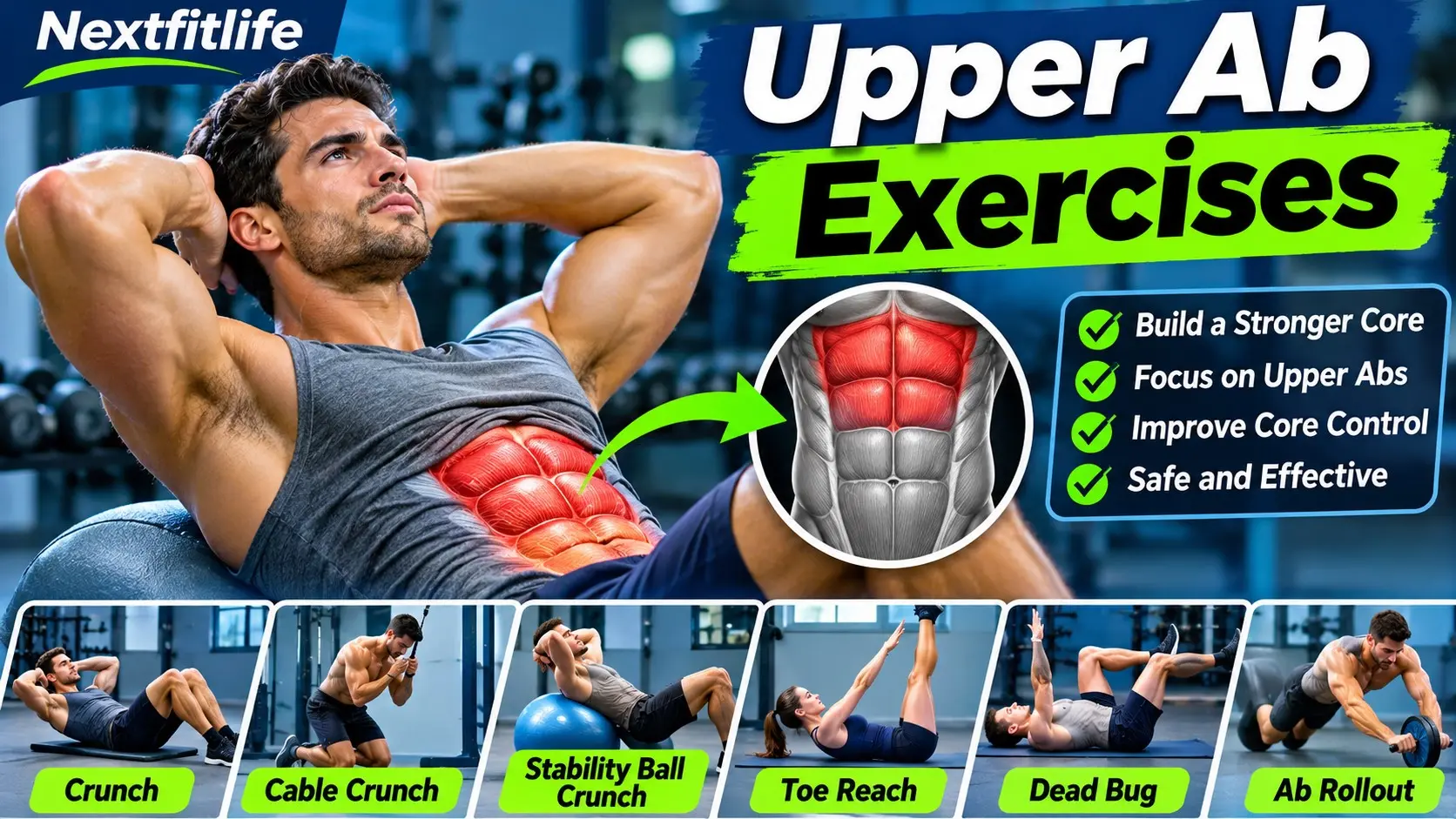
Upper Ab Exercises can help you build stronger abdominal muscles, but there is an important fact to know first.
You do not have a separate upper ab muscle and lower ab muscle. The rectus abdominis runs along the front of your abdomen as one long muscle.
Still, some movements can place a little more emphasis on certain regions. Crunch based movements, for example, may create greater activity near the upper part of the rectus abdominis.
This article is for general information and education. It does not replace medical advice, diagnosis, or treatment.
Quick answer: The best Upper Ab Exercises include controlled crunches, cable crunches, stability ball crunches, toe reaches, dead bugs, rollouts, plank variations and loaded carries. Use slow movement, good breathing and progressive resistance rather than chasing endless repetitions.
Important: Upper Ab Exercises strengthen abdominal muscle, but they do not guarantee fat loss from the upper stomach. Visible abs depend on muscle development, total body fat, genetics and your overall lifestyle.
Table of Contents
- What are the upper abs?
- Can you target upper abs?
- 14 smart Upper Ab Exercises
- Traditional crunch
- Weighted crunch
- Cable crunch
- Stability ball crunch
- Toe reach
- Dead bug
- Hollow body hold
- Forearm plank
- Plank shoulder tap
- Ab wheel rollout
- Stability ball rollout
- Pallof press
- Suitcase carry
- Reverse crunch
- How many sets and reps?
- How often should you train abs?
- Upper ab exercises and belly fat
- Common mistakes
- Beginner workout
- Frequently asked questions
What Are the Upper Abs?
People often use the phrase “upper abs” to describe the top part of the visible six pack.
Anatomically, this area belongs to the rectus abdominis.
The same muscle continues toward the pelvis, so the upper and lower abs are not completely separate muscles.
Your wider core also includes:
- Internal obliques
- External obliques
- Transversus abdominis
- Spinal stabilizers
- Pelvic muscles
That is why a complete core workout should include more than crunches.
Can You Really Target the Upper Abs?
You can emphasize them, but you cannot completely isolate them.
Research using ultrasound and muscle activity testing has found that different abdominal exercises can produce different levels of activity along the rectus abdominis.
A crunch tends to create strong activity in the rectus abdominis, and some studies suggest greater emphasis near the region closest to the moving trunk.
However, the whole muscle still contributes.
Simple rule: Use crunch-based exercises to emphasize trunk flexion, but train anti-extension, anti-rotation, anti rotation and stability too if you want a complete core.
14 Smart Upper Ab Exercises
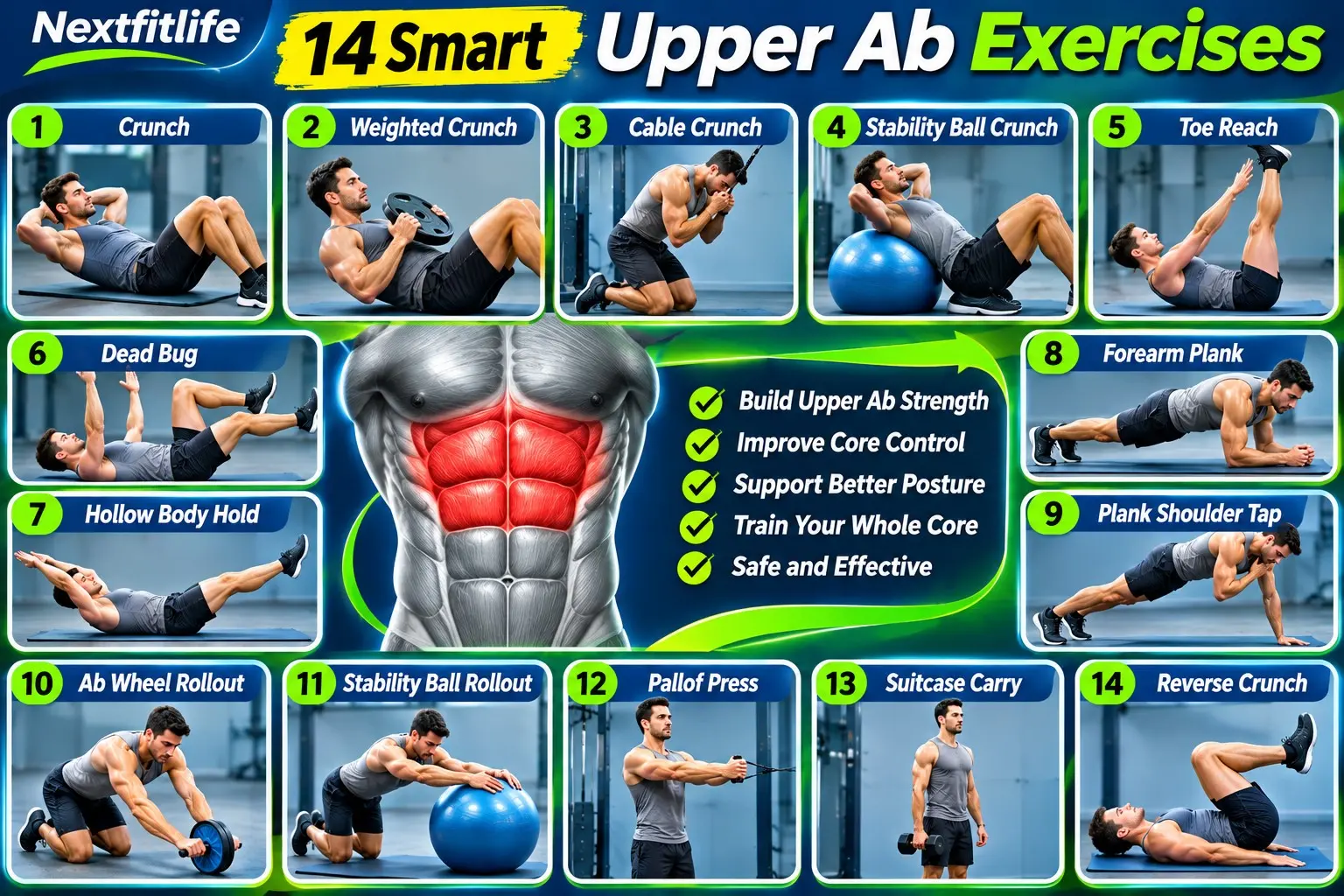
1. Traditional Crunch
The crunch remains one of the simplest upper abdominal exercises.
- Lie on your back.
- Bend your knees.
- Place your hands lightly near your head or across your chest.
- Lift your shoulder blades a short distance.
- Lower slowly.
Think about bringing your ribs gently toward your pelvis.
Do not pull on your neck.
2. Weighted Crunch
Once bodyweight crunches become easy, adding a small weight can create progressive overload for abs.
- Hold a light plate or dumbbell against your chest.
- Keep your lower body still.
- Curl your shoulders upward.
- Pause briefly.
- Lower under control.
Start light.
For more loaded options, see Weighted Ab Exercises.
3. Cable Crunch
The cable crunch makes resistance easy to adjust.
- Kneel in front of a cable stack.
- Hold the rope near your head.
- Keep your hips fairly still.
- Curl your ribs toward your pelvis.
- Return slowly.
Avoid turning the movement into a hip hinge.
4. Stability Ball Crunch
A stability ball can give you a comfortable range of motion.
- Sit on the ball.
- Walk your feet forward.
- Support your mid back on the ball.
- Crunch upward slowly.
- Lower with control.
Keep your feet secure.
5. Toe Reach
Toe reaches combine trunk flexion with a simple reaching target.
- Lie on your back.
- Raise your legs toward the ceiling.
- Reach your hands toward your toes.
- Lift the shoulder blades rather than jerking the neck.
- Lower slowly.
Your hands do not need to touch your feet.
6. Dead Bug
The dead bug trains the abs differently.
Instead of curling the trunk, you try to stop the spine and pelvis from moving while the limbs move.
- Lie on your back.
- Raise your arms.
- Bend your hips and knees.
- Extend one arm and the opposite leg.
- Return and switch sides.
See the full Dead Bug Exercise guide for progressions.
7. Hollow Body Hold
The hollow hold creates an anti extension challenge.
- Lie on your back.
- Gently brace your abdomen.
- Lift your shoulders slightly.
- Raise your legs only as far as you can control.
- Hold while breathing.
Bend your knees if the full version is too difficult.
8. Forearm Plank
The plank trains the entire trunk to stay steady.
- Place your forearms on the floor.
- Extend your legs.
- Keep your body in a straight line.
- Brace gently.
- Keep breathing.
Start with 15 to 30 seconds.
9. Plank Shoulder Tap
This adds an anti rotation challenge.
- Start in a high plank.
- Lift one hand.
- Touch the opposite shoulder.
- Return your hand.
- Switch sides.
Try to keep the hips quiet.
10. Ab Wheel Rollout
The rollout can produce high abdominal muscle activity.
It is also difficult.
- Kneel behind an ab wheel.
- Brace your abdomen.
- Roll forward slowly.
- Stop before your lower back arches.
- Pull back under control.
Use a short range at first.
11. Stability Ball Rollout
This is an easier way to learn the rollout pattern.
- Kneel in front of a stability ball.
- Place your forearms on the ball.
- Roll the ball forward slowly.
- Keep your ribs and pelvis controlled.
- Return to the start.
12. Pallof Press
The Pallof press trains your core to resist rotation.
- Stand sideways to a cable or band.
- Hold the handle at your chest.
- Press your arms forward.
- Do not let your body rotate.
- Return slowly.
13. Suitcase Carry
The suitcase carry looks simple, but it trains the trunk hard.
- Hold a dumbbell or kettlebell in one hand.
- Stand tall.
- Walk slowly.
- Keep your shoulders level.
- Switch sides.
Do not lean toward the weight.
14. Reverse Crunch
The reverse crunch involves more pelvic movement than a traditional crunch.
- Lie on your back.
- Bend your knees.
- Bring the knees toward your chest.
- Gently curl the pelvis upward.
- Lower slowly.
This exercise still works the rectus abdominis as a whole.
14 Upper Ab Exercises at a Glance
| Exercise | Main Pattern | Level |
|---|---|---|
| Crunch | Trunk flexion | Beginner |
| Weighted crunch | Loaded flexion | Intermediate |
| Cable crunch | Loaded flexion | Intermediate |
| Ball crunch | Trunk flexion | Beginner to intermediate |
| Toe reach | Trunk flexion | Beginner |
| Dead bug | Anti extension | Beginner to intermediate |
| Hollow hold | Anti extension | Intermediate |
| Forearm plank | Isometric stability | Beginner |
| Shoulder tap | Anti rotation | Intermediate |
| Ab wheel rollout | Anti extension | Advanced |
| Ball rollout | Anti extension | Intermediate |
| Pallof press | Anti rotation | Beginner to intermediate |
| Suitcase carry | Lateral stability | Beginner to advanced |
| Reverse crunch | Pelvic curl | Beginner to intermediate |
Which Exercises Emphasize the Upper Rectus Abdominis Most?
Crunch based movements are the clearest place to start.
Research has found strong rectus abdominis activity during traditional crunches, and ultrasound work suggests a crunch can create greater shortening and thickening than a leg raise.
This does not mean the lower portion switches off.
It means the exercise may bias the region closer to the moving trunk.
Do Upper and Lower Abs Work Separately?
Not completely.
Studies have produced mixed results when comparing upper and lower rectus abdominis activity.
Some show regional differences, while others find similar activity across both regions.
The safest conclusion is that you can create a bias, but not perfect isolation.
Do Upper Ab Exercises Burn Upper Belly Fat?
No exercise can promise that fat will disappear from one exact area.
There is limited research suggesting local endurance work may influence nearby fat tissue, but this evidence is still small and does not justify telling people that crunches will burn upper belly fat.
For practical fat loss, focus on:
- Total physical activity
- Resistance training
- Aerobic exercise
- A sustainable eating pattern
- Enough sleep
For a wider fat loss guide, read How to Lose Belly Fat Naturally Without Exercise.
Can Ab Exercise Reduce Visceral Fat?
Overall exercise can.
A 2025 systematic review found that exercise programs reduced both abdominal visceral fat and subcutaneous fat in adults with overweight or obesity.
The effect came from exercise programs as a whole, not from training one small muscle region.
How Many Upper Ab Exercises Should You Do?
You do not need all 14 exercises in one session.
Choose about three or four.
A balanced workout might include:
- One crunch movement
- One anti extension movement
- One anti rotation movement
- One carry or plank
How Many Sets and Reps?
A simple starting point is:
- 2 to 3 sets
- 8 to 15 repetitions for dynamic exercises
- 15 to 30 seconds for holds
The final repetitions should feel challenging without losing control.
Do Abs Need Progressive Overload?
Yes, if strength or muscle growth is your goal.
The 2026 American College of Sports Medicine position stand supports progressive resistance training for improving muscle strength and hypertrophy.
You can progress your abs by adding:
- Resistance
- Repetitions
- Range
- Sets
- A harder variation
Change one variable at a time.
Do You Need to Train Abs to Failure?
No.
Current resistance training evidence does not show that every set must reach complete muscular failure.
You can stop when you feel you have one to three clean repetitions left.
How Often Should You Train Upper Abs?
Two or three focused core sessions each week can work well for many people.
Your abdominal muscles need recovery just like your legs, chest and back.
You do not need a hard ab workout every day.
Can Beginners Train Upper Abs?
Yes.
Good beginner choices include:
- Crunch
- Dead bug
- Forearm plank
- Pallof press
- Suitcase carry
Build control first, then add resistance.
A Beginner Upper Ab Workout
| Exercise | Sets | Amount |
|---|---|---|
| Crunch | 2 | 8 to 12 reps |
| Dead bug | 2 | 6 to 8 each side |
| Forearm plank | 2 | 15 to 30 seconds |
| Suitcase carry | 2 | 20 seconds each side |
An Intermediate Upper Ab Workout
| Exercise | Sets | Amount |
|---|---|---|
| Cable crunch | 3 | 8 to 12 reps |
| Ball rollout | 3 | 8 to 10 reps |
| Shoulder tap | 2 | 8 each side |
| Pallof press | 2 | 10 each side |
Common Upper Ab Exercise Mistakes
1. Pulling the Neck
Keep your hands light and let your abdominal muscles lift the shoulders.
2. Doing Hundreds of Crunches
More repetitions are not automatically better. Add resistance or use a harder variation when the exercise becomes easy.
3. Moving Too Fast
Use slow, controlled repetitions so momentum does not take over.
4. Holding Your Breath
Keep breathing during most core exercises.
5. Training Only Crunches
Add anti extension, anti rotation and stability work.
6. Expecting Spot Fat Loss
Upper ab training builds muscle but does not guarantee upper belly fat loss.
7. Using Too Much Weight
The load should challenge your abs without changing the movement.
8. Arching the Lower Back
Reduce the range during rollouts, dead bugs and hollow holds if your back begins to arch.
9. Training Abs Hard Every Day
Give hard sessions time to recover.
10. Ignoring Whole Body Training
Full body strength and aerobic activity are still important for overall fitness and body composition.
Can Upper Ab Exercises Help Posture?
Core strength can support trunk control, but posture is affected by many things.
Strength, mobility, fatigue, work habits and comfort all matter.
One abdominal exercise will not permanently “fix” posture.
Can Upper Ab Exercises Hurt Your Back?
They can if the movement is too difficult or does not suit you.
Stop if you develop:
- Sharp back pain
- Numbness
- Tingling
- Pain travelling into the leg
- New weakness
If you have active nerve pain, read Sciatica Stretches before adding demanding core exercises.
Should You Train Upper Abs With Weights?
You can.
Weights make progression easier to measure and can support abdominal hypertrophy.
Start with bodyweight movements if you are new, then add resistance when you can control the full set.
Do Cardio and Walking Matter?
Yes, especially if body composition is one of your goals.
Adults should aim for about 150 minutes of moderate aerobic activity each week and muscle strengthening activity on at least two days.
Walking is one easy way to build that activity.
See Walking Techniques for Weight Loss for a practical progression.
Upper Ab Training Checklist
- Choose 3 or 4 exercises.
- Use slow, controlled movement.
- Train several core functions.
- Keep breathing.
- Add resistance gradually.
- Stop before form breaks.
- Train about 2 or 3 times per week.
- Do not rely on crunches for belly fat loss.
- Combine core work with full body exercise.
- Progress only when the current level feels controlled.
Conclusion
Upper Ab Exercises can strengthen the rectus abdominis and improve core control, but there is no separate upper ab muscle that works alone.
Use crunches and cable crunches for trunk flexion, then add dead bugs, rollouts, Pallof presses and carries to train the rest of your core.
For the best results, progress the challenge over time and combine core work with full body exercise rather than chasing spot reduction.
Your next step: choose three exercises from this guide and perform two controlled sets of each this week.
References and Sources
- American College of Sports Medicine. Resistance Training Prescription for Muscle Function, Hypertrophy, and Physical Performance in Healthy Adults, 2026.
https://pubmed.ncbi.nlm.nih.gov/41843416/ - Gomirato AP, Grenier SG. Diagnostic Ultrasound Shows Preferential Activation of Rectus Abdominis Segments With Exercises Targeting Upper Versus Lower Segments.
https://pubmed.ncbi.nlm.nih.gov/38288259/ - Muscle Activity in Upper and Lower Rectus Abdominis During Abdominal Exercises.
https://pubmed.ncbi.nlm.nih.gov/8976314/ - Core Muscle Activation During Swiss Ball and Traditional Abdominal Exercises.
https://pubmed.ncbi.nlm.nih.gov/20436242/ - Centers for Disease Control and Prevention. Adding Physical Activity as an Adult.
https://www.cdc.gov/physical-activity-basics/adding-adults/index.html - Igarashi Y, et al. Exercise Program to Reduce Abdominal Visceral and Subcutaneous Fat in Adults With Overweight and Obesity, 2025.
https://pubmed.ncbi.nlm.nih.gov/41109785/ - Brobakken MF, et al. Abdominal Aerobic Endurance Exercise Reveals Spot Reduction Exists: Randomized Controlled Trial.
https://pubmed.ncbi.nlm.nih.gov/38010201/
Internal Links + Hub
- NextFitLife Fitness Hub
- Fitness Program Guide
- Core Workouts at Home
- Weighted Ab Exercises
- Dead Bug Exercise
- Abs Workout at Home
- Lower Ab Exercises
- Simple Strength Training Exercises at Home
- Best Weight Loss Home Workouts
- Walking Techniques for Weight Loss
- How to Lose Belly Fat Naturally Without Exercise
About the Author
Adel Galal is the founder and lead writer of NextFitLife.com and the founder of Parnthub.com.
He is a father of four, three sons and a daughter, and a grandfather of four, with more than 33 years of hands on family experience. Adel is based in Cairo, Egypt.
He has maintained a personal interest in health, fitness, nutrition, strength training, walking, sleep, wellness and healthy aging for more than 30 years and has more than 15 years of health and wellness writing experience.
His work focuses on reviewing trusted sources, separating evidence based fitness guidance from exaggerated claims, and turning research into simple steps readers can use.
Adel is not a doctor, physical therapist, exercise physiologist, certified personal trainer, registered dietitian or other licensed healthcare professional. NextFitLife content is for general information and education and does not replace individual medical or exercise advice.
Learn more about Adel and NextFitLife on the About Us page.
Frequently Asked Questions
What are the best Upper Ab Exercises?
Good Upper Ab Exercises include crunches, cable crunches, stability ball crunches, toe reaches, dead bugs, rollouts and planks.
Are upper and lower abs separate muscles?
No. The rectus abdominis is one continuous muscle, although different movements may emphasize certain regions more than others.
Can you really target the upper abs?
You can create some regional emphasis, especially with trunk flexion exercises, but you cannot isolate the upper portion completely.
Do crunches work the upper abs?
Yes. Crunches create strong rectus abdominis activity and can emphasize the upper region during trunk flexion.
Do Upper Ab Exercises burn upper belly fat?
No exercise can guarantee fat loss from one exact area. Upper ab work strengthens muscle while overall exercise and energy balance affect fat loss.
How many Upper Ab Exercises should I do?
Three or four exercises in one session are usually enough.
How many sets should I do for abs?
Two to three sets per exercise is a practical starting point for many people.
How many reps should I do?
About 8 to 15 controlled repetitions works well for many dynamic exercises, while holds may begin around 15 to 30 seconds.
How often should I train my upper abs?
Two or three focused core sessions per week can work well for most people.
Can I train abs every day?
Light core work may be fine often, but hard resistance training also needs recovery.
Do abs need progressive overload?
Yes. Increasing resistance, repetitions, range or exercise difficulty over time can support continued strength and muscle gains.
Do I need weighted ab exercises?
No, but adding resistance can make progression easier once bodyweight exercises become too easy.
Are cable crunches good for upper abs?
Yes. Cable crunches provide adjustable resistance for trunk flexion and can be useful for progressive abdominal training.
Are toe touches good for upper abs?
Toe reaches can train trunk flexion when performed by lifting the shoulder blades rather than pulling on the neck.
Are rollouts good for abs?
Yes. Research shows rollouts can produce high activation in the rectus abdominis and obliques, but they require good trunk control.
Do planks work the upper abs?
Planks engage the rectus abdominis as part of the whole core while resisting spinal extension.
Can dead bugs work the upper abs?
Dead bugs recruit the abdominal muscles while training the trunk to stay stable as the arms and legs move.
Can Upper Ab Exercises make my waist smaller?
They can strengthen abdominal muscle, but waist size depends more strongly on total body fat, genetics and body structure.
Can Upper Ab Exercises hurt my neck?
They can if you pull on your head during crunches. Keep your neck relaxed and let the trunk perform the movement.
Can Upper Ab Exercises hurt my back?
They can if the exercise is too difficult or your form breaks down. Stop if you develop sharp pain, numbness, tingling or leg symptoms.
What should I combine with upper ab training?
Combine it with full body resistance training, aerobic exercise, enough recovery and nutrition that matches your goal.

Health & wellness writer with 30+ years of experience in nutrition, fitness, and healthy aging. Founder of NextFitLife.com — evidence-based health guidance.

