Published on: August 13, 2025
Updated on: October 17, 2026
Written and source checked by: Adel Galal, Founder and Lead Writer at NextFitLife
Medical review status: This article has not been medically reviewed by a cardiologist, physician, pharmacist, registered nurse, paramedic, or other licensed healthcare professional.
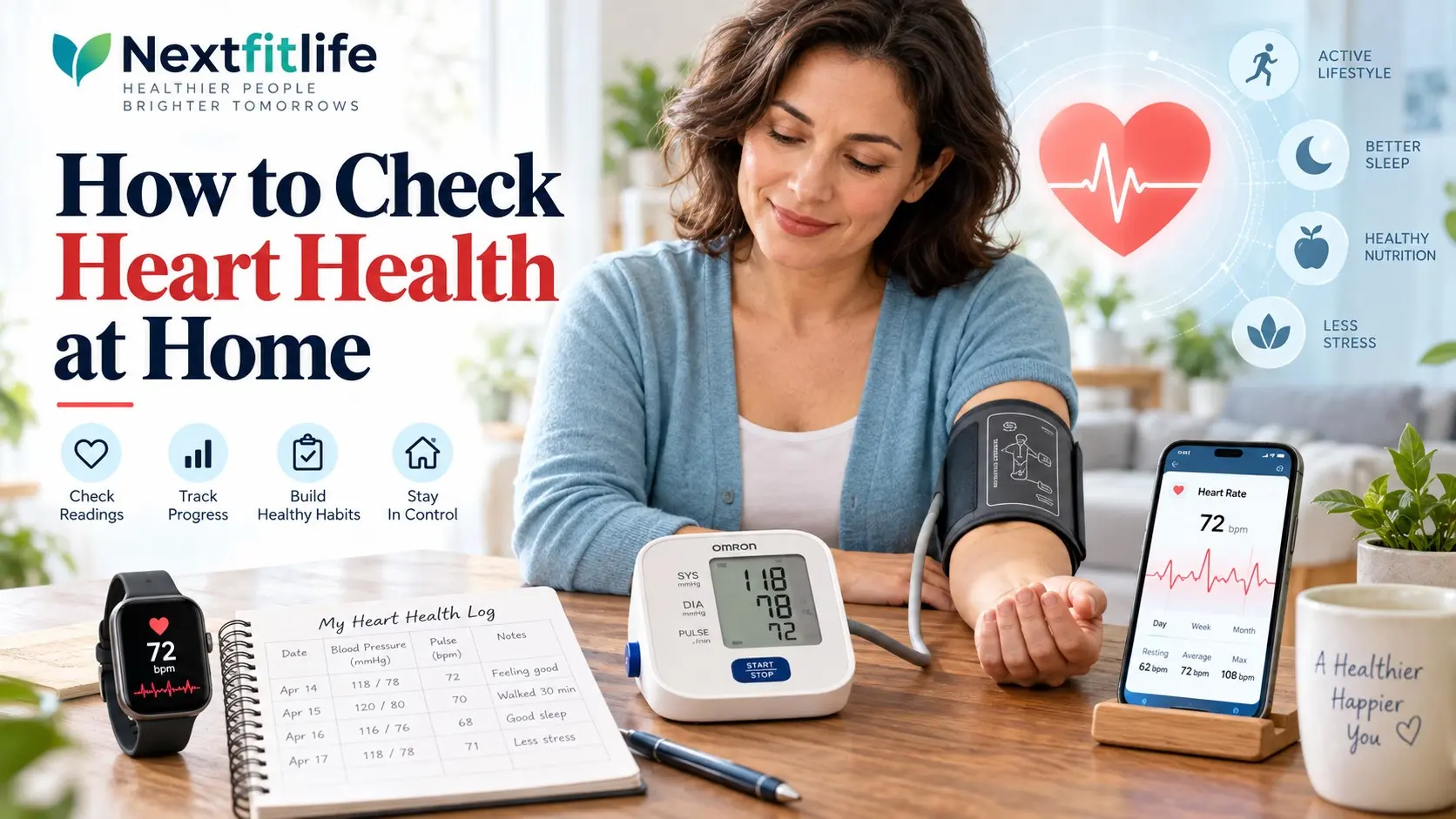
If you want to know how to check heart health at home, start with one key fact: home checks can give you useful information, but they cannot prove that your heart is healthy.
You can safely measure blood pressure, count your resting pulse, notice whether your heartbeat feels regular, track symptoms, watch for changes in exercise ability, record weight when advised, and save useful readings from approved devices.
These checks can help you spot trends and give your healthcare professional better information.
They cannot rule out blocked coronary arteries, heart valve disease, heart failure, cardiomyopathy, atrial fibrillation, a silent heart attack, or another cardiovascular condition.
This article is for general information and education. It does not replace medical advice, diagnosis, or treatment.
For a broader overview of cardiovascular risk, symptoms, testing, treatment, and prevention, see the NextFitLife Heart Disease Guide. If you have active chest symptoms, read Signs of a Heart Attack but do not delay emergency care to finish reading.
Table of Contents
- What home checks can and cannot tell you
- 9 smart heart health checks
- Blood pressure
- Resting pulse
- Pulse regularity
- Symptoms
- Activity tolerance
- Weight and swelling
- Wearable rhythm data
- Home cholesterol or glucose tests
- Risk factor review
- Blood pressure technique
- Understanding blood pressure numbers
- How to check your pulse
- Smartwatch limits
- Pulse oximeter limits
- Unsafe home heart tests
- Seven day monitoring routine
- Professional heart tests
- Common myths
- When to book an appointment
- Emergency warning signs
- Frequently asked questions
What Does Checking Heart Health at Home Really Mean?
Home heart monitoring means watching measurements and symptoms that may reflect cardiovascular health.
It does not mean diagnosing yourself.
Useful home information can include:
- Blood pressure
- Resting heart rate
- Pulse rhythm
- Palpitations
- Chest discomfort
- Shortness of breath
- Changes in stamina
- Swelling
- Weight changes
- Wearable rhythm alerts
One normal number does not cancel out concerning symptoms.
A person can have normal blood pressure and still have coronary artery disease. A person can have a normal resting heart rate and still have valve disease. A normal smartwatch tracing can occur between episodes of an arrhythmia.
What Home Heart Checks Cannot Prove
Home measurements cannot reliably tell you whether:
- Your coronary arteries are open
- You have plaque inside the heart arteries
- Your heart valves are normal
- Your heart pumping strength is normal
- You have had a small silent heart attack
- Your chest pain is heartburn or a heart attack
- You have cardiomyopathy
- You are safe for strenuous exercise
Professional heart tests exist because many important problems cannot be seen with a home monitor.
9 Smart Ways to Check Heart Health at Home
1. Measure Blood Pressure Correctly
Blood pressure is one of the most useful cardiovascular measurements you can take at home.
High blood pressure often causes no warning symptoms.
That means you cannot judge it by how you feel.
A home monitor may help:
- Find repeated high readings
- Confirm possible hypertension
- Track treatment response
- Identify readings that differ from clinic measurements
- Give your healthcare professional a longer term trend
Use an upper arm monitor
A validated automatic upper arm cuff is generally preferred.
Wrist and finger monitors can be less reliable because small changes in position may affect the result.
Cuff size matters
A cuff that is too small may give a falsely high reading.
A cuff that is too large can also affect accuracy.
Check the manufacturer's sizing guide and measure your upper arm if necessary.
How to Measure Blood Pressure at Home
Before the reading
- Avoid smoking for at least 30 minutes.
- Avoid caffeine for at least 30 minutes.
- Avoid exercise for at least 30 minutes.
- Empty your bladder.
- Sit quietly for at least five minutes.
- Do not talk or use your phone.
Use the right posture
- Sit with your back supported.
- Keep both feet flat on the floor.
- Do not cross your legs.
- Put the cuff on bare skin.
- Support your arm on a table.
- Keep the middle of the cuff near heart level.
- Relax your hand and arm.
Take more than one reading
Take two measurements about one minute apart.
Record both readings or the average if that matches your care plan.
Measure at roughly the same times on monitoring days so trends are easier to compare.
What Blood Pressure Numbers Mean
| Category | Systolic | Diastolic |
|---|---|---|
| Normal | Below 120 | Below 80 |
| Elevated | 120 to 129 | Below 80 |
| Stage 1 hypertension | 130 to 139 | 80 to 89 |
| Stage 2 hypertension | 140 or higher | 90 or higher |
| Severe hypertension | Higher than 180 | And or higher than 120 |
A single high reading does not by itself confirm chronic hypertension.
Blood pressure changes with:
- Stress
- Pain
- Exercise
- Caffeine
- Smoking
- Sleep
- Medication
- Bladder fullness
Repeated measurements under good conditions provide a better picture.
What if Blood Pressure Is Above 180 or 120?
If a reading is above 180 systolic or 120 diastolic:
- Sit quietly.
- Wait at least one minute.
- Measure again correctly.
If the repeat reading remains extremely high and you have chest pain, shortness of breath, back pain, numbness, weakness, vision change, trouble speaking, confusion, or another serious symptom, call emergency services.
If the reading remains extremely high without these symptoms, contact your healthcare professional promptly for instructions.
Do not take an extra dose of blood pressure medicine unless your personal treatment plan tells you to do so.
2. Check Your Resting Pulse
Your pulse tells you how often the heart is beating.
It can also give you a rough sense of whether beats feel evenly spaced.
Check it while:
- Sitting or lying down
- Calm
- Not exercising
- Not immediately after caffeine
Wrist method
- Place your index and middle fingers on the thumb side of the inner wrist.
- Press gently until you feel the pulse.
- Count every beat for 60 seconds.
- Note the rate.
- Notice whether the spacing feels regular or irregular.
Do not use your thumb because it has its own pulse.
What Is a Normal Resting Heart Rate?
For many adults, a resting heart rate from about 60 to 100 beats per minute is common.
That range is not a pass or fail test.
A rate below 60 can be normal in:
- Trained athletes
- Some very fit adults
- People taking certain heart medicines
- People during sleep
A rate above 100 can occur with:
- Exercise
- Anxiety
- Fever
- Pain
- Dehydration
- Anemia
- Thyroid disease
- Infection
- Medication
- An arrhythmia
The number matters most when interpreted with symptoms and your usual baseline.
3. Notice Whether the Pulse Feels Regular
A regular pulse usually has fairly even spacing between beats.
An irregular pulse may feel:
- Uneven
- Fluttery
- As if beats are skipped
- Suddenly fast
- Pounding
An occasional extra beat can happen in healthy people.
Repeated or sustained irregularity may be related to atrial fibrillation or another rhythm problem.
You cannot diagnose the exact rhythm by feeling your pulse.
Diagnosis usually requires an ECG or longer heart rhythm monitor.
For a deeper guide, read Heart Palpitations Causes.
When a Pulse Needs Urgent Attention
Call emergency services when a suddenly very fast or very slow pulse occurs with:
- Chest pain
- Severe shortness of breath
- Dizziness
- Fainting
- Severe weakness
- Confusion
For a new persistent change without emergency symptoms, contact your healthcare professional.
4. Track Heart Symptoms
Symptoms can sometimes reveal more than one home number.
Useful symptoms to track include:
- Chest pressure
- Chest tightness
- Chest burning
- Shortness of breath
- Palpitations
- Dizziness
- Near fainting
- Fainting
- Unusual fatigue
- Swelling
- Reduced exercise tolerance
Record the context
For each symptom, write down:
- Date
- Time
- What you were doing
- How long it lasted
- How severe it felt
- Pulse if available
- Blood pressure if available
- Medicine taken
- Whether the symptom resolved
Do not spend time creating a perfect symptom log during an emergency.
5. Watch Changes in Activity Tolerance
You do not need to perform a special test to notice changes in daily function.
Simply compare normal activities with your usual ability.
For example, ask:
- Can I walk my normal route?
- Do I need more rest than before?
- Do stairs now cause unusual breathlessness?
- Do ordinary chores cause chest pressure?
- Am I avoiding activity because of symptoms?
A gradual decline can occur with:
- Heart failure
- Coronary artery disease
- Valve disease
- Arrhythmia
- Cardiomyopathy
- Anemia
- Lung disease
Reduced stamina is not always “just aging.”
Do Not Use a Stair Test to Prove Your Heart Is Healthy
You may see online advice suggesting that climbing a certain number of stairs within a certain time can prove that your heart is healthy.
That is not a safe diagnostic rule.
Stair climbing reflects fitness, leg strength, lung health, body weight, balance, age, and many other factors.
Someone with coronary artery disease may still perform well.
Someone with a healthy heart may perform poorly for another reason.
Never intentionally provoke chest pain or breathlessness to “test” the heart.
6. Check Weight and Swelling When Relevant
Weight tracking is especially useful for some people with diagnosed heart failure.
It is not a general screening test for everyone.
If your healthcare team has asked you to track weight:
- Use the same scale.
- Weigh at about the same time each day.
- Morning is often preferred.
- Use similar clothing.
- Record the result.
- Follow the weight change threshold in your personal care plan.
A sudden increase can sometimes mean fluid is building up.
Read Congestive Heart Failure for more information.
What Does Leg Swelling Mean?
Swelling of the feet or ankles can occur with heart failure.
But it can also come from:
- Vein disease
- Kidney disease
- Liver disease
- Medication
- Pregnancy
- Injury
- Blood clot
Do not diagnose heart failure by pushing on your shin and checking whether a dent remains.
New persistent swelling deserves medical assessment.
7. Use Smartwatch and Portable ECG Data Carefully
Some watches and handheld devices can record a short ECG or alert you to an irregular rhythm.
That can be useful, especially when symptoms come and go.
Save a tracing if:
- You feel palpitations
- The watch reports possible atrial fibrillation
- The rhythm feels newly irregular
- You have repeat episodes
Show the information to a healthcare professional.
What a smartwatch cannot do
A consumer wearable cannot reliably:
- Detect every abnormal rhythm
- Rule out a heart attack
- Measure coronary artery narrowing
- Assess heart valves
- Measure heart pumping strength
- Replace a medical ECG
A normal wearable reading does not make active chest pain or fainting safe.
Can a Smartwatch Detect Atrial Fibrillation?
Some devices can flag patterns that may be consistent with atrial fibrillation.
This can be useful for screening or capturing intermittent symptoms.
But an alert is not the same as a final diagnosis.
A clinician may use:
- A 12 lead ECG
- Holter monitoring
- A patch monitor
- An event recorder
to confirm the rhythm.
8. Use Home Cholesterol or Glucose Tests as Supporting Information
Some home tests can measure cholesterol or blood glucose.
These can be helpful for selected people.
But cardiovascular risk is not based on one home test result.
A complete cholesterol assessment may include:
- Total cholesterol
- LDL cholesterol
- HDL cholesterol
- Triglycerides
Heart risk assessment may also consider:
- Age
- Blood pressure
- Diabetes
- Smoking
- Kidney disease
- Family history
- Previous cardiovascular disease
Do not start or stop cholesterol medicine based only on a home test.
9. Review Your Cardiovascular Risk Factors
One of the best home heart checks is not a device at all.
It is an honest review of your risk factors.
Ask yourself:
- Do I smoke or vape?
- Do I know my blood pressure?
- Do I know my LDL cholesterol?
- Have I been screened for diabetes when appropriate?
- Do I exercise regularly?
- Do I sleep well?
- Do I have sleep apnea symptoms?
- Do I have kidney disease?
- Do close relatives have early heart disease?
- Have I gained significant weight?
- Do I have a history of pregnancy related hypertension or gestational diabetes?
This risk picture often tells you more than a single pulse or smartwatch reading.
Heart Health Screening You Cannot Fully Do at Home
Several important cardiovascular checks require a healthcare professional or laboratory.
Cholesterol testing
Laboratory lipid testing can measure:
- Total cholesterol
- LDL cholesterol
- HDL cholesterol
- Triglycerides
Blood glucose and A1C
Diabetes increases cardiovascular risk.
Blood glucose and A1C testing may be recommended based on age and risk factors.
Kidney function
Kidney disease and cardiovascular disease are closely connected.
Family history review
A strong family history may change how early or how aggressively risk factors are treated.
Can a Pulse Oximeter Check Heart Health?
A pulse oximeter estimates blood oxygen saturation and pulse rate.
It does not directly measure:
- Coronary artery blockage
- Heart pumping strength
- Valve function
- Blood pressure
- The cause of chest pain
Readings may also be affected by:
- Poor circulation
- Skin temperature
- Movement
- Nail polish
- Device quality
- Other technical limitations
Do not ignore severe breathlessness, chest pain, blue lips, confusion, or rapid deterioration because an oxygen number looks normal.
Can Blood Pressure Tell You if Your Arteries Are Blocked?
No.
Normal blood pressure does not prove that the coronary arteries are clear.
A person can have severe coronary artery disease with normal blood pressure.
Coronary disease is assessed with clinical evaluation and, when needed, tests such as:
- ECG
- Stress testing
- Coronary CT angiography
- Coronary angiography
Can a Normal Resting Heart Rate Prove Your Heart Is Healthy?
No.
A resting pulse between 60 and 100 is common, but it cannot rule out:
- Coronary disease
- Valve disease
- Heart failure
- Cardiomyopathy
- Intermittent arrhythmia
Heart rate is one piece of information.
Can You Check Heart Pumping Strength at Home?
No.
Heart pumping function is commonly assessed with an echocardiogram.
This ultrasound test can evaluate:
- Ejection fraction
- Heart chamber size
- Wall movement
- Valve function
- Filling patterns
- Pressure estimates
A home blood pressure monitor cannot measure these things.
Can You Check for a Heart Attack at Home?
No home test can safely rule out a heart attack.
A heart attack is diagnosed using:
- Symptoms
- ECG
- Troponin blood testing
- Clinical examination
- Sometimes imaging
A normal smartwatch, pulse, blood pressure, or oxygen reading cannot exclude a heart attack.
Read Signs of a Heart Attack for a detailed warning sign guide.
Can You Check for Angina at Home?
You can notice a pattern, but you cannot confirm angina at home.
A classic pattern may look like:
This pattern deserves medical assessment.
Do not deliberately repeat the activity to prove that it happens again.
Read Angina Symptoms for more information.
Unsafe Home Heart Tests to Avoid
Do not use these methods as proof that your heart is healthy:
- A one minute step test
- Running stairs until breathless
- Push ups to see whether chest pain appears
- Heavy lifting as a heart test
- Holding your breath
- Exercising until symptoms appear
- Using only a smartwatch result
- Using only a pulse oximeter reading
- Taking an antacid to decide whether chest pain is reflux
- Taking aspirin to see whether symptoms improve
- Using another person's nitroglycerin
These methods can create false reassurance or unnecessary risk.
Why the Popular Stair Test Is Limited
Stair climbing can be useful as part of normal daily activity.
But a timed stair challenge does not diagnose heart health.
Performance depends on:
- Age
- Leg strength
- Lung function
- Balance
- Body size
- Fitness
- Joint health
- Motivation
A fast time does not rule out coronary artery disease.
A slow time does not prove heart disease.
A Safe Seven Day Home Heart Monitoring Routine
This routine is designed to gather information.
It is not a diagnostic test and it does not involve provoking symptoms.
Day 1: Check your equipment
- Confirm that your blood pressure monitor is validated.
- Check that the cuff fits.
- Read the device instructions.
- Create a paper or digital log.
Day 2: Practice blood pressure technique
- Rest for five minutes.
- Use correct posture.
- Take two readings one minute apart.
- Record both results.
Day 3: Check your resting pulse
- Count the pulse for 60 seconds.
- Record the rate.
- Note whether it feels regular.
- Note caffeine, medication, fever, pain, or stress.
Day 4: Review symptoms
Write down any:
- Chest discomfort
- Breathlessness
- Dizziness
- Palpitations
- Swelling
- Reduced stamina
Do not exercise to provoke symptoms.
Day 5: Repeat blood pressure
Measure under similar conditions.
Look for trends rather than worrying about a small difference.
Day 6: Review wearable alerts
- Save ECG recordings if your device provides them.
- Save repeated rhythm alerts.
- Do not diagnose the rhythm yourself.
Day 7: Decide on follow up
Contact your healthcare professional if you have:
- Repeated abnormal readings
- Persistent pulse changes
- Recurring palpitations
- New breathlessness
- Reduced exercise ability
- New swelling
Emergency symptoms should never wait until the end of a seven day log.
Professional Heart Tests That Home Devices Cannot Replace
Electrocardiogram
An ECG records the electrical activity of the heart.
It can identify many:
- Arrhythmias
- Conduction problems
- Signs of heart strain
- Signs of heart injury
Blood tests
Tests may include:
- Troponin
- Cholesterol
- Blood glucose
- A1C
- Kidney function
- Electrolytes
- Thyroid tests
- Blood count
Echocardiogram
An echocardiogram evaluates heart structure and function.
Ambulatory rhythm monitoring
A Holter monitor, patch, or event recorder can capture intermittent rhythm problems over hours, days, or longer.
Stress testing
A supervised stress test may assess the heart's response to exertion when clinically appropriate.
Coronary CT angiography
This can provide detailed images of the coronary arteries in selected patients.
Coronary calcium scoring
A calcium scan can help refine cardiovascular risk for selected adults when the result would change prevention decisions.
It is not a routine home test and it is not appropriate for everyone.
How Often Should You Check Blood Pressure?
The answer depends on why you are checking it.
People with diagnosed hypertension may monitor more often, especially when treatment changes.
People with normal blood pressure usually do not need constant home checking.
Your healthcare professional can recommend a schedule based on:
- Your usual readings
- Your medicines
- Your cardiovascular risk
- Pregnancy
- Kidney disease
- Diabetes
Repeated checking every few minutes can create anxiety and produce less useful information.
Should You Check Your Pulse Every Day?
Most healthy adults do not need to count their pulse every day.
It can be useful when:
- You have palpitations
- Your clinician asks you to monitor it
- You take heart rate lowering medicine
- You have known atrial fibrillation
- You are tracking recovery after illness
Look for meaningful changes rather than chasing one number.
What About Heart Rate During Walking?
Heart rate normally rises during physical activity.
The amount of increase depends on:
- Fitness
- Age
- Exercise intensity
- Medication
- Temperature
- Illness
Exercise heart rate targets should be individualized, especially when you take a beta blocker or have cardiovascular disease.
Read Brisk Walking Heart Rate for a more detailed guide.
Can You Check Circulation at Home?
You can notice clues such as:
- Cold feet
- Skin color changes
- Slow healing wounds
- Leg pain during walking
- Swelling
These do not prove poor arterial circulation.
A clinician may use the ankle brachial index or vascular ultrasound when circulation needs to be assessed.
See How to Improve Blood Circulation in Legs.
Daily Habits That Support Heart Health
Monitoring works best when paired with prevention.
Strong heart healthy habits include:
- Do not smoke
- Avoid nicotine exposure
- Take prescribed medicines consistently
- Eat mostly nutrient rich foods
- Limit excess sodium
- Stay physically active
- Manage blood pressure
- Manage cholesterol
- Manage diabetes
- Protect sleep
- Seek care for sleep apnea
- Limit excess alcohol
- Avoid cocaine and amphetamine use
- Attend preventive medical visits
What Foods Support Heart Health?
A heart healthy eating pattern can include:
- Vegetables
- Whole fruits
- Beans
- Lentils
- Whole grains
- Fish
- Nuts
- Seeds
- Unsaturated fats
Limit large amounts of:
- Added sugar
- Processed meat
- Saturated fat
- Very salty processed foods
Food can reduce long term cardiovascular risk, but no food can replace emergency treatment for heart attack symptoms.
Common Home Heart Health Myths
| Myth | What Is More Accurate |
|---|---|
| Normal blood pressure means my heart is healthy | Normal blood pressure does not rule out coronary, valve, rhythm, or heart muscle disease. |
| A pulse from 60 to 100 proves everything is normal | Resting pulse is only one measurement. |
| A smartwatch can rule out a heart attack | A consumer wearable cannot safely exclude a heart attack. |
| A normal oxygen reading proves my heart and lungs are fine | Pulse oximeters have important limitations and cannot rule out many conditions. |
| Passing a stair test proves a healthy heart | Stair performance cannot diagnose or exclude cardiovascular disease. |
| The lower my resting heart rate, the healthier I am | A low rate can reflect fitness, medicine, or a rhythm problem. |
| I can diagnose AFib by feeling my pulse | An irregular pulse can raise suspicion, but ECG confirmation is usually needed. |
| No symptoms means no high blood pressure | High blood pressure often causes no symptoms. |
| Home monitoring replaces checkups | Home monitoring supports professional care but does not replace it. |
When Should You Book a Medical Appointment?
Arrange medical review for:
- Repeated blood pressure readings of 130 over 80 or higher
- A new resting pulse that is repeatedly above 100
- A new resting pulse below 60 when that is unusual for you
- A newly irregular pulse
- Repeated smartwatch rhythm alerts
- Recurring palpitations
- New exercise intolerance
- Persistent ankle or leg swelling
- Breathlessness when lying flat
- Unexplained ongoing fatigue
- A strong family history of early heart disease
- A family history of sudden cardiac death
The right urgency depends on symptoms and medical history.
When Is a Heart Symptom an Emergency?
Call emergency services for:
- New chest pressure, squeezing, heaviness, fullness, or pain
- Pain spreading to an arm, shoulder, neck, jaw, back, or upper stomach
- Severe or sudden shortness of breath
- Cold sweating with chest symptoms
- Severe weakness with chest symptoms
- Fainting
- Collapse
- A very fast or very slow pulse with chest pain, breathlessness, or fainting
- Blue or gray lips
- Sudden facial weakness
- Sudden arm weakness
- Speech difficulty
- Sudden vision loss
- Severe balance problems
Do not delay emergency care while repeating measurements or waiting for a smartwatch reading.
Conclusion: Home Checks Are Useful, but They Are Not a Diagnosis
Learning how to check heart health at home safely means collecting useful information without treating one normal number as proof that your heart is healthy.
Use a validated upper arm blood pressure monitor, count your resting pulse, notice rhythm changes, track symptoms, monitor weight when appropriate, and save useful wearable readings.
Avoid stair challenges, push up tests, breath holding, or other attempts to provoke symptoms.
If your readings or symptoms keep changing, share them with a healthcare professional. If you have chest pain, severe breathlessness, fainting, stroke symptoms, or another acute warning sign, call emergency services immediately.
References and Sources
- American Heart Association. Home Blood Pressure Monitoring.
Covers validated upper arm monitors, cuff size, preparation, correct positioning, repeated readings, blood pressure categories, and severe hypertension guidance.
https://www.heart.org/en/health-topics/high-blood-pressure/understanding-blood-pressure-readings/monitoring-your-blood-pressure-at-home - American Heart Association. Blood Pressure Explained.
Covers correct home technique, two readings one minute apart, tracking trends, and interpretation of home readings.
https://www.heart.org/en/health-topics/high-blood-pressure/blood-pressure-explained - American Heart Association. Heart Health Screenings.
Covers blood pressure, cholesterol, blood glucose, weight, smoking, physical activity, and cardiovascular screening intervals.
https://www.heart.org/en/health-topics/consumer-healthcare/what-is-cardiovascular-disease/heart-health-screenings - National Heart, Lung, and Blood Institute. Coronary Heart Disease Diagnosis.
Covers cardiovascular risk assessment, blood pressure, cholesterol, diabetes screening, ECG, imaging, stress testing, and other professional tests.
https://www.nhlbi.nih.gov/health/coronary-heart-disease/diagnosis - National Heart, Lung, and Blood Institute. Coronary Heart Disease Symptoms.
Covers silent coronary disease, exertional chest pain, shortness of breath, symptoms that improve with rest, and emergency warning signs.
https://www.nhlbi.nih.gov/health/coronary-heart-disease/symptoms - U.S. Food and Drug Administration. Pulse Oximeter Accuracy and Limitations.
Covers factors that affect home oxygen readings and why symptoms must be considered along with device measurements.
https://www.fda.gov/medical-devices/products-and-medical-procedures/pulse-oximeters - Centers for Disease Control and Prevention. About Heart Disease.
Covers cardiovascular risk, major forms of heart disease, symptoms, and prevention.
https://www.cdc.gov/heart-disease/about/index.html - American Heart Association. Warning Signs of a Heart Attack.
Covers chest discomfort, upper body pain, breathlessness, sweating, nausea, dizziness, and emergency action.
https://www.heart.org/en/health-topics/heart-attack/warning-signs-of-a-heart-attack
Internal Links and Helpful NextFitLife Guides
- Heart Disease: Causes, Symptoms, Risk Factors, Prevention and Treatment
- Symptoms of Heart Disease: Critical Warning Signs
- Signs of a Heart Attack: Critical Warning Signs
- Angina Symptoms: Causes, Treatment and Prevention
- Heart Palpitations Causes: Warning Signs and Smart Fixes
- Waking Up With Racing Heart: Causes and Red Flags
- Congestive Heart Failure: Symptoms, Causes and Treatment
- Brisk Walking Heart Rate: Safe Zones and Warning Signs
- Blood Pressure Higher at Night: Causes and Smart Checks
- High Cholesterol: Symptoms, Causes and Treatment
- How to Improve Blood Circulation in Legs
About the Author
Adel Galal is the Founder and Lead Writer at NextFitLife. He researches heart health, circulation, fitness, nutrition, sleep, healthy aging, and evidence based wellness and turns current medical and public health guidance into clear practical information for everyday readers.
I am not a doctor or licensed healthcare professional, and this content does not replace professional medical advice, diagnosis, or treatment. I share information based on extensive research, real life experience, and consultation with healthcare providers. Always consult a qualified healthcare professional for diagnosis, treatment, or guidance about any health condition.
Learn more about Adel Galal, NextFitLife, and the site's editorial approach on the About Us page.
Frequently Asked Questions
How can I check heart health at home?
You can safely monitor blood pressure, resting pulse, pulse regularity, symptoms, activity tolerance, weight when advised, and useful data from wearable devices. These checks can reveal trends but cannot prove that your heart is healthy.
What is the best home heart test?
There is no single best home test. Blood pressure is one of the most useful measurements, while pulse, symptoms, activity tolerance, and risk factor tracking add important context.
Can I test for blocked arteries at home?
No. Home blood pressure monitors, smartwatches, pulse oximeters, and stair tests cannot show whether coronary arteries are blocked.
What blood pressure is considered normal?
For adults, blood pressure below 120 systolic and below 80 diastolic is considered normal under current American Heart Association categories.
How should I measure blood pressure correctly?
Rest quietly for five minutes, avoid caffeine, smoking, and exercise for 30 minutes, sit with your back supported and feet flat, keep the arm supported at heart level, and take two readings about one minute apart.
What resting heart rate is normal?
A resting heart rate between about 60 and 100 beats per minute is common for adults, but lower or higher rates may be normal or abnormal depending on fitness, medicine, illness, symptoms, and personal history.
How do I check my pulse at home?
Place your index and middle fingers on the thumb side of the inner wrist, press gently, count beats for 60 seconds, and notice whether the spacing feels regular or irregular.
Does an irregular pulse mean atrial fibrillation?
Not necessarily. Premature beats and other rhythms can also feel irregular. Atrial fibrillation usually needs confirmation with an ECG or heart rhythm monitor.
Can a smartwatch tell if my heart is healthy?
No. A smartwatch may record heart rate or selected rhythm information, but it cannot rule out coronary artery disease, valve disease, cardiomyopathy, heart failure, or a heart attack.
Can a smartwatch detect a heart attack?
No. Consumer smartwatches cannot safely rule out a heart attack. New chest pressure or other heart attack symptoms need emergency evaluation even if the watch appears normal.
Can a pulse oximeter check my heart?
A pulse oximeter estimates oxygen saturation and pulse rate, but it does not assess coronary arteries, valves, heart pumping strength, or the cause of chest pain.
Can a stair test tell if my heart is healthy?
No. Stair performance depends on fitness, leg strength, lungs, joints, balance, age, and other factors. It cannot diagnose or rule out heart disease.
Can I check heart pumping strength at home?
No. Heart pumping function is usually evaluated with an echocardiogram or other medical imaging.
Can normal blood pressure rule out heart disease?
No. You can have coronary artery disease, valve disease, cardiomyopathy, arrhythmias, or heart failure with normal blood pressure.
Can a normal heart rate rule out heart disease?
No. Resting heart rate is only one measurement and cannot exclude many important heart conditions.
Should I check my blood pressure every day?
Daily monitoring is useful for some people with hypertension or changing treatment, but not everyone needs daily checks. Follow the schedule recommended by your healthcare professional.
What symptoms should I track at home?
Track chest discomfort, shortness of breath, palpitations, dizziness, fainting, fatigue, swelling, reduced activity tolerance, trouble lying flat, and waking breathless at night.
When should I see a doctor about home heart readings?
Arrange medical review for repeated high blood pressure, a new persistent pulse change, irregular rhythm, recurring palpitations, reduced exercise ability, swelling, breathlessness, or unexplained fatigue.
What heart symptoms need emergency care?
Call emergency services for chest pressure or pain, severe shortness of breath, fainting, collapse, blue or gray lips, stroke symptoms, or a very fast or very slow heartbeat with severe symptoms.
Can home monitoring replace a heart checkup?
No. Home monitoring can provide useful trends, but professional evaluation may still require blood tests, an ECG, echocardiogram, rhythm monitoring, stress testing, or coronary imaging.

Health & wellness writer with 30+ years of experience in nutrition, fitness, and healthy aging. Founder of NextFitLife.com — evidence-based health guidance.