Published on: August 5, 2025
Updated on: October 17, 2026
Written and source checked by: Adel Galal, Founder and Lead Writer at NextFitLife
Medical review status: This article has not been medically reviewed by a doctor, cardiologist, emergency physician, pharmacist, paramedic, registered nurse, or other licensed healthcare professional.
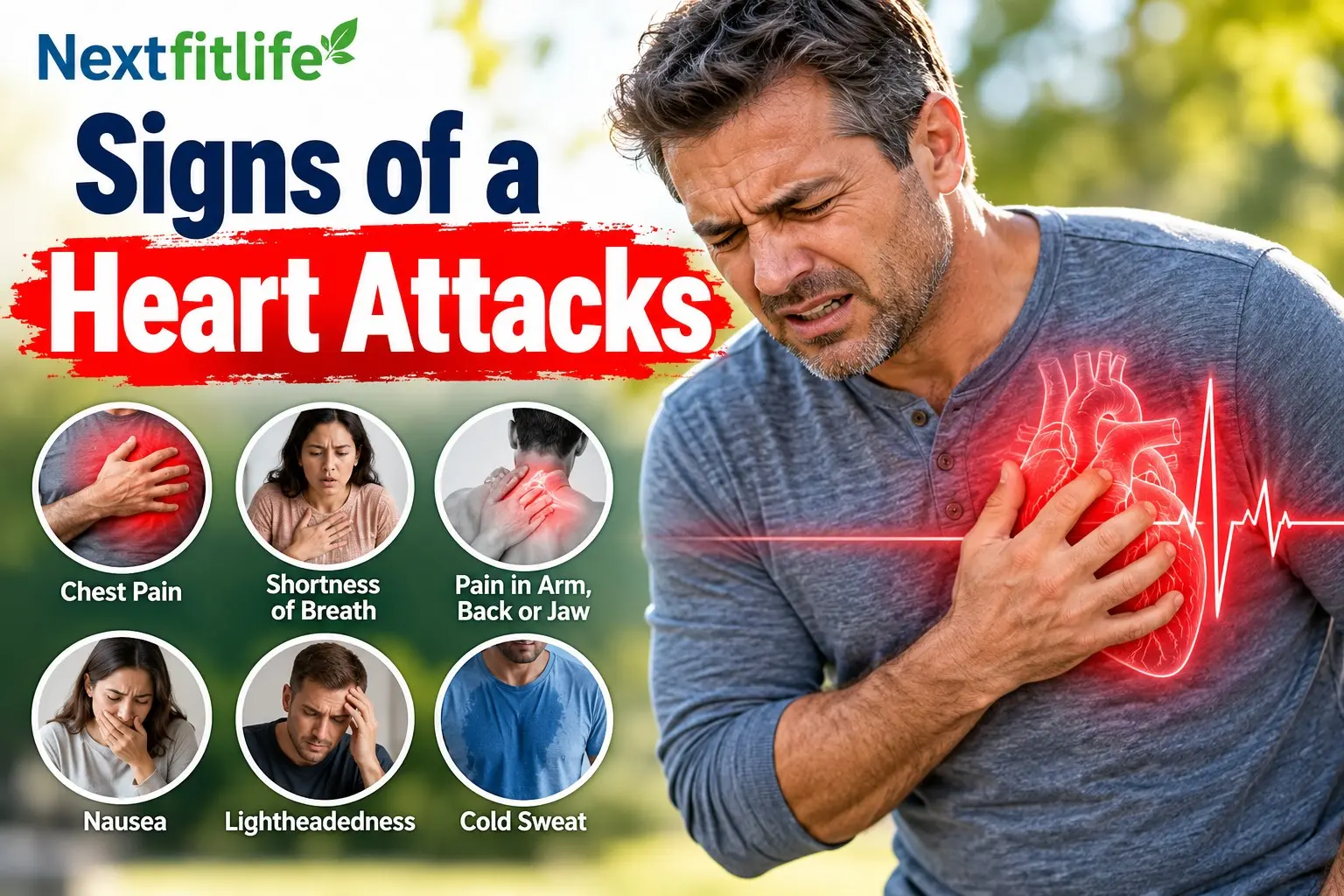
The signs of a heart attack are not always dramatic. A heart attack may begin with crushing chest pain, but it can also start with mild pressure, breathlessness, nausea, unusual tiredness, jaw discomfort, back pain, or a feeling that something is seriously wrong.
Chest discomfort is the most common symptom, yet no single symptom appears in every person. Some heart attacks develop suddenly, while others build over minutes or hours and may even produce warning symptoms days earlier.
The safest rule is simple: if a heart attack is possible, treat it as an emergency.
This article is for general information and education. It does not replace medical advice, diagnosis, or treatment.
If you also want to understand racing or irregular heart sensations, see Waking Up With Racing Heart. For broader cardiovascular health information, visit the NextFitLife Heart Health Guide.
Table of Contents
- What a heart attack is
- What to do immediately
- Call emergency services
- Do not drive yourself
- Use prescribed nitroglycerin correctly
- Take aspirin only when advised
- Begin CPR if cardiac arrest occurs
- 15 critical warning signs
- Chest pressure
- Squeezing or tightness
- Arm discomfort
- Shoulder pain
- Back pain
- Neck discomfort
- Jaw pain
- Upper stomach discomfort
- Shortness of breath
- Cold sweat
- Nausea or vomiting
- Dizziness
- Sudden weakness
- Unusual fatigue
- Palpitations or fainting
- Symptoms in women and men
- Silent and subtle heart attacks
- Early warning symptoms
- Stable and unstable angina
- Heart attack look alike conditions
- Heart attack versus cardiac arrest
- Diagnosis and treatment
- Recovery and prevention
- Common myths
- Frequently asked questions
What Is a Heart Attack?
A heart attack happens when part of the heart muscle does not receive enough oxygen rich blood.
The medical term is myocardial infarction.
The most common cause is coronary artery disease. Fatty plaque can build inside an artery that supplies the heart. If a plaque breaks open, a blood clot can form and reduce or completely block blood flow.
Heart muscle begins to suffer when oxygen delivery falls.
The longer blood flow remains blocked, the more heart muscle can be damaged.
This is why early emergency treatment matters.
What Should You Do if You Suspect a Heart Attack?
Do not spend time trying to prove whether the pain is heartburn, anxiety, muscle strain, or a heart attack.
Several dangerous conditions can produce similar symptoms, and that distinction may require an ECG, blood tests, imaging, and medical examination.
1. Call emergency services immediately
Use the emergency number for the country where you are located.
An ambulance is generally safer than driving yourself because emergency medical personnel can:
- Check the heart rhythm
- Monitor vital signs
- Begin emergency treatment
- Respond if cardiac arrest occurs
- Alert the receiving hospital
2. Stop physical activity
Sit or rest in a safe position while waiting for emergency care.
Do not walk around to “test” whether symptoms improve with movement.
3. Tell another person
If possible, let someone nearby know what is happening.
If you are at home and can do so safely, unlock the door so emergency personnel can reach you quickly.
4. Use prescribed nitroglycerin only as directed
If a healthcare professional prescribed nitroglycerin for you and gave you instructions for chest symptoms, follow those instructions.
Do not take another person's nitroglycerin.
5. Ask before taking aspirin
Aspirin can reduce blood clotting and is used during many heart attacks.
But it is not safe for everyone.
Call emergency services first, then follow the operator's or healthcare professional's advice.
15 Critical Signs of a Heart Attack
A person may have one symptom or several.
The pattern matters more than checking every box on a list.
1. Chest Pressure or Heaviness
Chest discomfort is the most common heart attack symptom.
It may feel like:
- Pressure
- Heaviness
- A weight on the chest
- Fullness
- A band around the chest
The discomfort commonly occurs in the center or left side of the chest.
It can last for more than a few minutes or disappear and return.
2. Chest Squeezing, Tightness, or Pain
Not everyone describes heart attack discomfort as “pain.”
Some people say their chest feels squeezed, tight, compressed, or uncomfortable.
Mild symptoms do not prove the situation is safe.
A heart attack can begin gradually with discomfort that seems easy to dismiss.
3. Pain or Discomfort in One or Both Arms
Heart related pain may travel from the chest into an arm, but arm discomfort can also appear without obvious chest pain.
It may involve the left arm, right arm, or both.
The sensation may feel like:
- Aching
- Pressure
- Heaviness
- Weakness
- Unusual discomfort
Do not rely on the myth that only left arm pain matters.
4. Shoulder Discomfort
One or both shoulders may ache during a heart attack.
This can be confusing because shoulder pain is common from muscles and joints.
It becomes more concerning when it is new and occurs with:
- Chest discomfort
- Breathlessness
- Sweating
- Nausea
- Weakness
5. Upper Back Pain
Heart attack discomfort can spread to the upper back or appear there without strong chest pain.
Back pain has many causes, so location alone cannot diagnose a heart attack.
Sudden or unexplained upper back discomfort paired with chest pressure, shortness of breath, sweating, nausea, or weakness deserves emergency evaluation.
6. Neck Discomfort
Heart related discomfort can travel into the neck.
Some people describe:
- Pressure
- Aching
- Tightness
- A strange heavy feeling
New neck discomfort paired with other heart attack symptoms should not be dismissed as a sleeping position or muscle strain without assessment.
7. Jaw Pain
Jaw discomfort is one of the heart attack symptoms people may not recognize.
The pain can occur on one or both sides.
It may be more concerning when it appears together with:
- Chest pressure
- Arm discomfort
- Breathlessness
- Cold sweat
- Nausea
Dental and jaw disorders are much more common causes, but a heart attack should not be ruled out from location alone.
8. Upper Stomach Pain or Indigestion Like Discomfort
A heart attack can feel surprisingly similar to a digestive problem.
Symptoms may include:
- Upper abdominal pressure
- Burning
- Indigestion
- Unusual fullness
- Nausea
Do not repeatedly take antacids to test whether new unexplained symptoms are heartburn.
If a heart attack is possible, emergency evaluation is safer.
9. Shortness of Breath
Shortness of breath can happen with or without chest discomfort.
It may occur:
- At rest
- During light activity
- Before chest discomfort
- At the same time as chest discomfort
New breathlessness is especially concerning when it occurs with sweating, weakness, nausea, chest pressure, faintness, or upper body discomfort.
10. Cold or Clammy Sweat
A sudden unexplained cold sweat can occur during a heart attack.
This does not mean ordinary sweating from heat or exercise.
It is more concerning when the person also feels:
- Chest discomfort
- Weakness
- Breathlessness
- Nausea
- Dizziness
11. Nausea or Vomiting
A heart attack can cause nausea and sometimes vomiting.
This symptom can be mistaken for:
- Food poisoning
- Stomach flu
- Reflux
- Indigestion
Nausea deserves more attention when it is unexplained and occurs with chest discomfort, sweating, breathlessness, jaw pain, arm pain, or unusual weakness.
12. Lightheadedness or Sudden Dizziness
A heart attack may reduce the heart's ability to pump effectively or trigger an abnormal rhythm.
This can cause:
- Lightheadedness
- Dizziness
- A feeling that you may faint
Dizziness alone has many causes.
Dizziness with chest discomfort, breathlessness, sweating, or sudden weakness is much more concerning.
13. Sudden Weakness
Some people describe a sudden loss of strength or an overwhelming feeling that something is wrong.
This may happen with:
- Cold sweat
- Nausea
- Chest discomfort
- Breathlessness
- Dizziness
Do not assume sudden severe weakness is simply low energy or lack of sleep.
14. Unusual or Extreme Fatigue
Some people feel unusually tired before or during a heart attack.
The fatigue can feel different from normal tiredness.
You may notice that ordinary activities suddenly feel much harder.
Fatigue alone has many possible causes, but it becomes more concerning when it is:
- Sudden
- Extreme
- Unexplained
- Paired with breathlessness
- Paired with chest discomfort
- Paired with nausea or sweating
15. Palpitations, Fainting, or Collapse
A heart attack can sometimes trigger an abnormal heart rhythm.
A person may notice:
- A racing heartbeat
- A fluttering sensation
- A pounding heartbeat
- An irregular pulse
- Fainting
Palpitations have many causes and are often not due to a heart attack.
They need emergency evaluation when accompanied by chest pain, severe breathlessness, fainting, sweating, or sudden weakness.
Heart Attack Symptoms at a Glance
| Symptom | Possible Description | Why It Matters |
|---|---|---|
| Chest discomfort | Pressure, squeezing, fullness, heaviness, burning, pain | Most common symptom |
| Arm or shoulder discomfort | Ache, heaviness, pressure, weakness | Can occur in either or both arms |
| Jaw, neck, or back pain | Aching, tightness, pressure | May happen without major chest pain |
| Shortness of breath | Breathless at rest or with little activity | Can occur before or without chest discomfort |
| Cold sweat | Sudden clammy sweating | More concerning with other symptoms |
| Nausea | Upset stomach or vomiting | May resemble digestive illness |
| Dizziness or fainting | Lightheaded, weak, collapse | May signal reduced circulation or rhythm problems |
| Unusual fatigue | Sudden extreme tiredness | Can be prominent in women and older adults |
Heart Attack Symptoms in Women
One persistent myth is that women usually do not have chest pain during a heart attack.
That is not accurate.
Chest pain or discomfort remains common in women.
However, women are more likely than men to also experience symptoms such as:
- Shortness of breath
- Back discomfort
- Shoulder pain
- Arm pain
- Nausea
- Unusual tiredness
- Weakness
- Upset stomach
- Lightheadedness
Some women have a heart attack without obvious chest pain.
This can lead symptoms to be mistaken for anxiety, indigestion, menopause, flu, stress, or exhaustion.
The safer approach is to evaluate the whole symptom pattern.
Heart Attack Symptoms in Men
Men commonly experience:
- Chest pressure or pain
- Arm or shoulder discomfort
- Back, neck, or jaw pain
- Shortness of breath
- Cold sweat
- Nausea
- Weakness
- Lightheadedness
Men can also have mild or unusual symptoms.
Do not dismiss a possible heart attack simply because pain is not severe.
Heart Attack Symptoms in Older Adults
Older adults may have less obvious symptoms.
Instead of dramatic chest pain, they may develop:
- Breathlessness
- Weakness
- Sudden confusion
- Dizziness
- Fatigue
- Nausea
- Mild chest discomfort
A sudden decline in function deserves attention, especially in someone with known heart disease.
Heart Attack Symptoms With Diabetes
Diabetes can damage nerves over time.
This may make heart attack symptoms less obvious.
People with diabetes have a higher chance of a silent heart attack or subtle symptoms.
Possible clues include:
- Unusual breathlessness
- Extreme fatigue
- Mild chest pressure
- Nausea
- Back or jaw discomfort
- Dizziness
Do not wait for severe chest pain before seeking care.
What Is a Silent Heart Attack?
A silent heart attack causes little, mild, unusual, or unrecognized symptoms.
A person may later learn that a heart attack occurred through:
- ECG findings
- Blood tests
- Imaging
- A medical evaluation for another problem
Possible subtle symptoms include:
- Mild chest discomfort
- Indigestion like discomfort
- Unusual fatigue
- Breathlessness
- Jaw discomfort
- Back discomfort
- Feeling generally unwell
Silent does not mean harmless.
Heart muscle can still be damaged.
Can Heart Attack Warning Signs Start Days Earlier?
Yes, some people experience symptoms before the actual heart attack.
Others receive no advance warning.
There is no reliable list of “six symptoms exactly one month before a heart attack.”
Possible earlier warning symptoms may include:
- New chest pressure during activity
- Repeated chest discomfort
- Increasing shortness of breath
- Reduced exercise tolerance
- Unusual fatigue
- Arm, shoulder, jaw, neck, or back discomfort
- New indigestion like discomfort
These symptoms do not prove a heart attack is coming.
They can indicate angina or another cardiovascular problem that deserves assessment.
Stable Angina vs Unstable Angina
Angina is chest or upper body discomfort caused by reduced blood flow to the heart muscle.
Stable angina
A known stable pattern often:
- Occurs with exercise or stress
- Feels similar each time
- Improves with rest
- Responds to prescribed treatment
Follow the emergency and medication plan provided by your heart care team.
Unstable angina
Unstable angina is an emergency.
Warning changes include symptoms that:
- Occur at rest
- Last longer
- Become stronger
- Happen more often
- Start with less activity
- Do not improve as expected
Unstable angina and heart attack are both forms of acute coronary syndrome.
Heart Attack or Heartburn?
Heartburn and heart attack symptoms can overlap.
Both may cause:
- Burning
- Pressure
- Upper stomach discomfort
- Nausea
Heartburn may be more likely when there is:
- A sour taste
- Food coming back into the mouth
- Symptoms after certain meals
But these clues cannot safely rule out a heart attack.
Seek emergency care for new or unexplained chest or upper abdominal discomfort, especially when it comes with sweating, breathlessness, dizziness, arm pain, jaw pain, or weakness.
Heart Attack or Panic Attack?
A panic attack can cause:
- Chest tightness
- Rapid heartbeat
- Sweating
- Dizziness
- Breathlessness
- Intense fear
A heart attack can cause several of the same symptoms.
That means a person should not diagnose a new severe episode as anxiety simply because they have experienced anxiety before.
If a heart attack is possible, emergency evaluation comes first.
Other Serious Conditions That Can Cause Chest Pain
Heart attack is not the only dangerous cause of chest pain.
Emergency teams may also consider:
- Pulmonary embolism
- Aortic dissection
- Collapsed lung
- Serious abnormal heart rhythm
- Inflammation around the heart
- Severe lung infection
This is another reason not to try to diagnose unexplained chest pain at home.
Heart Attack vs Cardiac Arrest
These terms are often used as though they mean the same thing.
They do not.
| Feature | Heart Attack | Cardiac Arrest |
|---|---|---|
| Main problem | Blood flow to heart muscle is blocked or severely reduced | Heart suddenly stops pumping effectively |
| Person usually conscious | Often yes | No |
| Breathing | May be present but difficult | Absent or abnormal gasping |
| Immediate response | Call emergency services | Call emergency services, begin CPR, use AED |
A heart attack can trigger cardiac arrest.
What Should You Do if Someone Collapses?
If a person suddenly collapses and is unresponsive:
- Call emergency services or send another person to call.
- Check whether the person is breathing normally.
- If the person is not breathing normally or is only gasping, begin CPR.
- If you are not trained, use Hands Only CPR for an adult or teenager who suddenly collapses.
- Push hard and fast in the center of the chest.
- Aim for about 100 to 120 compressions per minute.
- Use an AED as soon as one is available.
- Follow the AED voice prompts.
- Continue until professional help takes over or the person begins showing signs of life.
Do not use so called cough CPR.
What Causes a Heart Attack?
The most common cause is coronary artery disease.
Plaque builds inside a coronary artery.
If the plaque ruptures, a clot can form and block blood flow.
Less common causes can include:
- Coronary artery spasm
- Spontaneous coronary artery dissection
- A clot traveling into a coronary artery
- Severe imbalance between heart oxygen supply and demand
Who Is at Higher Risk?
Heart attack risk can increase with:
- Smoking
- High blood pressure
- High LDL cholesterol
- Diabetes
- Chronic kidney disease
- Low physical activity
- Obesity
- Sleep apnea
- Older age
- Family history
- Inherited cholesterol disorders
- Previous coronary disease
- Previous heart attack
- Some pregnancy related conditions
- Stimulant drug use
A person without known risk factors can still have a heart attack.
Do not use your age or a healthy lifestyle as a reason to ignore emergency symptoms.
How Doctors Diagnose a Heart Attack
Emergency teams combine your symptoms, examination, medical history, and tests.
Electrocardiogram
An ECG or EKG records the electrical activity of the heart.
It is usually one of the first tests performed.
A single normal ECG does not always rule out a heart attack, so repeat testing may be needed.
Troponin blood test
Troponin is a protein released when heart muscle is injured.
Doctors may repeat the test because blood levels can change over time.
Other testing
Depending on the situation, doctors may use:
- Blood pressure measurement
- Oxygen measurement
- Chest X ray
- Echocardiogram
- Coronary angiography
- CT imaging
- Additional blood tests
Active suspected heart attack symptoms should not be delayed for an outpatient stress test.
How Is a Heart Attack Treated?
The goal is to restore blood flow as quickly and safely as possible.
Treatment depends on:
- Type of heart attack
- ECG findings
- Time since symptoms began
- Coronary anatomy
- Bleeding risk
- Other health conditions
Treatment can include:
- Aspirin and other antiplatelet medicine
- Anticoagulant medicine
- Medicine for symptoms or blood flow
- Emergency coronary angiography
- Balloon angioplasty
- Coronary stent placement
- Clot dissolving medicine in selected cases
- Coronary bypass surgery in selected cases
- Treatment for dangerous heart rhythms
Oxygen is used when medically needed rather than automatically for every person.
Why Treatment Speed Matters
Heart muscle needs oxygen continuously.
When an artery is blocked, damage increases as time passes.
Emergency treatment can:
- Restore blood flow
- Limit heart damage
- Reduce complications
- Improve survival
This is why waiting to “see what happens” can be dangerous.
Can You Have a Heart Attack With Normal Blood Pressure?
Yes.
Blood pressure during a heart attack can be:
- High
- Normal
- Low
A normal home blood pressure reading does not rule out a heart attack.
The same applies to a normal looking pulse or oxygen reading.
Can a Smartwatch Detect a Heart Attack?
A smartwatch can provide useful information about heart rate or rhythm, but it cannot safely rule out a heart attack.
A heart attack can occur even when:
- Heart rate looks normal
- The wearable ECG looks normal
- Oxygen saturation looks normal
Do not delay emergency care while repeatedly checking a watch.
Can You Have a Heart Attack While Sleeping?
Yes.
A heart attack can occur at any time.
A person may wake with:
- Chest pressure
- Breathlessness
- Sweating
- Nausea
- Arm or jaw discomfort
- Weakness
Do not try to go back to sleep if symptoms could be a heart attack.
Can Heart Attack Pain Come and Go?
Yes.
Heart attack discomfort can improve and then return.
Do not cancel emergency help because pain fades.
Unstable angina can also come and go and remains an emergency.
Can Heart Attack Pain Be Mild?
Yes.
Pain intensity does not tell you how much danger exists.
Some people experience strong crushing pain, while others report only pressure, fullness, burning, or mild discomfort.
Never wait for pain to become severe before asking for help.
Can You Have a Heart Attack Without Chest Pain?
Yes.
This is more likely in some:
- Women
- Older adults
- People with diabetes
- People with nerve damage
Possible symptoms without obvious chest pain include:
- Breathlessness
- Nausea
- Jaw pain
- Back pain
- Extreme fatigue
- Dizziness
- Weakness
Should You Take Aspirin During a Suspected Heart Attack?
Do not make aspirin the first step.
The first step is calling emergency services.
An emergency operator or healthcare professional may advise you to chew aspirin when:
- A heart attack is suspected
- You are not allergic to aspirin
- You do not have a reason that makes aspirin unsafe
Do not take aspirin and wait to see whether symptoms improve.
Also, do not start daily aspirin on your own for heart attack prevention.
Daily aspirin can cause serious bleeding and is not right for everyone.
Should You Take Nitroglycerin?
Only use nitroglycerin if it was prescribed to you and you were given instructions for when and how to use it.
Do not:
- Take someone else's nitroglycerin
- Use it instead of calling emergency services
- Assume improvement rules out a heart attack
What Happens After a Heart Attack?
Recovery varies from person to person.
It depends on:
- How much heart muscle was injured
- How quickly blood flow was restored
- Heart pumping function
- Other health conditions
- Complications
Follow up care can include:
- Heart medicines
- Blood pressure management
- Cholesterol treatment
- Diabetes management
- Smoking cessation
- Gradual return to physical activity
- Nutrition guidance
- Cardiac rehabilitation
What Is Cardiac Rehabilitation?
Cardiac rehabilitation is a medically supervised recovery program for eligible people after a heart attack and other heart procedures.
It can include:
- Supervised exercise
- Medicine education
- Nutrition support
- Smoking cessation
- Stress management
- Blood pressure control
- Cholesterol management
- Diabetes care
If you have had a heart attack, ask whether you qualify for cardiac rehabilitation.
How Can You Lower the Risk of Another Heart Attack?
No plan can prevent every heart attack, but risk can often be reduced.
Important steps include:
- Do not smoke or vape
- Control blood pressure
- Manage LDL cholesterol
- Manage diabetes
- Take prescribed medicines consistently
- Attend cardiac rehabilitation when eligible
- Exercise according to medical advice
- Follow a heart healthy eating pattern
- Maintain a healthy weight when appropriate
- Get adequate sleep
- Address sleep apnea
- Attend regular follow up
Common Heart Attack Myths
| Myth | What Is More Accurate |
|---|---|
| A heart attack always causes crushing chest pain | Symptoms can be mild, gradual, or occur without obvious chest pain. |
| Women usually do not have chest pain | Chest discomfort remains common in both women and men. |
| Only left arm pain matters | Discomfort can occur in either arm or both arms. |
| If pain goes away, you are safe | Heart attack and unstable angina symptoms can stop and return. |
| A normal smartwatch reading rules out a heart attack | Wearables cannot safely exclude a heart attack. |
| You should take aspirin before calling | Call emergency services first and follow professional instructions. |
| You should drive yourself to save time | An ambulance is generally safer and can begin emergency care. |
| Cough CPR can stop a heart attack | Do not rely on cough CPR. Call emergency services and use standard CPR if cardiac arrest occurs. |
A Simple Heart Attack Emergency Plan
Remember these steps:
- Recognize: New chest pressure, upper body discomfort, breathlessness, sweating, nausea, dizziness, unusual weakness, or another concerning pattern.
- Call: Contact your local emergency service immediately.
- Rest: Stop activity and stay in a safe position.
- Listen: Follow the emergency dispatcher's instructions.
- Medicine: Use your prescribed nitroglycerin only as instructed. Take aspirin only when advised.
- Respond: If the person collapses and is not breathing normally, begin CPR and use an AED as soon as possible.
Save the emergency number for the country where you live or travel.
When Should You Call Emergency Services?
Call immediately if you have new or unexplained:
- Chest pressure or pain
- Chest squeezing or tightness
- Pain spreading to an arm, shoulder, back, neck, or jaw
- Shortness of breath
- Cold sweat
- Nausea with chest or upper body symptoms
- Fainting
- Severe sudden weakness
- A concerning combination of symptoms even without chest pain
You do not need to prove that it is a heart attack before calling.
Conclusion: Know the Pattern and Act Fast
The signs of a heart attack can range from severe chest pressure to mild breathlessness, jaw pain, nausea, sweating, dizziness, unusual fatigue, or a combination that simply feels wrong.
Do not wait for crushing pain, and do not assume symptoms are harmless because they improve for a few minutes.
If a heart attack is possible, call emergency services immediately. Fast treatment can reduce heart damage and save a life.
References and Sources
- American Heart Association. Warning Signs of a Heart Attack.
Covers chest discomfort, arm, shoulder, back, neck, jaw and stomach discomfort, shortness of breath, sweating, nausea, fatigue, and emergency action.
https://www.heart.org/en/health-topics/heart-attack/warning-signs-of-a-heart-attack - National Heart, Lung, and Blood Institute. Heart Attack Symptoms.
Covers mild and severe presentations, symptoms that come and go, silent heart attacks, chest discomfort, breathlessness, unusual fatigue, nausea, dizziness, and emergency action.
https://www.nhlbi.nih.gov/health/heart-attack/symptoms - National Heart, Lung, and Blood Institute. Heart Attacks in Women.
Covers heart attack symptoms in women, including chest pain, shoulder, back and arm pain, shortness of breath, fatigue, nausea, and differences in presentation.
https://www.nhlbi.nih.gov/health/heart-attack/women - Centers for Disease Control and Prevention. About Heart Attack.
Covers heart attack symptoms, emergency response, risk factors, treatment urgency, CPR, and recovery.
https://www.cdc.gov/heart-disease/about/heart-attack.html - Mayo Clinic. Heart Attack Symptoms and Causes.
Updated in 2026. Covers chest pressure, radiating pain, sweating, fatigue, indigestion, dizziness, nausea, shortness of breath, emergency transport, nitroglycerin, and aspirin safety.
https://www.mayoclinic.org/diseases-conditions/heart-attack/symptoms-causes/syc-20373106 - Mayo Clinic. Heart Attack First Aid.
Updated April 3, 2026. Covers emergency calling, aspirin advice, prescribed nitroglycerin, CPR, Hands Only CPR, and AED use.
https://www.mayoclinic.org/first-aid/first-aid-heart-attack/basics/art-20056679 - Mayo Clinic. Heart Attack Symptoms: Know What's a Medical Emergency.
Updated July 16, 2026. Covers less obvious symptoms, women, older adults, diabetes, warning symptoms, and when emergency help is needed.
https://www.mayoclinic.org/diseases-conditions/heart-attack/in-depth/heart-attack-symptoms/art-20047744
Internal Links and Helpful NextFitLife Guides
- Heart Health Complete Guide
- Waking Up With Racing Heart: Causes and Red Flags
- Right Side Chest Pain: Causes and Warning Signs
- Brisk Walking Heart Rate: Safe Zones and Warning Signs
- How to Improve Blood Circulation Safely
- How to Improve Blood Circulation in Legs
- Foods That Increase Blood Flow
- Heart Rate After Eating: Causes and Warning Signs
- Blood Pressure Higher at Night: Causes and Smart Checks
About the Author
Adel Galal is the Founder and Lead Writer at NextFitLife. He researches heart health, circulation, fitness, nutrition, healthy aging, and evidence based wellness and turns current medical and public health guidance into clear practical information for everyday readers.
I am not a doctor or licensed healthcare professional, and this content does not replace professional medical advice, diagnosis, or treatment. I share information based on extensive research, real life experience, and consultation with healthcare providers. Always consult a qualified healthcare professional for diagnosis, treatment, or guidance about any health condition.
Learn more about Adel Galal, NextFitLife, and the site's editorial approach on the About Us page.
Frequently Asked Questions
What are the most common signs of a heart attack?
The most common signs include chest pressure or pain, discomfort in one or both arms, shoulders, back, neck, jaw, or upper stomach, shortness of breath, cold sweat, nausea, dizziness, weakness, and unusual fatigue.
Can a heart attack start with mild symptoms?
Yes. Some heart attacks begin slowly with mild pressure, discomfort, nausea, breathlessness, fatigue, or other symptoms rather than severe chest pain.
Can heart attack symptoms come and go?
Yes. Heart attack discomfort can disappear and return. Improvement does not mean the danger has passed, so emergency help should not be cancelled.
Can you have a heart attack without chest pain?
Yes. Some people have breathlessness, nausea, jaw or back pain, dizziness, extreme fatigue, or weakness without obvious chest pain.
What are heart attack symptoms in women?
Women commonly have chest discomfort but may also have shortness of breath, shoulder, back or arm pain, nausea, unusual fatigue, weakness, dizziness, or stomach discomfort.
What are heart attack symptoms in men?
Men commonly report chest pressure or pain, arm or shoulder discomfort, shortness of breath, sweating, nausea, jaw or back discomfort, dizziness, and weakness.
Can jaw pain be a heart attack symptom?
Yes. Heart related discomfort can spread to the jaw, especially when it occurs with chest pressure, breathlessness, arm discomfort, nausea, sweating, or weakness.
Can back pain be a heart attack symptom?
Yes. Some heart attacks cause upper back discomfort, either with chest symptoms or without obvious chest pain.
Can indigestion be a heart attack?
Heart attack symptoms can resemble indigestion or heartburn. New unexplained upper stomach or chest discomfort with sweating, breathlessness, weakness, arm pain, or jaw pain needs emergency evaluation.
What is a silent heart attack?
A silent heart attack causes mild, unusual, or unrecognized symptoms. It can still damage heart muscle and is more common in older adults and people with diabetes.
Can heart attack warning signs start days earlier?
Yes. Some people develop repeated chest pressure, reduced exercise ability, breathlessness, unusual fatigue, or upper body discomfort hours or days earlier, although others have no advance warning.
Should I take aspirin if I think I am having a heart attack?
Call emergency services first. Take aspirin only if an emergency operator or healthcare professional advises it or you have previously been given a personal emergency plan that tells you to do so.
Should I drive myself to the hospital?
No, not when emergency medical transport is available. An ambulance can begin assessment and treatment and respond if your condition suddenly worsens.
Can normal blood pressure rule out a heart attack?
No. Blood pressure can be high, normal, or low during a heart attack. A normal home reading does not make concerning symptoms safe.
Can a smartwatch rule out a heart attack?
No. A smartwatch may show heart rate or rhythm information, but a normal wearable reading cannot safely exclude a heart attack.
What is the difference between heart attack and cardiac arrest?
A heart attack is mainly a blood flow problem affecting heart muscle. Cardiac arrest is an electrical emergency in which the heart suddenly stops pumping effectively. A heart attack can trigger cardiac arrest.
What should I do if someone suddenly collapses?
Call emergency services. If the person is unresponsive and not breathing normally, begin CPR and use an AED as soon as one is available.
How is a heart attack diagnosed?
Doctors use symptoms, examination, an ECG, troponin blood tests, and sometimes imaging or coronary angiography. Repeat ECG or blood testing may be necessary.
How is a heart attack treated?
Treatment may include antiplatelet and anticoagulant medicine, angiography, angioplasty, stent placement, clot dissolving medicine in selected cases, bypass surgery, and treatment for dangerous heart rhythms.
When should I call emergency services?
Call immediately for new or unexplained chest pressure, squeezing, shortness of breath, arm, shoulder, back, neck or jaw discomfort, cold sweat, nausea, fainting, severe weakness, or another symptom pattern that could be a heart attack.

Health & wellness writer with 30+ years of experience in nutrition, fitness, and healthy aging. Founder of NextFitLife.com — evidence-based health guidance.