
Published on:
If the front of your hips feels stiff after sitting, walk for a minute or two first. Then try one of these hip flexor mobility exercises: a small standing stretch if you want to move your thigh back, or a slow chair march if you want to practice lifting your knee.
Quick answer: Start with one gentle stretch or one set of knee lifts. For a stretch, try 10 to 20 seconds on each side. For a march, try five slow lifts per side. Keep the range easy, then walk a few steps to see how you feel.
Educational disclaimer: This guide is for general fitness education. A health care professional can help you decide which movements are suitable if you have an injury, recent surgery, a hip replacement, or restrictions on how you can move.
What do your hip flexors do?
Your hip flexors are muscles that help lift your thigh. They work when you step up on a curb, lift a foot to put on a shoe, or bring a leg into a car. Two of the main muscles are the psoas and iliacus. You may see them named together as the iliopsoas. You only need to know what they help you do: bring your thigh up toward your body. Harvard Health’s hip flexor overview.
At a desk, your thighs stay bent in front of you. When you stand and take a step, your hip also has to let your leg travel back a bit. That motion is called hip extension. You can feel a mild pull near the front of your back hip as you practice it. A chair march goes in the other direction. You lift your own leg with your muscles and then set it down with care.
It is common to notice a change when you go from a long sit to your first few steps. A stiff feeling alone cannot tell you how long a muscle is or why your hip feels that way. Notice what happens when you get up and walk at your usual pace. If that feels good and the stiffness fades, you can get on with your day. If you still want to work on the motion, try one easy drill and see how it feels.
Stretching and lifting serve two different goals
A stretch lets you spend a short time in a position where the front of the hip feels a light pull. A knee lift lets you use your own muscles to move the thigh. Think about tying your shoe. You might need your thigh to come up a bit, and you also need to be able to set the foot back down at your own pace. You can practice that small lift while seated.
In a review of stretching studies, regular practice helped increase how far joints could move. The studies tested a range of muscles, joints, and methods. Use that finding as a reason to give easy practice time. How your hip feels after a meeting or how well you step into your car are more useful day-to-day checks than the depth of a stretch. Konrad and colleagues’ review of stretching and range of motion.
If your hips also feel stiff when you turn, sit down, or get up, explore the wider hip mobility routine for desk workers. It covers how the hips move in more than one direction.
Which move should you try first?
Start with the setup that feels steady. Beside a counter, you can hold on with both hands and use small steps. In a chair, both feet can rest on the floor between lifts. At home, you might have space for a mat. The first three exercises below are ways to practice a similar front-of-hip stretch. Pick the one you can set up well.
| Your setup or goal | Start here | First try |
|---|---|---|
| You just stood up after a long sit | Easy walk, then decide | Take your normal steps for a minute or two. |
| You want a stretch without kneeling | Supported standing stretch | Try 10 to 20 seconds per side. |
| You kneel with ease and have a mat | Half-kneeling stretch | Make a small shift and try a short hold. |
| You prefer to lie down and have a firm bed | Gentle bed-edge stretch | Let the leg lower a little and hold for about 10 seconds. |
| You want to work on a knee lift while sitting | Seated march | Try five slow lifts per side. |
| You want to lift a foot while standing | Supported standing march | Keep both hands on the counter for five lifts per side. |
For a longer practice session, warm up first with some easy movement. The American Academy of Orthopaedic Surgeons uses five to ten minutes of light activity before its hip conditioning program. An ordinary walk is a simple way to start if you walk with ease. Afterward, you can choose the stretch or lift that fits how you feel that day. AAOS hip conditioning guidance.
Five hip flexor mobility exercises
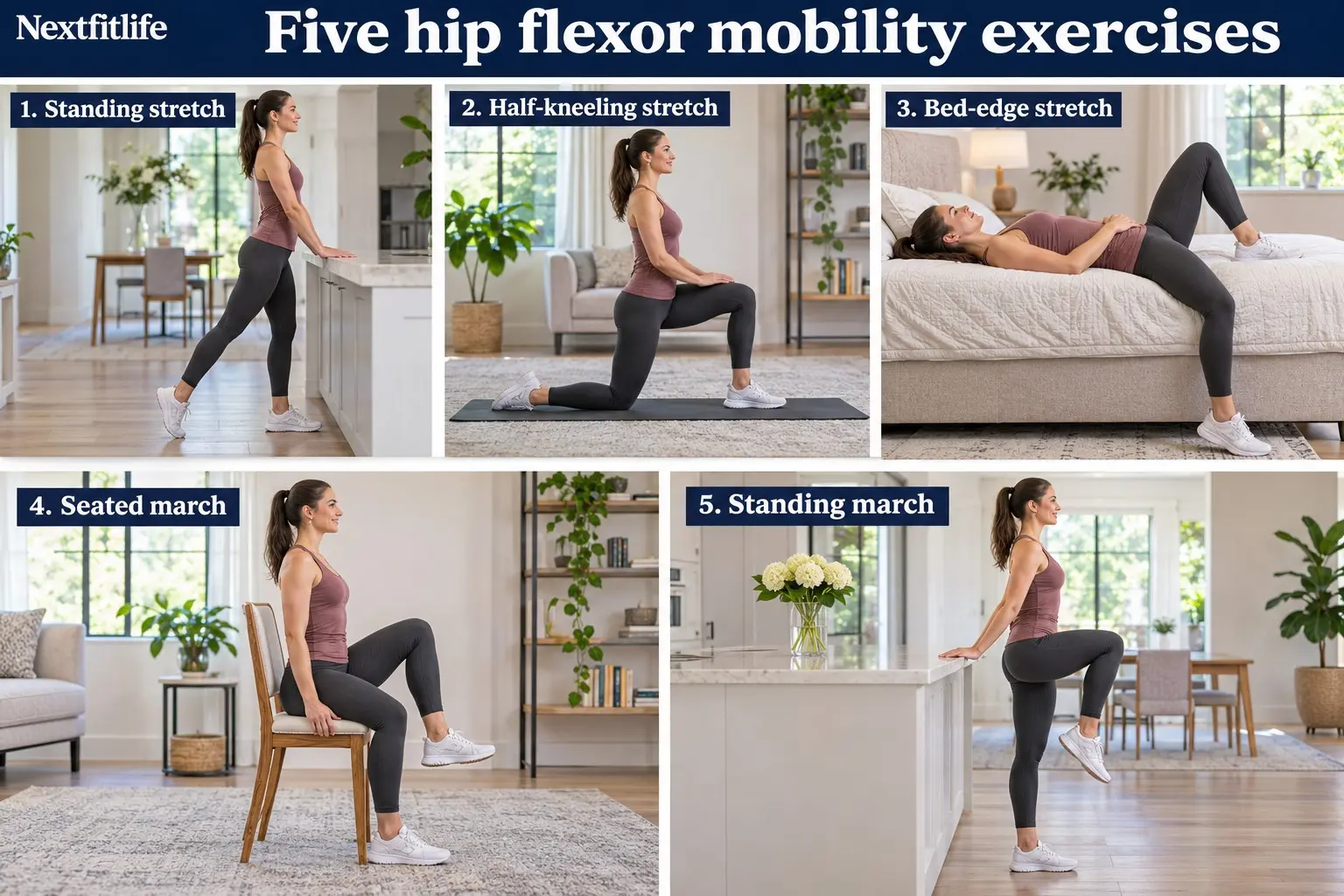
1. Supported standing hip flexor stretch
This is a useful first move if you have a counter nearby or prefer to stay off the floor. The stretch goes to the hip of the leg you step back with. To work on the right side, start with the right foot behind you.
- Face a fixed counter and rest both hands on it. Stand tall with your feet about as far apart as your hips.
- Take a short step back with the right foot. Keep the feet on separate tracks, with room between them from side to side. Let the back heel rise if that feels natural.
- Soften the front knee. Breathe out and let the front of your belt tip up a little. Keep your chest over your hips.
- Shift your weight a small amount toward the front foot. Pause at the first mild pull at the front of the right hip or upper thigh.
- Take a few easy breaths for 10 to 20 seconds. Step back to the start, then change sides.
If you feel it in your lower back: Back out of the shift. Shorten your step, let your ribs settle, and try again with less range. You might feel the right area with just a small change in how you stand. If the back keeps hurting, leave this move out.
If you feel it mostly in your calf: Check that you are free to lift the back heel. You can also put the rear foot a bit closer to the front foot. If you need to grip the counter hard to hold the pose, bring the feet closer and keep the weight shift small. Finish by bringing the rear foot in before you let go of the counter. HSS hip flexor stretch guidance.
2. Half-kneeling hip flexor stretch
Use this version if you can get down to the floor and stand back up with ease. A folded towel or mat can pad the rear knee. Keep a firm support close if you need one. To stretch the right side, put the right knee on the mat.
- Place your left foot flat in front of you. Give your feet and knees some width so the pose feels stable.
- Bring your ribs above your hips. Breathe out, tip the front of your belt up a little, and gently tighten the right buttock.
- Move your body forward a small amount until you feel a light pull at the front of the right hip or thigh.
- Hold for 10 to 20 seconds while you breathe. Move back to the start and repeat on the other side.
Check the rear side. When your right knee is on the floor, expect the pull on the right. If most of the effort is in the front thigh, you may have leaned too far or put the front foot too close. Reset with a little more room for the front foot and make the shift smaller.
Keep the knee comfortable. A pad can make a firm floor easier to kneel on. If the kneeling knee still hurts with a pad, use the supported standing version. If you tend to arch your back, keep your hands low on a support and look straight ahead. An easy hold gives you time to breathe and feel where the motion comes from. HSS half-kneeling stretch instructions.
3. Gentle bed-edge hip flexor stretch
This option uses a firm bed without asking you to balance in a split stance. Choose an edge that lets you lie on your back with your hips and trunk well supported. If you would need to perch, slide, or twist to get in place, choose the standing stretch.
- Lie on your back near the right edge, with your upper body and hips on the bed.
- Bend your left knee and rest that foot flat on the bed. Keep the lower back in an easy position.
- Slowly let the right thigh lower a little over the edge with the knee at ease. Pause as soon as you feel a light pull at the front of the right thigh or hip.
- Try about 10 seconds. Bring the leg back onto the bed before you move to the other side.
Let the leg settle gently. The bed should feel stable under you. If the back arches, the leg may have dropped farther than you can control with ease. Bring it back up and try a smaller dip. If your knee, back, or hip hurts in the setup, come out of the pose. Use a version you can enter and leave at your own pace.
This version can feel quite different from the standing stretch because the bed carries most of your weight. The mild pull at the front of the hip is enough. If the mattress is soft enough that you have to brace against rolling, choose a counter for a more stable setup. HSS bed-edge stretch guidance.
4. Seated march
The chair march is an active hip flexor exercise. Try it if you want to practice lifting a foot and setting it down with control. Use a solid chair without wheels and a seat height that lets you rest both feet flat.
- Sit upright with both feet down, a little away from the chair back. Hold the sides of the seat for support if that helps.
- Keep one foot down while you lift the other foot a little. Let the knee stay bent.
- Set the foot back down softly. Take a breath and switch sides.
- Try five lifts on each side. Rest both feet at the end.
Watch for a lean. If your chest tips back each time you lift, try raising the foot just enough to clear the floor. Give the foot time to come down. A slow lift and a soft landing are easy targets you can see and hear. They give you a way to judge the move even if you barely feel the muscle work.
Check for a pinch at the top. Lower the height of your lift and see if the range feels easy. If you still get a pinch, stop the move. If the same pain shows up when you put on a shoe, get into a car, or walk up stairs, tell a health care professional which actions bring it on. NHS sitting exercises and hip marching.
5. Supported standing march
This march adds a small weight shift. When you lift your right foot, the left leg takes your weight with help from the counter. Use both hands so you can focus on the lift and return.
- Face a fixed counter with feet about hip-width apart. Take off any loose slippers that might slip.
- Let your weight settle over the left foot. Lift the right foot just above the floor with the right knee bent.
- Set the right foot down. Get steady on both feet before you change sides.
- Try five lifts per side, with a short pause between each one.
Start low. Your knee can stay well below waist height. A low lift is easier to control if you are new to the move, and it gives you time to feel your weight shift. If the standing knee feels locked or you sway to the side, put both feet down and reset. If you still feel unsteady with both hands on the counter, use the chair march.
A slow march can fit into a break at home, such as while you wait for the kettle. Save it for a time when you can hold the counter and give the move your full attention. If you are already holding a mug or the counter is wet, take a short walk and try it later. National University Health System guide to seated and standing marching.
How much should you do?
Try one round on the first day. For a stretch, take one short hold on each side. For a march, do one set of five lifts on each side. If you try both, take a short pause between the two so you can tell how each one feels. You can start with less if the setup is new to you.
Make the first hold short
Ten to twenty seconds gives you time to check your form and take a few breaths. Start near the low end if you are still learning where you should feel the pull. If the stretch feels mild and you can leave the pose smoothly, you may work up toward 20 to 30 seconds over several sessions. That is an option when a hold feels useful, not a deadline to reach. See our guide to how long to hold a stretch for more examples.
Use the next day as feedback
See how you feel while you practice, when you walk away, and the next time you do a task that matters to you. You might notice that the first few steps after lunch feel the same, even if the stretch felt good. You can still use it when you like it. If the next day brings new soreness that makes ordinary tasks harder, give the drill a break or use a smaller amount when you return to it. If pain persists or returns often, seek advice.
When five knee lifts feel easy, try six next time or see if you can lower each foot a little more slowly. Change one thing at a time. For example, keep the same lift height while you add a rep. That makes it easier to see which change felt good. You can keep the same short hold or rep count on busy days.
Keep some time for walking and strength
A short set of hip exercises can fit into a bigger plan. Give yourself a chance to walk, and make room for strength work that uses more of your body. The CDC encourages adults to move more and sit less and sets separate weekly goals for aerobic and strength activity. You can build toward those goals in small blocks that suit your day. CDC adult activity guidelines.
If you are building a routine from scratch, the Fitness for Beginners guide has options for getting started. Pick one change you can fit into a real day, such as taking a short walk after lunch or setting aside time for a simple strength session.
How can you fit this into your day?
At work, use a break you already have
Say you have just finished a long call. Stand up, let both feet settle, and walk to get water. Take your usual steps on the way back. If the front of your hip feels better by the time you reach the desk, you can keep the walk as your break. If you still feel a mild pull as you step, try one standing stretch at a fixed counter, then take a few easy steps again.
If you sit through one call after another, pick a point you can see coming. You might walk after the first call of the morning and do a chair march after lunch. A daily cue you already have can be easier to use than a timer that goes off while you are busy. You can start with one cue and add a second later if it fits.
After a drive, give yourself room to move
Once you have parked and can get out safely, take a short walk on level ground. Use your normal pace and give yourself enough room to turn. If you want a stretch when you get home, set up beside a fixed counter. Try one hold on each side before you sit down again. If you feel fine after the walk, the walk may be all you need that day.
At home, pair a stretch with one type of march
Walk for a few minutes, then pick one stretch. Take a short hold on each side. Rest, then choose the seated or standing march and try five slow lifts per side. End with a few normal steps. The stretch gives you time to explore the thigh moving back. The march gives you a chance to lift the thigh and return it with care.
You can use a simple note to see which version you like. Write down the move you chose, how it felt, and what the next few steps felt like. For instance, “walked, tried the standing stretch, and had easier first steps back to the desk” is enough. If your upper back also feels stiff after a long work block, try the separate thoracic mobility guide when you have time to work on that area.
What if a move feels wrong?
The stretch turns into a deep pinch
Come out of the pose. A light pull along the front of the thigh can feel spread out, while a pinch may feel sharp or deep in one spot. If you get that pinch each time you move in or out of the pose, leave the exercise out. If it also happens on stairs, during a walk, or when you sit low, ask for an assessment and describe when it starts. The pattern can help a clinician decide what to check. NHS guidance on hip pain and when to seek care.
One side moves farther than the other
Use the range each side can handle on that day. In a standing stretch, one side may feel a pull with a very small step back. In a chair march, your right foot might lift a little higher than your left. Use the same slow pace and let each side set its own range. A change that is painful, getting worse, or affecting how you walk is a reason to get help.
You have had hip surgery or a recent injury
Follow the plan from your care team. Ask which positions you can use, how far you can move, and whether you can put your full weight on the leg. Those details matter when you step back in a stretch, kneel on a mat, or shift your weight in a march. Bring the name of the move you want to try so the team can suggest a suitable version. AAOS guidance on hip exercise after injury or surgery.
You keep needing a bigger stretch to feel anything
Pause and think about the task you want to feel easier. If you can get up and walk well, you can finish the stretch at a mild pull or use a march for that session. If your goal is to clear a curb with ease, a slow, low knee lift gives you a movement closer to that task. If your usual walk, sleep, or daily tasks are getting harder, an assessment can help you decide what kind of care makes sense. The Recovery & Injury Prevention hub has more on how to respond when an exercise brings on symptoms.
What should you try today?
Pick the next time you can get up after a long sit. Walk at an easy pace. If you want to stretch, try the supported standing version for one short hold on each side. If you want to work on the lift, use the chair march for five slow lifts per side. Check how you feel in your next few steps and choose the move you would use again.
References and Sources
- Hospital for Special Surgery. Four hip flexor stretches from a physical therapist. Stretch options, including the bed-edge setup.
- Hospital for Special Surgery. Hip stretches and strengthening exercises. Half-kneeling setup and form.
- Harvard Health Publishing. Hip flexor stretches for people who sit most of the day. Hip flexor anatomy and everyday movement.
- NHS. Sitting exercises. Chair setup and seated hip marching.
- NHS. Hip pain in adults. Emergency, urgent, and routine care signs.
- American Academy of Orthopedic Surgeons. Hip conditioning program. Warm-up and guidance after injury or surgery.
- National University Health System. Falls prevention guidebook. Examples of sitting and standing marching.
- Konrad A, et al. Chronic effects of stretching on range of motion. Systematic review and meta-analysis, Journal of Sport and Health Science, 2024.
- Centers for Disease Control and Prevention. Adult activity overview. Guidance on sitting less, aerobic activity, and strength work.
Related NextFitLife Guides
- Yoga & Flexibility hub for more stretching and mobility guides.
- Hip mobility routine for desk workers for hip rotation, inner thigh work, and simple strength moves.
- Fitness Hub for walking, strength, and beginner exercise plans.
Frequently Asked Questions
What is a good hip flexor exercise after sitting?
Walk for a minute or two first. If you still want a stretch, try the supported standing hip flexor stretch for 10 to 20 seconds on each side. For an active knee lift, try five slow chair marches per side.
Can I work on hip flexor mobility without kneeling?
Yes. Use a fixed counter for the standing stretch, or use a firm chair for seated marches. The stretch lets your thigh move back a little. The march lets you lift your thigh with your own muscles.
Where should I feel a hip flexor stretch?
In a standing or half-kneeling stretch, look for a mild pull at the front of the rear hip or upper thigh. If you feel a deep pinch, sharp pain, or tingling, come out of the position.
How long should a beginner hold a hip flexor stretch?
Try 10 to 20 seconds per side to start. Keep the pull mild and breathe as usual. After a few easy sessions, you can try 20 to 30 seconds if the stretch feels comfortable.
Should I stretch both sides if only one side feels stiff?
You can try one gentle hold per side. Let each side use its own comfortable range. Seek advice if the difference comes with pain, gets worse, or changes how you walk.
Do I need to do hip flexor exercises every day?
You can take short walks or change position each day and add an exercise when it feels useful. Start with a few easy sessions and see how you feel during the move and the next day.