First published: May 27, 2023
Last updated: July 30, 2026
Written and source checked by: Adel Galal
Clinical review status: This article has not been reviewed by a dentist or dental hygienist.
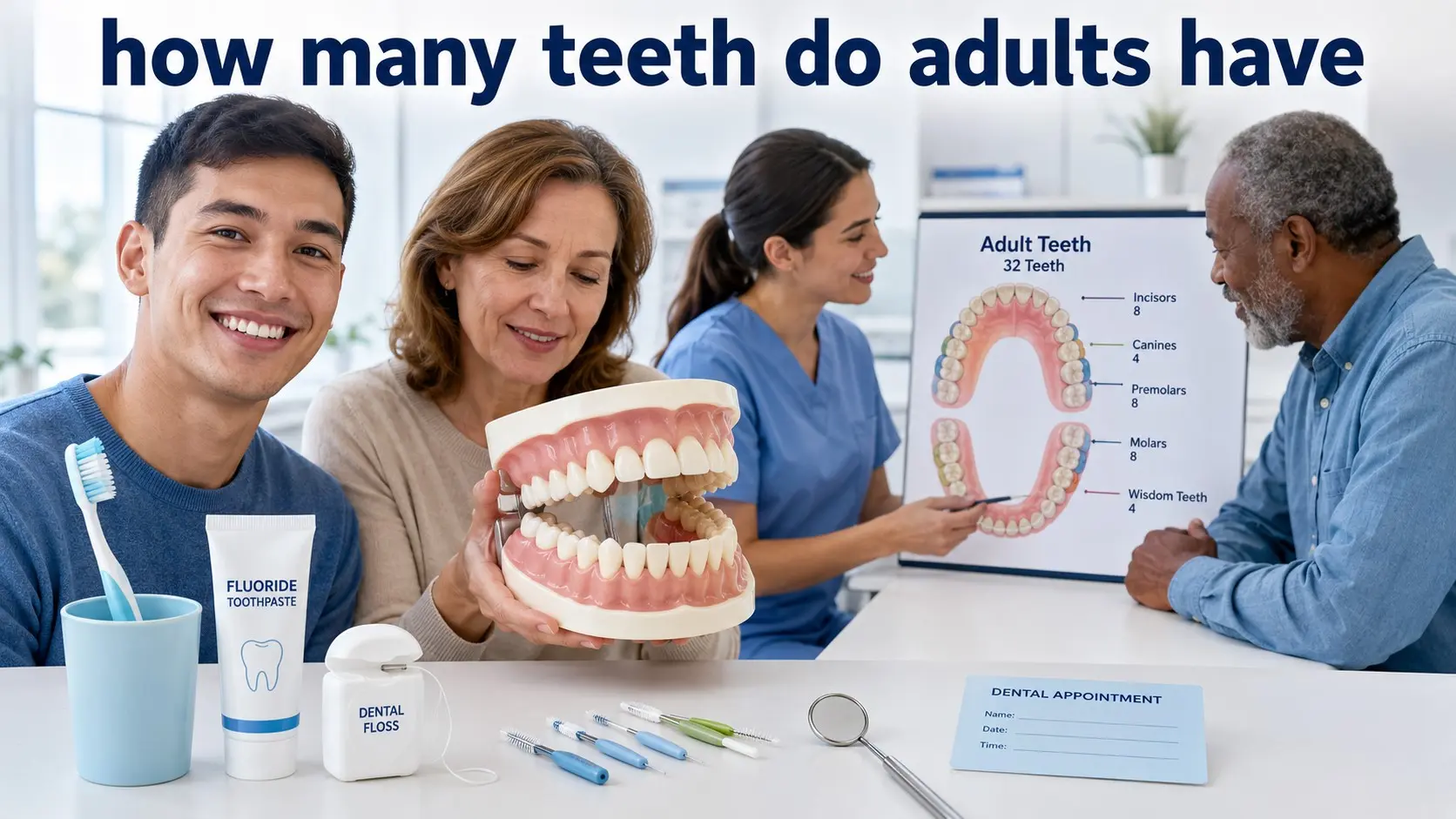
Most adults can have 32 permanent teeth when all four wisdom teeth are present.
Adults without wisdom teeth usually have 28 teeth.
Having fewer than 32 teeth does not always mean something is wrong.
Some people never develop wisdom teeth.
Some have them removed.
Other teeth may be missing from birth, lost through injury, or removed because of decay or gum disease.
The normal adult set includes:
- Eight incisors
- Four canines
- Eight premolars
- Twelve molars
The twelve molars include four wisdom teeth.
This guide answers how many teeth do adults have, what each tooth does, when adult teeth appear, how dentists number them, why teeth may be missing, and when dental symptoms require care.
For more support, visit the Oral Care Guide, the Oral Hygiene Guide, and the Healthy Teeth Guide.
Important: Tooth pain, facial swelling, fever, pus, a loose permanent tooth, or trouble breathing needs prompt dental or medical attention.
Quick Answer
A full adult mouth normally has 32 permanent teeth.
This includes:
- Eight incisors
- Four canines
- Eight premolars
- Eight first and second molars
- Four wisdom teeth
Without wisdom teeth, the normal count is 28.
The upper jaw normally holds 16 teeth.
The lower jaw normally holds 16 teeth.
Each side normally has eight teeth when the wisdom tooth is present.
The Four Types of Adult Teeth
| Tooth type | Number | Main job | Position |
|---|---|---|---|
| Incisor teeth | 8 | Cut and bite food | Front of the mouth |
| Canine teeth | 4 | Grip and tear food | Beside the lateral incisors |
| Premolar teeth | 8 | Crush and begin grinding food | Between canines and molars |
| Molar teeth | 12 | Crush and grind food | Back of the mouth |
Incisors
Adults normally have eight incisors.
There are four in the upper jaw and four in the lower jaw.
They include:
- Four central incisors
- Four lateral incisors
Their thin edges help cut food.
They also support speech and the appearance of the smile.
Canines
Adults normally have four canines.
There are two in the upper jaw and two in the lower jaw.
They sit beside the lateral incisors.
Canines have pointed crowns and long strong roots.
They help grip and tear food.
They also help guide jaw movement.
Premolars
Adults normally have eight premolars.
Children do not have premolars in their first set of teeth.
Premolars replace the primary molars.
There are:
- Four first premolars
- Four second premolars
Their broad chewing surfaces help crush food.
Molars
Adults can have twelve molars.
They include:
- Four first molars
- Four second molars
- Four third molars
Third molars are better known as wisdom teeth.
The large chewing surfaces of molars grind food before swallowing.
Wisdom Teeth
Wisdom teeth are the four possible third molars at the back of the mouth.
They often appear between ages 17 and 21.
Some people develop all four.
Some develop one, two, or three.
Some develop none.
A wisdom tooth may:
- Erupt normally
- Erupt partly
- Remain under the gum
- Grow at an angle
- Press against a nearby tooth
A tooth that cannot erupt normally is called an impacted wisdom tooth.
Do Wisdom Teeth Always Need Removal?
No.
Healthy wisdom teeth, fully erupted, painless, and easy to clean may remain in place.
Removal may be considered when a wisdom tooth causes:
- Repeated pain
- Infection
- Tooth decay
- Gum disease
- Damage to a nearby tooth
- A cyst
- Food trapping
- Repeated swelling
A dentist may use an examination and dental X ray to assess the tooth.
How Many Upper and Lower Teeth Do Adults Have?
A complete adult mouth has:
- 16 upper teeth
- 16 lower teeth
Without wisdom teeth, there are normally:
- 14 upper teeth
- 14 lower teeth
The teeth are usually arranged evenly on the right and left sides.
Each complete quarter of the mouth has:
- Two incisors
- One canine
- Two premolars
- Three molars
Adult Teeth Compared With Baby Teeth
| Feature | Primary teeth | Permanent teeth |
|---|---|---|
| Total possible number | 20 | 32 |
| Incisors | 8 | 8 |
| Canines | 4 | 4 |
| Premolars | 0 | 8 |
| Molars | 8 | 12 |
| Wisdom teeth | 0 | Up to 4 |
Primary teeth hold space and guide the development of permanent teeth.
They should still be treated when they develop decay or infection.
When Do Permanent Teeth Appear?
The first permanent molars often appear around ages five to seven.
Permanent incisors commonly appear during the early school years.
Premolars and canines usually appear later.
Second molars commonly emerge during the early teen years.
Wisdom teeth may appear in late adolescence or early adulthood.
Timing differs from one person to another.
How Dentists Number Adult Teeth
Dentists use numbering systems to record treatment clearly.
The system depends on the country.
Universal Numbering System
This system is common in the United States.
Adult teeth are numbered from 1 to 32.
Number 1 is the upper right wisdom tooth.
The count moves across the upper jaw to number 16.
It then continues from the lower left wisdom tooth, number 17, across to the lower right wisdom tooth, number 32.
FDI System
This system divides the mouth into four sections.
Each tooth receives two numbers.
The first number identifies the section.
The second number identifies the tooth position from the center.
Palmer System
This system uses section symbols and numbers from 1 to 8.
Your dental record may use any of these systems.
Basic Tooth Anatomy
Crown
The tooth crown is the visible part above the gum.
Root
The tooth root holds the tooth inside the jawbone.
Enamel
Tooth enamel is the hard outer covering of the crown.
It protects the softer tissue below.
Dentin
Tooth dentin lies below enamel and cementum.
It is naturally more yellow and can carry sensations toward the pulp.
Pulp
The dental pulp contains nerves and blood vessels.
Cementum
Cementum covers the root and helps attach the tooth to supporting tissues.
Why Might an Adult Have Fewer Than 32 Teeth?
Possible reasons include:
- Wisdom teeth never developed
- Wisdom teeth were removed
- Congenitally missing teeth
- Tooth decay
- Gum disease
- Dental injury
- Orthodontic extraction
- A failed root canal
- A cracked tooth
- A retained tooth under the gum
A dental examination and X ray can show whether a tooth is missing, hidden, or previously removed.
Can an Adult Have More Than 32 Teeth?
Yes, but it is less common.
Extra teeth are called supernumerary teeth.
They may appear anywhere in the mouth.
An extra tooth may:
- Erupt normally
- Stay inside the jaw
- Block another tooth
- Cause crowding
- Cause no clear problem
A dentist or oral surgeon can decide whether monitoring or removal is appropriate.
How Many Natural Teeth Does the Average Adult Have?
A complete adult set contains 32 teeth.
Real population averages are lower because many adults have missing or extracted teeth.
United States oral health data report that:
- Adults ages 20 to 64 have an average of 26 remaining natural teeth
- Adults age 65 and older have an average of 21 remaining natural teeth
These figures do not mean tooth loss is an unavoidable part of aging.
Many teeth can remain healthy for life with prevention and dental care.
Common Causes of Adult Tooth Loss
Tooth Decay
Tooth decay begins when acids made by oral bacteria damage enamel.
Untreated decay may reach the pulp and cause infection or tooth loss.
Gum Disease
Gum disease damages the tissues and bone that support the teeth.
Advanced disease may make teeth loose.
Dental Injury
A fall, collision, sport injury, or accident may crack or knock out a tooth.
Cracked Teeth
A deep crack may make a tooth impossible to restore.
Failed Dental Treatment
Some heavily damaged teeth cannot be saved even after treatment.
What Happens When a Tooth Is Missing?
The effect depends on the tooth and location.
A missing tooth may cause:
- Difficulty chewing
- Changes in speech
- Movement of nearby teeth
- Changes in the bite
- Food trapping
- Jawbone loss
- Appearance concerns
Not every missing wisdom tooth needs replacement.
Other missing teeth may benefit from replacement.
Ways to Replace Missing Adult Teeth
Dental Implant
A dental implant is placed in the jawbone and supports a crown, bridge, or denture.
It needs enough bone, healthy tissues, surgery, and ongoing cleaning.
Dental Bridge
A dental bridge is a fixed replacement supported by nearby teeth or implants.
Partial Denture
Partial dentures replace some missing teeth and can usually be removed for cleaning.
Complete Denture
Complete dentures replace all teeth in the upper jaw, lower jaw, or both.
A dentist can compare cost, health, function, cleaning, and long-term needs.
How to Protect Adult Teeth
- Brush twice daily with fluoride toothpaste.
- Clean between the teeth every day.
- Spit out excess toothpaste after brushing.
- Limit frequent sugary food and drinks.
- Drink water regularly.
- Avoid smoking and tobacco.
- Wear a mouthguard during contact sports.
- Attend dental examinations based on your needs.
- Seek treatment early for pain or damage.
Read the Oral Hygiene Guide for a complete routine.
How to Count Your Own Teeth
You can make a rough count at home.
- Wash your hands.
- Stand in good light.
- Start with the upper right back tooth.
- Move across the upper jaw.
- Count the lower jaw in the same way.
- Do not force your fingers behind a painful area.
A home count may miss:
- Unerupted wisdom teeth
- Partly erupted teeth
- Retained roots
- Extra teeth inside the jaw
A dentist and X-ray provide a more accurate assessment.
When to See a Dentist
Arrange dental care for:
- Tooth pain
- Sensitivity that continues
- A visible hole
- A broken tooth
- A loose permanent tooth
- Bleeding gums
- Swollen gums
- Bad breath that continues
- A wisdom tooth that repeatedly hurts
- A tooth that changes color
- Difficulty chewing
- A missing tooth that affects function
When Dental Symptoms Are Urgent
Seek urgent dental or medical help for:
- Fast facial swelling
- Trouble breathing
- Trouble swallowing
- Severe pain with fever
- Swelling near the eye
- Heavy bleeding
- A permanent tooth knocked out
- A spreading dental infection
A knocked out permanent tooth is a dental emergency. Hold it by the crown, avoid touching the root, and seek urgent dental care.
Common Adult Teeth Myths
Myth: Every Adult Has Exactly 32 Teeth
Some adults have fewer because wisdom teeth never developed, were removed, or another tooth is missing.
Myth: Adults Have 36 Teeth
The usual complete permanent set contains 32 teeth.
Myth: Wisdom Teeth Always Need Removal
Healthy wisdom teeth that are painless and easy to clean may remain.
Myth: Losing Teeth Is a Normal Part of Aging
Age raises some risks, but many natural teeth can last for life.
Myth: A Missing Back Tooth Does Not Matter
Missing teeth may affect chewing, movement of nearby teeth, and the bite.
Myth: Dental Implants Cannot Develop Problems
Implants need cleaning and professional monitoring.
Myth: Dentures Replace the Need for Oral Care
Dentures, gums, tongue, and remaining teeth still need daily cleaning.
Myth: Baby Teeth Do Not Matter
Primary teeth support eating, speech, and proper spacing for permanent teeth.
Five High Authority References and Sources
Cleveland Clinic: Teeth Anatomy, Types, Function and Care
Open medically reviewed guidance on the normal adult tooth count, tooth anatomy, tooth types, function, development, and oral care.
Merck Manual: Identifying the Permanent Adult Teeth
An open dental diagram identifying all 32 permanent teeth and their standard United States tooth numbers.
American Dental Association MouthHealthy: Wisdom Teeth
Open dental guidance on third molars, common eruption age, monitoring, impaction, and reasons treatment may be required.
National Institute of Dental and Craniofacial Research: Tooth Decay
Open guidance on how decay starts, cavities, pain, infection, prevention, fluoride, and treatment.
National Institute of Dental and Craniofacial Research: Gum Disease
Open guidance on infection of tooth-supporting tissues, risk factors, symptoms, diagnosis, treatment, and prevention.
Conclusion
The answer to how many teeth do adults have is normally 32 when all wisdom teeth are present.
Without wisdom teeth, the usual count is 28.
The full set includes incisors, canines, premolars, and molars.
Some adults naturally have fewer or more teeth.
Others lose teeth through decay, gum disease, injury, or extraction.
Call to action: Count the visible teeth in your mouth, review your brushing and interdental cleaning routine, and book a dental examination if you have pain, loose teeth, missing teeth, or wisdom tooth symptoms.
Related NextFitLife Guides and Hubs
Medical and Dental Disclaimer
This article provides general education about adult teeth and oral health.
It does not diagnose tooth decay, gum disease, tooth injury, wisdom tooth impaction, infection, or another dental condition.
It does not replace a dental examination, dental X-ray, diagnosis, prescription, treatment plan, or emergency dental care.
This content is for general educational purposes and does not replace professional medical advice, diagnosis, or treatment. Consult an appropriately qualified healthcare professional for personal medical concerns. This article explains published guidance and does not provide a personal clinical assessment. Always consult qualified medical professionals for diagnosis and treatment of any health condition.
I am also not a dentist or dental hygienist. Consult a qualified dental professional for diagnosis and treatment of tooth, gum, jaw, and mouth conditions.
About the Author
Frequently Asked Questions
How many teeth do adults have?
Adults can have 32 permanent teeth when all four wisdom teeth are present.
How many teeth do adults have without wisdom teeth?
Adults normally have 28 teeth without the four wisdom teeth.
How many upper teeth do adults have?
A complete adult upper jaw normally contains 16 teeth, or 14 without wisdom teeth.
How many lower teeth do adults have?
A complete adult lower jaw normally contains 16 teeth, or 14 without wisdom teeth.
What are the four types of adult teeth?
The four types are incisors, canines, premolars, and molars.
How many incisors do adults have?
Adults normally have eight incisors, with four in each jaw.
How many canines do adults have?
Adults normally have four canine teeth.
How many premolars do adults have?
Adults normally have eight premolars.
How many molars do adults have?
Adults can have twelve molars when the four wisdom teeth are included.
Does every adult have four wisdom teeth?
No. Some people develop fewer than four, while others do not develop any.
Do wisdom teeth always need removal?
No. Healthy wisdom teeth that cause no problems and can be cleaned may remain in place.
Can an adult have more than 32 teeth?
Yes. Extra teeth are called supernumerary teeth, but they are less common.
Why do some adults have only 24 or 26 teeth?
They may have had wisdom teeth or other teeth removed, never developed certain teeth, or lost teeth through decay, gum disease, or injury.
Should a missing adult tooth be replaced?
It depends on its location, function, bite, bone, nearby teeth, and personal health. A dentist can assess the options.
When should I see a dentist?
Seek dental care for pain, swelling, a loose tooth, a broken tooth, bleeding gums, a visible hole, or wisdom tooth symptoms.

Health & wellness writer with 30+ years of experience in nutrition, fitness, and healthy aging. Founder of NextFitLife.com — evidence-based health guidance.