Published on: June 2026
Updated on: October 20, 2026
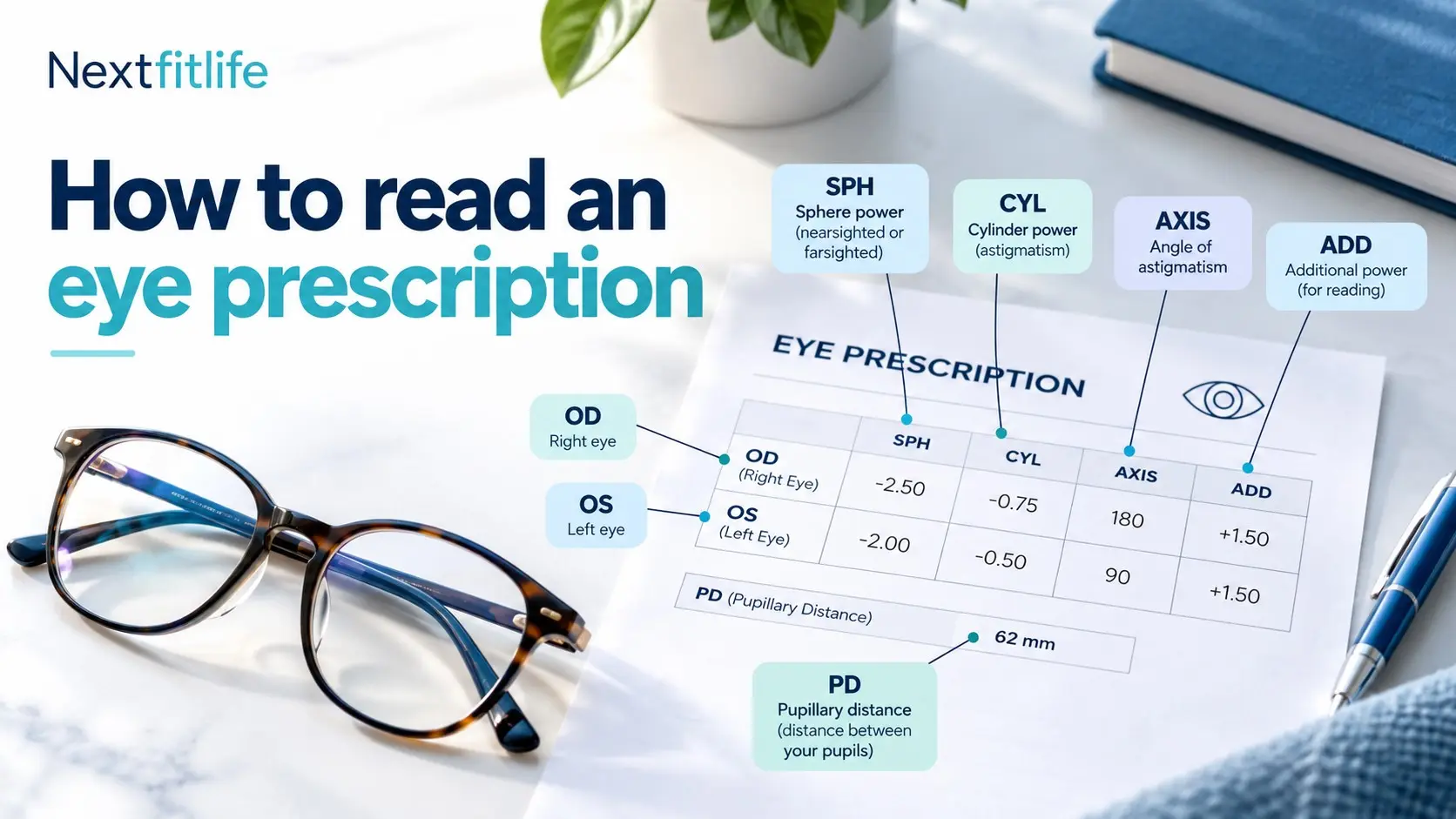
How to read an eye prescription becomes much easier once you know that every number has one job. OD and OS tell you which eye the row belongs to. SPH shows the main focusing power. CYL and AXIS describe astigmatism. ADD provides extra near power, while prism may help with eye alignment.
The prescription is not a report card for how “good” or “bad” your eyes are. It is a set of optical instructions used to make lenses that focus light more accurately on the retina.
Quick answer: A minus SPH usually means myopia, while a plus SPH usually means hyperopia. CYL shows the amount of astigmatism correction, and AXIS shows its orientation from 1 to 180 degrees. ADD is extra near power, most often used for presbyopia. PD helps position the optical centers of the lenses correctly.
Medical note: This article is for general information and education. It does not replace medical advice, diagnosis, or treatment.
I am not a dermatologist or a doctor, and this content does not replace professional medical advice. What I share comes from real life experience, extensive research, and consultation with healthcare providers. Always consult qualified medical professionals for diagnosis and treatment of any health condition.
First, Know What an Eye Prescription Can Tell You
An eyeglass prescription describes the lens powers and measurements needed to correct a refractive error.
The National Eye Institute lists four common refractive errors:
- Myopia, or nearsightedness
- Hyperopia, or farsightedness
- Astigmatism
- Presbyopia, the age related loss of near focusing ability
A prescription can tell you how much optical correction is needed, but it cannot tell you whether your retina, optic nerve, lens or other eye structures are healthy.
You can have a very small prescription and still have eye disease. You can also have a high prescription and otherwise healthy eyes.
That is why a prescription is not a substitute for a proper eye examination.
For a wider look at eye care, prevention and common vision conditions, visit the NextFitLife Eye Health and Vision Hub.
Table of Contents
- What an eye prescription tells you
- Sample prescription
- 12 essential codes and symbols
- OD
- OS
- OU
- SPH
- Plus and minus signs
- CYL
- AXIS
- ADD
- Prism
- Base direction
- PD
- Plano and visual acuity
- Worked prescription example
- How astigmatism is written
- How to compare old and new prescriptions
- Glasses versus contact lens prescriptions
- When a prescription change needs an eye exam
- Common myths
- Frequently asked questions
- References and Sources
What Does a Typical Eye Prescription Look Like?
Prescription forms vary between clinics, countries and optical systems, but a typical eyeglass prescription may look like this:
| Eye | SPH | CYL | AXIS | ADD | Prism |
|---|---|---|---|---|---|
| OD | −2.50 | −0.75 | 180 | +2.00 | Blank |
| OS | −1.75 | −1.25 | 165 | +2.00 | Blank |
This example describes two nearsighted eyes with astigmatism and extra near power for reading or multifocal lenses.
It does not tell us whether the person's retina, optic nerve or eye pressure is normal.
12 Essential Eye Prescription Codes and Symbols
1. OD Means Right Eye
OD comes from the Latin words oculus dexter, meaning right eye.
Anything written across the OD row applies to your right eye.
Some modern prescriptions simply use “R” or “RE” instead.
2. OS Means Left Eye
OS comes from oculus sinister, meaning left eye.
You may also see “L” or “LE.”
Do not assume the top or bottom line is always a particular eye. Read the label because different forms can be arranged differently.
3. OU Means Both Eyes
OU comes from oculus uterque, meaning both eyes.
It is used when an instruction or value applies to both eyes together.
OU is less common in the main prescription table because the two eyes often have different powers.
4. SPH Means Sphere
SPH, short for sphere, is the main lens power.
It is measured in diopters, often written as D.
Examples include:
- −0.50 D
- −2.25 D
- +1.00 D
- +4.50 D
The farther the number is from zero, the more optical power the lens contains.
That does not mean your eye itself is “weaker.” It only describes how much lens power is needed to focus light properly.
5. Plus and Minus Signs
The sign in front of SPH is important.
| Sign | Usually Means | Common Effect |
|---|---|---|
| − | Myopia | Distant objects tend to look blurry |
| + | Hyperopia | Near focusing may be harder, though symptoms vary |
| 0.00 | No spherical correction | Astigmatism or another correction may still be present |
A positive prescription does not always mean distance vision is perfectly clear, and hyperopia can affect people differently. The sign mainly tells the lens maker which type of spherical correction is needed.
6. CYL Means Cylinder
CYL shows the amount of lens power used to correct astigmatism.
Astigmatism happens when the cornea or lens has a shape that bends light differently in different directions.
CYL may be written as either a plus or a minus value depending on the notation system used by the prescriber.
That is an important point because the same astigmatism correction can often be written in two mathematically equivalent forms called plus cylinder and minus cylinder notation.
So, do not compare CYL values from two prescriptions without checking whether the notation system is the same.
7. AXIS Shows the Direction of Astigmatism Correction
AXIS is written as a number from 1 to 180 degrees.
It does not show how strong the astigmatism is.
Instead, it tells the optical laboratory how the cylinder correction should be oriented in the lens.
For example:
- CYL −1.00 AXIS 180
- CYL −1.00 AXIS 90
Both prescriptions have the same cylinder power, but the correction is positioned at a different angle.
If no cylinder correction is prescribed, an axis value is generally not needed.
8. ADD Means Addition Power
ADD is extra plus power used for near vision.
It is common on prescriptions for:
- Progressive lenses
- Bifocals
- Trifocals
- Some occupational lenses
ADD is most often needed because of presbyopia, the normal age related decline in the eye's ability to focus up close.
The National Eye Institute notes that presbyopia usually becomes noticeable in middle age, commonly after about age 45.
An ADD value might look like:
- +1.00
- +1.50
- +2.00
- +2.50
Do not use age alone to guess what ADD you need. Two people of the same age can need different near additions.
9. Prism Corrects Certain Alignment Problems
Prism correction may be prescribed when the two eyes are not working together comfortably or when double vision needs to be managed.
Prism bends light so the image appears in a position that is easier for the eyes and brain to combine.
The amount is usually measured in prism diopters and may be written with the triangular prism symbol.
For example:
2Δ BO
This means 2 prism diopters with the base directed outward.
10. Base Shows Prism Direction
If prism is prescribed, you may see one of four directions:
| Code | Meaning |
|---|---|
| BU | Base up |
| BD | Base down |
| BI | Base in |
| BO | Base out |
The prism amount and base direction work together. One without the other is not enough to manufacture the correction properly.
11. PD Means Pupillary Distance
PD stands for pupillary distance.
It is the distance, usually measured in millimeters, between the centers of your pupils or from the center of the nose to each pupil.
PD helps the optical laboratory position the optical center of each lens correctly in front of your eyes.
You may see:
- A single binocular PD, such as 63 mm
- Two monocular PD values, such as 32 mm right and 31 mm left
PD is an important dispensing measurement, but it is not always written on the original eyeglass prescription. In many settings, an optician measures it when fitting the glasses.
This matters if you order glasses online because the retailer may ask you for a PD even when it is not shown on the prescription form.
12. Plano, PL and Visual Acuity
Plano, sometimes written as PL, means zero spherical power.
It does not always mean the eye needs no correction at all. The eye may still have cylinder, prism or another lens instruction.
Visual acuity, often written as VA, describes how clearly you see on an eye chart.
You may see values such as:
- 20/20
- 20/40
- 6/6
- 6/12
Visual acuity is not the same thing as lens power.
A person with a strong prescription can achieve excellent corrected visual acuity, while another person may have a mild prescription but reduced acuity because of an eye condition.
A Worked Example: How to Read an Eye Prescription
Now let us decode this example:
| Eye | SPH | CYL | AXIS | ADD |
|---|---|---|---|---|
| OD | −2.50 | −0.75 | 180 | +2.00 |
| OS | −1.75 | −1.25 | 165 | +2.00 |
Here is what it means:
- Both SPH values are negative. The person has myopic distance correction in both eyes.
- The right eye has −2.50 SPH. The left eye has −1.75 SPH.
- Both eyes also have cylinder correction. This means the prescription includes astigmatism correction.
- The right eye cylinder is −0.75 at axis 180.
- The left eye cylinder is −1.25 at axis 165.
- Both eyes have ADD +2.00. Extra near power is needed for reading or a multifocal lens.
What can we not tell from this prescription?
- Whether the person has cataracts
- Whether the retina is healthy
- Whether eye pressure is high
- Whether glaucoma is present
- Whether the optic nerves are normal
- Whether they are suitable for contact lenses
That information comes from the eye examination, not from the spectacle prescription alone.
How Astigmatism Can Be Written Two Different Ways
This is one of the most useful details to know when comparing prescriptions.
Astigmatism prescriptions can often be written in either minus cylinder or plus cylinder notation.
For example, these two prescriptions can describe the same optical correction:
Minus cylinder: −2.00 −1.00 × 180
Plus cylinder: −3.00 +1.00 × 90
The numbers look different, but an optician or eye care professional can transpose one notation into the other.
This is why you should not assume your astigmatism suddenly changed just because CYL switched from a minus value to a plus value on a new form.
Does a Higher Prescription Mean Worse Eyes?
Not in the way many people think.
A number farther from zero means more lens power is needed to correct the refractive error.
For example, −6.00 D requires more minus lens power than −1.00 D.
But prescription power and eye health are different things.
A high myopic prescription can carry certain health risks, such as a greater risk of retinal problems, but a stronger prescription by itself does not prove that the eye is diseased.
The National Eye Institute notes that high myopia can increase the risk of conditions such as retinal detachment, which is one reason regular eye care matters.
If you are interested in the link between screens and nearsightedness, read our digital eye strain guide.
Can You Calculate Your Reading Prescription From ADD?
Sometimes you can understand the optical idea, but do not use the calculation alone to order glasses unless you know exactly what lens type was prescribed.
For a simple example:
Distance SPH: −2.00
ADD: +2.00
The spherical near power would mathematically become 0.00 D before considering cylinder and other prescription details.
Another example:
Distance SPH: +1.00
ADD: +2.00
The spherical near power becomes +3.00 D.
However, progressive and occupational lenses also depend on fitting height, frame measurements and intended working distance. An optician should handle those measurements.
What Do DV, NV and Intermediate Mean?
| Code | Meaning | Typical Use |
|---|---|---|
| DV | Distance vision | Driving, television, outdoor distance |
| NV | Near vision | Reading and close work |
| INT | Intermediate vision | Computer and arm's length tasks |
Intermediate distance is especially important for office lenses because computer screens are usually farther away than a book but much closer than a road sign.
What Does BAL Mean?
You may occasionally see BAL or “balance.”
This can be used when one lens is being made to balance the appearance, weight or optical characteristics of the pair rather than to provide full visual correction in that eye.
The exact meaning depends on the prescription and clinical situation, so ask the prescriber or dispensing optician rather than guessing.
How to Compare Two Eye Prescriptions Safely
Comparing prescriptions can be useful, but small differences do not always mean a major change in your eyesight.
Check each part separately.
Compare SPH
Look at whether the spherical power moved toward more minus, more plus or closer to zero.
Do not decide that a difference is “significant” from one fixed cutoff. The importance depends on your symptoms, age, baseline prescription and the rest of the refraction.
Compare CYL and AXIS Together
A cylinder change should be interpreted with its axis.
Also check whether one prescription uses plus cylinder and the other uses minus cylinder notation.
Compare ADD
ADD often increases gradually as presbyopia progresses, but the correct value depends on your working distance and visual needs.
Do Not Judge Change From PD
Adult pupillary distance is generally fairly stable, but PD is a fitting measurement rather than a measure of refractive error.
A small difference between two recorded PD values can reflect measurement technique rather than a change in your eyes.
Glasses Prescription Versus Contact Lens Prescription
A contact lens prescription is not the same as an eyeglass prescription.
Contact lenses sit directly on the eye. They also need to fit the cornea safely.
The FDA states that a valid contact lens prescription may include the lens power, manufacturer or material, base curve and diameter, along with other identifying information.
| Feature | Glasses Prescription | Contact Lens Prescription |
|---|---|---|
| SPH | Yes | Yes |
| CYL and AXIS | When needed | When a toric lens is prescribed |
| Base curve | No | Usually yes |
| Diameter | No | Often included |
| Brand or manufacturer | Usually not part of the prescription | Often specified |
| Fit assessment | Frame and lens fitting | Lens must fit the cornea safely |
Do not order contact lenses using only the numbers from your glasses prescription.
Even when the powers look similar, contact lens fitting involves more than power.
Why Contact Lens Power Can Differ From Glasses Power
Eyeglasses sit a short distance in front of the eye, while contact lenses sit on the cornea.
This difference becomes more important with higher prescriptions because moving a lens closer to the eye changes its effective power.
That calculation is only one part of contact lens prescribing. The clinician must also choose a lens that fits the eye properly.
How Do You Know Whether a Prescription Is for Distance or Reading?
A prescription may say:
- Distance
- DV
- Near
- NV
- Reading
- Intermediate
- Computer
If an ADD is present, the prescription may be intended for bifocals, progressives, trifocals or another multifocal design.
Do not assume that a prescription with plus power is automatically “reading glasses.” Plus lenses can also be prescribed for hyperopia at distance.
What Is a Progressive Lens Prescription?
A progressive lens usually uses the distance prescription plus an ADD.
The lens then changes gradually from distance power at the top through intermediate power in the middle to near power lower in the lens.
Unlike traditional bifocals, progressives do not have a visible line.
Progressive lenses depend heavily on accurate fitting measurements, including the vertical position of the pupils in the chosen frame.
That is why a good frame fitting matters just as much as copying the prescription numbers correctly.
Can an Eye Prescription Expire?
Yes. Prescription validity depends on where you live and the type of lens.
Contact lens prescriptions are regulated differently from spectacle prescriptions in many countries because contact lenses are medical devices worn directly on the eye.
In the United States, the FDA notes that contact lens prescription expiration depends partly on state law, with federal rules setting certain minimum requirements when states do not specify one.
Do not assume that every eyeglass prescription worldwide automatically expires after exactly two years.
Follow the expiry date written on your prescription and local rules.
Do Glasses Make Your Eyes Weaker?
No.
Corrective lenses change the path of light before it enters the eye so that the image focuses more accurately.
The National Eye Institute states that wearing glasses does not make the eyes weaker or worsen vision.
Your prescription may change over time because your eyes change with growth, age or other factors. The glasses do not cause that change.
When Should a Prescription Change Be Checked?
A small prescription change can be normal.
Arrange an eye examination if you notice:
- New persistent blurry vision
- Frequent headaches with visual tasks
- New double vision
- Increasing difficulty reading
- Problems driving at night
- One eye becoming noticeably worse than the other
- A rapid change in prescription
- Vision that remains poor despite new glasses
Seek urgent medical care for sudden vision loss, a curtain or shadow over vision, many new floaters, flashing lights, or a painful red eye with blurred vision.
A prescription change cannot safely explain every sudden visual symptom.
Common Eye Prescription Mistakes
Mistake 1: Mixing Up OD and OS
OD is right eye. OS is left eye.
Always check the label rather than the physical position of the row on the page.
Mistake 2: Ignoring the Plus or Minus Sign
−2.00 and +2.00 are completely different prescriptions.
The sign is not optional.
Mistake 3: Treating AXIS as Lens Strength
AXIS shows orientation, not the amount of astigmatism.
CYL gives the power.
Mistake 4: Assuming PD Measures Vision
PD is a positioning measurement. It does not tell you whether you are nearsighted, farsighted or astigmatic.
Mistake 5: Ordering Contacts From a Glasses Prescription
Contact lenses require their own prescription and fitting.
Mistake 6: Assuming a Strong Prescription Means Eye Disease
Lens power measures refractive correction. Eye health requires a separate examination.
Mistake 7: Comparing Plus Cylinder With Minus Cylinder Directly
The same astigmatism correction can look very different after mathematical transposition.
Mistake 8: Using an Old Prescription Forever
Your vision and eye health can change. Use a current prescription and follow the examination schedule recommended by your eye care professional.
Eye Prescription Myths Worth Dropping
Myth 1: Minus Means Bad Eyes
No. Minus means the lens needs negative power, usually to correct myopia.
Myth 2: Plus Means Reading Glasses
Not always. Plus power may correct hyperopia at distance, presbyopia at near or both depending on the prescription.
Myth 3: Axis 180 Means Severe Astigmatism
No. Axis 180 only describes orientation. CYL tells you the amount of cylinder power.
Myth 4: A Zero SPH Means Perfect Vision
No. An eye with plano SPH can still have astigmatism, prism correction, reduced visual acuity or eye disease.
Myth 5: PD Is Your Prescription Strength
No. PD is a lens positioning measurement in millimeters.
Myth 6: Stronger Glasses Make Your Eyes Dependent
No. Correct glasses improve focus while you wear them. They do not weaken the eyes.
Myth 7: Your Glasses Prescription Can Diagnose Eye Disease
No. A prescription measures refractive correction. Diagnosing eye disease requires an eye examination and, when needed, additional testing.
Conclusion: How to Read an Eye Prescription With Confidence
Once you know the main codes, how to read an eye prescription becomes much less intimidating.
OD and OS identify the eyes. SPH gives the main spherical power. The plus or minus sign shows the direction of that correction. CYL and AXIS describe astigmatism, ADD provides near power, prism helps selected alignment problems, and PD helps position the lenses correctly.
The most important lesson is not to turn the numbers into a diagnosis. A prescription explains lens correction, not the full health of your eyes.
Your next step: keep a copy of each prescription and compare it with your next one, but ask your optometrist, ophthalmologist or optician whenever a code is unclear. If your vision changes suddenly or remains poor despite the correct lenses, arrange an eye examination rather than simply ordering stronger glasses.
Internal Links + Hub
- Eye Health and Vision Hub
- Digital Eye Strain Guide
- Night Vision Problems
- Eye Floaters and Retinal Warning Signs
- Simple Eye Care Tips
- UV Protection for Eyes
- Sleep and Eye Health
About the Author
Adel Galal is a father of four, three sons and a daughter, and a grandfather of four, with 33 years of hands on parenting experience. He is the founder of Parnthub.com, based in Cairo, Egypt, where he shares practical guidance on feeding, development and family life from newborns to teenagers.
Adel is not a medical professional. Health articles cite trusted sources and are for general information only.
For more information about NextFitLife, its editorial approach and content standards, visit the NextFitLife About Us page.
Frequently Asked Questions About Eye Prescriptions
What do OD and OS mean on an eye prescription?
OD means right eye, from the Latin term oculus dexter. OS means left eye, from oculus sinister. Some prescriptions use R and L or RE and LE instead.
What does SPH mean on an eye prescription?
SPH means sphere. It is the main lens power used to correct myopia or hyperopia and is measured in diopters. A negative SPH usually corrects myopia, while a positive SPH usually corrects hyperopia.
What do CYL and AXIS mean?
CYL is the amount of lens power used to correct astigmatism. AXIS shows the orientation of that cylinder correction from 1 to 180 degrees. AXIS does not show how severe the astigmatism is.
What does ADD mean on an eye prescription?
ADD is extra plus power used for near vision. It is often prescribed for presbyopia and used in bifocal, trifocal, progressive or other multifocal lenses.
What does plano mean?
Plano means zero spherical power. It may be written as PL or 0.00. An eye with plano sphere can still have cylinder, prism or another prescription component.
What does PD mean on an eye prescription?
PD means pupillary distance. It is a measurement in millimeters used to help center the optical areas of the lenses in front of the pupils. It may be recorded as one total value or separate right and left values.
Is a minus prescription worse than a plus prescription?
No. Minus and plus indicate different directions of lens power. A minus prescription usually corrects myopia, while a plus prescription usually corrects hyperopia or may be used as near addition power. Neither sign means the eye is healthier or less healthy.
Can I use my glasses prescription to buy contact lenses?
No. Contact lenses require a separate fitting and prescription. A contact lens prescription may include lens power, base curve, diameter and a specific lens brand or manufacturer in addition to other details.
Do stronger glasses make your eyes weaker?
No. Corrective lenses change how light enters the eye so that it focuses more clearly. Wearing an accurate prescription does not weaken the eyes or make refractive error progress simply because you use the glasses.
Can an eye prescription tell if I have glaucoma or cataracts?
No. An eyeglass prescription describes optical correction. Conditions such as glaucoma, cataracts, retinal disease and other eye problems require an eye examination and sometimes additional tests.
References and Sources
- National Eye Institute. Refractive Errors.https://www.nei.nih.gov/eye-health-information/eye-conditions-and-diseases/refractive-errors
- National Eye Institute. Types of Refractive Errors.https://www.nei.nih.gov/eye-health-information/eye-conditions-and-diseases/refractive-errors/types-refractive-errors
- National Eye Institute. Eyeglasses for Refractive Errors.https://www.nei.nih.gov/eye-health-information/eye-conditions-and-diseases/refractive-errors/eyeglasses-refractive-errors
- Cleveland Clinic. Got a New Eye Prescription? Here’s What It Means.https://health.clevelandclinic.org/how-to-read-your-eye-prescription
- U.S. Food and Drug Administration. Buying Contact Lenses.https://www.fda.gov/medical-devices/contact-lenses/buying-contact-lenses
- National Eye Institute. Astigmatism.https://www.nei.nih.gov/eye-health-information/eye-conditions-and-diseases/astigmatism
- National Eye Institute. Nearsightedness, Myopia.https://www.nei.nih.gov/eye-health-information/eye-conditions-and-diseases/nearsightedness-myopia
- Mayo Clinic. Presbyopia: Diagnosis and Treatment.https://www.mayoclinic.org/diseases-conditions/presbyopia/diagnosis-treatment/drc-20363329
Medical disclaimer: I am not a dermatologist or a doctor, and this content does not replace professional medical advice. What I share comes from real life experience, extensive research, and consultation with healthcare providers. Always consult qualified medical professionals for diagnosis and treatment of any health condition.

Health & wellness writer with 30+ years of experience in nutrition, fitness, and healthy aging. Founder of NextFitLife.com — evidence-based health guidance.