Published on: November 20, 2026
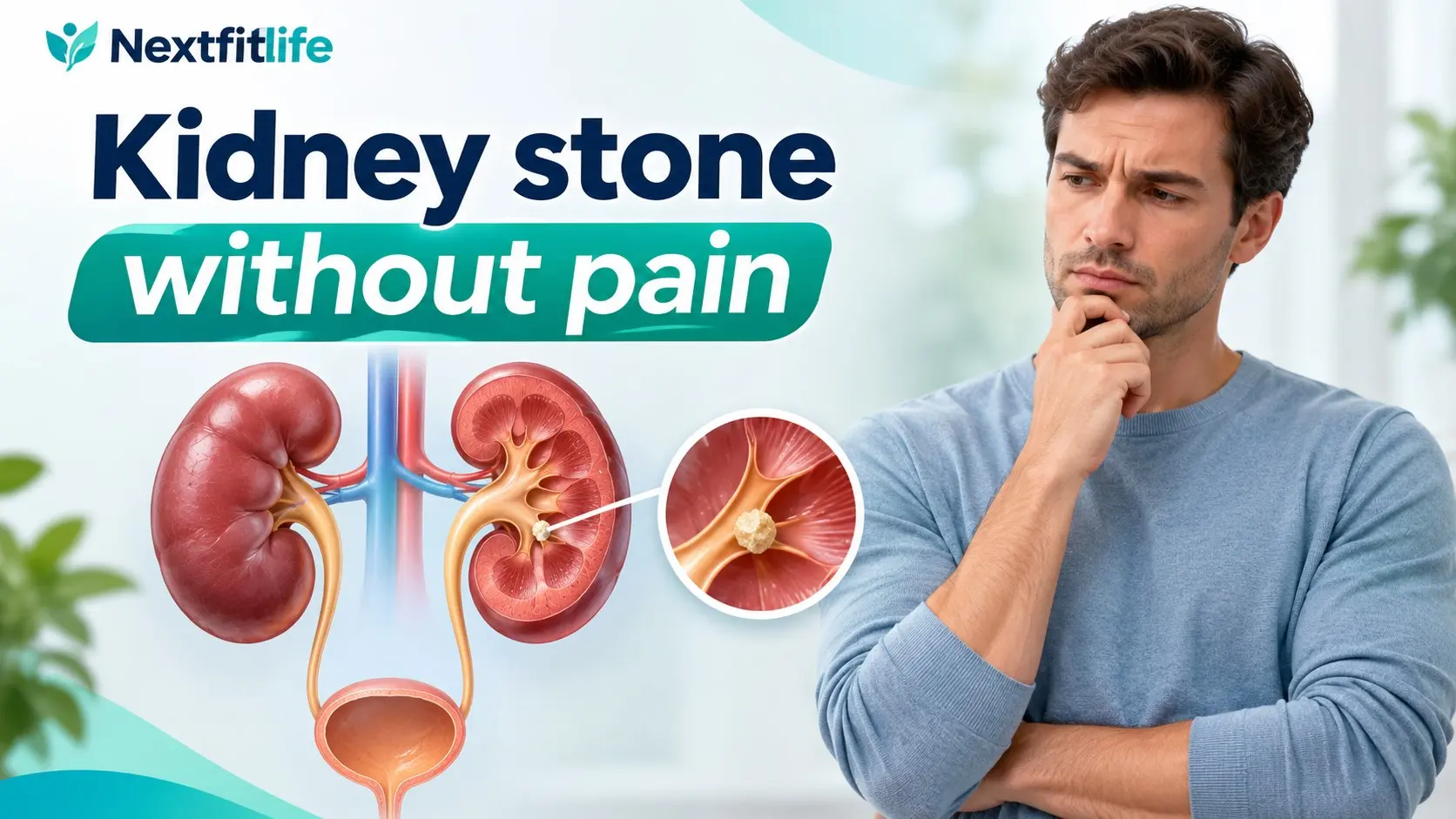
Yes, you can have a kidney stone without pain.
A stone may sit quietly inside the kidney, move with little irritation, or pass with few symptoms. The key point is simple: no pain does not prove that the stone is gone or harmless.
Quick answer: A kidney stone can cause no pain when it stays inside the kidney, does not block urine, or passes easily. The useful checks are the stone's size and location, whether urine flow is blocked, signs of infection, kidney function, and follow-up imaging when needed.
This article is for general information and education. It does not replace medical advice, diagnosis, or treatment.
Get urgent medical care if you have a known or suspected kidney stone with fever, chills, inability to urinate, very little urine, repeated vomiting, confusion, severe weakness, or rapidly worsening illness. A blocked urinary system with infection can be an emergency.
If you currently have severe stone pain, see the NextFitLife Kidney Stone Pain Guide. If you are trying to work out whether pain is coming from your kidney or your back, use the Kidney Pain vs Back Pain Guide.
Table of Contents
- Can a kidney stone cause no pain?
- 7 reasons a kidney stone may be painless
- Does no pain mean the stone is safe?
- Useful tests and checks
- Blood in urine without pain
- What if a scan finds a stone?
- Silent obstruction
- Infection and urgent care
- What if pain suddenly stops?
- When observation is reasonable
- Hydration and prevention
- 24 hour urine testing
- Watch, call, or seek urgent care
- Common mistakes
- References and Sources
- Internal Links and NextFitLife Hubs
- About the Author
- Frequently Asked Questions
Can a Kidney Stone Cause No Pain?
Yes.
Most people think of kidney stones as a cause of severe side or back pain. That pain often starts when a stone moves into the ureter or blocks urine flow.
A stone that stays inside the kidney may cause no pain at all.
Small stones may also pass with few symptoms. NIDDK notes that a small stone that moves easily through the urinary tract may cause no symptoms.
This means having a renal stone and having renal colic are not the same thing.
For a wider overview of stone causes, types, symptoms, and treatment, read the NextFitLife Kidney Stones Guide.
7 Reasons a Kidney Stone May Not Hurt
1. The Stone Is Still Inside the Kidney
A stone can stay in a kidney calyx without moving into the ureter.
Many of these stones are found by chance during an ultrasound or CT scan done for another reason.
This is often called an asymptomatic kidney stone or silent kidney stone.
The lack of pain is useful information, but it is not enough by itself. Size, location, growth, and urine flow matter too.
2. The Stone Is Small
Small stones have a better chance of passing on their own than large stones.
But size does not predict pain perfectly.
One small stone may cause severe pain, while another may move with little discomfort.
This is why I would never use pain alone to guess stone size.
3. The Stone Is Not Blocking Urine
A nonobstructing kidney stone may sit quietly in the kidney.
If there is no infection, no blockage, stable kidney function, and no stone growth, a clinician may recommend observation rather than immediate treatment.
Observation still needs a plan.
It does not mean forgetting that the stone exists.
4. The Stone Has Stopped Moving
Pain may improve when a stone stops moving or reaches a less sensitive position.
That does not prove it has passed.
A person can feel much better while the ureteral stone is still present.
If your clinician wants proof of passage, follow the agreed imaging or stone collection plan.
5. The Stone Was Found Before Symptoms Started
Modern scans find many things by accident.
A CT scan for abdominal symptoms or an ultrasound for another urinary problem may show a kidney stone before it ever hurts.
This gives you time to assess it instead of waiting for a painful episode.
6. You Have Other Signs Instead of Pain
No flank pain does not always mean no symptoms.
Other signs can include:
- Blood in urine
- Frequent urination
- Burning when urinating
- Urgency
- Cloudy urine
- Bad smelling urine
- Reduced urine output
These symptoms can also have other causes, so do not assume every urine change comes from a stone.
7. People Experience Stones Differently
Stone symptoms vary a lot.
Even the same person can have two very different stone episodes.
One stone may cause severe renal colic. Another may remain in the kidney for months or years with no clear symptoms.
Pain level is therefore a poor way to judge risk by itself.
Does No Pain Mean the Stone Is Safe?
No.
No pain can be reassuring, but it does not answer the main medical questions.
A clinician still wants to know:
- Where is the stone?
- How large is it?
- Is it blocking urine?
- Is infection present?
- Is kidney function normal?
- Is the stone growing?
- Do stones keep coming back?
A painless small stone inside the kidney is very different from a painless stone causing urinary obstruction.
That difference matters more than the pain score.
Which Tests Are Useful?
You do not need every test on this list.
The right checks depend on whether this is your first stone, whether it was found by chance, whether stones keep returning, and whether infection or blockage is suspected.
Imaging Shows Where the Stone Is
Kidney stone imaging can help answer:
- Is a stone really present?
- Where is it?
- How large is it?
- Is the urinary tract blocked?
- Is the kidney swollen?
A CT scan can define stone size and location very well and can show urinary blockage.
Ultrasound
Ultrasound does not use radiation.
It can show some kidney stones and can also show swelling of the kidney from backed up urine.
Current guidelines use ultrasound in many nonacute settings and favor it in pregnancy and children.
CT Scan
A low dose noncontrast CT is very good at finding urinary stones.
It is especially useful when the diagnosis, size, or location needs to be clearer.
Repeated CT scans expose a person to more radiation, so they should be used for a reason rather than repeated automatically.
Urine Test
A urinalysis may look for:
- Blood
- White blood cells
- Bacteria
- Urine pH
- Crystals
- Other clues
White blood cells, nitrites, or bacteria can raise concern for urinary infection.
Blood Tests
Blood tests can check kidney function and look for factors linked with stone formation.
Depending on the situation, tests may include:
- Creatinine
- Calcium
- Uric acid
- Sodium
- Potassium
- Blood count
- Inflammation markers
Creatinine is useful because it helps show how well the kidneys are filtering blood.
What if You Have Blood in Urine but No Pain?
Do not assume the stone is the only possible cause.
A kidney stone can cause hematuria, which means blood in urine.
But blood can also come from:
- Urinary infection
- Kidney disease
- Prostate problems
- Bladder conditions
- Other urinary tract problems
Visible blood in urine should be medically assessed, even if you already know you have a stone.
A known stone does not prove that the stone caused the bleeding.
What if a Scan Shows a Stone but You Feel Fine?
This is where people often go to one of two extremes.
Some assume every stone must be removed. Others assume no pain means no follow up is needed.
Neither rule works for everyone.
For a small, stable, nonobstructing stone, observation can be reasonable.
A good follow up plan should state:
- Stone size
- Stone location
- Whether it blocks urine
- When imaging should be repeated
- Which symptoms should trigger earlier review
Current European guidance says the natural history of small asymptomatic renal stones is not fully predictable. Stone growth, obstruction, infection, and new symptoms can all change the treatment plan.
Can a Painless Stone Still Block the Kidney?
Yes.
A lack of renal colic does not prove urine drainage is normal.
A silent obstruction can still matter because urine may back up above the blockage.
This can cause hydronephrosis, which means swelling of the kidney's collecting system.
Imaging is the way to check this. Pain alone cannot rule it out.
Infection Plus Obstruction Needs Urgent Care
This is the part I would never watch casually at home.
A blocked urinary system with infection can become dangerous.
Current European urology guidance treats an obstructed kidney with signs of urinary infection or inability to pass urine as a urological emergency.
Seek urgent care for:
- Fever
- Chills
- Inability to urinate
- Very little urine
- Confusion
- Severe weakness
- Repeated vomiting
- Rapidly worsening illness
You do not need to wait for severe flank pain before taking these signs seriously.
What if Kidney Stone Pain Suddenly Stops?
There are several possibilities.
The stone may have:
- Passed into the bladder
- Passed out of the body
- Moved to a less irritating position
- Stopped moving
- Remained present without current pain
This is why “I feel better” and “the stone is gone” are not the same statement.
If passage matters for your treatment plan, your clinician may use follow up imaging or ask you to collect the stone.
If you catch one, keep it for stone analysis. Knowing the type can help guide prevention.
Do All Painless Kidney Stones Need Treatment?
No.
Some need monitoring, while others need treatment.
| Finding | Why It Matters |
|---|---|
| Stable small stone | Observation may be reasonable |
| Stone growth | May change the treatment plan |
| Obstruction | Can affect urine drainage and kidney function |
| Infection | Can require urgent treatment if obstruction is present |
| Reduced kidney function | Needs medical review |
| Repeated stones | May justify metabolic testing and prevention planning |
A clinician may also consider stone location, stone type, whether you have one functioning kidney, your other health conditions, travel plans, and your own preference.
Should You Drink Huge Amounts of Water to Push It Out?
No.
Good hydration matters for kidney stone prevention, but forcing a very large amount of water quickly is not a treatment for obstruction.
Drink normally according to your medical advice.
If you have heart failure, kidney failure, or another reason to limit fluid, do not suddenly increase your intake without guidance.
For more practical kidney friendly habits, see How to Protect Your Kidneys and Kidney Healthy Foods.
Do You Need a 24 Hour Urine Test?
Not everyone with one small stone needs one.
A 24 hour urine test becomes more useful when stones keep returning or when a person has a higher risk of making more stones.
It can measure:
- Total urine volume
- Calcium
- Oxalate
- Uric acid
- Citrate
- Sodium
- Other stone related factors
A strong prevention plan is based on why you form stones, not on banning random foods.
For an overview of causes, see Urinary Stones Causes.
What Should You Track at Home?
If a clinician has chosen observation, keep the plan simple.
Write down:
- The stone size
- Which kidney it is in
- Where it is located
- Whether it blocks urine
- Your next imaging date
- Any new urinary symptoms
- Any blood in urine
- Fever or chills
- Any new pain
- Whether you actually saw the stone pass
A stone that changes size on a later scan deserves a new discussion.
Kidney Stone Without Pain: Watch, Call, or Seek Urgent Care?
| Situation | What to Do |
|---|---|
| Small nonobstructing stone, no symptoms, stable kidney function | Follow the monitoring plan |
| Stone found by chance and never reviewed | Arrange routine medical review |
| New visible blood in urine | Contact a healthcare professional |
| Burning, urgency, cloudy urine, or bad smell | Arrange urine testing if infection is possible |
| Stone is growing | Discuss the change with a clinician or urologist |
| One functioning kidney with a known stone | Seek prompt medical guidance |
| Fever or chills with a stone | Seek urgent medical care |
| Unable to urinate or passing very little urine | Seek urgent medical care |
| Repeated vomiting, confusion, or severe weakness | Seek urgent medical care |
| Pain stops but passage was never confirmed | Do not assume the stone is gone |
Common Mistakes With a Painless Kidney Stone
Assuming No Pain Means No Stone
Painless stones are real.
Imaging tells you whether the stone is still there.
Assuming Pain Relief Means It Passed
The stone may have passed, but it may also have stopped moving.
Ignoring Fever Because There Is No Flank Pain
Infection plus obstruction matters more than the pain score.
Drinking Huge Amounts of Water
Hydration is useful, but forced fluid loading does not replace medical assessment.
Blaming All Blood in Urine on the Stone
A stone is one possible cause, not the only cause.
Never Checking the Stone Again
Observation means surveillance.
It does not mean forgetting the stone exists.
Changing Your Whole Diet Without Knowing the Stone Type
Calcium oxalate, uric acid, cystine, and infection related stones do not all have the same prevention plan.
When Should You See a Urologist?
A urology review is especially useful when:
- The stone is growing
- A ureteral stone is not passing
- Imaging shows obstruction
- Stones keep returning
- You have stones in both kidneys
- You have one functioning kidney
- Kidney function is affected
- Infections keep returning
- The stone is unlikely to pass safely
- You want to discuss observation versus treatment
Treatment can include shock wave lithotripsy, ureteroscopy, or percutaneous nephrolithotomy. The right option depends on stone size, position, anatomy, and your overall health.
Conclusion
A kidney stone without pain is possible, and many silent stones are found by chance.
The key question is not simply whether it hurts. Find out where the stone is, how large it is, whether it blocks urine, whether infection is present, and whether kidney function is normal.
Your next step: if you know you have a painless stone but do not know its size, location, or whether it blocks urine, ask your healthcare professional what the scan showed and when it should be checked again.
References and Sources
- National Institute of Diabetes and Digestive and Kidney Diseases. Symptoms and Causes of Kidney Stones.
https://www.niddk.nih.gov/health-information/urologic-diseases/kidney-stones/symptoms-causes - National Institute of Diabetes and Digestive and Kidney Diseases. Diagnosis of Kidney Stones.
https://www.niddk.nih.gov/health-information/urologic-diseases/kidney-stones/diagnosis - National Institute of Diabetes and Digestive and Kidney Diseases. Treatment for Kidney Stones.
https://www.niddk.nih.gov/health-information/urologic-diseases/kidney-stones/treatment - European Association of Urology. EAU Guidelines on Urolithiasis.
https://uroweb.org/guidelines/urolithiasis/chapter/guidelines - CARI Guidelines. Diagnosis and Risk Factors of Kidney Stones.
https://www.cariguidelines.org/guidelines/kidney-stones/diagnosis-and-risk-factors-of-kidney-stones/ - MedlinePlus. Kidney Stones.
https://medlineplus.gov/kidneystones.html
Internal Links and NextFitLife Hubs
- Kidney Stones Guide
- Kidney Stone Pain
- Kidney Pain vs Back Pain
- Urinary Stones Causes
- Kidney Healthy Foods
- How to Protect the Kidneys
- Kidney Disease Treatment Guide
- Nutrition and Vitamins Hub
- About NextFitLife
Frequently Asked Questions
Can you have a kidney stone without pain?
Yes. A kidney stone may cause no pain if it stays inside the kidney, does not block urine, or passes easily. Some stones are found by chance during imaging for another reason.
Does no pain mean a kidney stone is harmless?
No. Lack of pain does not show whether the stone is blocking urine, causing infection, growing, or affecting kidney function. Size, location, urine flow, infection, and kidney function matter more.
Can a kidney stone block urine without pain?
Yes. Some ureteral stones can be asymptomatic. Imaging can show whether urine is backing up or whether the kidney is swollen from obstruction.
What tests are useful for a painless kidney stone?
Useful tests can include ultrasound or CT imaging, urinalysis, urine culture when infection is suspected, and blood tests such as creatinine to check kidney function.
Can a kidney stone cause blood in urine without pain?
Yes. Stones can cause blood in urine without severe pain, but stones are not the only possible cause. New or visible blood in urine should be medically assessed.
If kidney stone pain stops, has the stone passed?
Not always. The stone may have passed, but it may also have stopped moving or reached a less irritating position. Follow the plan your healthcare professional gave you for confirming passage.
Do painless kidney stones always need treatment?
No. Some small, stable, nonobstructing stones can be monitored. Treatment becomes more likely when a stone grows, causes obstruction, is linked with infection, affects kidney function, or causes symptoms.
When is a kidney stone an emergency even without pain?
Seek urgent care if a known or suspected stone occurs with fever, chills, inability to urinate, very little urine, repeated vomiting, confusion, severe weakness, or rapidly worsening illness.
Should I drink a huge amount of water to pass a painless stone?
No. Normal hydration is useful for many people, but forcing a large amount of water quickly does not treat urinary obstruction. Follow your healthcare professional's fluid advice.
Can an asymptomatic kidney stone stay in the kidney for years?
Yes. Some asymptomatic stones remain stable for long periods, while others grow, move, or later cause symptoms. This is why selected stones are monitored with follow up rather than ignored.