
Published on: November 20, 2026
If you work at a desk all day, you do not need an hour of yoga to feel better. You need to stop staying in one position for so long, then move the areas that have barely moved.
Yoga for desk workers works best as a short movement break, not as a cure for sitting.
Quick answer: Yoga for desk workers should focus on the neck, shoulders, upper back, wrists, hips, and legs. Start by standing and walking, then use simple seated or standing yoga moves. Add a little strength work too. Short movement breaks during the day matter more than trying to stretch deeply after hours of sitting.
This article is for general information and education. It does not replace medical advice, diagnosis, or treatment.
Stop the routine and get medical advice if movement causes sharp pain, new weakness, lasting numbness, pain that spreads down an arm or leg, severe dizziness, or symptoms after a serious injury. Seek urgent care for new loss of bladder or bowel control, numbness around the groin, rapidly worsening weakness, severe chest pressure, or trouble breathing.
If your hips feel especially stiff after sitting, start with the NextFitLife Hip Mobility Routine for Desk Workers. It combines walking, rotation, stretching, and strength instead of treating every tight feeling as a muscle that needs a deeper stretch.
Table of Contents
- Why desk workers feel stiff
- Does yoga help?
- 13 useful yoga moves
- The 2 minute desk reset
- The 10 minute routine
- How often to move
- Posture and desk setup
- Hips and shoulders
- Lower back and neck
- Why strength matters
- A simple weekly plan
- Common mistakes
- When to get medical advice
- References and Sources
- Internal Links and NextFitLife Hubs
- About the Author
- Frequently Asked Questions
Why Do Desk Workers Feel Stiff?
I would not tell a desk worker that sitting is ruining their posture.
That is too simple.
The bigger problem is spending a large part of the day with very little movement or position change.
Your hips stay bent. Your hands repeat the same small movements. Your upper back may move very little, and your shoulders can spend a long time in front of you while you type or use a mouse.
The answer is not to fear sitting.
The better goal is more movement breaks and more position changes across the day.
The World Health Organization recommends limiting sedentary time and replacing some of it with physical activity. Even light movement counts.
So the first rule for desk workers is simple:
Move before you stretch harder. A short walk may help more than another long stretch while you stay beside the same chair.
Does Yoga Really Help Desk Workers?
It can be useful, but the promise should stay realistic.
Workplace yoga gives you a reason to stop, breathe, change position, and move joints that have been quiet for a while.
Research on workplace exercise suggests that exercise programs can reduce some musculoskeletal discomfort in office workers. Newer research also supports resistance exercise as part of a broader plan for sedentary workers.
That does not mean one yoga pose fixes neck pain, corrects posture forever, or reverses a whole day of sitting.
I would use yoga as one part of a larger plan that includes walking, regular activity, and strength work.
For more mobility work, visit the NextFitLife Fitness Hub.
13 Smart Yoga Moves for Desk Workers
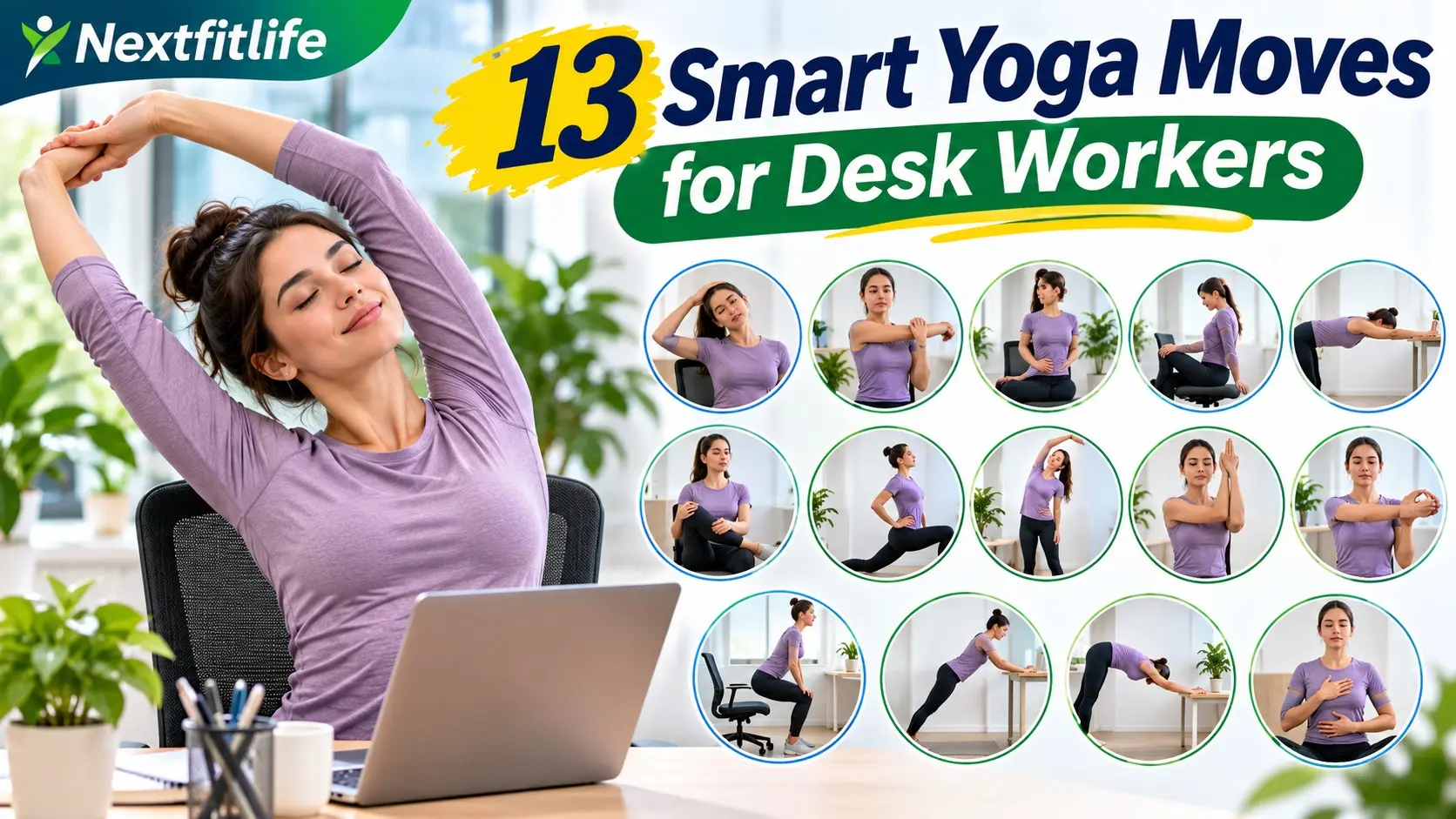
You do not need all thirteen every time.
Choose the moves that match how your body feels that day.
1. Start With a Short Walk
This is not a yoga pose, and I am putting it first on purpose.
Stand up and walk for one or two minutes. Let your arms swing and look away from the screen.
If you have spent a long time sitting, movement should usually come before a deep stretch.
Even a short walk changes the load on your hips, spine, shoulders, and legs.
2. Seated Cat Cow
Sit near the front of a stable chair with both feet on the floor.
- Place your hands on your thighs.
- Gently lift your chest as you breathe in.
- Let your upper back extend a little.
- Round through the upper back as you breathe out.
- Repeat 6 to 10 times.
Try to move the ribs and upper back instead of creating a large arch through the lower back.
Cat Cow also appears in the NextFitLife Thoracic Mobility Exercises guide.
3. Shoulder Rolls
Let your arms rest comfortably.
Lift the shoulders gently, move them back, then let them drop. Repeat 5 to 8 times before changing direction.
The circles should feel smooth.
Do not squeeze your shoulder blades together as hard as possible.
4. Gentle Neck Turns
Keep your shoulders relaxed and slowly look toward one side.
Return to the middle, then turn toward the other side.
Try 3 to 5 slow repetitions each way.
If you want a mild hold, stay in a comfortable position for about 10 to 30 seconds.
For more detail on stretch timing, see How Long to Hold a Stretch.
Do not pull hard on your head.
5. Eagle Arms
Reach both arms forward and cross one over the other.
Bend your elbows and bring the backs of the hands or palms toward each other.
If that position feels awkward, put each hand on the opposite shoulder instead.
Lift the elbows slightly and take 3 to 5 calm breaths.
You may feel gentle tension between the shoulder blades and across the back of the shoulders.
6. Seated Thoracic Rotation
Sit tall with both feet supported.
Cross your arms over your chest and turn your rib cage slowly toward one side. Return to the center, then repeat on the other side.
Try 5 controlled rotations each way.
Your upper back is designed to rotate, yet many desk routines focus only on the neck.
For a full routine, use the 8 Smart Thoracic Mobility Exercises Guide.
7. Desk Supported Puppy Stretch
Stand and place both hands on a stable desk or counter.
Walk backward, soften the knees, then move your hips behind you while allowing your chest to lower gently between your arms.
Take 3 to 5 easy breaths.
If reaching overhead causes shoulder pinching, keep the hands lower or skip the stretch.
You can also use the Shoulder Mobility Routine for a more active approach to shoulder movement.
8. Wrist and Forearm Stretch
Typing and mouse work keep the hands busy even while the rest of the body moves very little.
Extend one arm with the elbow relaxed. Use the other hand to move the fingers gently until you feel mild tension through the forearm.
Hold for about 10 to 20 seconds, then change sides.
Stop if the movement causes numbness, tingling, or sharp pain.
9. Seated Figure Four
Sit on a stable chair and place one ankle over the opposite thigh.
Keep the raised foot comfortable, then lean forward slightly from the hips until you feel mild tension around the outer hip or buttock.
Hold for about 20 to 30 seconds, then switch sides.
Do not push the raised knee toward the floor.
If your hips need more work, use Yoga for Tight Hips.
10. Standing Hip Flexor Stretch
Stand with one foot in front and the other behind you.
Keep your torso upright, then move your pelvis forward a little until you feel mild tension at the front of the back hip.
Hold for about 20 to 30 seconds, then change sides.
Avoid creating the stretch by arching the lower back.
For a fuller mix of hip mobility, rotation, and strength, see the Hip Mobility Routine for Desk Workers.
11. Standing Side Reach
Stand with your feet in a comfortable position.
Reach one arm overhead and lean slightly to the other side.
Return to the middle and switch.
Try 3 to 5 slow repetitions each way.
Think about making the side of your body long instead of trying to bend as far as possible.
12. Chair Sit to Stand
This looks more like strength training than yoga.
That is exactly why I included it.
Sit toward the front of a stable chair. Place both feet on the floor, lean forward slightly, then stand.
Lower yourself back to the chair with control.
Try 6 to 12 repetitions.
Desk workers do not need to stretch everything that feels stiff. Sometimes active movement is the better answer.
13. Wall or Desk Push Up
Place your hands against a wall or stable desk.
Move your feet back, bend your elbows, then press yourself away.
Try 6 to 12 slow repetitions.
This adds a little upper body strength and changes the load on your shoulders and trunk.
That matters because a good desk routine should include some shoulder mobility and strength, not stretching alone.
A 2 Minute Desk Reset
Use this when work is busy and ten minutes feels unrealistic.
- Walk for about 30 seconds.
- Do 5 slow shoulder rolls.
- Do 4 upper back rotations each way.
- Perform 5 controlled sit to stands.
- Finish with a few slow breaths while standing.
This is not a workout.
It is simply a fast way to stop one sitting position from owning the whole afternoon.
The 10 Minute Desk Yoga Routine
| Time | Move | Main Goal |
|---|---|---|
| Minute 1 | Walk | Break up sitting |
| Minute 2 | Seated Cat Cow | Upper back movement |
| Minute 3 | Shoulder rolls and neck turns | Neck and shoulders |
| Minute 4 | Eagle Arms | Upper back and shoulders |
| Minute 5 | Thoracic rotation | Upper back rotation |
| Minute 6 | Wrist stretch | Forearms and hands |
| Minute 7 | Seated Figure Four | Outer hips |
| Minute 8 | Standing hip flexor stretch | Front of hips |
| Minute 9 | Chair sit to stands | Leg and hip strength |
| Minute 10 | Desk push ups and breathing | Upper body strength and reset |
You should finish feeling less stuck, not exhausted.
How Often Should Desk Workers Move?
There is no magic timer that every person must follow.
The World Health Organization recommends reducing sedentary time and replacing some of it with activity.
You can build movement into your normal workday instead of trying to follow a perfect schedule.
Useful cues include:
- Stand after a long meeting.
- Walk while taking some phone calls.
- Refill your water.
- Use the stairs when practical.
- Move after a long block of focused work.
- Change position before stiffness becomes strong.
The goal is fewer long blocks of near total stillness.
Desk Yoga Does Not Cancel a Sedentary Day
Ten minutes of desk yoga is useful.
It does not make a full day of sitting disappear.
Adults should still aim for regular aerobic activity and muscle strengthening across the week.
Current WHO guidance recommends 150 to 300 minutes of moderate aerobic activity per week, or 75 to 150 minutes of vigorous activity, plus strength work for the major muscle groups on at least 2 days each week.
Walking, cycling, swimming, gym training, home workouts, sport, and other activities can all count.
If you prefer to train at home, use the NextFitLife Home Workouts and Equipment Guide.
What About Posture?
There is no one sitting position that you need to freeze in all day.
A reasonable desk setup can make work more comfortable, but even a good chair does not remove your need to move.
Office ergonomics should make the screen, keyboard, mouse, desk, and chair easier to use.
A Simple Desk Check
- Support your feet comfortably.
- Use a chair that supports you.
- Keep the keyboard and mouse easy to reach.
- Let your shoulders stay relaxed.
- Place the monitor where you do not need to twist.
- Keep enough room to change position.
Then move anyway.
Do Desk Workers Need Hip Flexor Stretches?
Sometimes, but I would not label every desk worker as having short hip flexors.
Sitting keeps your hips in a bent position for a long time, and the first few steps after standing can feel stiff.
A gentle hip flexor stretch can feel useful, but it is only one option.
Walking, hip rotation, controlled sit to stands, bridges, and other active moves also give the hips a different job.
The 7 Smart Hip Mobility Moves for Desk Workers uses that broader approach.
What Should You Do for Stiff Shoulders?
Start by moving your shoulders instead of forcing them down and back.
Useful choices include:
- Shoulder circles
- Eagle Arms
- Wall slides
- Thoracic rotation
- Desk Puppy stretch
- Light pushing and pulling exercises
The shoulder blade needs to move over the rib cage during reaching.
For a fuller approach to shoulder mobility, use the NextFitLife Shoulder Mobility Routine.
What About Lower Back Stiffness?
Do not assume your lower back needs a deeper forward fold.
Try walking first.
Then use a small Cat Cow movement, gentle rotation, or a few sit to stands.
If bending or stretching makes pain travel down a leg, causes numbness, or clearly makes symptoms worse, stop.
For back friendly exercise options, see 9 Safe Core Fixes for Lower Back Pain.
Do You Need to Stretch Your Neck All Day?
No.
Your neck needs movement, not constant pulling.
Use small turns, gentle side movements, walking breaks, and changes in screen position.
Do not bounce or force the stretch.
If neck symptoms include persistent arm tingling, numbness, weakness, or severe headache, get medical advice instead of trying a stronger stretch.
Should You Stretch Before or After Exercise?
Desk movement breaks and workout stretching have different jobs.
During work, the goal is to stop being still and move through comfortable ranges.
Before exercise, dynamic movements usually fit better than long passive holds.
Longer static stretches can fit after training or during a separate mobility session.
Use the Stretching Before or After Workout Guide for a full explanation.
A Better After Work Routine
If you have ten to fifteen minutes after work, you can use more floor based movements.
- Walk for about 2 minutes.
- Do Cat Cow for 6 to 10 repetitions.
- Try Thread the Needle for 5 repetitions each side.
- Use a gentle Low Lunge for 20 to 30 seconds each side.
- Perform 90/90 hip switches for 6 to 10 repetitions.
- Use Supported Puppy Pose for 3 to 5 breaths.
- Perform 8 to 12 glute bridges.
- Finish with about one minute of relaxed breathing.
This adds hip rotation, upper back movement, shoulder motion, and active hip work.
You do not need to turn every evening into a full yoga class.
Why Strength Belongs in a Desk Work Plan
Stretching improves one part of movement.
It does not build every quality you need.
Desk workers also benefit from being able to stand, push, pull, carry, squat, hinge, and control useful joint ranges.
A 2026 systematic review and meta analysis found that resistance exercise in sedentary office workers produced improvements in several musculoskeletal and strength outcomes.
A separate 2026 review of workplace exercise found modest improvements in flexibility and grip strength, while also making the useful point that workplace exercise is a practical way to deliver activity rather than a special kind of exercise with magical effects.
That is why this routine contains sit to stands and desk push ups.
Chair yoga and strength training do not compete. They solve different parts of the problem.
A Simple Weekly Plan for Desk Workers
| When | What to Do | Main Goal |
|---|---|---|
| During work | Short standing or walking breaks | Break up sitting |
| 1 or 2 times during work | 2 to 10 minute desk routine | Mobility and comfort |
| 2 or more days each week | Strength training | Build strength and capacity |
| Most days | Walk or use another comfortable activity | General movement |
| When useful | Longer yoga or mobility session | Flexibility and recovery |
Do not turn this into another stressful work task.
Start with the easiest part: leave the chair more often.
Common Desk Yoga Mistakes
Stretching Everything That Feels Tight
A tight feeling does not always mean a muscle needs more stretching.
Walking or active movement may feel better.
Pulling Hard on the Neck
Keep neck stretches gentle.
More force does not make a better stretch.
Forcing Deep Hip Poses
You do not need a deep Pigeon Pose to work comfortably at a desk.
Use a seated Figure Four if deeper hip positions do not suit you.
Doing Yoga but Never Leaving the Chair
This misses the main goal.
Stand and walk.
Stretching but Never Building Strength
Add basic resistance training during the week.
Trying to Hold One Perfect Posture
A useful position can become uncomfortable when you hold it for too long.
Give yourself permission to move.
Stretching Through Numbness or Sharp Pain
Stop.
Those symptoms need a different approach.
When Should You Get Medical Advice?
Office yoga is for ordinary stiffness and movement breaks.
Arrange medical assessment if pain keeps returning, gets worse, wakes you at night, or stops you from doing normal activities.
Get prompt medical advice for:
- Persistent numbness or tingling
- New arm or leg weakness
- Pain that keeps spreading down an arm or leg
- Severe or worsening pain
- Symptoms after a significant injury
- Fever with severe back or joint pain
Seek urgent medical care for:
- New loss of bladder or bowel control
- Numbness around the groin, buttocks, or saddle area
- Rapidly worsening leg weakness
- Severe neurological symptoms
- Chest pressure with shortness of breath, sweating, or spreading arm or jaw discomfort
- Severe pain after major trauma
These are not symptoms to treat with another stretch.
How Do You Know the Routine Is Working?
The signs should be ordinary.
You stand more comfortably after a meeting, your shoulders feel less stuck, your upper back turns more easily, and your hips loosen after the first few steps.
You may also notice that you remember to leave the chair more often.
That is useful progress.
You do not need to touch your toes or become extremely flexible.
Conclusion
Yoga for desk workers works best when it helps you move more rather than keeping you in the same chair for another activity.
Start with walking. Move your upper back and shoulders, give your hips some variety, and add a little strength. Use deeper stretches only when they feel useful.
Your next step: after your next long block of work, stand up and try the 2 minute reset. If it feels good, use the 10 minute routine once during your workday this week.
References and Sources
- World Health Organization. Physical Activity Recommendations.
https://www.who.int/europe/news-room/fact-sheets/item/physical-activity - Mayo Clinic. Office Ergonomics: Your How To Guide.
https://www.mayoclinic.org/healthy-lifestyle/adult-health/in-depth/office-ergonomics/art-20046169 - Mayo Clinic. Desk Stretches and Workplace Movement.
https://www.mayoclinic.org/healthy-lifestyle/adult-health/in-depth/office-stretches/art-20046041 - BMJ Open via PubMed. Effectiveness of Workplace Exercise Interventions in the Treatment of Musculoskeletal Disorders in Office Workers.
https://pubmed.ncbi.nlm.nih.gov/35105632/ - Journal of Occupational Rehabilitation via PubMed. Resistance Exercise Training on Musculoskeletal, Metabolic and Psychological Health in Sedentary Office Workers.
https://pubmed.ncbi.nlm.nih.gov/39953203/ - Journal of Occupational Health via PubMed. Effectiveness of Exercise Interventions for Chronic Low Back Pain Among Office Workers.
https://pubmed.ncbi.nlm.nih.gov/42775848/
Internal Links and NextFitLife Hubs
- NextFitLife Fitness Hub
- Hip Mobility Routine for Desk Workers
- Shoulder Mobility Routine
- Thoracic Mobility Exercises
- Yoga for Tight Hips
- Stretching Before or After Workout
- How Long to Hold a Stretch
- Lower Back Pain Exercise Guide
- Home Workouts and Equipment Guide
- About NextFitLife
Frequently Asked Questions
What is the best yoga for desk workers?
A useful desk routine combines walking, shoulder movement, upper back rotation, gentle hip work, wrist movement, and a little strength. Seated Cat Cow, Eagle Arms, thoracic rotation, Figure Four, hip flexor stretches, sit to stands, and desk push ups are simple options.
How long should desk yoga take?
It does not need to take long. A 2 minute movement break can be useful during a busy day, while a 10 minute routine gives you more time for the shoulders, upper back, wrists, hips, and legs.
How often should desk workers stand up?
There is no single perfect interval for everyone. The main goal is to reduce long periods of sitting by adding regular standing, walking, and position changes throughout the workday.
Can desk yoga fix bad posture?
There is no one perfect posture that desk yoga needs to fix. A better plan is to use a comfortable desk setup, change position regularly, stay active, and build enough mobility and strength for normal movement.
Is yoga enough if I sit all day?
No. Yoga is useful, but it should be combined with general physical activity and strength work. Short yoga breaks do not replace walking, aerobic exercise, or regular strength training.
What yoga moves help stiff hips from sitting?
Seated Figure Four, a gentle standing hip flexor stretch, 90/90 hip movement, and easy hip rotation can be useful. Walking and active leg work also belong in the plan.
What yoga moves help desk shoulders?
Shoulder circles, Eagle Arms, thoracic rotation, wall slides, and a supported Puppy stretch can help the shoulders move through different ranges. Light pushing and pulling exercises can add strength.
Should I stretch my neck at my desk?
Gentle neck movement can be useful, but avoid hard pulling. Slow turns and small comfortable movements are enough. Stop if you develop pain, numbness, tingling, dizziness, or weakness.
Are chair yoga exercises enough for desk workers?
Chair yoga can be useful, especially when space is limited, but you should still stand and walk during the day. Staying seated for every movement misses part of the reason for taking a break.
Should desk workers stretch or strengthen more?
Most desk workers do not need to choose only one. Mobility can help you move comfortably, while strength helps you control those ranges and handle daily tasks. A balanced plan uses both.

