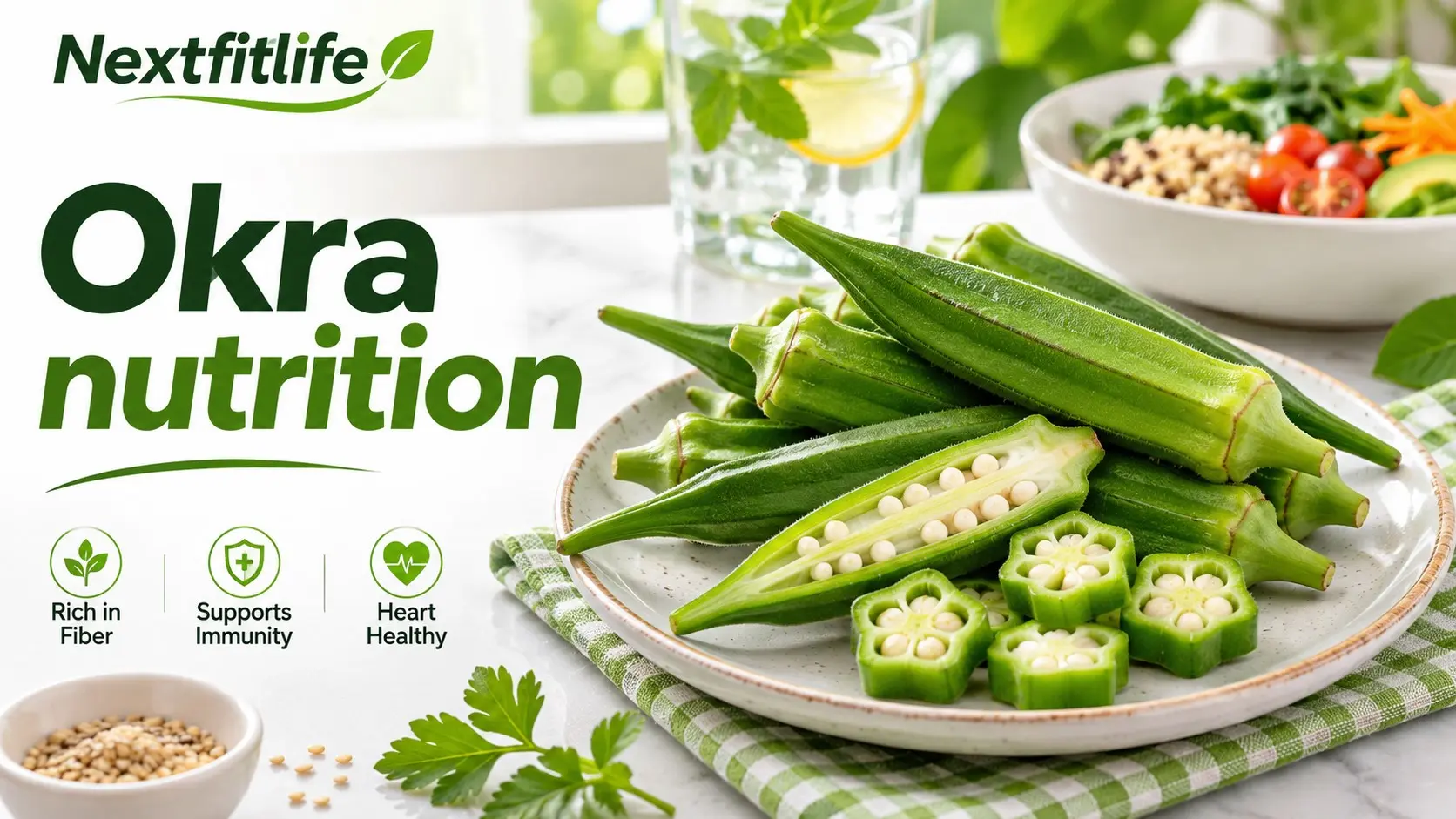
Published on: November 19, 2026
Okra gives you a useful mix of nutrients for very few calories.
It provides fiber, vitamin C, vitamin K, folate, magnesium, and potassium. The bigger issue is separating those real benefits from claims about okra water, supplements, diabetes treatment, and weight loss.
Quick answer: Okra nutrition is strong for a low calorie food. About 100 grams of raw okra provides roughly 33 calories, 7.5 grams of carbohydrate, 3.2 grams of fiber, and 1.9 grams of protein, plus vitamin C, vitamin K, folate, magnesium, and potassium. Whole okra is nutritious, but it is not diabetes medicine.
This article is for general information and education. It does not replace medical advice, diagnosis, or treatment.
If you want a wider guide to food sources, vitamins, minerals, and supplement safety, visit the NextFitLife Nutrition & Vitamins Hub.
Table of Contents
- Okra nutrition facts
- 11 smart nutrition facts
- Okra and blood sugar
- Okra water and supplements
- Pregnancy and folate
- Warfarin and vitamin K
- Kidney stone questions
- Raw versus cooked okra
- Healthy serving ideas
- Common okra mistakes
- References and Sources
- Internal Links and NextFitLife Hubs
- About the Author
- Frequently Asked Questions
Okra Nutrition Facts at a Glance
Okra, also called lady's finger or gumbo, is technically a fruit because the pod develops from a flower and contains seeds. In the kitchen, we use it more like a vegetable.
About 100 grams of raw okra provides approximately:
| Nutrient | Approximate Amount | Main Role |
|---|---|---|
| Calories | 33 kcal | Energy |
| Carbohydrate | About 7.5 g | Energy and fiber containing carbohydrate |
| Fiber | About 3.2 g | Digestion and fullness |
| Protein | About 1.9 g | Small contribution to daily protein |
| Fat | About 0.2 g | Naturally very low |
| Vitamin C | About 23 mg | Collagen and normal immune function |
| Vitamin K | About 31 mcg | Normal blood clotting and bone proteins |
| Folate | About 60 mcg | Cell division and DNA formation |
| Magnesium | About 57 mg | Muscle, nerve, and enzyme function |
| Potassium | About 299 mg | Fluid balance, nerves, and muscles |
These figures describe raw okra. Cooking changes water content, so a cooked cup will not match the raw values exactly.
11 Smart Okra Nutrition Facts
1. Okra Gives You a Lot of Food for Few Calories
One of the simplest okra benefits is food volume.
About 100 grams of raw okra has only around 33 calories. That makes it easy to add vegetables to a meal without adding much energy.
The cooking method can change that quickly.
Roasted, grilled, steamed, or tomato cooked okra stays very different from heavily breaded and deep fried okra.
If weight management is part of your goal, pay more attention to the whole dish than the vegetable alone.
2. Okra Provides Useful Fiber
A 100 gram serving contains about 3.2 grams of okra fiber.
Fiber supports normal bowel function and can help meals feel more filling. Okra also develops a gel like substance called okra mucilage when cut and cooked with water.
One serving will not meet your full fiber needs.
Build the rest of your day with beans, lentils, whole grains, fruit, vegetables, nuts, and seeds.
For more food ideas, see the High Fiber Fruits List and the Gut Health Foods Guide.
3. Okra Contains Vitamin C
Raw okra provides around 23 milligrams of vitamin C per 100 grams.
Vitamin C supports collagen production, normal immune function, and the absorption of non heme iron from plant foods.
Heat can reduce some vitamin C.
That does not make cooked okra unhealthy. It simply means raw and cooked portions are not nutritionally identical.
4. Okra Provides Vitamin K
Okra contains a useful amount of vitamin K.
Your body needs vitamin K for normal blood clotting and for proteins involved in bone health.
For most people, this is simply part of okra's nutritional value.
People who take warfarin need a little more context, which we cover below.
5. Folate Makes Okra Useful During Pregnancy
About 100 grams of raw okra provides roughly 60 micrograms of folate.
Folate is needed for cell division and DNA formation. It also matters during early fetal development.
This makes okra a good food to include during pregnancy.
It does not mean okra replaces recommended folic acid before conception and during early pregnancy.
The NextFitLife Nutrition & Vitamins Hub explains why food folate and folic acid recommendations should not be treated as the same thing.
6. Okra Adds Magnesium
A raw 100 gram serving contains about 57 milligrams of magnesium.
Magnesium supports muscle function, nerve signaling, energy production, and many enzyme reactions.
Okra is useful, but seeds, nuts, beans, leafy greens, whole grains, and soy foods can provide much more.
For stronger sources, see 14 Powerful Magnesium Rich Foods.
7. Potassium Adds to the Mineral Profile
Okra provides around 299 milligrams of potassium per 100 grams.
Potassium helps with muscle contraction, nerve signals, and normal fluid balance.
For most healthy people, potassium rich whole foods are useful.
People with advanced kidney disease may have different potassium needs, so their food plan should follow their laboratory results and healthcare advice.
8. Okra Is Not a High Protein Food
Okra contains protein, but not much.
A raw 100 gram portion provides around 1.9 grams.
So I would not describe okra as a meaningful protein source for a main meal.
Pair it with:
- Beans
- Lentils
- Eggs
- Tofu
- Greek yogurt
- Fish
- Chicken
- Another suitable protein food
If you are trying to raise protein while keeping vegetables high, use the High Protein Diet Plan as a wider meal guide.
9. Okra and Diabetes Need a Careful Explanation
The research is more interesting than many food articles admit, but it is also easier to misrepresent.
Randomized trials have tested okra supplements, powder, capsules, and other concentrated preparations in people with type 2 diabetes.
A 2026 meta analysis of 14 randomized trials found improvements in fasting glucose, post meal glucose, HbA1c, insulin resistance, LDL cholesterol, and total cholesterol.
But the certainty of evidence was very low for most outcomes and low for HbA1c.
That means the research is promising, not conclusive.
More importantly, those trials do not prove that a serving of cooked okra will lower blood sugar like a medicine.
If you live with diabetes, think about the whole meal instead.
The NextFitLife Foods for People Living With Diabetes Guide explains how vegetables, protein, carbohydrate, medication, and portions fit together.
10. Okra Water Is Not the Same as Whole Okra
Okra water has become popular online.
People soak cut pods in water, then drink the liquid and discard the vegetable.
There is limited human evidence for this practice, and there is no good reason to assume the water contains the full nutritional value of the whole pod.
Most of the fiber stays with the food.
Practical rule: If you like okra, eating the whole vegetable is the simpler way to get its fiber, vitamins, minerals, and food structure. Okra water should not be treated as a stronger version of okra.
11. Whole Okra and Okra Supplements Are Different
A supplement can deliver a much more concentrated amount than a normal serving of food.
For example, a randomized clinical trial in adults with type 2 diabetes used 1,000 milligrams of powdered okra fruit three times daily for three months.
Another clinical trial used concentrated okra powder as part of the intervention.
Those studies tell us about supplementation under study conditions.
They do not prove that a bowl of okra has the same effect.
This distinction is important for both AEO and real life health decisions:
Whole okra is food. Okra powder is a supplement intervention.
Is Okra Good for Blood Sugar?
Okra can fit well into a diabetes eating pattern because it is low in calories and provides fiber.
But the stronger blood glucose studies mainly involve concentrated okra interventions.
A 2023 randomized, double blind trial gave adults with type 2 diabetes 1,000 milligrams of powdered okra fruit three times daily for three months while they continued standard diabetes treatment.
The study reported improvements in fasting glucose and HbA1c.
That is useful research.
It still does not turn normal cooked okra into a treatment for diabetes.
If you use insulin or medicine that can cause low blood glucose, do not replace your treatment or change doses because of an okra article or supplement claim.
What About Okra Water for Diabetes?
The evidence is much weaker.
Some animal studies and small human studies have explored soaked okra water, but current evidence does not justify treating it as a proven diabetes therapy.
The most reliable thing in a glass of okra water is still water.
If you enjoy it, that is fine.
I would not choose it instead of eating vegetables, taking prescribed medicine, staying active, or following your glucose plan.
Can Okra Help With Digestion?
Yes, as part of a broader fiber rich diet.
Okra provides fiber and water, and its mucilage gives cooked dishes a thick texture.
That can help make meals more filling.
But okra is not a constipation treatment by itself.
If constipation is the problem, look at your full pattern:
- Total fiber
- Fluid intake
- Physical activity
- Medication use
- Fruit and vegetable intake
- Whole grains and legumes
For persistent constipation, see the Best Constipation Treatments Guide and Constipation Exercises Guide.
Can Okra Support Heart Health?
Okra fits naturally into a heart healthy food pattern.
It is low in saturated fat and sodium while providing fiber, potassium, magnesium, and plant compounds.
Recent meta analyses of okra supplementation have reported improvements in some cholesterol and glucose markers.
Again, the supplement research should not be turned into a claim that one vegetable treats heart disease.
The stronger approach is to build meals around vegetables, whole grains, legumes, fruit, suitable proteins, and unsaturated fats.
The Healthy Fitness Foods Guide gives practical examples of that kind of meal structure.
Does Okra Help With Weight Loss?
Okra can fit very well into a weight loss diet because it is low in calories and provides fiber.
It does not burn fat.
Research on concentrated okra supplementation has not shown a reliable weight loss effect.
The better reason to eat it is simple: it gives meals volume and nutrition without many calories.
That advantage disappears if the main preparation is deep fried okra with a heavy coating.
Is Okra Good During Pregnancy?
Yes. Normal food portions of okra can be part of a healthy pregnancy diet.
It provides folate, vitamin C, fiber, magnesium, and other nutrients.
But okra should not replace folic acid guidance.
People who could become pregnant are generally advised to get 400 micrograms of folic acid each day from fortified foods, supplements, or both, in addition to folate from a varied diet, unless their healthcare professional gives different advice.
So think of okra as a useful food, not a prenatal supplement.
What if You Take Warfarin?
Okra contains vitamin K.
If you take warfarin, the main issue is consistency.
You do not automatically need to stop eating okra.
Large sudden changes in vitamin K intake can change how warfarin works.
A practical rule is:
- Keep vitamin K foods fairly consistent
- Avoid sudden major diet changes without advice
- Tell your anticoagulation team about large changes
This approach is safer than creating a long forbidden food list.
Does Okra Interact With Metformin?
This claim needs care.
An older animal study found that water soluble fractions of okra affected metformin absorption in rats.
That does not prove that eating cooked okra with metformin causes a clinically important interaction in people.
I would not tell someone to avoid normal servings of okra based on that animal study alone.
However, if you plan to use concentrated okra supplements while taking diabetes medicine, discuss the combination with your doctor or pharmacist.
Can People With Kidney Stones Eat Okra?
Okra contains oxalate, so it sometimes appears on lists for people with calcium oxalate kidney stones.
That does not mean everyone who has ever had a kidney stone must avoid okra.
Stone prevention depends on the type of stone, total diet, calcium intake, sodium intake, fluid intake, and other medical factors.
If you have recurrent calcium oxalate stones and were given a low oxalate diet, ask your clinician or renal dietitian how often okra fits your plan.
Do not remove several nutritious foods because of a generic online list.
Raw Okra vs Cooked Okra
| Feature | Raw Okra | Cooked Okra |
|---|---|---|
| Texture | Crisp | Softer |
| Vitamin C | Higher before heating | Some may be lost with heat |
| Fiber | Useful source | Still useful |
| Mucilage | Less obvious | More noticeable in wet cooking |
| Best use | Salads or crisp preparations | Roasting, stews, curries, grilling |
Both versions can be nutritious.
The bigger difference often comes from what you add during cooking.
How Do You Cook Okra Without Too Much Slime?
The slippery texture comes from mucilage.
It is natural and safe.
If you dislike it, use cooking methods that reduce moisture.
Try:
- Roasting
- Grilling
- High heat sautéing
- Cooking whole pods
- Using tomato or another acidic ingredient
Do not overcrowd the pan if you want the surface to brown.
If you like the thick texture, sliced okra works very well in soups and stews.
6 Easy Ways to Eat Okra
1. Roast It
Toss whole or sliced pods with a small amount of olive oil and seasoning, then roast until lightly browned.
2. Cook It With Tomato
Okra works well with tomato, onion, garlic, herbs, and spices.
3. Add It to Curry
Pair it with lentils or chickpeas so the meal has more protein and fiber.
4. Grill Whole Pods
Whole pods hold their shape well and develop a firmer texture.
5. Add It to a Grain Bowl
Use roasted okra with brown rice or quinoa, beans, yogurt, tahini, or another suitable protein source.
6. Use It in Soup or Gumbo
The natural mucilage helps thicken the dish.
How to Build a Balanced Okra Meal
Okra works best as part of a plate rather than as a miracle ingredient.
| Meal Part | Example | What It Adds |
|---|---|---|
| Vegetable | Okra with tomato | Fiber and micronutrients |
| Protein | Lentils, beans, fish, chicken, tofu, eggs | Main protein source |
| Carbohydrate | Brown rice, potatoes, whole grain bread | Energy |
| Healthy fat | Olive oil, nuts, tahini | Unsaturated fat and flavor |
For more balanced meal ideas, read the Healthy Fitness Foods Guide.
Common Okra Nutrition Mistakes
Treating Okra Water Like a Concentrated Health Drink
It is not proven to be better than eating the vegetable.
Applying Supplement Trials to Normal Food Portions
Powders and capsules can deliver very different amounts from a serving of food.
Calling Okra a Diabetes Treatment
The supplement research is promising, but evidence certainty is still limited.
Using Okra Instead of a Protein Food
It contains less than 2 grams of protein per 100 grams.
Avoiding Okra Completely Because of Warfarin
Consistency in vitamin K intake is usually the main issue, not total avoidance.
Assuming More Okra Means Faster Weight Loss
Okra is low in calories, but it does not burn fat.
Ignoring the Cooking Method
A vegetable can still become part of a very high calorie meal when it is heavily battered, fried, and served with calorie dense sauces.
What Okra Does Not Do
Okra is a useful food without miracle claims.
It does not:
- Cure diabetes
- Replace insulin or diabetes medicine
- Burn body fat
- Detox the body
- Prevent cancer by itself
- Replace prenatal folic acid
- Become more nutritious just because it is soaked in water
A healthy food does not have to behave like medicine to deserve a place on your plate.
Conclusion
Okra nutrition is genuinely impressive for a low calorie food. It provides fiber, vitamin C, vitamin K, folate, magnesium, potassium, and other plant compounds.
The useful distinction is between whole okra and concentrated products. The stronger diabetes studies mainly involve powder or supplements, while viral okra water claims remain much less certain.
Your next step: try roasted, grilled, or tomato cooked okra this week and pair it with a real protein source. If you take warfarin, diabetes medicine, or plan to use concentrated okra supplements, discuss major changes with your healthcare professional.
References and Sources
- USDA Agricultural Research Service. Okra, raw, nutrient data.
https://www.ars.usda.gov/ARSUserFiles/80400535/Data/SR/SR28/reports/sr28fg11.pdf - NIH Office of Dietary Supplements. Vitamin K Fact Sheet for Health Professionals.
https://ods.od.nih.gov/factsheets/VitaminK-HealthProfessional/ - PubMed. Therapeutic Potential of Okra in Dysglycaemia and Metabolic Dysfunction: Systematic Review and Meta Analysis.
https://pubmed.ncbi.nlm.nih.gov/41823653/ - PubMed. Clinical Efficacy and Safety of Okra in Type 2 Diabetic Patients: Randomized Double Blind Placebo Controlled Trial.
https://pubmed.ncbi.nlm.nih.gov/37507536/ - PubMed. Anti Hyperglycemic Effect of Okra on Patients With Type 2 Diabetes: Randomized Clinical Trial.
https://pubmed.ncbi.nlm.nih.gov/35434945/ - Cleveland Clinic. Okra: What It Is, Benefits and Side Effects.
https://health.clevelandclinic.org/okra-benefits - WebMD. Is Okra Good for Diabetes?
https://www.webmd.com/diabetes/okra-diabetes-benefits-risks-uses
Internal Links and NextFitLife Hubs
- Nutrition & Vitamins Hub
- High Fiber Fruits List
- Gut Health Foods Guide
- Foods for People Living With Diabetes
- High Protein Diet Plan
- Magnesium Rich Foods Guide
- Best Constipation Treatments
- Constipation Exercises
- Healthy Fitness Foods
- About NextFitLife
Frequently Asked Questions
What are the main okra nutrition facts?
About 100 grams of raw okra provides roughly 33 calories, 7.5 grams of carbohydrate, 3.2 grams of fiber, and 1.9 grams of protein. It also provides vitamin C, vitamin K, folate, magnesium, and potassium.
Is okra good for diabetes?
Okra can fit into a diabetes eating plan because it is low in calories and provides fiber. Some trials of okra powder and supplements have improved glucose markers, but whole okra should not be treated as diabetes medicine.
Does okra water lower blood sugar?
Evidence for okra water is limited. Some small studies and animal research exist, but there is not enough high quality evidence to treat okra water as a proven blood sugar treatment.
Is okra high in fiber?
Okra is a useful fiber food. About 100 grams of raw okra provides roughly 3.2 grams of fiber, so it can contribute to daily intake alongside beans, whole grains, fruit, nuts, seeds, and other vegetables.
Is okra good during pregnancy?
Yes. Okra provides folate, vitamin C, fiber, and minerals. It can be part of a healthy pregnancy diet, but it does not replace recommended folic acid intake or prenatal care.
Can I eat okra if I take warfarin?
Okra contains vitamin K. People taking warfarin are usually advised to keep vitamin K intake reasonably consistent rather than avoiding every vitamin K food. Discuss major diet changes with the clinician managing your anticoagulation.
Does okra interact with metformin?
An animal study found that an okra fraction affected metformin absorption, but this does not prove a clinically important interaction from normal cooked okra in humans. Ask your clinician or pharmacist before using concentrated okra supplements with diabetes medicine.
Can okra help with constipation?
Okra provides fiber and can support a fiber rich diet, but it is not a constipation treatment by itself. Persistent constipation can have many causes and may need medical assessment.
Is raw or cooked okra healthier?
Both can be nutritious. Raw okra retains more heat sensitive vitamin C, while cooked okra remains a useful source of fiber and minerals. The cooking method and added ingredients matter more than choosing one form for every meal.
What is the healthiest way to cook okra?
Roasting, grilling, steaming, sautéing with a small amount of oil, or cooking okra with tomato are practical choices. Deep frying adds much more fat and energy.