Next review: September 2027 or sooner if major nutrition, kidney, cardiovascular, or medication guidance changes
Written and source -checked by: Adel Galal, Founder and Lead Writer at NextFitLife
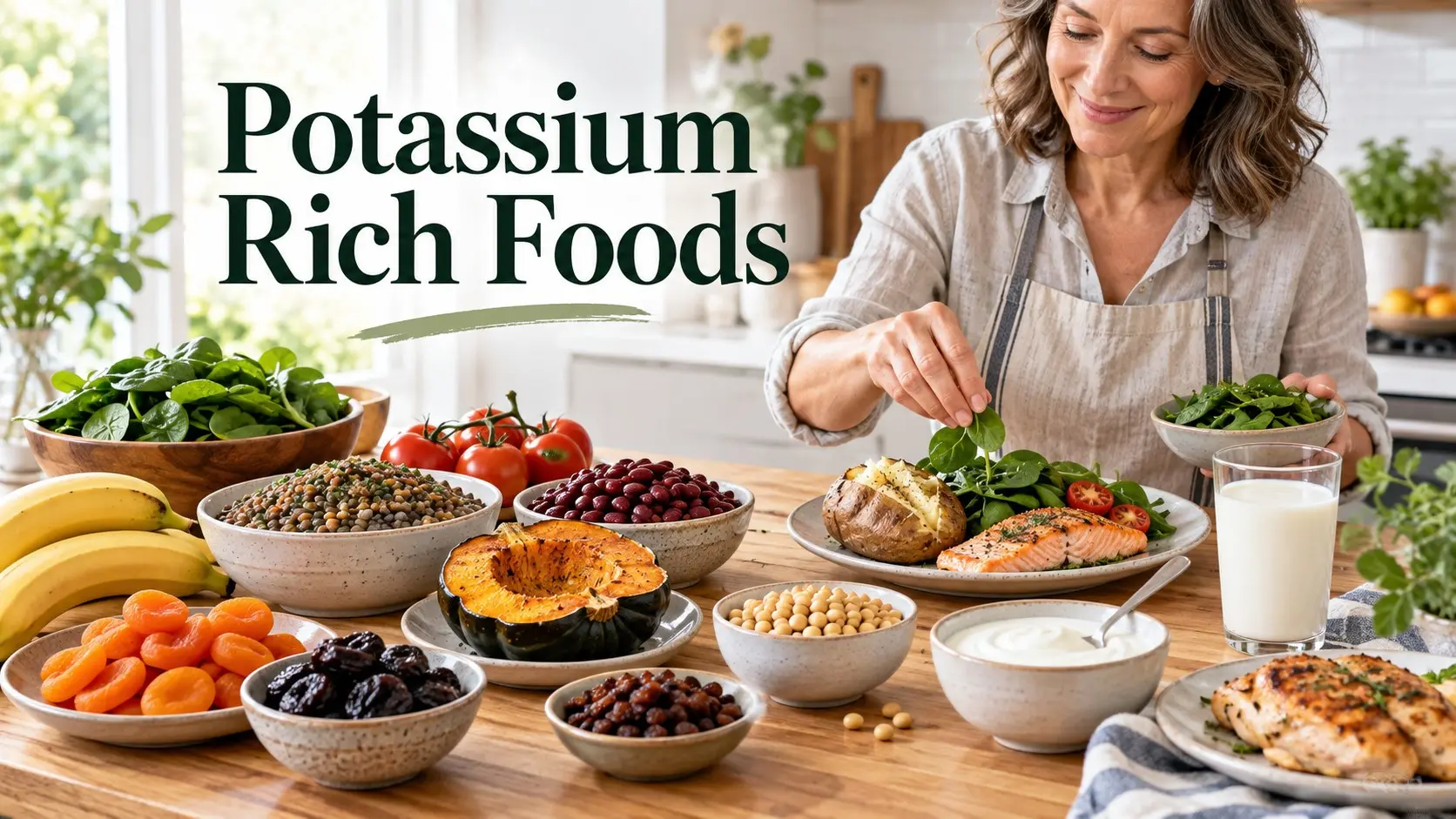
Review status: Checked against current NIH Office of Dietary Supplements guidance, FDA Nutrition Facts guidance, American Heart Association guidance, and National Kidney Foundation recommendations. This article has not been medically reviewed by a physician, registered dietitian, nephrologist, cardiologist, or pharmacist.Quick answer: Potassium rich foods include dried apricots, lentils, squash, prunes, potatoes, kidney beans, bananas, soybeans, spinach, milk, yogurt, tomatoes, chicken, and salmon. Most healthy adults can focus on getting potassium from varied foods rather than supplements. Kidney disease, high blood potassium, and certain medicines can change what is safe.Bananas get all the attention.
They should not.
A medium banana is a useful potassium source.
But lentils provide more in a normal serving.
So do dried apricots.
So does a medium baked potato.
This is why a good potassium rich foods list needs real serving sizes.
Not random rankings based on 100 grams of food nobody eats that way.
The other mistake is more serious.
Articles often tell everyone to “eat more potassium” and place kidney safety at the bottom.
I would put the warning near the top.
If you have chronic kidney disease, high blood potassium, or take medicines that affect potassium, do not deliberately raise your potassium intake without checking with your healthcare team.
For most other adults, food is the place to start.
For more mineral and vitamin guidance, visit the NextFitLife Nutrition and Vitamins Hub.
What is potassium, and why does your body need it?
Potassium is a mineral.
It is also an electrolyte.
Your body needs potassium for:
- Normal nerve signals
- Muscle contraction
- Normal heart function
- Kidney function
- Fluid balance inside cells
Potassium also interacts with sodium.
That is one reason potassium rich eating patterns are often discussed in relation to blood pressure.
The American Heart Association explains that potassium rich foods can help reduce some of sodium's effects and can support blood pressure control in appropriate adults.
That does not make potassium a replacement for blood pressure medicine.
It is one piece of the eating pattern.
If blood pressure is a concern for you, read our High Blood Pressure Guide.
How much potassium do adults need each day?
This is where online advice gets confusing.
There are two numbers you may see.
Adequate Intake
NIH lists the daily potassium intake for adults as:
| Group | Daily potassium amount |
|---|---|
| Men age 19 and older | 3,400 mg |
| Women age 19 and older | 2,600 mg |
| Pregnant women | 2,900 mg |
| Breastfeeding women | 2,800 mg |
FDA Daily Value
Nutrition Facts labels use a different reference.
The FDA Daily Value for potassium is:
4,700 mg.
This does not mean that every woman suddenly needs 4,700 mg because she read a food label.
The Daily Value helps people compare foods.
The age and sex-specific Adequate Intake is a different nutrition reference.
Keep those two systems separate.
What does “high in potassium” mean on a food label?
The FDA says a food providing 20 percent or more of the Daily Value per serving is considered high in that nutrient.
For potassium, 20 percent of the 4,700 mg Daily Value is 940 mg.
That is quite a lot for one serving.
Many useful foods do not reach that label threshold.
They still contribute meaningfully to your diet.
Kidney resources sometimes use another definition.
The National Kidney Foundation describes foods with about 200 mg or more potassium per serving as higher potassium for kidney diet planning.
Same mineral.
Different purpose.
Do not mix the two definitions.
Potassium Rich Foods Chart with 15 practical choices
This potassium rich foods chart uses normal serving sizes from the NIH Office of Dietary Supplements food table.
Values can vary by brand, size, variety, and cooking method.
| Food | Serving | Potassium | Percent Daily Value |
|---|---|---|---|
| Dried apricots | 1/2 cup | 755 mg | 16% |
| Lentils, cooked | 1 cup | 731 mg | 16% |
| Acorn squash, mashed | 1 cup | 644 mg | 14% |
| Prunes, dried | 1/2 cup | 635 mg | 14% |
| Raisins | 1/2 cup | 618 mg | 13% |
| Baked potato, flesh only | 1 medium | 610 mg | 13% |
| Kidney beans, canned | 1 cup | 607 mg | 13% |
| Orange juice | 1 cup | 496 mg | 11% |
| Soybeans, cooked | 1/2 cup | 443 mg | 9% |
| Banana | 1 medium | 422 mg | 9% |
| Low fat milk | 1 cup | 366 mg | 8% |
| Spinach, raw | 2 cups | 334 mg | 7% |
| Chicken breast, grilled | 3 oz | 332 mg | 7% |
| Atlantic salmon, cooked | 3 oz | 326 mg | 7% |
| Tomato, raw | 1 medium | 292 mg | 6% |
Look at the table again.
The banana is number ten.
That is why “eat bananas” is weak potassium advice.
1. Dried apricots are very concentrated
Half a cup of dried apricots provides about 755 mg of potassium.
That is one of the highest values in the NIH table.
But dried fruit needs context.
Removing water concentrates the fruit.
That means natural sugar, calories, and potassium all fit into a smaller volume.
I would use dried apricots as a small snack or meal addition.
Not eat a large bag because potassium is healthy.
2. Lentils are one of my favorite practical choices
One cup of cooked lentils contains about 731 mg.
That is more than a banana.
Lentils also give you fiber and plant protein.
Use them in:
- Soup
- Stew
- Curry
- Salad
- Grain bowls
They are affordable.
They store well.
And they solve more than one nutrition problem at once.
3. Acorn squash is an easy dinner upgrade
One cup of mashed acorn squash provides about 644 mg.
Roast it.
Mash it.
Add it to soup.
Serve it beside chicken, fish, lentils, or beans.
This is a good example of why variety beats chasing one “superfood.”
4. Prunes provide potassium in a small portion
Half a cup of dried prunes provides about 635 mg.
Prunes are also known for their fiber content.
The same dried fruit rule applies.
Portions can grow quickly.
A small serving is enough.
5. Raisins are another concentrated option
Half a cup contains around 618 mg.
You can add raisins to:
- Oatmeal
- Plain yogurt
- Whole grain cereal
- Salads
You do not need to eat half a cup at once.
Smaller servings still contribute.
6. Potatoes are better potassium foods than many people realize
One medium baked potato, flesh only, provides about 610 mg in the NIH table.
Potato values can differ depending on size, variety, preparation, and whether the skin is included.
A plain potato is not junk food.
The toppings and cooking method can change the meal dramatically.
A baked potato with beans and vegetables is very different from a large salty serving of fries.
7. Kidney beans add potassium, fiber, and protein
One cup of canned kidney beans provides about 607 mg.
Beans work well in:
- Chili
- Soup
- Salads
- Rice bowls
- Wraps
If sodium is a concern, compare labels.
Rinsing canned beans can also remove some of the sodium from the packing liquid.
8. Orange juice is rich in potassium but portion still matters
One cup provides around 496 mg.
That is a useful amount.
I still prefer whole fruit as the everyday default for most people because whole fruit gives you fiber and takes longer to eat.
Juice can fit.
It does not need to be unlimited.
For more fruit nutrient guidance, see our Vitamin C Foods Guide.
9. Soybeans give you potassium plus plant protein
Half a cup of boiled mature soybeans provides about 443 mg.
Soy foods can be useful in plant based eating patterns.
Other soy foods such as tofu and soy milk contain different amounts.
Read the label when using packaged soy foods.
10. Bananas are useful because they are easy
One medium banana provides about 422 mg.
The banana is a good food.
It is just not the king of potassium.
What bananas do very well is convenience.
No cooking.
No preparation.
Easy to carry.
Easy to add to breakfast.
That is enough reason to keep them on the list.
11. Milk quietly adds potassium
One cup of 1 percent milk contains about 366 mg.
Milk is usually discussed for calcium.
It also contributes potassium, protein, and other nutrients.
If dairy fits your diet, it is an easy way to add potassium through a normal meal rather than a supplement.
12. Spinach adds potassium without making the meal complicated
Two cups of raw spinach provide about 334 mg.
Cooking shrinks leafy greens.
That means a normal bowl of cooked greens can contain much more plant material than the same bowl filled with raw leaves.
Add spinach to:
- Eggs
- Lentils
- Soup
- Beans
- Rice bowls
- Pasta
13. Chicken contributes too
Three ounces of grilled chicken breast provide about 332 mg.
This is a useful reminder.
Foods high in potassium are not only fruits and vegetables.
Animal protein foods contribute too.
Chicken paired with potato and spinach gives you potassium from several parts of the meal.
14. Salmon gives you potassium with protein
Three ounces of cooked Atlantic salmon provide about 326 mg.
Salmon also provides protein and omega 3 fats.
A simple dinner could be:
Salmon.
Baked potato.
Cooked vegetables.
You just built a potassium rich meal without measuring one milligram.
For more B12 rich fish choices, see our B12 Rich Foods Guide.
15. Tomatoes become even more useful across real meals
One medium raw tomato provides about 292 mg.
Tomato products can be more concentrated.
But packaged tomato sauces, soups, and juices can also contain a lot of sodium.
Check the label.
A potassium rich food does not erase a large sodium load.
What are potassium rich foods if you hate bananas?
You have plenty of choices.
Try:
- Lentils
- Potatoes
- Kidney beans
- Squash
- Spinach
- Soybeans
- Milk
- Yogurt
- Tomatoes
- Salmon
- Dried apricots
You can eat a high potassium diet without eating bananas at all.
How can you eat more potassium without tracking milligrams?
This is the way I would do it.
At breakfast
Choose something like:
- Plain yogurt with banana
- Oatmeal with milk and dried fruit
- Eggs with spinach and tomato
At lunch
Try:
- Lentil soup
- Bean salad with tomato
- Chicken bowl with spinach
At dinner
Try:
- Salmon with potato and vegetables
- Chicken with squash and greens
- Lentil curry with spinach and tomato
Several moderate sources add up.
You do not need one enormous potassium food.
A simple one day potassium rich meal plan
This is an example.
It is not a medical potassium prescription.
Breakfast
Plain yogurt with banana and oats.
Lunch
Lentil soup with spinach and tomatoes.
Snack
A small serving of dried apricots.
Dinner
Salmon with a baked potato and vegetables.
That gives you potassium from different food groups.
It also keeps the diet more interesting.
Can potassium rich foods help blood pressure?
Yes, for many appropriate adults.
But use the right wording.
Potassium does not “cure” hypertension.
The American Heart Association explains that potassium rich foods can help reduce sodium's effects and support healthier blood pressure.
Potassium works best as part of a heart healthy eating pattern.
That pattern also pays attention to:
- Sodium
- Vegetables
- Fruit
- Whole grains
- Beans
- Fish
- Healthy fats
- Overall calorie intake when relevant
Do not stop prescribed blood pressure medicine because you started eating more potatoes and beans.
Use food and medical treatment together when treatment is needed.
Potassium and sodium should be discussed together
Potassium gets more useful when the rest of the eating pattern makes sense.
A person can eat one banana and still consume a very high sodium diet.
Common sodium sources include:
- Fast food
- Processed meats
- Packaged soups
- Salty snacks
- Restaurant meals
- Sauces
Do not use potassium as permission to ignore sodium.
The better plan is to improve both sides of the pattern.
Should healthy adults use potassium supplements?
I would start with food.
NIH notes that healthy people with normal kidney function usually remove excess dietary potassium in urine.
Supplements are a different situation.
Potassium supplements can interact with medicines.
They are also not the right way to self treat a blood test.
If your blood potassium is low, find out why.
Causes can include:
- Vomiting
- Diarrhea
- Certain diuretics
- Laxative misuse
- Other medical conditions
Severe low blood potassium is called hypokalemia.
It can affect muscles and heart rhythm.
That needs medical assessment.
Potassium salt substitutes need extra caution
This is one of the most overlooked parts of the subject.
Some reduced sodium salts use potassium chloride.
That can help some people reduce sodium.
It can be unsafe for others.
Always read the ingredient list on:
- Lite salt
- Low sodium salt
- Salt substitute
- Some low sodium packaged foods
If potassium chloride appears, that product adds potassium.
This matters much more if you have kidney disease or take medicines that raise potassium.
Which medicines can raise potassium?
Some medicines reduce the body's ability to remove potassium or otherwise raise blood potassium.
Examples include some:
- ACE inhibitors
- ARBs
- Potassium sparing diuretics such as spironolactone
This does not mean you should stop any of these medicines.
Do not change prescribed treatment because of a food article.
Ask your doctor or pharmacist whether you need potassium monitoring or dietary changes.
Who should not deliberately increase potassium without advice?
Talk with your healthcare team first if you have:
- Chronic kidney disease
- Known high blood potassium
- A history of hyperkalemia
- A medical condition that changes potassium handling
- Medicines that raise potassium
- A prescription potassium supplement
This is especially important because high blood potassium may cause few or no early symptoms.
You cannot reliably judge your potassium level by how you feel.
A blood test tells you the level.
Does kidney disease mean you have to avoid every potassium rich food?
No.
This is where generic internet lists can do harm.
The National Kidney Foundation says potassium needs in chronic kidney disease depend on:
- Your blood potassium
- Your kidney function
- Your medicines
- Your serving sizes
- Your overall eating plan
Some people with kidney disease need a lower potassium diet.
Others do not need to eliminate all higher potassium foods.
A renal dietitian can help decide what fits your actual laboratory results.
Do not remove all fruit, beans, potatoes, and vegetables because one article called them “high potassium.”
Serving size matters in a kidney diet
A low potassium food can become a high potassium meal if you eat enough of it.
The reverse matters too.
A smaller portion of a higher potassium food may fit some individualized kidney plans.
That is why a list alone is not enough.
Portion size matters.
Can cooking lower potassium?
Yes.
Potassium can move from food into cooking water.
The National Kidney Foundation describes methods such as soaking and boiling certain vegetables to lower some of their potassium content.
This is useful for people who have been told to restrict potassium.
It is not something a healthy adult trying to eat more potassium needs to do.
Can you eat too much potassium from food?
For a healthy adult with normal kidney function, excess potassium from normal food is much less concerning than it is for someone with impaired potassium removal.
The situation changes when the kidneys cannot clear potassium normally.
High blood potassium is called hyperkalemia.
Severe hyperkalemia can affect the heart.
Get medical advice if a clinician tells you that your potassium is high.
Do not try to correct it only by searching for a low potassium food list.
What symptoms can very high potassium cause?
High potassium can cause no obvious symptoms.
When symptoms occur, they can include:
- Muscle weakness
- Palpitations
- Nausea
- Shortness of breath
- Chest discomfort
These symptoms are not specific to potassium.
Do not diagnose yourself from symptoms.
Severe symptoms or known severe hyperkalemia need urgent medical care.
Does potassium prevent muscle cramps?
Potassium is needed for normal muscle function.
That does not prove every muscle cramp comes from low potassium.
Cramps can have many causes.
If you repeatedly develop painful cramps, weakness, or other symptoms, do not assume another banana is the treatment.
Persistent symptoms deserve assessment.
Do athletes need potassium supplements?
Not automatically.
A normal balanced meal can replace potassium after ordinary exercise.
Examples include:
- Banana with yogurt
- Potato with chicken
- Lentils with vegetables
- Milk with a meal
Long endurance events, extreme heat, heavy sweating, vomiting, diarrhea, or medical conditions change the situation.
That is where individual hydration and electrolyte advice becomes more useful.
Are dried fruits better than fresh fruit for potassium?
Not necessarily better.
They are more concentrated.
Dried fruit has less water.
That means a smaller volume contains more potassium and more natural sugar.
Fresh fruit gives you more water and can be easier to portion.
Use both if you enjoy them.
Is orange juice better than an orange?
Not automatically.
Juice can contribute potassium.
Whole fruit also gives you fiber.
If you enjoy orange juice, use a sensible serving.
You do not need juice to meet potassium needs.
Are potatoes unhealthy because they are high in carbohydrates?
No.
Potatoes are normal nutrient rich foods.
How you cook and serve them matters.
A baked potato with beans and vegetables is different from a large portion of salty fries.
Do not judge a food by one nutrient.
What is the easiest shopping list for more potassium?
Keep it simple.
Produce
- Bananas
- Potatoes
- Spinach
- Tomatoes
- Squash
- Dried apricots
- Prunes
Beans and legumes
- Lentils
- Kidney beans
- Soybeans
Protein and dairy foods
- Salmon
- Chicken
- Milk
- Plain yogurt
That is enough to build a week of potassium rich meals without buying a special product.
My approach to Potassium Rich Foods advice
At NextFitLife, I prefer food lists that answer a practical question.
Not just:
Which food contains the most potassium?
I want to know:
Can someone realistically eat this serving?
Can it fit into a normal meal?
Does a medical condition change the advice?
For this guide, I compared NIH potassium intake and food data with FDA label guidance, American Heart Association blood pressure advice, and National Kidney Foundation safety information.
That matters because potassium is a perfect example of a nutrient where “more” is not automatically better for every reader.
Conclusion
Potassium Rich Foods are easier to find than most people think.
You do not need to build your diet around bananas.
Lentils, beans, potatoes, squash, leafy greens, milk, yogurt, soybeans, salmon, chicken, tomatoes, and dried fruit can all contribute.
Use normal meals.
Let several sources add up across the day.
Your next step: add one bean or lentil meal, one potato or squash meal, and one fruit or dairy potassium source to your week. If you have kidney disease, high potassium, or medicines that affect potassium, ask your healthcare team before making that change.
References and Sources
These sources are public and clickable so readers can check the original nutrition and medical guidance.
- National Institutes of Health Office of Dietary Supplements
Potassium Fact Sheet for Consumers
https://ods.od.nih.gov/factsheets/Potassium-Consumer/
Used for daily potassium intake recommendations, potassium functions, deficiency, supplement safety, and medical cautions. - National Institutes of Health Office of Dietary Supplements
Potassium Fact Sheet for Health Professionals
https://ods.od.nih.gov/factsheets/Potassium-HealthProfessional/
Used for the detailed potassium food table, food serving values, medication interactions, and nutrition reference information. - U.S. Food and Drug Administration
Daily Value on the Nutrition and Supplement Facts Labels
https://www.fda.gov/food/nutrition-facts-label/daily-value-nutrition-and-supplement-facts-labels
Used for the 4,700 mg potassium Daily Value and the rule that 20 percent Daily Value or more is considered high in a nutrient. - American Heart Association
How Potassium Can Help Prevent or Treat High Blood Pressure
https://www.heart.org/en/health-topics/high-blood-pressure/changes-you-can-make-to-manage-high-blood-pressure/how-potassium-can-help-control-high-blood-pressure
Used for potassium, sodium, and blood pressure guidance and the warning that increasing potassium is not suitable for everyone. - National Kidney Foundation
Potassium in Your CKD Diet
https://www.kidney.org/kidney-topics/potassium-your-ckd-diet
Used for chronic kidney disease safety, serving size, higher and lower potassium foods, and methods used to lower potassium in selected foods when medically advised.
Explore More on NextFitLife
Foods and Nutrition Hub
Nutrition and Vitamins Hub
High Blood Pressure Guide
Vitamin C Foods
B12 Rich Foods
NextFitLife Health Fitness Nutrition and Beauty Guides
About the Author
Adel Galal
Founder and Lead Writer at NextFitLife
Adel Galal is the founder and lead writer of NextFitLife.
At NextFitLife, Adel researches health, fitness, foods, nutrition, beauty, and healthy aging topics by comparing authoritative guidance, checking strong claims, highlighting uncertainty, and translating technical information into practical language.
For nutrition articles, the editorial approach separates three questions:
- What foods provide the nutrient?
- How much do people usually need?
- When can supplements, disease, or medicines change the advice?
That approach is especially important for potassium because kidney function and some medicines can make a normally healthy food recommendation unsafe for a specific person.
Adel is not a physician, registered dietitian, nephrologist, cardiologist, pharmacist, or other licensed healthcare professional.
This content is for general educational purposes and does not replace professional medical advice, diagnosis, or treatment. Consult an appropriately qualified healthcare professional for personal medical concerns. This article explains published guidance and does not provide a personal clinical assessment. Always consult qualified medical professionals for diagnosis and treatment of any health condition.
Learn more about Adel Galal and NextFitLife
Frequently Asked Questions
What are potassium rich foods?
Potassium rich foods include lentils, potatoes, beans, squash, dried apricots, prunes, raisins, bananas, spinach, soybeans, milk, yogurt, tomatoes, salmon, chicken, and many other plant and animal foods.
What food is highest in potassium?
There is no single answer without defining the serving. In the NIH selected food table, half a cup of dried apricots provides about 755 mg and one cup of cooked lentils provides about 731 mg.
Are bananas the best source of potassium?
No. A medium banana provides about 422 mg, while normal servings of lentils, baked potatoes, kidney beans, squash, dried apricots, prunes, and raisins provide more in the NIH table.
How much potassium do adults need each day?
NIH lists an Adequate Intake of 3,400 mg per day for adult men and 2,600 mg for adult women. Pregnancy and breastfeeding have different amounts.
Why does the food label say 4,700 mg potassium?
The FDA uses 4,700 mg as the Daily Value on Nutrition Facts labels. This is a labeling reference and is different from the age and sex specific Adequate Intake recommendations.
Are potatoes high in potassium?
Yes. The NIH selected food table lists about 610 mg in the flesh of one medium baked potato. The exact amount changes with potato size and preparation.
Are beans high in potassium?
Many beans are useful potassium sources. One cup of canned kidney beans provides about 607 mg in the NIH table.
Are lentils high in potassium?
Yes. One cup of cooked lentils provides about 731 mg of potassium in the NIH food table.
Does spinach have potassium?
Yes. Two cups of raw spinach provide about 334 mg in the NIH table. Cooked greens can provide more per cup because cooking reduces their volume.
Does milk contain potassium?
Yes. One cup of 1 percent milk provides about 366 mg of potassium according to NIH.
Can potassium help lower blood pressure?
Potassium rich foods can support healthier blood pressure for many appropriate adults, especially as part of a healthy eating pattern that also controls excess sodium. They do not replace prescribed blood pressure treatment.
Should I take potassium supplements?
Do not take potassium supplements simply because you want more potassium. Food is a practical starting point for most healthy adults. Supplements can interact with medicines and should be used when appropriate for your health needs.
Can potassium be dangerous with kidney disease?
Yes. Some people with chronic kidney disease cannot remove potassium efficiently. Blood potassium, kidney function, medicines, and serving sizes should guide the diet.
Which medicines can raise potassium?
Some ACE inhibitors, ARBs, and potassium sparing diuretics can raise blood potassium. Do not stop these medicines. Ask your doctor or pharmacist whether potassium monitoring or diet changes are needed.
Are salt substitutes high in potassium?
Some reduced sodium salt substitutes contain potassium chloride. They can add a significant potassium source and may be unsafe for people with kidney disease or medicines that raise potassium.
Can I eat too much potassium from food?
Healthy kidneys usually remove excess dietary potassium effectively. Risk rises when kidney function is impaired or when medical conditions or medicines interfere with potassium removal.
Does potassium stop muscle cramps?
Potassium is needed for normal muscle function, but not every muscle cramp is caused by low potassium. Persistent or severe cramps should not automatically be treated with potassium supplements.
What is the easiest way to eat more potassium?
Add potassium foods to normal meals. Use beans or lentils several times each week, serve potatoes or squash with dinner, add leafy greens to meals, and include fruit, dairy, soy foods, fish, or other suitable sources.

Health & wellness writer with 30+ years of experience in nutrition, fitness, and healthy aging. Founder of NextFitLife.com — evidence-based health guidance.