Published on: December 22, 2025
Last updated: September 14, 2026
Next review: September 2027, or sooner if major vitamin C or nutrition guidance changes
Written and source-checked by: Adel Galal, Founder and Lead Writer at NextFitLife
Medical review status: This article has not been medically reviewed by a doctor, registered dietitian, pharmacist, or other licensed healthcare professional.
You do not need a rare fruit or an expensive supplement to get enough vitamin C.
Many everyday foods contain plenty.
Red peppers.
Oranges.
Kiwi.
Strawberries.
Broccoli.
Brussels sprouts.
Even potatoes and tomatoes contribute.
Vitamin C is also known as ascorbic acid.
It is an essential water soluble vitamin.
Your body needs it for collagen synthesis, normal immune function, antioxidant activity, and better absorption of nonheme iron from plant foods.
The goal of this guide is not to make vitamin C sound magical.
It is to show you which Vitamin C Foods provide useful amounts, how much you need, what cooking changes, when supplements may help, and which old vitamin C claims deserve more caution.
Important health note: This content is for general educational purposes and does not replace professional medical advice, diagnosis, or treatment. Consult an appropriately qualified healthcare professional for personal medical concerns. This article explains published guidance and does not provide a personal clinical assessment. Always consult qualified medical professionals for diagnosis and treatment of any health condition.
Speak with a qualified healthcare professional before using large vitamin C supplement doses if you have kidney disease, iron overload, a history of kidney stones, cancer treatment, or another medical condition that changes supplement safety.
What Are the Best Vitamin C Foods?
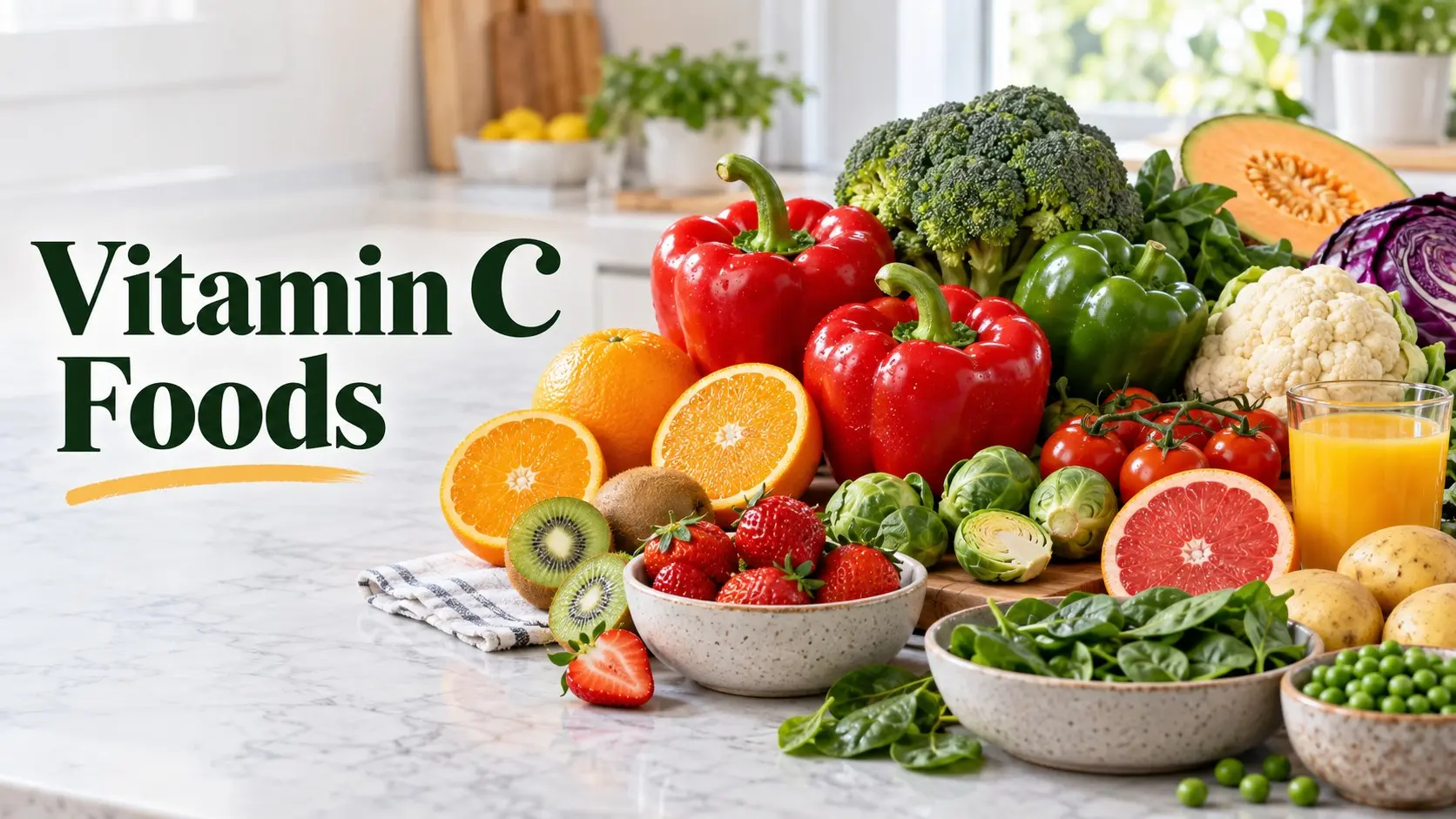
Quick answer: Some of the most practical Vitamin C Foods are red bell peppers, oranges, kiwi, green bell peppers, broccoli, strawberries, Brussels sprouts, grapefruit, cantaloupe, cabbage, cauliflower, potatoes, tomatoes, spinach, and peas.
NIH identifies fruits and vegetables as the best food sources of vitamin C.
One half cup of raw red pepper provides about 95 mg.
A medium orange provides about 70 mg.
One medium kiwi provides about 64 mg.
That means many adults can reach their daily requirement with ordinary food.
What Does Vitamin C Actually Do?
Vitamin C has several established jobs.
It supports collagen synthesis.
Collagen is used in skin, blood vessels, cartilage, bone, and connective tissue.
Vitamin C also supports normal wound healing.
It acts as an antioxidant.
That means it helps protect cells from damage related to oxidative stress.
It supports normal immune function.
And it helps your body absorb nonheme iron, the type of iron found in foods such as beans, lentils, tofu, cereals, and vegetables.
These are important functions.
They do not mean vitamin C prevents every infection, clears skin instantly, or creates an energy boost within minutes.
18 Vitamin C Foods at a Glance
| Food | Serving | Vitamin C | Percent Daily Value |
|---|---|---|---|
| 1. Red sweet pepper | 1/2 cup raw | 95 mg | 106 percent |
| 2. Orange juice | 3/4 cup | 93 mg | 103 percent |
| 3. Orange | 1 medium | 70 mg | 78 percent |
| 4. Grapefruit juice | 3/4 cup | 70 mg | 78 percent |
| 5. Kiwi | 1 medium | 64 mg | 71 percent |
| 6. Green sweet pepper | 1/2 cup raw | 60 mg | 67 percent |
| 7. Broccoli | 1/2 cup cooked | 51 mg | 57 percent |
| 8. Strawberries | 1/2 cup sliced | 49 mg | 54 percent |
| 9. Brussels sprouts | 1/2 cup cooked | 48 mg | 53 percent |
| 10. Grapefruit | 1/2 medium | 39 mg | 43 percent |
| 11. Tomato juice | 3/4 cup | 33 mg | 37 percent |
| 12. Cantaloupe | 1/2 cup | 29 mg | 32 percent |
| 13. Cabbage | 1/2 cup cooked | 28 mg | 31 percent |
| 14. Cauliflower | 1/2 cup raw | 26 mg | 29 percent |
| 15. Potato | 1 medium baked | 17 mg | 19 percent |
| 16. Tomato | 1 medium raw | 17 mg | 19 percent |
| 17. Spinach | 1/2 cup cooked | 9 mg | 10 percent |
| 18. Green peas | 1/2 cup cooked | 8 mg | 9 percent |
1. Red Bell Peppers
Red peppers are one of the easiest high vitamin C foods to find.
One half cup raw provides about 95 mg.
That is more than the FDA Daily Value of 90 mg.
Eat them:
- Raw with hummus
- In salads
- With eggs
- In sandwiches
- Lightly cooked with rice or meat
You do not need citrus fruit to meet your vitamin C needs.
2. Orange Juice
Three-quarters of a cup provides about 93 mg.
That is a large amount of vitamin C.
But juice is not automatically better than whole fruit.
Whole fruit provides more fibre and usually takes longer to eat.
If you enjoy juice, keep the serving sensible.
3. Oranges
One medium orange provides about 70 mg.
Oranges are portable.
They are easy to store.
And they provide vitamin C together with water and fiber.
You do not need to drink orange juice to get the benefit.
4. Grapefruit Juice
Three-quarters of a cup provides about 70 mg of vitamin C.
Grapefruit can interact with some medicines.
If you take prescription medicine and regularly eat grapefruit or drink grapefruit juice, ask your pharmacist whether it is safe with your medicine.
5. Kiwi
One medium kiwi provides about 64 mg.
That is about 71 percent of the FDA Daily Value.
Kiwi works well with:
- Plain yogurt
- Oats
- Fruit salad
- Smoothies
You can also eat the skin if you like the texture and wash the fruit well.
6. Green Bell Peppers
Green peppers provide about 60 mg in one half cup raw.
They work well in:
- Salads
- Eggs
- Bean meals
- Chicken dishes
- Rice bowls
Red peppers contain more vitamin C in the NIH comparison, but green peppers are still an excellent source.
7. Broccoli
One half cup cooked broccoli provides about 51 mg.
Raw broccoli also provides vitamin C.
Broccoli gives you more than one nutrient.
It also contributes fibre, folate, vitamin K, and other plant compounds.
Steaming or microwaving can help reduce vitamin C losses compared with long boiling.
8. Strawberries
One half cup sliced provides about 49 mg.
Use strawberries with:
- Yogurt
- Oats
- Cottage cheese
- Whole grain cereal
- Other fruit
Fresh and frozen strawberries can both fit a healthy diet.
9. Brussels Sprouts
One half cup cooked provides about 48 mg.
Roasting can improve flavour.
But very long cooking can reduce vitamin C.
Cook until tender rather than cooking them far beyond what is needed.
10. Grapefruit
Half a medium grapefruit provides about 39 mg.
Whole grapefruit provides fibre that juice does not provide in the same amount.
Again, check medicine interactions if you use grapefruit regularly.
11. Tomato Juice
Three-quarters of a cup provides about 33 mg.
Tomato juice can also be high in sodium.
If sodium matters for your health, compare labels and choose a lower sodium version when appropriate.
12. Cantaloupe
One half cup provides about 29 mg.
It also provides water and carotenoids.
Keep cut melon refrigerated.
13. Cabbage
Cooked cabbage provides about 28 mg in one half cup.
Cabbage is inexpensive.
It works in:
- Soup
- Stir-cooked meals
- Slaw
- Bean dishes
- Rice dishes
14. Cauliflower
One half cup raw provides about 26 mg.
Cauliflower does not need to replace rice or potatoes to be healthy.
Use it because you enjoy it.
Roast it, steam it, or serve it raw.
15. Potatoes
This surprises many people.
A medium baked potato provides about 17 mg of vitamin C.
Potatoes are not empty carbohydrates.
They also provide potassium and other nutrients.
The cooking method and toppings still matter.
16. Tomatoes
One medium raw tomato provides about 17 mg.
Tomatoes are easy to use often.
Add them to:
- Eggs
- Salads
- Sandwiches
- Beans
- Lentils
- Whole grain dishes
17. Spinach
Cooked spinach provides a smaller amount of vitamin C than peppers, kiwi, or broccoli.
One half cup provides about 9 mg in the NIH table.
Spinach is still useful because it provides folate, vitamin K, carotenoids, and nonheme iron.
Pairing spinach with a stronger vitamin C source such as peppers or tomatoes can help improve plant iron absorption.
18. Green Peas
One half cup cooked provides about 8 mg.
That is not a huge amount.
But nutrients add up across the day.
Peas also contribute protein, carbohydrate, and fibre.
How Much Vitamin C Do You Need?
Your personal requirement is not the same thing as the food label Daily Value.
The FDA uses 90 mg as the vitamin C Daily Value.
NIH recommendations depend on age, sex, pregnancy, breastfeeding, and smoking.
| Group | Recommended Amount | Context |
|---|---|---|
| Children age 1 to 3 | 15 mg per day | General NIH recommendation |
| Children age 4 to 8 | 25 mg per day | General NIH recommendation |
| Children age 9 to 13 | 45 mg per day | General NIH recommendation |
| Teen boys age 14 to 18 | 75 mg per day | General NIH recommendation |
| Teen girls age 14 to 18 | 65 mg per day | General NIH recommendation |
| Adult men | 90 mg per day | Adult RDA |
| Adult women | 75 mg per day | Adult RDA |
| Pregnancy | 85 mg per day | For adult women |
| Breastfeeding | 120 mg per day | For adult women |
Why Do Smokers Need More Vitamin C?
Cigarette smoke increases oxidative stress.
NIH therefore recommends that smokers consume 35 mg more vitamin C per day than people who do not smoke.
People exposed to secondhand smoke can also have lower vitamin C status.
This does not mean vitamin C cancels the health effects of smoking.
It does not.
How Much Vitamin C Can Your Body Absorb?
Your body regulates vitamin C absorption.
NIH reports that around 70 to 90 percent is absorbed when daily intake is roughly 30 to 180 mg.
At doses above 1,000 mg, absorption falls below 50 percent.
Unmetabolized vitamin C is then excreted in urine.
| Daily Intake | Approximate Absorption | What It Means |
|---|---|---|
| 30 to 180 mg | About 70 to 90 percent | Moderate food level intake is absorbed efficiently. |
| Above 1,000 mg | Less than 50 percent | Absorption falls and more unmetabolized vitamin C is excreted. |
You do not need to divide an orange into tiny portions throughout the day to improve absorption.
Just eat a varied diet.
Does Vitamin C Boost Immunity?
Vitamin C supports normal immune function.
That is different from saying it makes you immune to infection.
Vitamin C deficiency can impair immune function.
Adequate intake supports normal immune processes.
But eating an orange does not create an instant shield against colds, flu, or other infections.
Does Vitamin C Prevent the Common Cold?
For most people, vitamin C does not prevent the common cold.
NIH reports that taking vitamin C regularly may slightly shorten a cold or reduce symptom severity.
It may also reduce cold risk in some people exposed to extreme physical stress.
Starting vitamin C after cold symptoms begin does not appear to provide much benefit.
Practical point: Eat vitamin C foods because they are part of a nutritious diet, not because they guarantee that you will avoid every cold.
Vitamin C and Plant Iron Absorption
This is one of vitamin C's most useful food interactions.
Vitamin C improves absorption of nonheme iron.
Nonheme iron is found in foods such as:
- Lentils
- Beans
- Chickpeas
- Tofu
- Fortified cereal
- Spinach
- Other plant foods
You do not need a supplement.
Pair the meal with a vitamin C food.
Easy Vitamin C and Iron Pairings
| Iron Food | Vitamin C Partner | Simple Meal Idea |
|---|---|---|
| Lentils | Tomato and red pepper | Lentil soup with tomato and chopped pepper |
| Black beans | Green pepper | Beans, rice, and peppers |
| Chickpeas | Tomato | Chickpea salad with tomatoes |
| Tofu | Broccoli | Tofu with broccoli and rice |
| Iron-fortified cereal | Strawberries | Cereal with sliced strawberries |
| Spinach | Red pepper | Spinach salad with raw red pepper |
| Hummus | Bell peppers | Hummus with raw pepper strips |
Does Vitamin C Help Collagen?
Yes.
Vitamin C is required for normal collagen synthesis.
Collagen is part of:
- Skin
- Blood vessels
- Cartilage
- Bone
- Connective tissue
But eating very large amounts of vitamin C does not mean your body will make unlimited collagen.
Protein intake, overall nutrition, age, health, and other factors matter too.
Does Vitamin C Heal Wounds Faster?
Vitamin C is required for normal wound healing because collagen formation depends on it.
Severe deficiency can impair healing.
But taking large doses when you already get enough vitamin C does not guarantee dramatically faster healing.
A wound that is deep, infected, worsening, or slow to heal should be assessed by a healthcare professional.
Does Vitamin C Give You More Energy?
Vitamin C is not a stimulant.
It does not work like caffeine.
Severe vitamin C deficiency can cause fatigue.
Correcting a deficiency may improve deficiency related symptoms.
But someone who already gets enough vitamin C should not expect peppers or oranges to create an immediate energy boost.
Vitamin C Deficiency and Scurvy
Severe deficiency causes scurvy.
Scurvy is uncommon in people who eat a varied diet.
Possible deficiency features can include:
- Fatigue
- Weak connective tissue
- Easy bruising
- Bleeding gums
- Poor wound healing
- Other signs of capillary fragility
These symptoms are not specific to vitamin C deficiency.
Do not diagnose yourself from symptoms alone.
Who Is More Likely to Get Too Little Vitamin C?
NIH identifies several groups at higher risk of inadequate intake.
These include:
- People who smoke
- People exposed to secondhand smoke
- People who eat a very limited range of foods
- People with severe malabsorption
- Some people with cancer
- People with kidney disease requiring hemodialysis
Someone with a medical condition may need individualized advice.
Does Cooking Destroy Vitamin C?
Cooking can reduce vitamin C.
Vitamin C is water soluble and sensitive to heat.
Long storage can also reduce the amount in food.
That does not mean all cooked vegetables are nutritionally useless.
NIH specifically notes that steaming and microwaving may reduce losses compared with longer cooking methods.
Best Ways to Preserve Vitamin C
| Method | Practical Effect | Simple Advice |
|---|---|---|
| Eat raw when suitable | Avoids cooking loss | Useful for peppers, oranges, kiwi, strawberries, tomatoes |
| Steam vegetables | Can reduce losses compared with prolonged boiling | Cook only until tender |
| Microwave vegetables | Can preserve vitamin C well because cooking is fast | Use minimal water |
| Long boiling | Can increase loss into cooking water | Avoid unnecessary long cooking |
| Long storage | Can gradually reduce vitamin C content | Use produce while fresh when practical |
| Freezing | Can preserve produce for later use | Frozen fruit and vegetables remain useful choices |
Do You Have to Eat Vitamin C Foods Raw?
No.
Raw produce can provide plenty of vitamin C.
Cooked vegetables can also contribute.
For example, the NIH table lists 51 mg in one half cup of cooked broccoli and 48 mg in one half cup of cooked Brussels sprouts.
Use both raw and cooked foods.
Does Cutting Fruit Destroy Vitamin C Immediately?
No.
Vitamin C can decline with exposure to air, light, heat, and prolonged storage.
But a sliced orange or pepper does not suddenly lose all of its vitamin C within minutes.
Prepare food in a way that fits your life.
You do not need to race the clock.
Fresh Versus Frozen Vitamin C Foods
Frozen fruit and vegetables can be practical choices.
They are usually frozen soon after harvest.
Fresh produce can lose nutrients during long storage too.
The best choice is often the one you will actually eat.
For everyday meal ideas, see Healthy Snack Recipes.
Whole Fruit Versus Juice
Both can contain vitamin C.
Whole fruit usually provides more fibre and takes longer to eat.
CDC recommends choosing whole fruit over fruit juice more often.
Juice can still fit.
It simply should not replace all whole fruit.
Do You Need a Vitamin C Supplement?
Many people can meet their vitamin C needs from food.
One half cup of raw red pepper already provides about 95 mg.
One orange plus some vegetables can easily reach a typical adult requirement.
A supplement may be useful when:
- Your diet is very limited
- A healthcare professional identifies a need
- A medical condition affects absorption
- Your food intake is restricted for another reason
A supplement should solve a real problem.
It should not replace fruit and vegetables.
Are Special Forms of Vitamin C Better?
Vitamin C supplements often use ascorbic acid.
Other products use sodium ascorbate, calcium ascorbate, or branded forms.
NIH notes that research has not established a clear overall advantage for the more expensive forms.
Simple ascorbic acid is well absorbed.
How Much Vitamin C Is Too Much?
The adult tolerable upper intake level is 2,000 mg per day.
This is an upper safety boundary.
It is not a target.
Large supplement doses can cause:
- Diarrhea
- Nausea
- Stomach cramps
Some people require extra caution.
High Vitamin C and Iron Overload
Vitamin C improves iron absorption.
That is useful for many people.
It can be a problem for someone with an iron overload disorder such as hemochromatosis.
People with iron overload should discuss high vitamin C supplement doses with their healthcare professional.
Vitamin C During Cancer Treatment
Vitamin C supplements can have biologic effects.
NIH notes concerns about possible interactions between antioxidant supplements and some chemotherapy or radiation treatments.
If you are receiving cancer treatment, do not add high-dose vitamin C without discussing it with your oncology team.
Vitamin C and Kidney Health
Very high supplemental intake is not automatically safe for everyone.
If you have kidney disease or a history of kidney stones, ask your healthcare professional before taking large vitamin C doses.
Vitamin C During Pregnancy
Adult women need about 85 mg per day during pregnancy according to NIH.
Food sources such as peppers, citrus fruit, kiwi, strawberries, broccoli, tomatoes, and potatoes can contribute.
More is not automatically better.
Pregnancy supplements should be reviewed with the obstetric care team.
Vitamin C During Breastfeeding
Adult women need about 120 mg per day while breastfeeding.
A varied diet rich in fruits and vegetables can provide this amount for many people.
Can Children Get Vitamin C From Food?
Yes.
Children need less vitamin C than adults.
Age-appropriate foods can include:
- Soft strawberries
- Kiwi
- Orange pieces
- Cooked broccoli
- Tomato
- Potato
- Soft bell pepper prepared safely for age
Food size and texture should always match the child's developmental stage.
Vitamin C Foods for Vegetarians and Vegans
Vitamin C is especially useful in plant-based diets because it improves nonheme iron absorption.
Pair foods such as lentils, beans, tofu, and iron-fortified cereal with peppers, tomatoes, kiwi, strawberries, or citrus fruit.
For broader nutrient planning, visit the NextFitLife Nutrition and Vitamins Hub.
A Simple One-Day Vitamin C Food Pattern
| Meal | Example | Vitamin C Food |
|---|---|---|
| Breakfast | Plain yogurt with oats and strawberries | Strawberries |
| Lunch | Lentils with tomato and red pepper | Red pepper and tomato |
| Snack | Kiwi or orange | Kiwi or orange |
| Dinner | Chicken, tofu, or beans with broccoli and potato | Broccoli and potato |
Common Vitamin C Myths
Myth 1: Oranges Are the Highest Vitamin C Food
No.
In the NIH selected food table, one half cup of raw red pepper provides more vitamin C than one medium orange.
Myth 2: Vitamin C Prevents Every Cold
No.
It supports immune function, but routine vitamin C does not prevent most common colds.
Myth 3: More Vitamin C Is Always Better
No.
Absorption falls at very high doses.
Large supplement doses can cause digestive side effects.
Myth 4: Vitamin C Gives Instant Energy
No.
Vitamin C is not a stimulant.
Myth 5: Raw Food Is the Only Way to Get Vitamin C
No.
Cooked broccoli, Brussels sprouts, cabbage, potatoes, and other foods still contribute.
Myth 6: Supplements Work Better Than Food
Not generally.
Ascorbic acid from normal supplements is bioavailable, but food also provides fiber and many other nutrients.
Myth 7: You Need Exotic Fruit
No.
Peppers, oranges, kiwi, broccoli, strawberries, tomatoes, and potatoes are enough for most people.
How I Evaluate Vitamin C Claims
I do not rank a food because it sounds exotic.
I first check its serving size.
Then I check the vitamin C amount.
I compare that amount with the recommended dietary allowance and FDA Daily Value.
I also check whether the claim is about normal nutrition, deficiency treatment, supplement use, or a medical condition.
That distinction matters.
A food can support normal health without being a treatment.
A vitamin can be essential without being a miracle cure.
For related educational guides, visit our Food and Nutrition Hub.
Conclusion
Vitamin C Foods are easy to find and easy to use.
Red peppers, oranges, kiwi, broccoli, strawberries, Brussels sprouts, tomatoes, cabbage, cauliflower, potatoes, and many other foods contribute vitamin C.
You do not need an exotic fruit.
You do not need to chase megadoses.
And you do not need to fear cooked vegetables.
Use a varied mix of fruit and vegetables.
Pair vitamin C foods with plant iron foods when useful.
Choose whole fruit more often than juice.
And use supplements for a clear reason rather than assuming more is always better.
Your next step: Pick two Vitamin C Foods from this guide and add one to breakfast or lunch and one to dinner tomorrow.
References and Sources
- National Institutes of Health Office of Dietary Supplements. Vitamin C Fact Sheet for Health Professionals.Covers vitamin C functions, recommended intake, food values, absorption, deficiency, common cold evidence, upper limits, and supplement safety.
- National Institutes of Health Office of Dietary Supplements. Vitamin C Fact Sheet for Consumers.Provides plain language guidance on food sources, daily needs, smokers, deficiency risk, and supplements.
- United States Food and Drug Administration. Daily Value on the Nutrition and Supplement Facts Labels.FDA lists the vitamin C Daily Value as 90 mg and explains how percent Daily Value works.
- MedlinePlus, United States National Library of Medicine. Vitamin C.Reviews vitamin C functions, food sources, common cold evidence, deficiency, and excessive intake.
- Centers for Disease Control and Prevention. Healthy Eating Tips.CDC recommends a varied eating pattern that includes vegetables, fruit, protein foods, healthy fats, dairy foods without added sugars, and whole grains.
Continue Reading on NextFitLife
- Nutrition and Vitamins HubExplore vitamin C, vitamin D, vitamin B12, iron, folate, calcium, magnesium, zinc, supplements, deficiencies, and safety.
- Top Healthy Foods GuideBuild a varied diet using vegetables, fruit, legumes, whole grains, protein foods, nuts, seeds, and healthy fats.
- Healthy Fitness FoodsLearn how protein, carbohydrate, hydration, fruit, vegetables, and everyday foods support an active lifestyle.
- Healthy Snack RecipesUse fruit, yogurt, vegetables, beans, eggs, oats, nuts, and seeds for easy everyday snacks.
- Foods High in Iron for ToddlersFor parents, this guide explains how vitamin C foods can be paired with plant iron foods in age appropriate meals.
Main nutrition hub: Visit the NextFitLife Nutrition and Vitamins Hub for related nutrient, food source, deficiency, and supplement safety guides.
About the Author
Adel Galal is the Founder and Lead Writer at NextFitLife.
Adel has maintained a personal interest in health, fitness, nutrition, sleep, wellness, and healthy aging for more than 30 years.
His health and wellness writing and research communication experience spans more than 15 years.
NextFitLife launched in January 2022.
Adel's role is to research topics, compare reputable sources, organize evidence, identify important limitations, and explain complex nutrition information in clear language.
For vitamin and mineral articles, he compares sources such as the National Institutes of Health, MedlinePlus, CDC, FDA, and other established public health references.
His professional background includes 29 years in information technology management, data analysis, structured review, information management, and problem-solving.
These skills support his research and publishing work but are not medical or nutrition credentials.
Adel is not a physician, registered dietitian, pharmacist, certified personal trainer, or other licensed healthcare professional.
This article provides general education only and does not diagnose vitamin C deficiency, scurvy, anemia, immune disorders, kidney disease, or another medical condition. It also does not prescribe supplements.
Learn more about Adel Galal, NextFitLife, and the site's editorial process on the About Us page.
Frequently Asked Questions
What foods are highest in vitamin C?
Red bell peppers, orange juice, oranges, kiwi, green peppers, broccoli, strawberries, and Brussels sprouts are among the strong vitamin C sources listed by NIH.
What is the best everyday vitamin C food?
There is no single best food. Red peppers, oranges, kiwi, strawberries, and broccoli are all practical choices.
How much vitamin C do adult men need?
Adult men generally need 90 mg per day according to NIH.
How much vitamin C do adult women need?
Adult women generally need 75 mg per day, according to NIH.
How much vitamin C is needed during pregnancy?
Adult women generally need 85 mg per day during pregnancy.
How much vitamin C is needed while breastfeeding?
Adult women generally need 120 mg per day while breastfeeding.
Do smokers need more vitamin C?
Yes. NIH recommends 35 mg more vitamin C per day for people who smoke.
Is an orange enough vitamin C for one day?
A medium orange provides about 70 mg. That meets most of an adult woman's daily requirement and a large share of an adult man's requirement.
Do bell peppers have more vitamin C than oranges?
Yes in the NIH serving comparison. One half cup of raw red pepper provides about 95 mg, while one medium orange provides about 70 mg.
Is kiwi high in vitamin C?
Yes. One medium kiwi provides about 64 mg in the NIH table.
Are strawberries high in vitamin C?
Yes. One half cup of sliced strawberries provides about 49 mg.
Is broccoli high in vitamin C?
Yes. One half cup of cooked broccoli provides about 51 mg.
Do potatoes contain vitamin C?
Yes. A medium baked potato provides about 17 mg.
Does cooking destroy all vitamin C?
No. Cooking can reduce vitamin C, especially with long heating and water exposure, but cooked vegetables can still provide meaningful amounts.
Is steaming better than boiling for vitamin C?
NIH notes that steaming or microwaving may reduce vitamin C losses compared with prolonged cooking.
Does vitamin C help iron absorption?
Yes. Vitamin C improves absorption of nonheme iron from plant foods such as beans, lentils, tofu, and fortified cereals.
Does vitamin C prevent colds?
For most people, vitamin C does not prevent the common cold. Regular supplementation may slightly reduce cold duration or severity in some people.
Should I take vitamin C when a cold starts?
Research does not show a clear benefit from starting vitamin C only after cold symptoms begin.
Does vitamin C boost the immune system?
Vitamin C supports normal immune function, but it does not make a person immune to infections.
Does vitamin C help collagen production?
Yes. Vitamin C is required for normal collagen synthesis.
Does vitamin C help wound healing?
Vitamin C is needed for normal collagen formation and wound healing. High doses do not guarantee faster healing when intake is already adequate.
Does vitamin C give you energy?
Vitamin C is not a stimulant. Severe deficiency can cause fatigue, but extra vitamin C does not create an instant energy boost when intake is already adequate.
What happens if vitamin C intake is too low?
Severe deficiency can lead to scurvy, which can cause fatigue, connective tissue weakness, easy bruising, bleeding gums, and poor wound healing.
Can you take too much vitamin C?
Yes. The adult upper intake level is 2,000 mg per day. Large supplemental doses can cause diarrhea, nausea, and stomach cramps.
Are vitamin C supplements better than food?
Not generally. Supplements can provide vitamin C, but fruits and vegetables also provide fiber and many other nutrients.
Is expensive vitamin C better than ascorbic acid?
Research has not established a clear overall advantage for expensive alternative forms over ordinary ascorbic acid.
Are frozen fruits and vegetables good sources of vitamin C?
Yes. Frozen fruit and vegetables can contribute vitamin C and are practical alternatives when fresh produce is unavailable.
Is juice as healthy as whole fruit?
Juice can provide vitamin C, but whole fruit usually provides more fibre and greater fullness.
What vitamin C foods are good for vegans?
Peppers, oranges, kiwi, strawberries, broccoli, Brussels sprouts, tomatoes, cabbage, cauliflower, potatoes, and many other plant foods provide vitamin C.
Can vitamin C help absorb iron from lentils?
Yes. Pair lentils with foods such as tomatoes, peppers, broccoli, kiwi, strawberries, or citrus fruit to improve nonheme iron absorption.

Health & wellness writer with 30+ years of experience in nutrition, fitness, and healthy aging. Founder of NextFitLife.com — evidence-based health guidance.