
Published on: November 21, 2026
If bedtime yoga feels like another workout, make it easier.
Restorative yoga before bed should feel closer to resting than exercising. Pillows, blankets, a wall, or a chair support your body so you can slow down without chasing a deep stretch.
Quick answer: Restorative yoga before bed uses easy, supported poses and calm breathing to help you wind down before sleep. A useful routine can take 10 to 20 minutes. Choose poses you can hold without strain, dim the lights, breathe normally, and finish close to the time you plan to sleep.
This article is for general information and education. It does not replace medical advice, diagnosis, or treatment.
Stop and get advice if needed: Skip any pose that causes sharp pain, numbness, tingling, dizziness, breathing trouble, or worsening symptoms. Pregnant people, older adults, and people with glaucoma, severe high blood pressure, balance problems, significant joint injuries, or spine conditions may need pose changes.
If sitting all day is part of why you feel stiff at night, try the NextFitLife Yoga for Desk Workers guide earlier in the day, then keep your evening routine much softer.
Table of Contents
- What makes yoga restorative
- Does bedtime yoga help sleep?
- How to set up the room
- 7 soothing restorative poses
- The 20 minute bedtime routine
- The 5 minute short version
- How long to hold each pose
- Restorative yoga vs Yin yoga
- Breathing before sleep
- Best time to practice
- When yoga is not enough for insomnia
- Common bedtime yoga mistakes
- References and Sources
- Internal Links and NextFitLife Hubs
- About the Author
- Frequently Asked Questions
What Makes Bedtime Yoga Truly Restorative?
Slow yoga is not always restorative yoga.
The main difference is support.
In restorative yoga poses, pillows, blankets, bolsters, blocks, a chair, or a wall hold much of your body weight. Your muscles do very little work, and the position should feel easy enough to stay in without fighting it.
If you are shaking, holding your breath, or pulling hard into a stretch, make the pose easier.
A useful rule: bedtime restorative yoga should feel more like settling down than training flexibility.
Save strong backbends, deep hamstring work, fast flows, and demanding balances for another time.
If you want a dedicated flexibility session, see Stretching Before or After Workout.
Does Restorative Yoga Before Bed Help Sleep?
Yoga can support sleep for some people, but the evidence does not prove that one bedtime pose works like a sleeping pill.
The National Center for Complementary and Integrative Health reports that yoga has shown benefits for sleep in several groups, including older adults and people with sleep problems.
A 2025 review of yoga and sleep studies also found that many yoga programs were linked with better sleep outcomes. The studies used different yoga styles, schedules, and populations, so the exact best routine is still not known.
That gives us a reasonable message:
Bedtime yoga can be part of a helpful wind down routine, but it is not a guaranteed cure for insomnia.
The habit matters more than finding one “perfect” pose.
How Should You Set Up the Room?
Keep the room quiet and simple.
You do not need candles, expensive bolsters, or special clothes.
Useful items include:
- One or two pillows
- A folded blanket
- A yoga mat or carpet
- A stable chair
- A clear wall
Dim the lights and put your phone away when you can.
NIH sleep guidance recommends a quiet, cool, dark sleep environment and a calming routine before bed.
The goal is to make the room tell your brain that the busy part of the day is ending.
7 Soothing Restorative Yoga Poses Before Bed
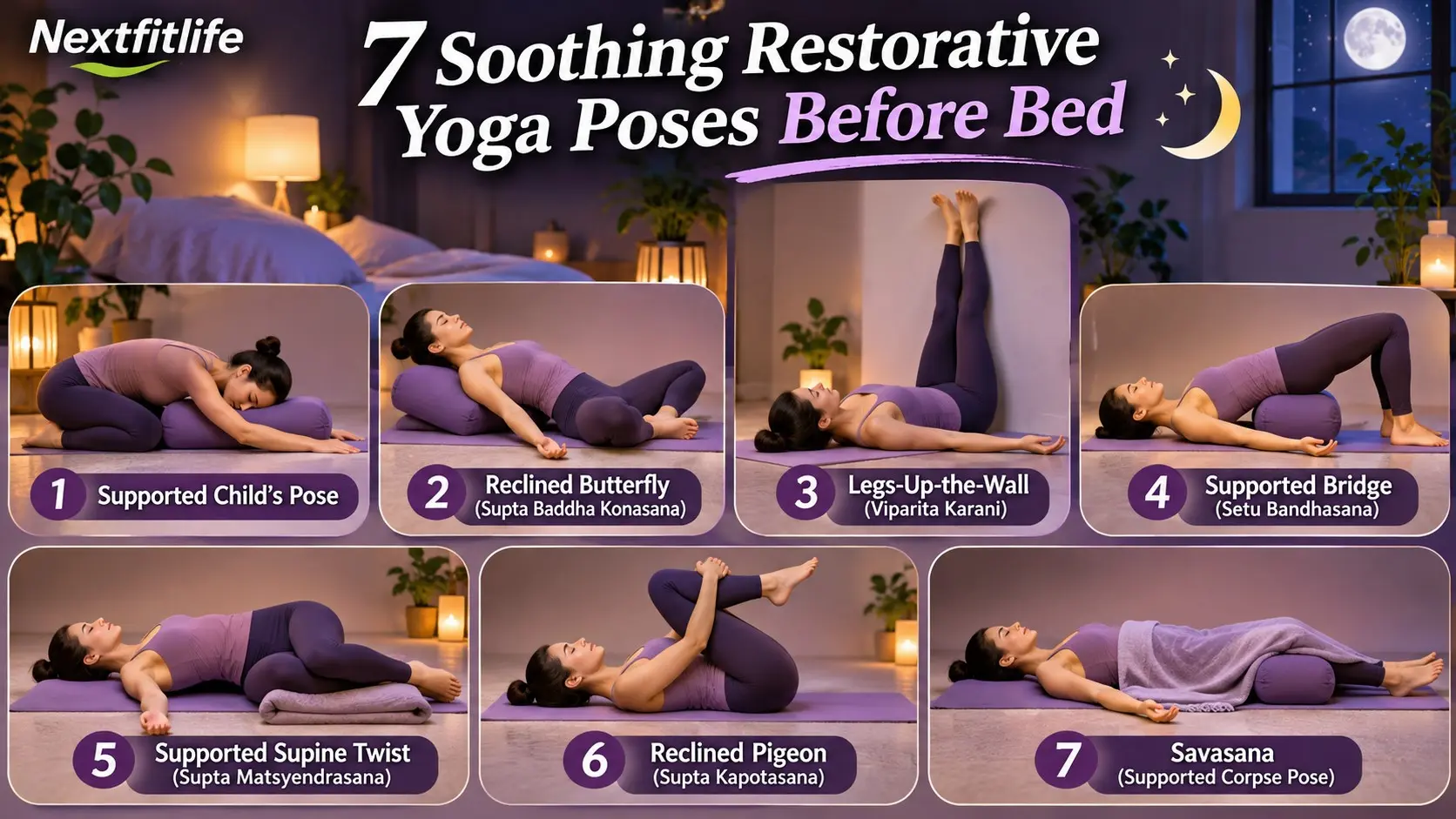
7 Restorative yoga before bed uses comfortable, supported poses and easy breathing to create a gentle wind down before sleep.
1. Constructive Rest
Start on your back with your knees bent and feet on the floor.
Let your knees rest toward each other if that feels comfortable, or place a pillow under them.
Put one hand on your chest and one on your belly.
Stay here for about two minutes.
Do not force a huge breath. Let your breathing settle on its own.
This simple start helps you stop moving before you begin stretching.
2. Supported Child’s Pose
Place one or two firm pillows lengthwise in front of you.
Kneel with your knees at a comfortable width, then rest your chest and head on the pillows.
Turn your head to one side. If you stay for a few minutes, turn it the other way halfway through.
Your hips do not need to touch your heels.
Add more support if your knees, hips, back, shoulders, or neck feel strained.
A good Supported Child’s Pose should feel restful enough that you are not holding yourself up.
If shoulder stiffness makes this position awkward, see Yoga for Stiff Shoulders.
3. Supported Reclined Butterfly
Sit in front of a stack of pillows or a bolster.
Bring the soles of your feet toward each other and allow your knees to move outward.
Now add support under both thighs.
Slowly recline onto the pillows behind you.
If your inner thighs feel strongly stretched, move your feet farther away or bring your knees closer together.
This pose is also called Supported Reclining Bound Angle Pose.
The goal is comfort, not maximum hip opening.
If your hips need more active mobility earlier in the day, use the Yoga for Tight Hips guide.
4. Supported Supine Twist
Lie on your back and bend your knees.
Let both knees move slowly toward one side and place a pillow under them.
Your legs should be supported rather than hanging above the floor.
Keep your chest mostly facing upward if a deeper twist feels uncomfortable.
Stay for about two minutes, then switch sides.
You do not need to push the top knee down.
Let the pillow meet your body instead.
5. Legs on a Chair
This is one of my favorite beginner options because it needs very little flexibility.
Lie on your back and place your lower legs on the seat of a stable chair or on the edge of your bed.
Let your knees bend naturally.
Put a folded blanket under your head if that feels better.
Stay for about three minutes.
Your legs are supported, your lower body can relax, and you do not need to shuffle close to a wall.
6. Legs Up the Wall
Legs Up the Wall, also called Viparita Karani, appears in many bedtime yoga routines.
Sit beside a wall, then gently turn onto your back while bringing your legs upward.
Your hips do not have to touch the wall.
Move farther away if your hamstrings feel tight.
Stay for about three to five minutes if the position feels easy.
Skip it if it causes pressure, tingling, numbness, pain, or dizziness.
Do not treat this pose as a medical treatment for circulation, blood pressure, or insomnia. Use it simply as an optional comfortable position.
7. Supported Savasana
Finish with Supported Savasana.
Lie on your back with a pillow under your knees and another under your head if needed.
You can also lie on your side if that is more comfortable.
Let your arms rest wherever they feel easy.
No stretching now.
No perfect breathing pattern.
Stay for three to five minutes and let your breathing return to normal.
A 20 Minute Restorative Yoga Before Bed Routine
| Time | Pose | Main Goal |
|---|---|---|
| 2 minutes | Constructive Rest | Settle after the day |
| 3 minutes | Supported Child’s Pose | Comfortable supported rest |
| 3 minutes | Reclined Butterfly | Gentle hip opening |
| 4 minutes | Supported Twist | Two minutes each side |
| 3 minutes | Legs on Chair or Wall | Quiet supported rest |
| 5 minutes | Supported Savasana | Finish the wind down |
You do not need to complete every pose.
If one position feels especially comfortable, stay there a little longer and remove another pose.
The 5 Minute Version for Busy Nights
Some nights, twenty minutes is unrealistic.
Use this shorter routine:
- Lie with your calves on a chair for two minutes.
- Use a supported twist for one minute on each side.
- Finish with one minute of comfortable breathing.
Five quiet minutes you actually use are better than a long routine you keep postponing.
How Long Should You Hold Restorative Yoga Poses?
There is no required number.
Long restorative classes may hold poses for many minutes, but your bedtime routine does not have to.
For beginners, about two to five minutes per well supported pose is a practical starting point.
That timing is not a medical sleep dose.
Leave a pose sooner if you notice:
- Numbness
- Tingling
- Pinching
- Increasing joint pain
- Dizziness
- Breath holding
- Growing discomfort
A restorative pose should usually feel easier as you settle into it.
If you want more detail on stretch timing, read How Long to Hold a Stretch.
Should You Stretch Deeply Before Bed?
I would not make deep stretching the goal.
There is no bedtime reward for reaching your maximum range.
A strong stretch can keep your attention on discomfort, and aggressive stretching can irritate an already sensitive joint or muscle.
This routine is gentle yoga.
If you want serious flexibility work, do it in a separate session.
Restorative Yoga vs Yin Yoga Before Bed
These two styles are often grouped together online, but they are not identical.
| Feature | Restorative Yoga | Yin Yoga |
|---|---|---|
| Main aim | Rest and support | Long passive stretching |
| Sensation | Very comfortable | May include noticeable stretch |
| Props | Used heavily for support | Often used, but less total support |
| Muscle work | Very low | Low |
| Bedtime fit | Excellent when comfortable | Can suit some people |
Yin yoga is not bad before bed.
I simply would not call a long, noticeable stretch restorative if your body is working to tolerate it.
For bedtime, comfort wins.
What Kind of Breathing Should You Use?
Keep breathing easy.
Slow, quiet breathing can fit naturally into relaxation and restorative yoga.
If it feels comfortable, allow the exhale to become a little longer than the inhale without forcing a count.
You do not need:
- Long breath holds
- Fast breathing
- Forceful breathing
- A complicated breathing pattern
NCCIH advises beginners to avoid forceful breathing practices.
A useful cue is simple: breathe in a way you could continue comfortably for several minutes.
When Is the Best Time for Bedtime Yoga?
Practice close enough to bedtime that you do not become fully active again afterward.
A simple order looks like this:
- Finish work and chores.
- Brush your teeth.
- Dim the lights.
- Put your phone away.
- Do 10 to 20 minutes of restorative yoga.
- Go to bed.
If you finish yoga and then spend another hour answering email or scrolling your phone, it is no longer your final wind down routine.
Should You Do Bedtime Yoga in Bed?
You can.
I prefer the floor for most poses if getting down and up is safe and comfortable, because there is more space to set up props.
But accessibility matters more than a perfect rule.
If floor transfers are difficult, use your bed.
Supported Savasana, a gentle twist, or a reclined pose can be modified there.
Can You Practice Restorative Yoga Every Night?
For many healthy adults, a short gentle routine is reasonable if it feels good.
You do not need to practice every night.
Research on yoga and sleep quality looks more at regular programs over time than at one perfect daily schedule.
A simple experiment is better than guessing.
Try the routine three or four evenings this week and ask:
- Do I feel calmer afterward?
- Does the routine feel comfortable?
- Is bedtime easier?
- Do I enjoy doing it?
If yoga makes you more alert or frustrated, use another calming routine instead.
A warm shower, reading, quiet music, or simple breathing may suit you better.
Can Restorative Yoga Cure Insomnia?
No.
This distinction matters.
Yoga can support relaxation and may help some people sleep better, but chronic insomnia is a health condition that deserves proper assessment and treatment.
The American Academy of Sleep Medicine supports CBT I, or cognitive behavioral therapy for insomnia, as a first line behavioral treatment for chronic insomnia.
That treatment looks at sleep habits, thoughts about sleep, time in bed, and behaviors that keep insomnia going.
Restorative yoga can sit beside that care.
It should not replace it.
When Should Sleep Problems Be Checked?
Talk with a healthcare professional if poor sleep keeps happening despite giving yourself enough time and opportunity to sleep.
Assessment matters even more if you have:
- Loud snoring
- Choking or gasping during sleep
- Strong daytime sleepiness
- Restless or uncomfortable legs at night
- Frequent unusual sleep behaviors
- Pain that repeatedly wakes you
- Sleep problems affecting driving
- Sleep problems affecting work or mood
A sleep problem does not always come from stress or a poor bedtime routine.
Who Should Modify Restorative Yoga?
Yoga is considered relatively safe for healthy people when practiced appropriately, but injuries can happen.
NCCIH recommends extra care for older adults and people with some health conditions.
Ask for medical or professional guidance if you have:
- Pregnancy
- Glaucoma
- Severe high blood pressure
- Significant balance problems
- Knee or hip injuries
- Lumbar spine disease
- Recent surgery
- Another condition that limits movement
If a pose hurts, change it or skip it.
A pose is not safe for you simply because it appears on a bedtime yoga list.
Common Bedtime Yoga Mistakes
Turning It Into a Workout
If you are sweating or breathing hard, the routine has moved away from its purpose.
Save vigorous yoga for another time.
Chasing a Deep Stretch
Bedtime is not a flexibility test.
Use more support.
Using Too Few Props
A pillow is not cheating.
If your muscles must work hard to hold a pose, add support.
Staying Because the Timer Says So
Leave a pose if it causes pain, numbness, tingling, or dizziness.
Watching Your Phone Through the Whole Routine
A video can help while you learn the sequence.
Once you know it, a self guided routine lets you put the screen away sooner.
Treating Yoga as the Cure for Persistent Insomnia
If poor sleep keeps returning, investigate the sleep problem instead of adding more poses.
A Simple Weekly Bedtime Plan
| Day | Routine | Goal |
|---|---|---|
| Monday | 10 minute routine | Easy start |
| Tuesday | Normal bedtime routine | Notice the difference |
| Wednesday | 20 minute full routine | Longer wind down |
| Thursday | 5 minute routine | Keep the habit easy |
| Friday | Normal bedtime routine | Avoid making yoga a chore |
| Saturday | 20 minute full routine | Practice the full sequence |
| Sunday | Choose your favorite version | Build a routine you will keep |
After a week or two, keep the poses that actually help you settle.
You do not need all seven forever.
Conclusion
Restorative yoga before bed should make your evening easier, not give you another routine to perform perfectly.
Use enough pillows and blankets that your body can relax. Keep the poses gentle, skip anything that creates strain, and finish near bedtime.
Your next step: tonight, try just Supported Child’s Pose, Legs on a Chair, and Supported Savasana. Give yourself about ten quiet minutes and see whether that simple routine helps you slow down.
References and Sources
- National Center for Complementary and Integrative Health. Yoga: Effectiveness and Safety.
https://www.nccih.nih.gov/health/yoga-effectiveness-and-safety - National Heart, Lung, and Blood Institute. Insomnia Treatment.
https://www.nhlbi.nih.gov/health/insomnia/treatment - National Heart, Lung, and Blood Institute. Insomnia.
https://www.nhlbi.nih.gov/health/insomnia - PubMed Central. The Effect of Chronic Yoga Interventions on Sleep Quality in People With Sleep Disorders.
https://pmc.ncbi.nlm.nih.gov/articles/PMC12071090/ - Cleveland Clinic. Bedtime Yoga for Better Sleep.
https://health.clevelandclinic.org/bedtime-yoga-for-sleep - American Academy of Sleep Medicine. Behavioral and Psychological Treatments for Chronic Insomnia Disorder in Adults.
https://aasm.org/wp-content/uploads/2020/05/Behavioral-Insomnia-SR-05.12.2020-for-public-comment.pdf
Internal Links and NextFitLife Hubs
- NextFitLife Fitness Hub
- Yoga for Stiff Shoulders
- Yoga for Tight Hips
- Yoga for Desk Workers
- How Long to Hold a Stretch
- Stretching Before or After Workout
- Thoracic Mobility Exercises
- About NextFitLife
Frequently Asked Questions
Is restorative yoga good before bed?
Yes, a gentle supported routine can be a useful way to wind down before sleep. Choose comfortable poses with very little muscle effort and avoid turning the session into a hard workout.
How long should I do restorative yoga before bed?
About 10 to 20 minutes is enough for a simple bedtime routine. On busy nights, even a short five minute routine can create a clear break between the day and bedtime.
What are the best restorative yoga poses for sleep?
Useful options include Constructive Rest, Supported Child’s Pose, Supported Reclined Butterfly, a Supported Twist, Legs on a Chair, Legs Up the Wall, and Supported Savasana.
How long should I hold each restorative yoga pose?
For a beginner bedtime routine, about two to five minutes per comfortable supported pose is a practical starting point. Leave sooner if you develop pain, numbness, tingling, or dizziness.
Is restorative yoga the same as Yin yoga?
No. Restorative yoga uses heavy support and aims for comfort and rest. Yin yoga usually uses longer passive stretches that can create more noticeable stretch tension.
Can restorative yoga cure insomnia?
No. Yoga can support relaxation and may help some people sleep better, but chronic insomnia may need proper assessment and treatment such as cognitive behavioral therapy for insomnia.
Should I do Legs Up the Wall every night?
You do not need to. Use it when it feels comfortable, but skip it if it causes pressure, numbness, tingling, pain, or dizziness. Legs on a chair is an easier alternative for many people.
Should I stretch deeply before sleep?
No. A bedtime restorative routine should stay gentle. Deep stretching is not required for relaxation and can make the practice uncomfortable or stimulating.
Can I do restorative yoga in bed?
Yes. The floor usually gives you more room for props, but bed based poses are fine when floor transfers are difficult or uncomfortable.
Who should modify restorative yoga before bed?
Pregnant people, older adults, and people with glaucoma, severe high blood pressure, balance problems, joint injuries, spine conditions, or recent surgery may need modifications and should ask a healthcare professional when appropriate.

