Published on: October 12, 2026
Updated on: October 12, 2026
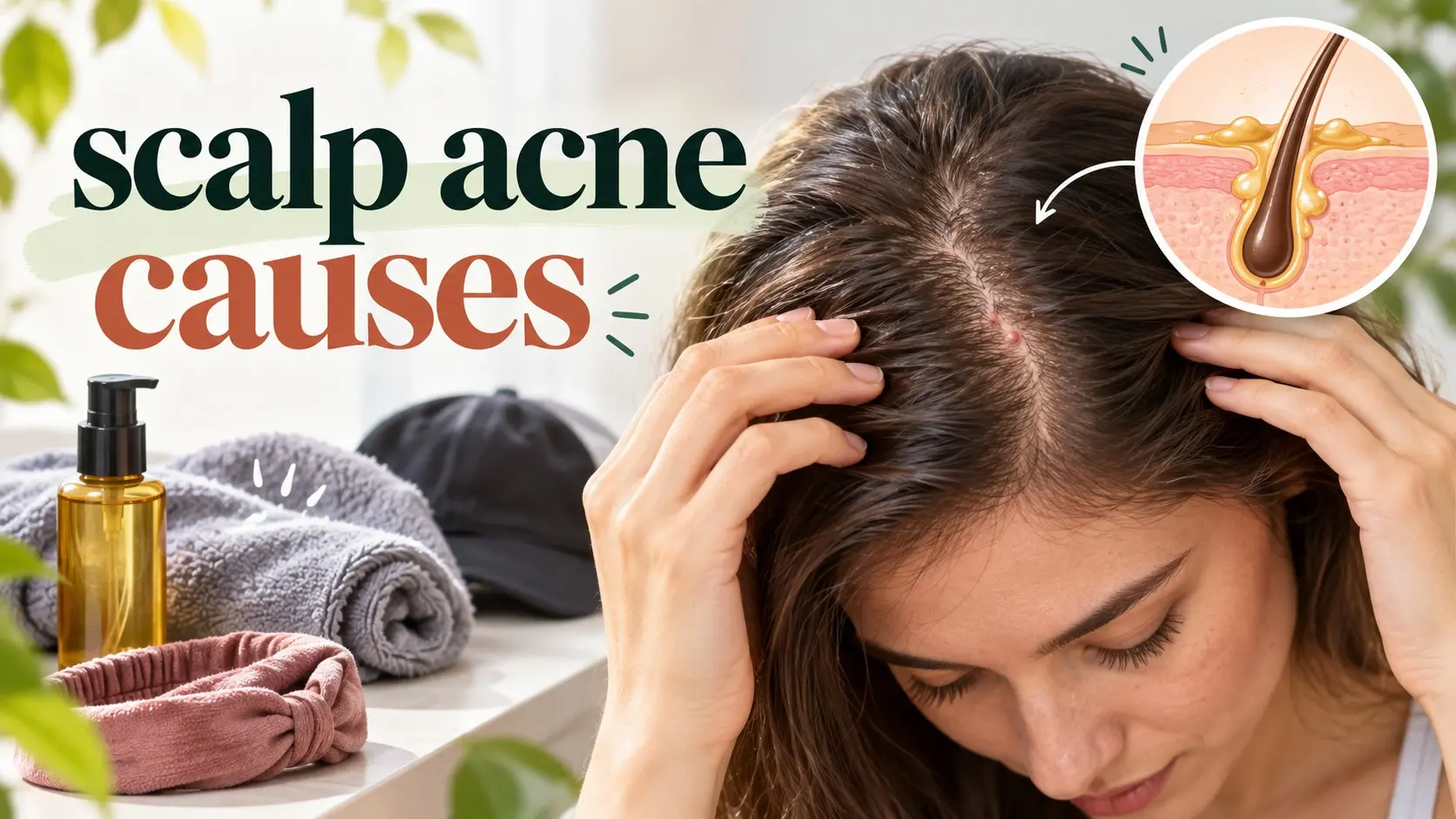
Scalp acne causes include blocked hair follicles, excess oil, hair product buildup, sweat, friction, hormones, and some medicines. But a bump on your scalp is not always acne. Bacterial folliculitis, yeast folliculitis, fungal infection, and several scarring scalp disorders can look like pimples but need different treatment.
That distinction is the key to clearing the problem safely.
A few whiteheads near an oily hairline tell a different story from dozens of identical itchy pustules. Deep draining lumps with hair loss tell a different story again.
This article is for general information and education. It does not replace medical advice, diagnosis, or treatment.
I am not a dermatologist or a doctor, and this content does not replace professional medical advice. What I share comes from real life experience, extensive research, and consultation with healthcare providers. Always consult qualified medical professionals for diagnosis and treatment of any health condition.
Medical review status: This article has not been independently medically reviewed by a dermatologist, physician, pharmacist, infectious disease specialist, or other licensed healthcare professional.
Get medical help sooner if scalp bumps come with:
- Rapidly spreading redness
- A sudden increase in pain
- Fever or chills
- Feeling seriously unwell
- Deep painful abscesses
- Repeated drainage
- New bald patches
- Scarring around the bumps
- Several hairs growing from one inflamed opening
Fever, rapidly spreading redness, worsening pain, or feeling unwell can point to spreading infection. Hair loss and scarring raise concern for a disorder that can permanently damage follicles.
Quick answer: If you have mixed whiteheads and red pimples, ordinary acne is more likely. If every bump looks similar and itches intensely, think about folliculitis. If you see bald patches, scars, deep draining lumps, crusting, or tufted hairs, stop treating the scalp as simple acne and see a dermatologist.
Table of Contents
- Is It Really Scalp Acne?
- 11 Critical Clues and Causes
- Blocked Follicles
- Hair Product Buildup
- Sweat and Scalp Oil
- Hats and Friction
- Hormonal Changes
- Stress
- Bacterial Folliculitis
- Malassezia Folliculitis
- Medicines
- Close Haircuts and Nape Bumps
- Scarring Scalp Disorders
- Scalp Acne vs Folliculitis
- What Actually Helps
- Best Shampoo Ingredients
- Four Week Scalp Reset
- What Not to Put on Your Scalp
- Hair Loss and Red Flags
- Frequently Asked Questions
- References and Sources
Is It Really Scalp Acne?
Start here before buying another shampoo.
True acne develops when a hair follicle becomes blocked with sebum, dead skin cells, or product residue. Inflammation can then create whiteheads, red papules, pustules, or deeper painful bumps.
Cleveland Clinic describes scalp acne as pimples caused by blocked pores or follicles and lists sweat, oil, dead skin, microorganisms, hair products, hormones, friction, medicines, and stress among possible contributors.
But the scalp has many follicles, so several other disorders can create pimple like bumps.
This is where appearance helps.
| Pattern | What It Suggests | Next Step |
|---|---|---|
| Whiteheads plus mixed red pimples | Ordinary acne is more likely | Simplify hair care and consider acne treatment |
| Many identical itchy bumps | Folliculitis, including Malassezia, becomes more likely | Do not assume ordinary acne treatment will work |
| Greasy scale with itch | Seborrheic dermatitis may be part of the problem | Consider dandruff focused care |
| Scaly bald patch with broken hairs | Fungal scalp infection needs consideration | Seek medical assessment |
| Pustules around a growing bald or scarred area | A scarring inflammatory disorder is possible | See a dermatologist promptly |
| Deep nodules with drainage | Deep follicular disease or abscesses | Medical assessment is needed |
For broader acne guidance, visit the Acne, Whiteheads and Pores Hub.
11 Critical Scalp Acne Causes and Clues
1. Blocked Hair Follicles Start the Acne Process
Ordinary acne starts with blockage.
Oil and dead skin build inside the follicle. The blocked follicle may then become inflamed.
You may see:
- Whiteheads
- Small red bumps
- Pus filled pimples
- Occasionally deeper painful lesions
The presence of comedones, meaning whiteheads or blackheads, makes true acne more likely than many forms of folliculitis.
Do not try to squeeze them through your hair.
Picking adds trauma and raises the risk of infection, dark marks, and scarring.
2. Hair Products Can Cause Acne Cosmetica
Look at what touches your scalp before blaming hormones.
Oily pomades, styling wax, conditioner, gels, sprays, and other products can block follicles.
The American Academy of Dermatology calls product triggered acne acne cosmetica.
A common pattern is lots of small whiteheads or flesh colored bumps around:
- The hairline
- Upper forehead
- Temples
- Back of the neck
If you suspect a hair product, switch to products labeled:
- Oil free
- Noncomedogenic
- Nonacnegenic
- Won't clog pores
AAD says product related acne can take about four to six weeks to clear after the trigger is removed.
Do not forget pillowcases, hats, bonnets, headbands, and helmet liners. Product residue transfers onto them too.
Read Noncomedogenic Skincare Meaning for a deeper explanation.
3. Sweat, Oil, and Buildup Can Keep Follicles Inflamed
A sweaty scalp after exercise is not a problem by itself.
The trouble starts when sweat sits under oil, styling products, or tight headwear for hours.
Cleveland Clinic lists sweat, excess oil, dead skin, and product buildup among common scalp acne contributors.
The practical fix is boring but useful:
- Wash after heavy sweating when practical.
- Rinse shampoo and conditioner well.
- Focus cleaning on the scalp rather than only the hair ends.
- Wash hats and helmet liners regularly.
Do not compensate by scrubbing until the scalp feels raw.
Irritation does not mean the scalp is cleaner.
4. Hats, Helmets, and Headbands Add Heat and Friction
Pressure changes the local environment around a follicle.
A helmet or tight headband can hold sweat and oil against the scalp while rubbing the same area again and again.
This is especially relevant if bumps appear exactly where equipment touches the skin.
Try:
- Cleaning helmet padding
- Washing sweat bands
- Avoiding very tight headwear when possible
- Showering after long sweaty sessions
If the problem sits mainly at the back of the head after close haircuts, there is another condition to consider. I cover that below.
5. Hormonal Changes Can Increase Sebum
Hormones influence oil glands.
This helps explain why scalp acne may appear alongside facial, jawline, chest, or back acne during times of hormonal change.
A hormonal pattern is more convincing when several acne prone areas flare together.
If your scalp bumps started at the same time as jawline acne, see Jawline Acne Causes.
Hormones are rarely something you can diagnose from the scalp alone.
A persistent adult acne pattern may need a wider medical history.
6. Stress Can Worsen an Existing Breakout
Stress gets blamed for almost everything in skin care.
The more accurate claim is narrower.
Stress can worsen acne that is already prone to flare.
It does not prove that emotional stress is the only reason you developed scalp bumps.
Look for the pattern.
If your scalp, face, back, and chest all worsen during a stressful month, stress may be part of the picture. If only one greasy hairline area breaks out after a new pomade, the product deserves more attention.
7. Bacterial Folliculitis Can Look Like Acne
This is one of the most common points of confusion.
Scalp folliculitis means inflammation of the hair follicles.
Mayo Clinic notes that bacterial folliculitis is commonly caused by Staphylococcus aureus. It can produce clusters of itchy or painful pus filled bumps that look like pimples.
Folliculitis is not one single disease.
Bacteria, yeast, medicines, physical injury, and other causes can inflame follicles.
A mild case may settle.
Repeated, widespread, or worsening pustules deserve medical assessment because treatment depends on the cause.
8. Malassezia Folliculitis Is Usually Itchier and More Uniform
Look closely at the bumps.
If they are tiny, very itchy, and almost identical to each other, Malassezia folliculitis deserves consideration.
DermNet describes this condition as uniform itchy papules and pustules without comedones.
That last detail helps.
No whiteheads or blackheads plus lots of matching itchy bumps is less typical of ordinary acne.
Heat, sweating, oily skin, occlusive products, antibiotic use, and reduced immune function can raise risk.
Antifungal treatment may be needed when Malassezia is the cause.
That is why using leftover antibiotics for every scalp pustule is a poor strategy.
9. Some Medicines Cause Acne Like Eruptions
A sudden breakout after a new medicine deserves a timeline check.
Acne or acne like eruptions can occur with medicines such as:
- Corticosteroids
- Testosterone
- Anabolic steroids
- Lithium
- Some anticonvulsants
- Some immune treatments
The bumps may appear unusually uniform.
Do not stop a prescribed medicine on your own.
Take the timeline to the clinician who prescribed it and ask whether the medicine could be contributing.
10. Close Haircuts Plus Nape Friction Can Point to Acne Keloidalis Nuchae
Bumps at the back of the scalp deserve their own section.
Acne keloidalis nuchae, also called folliculitis keloidalis, is not ordinary acne.
It tends to affect the nape and back of the scalp.
Early lesions may look like small itchy follicular bumps.
Over time, they can join into firm raised scars and cause permanent scarring alopecia.
Very close haircuts and repeated friction can aggravate the area.
If bumps at the nape are getting thicker, scarred, or associated with hair loss, see a dermatologist rather than treating them as simple pimples.
11. Deep or Scarring Scalp Disorders Can Masquerade as Bad Acne
This is the clue I would not ignore.
Several inflammatory scalp disorders can start with pustules or nodules.
Folliculitis Decalvans
Folliculitis decalvans causes recurrent pustules, crusting, and progressive scarring hair loss.
One useful clue is hair tufting, where several hairs appear to emerge from one follicular opening.
Once a follicle has been destroyed by scar tissue, the lost hair may not grow back.
Dissecting Cellulitis
Dissecting cellulitis can cause deep tender nodules, abscesses, drainage, and channels under the skin.
This is far beyond ordinary scalp acne.
Scarring hair loss can follow.
Tinea Capitis
Tinea capitis is a fungal scalp infection.
It is especially common in children but can occur in adults.
Possible clues include:
- Scaly patches
- Broken hairs
- Bald areas
- Itching
- Pustules
A scaly bald patch is not something I would treat for weeks with an acne shampoo.
Scalp Acne vs Folliculitis: The Practical Difference
| Clue | Acne | Folliculitis |
|---|---|---|
| Whiteheads or blackheads | Common clue | Usually absent in many types |
| Uniform bumps | Lesions often vary | Can look very similar to each other |
| Strong itch | Possible | Often more prominent |
| Hair product link | Common | Occlusion can contribute too |
| Pus filled bumps | Possible | Common |
| Cause | Blocked follicle plus acne inflammation | Can involve bacteria, yeast, injury, medicines, or other causes |
This table is a guide, not a home diagnosis.
Mayo Clinic notes that clinicians sometimes use a skin scraping, swab culture, or rarely biopsy when the cause of folliculitis is unclear or treatment fails.
What Actually Helps Mild Scalp Acne?
If the bumps look like ordinary mild acne and there is no hair loss, scarring, fever, or deep drainage, start simple.
Remove Heavy Hair Products First
Stop oily pomades, heavy waxes, and greasy scalp treatments.
Switch to noncomedogenic products when possible.
Also wash residue from:
- Pillowcases
- Hats
- Headbands
- Helmet liners
- Hair scarves
Give this change time.
AAD says product triggered acne can take four to six weeks to settle after the offending product is removed.
Wash According to Oil and Sweat, Not a Fixed Rule
Cleveland Clinic recommends washing daily or when the hair becomes greasy, especially after sweating, for people prone to scalp acne.
That does not mean every scalp needs harsh daily washing.
If your scalp becomes tight, raw, or very dry, adjust the routine.
The aim is clean follicles without unnecessary irritation.
Which Ingredients Can Help?
Salicylic Acid
Salicylic acid helps loosen dead skin and clear clogged pores.
The American Academy of Dermatology includes it among recommended topical acne therapies.
It makes the most sense when clogged follicles and small acne lesions are the main problem.
A scalp shampoo or liquid can be easier to use through hair than a thick facial cream.
Benzoyl Peroxide
Benzoyl peroxide is another evidence based acne treatment.
AAD strongly recommends it as part of acne management.
It can irritate a sensitive scalp, so more is not automatically better.
Also follow storage instructions carefully. AAD updated its safety advice in 2025 and recommends keeping benzoyl peroxide products at room temperature or cooler and replacing them regularly.
If you have concerns about benzoyl peroxide, salicylic acid, azelaic acid, or topical retinoids are other evidence based acne options that can be discussed with a dermatologist.
Ketoconazole or Other Antifungal Shampoo
Ketoconazole has a different job.
It is not simply another acne ingredient.
Antifungal shampoos make more sense when dandruff, seborrheic dermatitis, or yeast associated folliculitis is part of the picture.
DermNet notes that antifungal dandruff shampoos such as ketoconazole or ciclopirox can sometimes help scalp folliculitis.
If your scalp is very itchy and every pustule looks the same, this distinction becomes especially useful.
See Scalp Treatment for Dermatitis for more help with flaky or inflamed scalp conditions.
Should You Use Adapalene on the Scalp?
Topical retinoids are established acne treatments.
The issue on the scalp is practical.
Dense hair makes facial gels awkward to apply, and an already irritated scalp may not tolerate them well.
A small area near the hairline is easier to treat than dozens of lesions through thick hair.
If acne covers a large scalp area, I would rather confirm the diagnosis than keep adding facial acne products.
If you are pregnant or trying to become pregnant, discuss acne medicines with a healthcare professional before use.
A Simple Four Week Scalp Reset
This plan is for mild bumps without bald patches, scars, fever, or deep drainage.
Week 1: Remove the Obvious Triggers
Stop oily scalp products.
Clean anything that touches your head often.
Wash after heavy sweating and avoid picking.
Take a clear photo of the same scalp area every few days.
This is more useful than trying to remember whether the bumps looked “a bit better.”
Week 2: Add One Treatment
If you have clogged pore type acne, consider one scalp friendly product containing salicylic acid or benzoyl peroxide.
If heavy flaking and itch dominate, a dandruff or antifungal approach may make more sense.
Do not introduce three active products at once.
Week 3: Look for New Bumps, Not Just Old Ones
Ask:
- Are fewer new spots appearing?
- Is the itch better?
- Are the bumps becoming less painful?
- Are there new bald areas?
- Is there crusting or drainage?
A single old bump can take time to settle.
The number of new lesions gives better information about whether the trigger is still active.
Week 4: Decide Whether You Are Actually Improving
If the scalp is clearly improving, keep the routine simple.
If there is no real change, the diagnosis may be wrong or prescription treatment may be needed.
Cleveland Clinic notes that scalp acne can take several weeks to clear after treatment begins.
Do not extend months of unsuccessful self treatment when the scalp is getting worse.
What Should You Never Put on Scalp Pimples?
I would skip kitchen chemistry.
Avoid:
- Toothpaste
- Undiluted essential oils
- Undiluted apple cider vinegar
- Strong alcohol
- Harsh scrubs
- Leftover antibiotics
AAD specifically advises using proven acne ingredients rather than toothpaste.
The scalp is already inflamed. Adding an irritant can create dermatitis on top of the original problem and make the diagnosis harder.
If your skin barrier has become sore from too many products, read Damaged Skin Barrier.
Does Dandruff Cause Scalp Acne?
Not directly.
Dandruff, seborrheic dermatitis, acne, and folliculitis can exist in the same scalp.
A flaky oily scalp may also create an environment where yeast related inflammation becomes more noticeable.
But flakes do not automatically mean pimples are caused by dandruff.
If your main symptoms are:
- Greasy scale
- Flaking
- Itching
- Red patches
then seborrheic dermatitis may deserve more attention than acne.
Does Diet Cause Scalp Acne?
There is no proven special scalp acne diet.
Diet and acne are still being studied, but I would not blame dairy, chocolate, sugar, or one other food before checking direct scalp triggers.
AAD's acne guideline did not find enough evidence to make formal dietary treatment recommendations.
That makes the practical order simple.
Check:
- Hair products
- Oil and sweat
- Friction
- The shape and itch of the bumps
- Medicines
- Hair loss or scarring
Then look at the wider health pattern.
Can Scalp Acne Cause Hair Loss?
Mild acne does not usually explain a clear bald patch.
Severe inflammation, infection, picking, and especially scarring follicular disorders can damage follicles.
Cleveland Clinic notes that severe scalp acne can be associated with hair loss and scabbing.
Folliculitis decalvans, acne keloidalis nuchae, and dissecting cellulitis are more concerning because they can cause permanent scarring hair loss.
That changes the urgency.
New hair loss beside scalp pustules deserves a dermatologist.
For a broader guide, read Hair Loss Causes and Treatment.
When Should You See a Dermatologist?
Book an appointment if:
- The bumps keep returning
- Several weeks of sensible self care do not help
- The scalp is very painful
- The bumps are widespread
- You keep getting deep nodules
- There is repeated drainage
- You have crusting around hair loss
- You see scars forming
- You notice bald patches
- You see tufted hairs
- The nape is becoming thick or keloid like
Mayo Clinic advises medical review when folliculitis is widespread or does not improve with basic self care.
A dermatologist can decide whether you need:
- A bacterial culture
- A fungal scraping
- A different topical treatment
- Prescription antibiotics
- Antifungal medicine
- Acne treatment
- Occasionally a biopsy
When Is It More Urgent?
Seek prompt medical care for:
- Rapidly spreading redness
- A sudden increase in pain
- Fever
- Chills
- Feeling very unwell
- A large hot swelling
- A deep abscess
Mayo Clinic lists rapid worsening redness or pain, fever, chills, and malaise as possible signs of spreading infection.
My Practical Rule for Scalp Bumps
Do not judge the problem by how dramatic one pimple looks.
Judge the pattern.
Mixed pimples plus whiteheads: think acne.
Uniform itchy pustules: think folliculitis.
Greasy scale and itch: think dermatitis as well.
Bald patches, scars, drainage, tufting, or deep nodules: stop self treating and get a diagnosis.
That simple split is more useful than buying a stronger shampoo every time the last one fails.
Conclusion
Scalp acne causes range from blocked follicles and oily hair products to sweat, friction, hormones, and medicines. But some of the most important scalp bumps are not acne at all.
If you have mild mixed pimples, remove oily products, clean the scalp after heavy sweating, stop picking, and use one evidence based treatment at a time.
If the bumps are very itchy and uniform, repeatedly drain, form scars, or sit beside new hair loss, book a dermatologist instead of experimenting with more acne products.
Your next step is simple: part your hair in good light, look at the pattern of the bumps, and decide whether this really looks like ordinary acne before you treat it.
References and Sources
- Cleveland Clinic. Scalp Pimples and Acne.
https://my.clevelandclinic.org/health/diseases/24397-scalp-pimples-acne - American Academy of Dermatology. Are Your Hair Care Products Causing Breakouts?
https://www.aad.org/public/diseases/acne/causes/hair-products - American Academy of Dermatology. Acne Clinical Guideline.
https://www.aad.org/member/clinical-quality/guidelines/acne - American Academy of Dermatology. Benzoyl Peroxide in Personal Care Products.
https://www.aad.org/news/benzoyl-peroxide-personal-care-products - Mayo Clinic. Folliculitis: Symptoms and Causes.
https://www.mayoclinic.org/diseases-conditions/folliculitis/symptoms-causes/syc-20361634 - Mayo Clinic. Folliculitis: Diagnosis and Treatment.
https://www.mayoclinic.org/diseases-conditions/folliculitis/diagnosis-treatment/drc-20361662 - DermNet. Scalp Folliculitis.
https://dermnetnz.org/topics/scalp-folliculitis - DermNet. Malassezia Folliculitis.
https://dermnetnz.org/topics/malassezia-folliculitis - DermNet. Folliculitis Decalvans.
https://dermnetnz.org/topics/folliculitis-decalvans
Internal Links + Hub
- Acne, Whiteheads and Pores Hub
- Hair Care and Scalp Health Hub
- Skin, Hair and Nail Health Hub
- Skin Health Guide
- Acne Treatment Guide
- Noncomedogenic Skincare Meaning
- Forehead Acne Causes and Care
- Jawline Acne Causes
- Back Acne
- Chest Acne
- Scalp Treatment for Dermatitis
- Hair Loss Causes and Treatment
About the Author
Adel Galal is the Founder and Lead Writer of NextFitLife.com.
Adel has maintained a personal interest in health, fitness, nutrition, sleep, wellness, skin care, and healthy aging for more than 30 years. His health and wellness writing experience spans more than 15 years.
His approach is to compare popular health advice with current medical guidance, separate useful self care from weak home remedy claims, and point out the signs that mean a reader should stop experimenting and seek qualified care.
For scalp and acne topics, that means avoiding the common mistake of calling every follicular bump “acne.” Acne, bacterial folliculitis, yeast folliculitis, dermatitis, fungal scalp infection, and scarring follicular disorders do not all need the same treatment.
Adel is not a dermatologist, physician, pharmacist, infectious disease specialist, or other licensed healthcare professional. NextFitLife content is educational and does not replace diagnosis, prescription treatment, dermatology care, or emergency medical treatment.
Learn more about Adel and NextFitLife on the About Us page.
Frequently Asked Questions
What are the most common scalp acne causes?
Common scalp acne causes include blocked follicles, excess oil, dead skin, hair product buildup, sweat, friction from headwear, hormonal changes, stress, and some medicines. Acne like bumps can also come from folliculitis.
How do I know if my scalp bumps are acne or folliculitis?
Whiteheads and mixed types of pimples make acne more likely. Many identical itchy pustules suggest folliculitis. A dermatologist can confirm the cause when the pattern is unclear.
Can hair products cause scalp acne?
Yes. Oily pomades, conditioners, waxes, gels, and sprays can block follicles and trigger acne cosmetica. Switching to oil free or noncomedogenic products can help.
Does an oily scalp cause pimples?
Excess sebum can contribute to clogged follicles, especially when it mixes with dead skin, sweat, or product residue. Oil alone does not explain every scalp breakout.
Can sweat cause scalp acne?
Sweat can contribute when it stays trapped under oil, hair products, hats, helmets, or headbands. Washing after heavy sweating can help people who notice this pattern.
What is Malassezia folliculitis?
Malassezia folliculitis is inflammation of hair follicles linked with yeast that normally lives on the skin. It often produces many similar looking, itchy bumps and usually does not cause whiteheads or blackheads.
Does dandruff cause scalp acne?
Dandruff does not directly cause acne, but dandruff, seborrheic dermatitis, acne, and yeast related folliculitis can overlap. Greasy scale and itch point more strongly toward dermatitis.
Is salicylic acid good for scalp acne?
Salicylic acid is an evidence based acne ingredient that helps clear clogged follicles. A scalp product containing it can be useful for mild acne, but it will not treat every cause of scalp pustules.
Does benzoyl peroxide help scalp acne?
Benzoyl peroxide is an evidence based acne treatment and can help inflammatory acne. It can irritate sensitive skin, so follow product directions and stop if significant irritation develops.
Does ketoconazole help scalp acne?
Ketoconazole is an antifungal medicine rather than a standard acne treatment. It may help when dandruff, seborrheic dermatitis, or yeast associated folliculitis is part of the problem.
Can scalp acne cause hair loss?
Severe scalp inflammation can be associated with hair loss, but clear bald patches raise concern for infection or a scarring follicular disorder. New hair loss beside pustules deserves medical assessment.
What is folliculitis decalvans?
Folliculitis decalvans is a chronic inflammatory scalp disorder that can cause pustules, crusting, tufted hairs, and permanent scarring hair loss. It requires medical treatment.
When should I see a dermatologist for scalp acne?
See a dermatologist if the bumps keep returning, do not improve after several weeks, are very painful, or are associated with drainage, bald patches, scars, tufted hairs, or deep nodules.
When are scalp bumps urgent?
Seek prompt medical care for rapidly spreading redness, a sudden increase in pain, fever, chills, a large hot swelling, or feeling seriously unwell. These can be signs of spreading infection.

Health & wellness writer with 30+ years of experience in nutrition, fitness, and healthy aging. Founder of NextFitLife.com — evidence-based health guidance.